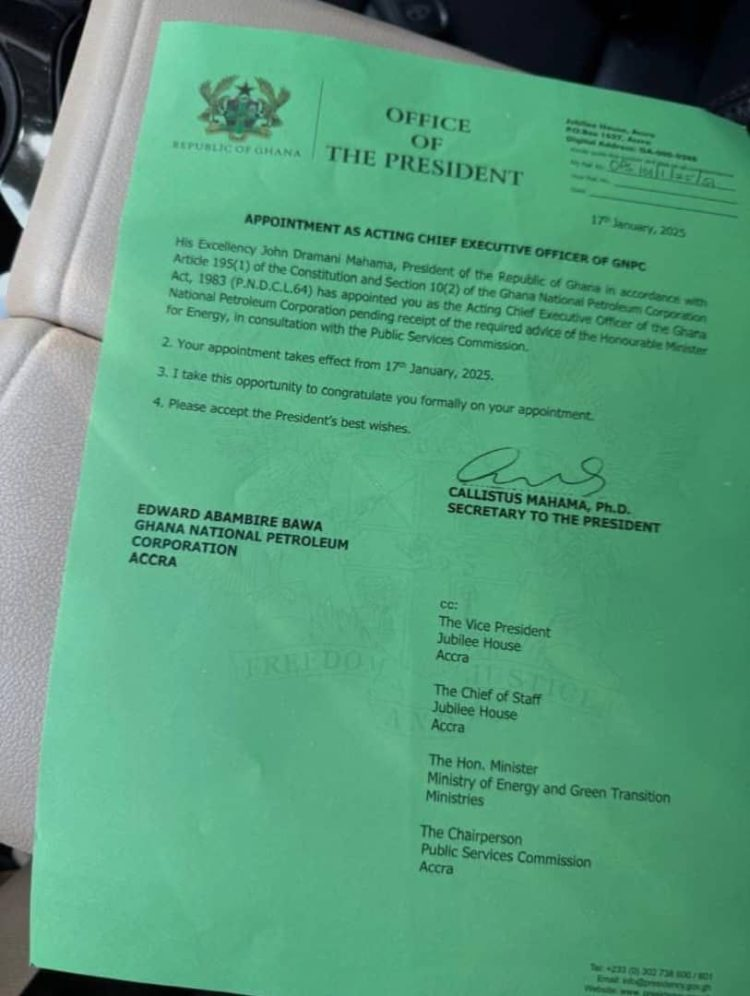
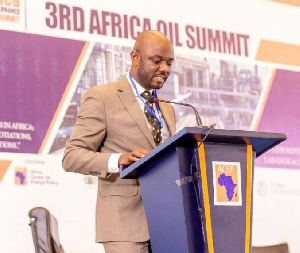
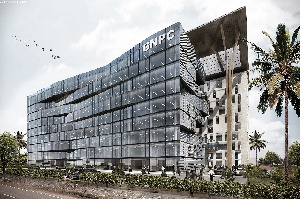
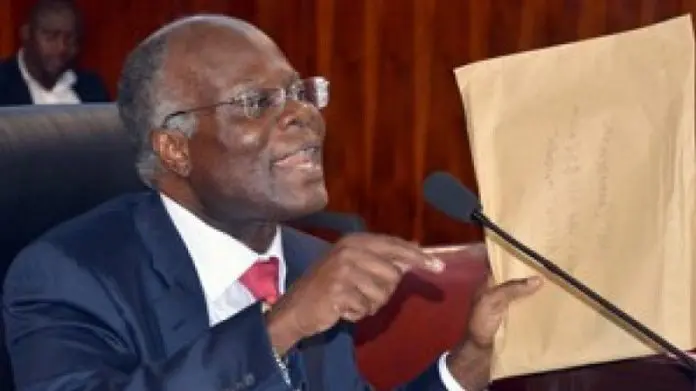
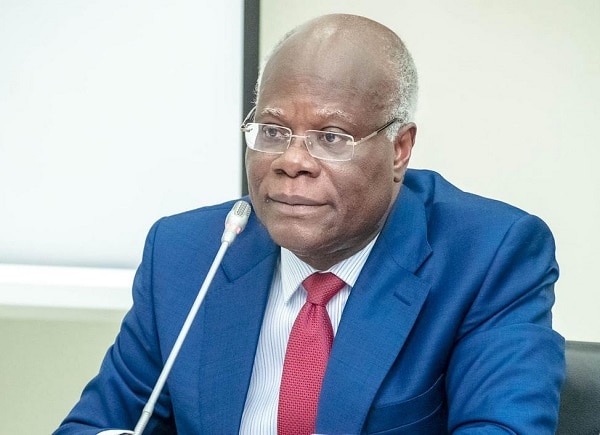
Edward Bawa has been appointed as the Acting Chief Executive Officer (CEO) of the Ghana National Petroleum Corporation (GNPC), with the appointment taking effect from Friday, January 17, 2025.
His appointment was made by President John Dramani Mahama in line with Article 195(1) of the 1992 Constitution and Section 10(2) of the Ghana National Petroleum Corporation Act, 1983 (P.N.D.C.L.64). This decision reflects the President’s aim to ensure strong and effective leadership at the GNPC.
The appointment remains subject to the formal advice of the Honourable Minister for Energy, in consultation with the Public Services Commission, as stipulated by law.
In a formal letter confirming the appointment, the President extended his congratulations to Edward Bawa, who previously served as the Member of Parliament for Bongo. President Mahama also expressed his best wishes for his success in this new role.
The official announcement was made by Dr. Callistus Mahama, Secretary to the President.
Bennet Ankantoa and Randy Abbey have been tipped for leadership roles at COCOBOD and GNPC, respectively, under the John Mahama administration, according to reports from The Herald.
Significant appointments to key state institutions have begun ahead of supervising ministers assuming office. Reports indicate further leadership changes are expected across other state agencies, including the Ghana Cocoa Board (COCOBOD) and the Ghana National Petroleum Corporation (GNPC).
Bennet Ankantoa, former Managing Director of the now-defunct Cocoa Marketing Company (CMC), is tipped for the COCOBOD CEO position, while Dr Randy Abbey, formerly of Metro TV, is rumored to take over GNPC.
Ankantoa, a professional accountant, served as a former Director of Finance at the Ghana High Commission in the UK and the Ghana Embassy in Washington, USA. He was also a former Regional Director of the Controller and Accountant-General’s Department for Brong-Ahafo and later Bono Region. In December 2022, he was enstooled as ‘Amankorahene’ of Chiraa with the stool name Nana Kofi Ankantoa Nana Akantoa I.
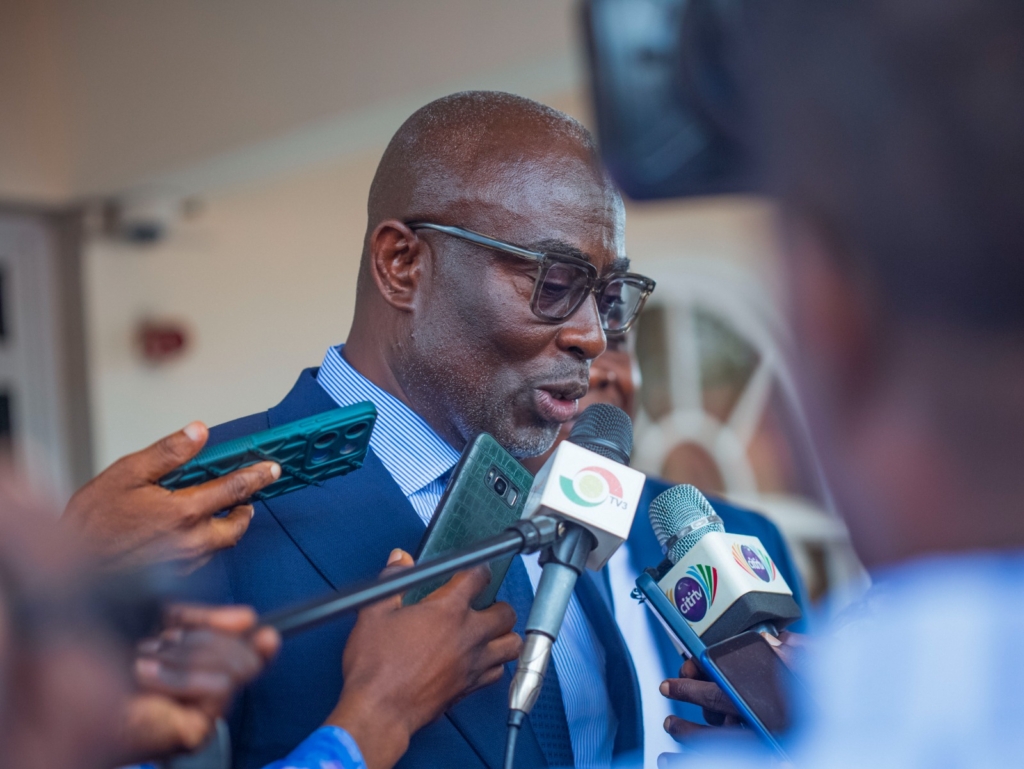
Dr Randy Abbey recently stepped down from his role as the host of Good Morning Ghana after 23 years and officially resigned from Ignite Media Group at the end of 2024. A video tribute released by Metro TV described his departure as the “end of an era.” Beyond the media, Abbey continues to play a prominent role in Ghanaian football, serving as a GFA Executive Council member and president of Kpando Hearts of Lions Football Club.
In 2006, Abbey received the prestigious Order of the Volta and a Grand Medal in recognition of his contributions to media and Ghana’s FIFA World Cup qualification.
IMANI Africa Vice President Bright Simons has raised concerns over the alleged high salaries paid to employees of the Ghana National Petroleum Corporation (GNPC), Ghana’s state-owned oil company, and the perception of political privilege influencing the company’s hiring and resource allocation practices.
According to Simons, the average monthly salary at GNPC stands at a striking 60,000 Ghana Cedis per employee, an amount vastly higher than the average salary in the public sector, which he noted as 2,594 Ghana Cedis per month.
Simons questioned the seeming disconnect between GNPC’s salary structure and its productivity, noting that despite these high wages, the corporation has yet to achieve a significant oil discovery in over two decades.
“GNPC doesn’t operate a single oil field,” Simons pointed out, adding that “GNPC hasn’t discovered a single barrel of oil in the last two decades.” This lack of operational achievement, coupled with its salary expenditure, has sparked public debate about the stewardship of resources within the corporation.
Addressing GNPC’s community involvement initiatives, Simons alleged that only those with political connections could gain access to the corporation’s benefits, such as scholarships, employment opportunities, or funding for community projects.
“GNPC won’t hire you, give you a scholarship, or spend a cent out of the millions of dollars it doles out in CSR on your community project…UNLESS…you have political connections,” he stated, adding that this has been the status quo for many years and is unlikely to change.
“Always been. Ever would be. And there is nothing you or any Ghanaian can do about it,” he wrote, expressing cynicism about the prospects for structural reform.
Not to be pedantic or to run stats classes, but for those genuinely interested in whether one can use a simple mean for any serious inference in a situation like this, here is a quick point.
The post doesn't just cite one average. It cites TWO averages. Read carefully.
The Public Interest and Accountability Committee (PIAC) has expressed concerns over the financial health of the Ghana National Petroleum Corporation (GNPC) due to the government’s outstanding $1 billion debt.
PIAC warns that GNPC’s financial stability is in jeopardy if it stops receiving funds from the Petroleum Holding Fund by 2026, as stipulated by the Petroleum Revenue Management Act.
Mark Agyemang, PIAC’s Technical Manager, pointed out that the government and its agencies owe nearly $1 billion to GNPC, which has led to severe financial pressure on the corporation.
He added that GNPC is often tasked with pre-financing or guaranteeing loans for other state-owned enterprises, including the Volta River Authority (VRA), Karpowership, the Electricity Company of Ghana (ECG), the Western Corridor Road Enclaves, and the Tema Oil Refinery.
“The government is responsible for the country’s development. These state-owned enterprises can contribute through corporate social responsibility or investment. We have extensively documented cases where the government requests GNPC to pre-finance, provide guarantees, or loan funds to other state-owned enterprises.
“We have examples like VRA, Karpowership, ECG, the western corridor road enclaves, and the Tema Oil Refinery, where GNPC is currently owed almost a billion dollars. The state is supposed to repay them, but it is also the state funding them. This inconsistency causes financial headaches for the corporation,” he said.
He called for a review of P.N.D.C.L 64, the law establishing GNPC, to allow the corporation to achieve financial independence.
“If GNPC’s governance structure is diversified enough, with appointees not solely from the government, independent bodies could also make board appointments to GNPC. This would enable them to reject certain demands from the government,” he said.
The Attorney General and Minister of Justice, Godfred Dame, has been accused of misleading the public regarding the outcome of an international arbitration case filed against the government of Ghana and the Ghana National Petroleum Corporation (GNPC) by Eni Ghana Exploration and Production Limited and Vitol Upstream Ghana Limited.
A statement by the Office of the Attorney General on the arbitration led to reports that the government and GNPC won the case filed against them by Eni Ghana and the other plaintiffs. Godfred Dame stated that the ruling represented a major victory for the government.
In the statement, the Office of the Attorney General claimed that the International Arbitration Tribunal had dismissed all claims for damages and compensation in a suit filed against the government of Ghana and GNPC.
The statement indicated that the ruling on July 8, 2024, dismissed the claimants’ request to declare that Ghana breached a petroleum agreement by “refusing to withdraw or prevent reliance by third parties on the Unitisation Directives.”
It also dismissed the claimants’ request for Ghana to notify the High Court, Court of Appeal, and Supreme Court of Ghana that the Unitisation Directives were issued in breach of the Petroleum Agreement. The tribunal affirmed Ghana’s right or authority to unitize oil fields to achieve efficient exploitation of the deposits.
However, the tribunal found that the Unitisation Directives, “in the circumstances in which they were issued,” breached the Petroleum Agreement and that the specific Unitisation Directives were contrary to the applicable regulations, thereby breaching Article 26(2) of the Petroleum Agreement.
Contrary to the Attorney General’s statement, Vice President of IMANI Africa, Kofi Bentil, a private legal practitioner and lecturer, pointed out that anyone claiming Ghana won the trial was not being truthful. According to Bentil, the court ruling showed that Eni Ghana and the other claimants won the case because their main relief was granted by the court.
“By Court… the ruling is as follows: 1. The merger was unlawful and wrong, so ENI should not join or merge with any company. Ghana’s orders were wrong, period! 2. ENI has not proven that it lost a billion dollars, so they won’t be given any damages. 3. Each party should go and pay their lawyers. The two parties should share and pay the court fees.
“If anyone tells you Ghana won, they are simply saying Ghana lost but avoided the payment of damages. It’s NOT a win; it is an escape!” Bentil wrote in a post shared on X on Tuesday, July 9, 2024.
Bentil added, “If they tell you ENI won. Indeed, they also escaped the forced merger, but to the extent that they got the main relief they sought, they won! Even if they didn’t get damages and they have to pay their own lawyers!! ENI won!!!”
Case Brief
A case brief from the arbitration shared by ghlawtrends.com also pointed out that the tribunal ruled that Ghana’s Minister of Energy was wrong in directing Springfield & Eni to begin a process of Unitisation of the Afina & Sankofa fields, which was the main relief sought by the claimants. The tribunal did not grant the damages sought by the claimant because, in its view, no substantial damage was caused.
“The tribunal concludes that the Minister of Energy did not fulfil the precondition of finding the existence of a single accumulation within the meaning of section 34 before ordering the initiation.
“The order of unitisation is premature. The imposition of unitisation terms is wrongful. It is improper for the Minister to decide tract participation solely based on the GNPC report without calling for any independent analysis.
“The claim of loss by the Claimants caused by the breaches of the Respondents is unsubstantiated, and the same is dismissed. Counterclaims by the Respondent are unfounded and are dismissed. The Republic of Ghana is ordered to pay 189,000 euros to the Claimants,” parts of the case brief read.
Summary of the Case
The dispute before this Arbitral Tribunal centered around “Unitisation.” The parties disputed the precise contents and requirements of this process under Ghanaian law, specifically section 34 of the Petroleum Act 2016.
Procedural & Historical Facts:
In 2018, Springfield delivered a proposal for the unitisation of the Sankofa East Oil Field & Sankofa Main Gas Field to the Minister of Energy.
Springfield presented its case to the Minister, and Eni was invited to do the same.
Eni contested the claim, arguing that there was no evidence that the Sankofa field had extended into the block operated by Springfield.
In April 2020, after several engagements, the Minister directed Springfield & Eni to begin a process of Unitisation of the Afina & Sankofa fields within 30 days.
Eni contested the claims of Springfield, necessitating the directive for unitisation.
In July 2020, Springfield brought an action in the High Court to compel Eni to comply with the directive made by the Minister.
Following the delayed compliance with the April directive, the Minister reissued a directive for unitisation in October 2020.
Eni contested the October directive and requested time, but the Minister informed Eni that the October directive was effective and non-negotiable.
In 2021, the Claimants (Eni & Vitol) wrote to the President of Ghana expressing commitment to unitisation only if the process was fair and transparent.
In 2021, the High Court granted an order prayed for by Springfield for the preservation of 30% of revenues from the operation of the Sankofa fields by the Claimants.
The Claimants also instituted a judicial review process to set aside the orders and directives of the Energy Minister. The High Court dismissed the application, and the Claimants filed an appeal with the Court of Appeal.
The tribunal concluded that the Minister of Energy did not fulfill the precondition of finding the existence of a single accumulation within the meaning of section 34 before ordering the initiation, making the order of unitisation premature and wrongful. The claim of loss by the Claimants was unsubstantiated and dismissed, as were the counterclaims by the Respondent.
Ultimately, the tribunal ordered the Republic of Ghana to pay 189,000 euros to the Claimants.
In a recent social media post, Counsel to the President of the Republic, Kow Essuman, clarified the outcome of an arbitration case involving Eni Ghana Exploration and Production Ltd, Vitol Upstream Ghana Ltd, the Republic of Ghana, and the Ghana National Petroleum Corporation (GNPC).
He highlighted key points from the 145-page decision issued under the 1976 Arbitration Rules of the United Nations Commission on International Trade Law (UNCITRAL).
Essuman emphasized that none of the financial claims made by Eni and Vitol were granted by the tribunal. This decision marks a significant win for Ghana and GNPC, countering the arbitration action filed by the claimants.
He urged Ghanaians to disregard any misinformation or disinformation circulating about the arbitration outcome. “This is the operative part of the arbitration award. In other words, the most important part of the arbitration award which will be implemented by the parties to the arbitration,” Essuman stated in his post.
According to Essuman, paragraph 489 of the arbitration award reveals that all the reliefs sought by Eni and Vitol were dismissed.
However, the tribunal did declare that the unitisation directives issued by Ghana breached the petroleum agreement, necessitating the issuance of new directives that comply with the agreement. The tribunal also ordered Ghana to pay its share of the arbitration costs, amounting to €189,900, while each party will bear its own costs.
“For the avoidance of doubt and to dispel any mischief from certain quarters, which I have seen circulating on social media, please note that there were no monetary damages awarded against Ghana. Eni/Vitol’s claim of $7 billion was dismissed entirely,” Essuman clarified.
Eni and Vitol initially claimed $7 billion in their statement of claim. However, during the arbitration hearing in Paris, Ghana, represented by its Attorney General, successfully challenged the figures. Consequently, Eni and Vitol reduced their claim to $915 million in their post-hearing brief submitted in November 2023.
“The tribunal dismissed the claim for monetary damages entirely,” Essuman reiterated. He called for accurate reporting of facts, stressing, “We have one Republic called Ghana. Let’s be accurate in reporting facts.”
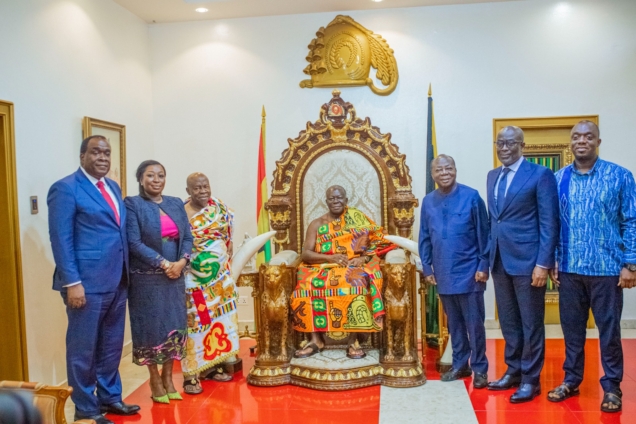
The Asantehene, Otumfuo Osei Tutu II, has urged the new management of the Ghana National Petroleum Corporation (GNPC) to implement strategic measures aimed at revitalizing the organization’s operations.
The GNPC, responsible for overseeing activities in the upstream sector of the petroleum industry, recently appointed a new Chief Executive Officer to lead the corporation.
As part of their courtesy visit during the celebration of his silver jubilee, a delegation from the GNPC, including the new CEO and Board Chairman, paid their respects to the Asantehene.
In his remarks, Otumfuo Osei Tutu II commended their efforts and encouraged the management team to prioritize sustainable measures to enhance the corporation’s operations.
“The President saw potentials in you and brought you back. Ensure to institute projects and measures that would promote operations at the business,” he said.
Otumfuo emphasized that a flourishing business would not only bring economic benefits to the country but also earn commendation for the management.
Chief Executive Officer of the Corporation, Joseph Abuabu Dadzie
“GNPC is dear to me and the nation. It is one of the strongest pillars of the country that could help in the development of Ghana,” the Asantehene underscored.
Since 2017, the Ghana National Petroleum Corporation (GNPC) has been backing social initiatives using the country’s oil revenues. Over 100 projects, such as educational and healthcare facilities, have been initiated by the GNPC in the Ashanti region alone.
Joseph Abuabu Dadzie, the Chief Executive Officer of the Corporation, reaffirmed GNPC’s dedication to investing in and maintaining these projects in the region.
“The foundation will continue with the projects that we’ve initiated in the region. We will ensure it benefits the youth and people of the Ashanti region,” he said.
The Ghana National Petroleum Corporation (GNPC) is pleased to announce the appointment of Joseph Abuabu Dadzie as its new Chief Executive.
Mr. Dadzie assumes the role from Mr. Opoku-Ahweeneh Danquah, whose tenure ended on April 26, 2024.
Prior to his appointment, Mr. Dadzie served as GNPC’s Deputy Chief Executive overseeing Commerce, Strategy & Business Development.
Previously, he held the position of General Manager, Commercial at the Corporation from June 2017 to August 2020.
Mr. Dadzie brings over 25 years of experience as a Financial and Management Executive across various sectors including energy, oil and gas, telecommunications, and banking.
His expertise encompasses finance, corporate management, governance, strategic planning, and leadership.
From April 2013 to August 2015, he served as Chief Operating/Finance Officer at Surfline Communications Limited, and from September 2008 to March 2013, as Chief Finance Officer at Woodfields Energy Resources.
Between 2003 and 2008, he held roles at Standard Chartered Bank including Senior Manager (Financial Institutions) and Director, Commodity Corporates.
Mr. Dadzie has contributed as a board member to four institutions in banking, energy, and financial services.
His international experience includes attachments with organizations such as Codi International BV (Netherlands), New York Mercantile Exchange (NYMEX), Societe Generale (Paris la Defense), Total Petroleum Services (London and Paris la Defense), and the UBS Trading floor (Stamford Connecticut, USA).
He holds a Master’s degree in Business Administration (Finance) and a Master of Science degree in General Management from Nyenrode Business Universiteit, Breukelen, Netherlands.
Additionally, he obtained a Bachelor of Science (Hons) in Chemical Engineering from the Kwame Nkrumah University of Science & Technology.
A report from the Public Interest and Accountability Committee (PIAC) indicates that the Ghana National Petroleum Corporation(GNPC) is in need of an overhaul amid the seismic shift toward sustainability in the global energy landscape.
PIAC, in its latest issue paper, has noted the unprecedented pressures faced by National Oil Companies (NOCs) worldwide amid the energy transition, stating: “The energy transition poses an existential threat to NOCs, as it could reduce the demand and value of their core products, expose them to environmental, social and governance (ESG) risks and liabilities, and undermine their competitive advantage and market share”.
This transition, characterised by a move away from fossil fuels to cleaner energy sources, poses existential challenges to traditional oil players like GNPC, PIAC says.
The call for change, specifically diversification, is driven by the outdated nature of the current legislation governing GNPC, which is nearly four decades old.
In addition to PIAC, experts assert that it is essential to review and amend the law to align with contemporary industry standards and practices.
Against this backdrop, PIAC recognises that GNPC’s role has evolved significantly since its inception, transitioning from a mere prospecting entity to a key commercial player in the burgeoning petroleum sector.
“After almost 40 years since its enactment, this law must be reviewed and amended to reflect the current role and international best practices of the industry. The review is also critical to direct and allow the NOC to be able to operate efficiently and effectively within the sector. GNPC’s role has evolved to become a key commercial player. It is expedient that the Law that established the Corporation be reviewed,” it stated.
The proposed revision seeks to bolsterGNPC’s fundamental businessoperations while fostering expansion into renewable energy sectors. This strategic realignment not only aligns with global climate objectives but also enhances the company’s environmental, social, and governance (ESG) performance.
However, PIAC highlighted delays in fund disbursement from the Petroleum Holding Fund (PHF) to GNPC, hampering the corporation’s ability to meet financial commitments. Despite statutory obligations for prompt payments, bureaucratic obstacles have frequently caused substantial delays, impacting GNPC’s operational efficiency and cash flow.
Moreover, PIAC underscored the strain on GNPC’s financial health due to its involvement in quasi-fiscal expenditures, including providing guarantees and making payments on behalf of the government and other state-owned entities. Urgent action is needed to address these financial burdens, with a focus on GNPC’s core mandate and development objectives.
As GNPC prepares for a future without PHF support post-2026, PIAC’s issue paper emphasizes the necessity of strategic planning and collaboration with the government and other stakeholders.
“One way for GNPC to be more resourceful, financially, while promoting autonomy and flexibility, is for the government to desist from imposing additional responsibilities and obligations on the corporation.
“An additional way to ensure secured funds is for the NOC to communicate and collaborate with the state and other stakeholders, such as regulators, investors, customers, employees, suppliers and communities, to align their expectations and interests, and to secure their support and participation,” the paper stated.
“While at this, the corporation also needs to advocate for and influence the policies andregulations that affect its transition, and to demonstrate their contribution and value to society and the economy,” it concluded.
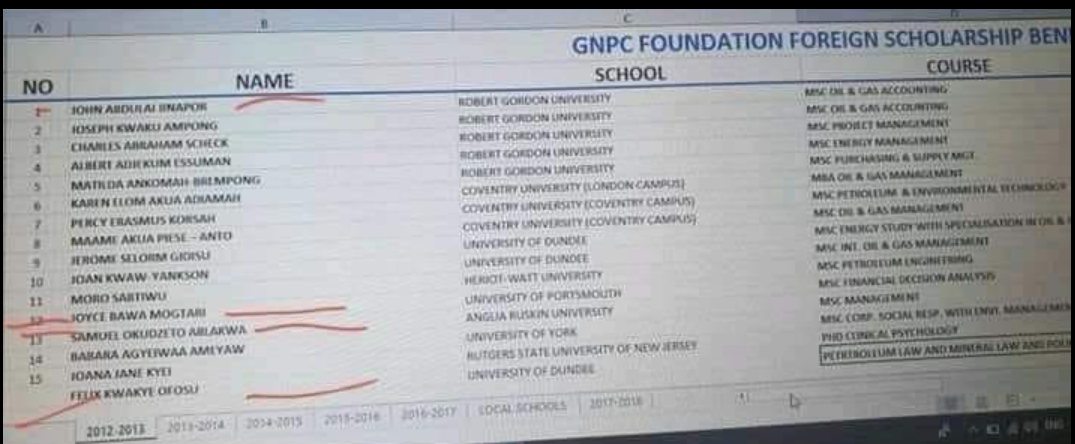
Social media rumors suggested that Jinapor was among the beneficiaries of the GNPC Foundation Scholarship.
However, in a Facebook post on Saturday, April 13, the MP categorically stated that he has never applied for or received any scholarship from the GNPC.
He urged the public to disregard these “baseless” allegations.
“Let me put on record that I have never applied for nor received any scholarship from the GNPC, Scholarship secretariat or GETFUND for any studies abroad.
“I will appeal to the general public to disregard such baseless, concocted, and contrived statements,” Jinapor wrote on his Facebook page.
The Public Interest and Accountability Committee (PIAC) has cautioned that the Ghana National Petroleum Corporation (GNPC) could encounter financial difficulties after 2026 if it loses government backing, as required by the Petroleum Revenue Management Act (PRMA).
The PRMA specifies that GNPC will cease to receive funding from the Petroleum Holding Fund (PHF) after 15 years from the commencement of commercial oil production.
PIAC stressed the necessity for GNPC to achieve financial independence, urging the government to avoid imposing further financial strains on the corporation.
In its report titled “The Role of GNPC in the Upstream Petroleum Industry: Challenges and Prospects,” PIAC suggested that GNPC collaborate with various stakeholders to align expectations and secure support. Additionally, it recommended revising GNPC’s strategy to adapt to the post-2026 financial landscape.
PIAC underscored GNPC’s substantial financial obligations, which include guarantees and receivables amounting to $1.14 billion as of 2022. These commitments involve payments made on behalf of the government, state-owned enterprises, and outstanding debts linked to infrastructure projects and gas supply to the Ghana National Gas Limited Company.
Furthermore, PIAC voiced concerns arising from public feedback regarding apprehensions about political interference in GNPC’s activities, resulting in quasi-fiscal spending and advances to other government entities.
The Public Interest and Accountability Committee (PIAC) is advocating for a significant overhaul of the 41-year-old legislation that established the Ghana National Petroleum Corporation (GNPC).
The committee contends that the Provisional National Defence Council Law (PNDCL) 64, which brought GNPC into existence in 1983, no longer corresponds to the dynamics of Ghana’s flourishing upstream sector.
In its most recent issue paper published on its website, PIAC emphasizes the necessity of updating the legislation to tackle GNPC’s challenges, enhance its efficiency within the sector, and align it with contemporary international industry standards.
The paper said “The law was established at a time when there was no petroleum activity and GNPC was used as a special purpose vehicle (SPV) to begin prospecting for economic activities in the industry.
“The industry has since that time evolved into a thriving one with three production fields (Jubilee, TEN, Sankofa), as well as new fields coming on stream (Jubilee South-East) and several other offshore explorations at various stages of development and onshore exploration (Voltaian Basin).”
According to PIAC, the revision of the law would fortify the core operations of GNPC by streamlining activities to improve efficiency, productivity, and reliability, while concurrently reducing costs and emissions.
PIAC asserts that this revision would also facilitate GNPC’s expansion into emerging energy sectors, such as renewables and low-carbon technologies. This diversification aims to capitalize on existing capabilities, access new markets, and enhance environmental, social, and governance performance.
Furthermore, PIAC emphasizes that the review process would transition GNPC into an integrated energy provider, offering comprehensive energy solutions such as electricity generation, distribution, and energy management. This transformation is crucial to meet evolving market demands and broaden the corporation’s footprint in the energy sector.
Another pressing issue highlighted by PIAC is GNPC’s reliance on time-limited funding from the Petroleum Holding Fund (PHF). The committee cautions that GNPC must develop strategic plans to ensure long-term financial sustainability.
As per the Petroleum Revenue Management Act (PRMA), GNPC’s access to PHF funds will cease 15 years after the start of commercial production, expected to conclude in 2026. PIAC criticizes delays in releasing PHF funds to GNPC, leading to challenges in meeting financial obligations to joint venture partners and affecting the corporation’s financial performance.
PIAC notes that GNPC’s balance sheet is encumbered by substantial guarantees and receivables owed by the government and state-owned entities, totaling over $1.14 billion. Urgent measures are needed to recover these amounts to enable the corporation to operate effectively.
Additionally, PIAC expresses concerns about GNPC’s governance structure, where the board’s appointments are solely controlled by the Energy Minister. This structure, according to PIAC, exposes GNPC to political influence, potentially compromising technical competence and strategic direction.
In light of these challenges, PIAC emphasizes the critical need to revise the legal framework and enhance institutional capacity to enable GNPC to operate as a robust standalone operator. Failure to address these issues, PIAC warns, could hinder Ghana’s ability to maximize its hydrocarbon resources amidst the global energy transition.
The Public Interest and Accountability Committee (PIAC) has issued a warning that the Ghana National Petroleum Corporation (GNPC) may face challenges surviving without government support if funding from the Petroleum Holding Fund (PHF) ceases after 2026, as mandated by the Petroleum Revenue Management Act (PRMA).
According to the PRMA, the GNPC is to be funded for 15 years from the start of commercial production of crude oil. After this period, the corporation will no longer receive financial support from the PHF.
This implies that after 2026, GNPC will need to find alternative sources of funding to sustain its operations.
“One way for GNPC to be more resourceful, financially, while promoting autonomy and flexibility, is for the government to desist from imposing additional responsibilities and obligations on the Corporation”, it disclosed in a report titled “The Role of GNPC in the Upstream Petroleum Industry: Challenges and Prospects”.
The report further suggested that to secure funds beyond 2026, the GNPC should engage in communication and collaboration with the state and other stakeholders.
These stakeholders include regulators, investors, customers, employees, suppliers, and communities. This engagement is essential to align expectations and interests, as well as to secure their support and participation in GNPC’s operations.
“While at this, the Corporation also needs to advocate for and influence the policies and regulations that affect their transition, and to demonstrate their contribution and value to society and the economy. It is therefore critical that the Corporation revises its strategy with this condition in mind while conducting its operations”, it pointed out.
According to PIAC’s report, as of the end of 2022, GNPC’s total guarantees and payment receivables stood at $1.14 billion.
These figures include payments and guarantees made on behalf of the Government of Ghana, State-Owned Enterprises (SOEs), national and local infrastructure projects, and outstanding debts related to gas supplied to the Ghana National Gas Limited Company.
PIAC also noted concerns raised during its public outreach and engagements at the district and regional levels.
Some Ghanaians fear that the Corporation is susceptible to political influence, leading it to undertake quasi-fiscal expenditures and provide advances to other parastatals, activities that are typically the responsibility of the central government.
President Nana Addo Dankwa Akufo-Addo has appointed Joseph Abuabu Dadzie as the acting Chief Executive Officer (CEO) of the Ghana National Petroleum Corporation (GNPC), effective Thursday, May 2, 2024, following the resignation of Opoku-Ahweneeh Danquah.
Joseph Abuabu Dadzie previously served as the Deputy Chief Executive (DCE) of GNPC, where he managed key areas such as commerce, strategy, and business development.
Joseph Dadzie brings a wealth of expertise in banking, energy, and communications to his new role. He holds an MBA in Finance and an MSc in General Management from Nyenrode Business Universiteit in the Netherlands, along with a BSc in Chemical Engineering from KNUST, Ghana.
His banking experience includes serving as Director of Commodity Corporate, Head of Large Local Corporate & Parastatals, and Senior Manager of Financial Institutions at Standard Chartered Bank. In communications, he served as the Chief Operating/Finance Officer for Surfline Communication Limited.
In the energy sector, Dadzie has worked as an Assistant Operations Officer with Tema Oil Refinery (TOR), a Market Research Analyst with GNPC, and Chief Financial Officer with Woodfields Energy Resources.
President Nana Addo Dankwa Akufo-Addo has named Joseph Abuabu Dadzie as the interim Chief Executive Officer (CEO) of the Ghana National Petroleum Corporation (GNPC),effective Thursday, May 2, 2024.
Prior to this appointment, Dadzie served as the Deputy Chief Executive, overseeing Commerce, Strategy, and Business Development at the corporation.
He will be succeeding Opoku-Ahweneeh Danquah, who assumed the CEO role in April 2022.
The announcement was made through a letter signed by the President’s Secretary, Nana Bediatuo Asante, dated Wednesday, April 3.
Joseph Abuabu Dadzie’s appointment is subject to the necessary advice from the energy minister.
“Pursuant to Section 10 (2) of the Ghana National Petroleum Corporation Act, 1983 (P.N.D.C.L. 64), I am pleased to inform you that the President has appointed you to act as the Chief Executive of Ghana National Petroleum Corporation (the “Corporation”) pending receipt of the required advice of the honourable Minister for Energy, given in consultation with the Public Services Commission.”
“Your appointment is effective May 2, 2024. I take this opportunity to congratulate you formally on your appointment Kindly indicate your acceptance or otherwise of this appointment,within 14 days of receipt of this letter Please accept the President’s best wishes,” the letter said.
President Akufo-Addo has named Joseph Abuabu Dadzie as the acting Chief Executive Officer (CEO) of the Ghana National Petroleum Corporation (GNPC), succeeding Opoku-Ahweneeh Danquah, who assumed the CEO role in April 2022.
Joseph Abuabu Dadzie, formerly the deputy chief executive (DCE) responsible for Commerce, Strategy, and Business Development, has been entrusted with the leadership of GNPC on an interim basis.
In his appointment letter dated Wednesday, 3rd April 2024, signed by the secretary to the President, Nana Bediatuo Asante, and referencing Section 10 (2) of the Ghana National Petroleum Corporation Act, 1983 (P.N.D.C.L. 64), President Akufo-Addo conveyed his pleasure in appointing Dadzie to the position.
The appointment is effective from 2nd May 2024, pending receipt of the necessary advice from the Minister for Energy, in consultation with the Public Services Commission.
The appointment letter further requested Dadzie’s acceptance or rejection of the appointment within 14 days and conveyed the President’s best wishes.
Dadzie’s professional background encompasses banking, energy, and communications expertise.
He holds an MBA in Finance and an MSc in General Management from Nyenrode Business Universiteit, Netherlands, as well as a BSc in Chemical Engineering from KNUST, Ghana.
In his banking career, Dadzie held various positions at Standard Chartered Bank, including Director (Commodity Corporate), Head (Large Local Corporate & Parastatals), and Senior Manager (Financial Institution). He also served as the Chief Operating/Finance Officer for Surfline Communication Limited in the communications sector.
Dadzie’s experience in the energy sector includes roles as an Assistant Operations Officer with TOR, a Market Research Analyst with GNPC, and a Chief Financial Officer (CFO) with Woodfields Energy Resources.
His diverse expertise and extensive experience make him well-suited to lead GNPC during this transitional period. The appointment letter was copied to several key officials, including the Vice President, Chief of Staff at the Office of the President, Minister for Energy, Chairman of the Public Services Commission, and the Board Chairman of the GNPC.
Member of Parliament for North Tongu, Samuel Okudzeto Ablakwa, has disclosed documents that highlight an increase in allowance for Ghana National Petroleum Corporation (GNPC) Board members.
According to Mr Ablakwa, in 2022, when Ghana’s economic crisis exacerbated, approved new rates as per diem and hotel rates for the Board Chairman, Freddie Blay, the Chief Executive, Board Members and External Committee Board Members
“When a government asks everyone to take financial haircuts due to the effects of their economic mismanagement, we don’t expect its officials to be approving for themselves fat increments in allowances.
“Intercepted memos from GNPC reveal that the Freddie Blay-led board and management have increased their allowances by up to 150% despite Ghana’s economic crisis and contrary to government’s assurances to Parliament of a general pay-cut,” he wrote in a post on X platform.
The daily hotel rate allowance has been raised from $400 to $1000, €400 to €1000, or £400 to £1000, depending on the travel destination.
Per diem for the Board Chairman has increased from $500 to $850, €500 to €850, or £500 to £850, and from $500 to $700, €500 to €700, or £500 to £700 for the CEO and other board members, also based on the travel location, Mr Ablakwa added.
Mr Abalkwa expressed deep dismay over the prospect of doubling the CEO’s salary, stating, “It is even more depressing to read other memos requesting that the salary of the CEO is doubled.”
He highlighted the frustration among insiders, who are reportedly angry over the perceived favoritism towards the CEO, Mr. Opoku Ahweneeh Danquah, who happens to be President Akufo-Addo’s nephew. According to sources, there is a prevailing sentiment that the CEO consistently receives preferential treatment and has his demands met without question.
“I believe it is time to regulate the incestuous discretion of boards and CEOs of State-Owned Enterprises to determine their own salaries and allowances without parliamentary approval — particularly when most SOEs are being terribly mismanaged and making huge losses. I shall in the coming days be proposing new private member’s legislation to end this detrimental practice,” he added.
When a government asks everyone to take financial haircuts due to the effects of their economic mismanagement, we don’t expect its officials to be approving for themselves fat increments in allowances.
Chief Executive Officer (CEO) of the Ghana National Petroleum Corporation (GNPC), Opoku–Ahweneeh Danquah, has underlined that the true measure of the Corporation’s success lies in the extent to which its endeavors benefit the people of Ghana.
Addressing attendees at the graduation ceremony organized by the GNPC Foundation for 166 artisans who received training and certification under its ‘Skilled Artisans Project’, Danquah underscored the corporation’s dedication to empowering Ghanaians by providing tangible opportunities for skill development and economic self-sufficiency.
He emphasized that while GNPC’s core function revolves around petroleum exploration and production, its broader mandate includes promoting sustainable socio-economic development for all Ghanaians.
“This graduation ceremony is not just a culmination of training programs; it is a testament to GNPC’s unwavering dedication to empowering our people,” Danquah remarked.
He added: “We firmly believe that a fundamental goal of our business is to uplift and empower Ghanaians, ensuring that they have the tools and resources to thrive in an ever-evolving economic landscape.”
The event, organized as part of GNPC’s esteemed livelihood empowerment program, provided a platform to honor the achievements of 166 artisans who had completed intensive training in diverse vocational fields.
Covering disciplines such as tailoring, welding, electronics, and carpentry, among others, these artisans not only acquired new skills but also emerged with a revitalized sense of purpose and determination.
During his speech, the CEO of GNPC highlighted the significant impact of skills development in enhancing individual prosperity and driving national advancement. He stressed the importance of equipping Ghanaians with practical skills tailored to meet market demands, thereby fostering entrepreneurship, innovation, and job creation across various sectors of the economy.
“By investing in skills development and entrepreneurship, we are not only empowering individuals to secure their livelihoods but also laying the foundation for sustainable economic growth and social cohesion,” he stressed
Dr. Dominic Kwesi Eduah, the Executive Director of the GNPC Foundation, emphasized significant milestones reached since the project’s launch in 2018.
He noted that over 2000 young people from various regions have benefitted from the project, receiving certifications from the National Vocational Training Institute (NVTI). These certifications have empowered them to establish their own businesses and enhanced their employability prospects.
“Our foundation is built on the belief that every individual possesses untapped potential waiting to be unleashed and with initiatives like this, we aim to unlock that potential and empower Ghanaian youth to become agents of change in their communities,” he concluded.
Echoing similar sentiments, Freddie Blay, Board Chairman of GNPC, emphasized the pivotal role of artisanal skills in driving economic growth and urged the graduates to seize the opportunities before them.
Embarking on a journey of entrepreneurship armed with the tools and knowledge to succeed, he further charged the youth to be guided by passion and determination as they carve out their path to be coming contributors to Ghana’s development.
The Akwamumanhene, Odeneho Kwaffo Akoto III, who was chairman for the occasion, in a brief remark, urged the graduands to make proper use of the tools and admonished them to be worthy ambassadors of GNPC.
Other notable figures in attendance were Hon Seth Acheampong, the Eastern Regional Minister, and Isaac Apaw Gyasi, the MCE for New Juaben South, underscoring the collaborative effort between GNPC and local government authorities in driving development initiatives.
Their words of encouragement and support further bolstered the graduates’ confidence as they embarked on their entrepreneurial journeys.
From sewing machines and welding equipment to diagnostic machines and gas stoves among others, and in an atmosphere imbued with a sense of optimism and possibility, each artisan received tools relevant to their area of expertise, with each tool symbolizing not just a means of livelihood but also a tangible manifestation of GNPC’s commitment to empowering Ghanaians and nurturing the growth and prosperity of Ghana’s artisanal workforce.
In a strategic move, the government has successfully concluded the divestiture of shares in Jubilee Oil Holdings Limited (JOHL), an offshore entity, transferring ownership to GNPC Explorco—a subsidiary under the umbrella of the Ghana National Petroleum Corporation (GNPC).
This milestone marks a pivotal moment in the government’s management of key assets in the energy sector.
In the third session of the 8th Parliament, Parliament‘s Committee on Mines and Energy disclosed the completion of the shares transfer to Explorco.
This development resolves longstanding concerns raised by the Public Interest and Accountability Committee (PIAC), a state watchdog, regarding the use and management of oil revenues.
Additionally, civil society organizations (CSOs) in extractives, anti-corruption, and good governance had persistently advocated for the prompt execution of this transfer.
This comes in the wake of a prior parliamentary directive instructing GNPC to promptly commence the process of transferring the shares to its subsidiary, Explorco.
Parliament’s directive and subsequent action also underscores the influence wielded by civil society and regulatory bodies in shaping the trajectory of Ghana’s energy policies and governance.
JOHL, the offshore company registered in the Cayman Islands, was acquired by GNPC through an over-US$164million ‘share purchase agreement’ between Ghana and Anadarko WCTP Company in 2021, when the latter announced plans to offload its interests.
The company holds 7 percent commercial interest in Jubilee and TEN oil fields operated by Tullow Ghana.
Although acquisition of the stake was well-received, the decision to incorporate JOHL in the Cayman Islands – a tax haven – per the argument of PIAC and CSOs complicates the nation’s interest in the oil fields, injects risks of revenue leakages and violates the transparency and accountability mechanisms established in the Petroleum Revenue Management Act (PRMA), according to many industry watchers and corruption fighters.
It made its first oil lifting of 944,164 barrels of oil in the Jubilee Field during the first half of 2022, realising over US$100million.
In 2022 alone, JOHL’s stake raked in some US$290million, according to the 2022 PIAC annual report. Total payments for cash calls (including fields in which Explorco holds an interest) amounted to US$83million – leaving a gross margin of US$207million for GNPC/JOHL from the Jubilee and TEN fields.
PIAC expressed concern about how GNPC used JOHL to carry out operations that were not approved in its plan; for example, in 2022.
Two notable examples are Explorco cash calls on Springfield, ENI Block 4 among others at US$5,546,419 – and decommissioning the Saltpond oil rig at US$11,000,000.
Responding to the action taken by government, Technical Manager-PIAC, Mark Agymang said: “PIAC has always been in constant discussions with GNPC, therefore we are not surprised with the current development. GNPC has since exhibited good faith by telling PIAC in its meetings that they are working on the process of transferring the shares to Explorco”.
However, he added that PIAC had always argued and still maintains that revenues from the resultant operations and earnings of JOHL will have to be lodged in PHF.
In view of this, he concluded that revenues that come from Explorco’s operations concerning the shares they have been assigned should be lodged into PHF, adding that the subsidiaries of GNPC should endeavour to focus on their specific mandates.
Also, the Head, Policy Lead, Petroleum and Conventional Energy at Africa Centre for Energy Policy (ACEP), Kodzo Yaotse, stressed the need for thorough accountability of the revenues accrued to JOHL – despite the transfer’s belated status.
The energy think tank ACEP has suggested the possibility of filing a legal suit against the Government of Ghana and the Ghana National Petroleum Corporation (GNPC) by Civil Society Organizations (CSOs) or a civilian concerning the domiciliation of assets belonging to Jubilee Oil Holdings Limited (JOHL), registered in the Cayman Islands.
The Executive Director of the think tank deems this legal action necessary, emphasizing that the government should promptly repatriate JOHL assets from the tax haven to Ghana. He also highlights that the GNPC, managing the JOHL assets, should be subject to the Petroleum Revenue Management Act (PRMA).
“It has been almost 2 years after advocating for the assets of JOHL to be domiciled in Ghana and nothing has still been done by GNPC and Government, clearly there is no commitment on the part of GNPC or Government to be transparent with JOHL assets.”
“Someone or CSOs must therefore challenge this illegality in court to ensure that JOHL assets are returned to Ghana.”
The ACEP boss made this known when he gave his submission during a Space on the X platform on November 12 on the topic “Is JOHL Under Political Capture? – Analyzing Implications of Securitizing JOHL assets for $420m LITASCO Loan”.
Ben Boakye also charged that the GNPC and the government were breaking the Petroleum Reserve Management Act (PRMA), which mandates that oil earnings go into the Petroleum Holding Fund until they are later approved by the legislature.
“Our fear of JOHL assets being used as a slush fund has been materialised and I’m making particular reference to the collateralisation of oil revenues accrued by JOHL for a $420m debt arrangement between GNPC and LITASCO,” Boakye said.
“The politicians are using it the way they want and being less accountable about the assets to Ghanaians,” he lamented.
Meanwhile, a recent 2023 Semi-Annual report published by the Public Interest and Accountability Committee (PIAC) highlighted that Jubilee Oil Holding Limited (JOHL) did not remit proceeds from liftings in H1 2023, totaling US$70,456,718.93, into the Petroleum Holding Fund (PHF).
This marks the fourth consecutive occurrence where the company failed to transfer the proceeds from liftings in the Jubilee and TEN Fields, amounting to US$343,108,927.88.
The petroleum revenue watchdog also noted that Kosmos Energy Ghana Limited incorrectly paid withholding tax into the Petroleum Holding Fund (PHF) in 2020 and 2021, totaling US$3,999,325.65.
The Ghana National Petroleum Corporation (GNPC) has been recognized as the “Most Compliant State-Owned Enterprise” in Ghana, as acknowledged by the Ministry of Public Enterprises.
This honor was presented at the Public Enterprises League Table (PELT) Awards held in Accra on October 11, 2023, organized in collaboration with the Ministry of Finance and the State Interests and Governance Authority (SIGA).
The organizers praised GNPC for its steadfast dedication to maintaining the highest standards of regulatory compliance and ethical business conduct, deeming it deserving of the title “Most Compliant State-Owned Enterprise (SOE).”
This recognition, along with GNPC’s ranking as the third Best Performing Entity on the PELT, resulted from an impartial assessment conducted by the multinational Accounting and Auditing firm, PricewaterhouseCoopers (PwC).
The award ceremony aimed to foster healthy competition among State Owned Enterprises (SOEs), Joint Venture Companies (JVCs), and State Entities, and it garnered attendance from industry leaders, government officials, and other distinguished guests.
“This achievement is a testament to the hard work of our staff whose efforts have now positioned GNPC as a trailblazer in the realm of corporate compliance, setting an inspiring example for other state-owned enterprises and businesses across the nation,” he remarked.
The outstanding compliance culture at GNPC has not only brought the company praise from the business community, but it has also fostered confidence and trust among partners and stakeholders.
Mr. Albert Akowuah, Manager of Corporate Strategy, and Mr. Albert Longdon Nyewan, Deputy Manager, Compliance at GNPC, attended the ceremony on behalf of the Corporation.
In Parliament, the Minority is sounding a cautionary note to the management of the Ghana National Petroleum Corporation (GNPC). They are advising against seeking approval for a $431 million loan facility.
The concern raised by the NDC MPs revolves around suspicions that the government is pressuring GNPC into obtaining this loan from a company called Litasco, using oil as collateral.
Isaac Adongo, the Ranking Member for the Finance Committee, addressed the media on September 28, asserting that this arrangement runs afoul of the conditions set by the existing IMF program.
Specifically, it violates the stipulation prohibiting the government from acquiring commercial loans with collateral.
“They should not even dare to invite parliament to consummate the illegality they are about to undertake. The conduct so far suggests that they are keen to breach the agreement they signed with the IMF. Otherwise, they would not even go to the GNPC Board to approve any term sheet, go to Ministry of Energy [to] go and get no objection, go to Ministry of Finance…and Ken Ofori-Atta you don’t even read the agreement you signed then you give no objection and the president approved it… They can do it there.”
He added, “They don’t even respect the laws of Ghana. So they should just stay there and do it. Then we will know that they don’t respect Parliament. But they should not even invite us to be part of that process that “
Minority Leader Dr. Cassiel Ato Forson, for his part, has warned that his party will not vote on an agreement that he claims is in flagrant violation of Ghana’s 17th IMF plan.
The planned US$620 million loan from Lukoil International Trading and Supply Company (LITASCO) SA to the Ghana National Petroleum Corporation (GNPC) will be forwarded to parliament for consideration next month, according to the Ministry of Energy.
The ministry explained that GNPC has initiated the process and has already received board approval. Following this, both the sector ministry and the Ministry of Finance have provided their ‘no objection’ and granted their approval in accordance with the Public Financial Management Act (PFMA).
The ministry further stated that the loan request will be submitted to parliament in mid-October when the legislative body reconvenes.
“From the foregoing, it is clear that GNPC needed to meticulously finalise the facility’s terms and conditions and obtain necessary procedural approvals ahead of the final parliamentary approval,” it stated.
The ministry issued the statement in response to concerns voiced by minority lawmakers regarding the government’s handling of the deal.
It should be noted that GNPC, as part of its 2023 work-plan presented to parliament, included efforts to refinance the LITASCO SA loan facility, which would involve incorporating bank guarantees in support of the Karpower Barge project. In the plan submitted to parliament, GNPC outlined its intentions to arrange a ‘pre-export financing facility’ of up to US$500 million, as well as a bank guarantee amounting to US$120 million.
However, John Jinapor, the Ranking Member of the Mines and Energy Committee, expressed apprehensions that the government is exerting undue pressure on GNPC to secure the facility.
“The Presidency is using coercive force to compel the GNPC to proceed and execute this loan agreement without parliamentary approval. This is unconstitutional, this is unlawful – and this is a blatant disregard to the directive and resolution of parliament”.
“If you (GNPC) proceed with this directive, you will be committing an illegality. You do not have the mandate and the power to enter into such an agreement without parliamentary approval. The minority wishes to serve notice that we shall use every necessary tool available to ensure that the right thing is done,” he said.
A deed of indebtedness on the Jubilee Oil Holding Limited (JOHL) crude oil supply and purchase deal, prepayment facility agreement, and guarantees facility agreement were also intercepted at the GNPC board level, he claimed.
“The key has to do with the fact that GNPC is raising this facility from LITASCO, and in return they are giving our oil out to this company for the next five-and-a-half years. Indeed, all the oil in the TEN Oil Field has been encumbered including royalties; and our carried and participating interests will be escrowed into this company,” he said.
During a press conference held in Accra, the parliamentary minority expressed concerns about the lack of transparency regarding the utilization of the loan. They argued that, apart from debt repayment, there is insufficient justification for obtaining a US$431 million loan that would tie up resources for the next five-and-a-half years. They also cautioned that this could potentially encumber the entire oil production from the TEN field.
However, the Ministry of Energy contends that GNPC’s annual work program, including any necessary loans for program execution, is approved by parliament.
“It is important to state that this particular facility that the minority mischievously makes allusion to is being re-financed for the sixth time”.
According to the statement, the Mines and Energy Committee of parliament has since requested that the loan’s terms and conditions be presented before the legislature in accordance with the house’s supervision powers.
“Government actors in this matter have no intention of hiding any part of the process in secrecy,” the energy ministry further assured.
The Minority in Parliament has raised accusations against the Presidency, alleging that it exerted pressure on the Ghana National Petroleum Corporation (GNPC) to secure a $431 million loan agreement from Lukoil International Trading and Supply Company (LITASCO) SA, a Swiss company involved in refinery and retail operations across Europe.
The Minority contends that this action by the Presidency is not only unconstitutional and unlawful but also a clear violation of Parliament’s directive and resolution.
Based on a memo obtained by the Minority, it appears that the Presidency convened a meeting on September 14, 2023, at 11 a.m.
During this meeting, the GNPC was directed to seek board approval to raise the specified amount without the need for parliamentary approval.
However, it’s worth noting that certain members of the GNPC board expressed their reservations about this directive.
The attendees at this meeting included the Chief of Staff, the Executive Secretary to the President, the Minister of Finance, the Deputy Minister of Energy, the CEOs of Karpower and LITASCO, as well as other executives from these companies.
Don’t commit illegality
Speaking to the press in Parliament on Wednesday (Sept 20), the Ranking Member on the Mines and Energy Committee, John Jinapor, called on the Chief Executive of the GNPC and the board to decline the directive from the Presidency.
“If you proceed with this directive, you will be committing an illegality. You do not have that mandate or that power to enter into such an agreement without parliamentary approval.
“The Minority wishes to serve notice that we shall use every necessary tool available to ensure that we do what is right and legal,” Mr Jinapor warned.
Parliament’s directive
Just before Parliament adjourned in August of this year, the Committee on Mines and Energy, led by Chairman Samuel Atta Akyea, presented a report on the GNPC’s 2023 work programme.
One of the significant matters discussed was the GNPC’s request to secure a $620 million loan facility from LITASCO SA.
Parliament made a decision during this session, opting not to approve the specified amount as part of the GNPC’s work program.
Instead, Parliament clearly instructed the corporation to provide the terms and conditions of the proposed loan, following the guidelines outlined in Article 181 of the Constitution. This information is necessary for the House to review and make a final determination regarding the loan request.
“To utmost shock, we have come across a document indicating that the Presidency is using coercive force and the power of the Presidency to compel the GNPC to proceed and execute this loan agreement without parliamentary approval,” he said. He pointed out that some of the board members kicked against such illegality.
Collaterizing TEN Field oil
The MP added that another document that was also intercepted at the board level of the GNPC had what he described as the deed of indebtedness, the JOHL Crude Oil Supply and Purchase Agreement, the Jubilee Oil Holding Limited (JOHL) prepayment facility agreement, the guarantees facility agreement and the crude oil supply and purchase agreement.
“The key has to do with the fact that GNPC is raising this facility from LITASCO LUKOIL and in return, they are giving our oil out to this company for the next five and a half years.
“Indeed, all the oil in the TEN Oil Field have been incorporated, including royalties and our carried and participating interests will be escrowed into this company
More importantly, Mr Jinapor explained that every year, a minimum of 3.8 million barrels of crude oil would be given to LITASCO for the loan being raised.
“No one even knows exactly what they want to use this money for apart from some repayment of debt.
“This is a government that received over $1.4 billion of oil receipts in 2022, the highest ever, and despite receiving this huge oil revenue from our oil sales, you want to take $431 million today and mortgage our future for the next five-and-a-half years and escrow the whole of TEN field oil,” he added.
The Minority in Parliament has accused President Akufo-Addo of unlawfully instructing the state oil company, the Ghana National Petroleum Corporation (GNPC), to borrow funds for its operations without obtaining the necessary approval from Parliament.
Prior to Parliament’s recess, GNPC had requested approval from the Mines and Energy Committee to borrow over $600 million. However, the committee instructed the company to present the loan’s terms and conditions to the House for review in accordance with Article 181 of the Constitution.
Nevertheless, the Minority contends that the President has directed GNPC to proceed with the borrowing process in violation of Ghana’s legal framework.
“To our utmost shock, I have come across documents – the Minority side in particular has become aware that the presidency is using coercive force to compel the GNPC to proceed and execute this loan agreement without parliamentary approval,” said Minority Spokesperson on Mines and Energy, John Jinapor.
He added “This is unconstitutional, this is unlawful and this is a blatant disregard to the directive and resolution of Parliament.”
Mr. Jinapor informed journalists that copies of the loan terms their side has obtained are heavily biased against Ghana, as the country stands to lose more than five years’ worth of oil revenue from the TEN oil field.
According to him, “If we allow government to plunder our oil resources will affect future generations.”
“Indeed, all of the oil in the TEN field has been incumbent including royalties, surface rentals and our current participatory interest – all of it for the next five and half years. Every year, the minimum of 3.8 million barrels of our crude oil will be given to Litasco,” he said.
Parliament has granted approval for the Ghana National Petroleum Corporation (GNPC) to proceed with its capital expenditure of $1.4 billion for the operational year 2023.
This endorsement sets the stage for the Corporation to undertake crucial projects aimed at sustaining activities within the petroleum upstream sector.
The allocated funds will enable GNPC, in collaboration with its partners, to execute developmental and production endeavors across various fields, including the Greater Jubilee field, Tweneboa, Enyenra, Ntomme (TEN) fields, and Sankofa Gye Nyame (SGN) fields.
Additionally, GNPC will continue exploration efforts in the Voltaian Basin and persist in decommissioning the Saltpond Field, all while advancing midstream and capital initiatives.
The anticipated total expenditure of $1.4 billion against total revenue of $1.2 billion creates a funding gap of approximately $172.82 million.
According to a report from the Parliament’s Committee on Mines and Energy, the GNPC’s 2023 work program received approval prior to the adjournment of the House last Thursday.
In support of GNPC’s plan to secure additional financing, it was emphasized that the Corporation’s robust operations would have a positive ripple effect on the overall economy.
Notably, given the constraints of the International Monetary Fund (IMF) bailout terms, the envisioned loans are expected to significantly enhance GNPC’s activities.
However, the Mines and Energy Committee’s endorsement of seeking additional financing hinges on GNPC’s adherence to the constitutional requirement of seeking parliamentary approval for intended loan facilities, as outlined in Article 181 Section 3 of the Constitution.
The Committee recommended that GNPC promptly transfer its shares in the offshore entity Jubilee Oil Holdings Limited (JOHL) to its subsidiary, GNPC Explorco.
This Committee’s actions align with the Petroleum Revenue Management Act (PRMA), Act 815 as amended, which stipulates that Parliament annually approves the national oil company’s program of activities.
Performance Highlights of GNPC in 2022
During the 2022 operational year, GNPC, in collaboration with its partners, achieved several milestones in its petroleum operations. These included drilling a water injector (J58-W) to enhance oil production, conducting drilling operations on J60-P and J59-W1, and successfully completing operations on J59-W1 at the Jubilee field.
Additionally, GNPC acquired and processed 1265.68-line kilometers of data for the Voltaian Basin Project in the Northern Sector and finalized a contract for the Saltpond Field Decommissioning project, among other achievements.
In its gas business segment, GNPC resolved land disputes at the Tema City Gas Project Site, completed a deed of transfer agreement, and conducted Front-End Engineering (FEED) studies on the Tema City Gas Project.
Regarding capital projects for 2022, GNPC accomplished 97 percent of civil and structural work at the Takoradi Operational Head Office, and also refurbished the existing Head Office (Petroleum House), among other initiatives.
Outlook for 2023
For the upcoming year, GNPC, in conjunction with its partners, plans to undertake various activities on the Greater Jubilee Field, including multiple liftings, drilling of new wells, completion of ongoing wells, and maintenance work on existing wells.
Furthermore, scheduled operations will continue on the Tweneboa-Enyenra-Ntomme (TEN) and Sankofa Gye-Nyame (SGN) fields, encompassing well drilling and oil-lifting activities throughout the operational year.
GNPC’s objectives for 2023 encompass the completion of the acquisition and processing of seismic data in the Tano Basin, in addition to finalizing the authorization process for Block 1 – Saltpond in the Ghana Central Basin.
The Corporation also allocates funds for the construction of gas enclave roads in the Western Region, in alignment with a 2015 Ministry of Finance request. A budget of $20 million has been earmarked to support this project in 2023.
Furthermore, GNPC has allocated $3 million to back the Ghana Petroleum Hub Development Corporation in 2023.
This ambitious project, set to conclude by 2030, encompasses the establishment of four oil refineries, two oil jetties, crude oil storage tanks, and two petrochemical plants.
In 2021, the Ghana National Petroleum Corporation (GNPC) achieved a profit of $10.681 million, marking a significant improvement of 106.5% compared to the $163.391 million loss recorded in 2020.
The 2022 Auditor General Report reveals a noteworthy 23.5% surge in total income, rising from $781.105 million in 2020 to $964.738 million in 2021.
This increase is primarily attributed to a substantial 23.6% growth in revenue, which escalated from $758.537 million in 2020 to $937.689 million in 2021.
The revenue boost was primarily propelled by a remarkable 47.5% increase, amounting to $94.286 million, in the net share of gas sales.
Total expenditure registered a modest $9.559 million rise or 1.0%, ascending from $944.497 million in 2020 to $954.057 million in 2021. The uptick can be attributed mainly to a 5.9% expansion in the cost of sales, reaching $800.853 million in 2021 from $756.239 million in 2020.
In terms of the balance sheet, Non-Current Assets witnessed a 1.4% upswing from $1.123 billion in 2020 to $1.139 billion in 2021. This growth primarily stemmed from a $165.594 million increase in investments in subsidiaries, notably Jubilee Oil Holding Company Limited.
Current Assets experienced a substantial surge of 39.4%, escalating to $1.152 billion in 2021 from $826.830 million. This surge can be attributed to a significant 152.1% increase, equivalent to $567.622 million, in prepayments.
Current Liabilities depicted a notable 43.4% reduction from the 2020 figure of $941.315 million to $533.057 million in 2021. This reduction was chiefly due to a substantial $341.449 million decrease, reflecting a 54.8% decline, in trade and other creditors.
The current ratio displayed a positive shift, increasing to 2.2:1 in 2021 from 0.9:1. This signifies that GNPC is well-positioned to fulfill its short-term obligations as they come due.
A Banking and Finance Expert has told an Accra Economic and Financial Court that a letter signed by former Deputy Finance Minister, Dr Cassiel Ato Forson requesting for letters of credit to be established by the Bank of Ghana (BoG) in favour of Big Sea Trading LLC of Dubai, is not an application for an LC (Letter of Credit).
Alexander Kofi Mensah Mould who testified as an expert witness on Thursday, July 27, in a case of causing financial loss to the state brought against Minority leader Dr Forson, explained under cross examination by the Attorney General, Godfred Dame, that whereas the Ministry of Finance needed write to the BoG requesting for LCs to be established, that letter alone cannot trigger the establishment of an LC unless there is a proper application from the MDA ( Ministries, Departments and Agencies) on for whom the LC is to be established.
Former Chief Executive Officer of Ghana National Petroleum Corporation (GNPC), Alexander Kofi-Mensah Mould had told the Court during cross examination at the last sitting that letters signed on behalf of then Finance Minister by Dr Cassiel Ato Forson, requesting for the establishment of letters of credit in favour of Big Sea General Trading LLC of Dubai, was only a first step in the process of establishing of the LCs and cannot constitute payment.
Mr Mould added that there was no way the Bank of Ghana or any other bank would set up an LC on the basis of the letters written by Dr Forson.
He further explained that the only document required in the establishment of such an LC would be the application forms filled by the applicant for the LC which in this case was the Ministry of Health.
The witness who has extensive experience in Trade Finance and the establishment of LCs due to his many years of work at the Union Bank of Switzerland and Standard Chattered Bank in the United States of America, further stated that LCs in themselves were not payment and that they constituted a guarantee of payment upon the occurence of a very specific event.
Mr Mould stressed that his review of the documents presented in evidence by the prosecution showed that it was “fallacious” to allege that by merely signing a letter on behalf of the Minister of Finance requesting for the establishment of an LC in favour of Big Sea, Dr Forson had caused financial loss.
The witness also indicated,that based on his knowledge of Ghana’s financial management laws,only the Finance Minister could authorise a request for the establishment of the letters of credit in question.
He said it was not unusual for Deputy Ministers to sign letters on behalf of their Ministers.
Dr Cassiel Ato Forson has been accused of causing financial loss to the state for allegedly causing an LC to be established in favour of Big sea for the supply of 30 ambulances without authorisation.
The Ghana National Petroleum Corporation (GNPC) Foundation has held the second edition of its Career Fair at Cape Coast University in the Central Region.
The event attracted hundreds of participants who engaged in an informative exchange with industry professionals.
The aim of the fair was to equip the attendees with the necessary skills and knowledge to meet the demands of the constantly evolving global workforce.
Themed “Strategic Positioning for the Job Market,” the highly anticipated second edition of the Ghana National Petroleum Corporation (GNPC) Foundation Career Fair was a resounding success. The event provided a dynamic platform for students, fresh graduates, and job seekers to enhance their skills and gain knowledge about the key competencies required by employers.
The Career Fair featured insightful presentations and expert-led discussions on topics such as Emotional Intelligence, Financial Management, and Design Thinking for Positive Change. Attendees had the opportunity to receive practical insights and guidance on how to thrive in the ever-evolving world of work.
The event also saw active participation from various companies in recruitment drives, offering exciting prospects for potential internships and job placements.
Participants engaged in networking sessions with industry professionals, gaining valuable insights into industry trends, skill development, and career pathways.
In a message read on his behalf by Dr. Dominic Eduah, Executive Director of the Foundation, GNPC CEO Opoku-Ahweneeh Danquah emphasized that the Career Fair is one of the educational and human capacity development initiatives funded by the Corporation. It aims to bridge the gap between academia and industry, empowering students to align themselves with the ever-changing job market’s unique expectations.
Dr. Eduah expressed his delight with the event’s success and its positive impact on the attending students. He reiterated the GNPC Foundation’s commitment to fostering the personal and professional growth of students, and the success of the second edition of the Career Fair reflects the Foundation’s dedication to this mission. He encouraged young Ghanaians to invest their time in research and innovation as a means to secure a successful future.
“We are thrilled to witness the exceptional outcomes from today’s session. The enthusiasm and active participation from both students and industry professionals have exceeded our expectations, and we are confident that the skills acquired here will be instrumental in shaping their future careers for the best,” he concluded.
The Dean of Students, who also served as the Chairperson for the occasion, Prof. Eugene Marfo Darteh, expressed gratitude for the initiative and added his expectation that “The GNPC Foundation Career Fair proves a transformative experience for our students.
“This program has provided an avenue for them to interact directly with industry experts, gaining valuable insights into the current job market’s expectations. We believe that this exposure will significantly enhance their career prospects and better prepare them to face the challenges of the professional world,” he concluded.
Also present at the program were Prof. Moses Jojo Eghan, Provost of the College of Agricultural and Natural Sciences, the National Petroleum Authority (NPA) CEO, Mustapha Abdul-Hamid, a representative of the Central Regional Minister as well as officials from a host of companies including Republic Bank, CBG, ADB, Enterprise Life and Hubtel, who lent their support to the programme.
Relatedly, and as part of its community sports development programme, the GNPC has also completed the construction and handing over of a new FIFA standard Artificial Turf for the people of Sekyere South in the Ashanti Region.
At a brief ceremony to handing over the facility, Lubaabat Habib-Jawulaa, Head of the Environment and Social Amenities Unit at the GNPC Foundation, said the Management of the Corporation, led by the CEO, O-A Danquah, holds a firm belief in adopting holistic approaches to contributing to the development of communities.
“At GNPC, we recognise that sports and the development of sporting facilities in communities do not only provide young Ghanaians with an avenue to display their talents or sharpen them into becoming professionals but also help in the development of their character; moulding them into responsible, disciplined members of society,” she added.
She further urged the District Assembly to ensure a high level of maintenance to preserve the pitch to last many years.
The Presiding Member of Sekyere South Assembly, Mr Michael Opoku who represented the DCE, praised GNPC for its commitment to ensuring every Ghanaian, directly or indirectly, benefits from the country’s oil activities.
He pledged the community’s readiness to use the facility for its intended purpose.
Over the weekend, the Ghana National Petroleum Corporation (GNPC) Foundation presented six fully furnished facilities to schools and a community in the Central Region.
Among the structures donated were a 31-seater sanitary facility for girls at the Ghana National College in Cape Coast and a 12-unit sanitary facility equipped with a borehole and facilities for people with disabilities in Abor, Ekumfi District.
The GNPC Foundation has also delivered additional infrastructure to various schools in the Central Region. This includes a 160-bed capacity girls’ dormitory with a 12-seater sanitary unit for Mando Senior High School and Technical School, as well as a five-chamber Science Laboratory with an ICT centre that can accommodate over 500 students for Bisease SHS in the Ajumako-Enyan-Essiam (AEE) District.
Furthermore, since 2018, the Foundation has successfully constructed six-unit classroom blocks in 14 other schools, namely Mosano SHS, Effutu SHS, Assin North SHS, Komenda SHS, Dunkwa SHS, and Abakrampa SHS, among others.
Other schools that have benefited from the GNPC Foundation’s infrastructure projects include Mankesim SHS, Swedru SHS, Gomoa German SHS, Assin Jakai Junior High School (JHS), Ankafo JHS, St. Peter’s Catholic JHS, Assin Nyankmasi JHS, and Kuntenase Presby JHS.
These structures were constructed in response to requests made to the GNPC Foundation, which is the corporate social responsibility arm of the Corporation dedicated to enhancing the well-being of all people in the country.
Concluding the commissioning tour at a ceremony in Mando, Dr. Dominic Eduah, the Executive Director of the GNPC Foundation, emphasized that the Foundation operates based on three main areas of focus: environment and social amenities, education and training, and economic empowerment.
By focusing on these areas, the GNPC Foundation aims to make a positive impact on the quality of life for Ghanaians. They believe that providing quality education and promoting environmental cleanliness are crucial in ensuring that every Ghanaian, regardless of their location, can benefit from the country’s oil resources.
Dr. Dominic Eduah emphasized the significance of education as a catalyst for national development. The Foundation is investing in the education sector to make it accessible to every Ghanaian child. In line with this, they have provided 7,300 scholarships to Ghanaian students, including 320 studying specialized courses in fields like medicine, which are not commonly pursued by Ghanaian universities. These students are committed to returning to their communities to contribute their skills and knowledge.
Furthermore, the Foundation has undertaken an environmental cleanliness initiative, constructing 800 water systems across the country, with a majority (70%) located in the northern part of Ghana.
In addition to the aforementioned initiatives, the region has also received the completion of six water system projects in Ajumako Adu-Yaw, Assasan in the AEE district, Mangoase, Suro Dofo in the Gomoa East District, and Kafodzidzi in the Cape Coast Metropolis. These water systems will contribute to improving access to clean water in these communities.
Looking ahead, Dr. Eduah announced the GNPC Foundation’s Skilled Artisan Project (SAP) as part of their livelihood empowerment program.
The SAP aims to graduate approximately 2,000 artisans who have undergone training at the National Vocational Training Institute (NVTI) and acquired certification and craftsmanship.
These artisans have received apprenticeship training in various vocational skills such as plumbing, fashion design, carpentry, auto-mechanics, general electrical work, hairdressing, interior designing and decoration, and aluminum fabrication. Upon graduation in August, the beneficiaries will be supported to establish their own businesses.
Dr. Eduah expressed the GNPC’s unwavering commitment to supporting communities and institutions in need of infrastructure.
He urged facility managers and authorities to ensure that the newly constructed structures are put to good use and encouraged parents to enroll their children in the schools.
Rev. Ransford Nyarko, the Chief Executive for AEE, expressed gratitude to the GNPC for their generous contribution, highlighting that it will greatly enhance education in the area.
Kosmos Energy, the Ghana National Petroleum Corporation (GNPC), Petro SA, and Jubilee Oil Holdings, as well as Tullow Ghana Limited, have announced the successful start-up of the Jubilee South East (JSE) Project offshore Ghana.
In order to maintain gross Jubilee output over 100,000 bopd, the first JSE production well has been brought online. Two further producers and one water injector are anticipated to go online this year.
Through an ongoing infill drilling program, Tullow and its partners want to maintain this higher level of production at Jubilee over the next years.
The partnership has identified multiple future drilling locations and is focused on high-grading these opportunities to further extend the plateau and realise the full potential of the significant Jubilee resource base.
To drill wells and put up the infrastructure necessary to bring previously untapped reserves to production, Tullow and its partners have invested over $1 billion over the last three years in the JSE Project.
The project pioneered the use of regional vendors, and the vast majority of the intricate offshore infrastructure was built by regional businesses in Ghana, employing more than 90% local workers.
This shows the growth of Ghana’s supplier base, which can now sustain important parts of the country’s oil and gas industry, and it is evidence of Tullow and its partners’ dedication to building up local capability.
A celebration honoring First Oil will take place in the third quarter of 2023.
The successful start-up at Jubilee South East is an important milestone for Tullow and for Ghana, and I would like to thank everyone who has contributed to putting this close-by Ghanaian facility into production, according to Rahul Dhir, Chief Executive Officer of Tullow.
“Through our strong project management and operating capability, we have delivered a complex offshore development which is one of the key catalysts to unlock value for our business.
“We are well positioned for future growth with production ramping up in the second half of 2023 that will generate significant free cash flow. This marks the start of material deleveraging as we continue our transition into a low-debt business with the financial flexibility to pursue value accretive opportunities.”
On his part, the Energy Minister, Dr Matthew Opoku Prempeh, said, “At the Ministry of Energy, we are delighted by this important milestone and wish to congratulate Tullow and the Jubilee partners who have contributed in diverse ways to this journey.
“The approval of the Greater Jubilee Full Field Development Plan by the Ministry in October 2017 paved the way for investment in the development of the JSE project, which has now culminated in the delivery of the First Oil from the JSE area.
“The government of President Nana Akufo-Addo will continue to work with all our strategic partners with a view to leveraging our God-given resources for the ultimate benefit of our people.”
A brilliant Secondary School graduate, Benjamin Darko, whose impressive 2021 West African Senior School Certificate Examination (WASSCE) result went viral online has been offered a full educational scholarship by the Ghana National Petroleum Corporation (GNPC) to pursue Chemical Engineering at the Kwame Nkrumah University of Science & Technology (KNUST).
Announcing the scholarship package during a meeting with Darko and his family today at the office of the Vice Chancellor (VC) of KNUST, the Executive Director of the GNPC Foundation, Dr. Dominic Eduah, said the Education & Training unit of the Foundation is offering the support to restore young Darko’s hopes and has, in collaboration with its educational partners, initiated steps to facilitate his successful admission in the University’s next enrolment window.
Despite scoring 5A’s and 3Bs, the intelligent 21-year-old former Science student at Presbyterian Senior Secondary School (PRESEC) – Legon has had his desire to pursue a Medical-Science related course at the University hindered by the lack of financial support.
In keeping himself busy and to give his dreams a chance, the boy from Bepowase, a farming community in Akuapim North Municipality of the Eastern Region, has since 2021 taken to several menial jobs in a rather daunting bid to save for his education.
Currently working as a fuel attendant at a GOIL station in Kumasi, Darko’s predicament gained national attention after his story was highlighted in a GHOne news report that went viral on social.
“At GNPC Foundation, we understand the challenges of many parents and students seeking advancements in education amidst tight financial constraints and we are happy to play the role of facilitating the realization of many dreams through our scholarships and other educational intervention programmes,” Dr. Eduah commented.
Professor Rita Akosua Dickson, VC of KNUST, expressed delight in the opportunity to contribute to the molding of Benjamin Darko when he begins his KNUST journey. She congratulated him and advised him to stay disciplined.
Excited about the prospects of finally getting his education back on track, Benjamin thanked GNPC for contributing to supporting his future and assured to do his best.
Stephen Koomson, a brilliant 21-year-old former student of Mpohor Senior High School in the Western Region who, for financial constraints, resorted to illegal mining (galamsey) instead of furthering his education, has been granted a full educational scholarship by the Ghana National Petroleum Corporation (GNPC) to study Law at the University of Ghana.
Koomson, whose plight caught the attention of GNPC when his story went viral on social media, recorded an impressive 5As and 3Bs across various subjects in the 2021 West African Senior School Certificate Examination (WASSCE) but has since had his education curtailed by the lack of support and this, according to him, led to his involvement in small-scale illegal mining.
At a brief meeting with the former Mpohor SHS student and his guardians, the Executive Director of the GNPC Foundation, Dr. Dominic Eduah, described Stephen’s circumstance as an “unfortunate situation deserving immediate attention” and hence, GNPC’s decision to intervene.
“We are enrolling him on the GNPC scholarship immediately to put his dreams of becoming a lawyer back on track and we are just as excited to offer him an opportunity to facilitate this in consonance with the tenets of our Education & Training mandate,” he said.
He added that GNPC, in collaboration with other relevant stakeholders, have set in motion plans to ensure Stephen gains admission into the University of Ghana Law School by the next Academic year.
A visibly elated yet emotional Koomson expressed his profound gratitude to GNPC for acting on his story to ensure the life and future he envisioned as a boy becomes a reality.
He assured of his readiness to remain studious and be a worthy ambassador for GNPC.
In what might be the country’s first onshore production, the Ghana National Petroleum Corporation (GNPC) has begun prospecting for possible hydrocarbons in the Northern and Savannah Regions.
The Voltaian Basin, which is believed to hold substantial hydrocarbon resources, spans about 460 communities in 13 metropolitan, municipal and district assemblies (MMDAs), with 10 of these communities in the Northern Region and three others located in the Savannah Region.
As part of its exploration efforts, GNPC said it has acquired and processed over 3,800-Iine km of 2D seismic data from phase 1 to 3 of the project.
The project is expected to attract investors and will support job opportunities and infrastructure within the 13 MMDAs, if results of the exploration turn out positive.
This came to light when the Chief Executive Officer (CEO) of GNPC, Opoku-Ahweneeh Danquah, paid a two-day visit to the onshore sedimentary basin (VBP) sites in the Northern and Savannah Regions.
The CEO, accompanied by deputy Minister of Energy Herbert Krampah, paid a visit to the sites in Yendi, Kpalbe base site, Kakpnade and Karaga in the Northern and Savannah Regions to ascertain progress of the work.
He expressed gratitude to the chiefs and people for their cooperation on the onshore sedimentary basin project.
Mr. Danquah noted that the exploration and commencement of the project will help cushion the economy by increasing job opportunities.
“This project is really a game-changer for the local communities and the country, because Ghanaians will now have on-shore oil and gas drilling while the various communities will benefit from the projects,” he said.
“When the oil is finally found, we will no longer go to the international market but utilize that found in Ghana to build the nation,” he added.
According to the CEO, work will commence from 2023 for the drilling exercise to take place, which will help determine the amount and quality of oil in those sites.
When the drilling exercise takes place, affected farmers will also benefit though certain packages have been provided to them, he stressed.
He called on people of the areas to support GNPC and the Ministry of Energy to ensure the project succeeds.
Herbert Krampah, deputy Minister of Energy, expressed government’s gratitude to the chiefs for their unwavering support since the projects began in their respective communities, and assured of government’s commitment to work with them until the actual project commences.
“We are happy for the project to be executed in the North, because it is going to be a game-changer in the Northern Region – where development will take place massively when the project starts,” he said.
“We have seen what the offshore discoveries have done for the Ghanaian economy; the growth that we see every year is because of oil, and if we find oil onshore I think government would have chalked up a big milestone; and that is why President Akufo-Addo is very committed to this project,” he recounted
The Deputy Chief of Party at BGP-BAY in charge of the Voltaian Basin Project, Frank Gkou Arkoful, said the project has created about 200 direct and indirect jobs in the various communities, and that efforts are being made to address infrastructure concerns.
The Akufo-Addo administration has been urged by the minority caucus in parliament to transfer Jubilee Holdings Limited’s (JOHL) shares to the Ghana National Petroleum Commission (GNPC).
The transfer of shares, the Minority believes will make Ghanaians confident that an appropriate oversight is being exercised on the assets.
It said it will also go a long way to ensure proper accountability and effective monitoring of the revenues accruing from petroleum resources.
The Minority in a statement signed by its Leader, Cassiel Ato Forson, stated “By this statement, the Minority calls on the Akufo-Addo/Bawumia NPP government to transfer the shares held by JOHL to GNPC without delay, in order that Ghanaians can be assured that appropriate oversight is being exercised on these assets by Parliament and other stakeholders. This will only go a long way to ensure proper accountability and effective monitoring of the revenues accruing from our petroleum resources”.
The Minister of Energy, Dr. Matthew Opoku Prempeh, claimed that GNPC under the Chairmanship of Freddie Blay is working on a transaction to relinquish about 50% of the shares of Jubilee Oil Holdings Limited to PetroSA, the state-owned oil company of South Africa.
Lower Manya‘s Krobo Girls Presbyterian Senior High School has a new constructed block that will serve as the Home Economics department’s classrooms and offices.
The gesture was made possible by the Ghana National Petroleum Corporation Foundation,( GNPC).
Construction of the new edifice started in in 2019 and comes with furniture and other equipment, costing the foundation some GHC1.7M.
Originally, a Science Block, the school’s Headmistress, Bernice Noel Mensah-Akutteh said management pleaded with GNPC to turn it into a block for the Home Economics students because of the classroom deficit.
Commissioning the project, Board Chairman of the GNPC Freddy Blay, said the GNPC set aside a portion of its budget to support infrastructure projects. Birthed in 2017, Freddy Blay defended the investments made into social impacts activities.
According to him, although the core mandate of GNPC is to explore for oil resources, oil itself all over the world sometimes creates problems for some communities because people fight over it. “Government is bent on ensuring that it is spread across the country. A lot of request have come but sometimes we need to select out of these requests. The region have benefited a lot, drilling bore- holes, and sanitation infrastructure and classroom blocks”.
The Executive Director of the GNPC Foundation, Dr Dominic Aduah, said GNPC is doing a lot through several models in the area of scholarships and training. “ GNPC Foundation is in to impact lives. One that I can talk of is scholarship. We have done about 6,000 local scholarshipin the tertiary.
This year we are about to handover 1,500 local scholarships”.
“Aside that we also have community empowerment project where we pick the youth from the streets and we give them skills, they then write the NVTI examinations after completion we take them through graduation and we give them requisite tools for them to train others”.
The Board Chairman of the Ghana National Petroleum Corporation (GNPC), Freddie Blay, has revealed that he has discontinued his efforts to propose an equal split of the interest held by GNPC’s subsidiary, Jubilee Oil Holdings Ltd, to PetroSA.
Blay stated that this decision was made in response to a directive issued by the Energy Minister, Dr. Matthew Opoku-Prempeh.
“As I talk to you now, I have ceased and I have desisted in accordance and with directives of my supervising minister,” he said in an interview with JoyNews on Saturday, May 26.
He refuted any allegations of misconduct in relation to his offer of interest in Ghana’s oil fields to a South African oil company while asserting that he acted in the best interest of the country.
He maintained that his decision was a result of careful consideration and exercised good judgment throughout the process hence sees no justification for calls demanding his resignation.
“Possibly, I could be fired, but I don’t see any reason why they are saying I should resign about this issue. I have done nothing wrong.
“I have observed my conscience and I thought I was protecting the interest of the country, and I am convinced about it and if others think otherwise, and if those who appointed me are saying otherwise, then so be it,” he said in an interview with Citi FM on Tuesday, May 23.
Already, some 29 Civil Society Organisations (CSOs) have also demanded the removal of the two.
The CSOs, made up of the Africa Centre for Energy Policy (ACEP), Centre for Democratic Development (CDD-Ghana), the Chamber of Petroleum Consumers Ghana (COPEC) and 26 others, say the two men have “become a threat to Ghana’s interest in the petroleum sector.”
In a statement endorsed by representatives from all 29 CSOs and sighted by JoyNews, the coalition argued that a country being micromanaged by the IMF cannot be seen to be engaging in fiscal recklessness.
The group is also demanding complete information on the AFC transaction and the actual amount that would constitute petroleum cost and the immediate closure of the Aker PoD from the Petroleum Commission and Government.”
The Chairman of the Board of the Ghana National Petroleum Corporation (GNPC), Freddie Blay, has denied any improper conduct in providing a stake in Ghana’s oil reserves to a South African oil business, Petroleum Oil and Gas Corporation of South Africa (PetroSA).
He says he acted in the best interest of the country.
According to the former National Chairman of the New Patriotic Party, he exercised good judgment in the matter.
He thus did not see any reason for demands for his resignation.
“Possibly, I could be fired, but I don’t see any reason why they are saying I should resign about this issue. I have done nothing wrong.
“I have observed my conscience and I thought I was protecting the interest of the country, and I am convinced about it and if others think otherwise, and if those who appointed me are saying otherwise, then so be it,” he said in an interview with Citi FM on Tuesday, May 23.
Mr Blay also revealed that he has spoken to President Akufo-Addo about the matter and he does not expect to be fired.
“I have spoken to the president about it, and we haven’t gotten to where he will ask for his job back. It is not about convincing the president, the law will speak for itself and the law will talk and there are few documents on the agreement,” he added.
Meanwhile, some 29 Civil Society Organisations (CSOs) are demanding the immediate removal of Mr. Blay as the Board Chairman, along with Opoku-Ahweneeh Danquah, the Chief Executive of GNPC.
The CSOs, made up of the Africa Centre for Energy Policy (ACEP), Centre for Democratic Development (CDD-Ghana), the Chamber of Petroleum Consumers Ghana (COPEC) and 26 others, say the two men have “become a threat to Ghana’s interest in the petroleum sector”.
In a statement endorsed by representatives from all 29 CSOs and sighted by JoyNews, the coalition argued that a country being micromanaged by the IMF cannot be seen to be engaging in fiscal recklessness.
The group is also demanding complete information on the AFC transaction and the actual amount that would constitute petroleum cost and the immediate closure of the Aker PoD from the Petroleum Commission and Government.”
Giving more details, the coalition said the recurring controversies surrounding Aker Energy and AGM operations in Ghana and the sale of 50% of Jubilee Oil Holding Limited’s interest in the Deepwater Tano block to PetroSA, are of great concern.
“In these difficult times, the nation needs prudent management of its resources to derive the fullest of benefits and bring relief to the suffering masses,” the statement added.
The GNPC Board Chairman is said to have written to PetroSA offering it an equal split in the interest held by GNPC’s subsidiary Jubilee Oil Holdings Ltd.
Energy Minister Matthew Opoku Prempeh is unenthused by the deal and wants it off the table, saying it does not favour the country.
Minister for Energy, Dr Matthew Opoku Prempeh, has chastised the Board Chairman of the Ghana National Petroleum Corporation (GNPC), Freddie Blay, for deliberately refusing to adhere to his directive with regards to working with South African National Company (PetroSA).
In a letter dated October 28, 2022, to the GNPC Board Chair, the Energy Minister ordered that “the Corporation should cease any further negotiations with PetroSA on matters of PetroSA’s intended pre-emption of the JOHL stakes.”
“The stakes were acquired by the Government of Ghana with State funds. The Government of Ghana has informed the South African Government through their Minister responsible for Natural Resources and Energy in a bilateral meeting on the sidelines of the African Energy Week, 2022 in Cape Town that Ghana would not approve any pre-emption of the JOHL stakes” it continued.
But according to Dr Opoku Prempeh, Mr Freddie Blay ignored the wider interest of the government and Ghanaians and offered part of the Government acquired JOHL interest (7%) in the DWT to PETROSA.
This, he said was not well thought through as the implication could be losses to the state.
The President’s attention has also been drawn to the gross disrespect by the GNPC Board Chair.
In a letter to President Akufo-Addo, the Energy Minister wrote:
“The Chairman of the GNPC Board, in the letter under reference, is inviting PetroSA to preempt the 7% interest that was recently acquired by the Government of Ghana from Anadarko West Cape Three Points Company (“Anadarko”) and proposing an equal split of the Deep Water Tano (“DWT”) portion which would decrease the government’s interest.
“We wish to bring this action of the Chairman, which is in direct contravention of the Government of Ghana’s express directives on the subject matter, to the urgent attention of His Excellency the President,” parts of the letter dated May 16, 2023, which was addressed to the secretary of the president read.
As it stands now, Dr Matthew Opoku Prempeh has directed Mr Freddie Blay to withdraw the offer presented to PetroSA.
“I direct that you cease and desist from any further flouting of the directives forthwith and withdraw the offer made to PetroSA in your letter of 23 April 2023 immediately,” the minister wrote in its letter to the GNPC Board Chair.
Read the letter NAPO wrote to Freddie Blay and President Akufo-Addo below:
A total of 29 Civil Society Organisations (CSOs) are championing an immediate dismissal campaign against the Board Chairman of the Ghana National Petroleum Corporation (GNPC), Freddie Blay and its acting Chief Executive Officer, Opoku Ahweneeh Danquah.
They accuse the duo of masterminding activities that continue to put the country’s interest in the petroleum sector in jeopardy.
The coalition cites the controversies surrounding Aker Energy and AGM operations in Ghana and the sale of 50% of Jubilee Oil Holding Limited’s interest in the Deepwater Tano block to PetroSA.
Already, Energy Minister Dr Mathew Opoku Prempeh has accused the Board Chairman, Mr Blay of offering interest in Ghana’s oil fields to a South African oil company, Petroleum Oil and Gas Corporation of South Africa (PetroSA). He has instructed Mr Blay to rescind the offer.
“The Corporation should cease any further negotiations with PetroSA on matters of PetroSA’s intended pre-emption of the JOHL stakes.
“The stakes were acquired by the Government of Ghana with State funds. The Government of Ghana has informed the South African Government through their Minister responsible for Natural Resources and Energy in a bilateral meeting on the sidelines of the African Energy Week, 2022 in Cape Town that Ghana would not approve any pre-emption of the JOHL stakes”.
Amidst this revelation, Africa Centre for Energy Policy (ACEP), Centre for Democratic Development (CDD-Ghana), the Chamber of Petroleum Consumers Ghana (COPEC) and 26 others want the two men out of post.
Again, the group is also demanding complete information on the AFC transaction and the actual amount that would constitute petroleum cost and the immediate closure of the Aker PoD from the Petroleum Commission and Government.
The Ghana National Petroleum Corporation (GNPC) has rejected allegations of any procurement violations associated with the allocation of consultancy contracts for the Saltpond decommissioning project.
In response to the allegations, GNPC released a 10-point statement on Friday, clarifying the procurement process for the project.
The Corporation emphasised that a news report by one Thibault Lanchon of the Africa Intelligence media entity, an affiliate of Indigo Publications run by Phillipe Vasset, had misrepresented the facts surrounding the contract awards.
It stated that the Saltpond Field, discovered in 1970 and put into production in October 1978, faced multiple shutdowns due to declining production, eventually leading to a complete shutdown in 2015.
Response
Furthermore, it explained that in response to the decision to decommission the Saltpond Field, the Ghanaian government appointed GNPC to manage the project.
On January 12, 2022, GNPC signed the Saltpond Field Decommissioning Contract with Hans & Co. Oil and Gas Limited, the chosen decommissioning contractor.
GNPC mentioned that, given its limited experience in decommissioning, it sought a project management consultant to ensure quality control and assurance throughout the Saltpond Field Decommissioning Project (SFDP).
According to the statement, GNPC applied for single-source procurement on October 19, 2021, but later canceled the tender based on legal grounds after an internal review.
GNPC said that following a comprehensive review in July 2022, it reapplied to the Public Procurement Authority (PPA) for a project management consultant, this time opting for an open competitive tender method based on PPA’s recommendation.
Interest
It said out of three firms that expressed interest, only two partnerships, Ensol Energy Ghana Limited (Ensol) and TSB Offshore Inc. (TSB) and PAP Energy Limited and Luy Resources, submitted proposals at the Request for Proposal (RFP) stage.
The statement mentioned that after a thorough evaluation of the proposals, GNPC awarded the contract to the Ensol-TSB partnership based on the merit of their tender.
“On March 7, 2023, Ensol notified GNPC of the withdrawal of its partner, TSB, from the project management consultancy contract and proposed a replacement,” the statement said.
“According to Ensol, TSB decided to prioritise other contracts it had over the project management consultancy contract due to the prolonged procurement process from tender submission in October 2022 until contract execution at the end of January 2023.
Nowhere in the communication between GNPC and Ensol is there a suggestion that TSB’s withdrawal was a result of any malpractice by anybody related to GNPC, and as such, anybody suggesting that must provide evidence.
Ensol’s request to replace TSB with another firm is currently going through GNPC’s internal due diligence process.
It is, therefore, false that the PPA objected to Ensol’s proposed new partner”.
GNPC
Addressing another allegation, GNPC said almost 70 per cent of the consultancy work was not completed by GNPC’s technical teams before the project management consultancy contract was awarded.
“It should be noted that the scope of the project managementconsultancy is in three phases: pre-decommissioning, decommissioning and post-decommissioning.
The critical phase covers decommissioning, which is ongoing, and post-decommissioning.
In recognition of the fact that part of the pre-decommissioning had been done at the time of execution of the project management consultancy contract, the final contract price of under three million US dollars (USD 3,000,000.00) was consistent with the change in scope”.
GNPC also reassured the public of its commitment to ensuring the successful execution of the Saltpond Field Decommissioning Project, considering the significant environmental health and safety implications involved.
The minister-designate for trade and industry, Kobina Tahir Hammond, has denied any illegality in the sale of a drill ship owned by the Ghana National Petroleum Corporation(GNPC) in 2001.
He found it worrying that most critics continue to hold him responsible for the transaction when he was only assigned the duty of leading the negotiations just three months after becoming Deputy Minister of Energy in charge of Petroleum in the Kufuor administration.
Speaking during his vetting on Monday, February 20, the Adansi Asokwa Member of Parliament (MP) explained that notwithstanding the circumstances, he was able to convince the creditors in Paris to reduce the debt from $47 million to $19.5 million for which the drill ship was sold.
He said for that outcome, he should have been conferred with a national award for saving the country over $27 million.
“They were asking for $47 million. Of the $47 million, following my arrangement and my going around and the compromise which the special commissioner states over there, they decided that instead of the $47 million that we had accumulated, they decided to charge $19.5 million.
“I think I need a national award for that. $47 million and we managed to get it to $19.5 million.”
The controversy over the sale of the GNPC drill ship has come up over and over again especially when Mr KT Hammond comes into the fray.
He appeared before the Apau Commission in 2015 over the issue, particularly on the disbursement of about $900,000 as remainder after GNPC’s debt were defrayed from the drill ship sale.
But KT Hammond, at the vetting, said he wants to put paid to the matter because no courts found him guilty over the transaction.
“Mr Chairman, when a report like this is presented to the government, the government comments on the back of the report, and not to make its own findings. That part over there was an addition by the government which had have no reflection in the report presented by Mr. Justice Appau. Actually, it is really unfair,” he said after he was queried by Minority Chief Whip Kwame Governs Agbodza over the $900,000.
MP for Adansi-Asokwa and Minister designate for Trade and Industry, Kobina Tahir Hammond, was questioned by the Minority in Parliament over how he disbursed $900k proceeds from sale of GNPC drill ship.
Mr Hammond had appeared before the vetting committee when the question was posed to him.
There is grave concern from the Majority leadership in Parliament that the Trade and Industry Minister-designate, KT Hammond, may not be passed by Parliament’s Appointment Committee.
Both the Majority Leader, Osei Kyei-Mensa-Bonsu and his Deputy, Alex Afenyo Markin on Monday sounded the alarm and attempted to get Parliament’s Appointments Committee to resolve what they believe to be a key constitutional matter.
The controversy revolves around KT Hammond’s involvement in the controversial sale of the Ghana National Petroleum Corporation (GNPC) drill ship as Deputy Energy Minister under the erstwhile Kufuor administration.
A commission of inquiry had questioned how Mr. Hammond disbursed some $900,000 after he sold the drill ship.
The question was put to him by the Minority Chief Whip, Kwame Agbodza when Mr. Hammond appeared before the Appointments Committee.
“KT Hammond’s disbursement of $900,000 to the law firm, Constant and Constant to cater for future debts of GNPC to other operations. Were you queried as to whether the $900,000, which mandate you had to expend that money?” Mr Agbodza asked.
But in response, Mr Hammond replied in the negative.
“No, I was not queried about that. Mr Chairman, you see, you guys should be a little careful.
“Mr Chairman, when a report like this is presented to the government, the government comments on the back of the report, and not to make its own findings. That part over there was an addition by the government which had have no reflection in the report presented by Mr. Justice Appau. Actually, it is really unfair,” he added.
There was a heated argument after this response because Mr Hammond accused Mr. Agbodza of reading from a paper and not the document presented.
Mr Agbodza then asked which company purchased the drill ship. “And do you have any relationship with the company that bought the real estate?”
The High Court in Accra has ordered Alex Mould, the former Chief Executive Officer (CEO) of the Ghana National Petroleum Corporation (GNPC) and Gavivina Tamakloe to pay GH¢5 million to the state after failing to produce Sedinam Ationu Tamakloe.
The two sureties executed the bail bond for the “absconded” former Chief Executive Officer of MASLOC, Sedinam Attionu Tamakloe to ensure she appear in court to stand trial.
But has been absent for the past 16 months.
In court on Tuesday, January 24, 2023 when the case was called, Justice Afia Serwaah Asare-Botwe said the court cannot wait any longer.
Correspondence from his lawyers to the court suggests that the accused who was granted request for medical evaluation on her spinal cord is requesting again for at least nine more months to undergo eye surgery.
But the court observed her to be “somebody who has opted to stay for medical tourism.”
Justice Asare-Botwe, now a Justice of the Court of Appeal said “an entire 16 months delay is more than enough time given and I do not think that anybody who is fair will complain about 16 months delay.”
To this, the court said, “the bail bond executed by the two sureties be forfeited to the Republic.”
https://youtube.com/watch?v=ZP_axfR9NKM
According to EIB Network Legal Affairs Correspondent, Murtala Inusah, the court will consider the trial in absentia in two weeks (February 7).
Alex Mould, a former Chief Executive Officer (CEO) of the Ghana National Petroleum Corporation (GNPC), and Gavivina Tamakloe have been ordered to pay a bond of GHC5 million to the state for failing to produce Sedina Tamakloe Attionu.
The sureties, Alex Mould and Gavivina Tamakloe, secured a GHC 5 million bail for the former boss of the Microfinance and Small Loans Centre (MASLOC), Sedina Tamakloe Attionu, who is standing trial for allegedly causing financial loss of GHC 90 million to the state during her tenure as the CEO of MASLOC between 2013 and January 2017.
The accused person was slapped with a forfeiture of recognisance today (January 24) when the case came up for hearing at the court presided over by Justice Afia Serwah Asare-Botwe, Graphiconline reports.
Per Section 104 of the Criminal Offences (Procedure) Act, 1960 (Act 30), if the two sureties are unable to pay the GHC 5 million bail sum, the court can order the sale of their properties to recover the amount.
On February 7, 2023, the Court will decide whether or not to try Attionu in absentia.
Sedina Tamakloe Attionu failed to show up for the trial for the past 16 months after being granted permission by the court to travel to the USA for medical treatment.
In May 2022, The financial and economic high court denied the request of state attorneys to trial the former chief executive officer (CEO) of the Microfinance and Small Loans Centre (MASLOC), Sedina Tamakloe Attionu, in absentia.
The presiding judge of the case, Justice Afia Serwaa Asare Botwe, said that the case will not proceed until the two people who stood surety for her (guaranteed the bail application for her release) including the former CEO of Ghana National Petroleum Commission (GNPC), Alex Mould, appear in court, asaaseradio.com reports.
The former MASLOC CEO, Sedina Tamakloe, who is accused of causing financial loss to the state and stealing around GH¢ 93 million from MASLOC coffers has been standing trial since 2020. She has, however, refused to return to Ghana after she was granted permission by the court to travel abroad on health grounds.
Ghana’s onshore sedimentary basin (Voltaian basin) is being surveyed for potential hydrocarbon reserves, the Ghana National Petroleum Corporation (GNPC) has said.
CEO of GNPC Opoku Awheneeh Danquah disclosed this at the 2023 Ghana Oil and Gas Roadshow on January 12, 2023, in London.
“In furtherance of our mandate of ‘leading sustainable exploration,’ GNPC has obtained Reconnaissance licences to explore our onshore and offshore basins.
“GNPC is currently exploring the hydrocarbon prospectivity of Ghana’s onshore sedimentary basin (Voltaian basin) under a Reconnaissance license through a mix of geophysical, geological and geochemical techniques and is looking to crown our efforts by drilling a well in Q4 2023,” he said.
Mr Danquah further mentioned that his outfit is constantly exploring opportunities to leverage its technical competence and financial strength in unlocking much needed hydrocarbon potential of our sedimentary basins.
In line with this, he disclosed that over the next two years, GNPC will acquire, process and interpret 3D seismic over the block to evaluate hydrocarbon potential and drill one (1) well.
About GNPC
GNPC is the state agency responsible for the exploration, licensing, and distribution of petroleum-related activities in Ghana.
It was established in 1983 by PNDC Law 64, to support the government’s objective of providing adequate and reliable supply of petroleum products and reducing the country’s dependence on crude oil imports, through the development of the country’s own petroleum resources.
In the early 2000’s, GNPC’s focus was amended to solely operate within the upstream energy sector, relinquishing previous downstream operations.
Prior to the establishment of Petroleum Commission Ghana in 2011, GNPC in addition to our core mandate played pseudo-regulatory roles in assisting the Ministry of Energy in chartering the path to commercial discoveries in Ghana.
Subsequently, GNPC has transformed into a fully commercial state-owned entity with the strategic objective of leading the sustainable exploration, development, production and disposal of the petroleum resources of Ghana, by leveraging the right mix of domestic and foreign investments in partnership with the people of Ghana.
GNPC’s role is to ensure the efficient supply of natural gas from our oil and gas fields to Ghana National Gas Company to meet Ghana’s increasing energy needs by efficiently negotiating gas sales from our producing fields.
As a partner in all Petroleum licenses, GNPC has developed diverse competencies across the entire value chain to support partners in the execution of agreed Work Programs.
The Executive Director of the Ghana National Petroleum Corporation (GNPC) Foundation, Dr. Dominic Eduah, says the local scholarship programme will offer 1,000 scholarships to Ghanaians in 2023.
Speaking at this year’s end-of-year media engagement in Takoradi, Dr. Dominic Eduah, said the GNPC Foundation Board of Trustees has already ordered for the local scholarship portal that was suspended for some reasons to be opened in January for qualified applicants to apply.
“Let me announce that the Board of Trustees of the Foundation has given clearance for the local scholarship portal to be opened next year for eligible needy but brilliant students to apply. I think this announcement will bring to finality to the numerous questions most parents have been asking staff and management of the Foundation at any given opportunity”, he said.
In addition to the Foundation previously offering 5,550 scholarships to brilliant but needy Ghanaians to pursue various undergraduate, post-graduate, and PhD programmes in Ghanaian tertiary institutions, he also said the Ghanaian youth in the informal sector has not been left out.
“Through the Economic Empowerment Unit of the Foundation, 2,450 artisans from both technical and domestic trades were supported to write their National Vocational Training Institute (NVTI) Proficiency examinations. Four hundred of these artisans have been equipped with start-up tools to commence their artisanal journeys while the remaining artisans are scheduled to receive their start-up tools in 2023. These artisans were from rural and peri-urban communities in the Western, Western North, Central, Eastern, Greater Accra and Ashanti regions. Let me announce that all artisans who have successfully passed the NVTI Proficiency I & II examinations in 2022 are to receive their start-up tools within the first quarter of 2023. Names of all successful artisans will be published on the Foundations’ website for verification. Training programmes have also been earmarked for fishermen and other small and medium enterprises next year”, he added.
Recounting the contributions of the GNPC Foundation to government’s infrastructural project, Dr. Eduah said a lot of successes have already been recorded in the provision of water, school, sanitary and sporting infrastructure.
“The GNPC Foundation, through its Environment and Social Amenities Unit, has over the past 5 years sponsored the construction of 702 borehole facilities in rural and peri-urban communities. A considerable number of these boreholes are in the northern parts of the country. We have also funded the construction of educational facilities such as 141 classroom blocks for use in basic and senior high schools, 11 dormitory blocks, and 8 science laboratories for senior high schools. In addition, the Foundation has funded the construction of 86 sanitary facilities in communities, schools, and markets across the country and 32 community pitches have been developed into standard astro turf facilities across Ghana for our youth. Most of these projects have been completed and handed over to the beneficiaries, while the remaining projects are at advanced levels of completion. Let me say that measures have been put in place to ensure that next year most ongoing projects such as classroom blocks, boreholes, astro turfs, dormitories and sanitary facilities in various communities will be completed and handed over for use by the beneficiaries”, he noted.
Dr. Dominic Eduah thanked the media for their support.
The Ghana National Petroleum Corporation (GNPC) has exonerated the Minister of Finance, Ken Ofori-Atta, of any wrongdoing in the payment of U$100.7 million into an offshore account in relation to petroleum funds from Jubilee Oil Holdings Limited (JOHL), a subsidiary of the Corporation.
“As far as JOHL is concerned, the finance minister is not responsible for their revenues. We have to, at the end of the day, submit our financials (to the Ministry) and pay our taxes to the Ghana Revenue Authority (GRA) and in 2021 JOHL paid 17 million to GRA in taxes,” a Deputy Chief Executive of the Corporation, Joseph Dadzie said.
He made this known yesterday at the day-two sitting of the eight-member Adhoc Committee constituted by parliament to probe grounds on which the minority wants the finance minister removed from office.
The Minority had claimed that the finance minister made illegal payment of oil revenues into offshore accounts in flagrant disregard for the Petroleum Revenue Management Act.
Their claim was anchored on a report by the Public Interest Accountability Committee (PIAC) in 2021 that the Ministry of Finance paid the amount into the offshore account illegally.
Appearing earlier before the Committee yesterday, Vice President of the PIAC, Nasir Alfa Mohammed, insisted that the payment of the amount was illegal.
He thinks that the right account to receive the money from the sale of 900 barrels of crude from the Jubilee Field as lifted by JOHL was the Petroleum Holding Fund and not the company’s offshore account.
But Mr Dadzie said the PIAC has misread the law.
“We disagree with PIAC that revenues from the liftings should have been paid into the Petroleum Holding Fund. JOHL is a hundred per cent subsidiary of GNPC and registered under the Companies Act and for that reason, hundred per cent of the revenues cannot be paid into the Petroleum Holding Fund.
“The company must operate and if at the end of the day it declares profit, and the directors decide that dividends must be paid, that money is paid to GNPC and subsequently into the Petroleum Holding Fund,” Mr Dadzie stated.
He explained that when the original owners of the block in Jubilee, Anadarko, decided to sell their share, GNPC approached to purchase seven per cent which it got for US$164.7 million but due to delays in the finalisation of the agreement, Anadarko decided to set up JOHL to curve out the seven per cent for GNPC.
“When we were ready, we had to buy JOHL so the structure of the transaction wasn’t a GNPC structure. It was a structure that was defined by the seller,” he said.
To this end, he said, when Tullow bought that particular lifting, it paid the money into JOHL’s Cayman Islands account.
The funding of the purchase, he said was done by the Ministry of Finance through a loan; a funding agreement which did not receive parliamentary approval though same was included in the Corporation’s work programme for the year 2021 as submitted to Parliament.
Pressed if the Finance Minister could be held liable for the payment, Mr Dadzie reiterated that “We believe that JOHL is governed by the Companies Act and not by the Petroleum Revenue Management Act and for that matter, the finance minister cannot be held responsible” albeit no illegality in the payment of the amount into the offshore account.
The Finance Minister, Ken Ofori-Atta, is expected to appear before the Committee today with his defence to the seven grounds for which the Minority wants him censured.
The Finance Minister Ken Ofori-Atta has told proponents of the motion of censure for his removal that they should not confuse Contingency Vault with Contingency Fund with respect to funding for the National Cathedral project.
He said funds were taken from the Contingency Vault for the cathedral and not from the Contingency Fund as is being alleged by the Minority.
Mr Ofori-Atta said these while denying allegation that he withdrew funds from the Contingency Fund for the National Cathedral project when he appeared before the 8-member committee on Friday November 18.
The Contingency Fund and the Contingency Vault, he said, are two different things altogether which should not be confused.
“I did not withdraw funds from the Contingency Fund for National Cathedral,” he told the committee on Friday November 18.
He added “The withdrawals were lawfully done from the Contingency Vault and not from the Contingency Fund as alleged by the proponents.”
The committee dropped two out of the seven charges against him.
This was after the Ghana National Petroleum Commission (GNPC) which was called upon by the committee to testify on Thursday did not say that the Finance Minister authroiused payment of oil revenues into offshore accounts.
During proceedings on Friday November 18, Co-chair of the committee Dr Dominic Ayine said “…They also did not say anything to the effect that you gave the instructions with respect to that payment. On account of the evidence adduced which kind of contradicted the evidence that was led by the proponent of the motion, the committee has taken the view that you will not be called to deal with this matter.”
He added “…So in essence, there are now five grounds that you will have to deal with. Those are grounds 2, that is the unconstitutional withdrawals in relation to the national for national cathedral, then we have ground 5, 6 and 7 to deal with.”
Mr Ofori-Atta appeared before the committee on Friday November 18 to answer the charges against him.
In his initial submission, he told the committee that “I am certain Ghanaians will have amore balance view of what has led us here.”
Ground three of the seven-point vote of censure hearing against embattled Finance Minister, Ken Ofori-Atta was up for hearing on Day Two (November 17) of Parliament’s ad hoc committee sitting.
The ground read: “Illegal payment of oil revenues into offshore accounts, in flagrant violation of Article 176 of the 1992 Constitution.”
To assist the committee, witnesses were called from the Ghana National Petroleum Corporation, GNPC, to explain matters, especially with the deposition of oil funds into specific accounts.
It emerged that the Finance Minister was not in any way connected to the receipt or transfer of any funds from GNPC’s Jubilee Oil Holdings Limited, JOHL, into any account.
Co-chair of the committee put a pointed question to the GNPC witness about the role of Ken Ofori-Atta in purported illegal payments.
“I need to understand this, in all of this, what relates to the Finance Minister in terms of the allegations made against him?” KT Hammond asked.
The GNPC witness responded: “As far as JOHL is concerned, the Finance Minister is not responsible for the revenues… obviously, we have to at the end of the day, submit our financials and GRA, and have to pay whatever assessed tax that we have to pay.”
“I don’t think the Finance Minister has any direct control,” Deputy Chief Executive (CEO) of the GNPC in charge of Commerce, Strategy and Business Development, Joseph Dadzie stressed.
Asked whether any monies from oil liftings were paid into an offshore account by the co-chair of the committee, Dominic Ayine, he added: “To the extent that the question relates to the receipt of crude, yeah, it was paid into an account held at the Ghana International Bank in London.”
He explained further that, “buyers of the crude paid directly into whichever account which you designate for them to pay.”