Greta Thunberg got arrested for protesting outside a fancy hotel in London where an oil and gas conference was happening. The conference used to be called the “Oil and Money” conference. People who saw it happen told CNN about it.
London’s Metropolitan Police said in a statement on X (previously known as Twitter) that they arrested several people outside a hotel on Park Lane in London. But CNN did not say for sure that Thunberg was one of the people who got arrested.
The young person, who is 20 years old, was participating in a protest organized by a climate group called Fossil Free London. The protest was taking place outside the Intercontinental Hotel, where the Energy Intelligence Forum was happening. This forum is a yearly meeting where top executives from oil and gas companies like TotalEnergies, Shell, and Aramco come together.
Thunberg and other protestors stopped people from going into the hotel to try and stop delegates from going inside.
The Energy Intelligence Forum did not reply to CNN’s request for comment when the article was published.
Thunberg said in a statement by Fossil Free London before being arrested that we have to interrupt because our world is being destroyed by false claims and deception.
She said: “The industry that extracts and uses fossil fuels has purposely diverted attention and postponed actions. ” They have made ways to keep their business going even if it harms the planet. We can’t breathe because of the gases they produce.
Greenpeace also went to the protest. They said that many people, including Thunberg, gathered in front of a fancy hotel to protest against the fossil fuel industry’s influence on climate politics in the UK and worldwide. The protesters had to deal with a lot of police being there too.
The group said that demonstrators stopped people from entering the hotel since 8 in the morning. The climbers descended from the roof of the building and displayed a large banner that said “Make Big Oil Pay. ”
During a press conference earlier today, Thunberg criticized politicians as being weak and lacking courage for having meetings with lobbyists from the oil industry, as stated by Greenpeace.
Thunberg has had encounters with the police before because of her climate protests. In January, the police stopped her at a protest in a coal mine. In July, a Swedish court made her pay a fine for not following the police’s instructions during a protest in June. This protest had caused oil tankers in part of Malmö harbor to be blocked.
Greenpeace said that the protest on Tuesday is the start of three days of action to stop the conference.
Tag: Greta Thunberg
-

Greta Thunberg detained during London oil conference
-

Court fines Greta Thunberg for defying police at climate protest
Greta Thunberg was punished by a Swedish court for violating the law while participating in a protest.
The environmental activist admits to defying police orders while participating in a demonstration last month in front of an oil complex.
She asserted that her activities were a sort of “self defence” against the growing threat posed by climate change, and hence she rejected any wrongdoing on her part.
After the decision, she stated that humans ‘cannot preserve the world by playing by the rules,’ and she added that she would ‘absolutely not’ be backing down.
The court nevertheless disagreed with her reasoning and fined her 2,500 kronor (approximately £187).
Ms Thunberg was among several youth members of the Reclaim the Future movement charged for refusing police orders to disperse when they blocked road access to an oil terminal in Malmo, southern Sweden, on June 19.
Irma Kjellstrom, a spokesperson for the movement who was also present at the demonstration, said: ‘If the court sees our actions of self-defence as a crime, that’s how it is. [Activists] have to be exactly where the harm is being done.’
Ms Thunberg and her fellow activists returned to the oil terminal just hours after sentencing to stage a further roadblock.
Amid the double-heatwave that has battered Europe over the past few weeks, their protest comes as extraordinary temperatures have sparked devastating wildfires across Greece.
More than 19,000 people have been evacuated from the island of Rhodes, with many hundreds still stranded at the beaches and the airport, as high-speed winds have fanned the spread of the flames.
Starting from Monday evening, four repatriation flights are planned to help those still left on the island escape, as anger continues to mount over what’s been slammed as an inadequate handling of the situation by airlines and travel agencies.
-

Police detain and transport Greta Thunberg
Police in Norway detained environmental activist Greta Thunberg during a demonstration for indigenous rights.
After her appearance at a march in Germany in January against the construction of a coal mine, the Swedish activist has been photographed being dragged away by police twice in the past two months.
Following today’s protest in Oslo, Greta and the other participants were briefly detained before being released. She was holding a red, blue, yellow, and green Sámi flag.
The demonstrators were calling for the removal of wind turbines from reindeer pastures on land belonging to the Sámi, an indigenous group living in central and northern Norway, Sweden and Finland, as well as parts of Russia.
Supporters say the transition to green energy should not come at the expense of Sámi rights.
In 2021, Norway’s supreme court ruled that two wind farms at Fosen, near Trondheim, violated the indigenous people’s rights under international conventions.
However, the turbines remain in operation 16 months later.
Reindeer herders say the sight and sound of the giant machinery frighten their animals.
In recent days, Greta joined protestors blocking access to some government buildings.

Greta Thunberg joined other protestors who blocked access to the energy ministry building yesterday (Picture: AP) 
The activist was briefly detained by Norwegian police before she was released (Picture: EPA) The increased focus on the issue led the energy minister Terje Aasland decided to call off an official visit to the UK.
In an interview with Reuters yesterday, Greta said: ‘Indigenous rights, human rights, must go hand-in-hand with climate protection and climate action.
‘That can’t happen at the expense of some people. Then it is not climate justice.’
The images of the 20-year-old being lifted by police echoed January’s protest at Luetzerath, near Dusseldorf.
Demonstrators gathered at the abandoned German village to try and prevent the expansion of the Garzweiler coal mine by energy company RWE.
-
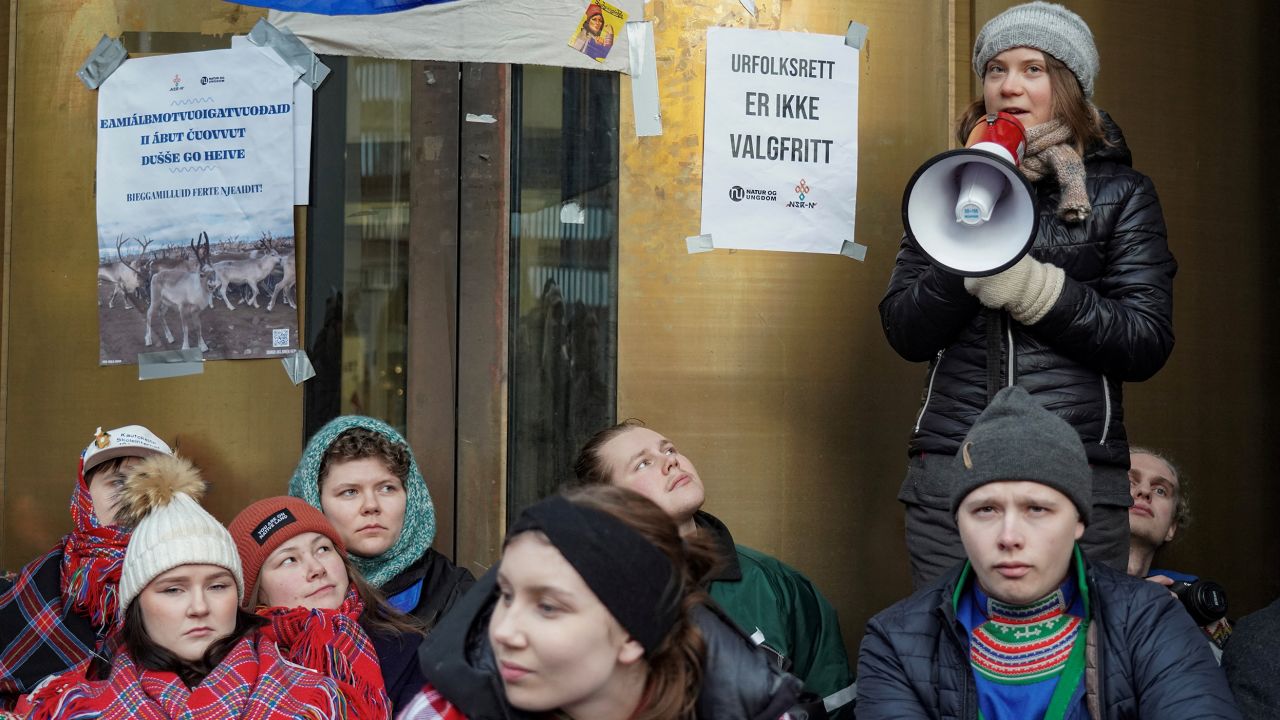
Greta Thunberg joins an anti-wind farm demonstration
Greta Thunberg joined Native American and environmental organizations in Norway this week to protest against wind turbines, which might seem weird to some.
In an effort to show their opposition to two wind farms constructed on Sámi reindeer grazing areas, dozens of protesters, including Thunberg, have blocked entry to Norwegian government facilities in Oslo.
A representative for the Oslo police district said that on Wednesday morning, police removed 10 persons, including Thunberg, from the door of the ministry of finance.
The Sámi people, the only recognized Indigenous group within the European Union, say their centuries-old tradition of reindeer herding is jeopardized by the windfarms in the Fosen region in Central Norway. Among the largest onshore windfarms in Europe, they are made up of 151 wind turbines that stretch 285 feet high.
“The constructions are stealing the reindeer’s grazing land,” Maja Kristine Jåma, a reindeer herder and Sámi politician, told CNN. The reindeer are also affected by the infrastructure around the turbines, including roads, she said. “It disturbs them a lot.”
Jåma and others are calling for the turbines to be torn down and the reindeer grazing lands restored.
“Indigenous rights, human rights, must go hand-in-hand with climate protection and climate action. That can’t happen at the expense of some people,” Thunberg told Reuters on Monday.
The fight over the wind turbines has been long running.
In October 2021, the Sámi people secured a legal victory. Norway’s Supreme Court ruled that the wind farm permits were invalid because the turbines violated the protected cultural rights of Sámi people by infringing on reindeer grazing lands.
But nearly a year and half on, the turbines are still operating.
“So far, the government has not even acknowledged the Supreme Court’s ruling on the violation of human rights or offered an apology to the Reindeer Sámi,” Eirik Larsen, Political Advisor to the Sámi Parliament in Norway, told CNN.
The Norwegian government said it is assessing how to secure the Sámi’s rights in Fosen. “The Supreme Court has considered that the permits that have been granted are invalid, but it does not follow from the judgment that the wind turbines must be taken down,” Elisabeth Sæther, State Secretary in the Norwegian Ministry of Petroleum, told CNN.
Sæther added that the government has been consulting with reindeer herders and the Sámi Parliament to find solutions “that make it possible for reindeer herding and the wind turbines to operate side by side.”
What’s happening in Norway is part of a growing conundrum when it comes to the green transition: How to implement climate policies without riding roughshod over Indigenous rights and the environment.
Wind energy is an important plank in Norway’s green energy transition. The country’s electricity generation is already almost completely renewable. In 2020, more than 90% of its electricity was generated using hydropower and wind, which has increased 10-fold in the last decade, accounted for 6.5%.
Norway, which remains a major oil and gas producer, has pledged to reduce its levels of planet heating pollution to 55% below 1990 levels by 2030.
“But you cannot have a green shift that violates human rights or Indigenous rights,” said Jåma. “These constructions threaten our way of living and our way of engaging in our culture as reindeer herders.”
Jåma calls what’s happening “green colonization,” a term the Norwegian government told CNN was “misleading and incorrect.”
Steve Trent, CEO and Founder of the Environmental Justice Foundation, told CNN: “The Sámi did not cause the climate crisis, and their traditional ways of life – which they have practiced for millennia – should not be jeopardized by efforts to resolve it.”
“Our efforts to roll back global heating must be equitable and fair,” he added.
The Sámi people, whose traditional lands – Sapmi – span northern parts of Sweden, Norway, Finland and Russia, already live on the frontline of the climate crisis.
The Arctic is warming as much as four times faster than the rest of the world and the temperature changes are making it harder for reindeer to feed, as increased rainfall means layers of ice freeze over their food.
“Indigenous Peoples are asked to give up their lands for the wind industry, mining, and other purposes to save the world from a crisis mainly created by others,” Larsen said.
-
How an Eco-friendly lifestyle can spice up your dating life
Do the words climate change light a fire in your heart? Or has sustainability never quite been on your mind? Is your favorite aesthetic environment-friendliness? Or do long-winded speeches about eco-consciousness serve as the perfect alternative to sleeping pills?
The world is changing. For many of us, it took a pandemic to make us realize just how much is at stake. The Amazon forest is burning. The turtles need to be saved. And it turns out that permafrost is permanent no more. Not long ago, it was considered a fad that teenagers like Greta Thunberg were screaming about from podiums. But what was once a snooze-fest is now a real concern for many. But does that really have to put a dampener on things?
What if eco-friendliness didn’t spell boredom but perfect, romantic bliss? What if you could take the worry that’s been boiling in your stomach and turn it into something effective, something good? And what if you could do it with the love of your life.
Is Eco-friendliness The New Sexy?
Who said saving the planet together cannot be romantic?
A passion for eco-friendliness can be just the thing that gets you both out of bed – brimming with the need to do something to help. In fact, it can be the thing that saves or spices up your love life. After all, is there anything fiercer or more rebellious than saving the world together?
But can a sustainable lifestyle truly sweep you and your boo off your feet? How can using bamboo brushes and rejecting plastic together ever be considered sultry? Is the effect worth the effort?
A healthier alternative
Leading an eco-friendly lifestyle is not just about saving the environment. It lets you both make healthy, wholesome choices. Organic food and locally sourced products may not sound exciting, but they do remove the pesky effect pesticides have on you. The result? Hot, healthier bodies that are primed for passionately long nights under the sheets, against the wall, and atop the kitchen counter.

Eco-friendly choices for hotter, healthier bodies The perfect wingman
Gone are the days when a picture of a puppy in your arms and a fancy car in your background would leave people swiping right on your profile at the speed of lightning. Material success is secondary. Climate change awareness is the new sexy. And dating apps like OkCupid prove just that.
For World Earth Day 2021, the app let users flaunt a Climate Change Advocate badge on their profiles and even went as far as to create a separate category for climate-conscious users. So, in case you are still on the fence about whether sustainability can really affect your love life, now you know.
A couple that saves the world together, stays together
No, we are not talking about marches and bringing down barricades together. Although, that feeling of danger and breaking rules does have its sultrier perks. But, for couples not into the clamor and cries of protests, quieter, softer sustainable practices are the way to go.
Go shopping together. Make a day of it. Compete on who can find the cheaper yet eco-friendly alternatives. Cook together and see who makes less waste. Then pack your lunches, lose yourself among nature, and remind yourself why you are doing this. Love is for the living. A planet that thrives breeds, breathes love. And love is what you are fighting for.
Admire, Awe, Adore
It is not all about being suave in the streets and freaky in the sheets. Passion is great. Passion keeps relationships alive and sets them afire. But to admire your partner, to be able to look at them with awe, adoration, and sheer, unadulterated respect – that does not come easy.
Saving the planet together may not be a cakewalk, but neither is sustaining a sizzlingly strong relationship. Practicing an eco-friendly lifestyle together can remind you that, deep down, you are both good, kind people – people who are ever ready to put their own comforts at stake for the sake of others. And that warrants and commands respect for your partner.
And we, for one, think that being smashed silly by someone you look up to just hits different, doesn’t it?
Source: Bonobology
-
Germany extends nuclear power in the face of an energy crisis
As a result of the energy crisis caused by Russia’s invasion of Ukraine, German Chancellor Olaf Scholz has ordered the country’s three remaining nuclear power plants to remain operational until mid-April.
Germany had originally planned to phase out all three by the end of this year.
Mr Scholz’s order overruled the Greens in his coalition, who wanted two plants kept on standby, to be used if needed.
Nuclear power provides 6% of Germany’s electricity.
The decision to phase it out was taken by former chancellor Angela Merkel after Japan’s Fukushima nuclear disaster in 2011.
But gas prices have soared since Russia’s invasion of Ukraine in February, which disrupted Russia’s huge oil and gas exports to the EU. In August Russia turned off the gas flowing to Germany via the Nord Stream 1 undersea pipeline.
After relying so heavily on Russian gas Germany is now scrambling to maintain sufficient reserves for the winter. The crisis has also prompted it to restart mothballed coal-fired power stations, though the plan is to phase out coal in the drive for green energy.
Last year Germany got 55% of its gas from Russia, but in the summer that dropped to 35% and it is declining further.
Chancellor Scholz’s third coalition partner, the liberal Free Democrats (FDP), welcomed his move to keep nuclear power as part of the mix. The three remaining nuclear plants are Isar 2, Neckarwestheim 2, and Emsland.
The Social Democrat (SPD) chancellor also called for ministries to present an “ambitious” law to boost energy efficiency and to put into law a phase-out of coal by 2030.
Last week climate activist Greta Thunberg said it was a “mistake” for Germany to press on with nuclear decommissioning while resorting to coal again.