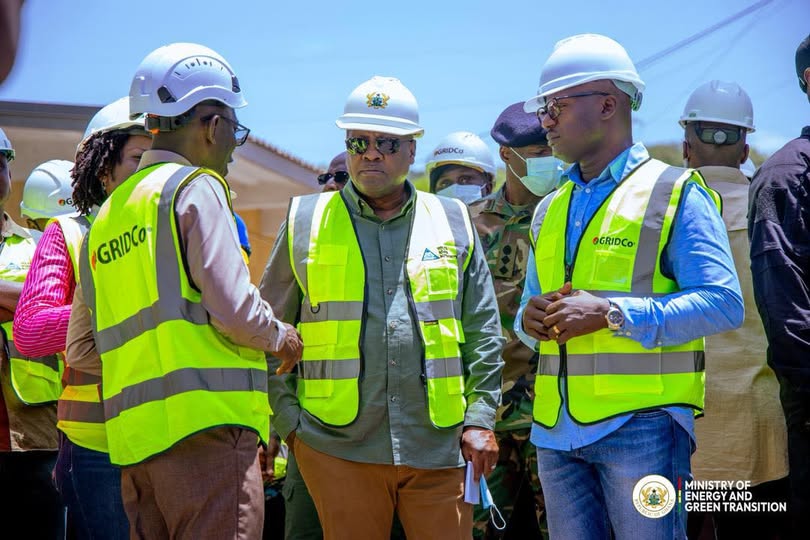
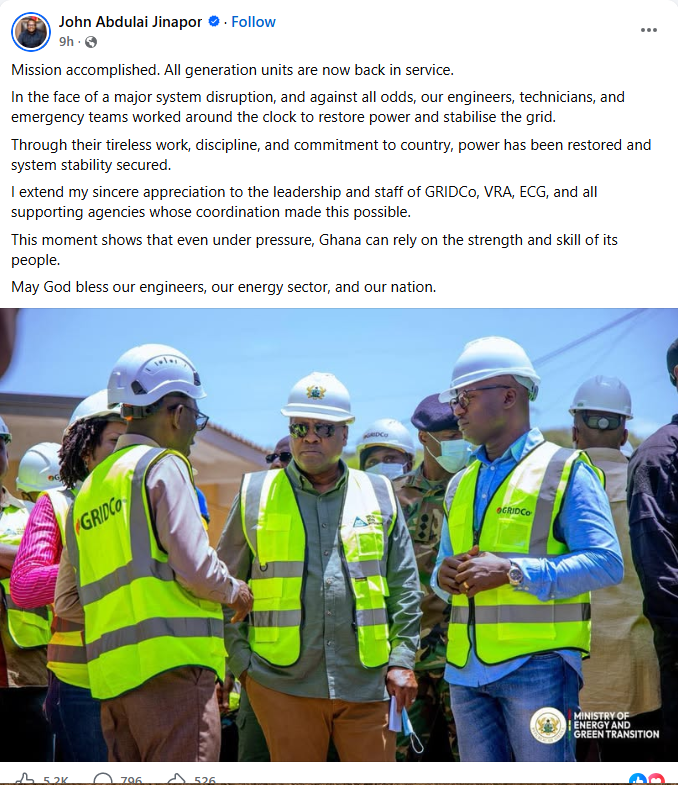
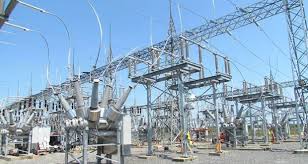
All generation units at the Akosombo Dam have been restored, bringing the power station to normalcy to operate at full capacity to supply sufficient power to the national grid, the Energy Minister, John Jinapor, has announced.
The Minister, in a Facebook post today, Friday, May 1, stated “Mission accomplished. All generation units are now back in service” while commending all team members who worked overtime to ensure restoration of power following the power outages nationwide.
He said, “ In the face of a major system disruption, and against all odds, our engineers, technicians, and emergency teams worked around the clock to restore power and stabilise the grid. Through their tireless work, discipline, and commitment to the country, power has been restored and system stability secured. May God bless our engineers, our energy sector, and our nation”
Mr Jinapor went on to thank the “…leadership and staff of GRIDCo, VRA, ECG, and all supporting agencies whose coordination made this possible. This moment shows that even under pressure, Ghana can rely on the strength and skill of its people”.
Why the power outages in the past few days
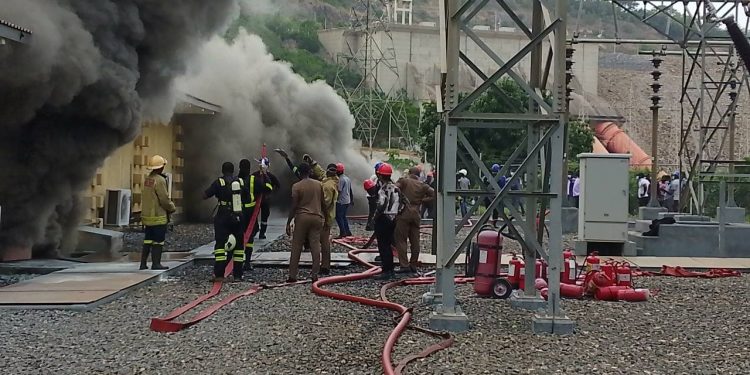
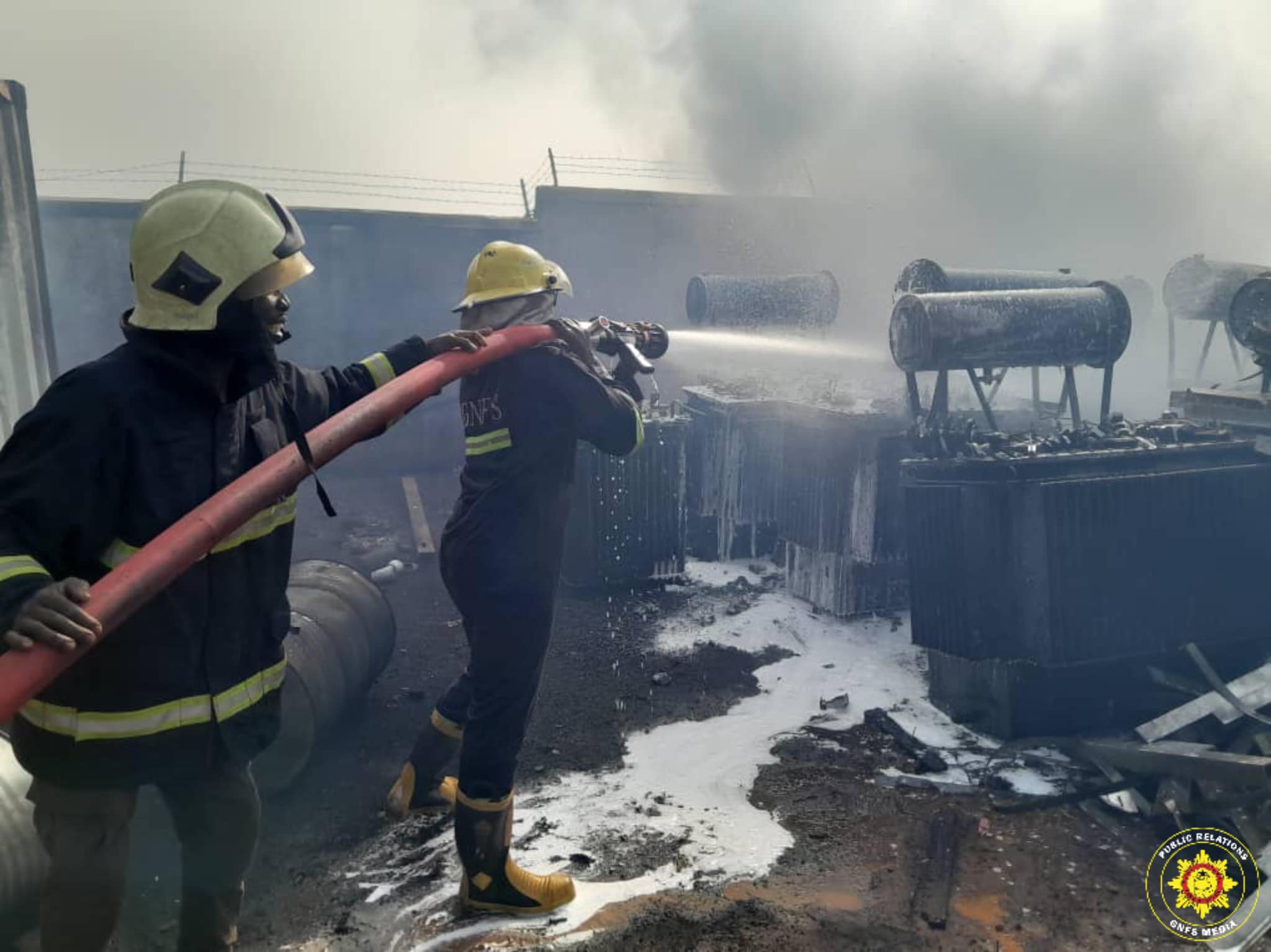
The outages began after a fire outbreak at the Akosombo GRIDCO substation on April 23, around 2 pm, which blocked about 1,000 megawatts of power.
Speaking on the situation on the Channel One Newsroom on Sunday, April 26, ECG’s General Manager for External Relations, Dr Charles Nii Ayiku Ayiku, apologised for the inconvenience caused, describing the incident as unexpected and significant.
“I sincerely apologise for the inconvenience our cherished customers are facing. The incident wasn’t expected. It was a major incident which has rendered the entire control room affected and down, and we sincerely apologise to our customers.
“After Akosombo, the fact is that it blocked about 1000 megawatts, but I am sure you also understand that even after losing 1000 megawatts, we have still been consistent with power supply within some parts of the country,” he said.
Dr Ayiku cautioned against calls for a load-shedding timetable at this stage, describing it as premature.
“So if we start talking about a load shedding timetable right now, don’t you think it is too early to call for a load shedding timetable?” he said.
He added that ECG, GRIDCO and the Volta River Authority (VRA) are working together to restore full power supply across the country.
Meanwhile, the Minister of Energy and Green Transition, John Abdulai Jinapor, directed the Chief Executive Officer of the Ghana Grid Company Limited (GRIDCo) to step aside pending an investigation into a fire at the Akosombo Power Control Centre while taking steps to avert disruptions in Ghana’s power supply following a major fire incident at the Akosombo transmission network.
As part of the measures, Ghana temporarily halted power supply to neighbouring countries. The Deputy Energy Minister, Richard Gyan-Mensah, disclosed this while engaging the press on Friday, April 24.
Ghana primarily exported electricity to Togo, Benin and Burkina Faso through the 225kV Bolgatanga-Ouagadougou interconnection.
However, these countries were left to temporarily cater for themselves as the fire outbreak damaged a transmission system with a capacity of about 720 megawatts at GRIDCo’s substation at Akosombo.
He added, “The system that got affected was about 720 megawatts. That system transmits power to major parts of the country, so this is a significant hit. The Akosombo Dam generates a little over 1,000 megawatts.”
“This is an emergency that has actually occasioned it. It is brief; it is not something that is going to last longer. I think they have also heard what has happened to us. In this situation, we need to take some actions, and this is one of them”.
The Chief Executive Officer of the Ghana Grid Company Limited (GRIDCo), Ing. Mark Awuah Baah, has been directed by the Minister for Energy and Green Transition, John Abdulai Jinapor, to step aside as investigations begin into the fire outbreak at the Akosombo Power Control Centre.
Authorities over the weekend announced that they have set up a seven-member committee to investigate the recent explosion and fire outbreak at the GRIDCo Akosombo Substation, which occurred on the afternoon of Thursday, April 23.
Recently, Ghana has been experiencing temporary power outages, locally known as “dumsor.” However, the Spokesperson and Head of Communications at the Ministry of Energy, Richmond Rockson, has attributed the disruption to damage caused to the transmission system with a capacity of about 720 megawatts as a result of the fire outbreak. He described the development as “a significant hit,” explaining that the affected system supplies electricity to major parts of the country.
He added, “The system that got affected was about 720 megawatts. That system transmits power to major parts of the country, so this is a significant hit. The Akosombo Dam generates a little over 1,000 megawatts.”
Meanwhile, the Ministry of Energy and Green Transition has taken steps to avert disruptions in Ghana’s power supply following a major fire incident at the Akosombo transmission network.
As part of the measures, Ghana will temporarily halt power supply to neighboring countries. The Deputy Energy Minister, Richard Gyan-Mensah disclosed while engaging the press on Friday, April 24.
Ghana primarily exports electricity to Togo, Benin and Burkina Faso through the 225kV Bolgatanga-Ouagadougou interconnection. To enhance revenue mobilisation in the energy sector and stabilise power supply, the Ministry of Energy and Green Transition says it will introduce standardised, accurate electricity meters from next month to boost revenue mobilisation and stabilise power supply.
In a related development, the Electricity Company of Ghana (ECG) has apologised to Ghanaians over the recent power outages across the country.
Speaking on the situation on the Channel One Newsroom on Sunday, April 26, ECG’s General Manager for External Relations, Dr Charles Nii Ayiku Ayiku, was sorry for the inconvenience caused, describing the incident as unexpected and significant.
“I sincerely apologise for the inconvenience our cherished customers are facing. The incident wasn’t expected. It was a major incident which has rendered the entire control room affected and down, and we sincerely apologise to our customers.
“After Akosombo, the fact is that it blocked about 1000 megawatts, but I am sure you also understand that even after losing 1000 megawatts, we have still been consistent with power supply within some parts of the country,” he said.
He assured that his outfit is making relentless efforts with restoration works currently underway across the transmission network, with full restoration imminent soon, hence he urged the public to remain calm amid the inconveniences being caused by the outages.
“The question is, the current situation at the Akosombo GRIDCO substation is a work in progress. As I speak to you, there is a resolution; there are some of the issues that have been resolved, some parts of the country are back on full supply, pending other lines that will be restored.
“The engineers have assured us that very soon we will get back on supply. I would once again urge the general public and our customers to remain calm and be assured that the situation is under control,” he stated.
Dr Ayiku cautioned against calls for a load-shedding timetable at this stage, describing it as premature.
“So if we start talking about a load shedding timetable right now, don’t you think it is too early to call for a load shedding timetable?” he said.
He added that ECG, GRIDCO, and the Volta River Authority (VRA) are working together to restore full power supply across the country.
Ghana faces possible intermittent power outages due to a fire incident at Ghana Grid Company Limited’s (GRIDCo) substation within the Akosombo Hydroelectric Dam complex in the Eastern Region.
Speaking to the media on Friday, the Spokesperson and Head of Communications at the Ministry of Energy and Green Transition Ghana, Richmond Rockson, disclosed that the blaze which occurred on Thursday, April 23, damaged a transmission system with a capacity of about 720 megawatts.
He described the development as “a significant hit,” explaining that the affected system supplies electricity to major parts of the country.
He added, “The system that got affected was about 720 megawatts. That system transmits power to major parts of the country, so this is a significant hit. The Akosombo Dam generates a little over 1,000 megawatts.”
Meanwhile, the cause of the fire is yet to be determined by authorities. Recently, the country has been experiencing temporary power outages, locally known as ‘dumsor’, but President John Dramani Mahama insists they are part of ongoing system upgrades.
While inspecting new transformers acquired for the Northern Electricity Distribution Company Limited (NEDCo), President Mahama noted that “The outages you are facing are not dumsor, it is to enable you to get better quality and stable power.”
As part of efforts to enhance revenue mobilisation in the energy sector and stabilise power supply, the Ministry of Energy and Green Transition says it will introduce standardised, accurate electricity meters from next month to boost revenue mobilisation and stabilise power supply.
The Minister disclosed this while answering questions on the floor of Parliament on Monday, March 16. According to him, all households will benefit from upgraded electricity infrastructure.
“Next month, we will start the large-scale rollout of transformers. Within that same month, we should see a much more massive injection of new, standardised, and accurate meters. That is how we can make sure that there is guaranteed revenue for investment. All meters procured are tested. I can assure you that these meters are of high quality; they meet the standards, and they do the job they are supposed to do,” he said.
His comments come amid growing concerns from sections of the public, who claim they are being overcharged and that their prepaid credit no longer lasts as long as before.
Meanwhile, the Communications Director of the Electricity Company of Ghana (ECG), William Boateng, has asserted that heat conditions, wiring, and earthing are most likely contributing factors to excessive electricity consumption affecting its customers.
This was in response to concerns from sections of the public who have made claims of being overcharged and that their prepaid credit no longer lasts as long as before.
In an interview on Adom FM’s morning show Dwaso Nsem, Mr. Boateng advised customers to frequently check for possible electrical faults in their homes.
“When the heat increases, someone can even double the use of cooling appliances. That alone can affect your consumption. Sometimes the issue may be with wiring or earthing. That is why we have certified electrical contractors who can check whether there is leakage or any fault affecting consumption,” he said.”
Mr. Boateng urged customers who notice irregularities in their billing to report them directly to ECG for investigation, so that engineers can inspect the meter, review consumption patterns, and identify the cause of the problem.
“We work with machines; it is not about defending anything. There could be a margin of error. If your bill exceeds what you expected or your credit finishes unusually fast, report it to ECG,” he urged, adding that, “When customers report, we can properly investigate, analyse the situation, and resolve it if there is a genuine problem,” he assured.
Last year, the Director-General of the Ghana Standards Authority (GSA), Professor Alex Dodoo, warned of the dangers associated with uncalibrated electricity meters, which were in use nationwide.
These uncalibrated metres, being utilised by the Electricity Company of Ghana (ECG), he said, did not guarantee the protection of consumers and also are not able to hold industry accountable for fair charges.
Calibration of meters ensures that energy usage is measured accurately, preventing overbilling or underbilling for consumers.His comments came amid growing public concerns of overbilling, inconsistent power supply, and inefficiencies in the power-producing company’s services.
Speaking at a stakeholder conference organized by the International Electrotechnical Commission yesterday, May 20, 2025, in Accra, Prof. Dodoo revealed that many ECG meters in circulation had not been calibrated or verified by the Ghana Standards Authority, as has been mandated by the National Instrumentation Regulation NI2413.
“Very few of our meters have been calibrated and verified by the GSA. If the meter you are using has not been calibrated or verified by the Ghana Standards Authority, as required by NI2413, its accuracy is questionable. We simply cannot vouch for it,” he said.Prof. Dodoo said meters not being calibrated put consumers at risk of under- and overbilling.
The NI2413 law mandates that all electricity meters in circulation must be calibrated and verified by the GSA to ensure accuracy, fair billing, and energy efficiency.
Additionally, the Weights and Measures Decree, NRCD 326 of 1975, empowers the GSA to oversee legal metrology, ensuring that measuring instruments used in trade and industry meet standardized accuracy requirements.
However, to resolve this, he mentioned that his outfit is currently working with the ECG and Public Utility and Regulatory Commission (PURC) to configure the millions of meters currently in circulation in the country.
“The law states it must be verified and calibrated. Thankfully, we are working with ECG and PURC to ensure that all the millions of meters in Ghana are properly calibrated and verified by the GSA,” he noted.
He also linked the issue to national development, emphasizing its importance in the government’s ambition to implement a 24-hour economy.
“And I know it’s a very troubling issue. But as we support the President in rolling out a 24-hour economy, it’s important that we provide the quality infrastructure that will make the 24-hour economy succeed,” he concluded.
Prof. Dodoo revealed that many ECG meters in circulation had not been calibrated or verified by the Ghana Standards Authority, asIn the same year, the government, through the Ministry of Energy and Green Transition, approved the procurement of 200 new transformers for the Electricity Company of Ghana (ECG) to strengthen power transmission and distribution to major cities across the country.
The sector minister, John Abdulai Jinapor, made information public on May 28, 2025, during the opening session of the 18th West Africa Mining and Power Exhibition (WAMPEX) at the Grand Arena and Accra International Convention Centre (AICC) in Accra.The Electricity Company of Ghana (ECG) made a formal request for 200 new transformers in April 2025, and after barely a month, the government gave the green light for the deployment of the transformers.
“Despite the challenges we inherited, recent reports show that power generation has been very stable” What we need to do is improve the transmission and distribution network. In this regard, I have granted approval to ECG as a matter of urgency to inject about 200 transformers in our major capital cities in order to ensure that we not only generate power but we can distribute power to (sic) consumers effectively and efficiently,” Mr Jinapor said.
Minister Jinapor noted that initial challenges with power generation have been stabilized, and Ghana is now exporting electricity to neighboring countries.
The current focus is on improving power transmission and distribution systems.WAMPEX, the largest forum for mining and power industries in West Africa, attracted over 240 exhibitors from 30 countries and more than 5,000 visitors this year.
The event, however, provided a platform for industry professionals, policymakers, and stakeholders to discuss challenges, innovations, and future opportunities.
Residents of Sunyani will face a three-day power fluctuation following the breakdown of the Ghana Grid Company Limited (GRIDCo) transformer.
According to a joint statement issued by the Volta River Authority (VRA) and the Northern Electricity Distribution Company (NEDCo) on Wednesday, January 21, the inconvenience is necessary to restore the faulty transformer to normal operation.
As part of the maintenance work, the power distribution companies have released a schedule for the affected areas. The affected areas have been grouped into three.
Group One includes Nana Bosoma Market, Newtown, Estate, Baakoniaba, Asufufu, Wawasua, Nanketwa, Municipal, Town Centre, Zinco, Airport, parts of UENR, St. Mary’s, and surrounding communities.
Group Two covers Abesim Estate, Tanoso, Yamfo, Susuanso, GWCL, Abesim, Mayfair, Nkwabeng North, Odumase, Pastoral Penkwase, Syn. NMTC, and surrounding communities.
Group Three comprises Nimpong, STU, GETFund, Magazine, SUSEC, Dr. Berko, St. James, Glamossay, Nkrankrom, Fiapre, Dumasua, Mantukwa, Ayakomaso, Nsoatre, and surrounding communities.
On Wednesday, January 21, Group Two will experience a power interruption from 6:00 a.m. to 2:00 p.m., followed by Group One from 2:00 p.m. to 10:00 p.m., while Group Three will be affected from 10:00 p.m. to 6:00 a.m. the following day.
On Thursday, January 22, Group One will be without power from 6:00 a.m. to 2:00 p.m., Group Three from 2:00 p.m. to 10:00 p.m., and Group Two from 10:00 p.m. to 6:00 a.m.
On Friday, January 23, Group Three will be affected from 6:00 a.m. to 2:00 p.m., Group Two from 2:00 p.m. to 10:00 p.m., and Group One from 10:00 p.m. to 6:00 a.m.
The power distribution companies have apologised for the inconvenience this temporary power interruption will cause, while assure the public of it continued commitment to deliver reliable and improved electricity transmission services.
In July last year, businesses and households in Greater Accra, Tema, and their surrounding areas were cautioned to brace themselves for a blackout lasting approximately 9 to 12 hours, the Electricity Company of Ghana (ECG) has announced.
In three separate public notices issued on Wednesday, July 2, the power supply company alerted consumers of an impending power interruption during the day on Thursday, July 3.
The blackout, according to ECG, was due to planned maintenance works to enhance service delivery and ensure a more stable power distribution system.
Communities affected by the maintenance in Accra were as follows: Glefe, Wiaboman, Odorkor, Awoshie, Mandela, SCC, Sunny Coast, Korkordjor, Gbawe, Alogboshie, Achimota Neoplan, Benjilo, Asofa, Amen Amen, Omandjor, Tesano, Alajo, Adenta Estate, Adenta Container, Ashaley Botwe Town, Ashongman Pure Water, Ashongman Estates, Osu, and surrounding areas.
The outage in these areas lasted from 9:00 a.m. to 5:00 p.m. And in the Tema Region, ECG said power was interrupted between 9:00 a.m. and 4:00 p.m.
The affected areas included Kpong, Nuaso, Kpongunor, Agormanya, Odumase, Kojonya, Atua, Sawer, Okornya, Somanya, Jericho, Roman Down, Under Bridge Market, State School for the Deaf, Kanawu, Adjei Kojo, Community 25, Bulasu, Ghana Flag, Afienya Zongo, and surrounding areas.
The notice prepared consumers accordingly to minimise the impact of the temporary outage. Nonetheless, ECG restored the power immediately after the completion of the maintenance works.
It also apologised for the inconvenience the outage is likely to cause. “ECG regrets the inconvenience that will arise out of this exercise,” parts of the statement read.
Residents in Pokuase Pharmacy, Ayawaso, Nii Ayi, Odumase, Amanfrom, Nsakina, Agbogba, and Pantang Royal also experienced a temporary power outage on Wednesday, March 12, 2025 as the Electricity Company of Ghana (ECG) wraps up its scheduled two-day maintenance exercise.
The outage lasted from 9:00 AM to 5:00 PM. The maintenance work, aimed at improving electricity distribution also affected parts of the Tema Region, where areas such as High Tension, Golf City, Community 17, Fafali, Cambodia, and HFC Estates were without power from 9:00 AM to 4:00 PM.
Earlier on Tuesday, March 11, the same year, similar maintenance activities were carried out in parts of the Volta and Ashanti Regions. Residents of Tsito and its surrounding areas in the Volta Region faced outages between 9:00 AM and 2:00 PM.
In the Ashanti Region, a two-phase exercise was conducted. The first phase impacted Darko, Bebu, Ampabame No.2, Trede, Sabin Akroform, and parts of Pakyi No.2, while the second phase, lasting from 9:00 AM to 6:00 PM, affected Atwima Agogo, Abuakwa, Mankranso, Kunsu, Sepaase, Nkawie, Afari, Abakomade, Kasapreko, and several nearby communities.
The ECG assured customers that this maintenance was crucial for enhancing power reliability and reducing unexpected disruptions.
Residents and businesses in the affected areas were advised to make necessary arrangements, while the company apologized for any inconvenience caused.
This came at a time when several parts of the country was experiencing power outages due to challenges in the energy sector. However, the Energy Minister at the time, John Jinapor, had rejected demands from the Minority and some Ghanaians for a load-shedding timetable, despite recent power outages in parts of the country.
Their demand stemed from concerns that the current power situation mirrors past periods of prolonged power crises (dumsor), despite government assurances that there is no full-scale rationing of electricity.
However, at a press conference at the Jubilee House last Friday, 7 March 2025, Mr. Jinapor explained that there was no need for such a timetable because the country was not experiencing full-scale power cuts.
The Ghana Grid Company (GRIDCo) has expressed grave concern over the encroachment on its transmission tower sites by galamsey operators who are digging dangerously close to the foundations.
Acting Deputy Chief Executive Officer of Engineering and Operations, Frank Otchere, made this known at GRIDCo headquarters in Tema on Thursday, September 25
Mr Otchere stated that maintenance teams now face attacks when they attempt to access some areas.
“Unfortunately, there are some areas that even when our maintenance teams go there, they get shot at. And some of them have had to run away,” he disclosed, adding that the situation has made it impossible for GRIDCo to operate in certain locations without security support.
He adds that the galamseyers are weakening the towers, which are carefully engineered to withstand immense weight and pressure.
He appealed for urgent assistance from national security agencies to protect transmission corridors and avert the potential collapse of towers.
Meanwhile, The Minister of State in charge of Government Communications and MP for Abura-Asebu-Kwamankese, Felix Kwakye Ofosu, has announced the government’s new strategy as part of efforts to eradicate illegal mining, also known as galamsey, in the country.
Speaking to the media on Tuesday, September 16, Felix Kwakye Ofosu said the government will, in the coming days, the government will deploy soldiers to permanently guard 44 galamsey hotspots, including waterbodies.
“All the 44 areas that are threatened by galamsey, there is going to be a permanent military presence,” he added.
The government’s recent move is a response to mounting calls for the declaration of a state of emergency on galamsey.
Meanwhile, the FixTheCountry movement will embark on vigil and march sessions on Sunday, September 21, and Monday, September 22, respectively, at Revolution Square in Accra, in response to illegal mining activities, locally known as galamsey, in the country.
This information was disclosed by the group’s convenor, Oliver Barker-Vormawor, in a post on X (formerly Twitter) on Monday, September 15.“On Sunday 21st September, we will have a vigil at the Revolution Square, and on Monday 22nd (a holiday), there will be a march, calling attention to the urgency of our environmental crisis,” he wrote.
In his post he stressed that the solution to end the menace requires collective efforts, hence, he called on all and sundry to participate in the upcoming protest.
“The responsibility to protect and preserve the environment is by divine assignment, ours as a people,” he wrote, adding that the issue transcends electoral politics.Our responsibility to end galamsey does not end at elections. Nor does it begin after our party loses one. This is bigger than petty politics,” he emphasised.
Illegal mining activities continue to retrogress the country’s development, as they lead to the loss of lives, destruction of properties and the environment, and water bodies, among others.For years, the country’s efforts to nip the canker in the bud have not yielded the needed results.
Among measures taken to protect water bodies from illegal miners is the deployment of river guards. The river guards are selected from communities most affected by illegal mining, ensuring they have a deep understanding of the local landscape and challenges.
Govt’s efforts to clamp down on illegal mining activities
The government has rolled out an official order requiring all machinery used in mining operations to be registered with the Driver and Vehicle Licensing Authority (DVLA) by 1st August.
A statement issued by the Ministry of the Interior on Tuesday, July 15, states that the state will go ahead to confiscate unregistered mining equipment after the deadline.
“The Government, as part of efforts to reform the mining sector in the country, requires that all machinery used in mining activities must be registered with the Driver and Vehicle Licensing Authority (DVLA) by 1st August 2025. Equipment that remains unregistered after this deadline will be confiscated by the State,” the Ministry stated on its website.
Mr Mubarak has empowered the Ghana Police Service and DVLA to begin strict enforcement of the new rule from August 2. “The Ghana Police Service and DVLA have been directed to enforce this directive from 2nd August 2025 onward rigorously. The general public, especially those who use mining machinery, is advised to take note and comply with the directive,” he wrote.
The Ministry reiterates its resolve to maintain national peace through effective internal security and law enforcement.
Meanwhile, a similar directive came in months ago, where excavator owners and operators were asked to register their machines with the Driver and Vehicle Licensing Authority (DVLA) within two weeks or risk losing them to the state, as the government intensifies efforts to clamp down on illegal mining activities.
The Chief Executive Officer (CEO) of the DVLA, Julius Neequaye Kotey, issued the directive in Accra, warning that effective June 1, any excavator not registered with the DVLA will be confiscated.
Speaking at a press briefing, Mr. Kotey announced that the Ghana Police Service and the DVLA’s operational team commenced a nationwide enforcement after the deadline, arresting and impounding excavators being used at mining sites or for commercial purposes without proper documentation.
“This exercise will help identify every excavator that enters the country and trace how it is being used. The goal is to ensure we can monitor and hold people accountable,” Mr. Kotey said.
The directive fell in line with Section 38 of the Road Traffic Act, 2004 (Act 683), which mandates the registration of all motor vehicles and trailers, including farm and heavy-duty equipment.
Despite the law, the DVLA found many unregistered excavators operating in mining areas, some of which have been used in illegal activities.
Mr. Kotey emphasized that the DVLA, with its 34 offices nationwide, could register all excavators and farm machinery within two weeks and was ready to strictly enforce the directive.
“Excavators in the hands of illegal miners have worsened the destruction of our environment. This is why we must act,” Mr Kotey said.
To further control the situation, the DVLA, in collaboration with key agencies like the Minerals Commission, National Security, the Ghana Ports and Harbours Authority (GPHA), and the Customs Division of the Ghana Revenue Authority (GRA), commenced tagging all newly imported excavators.
In addition to tagging new imports, the Minerals Commission was tasked with leading a team to tag all excavators already in the country. Legal small-scale mining sites have also been geo-fenced, with their site coordinates integrated into the Ghana Mine Repository and Tracking software for better oversight.
The move is part of the government’s broader efforts to combat illegal mining. Three months ago, Lands and Natural Resources Minister Emmanuel Armah-Kofi Buah announced the rollout of a system to monitor excavator imports and usage, involving port tagging and digital tracking in partnership with several state agencies.
According to the sector minister. The third most valuable item imported into this country is excavators, and it is worth GHC6.2 billion.
Crack down on illegal mining activities
In April, a total of 47 individuals were arrested for engaging in illegal mining activities along the Tano River and within the Aboi, Subri, and Nimiri forests in the Western Region. This followed a special four-day intelligence-led operation that commenced on April 17, within the Samreboi enclave.
According to the Ghana Police Service, the suspects include 39 Ghanaians and 8 Chinese nationals. The Police indicated that a significant amount of equipment and materials believed to have been used for the mining operations were retrieved.
These include seventeen excavators, one bulldozer, four motorbikes, two Toyota Hilux vehicles, one Rav4 vehicle, four pump-action guns, one single-barreled gun, fifty-four live BB cartridges, and eight pumping machines.
Prosecution began for the arrested suspects. On Tuesday, 41 of them were arraigned, with 29 remanded into Police custody to reappear before the court on April 30, 2025. Twelve others were also remanded to return to court on May 2, 2025.
The remaining seven were put before the court on April 23, 2025.Two coordinated operations conducted on Friday, June 20, at Nikanika and Adeade in the Central Region led to the arrest of 3 suspects and the seizure of several pieces of mining equipment.
The operations were executed by the Ghana Police Service through its Special Anti-Galamsey Task Force. The task force proceeded to a mining site at Nikanika. Although no operators were found at the scene, the team retrieved a single-barrel shotgun loaded with a cartridge and three water-pumping machines.
The task force extended its operation to Adeade, where three suspects—Prosper Quansah, Chrispin Nartey, and Owusu Gambra—were arrested with an excavator on a lowbed trailer.
One SANY excavator, four unregistered Haojin motorbikes, and one lowbed vehicle with registration number GN 2136-24 were seized from the scene. All exhibits were secured in police custody.
Some 12 accused persons standing trial for engaging in illegal mining activities at Tumetu near Princess Town in the Ahanta West Municipality of the Western Region have been remanded into prison custody. While 10 of the accused persons were arrested at a palm plantation, two were arrested at the Elluabo Chavene Ghana Rubber Estate Limited (GREL) plantation.
This was due to a coordinated police intelligence-led operation within the Ahanta West Municipality. The accused persons are Lord Yankey, Caleb Adu Kwaw, Stephen Agyei, Ebenezer Barnes, Mathew Somagevi, Paa Grant, Bashiru Kaviru, Joseph Borney, Aminu Issah, Kofi Sogah, Albert Normah, and Robert Mensah.
Four water pumping machines, one tricycle with registration number M-20-WR 1045, and two motorbikes were retrieved from the sites, according to the police.
All twelve accused persons admitted to the offence during police interrogations. They were subsequently put before the Takoradi Harbour Area Circuit Court ‘A’, and were remanded into prison custody at Sekondi and reappeared before the court on Tuesday, July 8.
Also, fifteen individuals are in police custody for engaging in illegal mining activities at Manso Adubia. They were arrested following a special intelligence-led operation at Watreso and Preacher Krom.
The suspects include Tahiru Ibrahim (24), Shaibu Idrissu, (23), Boateng Emmanuel (27), Jamon Kwaku Samuel (21), Yaro Patrick (29), Kofi Boakye (21), Gubong Mathew (45), Fatawu Zackari Seidu (26), and Abdul Malik Seidu (22).
The others are Dauda Tahiru (23), Sampson Grace (21), Boolangkpuo Freda (24), Arima Hagar (26), Kwarteng Vasco (30), and Kwame Adutwum (24).
Two excavator control boards, two automatic pump-action guns, two Musler 12 firearms, 59 BB cartridges, three AA cartridges, one water pumping machine, two power generators, one vulcanizing machine, and one Apsonic motorbike were seized from the site.
A major fault on the Tafo-Nkawkaw transmission line has been identified as the cause of the nationwide blackout that plunged several parts of Ghana into darkness on the night of Thursday, April 3, according to the Ghana Grid Company (GRIDCo).
In a statement issued following the incident, GRIDCo revealed that the disruption occurred at precisely 8:09 pm, initiating a cascading failure across the power network. The fault triggered further malfunctions on adjacent transmission lines, eventually forcing multiple power plants offline and leading to power outages in key areas such as Accra, Kumasi, Sunyani, Techiman, Bui, Tumu, Sawla, and parts of the northern regions.
The blackout, which was felt most intensely in areas beyond Kumasi, was attributed to a significant drop in national power generation. GRIDCo’s System Control Centre, however, acted swiftly, deploying emergency response protocols to stabilise the grid and begin the restoration process.
By 10:57 pm, full electricity supply had been restored to all affected regions.
“The Ghana Grid Company sincerely apologises to the general public for the disruption,” said Dzifa Bampoh, Manager of Corporate Communications at GRIDCo. The company expressed regret for the inconvenience caused and assured the public of its commitment to reliable power delivery.
A fire outbreak at the Ghana Grid Company Limited (GRIDCo) – Northern Electricity Distribution Company (NEDCo) substation warehouse in Choggu, Tamale, resulted in the destruction of vital electrical components, including transformers, high-tension cables, and meters.
The blaze, which was triggered by a transformer explosion, broke out on Sunday, March 2. Firefighters from the Tamale Metro and Tamale Teaching Hospital Fire Stations responded swiftly to the emergency, working tirelessly to bring the situation under control.
According to reports, fire crews managed to contain the flames at 16:49 hours and fully extinguished the fire by 17:52 hours, preventing further damage to other critical infrastructure within the facility.
Despite the destruction, the firefighters successfully salvaged several electrical components, including additional transformers, meters, and high-tension cables, mitigating the overall loss.
The Regional Fire Commander, ACFO II Franklin Masiku, was present at the scene to oversee the operation.
Authorities have yet to provide a full assessment of the damage or determine if any additional risks remain.
Ghana Grid Company Ltd (GRIDCo) has reassured the public that it has put in place steps to avert power failures, commonly known as “dumsor,” during the ongoing maintenance by the West Africa Gas Pipeline Company (WAPCo). The maintenance began on February 5 and is expected to conclude by March 2, 2025.
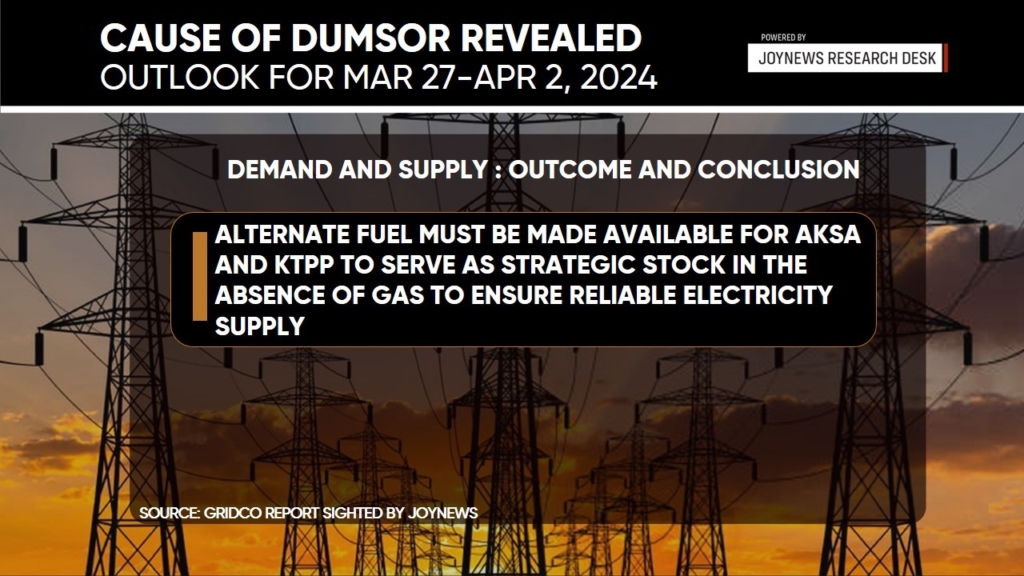
In a statement released jointly with the Electricity Company of Ghana Ltd (ECG), GRIDCo confirmed that, under the guidance of the Ministry of Energy and Green Transition, adequate supplies of liquid fuel have been secured to maintain operations at critical plants in Tema as an alternative energy source.
Speaking with Citi Business News, the executive Director of the Institute of Energy Security (IES), Nana Amoasi VII, praised the government’s foresight in securing fuel reserves to guarantee a continuous power supply.
“The postponement of the maintenance programme gives the government ample time to build up liquid fuel reserves. If the exercise proceeds and national gas flow to power plants in the Eastern enclave is disrupted, there will be enough liquid fuel to keep the plants operational,” he explained.
Amoasi also mentioned that plants like Asogli and the entire Tema power facility will stay operational, ensuring there is no decline in power generation capacity.
“This will allow the government to proceed with confidence, avoiding criticism, and ensuring consumers enjoy a steady and reliable power supply,” he added.
Ghana Grid Company Limited (GRIDCo) has warned that a financial injection of approximately US$89.90 million is urgently needed to avert the looming power crisis, often referred to as ‘dumsor,’ and meet the country’s power generation demand.
The critical funds are required to procure liquid fuels to keep thermal power plants running during the upcoming West African Gas Pipeline (WAGP) pigging exercise, scheduled from January 20 to February 16, 2025.
The pigging exercise, originally planned for October 2024 but rescheduled at the Ministry of Energy’s request, will temporarily halt gas offtake from WAPCo’s pipeline in Togo, Benin, and Tema, leaving thermal plants in Tema without their usual gas supply. As a result, plants that cannot switch to liquid fuels will be forced to shut down, leading to a reduction in power generation capacity.
“To ensure thermal plants in Tema can continue operating and meet demand, a total of US$89.90 million is required for the purchase of liquid fuel,” GRIDCo stated.
The situation is further compounded by scheduled generator shutdowns in key plants, including the Kpong and TICO plants, which will coincide with the pigging exercise, resulting in even greater generation deficits. While gas production from ENI and Tullow is sufficient to meet the demand in Takoradi and Kumasi, the excess natural gas from Nigeria will need to be curtailed, a move that will only add pressure to the country’s energy system.
GRIDCo also projected that the country will face a natural gas shortfall of 129 mmscfd in 2025, meaning that additional gas supplies or equivalent volumes of liquid fuels will be required to meet thermal generation needs. “There is an urgent need for at least 244.66 MW of additional dependable generation capacity by the end of 2025 to ensure sustained supply,” the company emphasized.
The report comes at a time when fears of a power crisis have intensified following warnings from Member of Parliament for Yapei Kusawgu, John Jinapor, who revealed that “Ghana’s fuel stock has dropped dangerously low, with only five hours of fuel remaining.” This revelation prompted an emergency meeting called by the Chief of Staff with key energy sector stakeholders to tackle the looming ‘dumsor’ crisis.
As the energy sector braces for the impact of the WAGP pigging exercise and ongoing fuel shortages, experts are calling for swift intervention to secure the necessary fuel supplies and boost the country’s energy infrastructure to prevent widespread power outages in 2025.
The Ghana Grid Company Limited (GRIDCo) has raised alarms over the imminent power crisis, commonly referred to as ‘dumsor,’ warning that the situation could worsen due to a looming fuel shortage.
In a detailed report outlining the potential consequences of the scheduled pigging exercise on the West African Gas Pipeline (WAGP), GRIDCo has placed significant responsibility on the immediate past administration under President Akufo-Addo for the current state of affairs.
According to GRIDCo, WAPCo’s upcoming pigging exercise, which involves mandatory maintenance from January 20 to February 16, 2025, will severely impact the country’s power generation capacity. “The exercise, originally planned for October 2024 but rescheduled at the Ministry of Energy’s request, will lead to a significant reduction in natural gas supply,” the company said.
During the pigging exercise, gas offtake from WAPCo’s pipeline in Togo, Benin, and Tema will be halted, meaning that thermal plants in Tema that rely on gas will be forced to shut down unless they can switch to liquid fuel. “This will require the purchase of liquid fuel, amounting to US$89.90 million to ensure thermal plants in Tema can meet demand,” GRIDCo stated. The exercise also coincides with scheduled generator shutdowns in key plants, further exacerbating the situation.
In terms of capacity, the report highlights that the closure of gas supply to Tema will affect thermal plants like Sunon Asogli, Cenpower, KTPP, and others. In Takoradi and Kumasi, while the available domestic gas production is expected to meet the demand, the excess natural gas from Nigeria via WAGP will result in a surplus. “To avoid an imbalance, gas production from ENI and Tullow will need to be reduced,” GRIDCo noted.
Moreover, GRIDCo has pointed out that the country’s electricity supply in 2025 faces even more significant challenges. The power sector is expected to face a deficit of 129 mmscfd of natural gas, a shortfall that could require procurement of liquid fuels or additional gas supplies to meet demand. “There is an urgent need for at least 244.66 MW of dependable additional generation capacity by the end of 2025 to ensure sustained supply,” the report emphasized.
These concerns come at a time when Member of Parliament for Yapei Kusawgu, John Jinapor, raised an urgent alarm over the dwindling fuel reserves in the country. Following the inauguration of President John Mahama on January 7, Jinapor disclosed that “Ghana’s fuel stock has dropped dangerously low, with only five hours of fuel remaining.” The alarming situation has already prompted an emergency meeting called by the Chief of Staff with key energy sector stakeholders to address the looming ‘dumsor’ crisis.
With the energy sector under immense pressure, stakeholders are urging swift action to avert widespread power outages. The implications of the WAGP pigging exercise, compounded by the fuel shortage, have exposed vulnerabilities in the nation’s power infrastructure, especially after the tenure of former Energy Minister, Herbert Krapa, during President Akufo-Addo’s administration.
In conclusion, the situation paints a grim picture for Ghana’s energy future, with experts calling for immediate solutions, including securing additional fuel supplies and accelerating the completion of energy projects to stabilize power generation and prevent another devastating power crisis.
The Ghana Grid Company Ltd (GRIDCo) and the Electricity Company of Ghana (ECG) have announced the restoration of gas supply from the West African Gas Pipeline Company (WAPCO) to thermal power plants in Tema.
This development has brought much-needed relief to affected customers, as all previously shutdown power plants have resumed operations, ensuring the restoration of electricity supply across the country.
In a joint press statement released on Friday, December 13, 2024, the two organizations reassured stakeholders of their commitment to providing uninterrupted power.
“With the return to normalcy, GRIDCo and ECG wish to assure that we will continue our collaborative efforts to ensure continued reliable supply,” the statement noted.
GRIDCo and ECG also expressed their appreciation to customers and stakeholders for their patience and understanding during the disruptions caused by the gas supply challenges.
“We thank our stakeholders and customers for their patience and understanding,” they added.
The Ghana Grid Company (GRIDCo) and the Electricity Company of Ghana (ECG) have announced limited load management across parts of the country following the temporary shutdown of some thermal power plants in Tema.
The shutdown was triggered by operational issues at the Tema Regulatory and Metering Station, caused by ongoing pipeline cleaning by the West African Gas Pipeline Company (WAPCo) in Nigeria.
In a joint statement released Wednesday, GRIDCo and ECG explained that the shutdown has resulted in a shortfall in electricity generation. “This has caused a shortfall in power supply, requiring some limited load management in parts of the country,” the statement read.
The issue stems from WAPCo’s cleaning and inspection of a 56km x 30” onshore pipeline section between Itoki and Badagry in Nigeria, which forms part of the West African Gas Pipeline (WAGP). During the process, a larger-than-expected volume of liquids and debris was received at the Lagos Beach Compressor Station. This triggered operational upsets at WAPCo’s Tema facility, necessitating the temporary closure of some thermal power plants for safety and investigation.
WAPCo, in its update, noted that investigations are ongoing to resolve the challenge. “During the cleaning exercise, a larger-than-expected volume of liquids and debris was received at the Lagos Beach Compressor Station. This has triggered some operational upsets at our Tema Regulatory & Metering Station requiring a temporary shutdown for safety reasons and investigation,” the company stated.
Both GRIDCo and ECG expressed optimism that WAPCo will resolve the issue soon to allow gas supply to resume and power generation to normalize. “We are optimistic that WAPCo will soon resolve the challenge and restore gas supply,” they stated.
They assured affected customers that the situation is being monitored closely and updates will be provided as necessary. “We express our gratitude to our key stakeholders for their patience during this process and apologize for any inconvenience caused,” the statement added.
In the meantime, GRIDCo and ECG have urged customers to conserve power where possible and stay informed through official updates.
WAPCo reaffirmed its commitment to addressing the operational challenges and thanked all stakeholders for their understanding during the process.
The Ghana Grid Company (GRIDCo) has clarified that the recent power outages in parts of the country are due to a shortage of gas needed to fuel thermal plants, impacting electricity transmission.
GRIDCo’s Corporate Communications Manager, Dzifa Bampoh, explained that the gas supply issues are tied to “commercial challenges” involving agreements, payments, and ongoing negotiations with gas suppliers.
These challenges have reduced generation capacity, leaving GRIDCo unable to provide sufficient power to the Electricity Company of Ghana (ECG).
“Currently, as a transmission entity, we are aware of some commercial challenges with gas supply. This involves agreements, payments, and negotiations with gas suppliers,” Bampoh stated. “Because of this, we are unable to provide the full quantum of power supply that ECG would need to plan electricity distribution across the country.”
She further emphasized that the outages are not related to the recent shutdown of Sunon Asogli Power Limited, which ceased operations due to ECG’s outstanding debt. Even if Sunon Asogli were operational, she noted, the current gas shortage would still affect its ability to function.
Assuring the public, Bampoh added that the government is working to resolve the commercial issues with gas suppliers, which should restore stable power generation and transmission once resolved.
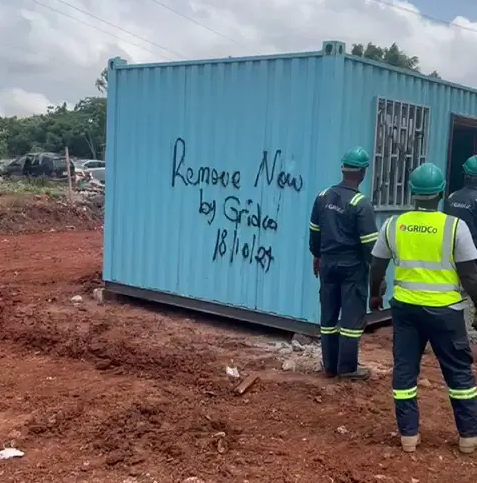
A group of Chinese nationals has been caught excavating land beneath high-voltage power lines owned by the Ghana Grid Company (GRIDCo) at Shiashie, prompting GRIDCo to order an immediate halt to the illegal project.
The excavation took place on GRIDCo-owned land, which is strictly regulated against any form of construction.
Although GRIDCo’s intervention initially stopped the excavation, the group resumed work a week later, this time with protection from Ayawaso West Municipal Assembly guards. In response, GRIDCo’s task force returned to the site, detained the workers, and dismantled an office container that had been set up as their base of operations.
The Chinese nationals insisted they had permission from Ayawaso West Municipal Chief Executive, Clement Wilkinson, to proceed with the project—a claim Mr. Wilkinson has denied.
GRIDCo has since ordered the workers to immediately backfill the trenches and leave the premises.
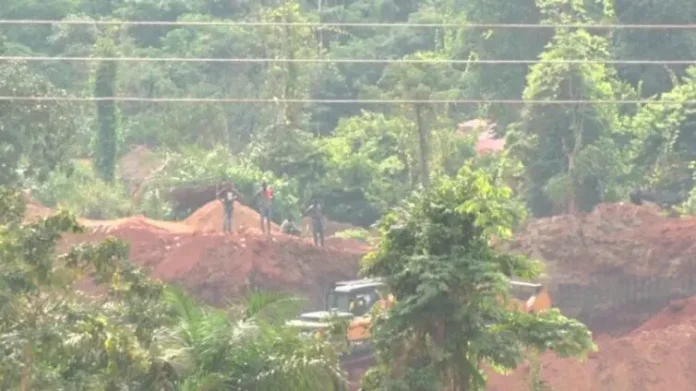
Illegal mining, commonly referred to as galamsey, is increasingly threatening the power supply in parts of the Ashanti and Eastern Regions, particularly in Konongo.
Illegal miners have encroached upon the concession of Northern Ashanti Mines, where crucial GRIDCo substation pylons are located, putting vital infrastructure at risk.
The encroachment poses a direct danger to the GRIDCo substation within the operational area of Northern Ashanti Mines.
Several poles supporting the power grid have been compromised, raising alarms about potential power outages that could disrupt Konongo Township and surrounding communities.
Despite ongoing efforts by the mine’s security task force, illegal mining activities continue unabated.
The mining company has expressed frustration over its failed attempts to engage local security agencies, such as the Municipal Security Council (MUSEC) and the Ashanti Regional Security Council (REGSEC), to help address the situation.
The threat intensified recently when armed individuals attacked the company’s security task force, resulting in injuries and damage to property.
This violent encounter underscores the significant challenges the company faces in protecting its operations and the region’s power infrastructure.
With intelligence suggesting that illegal miners are planning another attack on the mine on Thursday, October 10, the company is anxious about a potential confrontation between its security personnel and the galamseyers.
This ongoing situation continues to jeopardise both mining operations and the stability of the power supply in the affected regions.
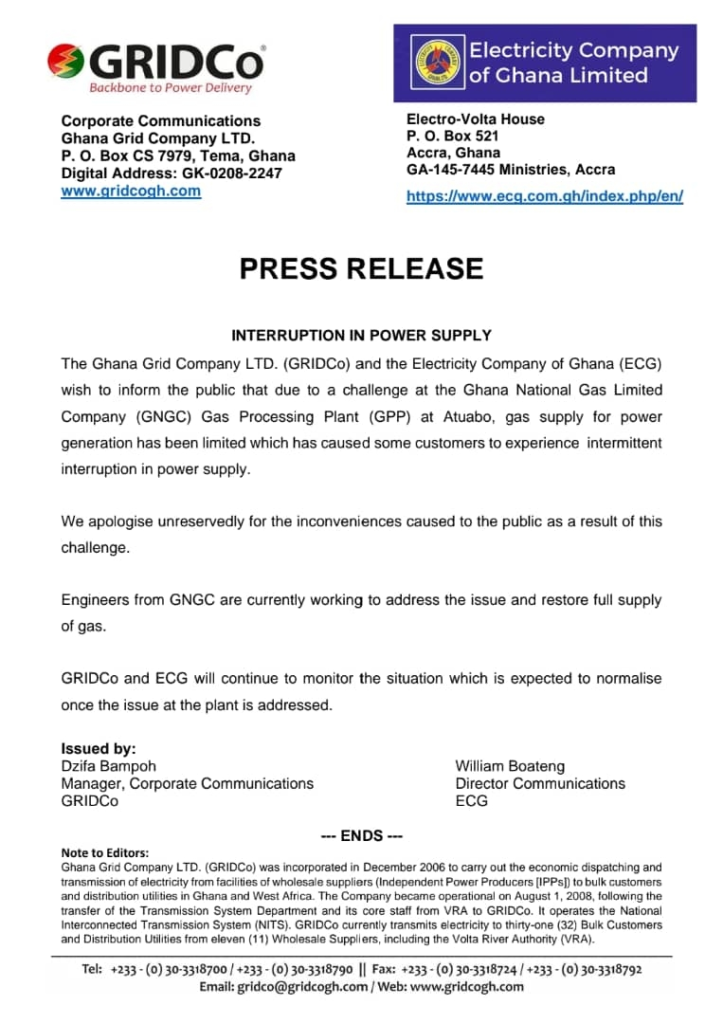
The Ghana Grid Company Ltd. (GRIDCo) and the Electricity Company of Ghana (ECG) have attributed the recent power outages experienced by some customers to a challenge at the Ghana National Gas Company (GNGC) Gas Processing Plant (GPP) located in Atuabo.
A pipeline runs from the gas processing plant near Atuabo to the Takoradi Thermal Power Station, in Aboadze, in Western Region. The Takoradi Thermal Power Station which started operation in 1997 was initiated by the Volta River Authority to complement the existing Hydro Plant at Akosombo and Kpong.
In a joint press release, both companies informed the public that the challenge has limited the gas supply for power generation, causing intermittent power supply to certain areas.
Engineers from GNGC are actively working to address the technical difficulties at the processing plant and are making efforts to restore the full supply of gas as soon as possible.
This week, several parts of the Greater Accra Region such as Dome, and Adenta have recorded intermittent power outages that lasted for several hours.
GRIDCo and ECG have extended an apology for the inconvenience this disruption has caused, emphasizing their commitment to resolving the issue.
The public is encouraged to remain patient as work continues to restore uninterrupted electricity supply.
In a related event, the Minority in Parliament has raised concerns over a reported load shedding, being downplayed by GRIDCo due to dubious contracts signed by the government through the Ghana Gas Company.
Ranking Member on the Energy Committee of Parliament, John Jinapor, alleges that there is pressure on the Ghana Gas Company from the Presidency to sign an $800 million contract with the Phoenix Park Gas Processors Consortium under questionable circumstances, without parliamentary approval.
The Minority caucus reveals that a power deficit of over 500 megawatts was recorded on Tuesday, September 24, negatively impacting customers.
Executive Director of the African Centre for Energy Policy, Ben Boakye, has urged the government to consider privatizing fuel purchases to alleviate financial strain during power crises.
He emphasized that the government’s exclusive role in purchasing fuel burdens the state with constant financial injections during energy shortages.
Speaking on Joy FM’s Top Story on June 14, Boakye advocated for a shift in approach “I think our position is that Government should just go off. Government is not the one who is supposed to ensure that there is fuel supply. This is a commercial enterprise. Let’s see power as a business and let people who have money to do the business come and do it,” he said.
The call for privatization comes amidst an announcement on June 13 by Ghana Grid Company Limited (GRIDCo) and Electricity Company of Ghana (ECG) of a potential three-week load management plan.
This plan, as clarified in a joint statement, is necessitated by maintenance work by a Nigerian gas supplier, reducing Ghana’s power generation capacity since June 12.
Boakye stressed that the government should focus on regulatory roles in the power sector rather than direct involvement in fuel procurement and distribution
“Due to maintenance works being undertaken by a gas supplier in Nigeria and is projected to last three (3) weeks.”The maintenance has caused a reduction in overall power generation capacity in Ghana which could result in load management over the period of the work,” the joint release indicated.
In summary, Boakye urged a restructuring where private capital takes the lead in fuel purchases for the power sector while government focuses on its regulatory role and broader socio-economic concerns.
“When we keep doing the politics with it and always looking to government to go and buy fuel in 21st century to come and produce electricity and distribute to the people that is why we have this challenges.
“So we abuse the system, create the inefficiencies and we are always looking to government when government should be doing other things. Looking at the other socio-economic welfare of the people and allowing the business side of things where private capital is interested to actually manage… we can’t keep looking to government to provide money for the power sector at the expense of any other socio-economic intervention we do have,” he said.
A statement from the two entities said, “The West Africa Gas Pipeline Company (WAPCo) has explained in a statement that the reduction in gas supply is due to maintenance works being undertaken by a gas supplier in Nigeria and is projected to last three weeks.”
“The maintenance has caused a reduction in the overall power generation capacity in Ghana, which could result in load management over the period of the work,” the statement further added.
See the statement by GRIDCo and ECG:
The Ghana Grid Company Ltd. (GRIDCo) and the Electricity Company of Ghana (ECG) wish to inform the public that, due to a reduction in gas supply from Nigeria since yesterday, June 12, 2024, some areas across the country have experienced interruptions in power supply.
The West Africa Gas Pipeline Company (WAPCo), in a statement, has explained that the reduction in gas supply was due to maintenance works being undertaken by a gas supplier in Nigeria and is projected to last three (3) weeks.
The maintenance has caused a reduction in overall power generation capacity in Ghana, which could result in load management over the period of the work.
GRIDCo and ECG, however, wish to assure the public that we are collaborating with other stakeholders in the power value chain to optimise available resources to ensure a minimal impact of the reduction in gas supply on consumers.
GRIDCo and ECG sincerely apologise for the inconvenience caused.
The Ghana Grid Company (GRIDCo) and National Security are collaborating to remove all unauthorized occupants living under high-tension power lines across Ghana.
This move follows financial strains caused by repairs at Kwame Nkrumah Circle after a recent fire outbreak.
Despite existing laws to protect these areas from encroachment, enforcement has been challenging. GRIDCo’s Head of Corporate Affairs, Dzifa Bampoh, explained on Joy FM’s midday news that the nationwide exercise aims to clear all unauthorized individuals near the high-tension lines, ensuring the safety and integrity of the power infrastructure.
She added that “in fact nobody should be living under a transmission line, so this is not just about this ECOMOG area; there are slum communities at Fiesta Royale; there’s Adjiringanor, Ashiaman. I mean, it’s not just even in Accra; we have Kumasi; we have the Western Region.
“We have a lot of galamsey activities that impact even the structure of these towers and because we do have legislation that backs it, it makes it an offense for anyone, persons, or institutions to be on these lines.”
Mrs. Bampoh also noted the Greater Accra Regional Minister’s commitment to preventing unauthorized human settlements near GRIDCo facilities, which is reassuring.
Despite GRIDCo’s efforts to enforce these regulations, Mrs. Bampoh highlighted that the company has faced resistance from various quarters, making it challenging to fully implement the necessary measures.
“But it does not end with this settlement. GRIDCo needs significant support to execute a campaign that clears people from under the transmission lines”.
Mrs Bampoh explained that ‘right-of-way’ challenges are among the most difficult aspects of GRIDCo’s operations, given the company’s responsibility for some 6,700 kilometres of transmission lines across the country.
“These are very high kilovolts of transmission lines that, God forbid, if were to touch anyone, that person will turn to ashes.
“So, we will continue to do what we can,” she noted.
The Electricity Company of Ghana‘s (ECG) Ashanti sub-transmission division has entered a collaborative agreement with the Ghana Grid Company (GRIDCo) to enhance supply capacity and meet the rising electricity demand in the region.
This partnership was formalized during a meeting held at GRIDCo’s headquarters in Anwomaso.
According to the agreement reached during the meeting, there are plans to install a 145MVA power transformer between GRIDCo and ECG Bulk Supply Points.
This upgrade aims to replace one of the existing three 50MVA transformers, thereby increasing installed capacity to address growing load demands, particularly during peak hours, typically between 7 pm and 11 pm.
Previously, the 50MVA transformers at the Anwomaso Bulk Supply Point sometimes operated at maximum capacity during peak periods due to increased demand.
However, with the planned installation of the 145MVA transformer, the total installed capacity will rise to 245MVA, compared to the current 150MVA provided by three 50MVA transformers.
Both parties anticipate that this initiative will improve supply capacity and reliability across the region.
Additionally, discussions during the meeting also focused on upgrading the Obuasi and Konongo Substations with 50/66 MVA transformers to meet growing industrial needs in those areas and enhance supply reliability.
Further discussions included plans to dispatch another 145MVA transformer to Ridge BSP shortly to increase supply capacity for the station and the broader region.
Following these discussions, a site visit was conducted to assess suitable installation locations for the new transformer.
Ing. Peter Kofi Fletcher, General Manager for Ashanti Sub-transmission, and his team collaborated closely with the GRIDCo team to identify optimal sites, aiming to minimize material costs associated with cable laying and civil works.
Currently, the region is served by two Bulk Supply Points, Anwomaso and Ridge, which distribute high-voltage power to primary substations, subsequently serving local transformers to meet consumer needs.
Asantehene Otumfuo Osei Tutu II has urged the Akufo-Addo government to address the economic realities by implementing policies that stimulate industrial growth, create jobs, and attract more investment.
In addition to prioritizing policies, the Asantehene suggested privatizing public enterprises like the Volta River Authority (VRA) and the Ghana Grid Company (GRIDCo) by involving the private sector.
He stressed that private sector involvement would bring in crucial financial investments and fresh ideas, competencies, and resources needed for the sustainability of these enterprises.
The Asantehene warned that without such reforms, both the government and the Ghanaian people would miss out on the benefits of these state-owned enterprises.
He made these remarks during the commissioning of a 430-kilometre natural gas pipeline by Genser Energy on Wednesday, April 17.
“It’s about time that the government realises that it’s not going to work for the government to be involved in setting up companies without involving the private sector. It doesn’t work. The government should confront policies and involve the private sector and you can attract more investors into the country which will create more employment.
“VRA and others are all government establishments, let’s give it out and diversify them into the private sector and get more money there and get the right people to do it. GRIDCo and others let’s give them the money and get the qualified people, diverse government from it and let them work. Electricity Company is in a situation where we don’t know, but that also must be diversified and given to the private sector.
“Why are we still holding on when we don’t have the money? We’re not able to collect all the taxes we want, we’re going to IMF and all those for money. We’re hanging onto industries we cannot maintain and run.
“It’s about time we face reality and decide on what government should be doing and what the private sector should be doing. This is a testimony of the private sector, and they were able to attract investors,” he said.
The government views the inauguration of the pipeline as a significant advancement in strengthening the nation’s power sector, increasing its capacity, and improving its reliability.
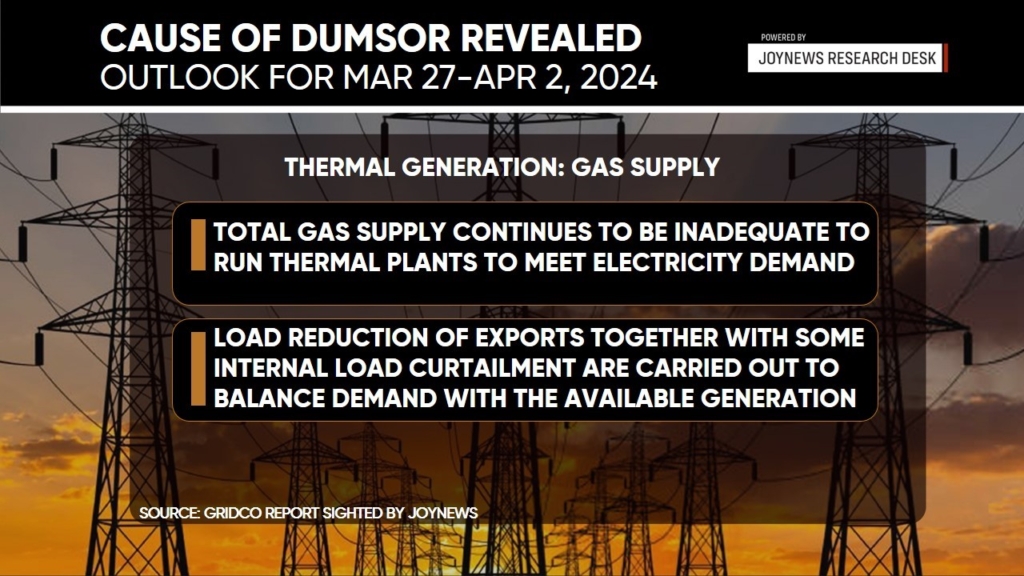
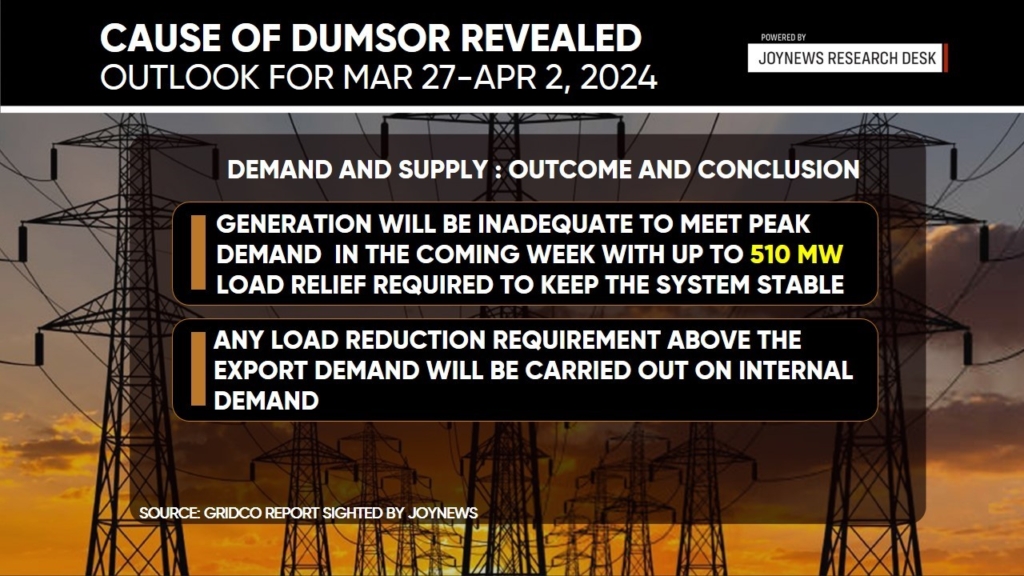
The following analysis by GRIDCo delves into Ghana’s power supply situation spanning from March 27 to April 2, 2024, shedding light on the factors contributing to the recurrence of dumsor or load management.
Since the onset of March 2024, GRIDCo has been diligently monitoring Ghana’s power generation crisis, acknowledging the hurdles in meeting the nation’s electricity demands. The decision to curtail power exports as of March 27 underscores the severity of the situation, signaling an urgent need for proactive measures and strategic planning.
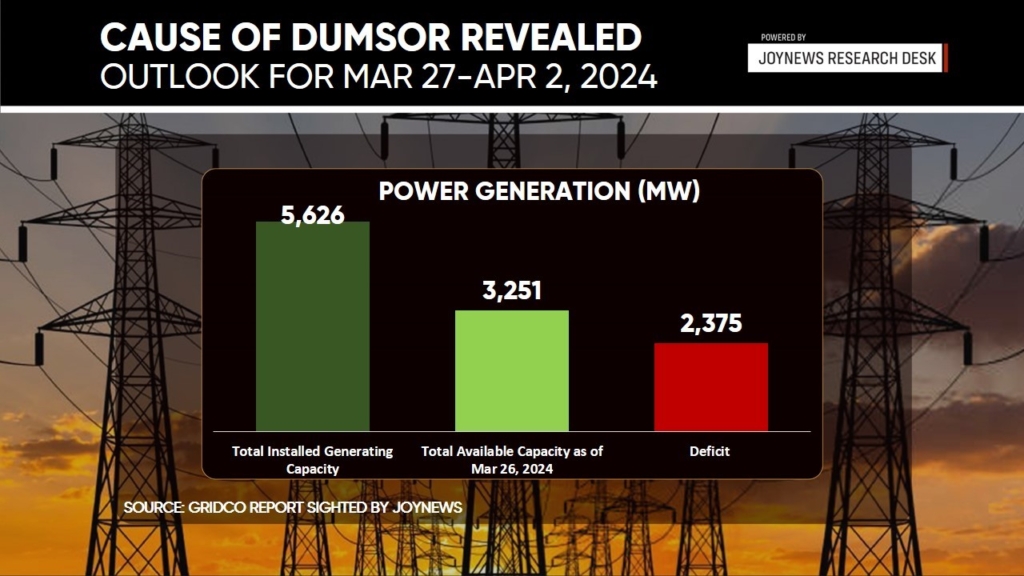
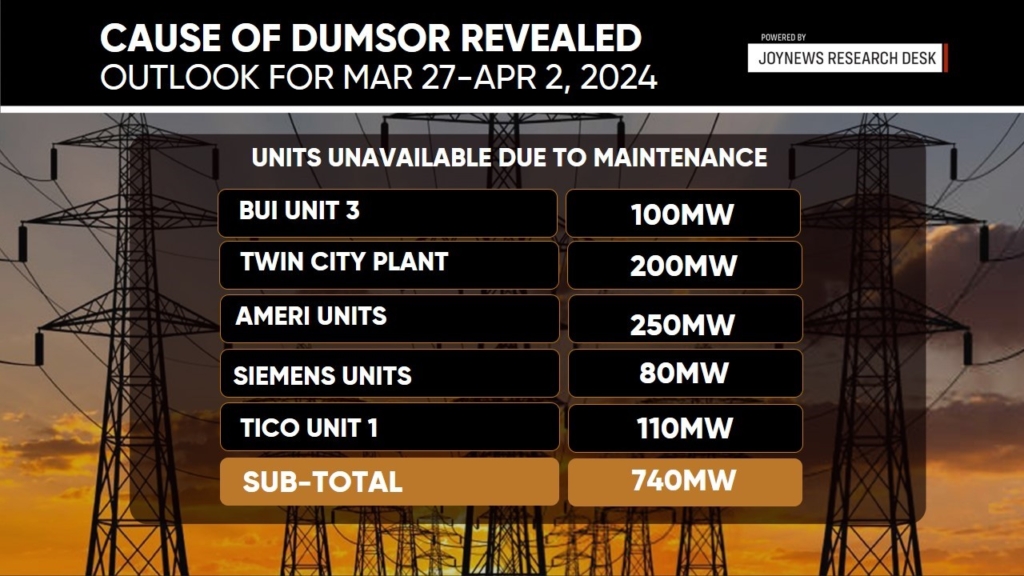
Ghana’s peak electricity demand has surged to 3,618 MW, surpassing the available capacity of 3,251 MW by a significant margin. Despite having an installed capacity of 5,626 MW, the country is utilizing only around 58% of its total capacity, resulting in a substantial deficit of 2,375 MW. This deficit is further compounded by a 740 MW shortfall attributed to ongoing maintenance activities, placing additional strain on the electricity supply infrastructure.
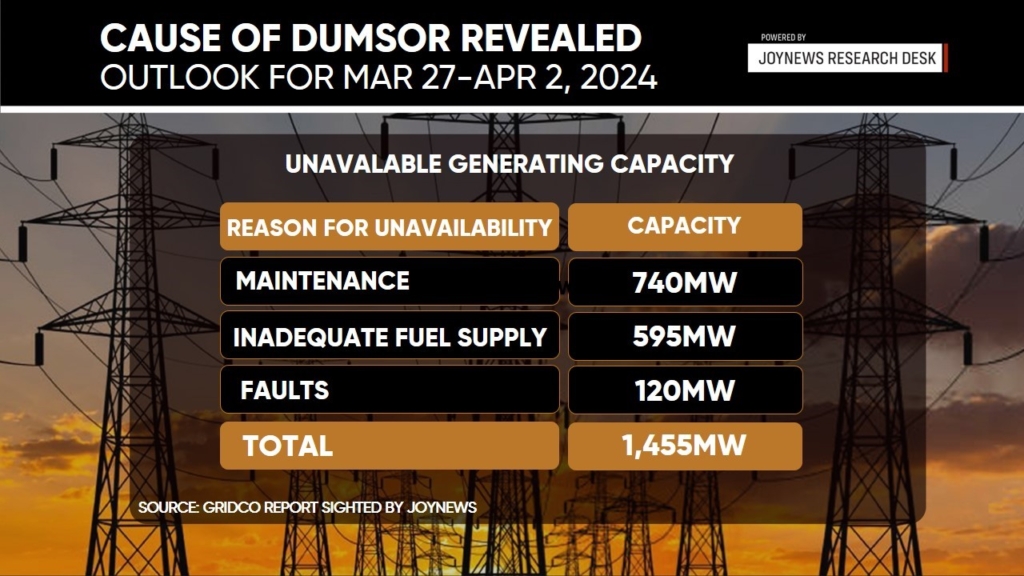
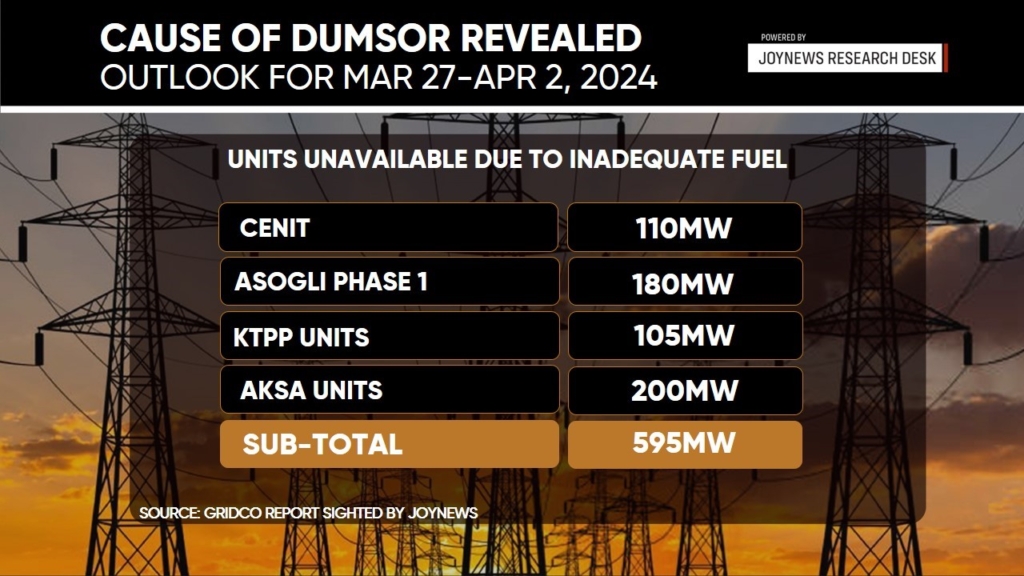
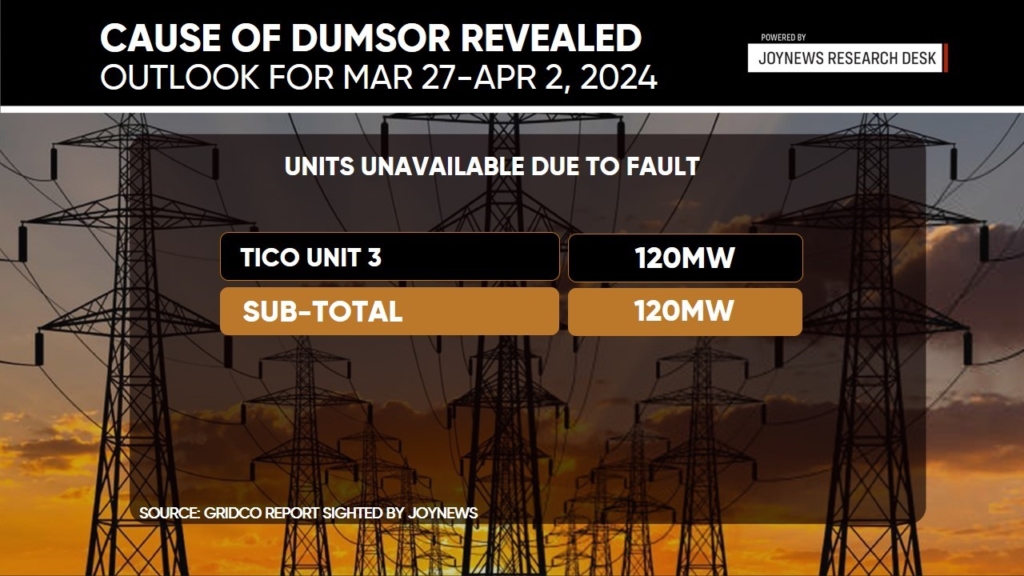
Amidst the maintenance-related challenges, uncertainties loom over the restoration timelines for 330 MW of capacity, adding complexity to the grid’s stability. Moreover, the absence of 4 thermal plants, collectively capable of generating 595 MW, due to inadequate fuel supply exacerbates the situation. Additionally, a fault in the TICO unit 3 plant has rendered 120 MW unavailable until December 2024, impacting the entire year’s power generation by that capacity.
As a result, Ghana grapples with a significant 1,455 MW shortfall in electricity generation capability, with limitations in gas supply further exacerbating the challenge. Despite efforts to reduce power exports by 40% during peak hours to prioritize local demand, the gap persists.
The hydroelectric landscape presents a mixed picture, with the Akosombo dam maintaining stable electricity generation owing to its sufficient water levels. However, declining water levels at the Bui dam raise concerns. If this downward trend persists, the Bui dam’s ability to generate power could be compromised, necessitating its restricted usage to peak hours only.
GRIDCo‘s recent analysis spanning March 27 to April 2, 2024, sheds light on Ghana‘s persistent power supply challenges, leading to the implementation of dumsor or load management.
The findings underscore a critical need for strategic interventions and immediate action to address the country’s escalating electricity deficit.
Monitoring Ghana’s power generation crisis since March 2024, GRIDCo acknowledges the stark reality of surpassing electricity demand against limited supply capabilities.
The decision to curtail power exports underscores the severity of the situation, necessitating urgent attention and long-term planning.
Ghana’s peak electricity demand has surged to 3,618 MW, surpassing the available capacity of 3,251 MW by a significant margin.
With an installed capacity of 5,626 MW, the nation utilises only 58% of its total capacity, resulting in a substantial deficit of 2,375 MW.
Furthermore, ongoing maintenance activities contribute to a 740 MW shortfall, further straining the power supply infrastructure.
Maintenance-related challenges, including uncertain restoration timelines for 330 MW, add complexity to stabilising the grid.
Additionally, 4 thermal plants capable of generating 595 MW are offline due to fuel supply issues, while a fault in the TICO unit 3 plant removes 120 MW until December 2024, impacting the year’s power generation by that capacity.
Consequently, Ghana faces a significant 1,455 MW deficit in electricity generation, worsened by gas supply limitations.
Despite efforts to reduce power exports by 40% during peak hours to prioritise local demand, the gap remains unbridged.
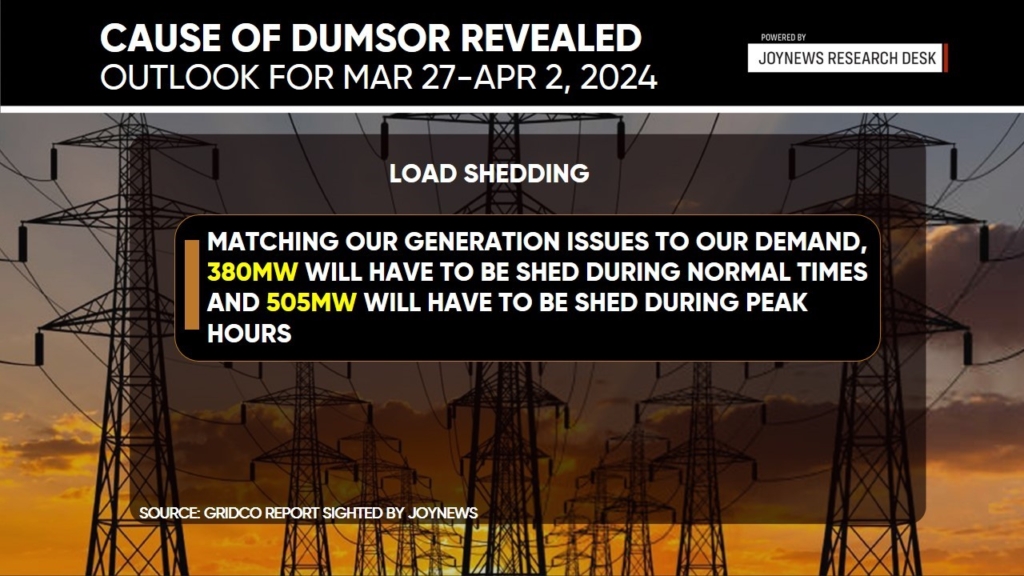
While the Akosombo dam maintains stable electricity generation due to ample water levels, concerns arise over declining levels at the Bui dam, risking its ability to generate power. Should this trend persist, the Bui dam may be restricted to peak-hour usage only. To balance generation capabilities with demand, Ghana implements power shedding measures, shedding 380 MW during normal times and an additional 505 MW during peak hours daily.
The primary challenge remains the inadequate gas supply, although utilizing idle thermal plants can partially offset peak-time shortfalls caused by fuel shortages or equipment faults.
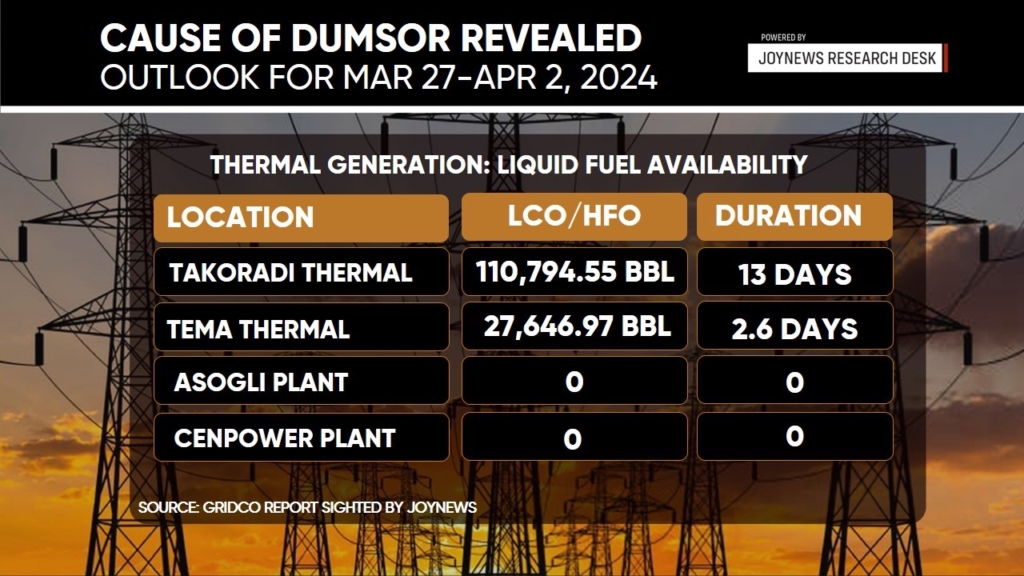
Find summary of all the relevant data in the graphic below:
The Institute for Energy Security (IES) has called on the Ghana Grid Company Limited (GRIDCo) to be transparent in communicating the current status of the power sector.
They are also urging GRIDCo to provide the Electricity Company of Ghana (ECG) with a clear estimate of the power supply that can be guaranteed within a specific period.
“Such an information is vital for the ECG to plan its load response with a timetable,” the IES added in a statement signed and issued by its Executive Director, Nana Amoasi VII on April 1.
The IES emphasized that ECG should concentrate on managing its load based on the power supply from GRIDCo and efficiently collecting revenue to ensure full cost recovery.
“The Public Utility and Regulatory Commission (PURC) must look beyond the ECG to audit the upstream segment of the power sub-sector, particularly the GRIDCo, and export sales by the Volta River Authority (VRA),” it added.
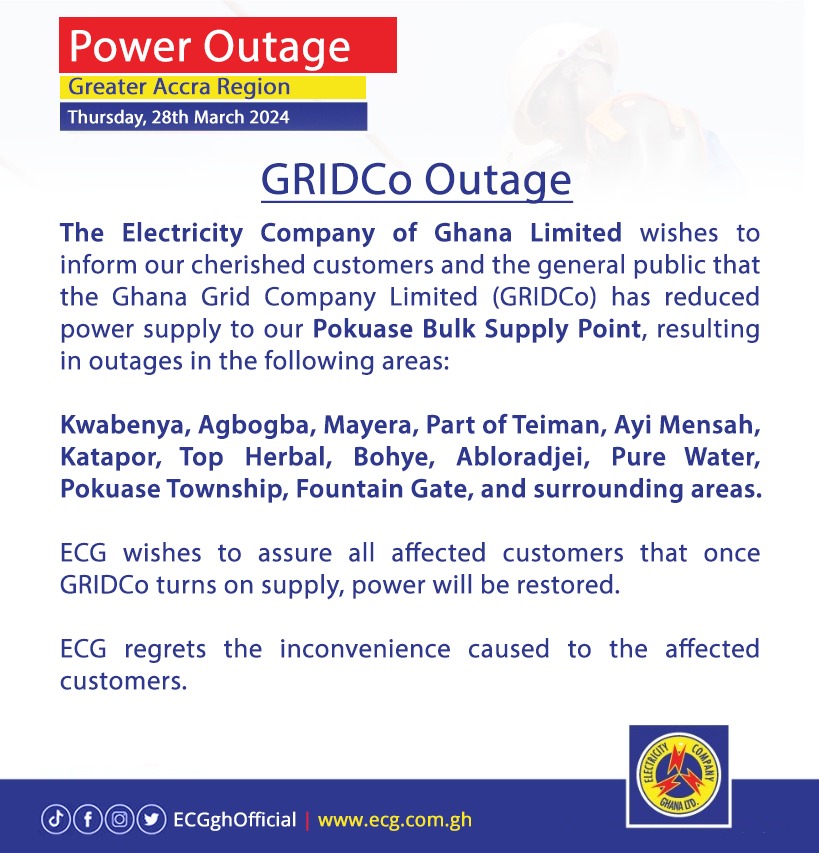
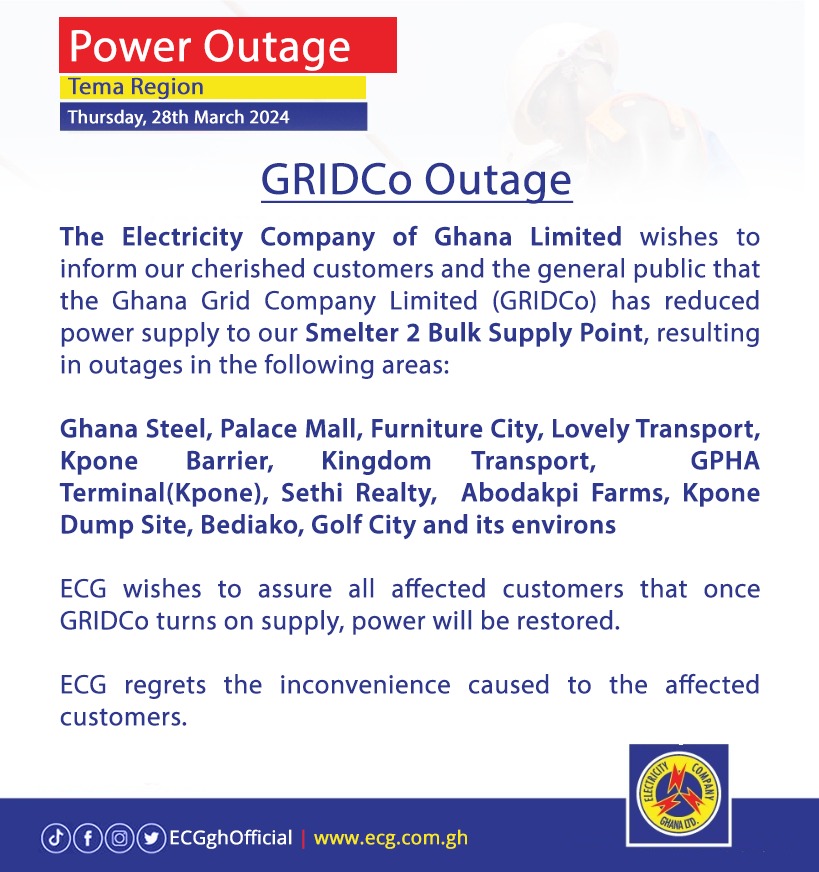
Certain areas in Accra are anticipated to experience power supply disruptions.
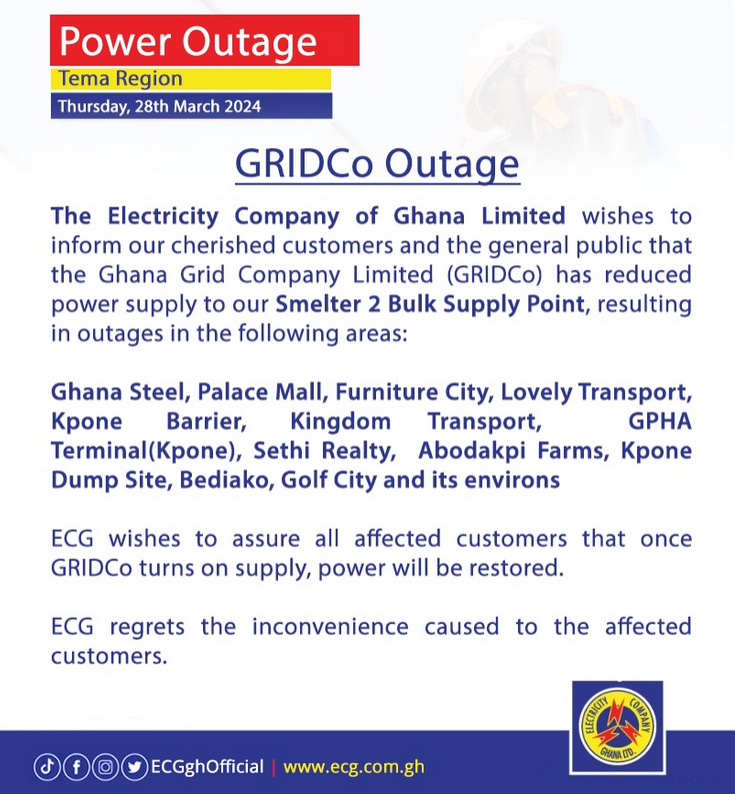
The Electricity Company of Ghana (ECG) has reported that the Ghana Grid Company Limited (GRIDCo) has decreased power distribution at select supply points within the Greater Accra Region.
The impacted stations are the Pokuase Bulk Supply Point and the Smelter 2 Bulk Supply Point.
The Electricity Company of Ghana (ECG) has announced power outages affecting over 25 areas communities in the Accra East and West regions.
Among the affected areas are Ghana Steel, Palace Mall, Furniture Citi, Lovely Transport, Kpone Barrier, Kingdom Transport, GPHA Terminal (Kpone), Sethi Realty, Abodakpi Farms, and Kpone Dump Site.
Additionally, areas such as Bediako, Golf City, and surrounding regions, including Kwabenya, Agbogba, Maryera, part of Teiman, Ayi Mensah, Katapor, Top Herbal, Bohye, Abloradjei, Pure Water, Pokuase Township, Fountain Gate, are experiencing power disruptions.
In a statement issued on Thursday, ECG apologized to its customers in both regions, attributing the outages to a shortfall in power supply by the Ghana Grid Company Limited (GRIDCo) to their Pokuase Bulk Supply Point and the Smelter 2 Bulk Supply Point.
The timeline for restoring power to these areas remains unclear, causing dissatisfaction among many ECG customers who seek a timetable for planning.
The absence of a clear timetable has sparked anger among Ghanaians, especially after Minister for Energy, Dr. Mathew Opoku Prempeh, stated that there’s no ‘dumsor’ (power outages) and hence no need for a timetable.
Despite the worsening situation, neither GRIDCo nor ECG has provided explanations to the public, a move criticized by many stakeholders.
According to a compilation by Citi News, the number of affected areas or communities in the past week in these two regions exceeds a hundred.
The Ashanti Regional Minister, Simon Osei Mensah, is contemplating leading demonstrations against the Electricity Company of Ghana (ECG) and Ghana Grid Company (GRIDCo) due to the ongoing erratic power supply in the region.
Osei Mensah expressed frustration over the recurring power outages without clear explanations and revealed his intention to meet the Ministry of Energy for answers.
In an interview with Angel FM, he warned that if the responses are unsatisfactory, he will organize demonstrations against the two companies, emphasizing his commitment to ensuring the people of his region have consistent electricity.
“The word of caution I’m sounding to the ECG and GRIDCO is that if I don’t get a satisfactory explanation after listening to the Ministry of Energy with their response, I’ll demonstrate against them,” he threatened.
“I’m saying this, and everybody should put on record, I’ll be the first government appointee, the first regional minister to lead a demonstration in this region if they are not able to give a reasonable explanation”, Osei Mensah told Kwame Tanko in his interview.
“I’ll lead a demonstration in the region, and when the time comes, nobody should come and stop me,” he added.
Despite being a part of the government, Mr Osei Mensah emphasized his readiness to lead protests if the power supply issue persists in the Ashanti Region while other regions remain unaffected.
The threat comes amid concerns over frequent power outages in Greater Kumasi, sparking discussions about the return of “dumsor.”
Residents have called for a timetable from ECG. If the minister proceeds with the demonstrations, he would become the first government appointee to lead a protest against his own administration.
Ashanti Regional Minister Simon Osei Mensah has issued a stern warning, threatening to organize a demonstration in his region against the Electricity Company of Ghana (ECG) and Ghana Grid Company (GRIDCo) due to the ongoing erratic power outages.
Mr. Osei Mensah expressed frustration over the lack of explanations from both ECG and GRIDCo regarding the cause of the outages. He emphasized that he has not received any satisfactory explanation despite efforts to engage with the Ministry of Energy on the matter.
Speaking on Angel FM in Kumasi, the Regional Minister indicated his readiness to lead the demonstration if necessary, making him potentially the first minister in the country to protest against his own government.
“The word of caution I’m sounding to the ECG and GRIDCO is that, if I don’t get a satisfactory explanation after listening to the Ministry of Energy with the response I’ll demonstrate against them,” he threatened.
Despite being a member of the current NPP government, the Minister expressed his strong disapproval of the situation and vowed not to allow ECG and GRIDCo to deprive the people of his region of electricity, especially when other regions are not facing similar challenges.
“I’m saying this and everybody should put on record, I’ll be the first government appointee, the first Regional Minister to lead a demonstration in this region if they are not able to give a reasonable explanation”, Mr Simon Osei Mensah told Kwame Tanko in his interview.
“I’ll lead a demonstration in the region and that time nobody should come and stop me”, he added.
Staff of the Ghana Grid Company, GRIDCo are threatening the return of incessant power cuts, popularly known as dumsor, which plagued the country some years back.
This is due to the failure of the government to settle some arrears of industry players.
In a statement registering their displeasure over the situation, the aggrieved staff noted that there will be a return of ‘dumsor’ this Christmas if the financial status of the company is not improved with immediate effect.
“The main cause of the poor cash flow situation is because the Cash Waterfall Mechanism which is used as the mode of payment to the industry players within the sector is not working and is suspected to have been discontinued,” they stated.
In the statement issued by the Senior Staff Association’s National Chairman and addressed to the Minister of Energy, the Board Chairman, and the Chief Executive of GRIDCo, the staff are pointing accusing fingers at ECG for their refusal to pay, in full, for the services rendered to them by the company.
They explain that GRIDCo bills ECG – their major customer – over GH₵100 million per month, out of which only about 18% to 25% is paid, and in an irregular manner.
“The chunk of the revenue sits in our books without any plans to redeem same. This situation has made it difficult to pay suppliers, procure the requisite tools, materials and spares, all of which adversely affect the business,” they wrote.
According to the staff of GRIDCo, the ongoing challenges in the cash flow of the company have implications not only on their operations but also on the service delivery to customers and the general welfare of staff.
They are threatening a possible return to the days of intermittent power outages that characterised the country some years back.
“We the staff groups wish to caution that if the Cash Waterfall Mechanism is not restored immediately or other means of financial support provided for GRIDCo, we cannot guarantee smooth power supply, especially during this festive season and going forward.”
The Ghana Grid Company (GRIDCo) has successfully restored power to customers who were affected by recent outages.
This restoration comes as a result of the resumption of gas supply from Takoradi to the generating plants in Tema.
Earlier this week, certain regions of the country faced power interruptions due to gas shortages.
In a joint statement issued by GRIDCo and the Electricity Company of Ghana, the public was encouraged to report any remaining power outages for prompt resolution.
Below is the joint statement.
FOR IMMEDIATE RELEASE
RESTORATION OF GAS SUPPLY
Accra, October 28, 2023 — The Ghana Grid Company LTD. (GRIDCo) and ECG wish to inform the public that power supply has been restored to all affected customers, following the resumption of gas supply from Takoradi for use by generating plants in Tema.
The improved gas supply has enabled power restoration to all loads across the country.
Customers currently experiencing any outage should report to the ECG Call Centre on 0302-611 611 or the Customer Service Office for the fault to be rectified, since this is likely to be a local fault.
GRIDCo and ECG regret the inconvenience caused by the recent load management exercise and thank the public for their patience.
A significant power outage has affected various regions of the country since approximately 6 pm on October 26, 2023.
The Ghana Grid Company Ltd (GRIDCo) has attributed this outage to challenges arising from a restricted gas supply in Tema.
In their statement issued on Thursday, October 26, GRIDCo expressed that the constrained gas supply situation is expected to result in “a supply deficit of 550MW during peak hours.”
“This will affect power supply to consumers in some parts of the country. The inconvenience caused is deeply regretted,” the statement added.
Read the full statement from GRIDCo below
POWER SUPPLY CHALLENGE
The Ghana Grid Company Ltd, (GRIDCo), the “Operator” of the National Interconnected Transmission System (NITS) informs the general public that due to limited gas supply to Tema, there will be a supply gap of 550MW at peak time.
This will affect power supply to consumers in some parts of the country.
The inconvenience caused is deeply regretted.
ISSUED BY: Corporate Communications Section Ghana Grid Company LTD. (GRIDCo)
Ghana Grid Company Limited (GRIDCo) saw a significant decline in its pre-tax profit, dropping by 99.5% to reach ¢1.296 million at the close of 2021.
This marked a noteworthy deterioration in the company’s fundamental business performance, given that it had achieved a profit of ¢270.704 million in the preceding year, 2020.
The 2022 Auditor General Report disclosed that the company’s Total Comprehensive Income also experienced a decline of 35.1%, amounting to ¢197 million compared to the ¢304.113 million recorded in 2020.
This decline was primarily attributed to the revaluation of GRIDCo’s property, plant, and equipment, a process conducted in 2021.
The revaluation exercise led to a corresponding tax liability of ¢111.331 million in 2021, in contrast to the ¢17,725 million in 2020.
Income tax expenses increased to ¢142.625 million in 2021, up from ¢88.425 million in the previous year.
However, there was a marginal rise of 8.3% or ¢100.258 million in Total Income, reaching ¢1.314 billion from ¢1.213 billion in 2020.
This increase was largely attributed to an 8.8% growth in revenue from transmission services throughout the year.
Conversely, GRIDCo’s total expenditure surged by 39.2% to ¢1.312 billion from ¢943.268 million recorded in 2020.
The increase stemmed mainly from higher impairment losses on trade receivables by ¢334.790 million and an increase in Direct costs by ¢67.828 million compared to the previous year.
In terms of the balance sheet, Current Assets witnessed a 9.8% increase, rising by ¢153.065 million to ¢1.718 billion from ¢1.565 billion in 2020, primarily due to the growth in cash and cash equivalents by ¢237.857 million.
Conversely, Non-Current Liabilities experienced a decrease of 5.7%, amounting to ¢119.525 million, with the year ending at ¢1.991 billion from ¢2.111 billion in 2020. This reduction was attributed to a decrease in Loans and borrowings.
However, Current Liabilities surged by 24.6%, translating to ¢484.928 million, reaching ¢2.452 billion compared to ¢1.967 billion in 2020.
This increase was mainly influenced by rises in current tax liabilities, loans and borrowings, and trade and other payables by 74.1%, 57.4%, and 14.5% respectively.
Moreover, the current ratio for the end of the 2021 fiscal year stood at 0.7:1, contrasting with 0.8:1 in 2020.
This implies that the company may face challenges in meeting its short-term financial obligations.
Ghana Grid Company (GRIDCo), the institution responsible for managing the National Interconnected Transmission System, has announced a shortage in thermal power generation.
This deficit is primarily attributed to the restricted availability of gas supply originating from both the Atuabo Gas Processing Plant (GPP) and the West African Gas Pipeline (WAPCo).
In a statement issued on Friday, July 7, GRIDCo said “This has created a supply gap of 650 Megawatts of power at peak time which will affect consumers in some parts of the country.”
GRIDCo has however assured that “Every effort is being made to restore gas supply from Atuabo.”
“As the situation improves, power will be restored to affected customers” the statement added.
In a recent statement released on Friday, July 7, the Electricity Company of Ghana (ECG), the power distributor, extended its apologies to customers who are currently facing power outages due to the prevailing circumstances.
It further explained that as a result of the gas situation at Atuabo and WAPCo, all Asogli phase-One units, Cenpower, and Aksa Power Plants have shutdown, leading to a generation shortfall.
It says the Ghana National Gas Company has assured that it will resolve the issue as soon as possible.
“Meanwhile, ECG expects power supply to be fully restored by 9:00pm today, Friday, 7th July, 2023” the statement added.
Ghana Grid Company Limited (GRIDCo) has apologized to Ghanaians who were affected by the recent power outage.
Recently, some parts of the country especially Accra experienced power cuts.
Head of Corporate Communications at GRIDCo,Dzifa Bampoh said the situation was a result of a generational challenge that is out of the control of GRIDCo
Speaking on News 360 on TV3 Wednesday, May 10, Dzifa Bampoh said “Sincerely, we apologize for the erratic power supply that many Ghanaians may have suffered for the last couple of days.”
She added “GRIDCo is a transmitter and we are not a generator however, we do have a view of what the generation is like, that is the generation coming from our power plants whether they are hydro or they are thermal or they are solar.
“Unfortunately, there has been a shortfall in generation capacity, meaning we have not been able to generate as much power as Ghanaians demand.
“That is out of the control of GRIDCo and it is partly because we don’t have enough gas coming in to power some of these plants. That is why we had some intermittent power supply, so there is no load-shedding.
“What has happened is, on some occasions, gas supply has been low and as a result, we have had to reduce supply to ECG.”
Two mechanized boreholes have been donated to theNavrongo Senior High School (NAVASCO) in the Kassena-Nankana Municipality of the Upper East Region by the Ghana Grid Company Limited (GRIDCo), Operator of the National Transmission supply, to improve the school’s water supply.
This came as a relief to staff and students in the school from their daily struggle for potable water.
The construction of the facilities which was started late 2022 under the GRIDCo’s Education Support Initiative and valued at GH₵100,000.00 have reservoir tanks with taps connected to the dormitories of the students and other major areas.
At a handing over ceremony at Navrongo, Ms. Dzifa Bampoh, Manager, Corporate Communications, GRIDCo, said the support was part of one of the core values of the company in supporting stakeholders in its operational areas.
“It is also in line with GRIDCo’s Sustainable Corporate Social Responsibility and the United Nations Sustainable Development Goals particularly goal six, to ensure the availability and sustainable management of water and sanitation for all,” she said.
Ms. Bampoh said access to water was critical in fighting critical infections and diseases, especially as the country was recovering from COVID-19, which puts emphasis on the need to practice good hygiene and washing protocols.
She said due to increasing challenges of climate change, water was becoming scarce especially in Northern Ghana and advised the management and students at the school to ensure maintenance of the facilities.
Ms. Mercy Babachuweh, the Headmistress of the school, expressed gratitude to GRIDCo for the intervention and said the support came at the right time.
She said before the intervention, the school had only two mechanised boreholes and four manual ones which were serving 2,034 students and 78 staff staying on campus, adding that this situation was putting lots of pressure on the boreholes leading to constant breakdown and increasing financial loss to the school.
She said this also affects contact hours as many students have to move out of the campus in search of water.
“And so, the provision of these two mechanised boreholes to the school is very timely. They are serving six dormitory blocks, that is, one borehole to three dormitory blocks. Students now spend less time searching for water. This will ultimately result in more contact hours for teaching and learning, hence, academic excellence, good personal hygiene and a disciplined student body,” she said.
The Headmistress, however, appealed for more support to renovate and expand the school’s dining hall which has limited space and is in a dilapidated state with the roof leaking anytime it rains. GRIDCo mechanised boreholes Navrongo SHS
Ms. Alice Ellen Abeere-Inga, the Kassena-Nankana Municipal Director of the Ghana Education Service, expressed optimism that the facilities would improve sanitation practices especially good hygiene among girls during their menstrual periods and advised the management and students to ensure that the facilities last to serve the purpose for which they were provided.
Mr Simon Anyoka Nyaaba, the Senior Prefect of the school said due to difficulty in getting water on campus, some students took advantage of the situation to move out of the school to engage in unproductive ventures.
He said the academic work would improve as a result of the support from GRIDCo and thanked them for the kind gesture.
In Saki, in the Nmlitsakpo Electoral area of the Kpone-Katamanso municipality of the Greater Accra Region, a middle-aged man who’s name is still unknown, was electrocuted after scaling the Gridco/VRA pylons.
The Ghana News Agency (GNA) on arriving at the scene, noticed some residents gathered at the place to catch a glimpse of what might have warranted such an incident.
The deceased is also unknown in the community making it difficult for the police to trace and find his identity or relatives.
The GNA observed that the victim rode on a bicycle to the place and committed the act.
Residents and passersby remained in shock trying to figure out what might trigger the man to end his life in such a manner.
A joint police team from the Tema Regional Command and the Tema Community 25 Unit of the Ghana Police Service conveyed the lifeless body to the hospital for autopsy and preservation.
Meanwhile, the Police have commenced an investigation and called on the public with any information to contact the Tema Regional Command, a police source told the GNA.
Fire prevention at GRIDCo’s Substations and Safety Training was the focus of discussions when a delegation from the company, led by its CEO Ebenezer Essienyi engaged the Chief Fire Officer and Management of the Ghana Fire Service (GNFS) on February 16.
The discussions with the GNFS reflected diverse ways to best protect the assets from fire.
One of GRIDCo’s core values is safety; for staff and the protection of its 68 substations and other assets nationwide.
The GNFS emphasised the need to undertake a risk assessment of GRIDCo’s facilities.
Based on the report, the GNFS will then advise on the best strategy to adopt to protect the substations from fire.
At the meeting, both entities agreed to sign a Memorandum of Understanding (MoU) to govern how the proposed collaboration, which includes safety training, will be executed.
Of critical mention is GRIDCo’s work with the Forestry Commission to create a green belt along GRIDCo’s Right of Way (or where the transmission lines are located) to protect them from encroachment and other risks.
The GNFS suggested the creation of a “brown belt” alongside the “green belt” to ensure it does not become a fire hazard for the assets (as branches and leaves scattered around the green belt can function as fuel for fire).
Ebenezer Kofi Essienyi thanked the Service for the audience and reception offered to him and his team. The entourage also included Bernard Gyan, Director-Technical Services; Samuel Kow Acquah, Manager of Strategy Risk and Compliance, and Kojo Kwarteng, Special Assistant to the Chief Executive.
Present at the meeting on behalf of the Service were ACFO II George Wiafe, Deputy Director, Fire Safety Education; David Sam Afful, Assistant Director of Investigations; Michael Ato Korsah, Deputy Director – of Fire Certification; Ernest Ampene of Investigation Directorate; Husbert Atobra Nyame-Boame of the Safety Directorate and Ackah Desmond, Deputy National Public Relations Officer.
Fire prevention at GRIDCo’s Substations and Safety Training was the focus of discussions when a delegation from the company, led by its CEO Ebenezer Essienyi engaged the Chief Fire Officer and Management of the Ghana Fire Service (GNFS) on February 16.
The discussions with the GNFS reflected diverse ways to best protect the assets from fire.
One of GRIDCo’s core values is safety; for staff and the protection of its 68 substations and other assets nationwide.
The GNFS emphasised the need to undertake a risk assessment of GRIDCo’s facilities.
Based on the report, the GNFS will then advise on the best strategy to adopt to protect the substations from fire.
At the meeting, both entities agreed to sign a Memorandum of Understanding (MoU) to govern how the proposed collaboration, which includes safety training, will be executed.
Of critical mention is GRIDCo’s work with the Forestry Commission to create a green belt along GRIDCo’s Right of Way (or where the transmission lines are located) to protect them from encroachment and other risks.
The GNFS suggested the creation of a “brown belt” alongside the “green belt” to ensure it does not become a fire hazard for the assets (as branches and leaves scattered around the green belt can function as fuel for fire).
Ebenezer Kofi Essienyi thanked the Service for the audience and reception offered to him and his team. The entourage also included Bernard Gyan, Director-Technical Services; Samuel Kow Acquah, Manager of Strategy Risk and Compliance, and Kojo Kwarteng, Special Assistant to the Chief Executive.
Present at the meeting on behalf of the Service were ACFO II George Wiafe, Deputy Director, Fire Safety Education; David Sam Afful, Assistant Director of Investigations; Michael Ato Korsah, Deputy Director – of Fire Certification; Ernest Ampene of Investigation Directorate; Husbert Atobra Nyame-Boame of the Safety Directorate and Ackah Desmond, Deputy National Public Relations Officer.
The Ghana Grid Company Limited (GRIDCO) has issued a warning that if its cash flow issues are not immediately resolved, a steady supply of electricity may be compromised.
The Electricity Company of Ghana (ECG) and Northern Electricity Distribution Company (NEDCo) owe them GHC2.7 billion, according to the company’s managing director Ebenezer Kofi Essienyi, who made the announcement on Monday during a press briefing.
GRIDCo claims that the debtors don’t have a specific plan in place to pay off the debt.
“From our last count, I think it is about 2.7 billion – ECG and NEDCo. The debt impacts our operations …it is an issue that is the reason government makes a conscious effort to find some resources for us to do the investment that we require. It is all with the understanding that this legacy debt will have to be addressed in a strategic way over time,” he said.
He added that there is a bulk of compensation that GRIDCo ought to pay to land owners who have leased out their lands to be used.
The Managing Director said the current state of the economy could worsen if there is a cut in electricity supply.
“.…tough economy not only the availability of fuel and electricity, the economy is tough, but if we don’t have these too, it will worsen the situation,” he stated.
The Grid Company is also spending over $200,000 to repair each destroyed power tower by illegal miners or ‘galamseyers’.
According to the Managing Director, some of their metal lines have been cut by scrap dealers, making power supply difficult.
“Galamsey cost is huge, some of them instead of one tower, we need to leave the tower place, get contractors to spend maybe $200,000 to insert an additional tower which under normal circumstances we shouldn’t have.
“When they do and the tower collapses, the cost of unserved energy, because industries will go down. Those are all big costs that we easily don’t quantify but it is really a challenge to us,” he said.
The Ghana Grid Company, (GRIDCo) says it has resolved the power outage that occurred earlier on Saturday.
GRIDCo in a statement in the evening of Saturday noted that it’s National Interconnected Transmission System has also been fully restored and is stable.
“The Ghana Grid Company, (GRIDCo) wishes to inform the Ghanaian public that as of 17:57GMT power has been restored to all areas earlier affected by the outage to its Transmission Lines,” it said.
The power transmission company early on announced that the power outage which occurred on Saturday, January 14 around 11:57 am was due to a systems disturbance.
According to them, the power outage occurred as a result of a trip in its 330kv Aboadze-Anwomaso line.
The statement added that this resulted in a system disturbance causing all thermal plants, Bui generators and customer loads to trip.
GRIDCo said the cause of the trip in the power lines was as a result of a raging bush fire under its high-voltage lines near Tarkwa.
GRIDCo extended “its appreciation to the Ghanaian public for its patience as efforts were made to restore the NITS and power to Ghanaians.”
“Once again GRIDCo apologises for the inconvenience caused by this incident,” the statement concluded.
Workers of the Volta Aluminium Company (VALCO) have accused the Chief Executive Officer (CEO) Daniel Acheampong of running the company into ruins.
The workers who embarked on a protest on Monday, October 31, 2022, in demand for the removal of top management of the company, who they claim are retirees, have also accused the CEO of implementing policies that do not favour them.
The workers of VALCO bemoaned the current management at the helm of affairs of the company.
The workers claim, despite operating locally, most operations of the company are carried out outside the country in dollars and most managerial roles are occupied by retirees who do not have the interest of the company at heart.
This, the workers said, is making their living conditions difficult, coupled with the current economic situation that has bedevilled the country thus their decision to embark on the protest, to register their displeasure with the prevailing conditions of the company.
A statement issued by the workers, signed by the President of the local workers union Edgar Mensah said the current crop of managers has “added nothing new to the operations of VALCO.
“The song they continue to sing is “We are not making a profit. Dan Acheampong keeps on telling us that the only reason why we can also benefit satisfactorily from VALCO is when these two (2) conditions are met:- When we are able to get Strategic Partner(s) to invest their money in the business; When the government is able to give us the power to start our second line at a reduced price.”
The statement said despite the conditions raised that need to be met, “They (the pensioners) continue to live opulent lifestyles whereas we have been denied the opportunity to have a fair share.
“He [CEO] says because we owe GRIDCO and VRA so much, if they heard he has increased our salary, they would not be pleased.”
It noted that: “Most of the retired top management personnel have continued to occupy company houses since retiring, blocking access to others to also enjoy same. Additionally, we have two (2) retired department directors heading the Maintenance Department.
“The unthinkable explanation is that one of them heads Mechanical related issues and the other Electrical matters. Dan Acheampong and Festus Quaidoo, in particular, have shown no love and commitment to improving the lives of the non-management employees.”
It further noted that Management has changed the “Tier 3 System” and “placed a blackmail on it once we speak for its reversal; Salary and Promotions for several non-management staff have been delayed unfairly for several years, leading to agitations.
“Wage Opener has been unnecessarily delayed as a result of bad faith on the part of management; Management has chosen ‘shutdown’ over ‘increment of salary’ for non-management; Financial malfeasance everywhere without any investigations.”
The workers, therefore, want all retirees occupying various managerial positions to step down.
The ECOWAS Bank for Investment and Development (EBID) has signed an agreement to extend a loan facility of 60 million dollars to the Ghana Grid Company Limited (GRIDCo).
A statement issued by the Bank, copied to the Ghana News Agency said the signing ceremony took place in Lome, Togo, its head office.
Dr George Agyekum Donkor, the President and Chairman of the Board of Directors, EBID, signed on behalf of the bank, while Mr Ebenezer Kofi Essienyi, the Chief Executive Officer of GRIDco, signed for the Company.
The facility is to finance the installation and upgrading of transmission lines in Ghana.
Dr George Agyekum Donkor (r) and Mr Ebenezer Kofi Essienyi, exchanging files.
Dr Donkor said as ECOWAS Member States worked towards post COVID-19 economic recovery, it was necessary to expand regional electricity connectivity to accommodate growth.
Therefore electricity infrastructure expansion in the sub-region is a key sector that must be given the necessary attention.
The Bank’s total commitment to Ghana stood at 250 million dollars as of October 12, 2022, he said.
He reiterated the Bank’s commitment to continuously finance infrastructure projects across all sectors of the economies of ECOWAS Member States to accelerate recovery and development of the Sub-region.
The project is in line with the Bank’s strategic objectives and aligned perfectly with Ghana’s Agenda for Jobs II.
Mr Kabral Blay-Amihere, the Chairman of the Board of Directors, GRIDco, said projects to be undertaken with EBID’s facility were part of a broader plan to upgrade infrastructure for improved efficiency and increase power transmission within Ghana and other West African countries such as Togo, Benin, Burkina Faso, Mali and the Ivory Coast.
While appreciating the confidence reposed in GRIDCo by EBID, he noted that the completion of the project would lead to reduction in technical losses to enhance businesses and livelihoods in Ghana and the ECOWAS sub region.
Mr Blay-Amihere commended the President of EBID and his team for their dedication and professionalism that saw the expeditious completion of the credit process and the consummation of the transaction.
Present at the ceremony were Mr Kofi Demetia, Ghana’s Ambassador to Togo, Mr Philip Owiredu, the Managing Director of Calbank PLC., and executives from C-Nergy Ghana.
EBID is a leading regional investment and development bank, owned by the 15 ECOWAS Member States.
These are Ghana, Benin, Burkina Faso, Cape Verde, the Ivory Coast, The Gambia, Guinea, Guinea-Bissau, Liberia, Mali, Niger, Nigeria, Senegal, Sierra Leone, and Togo.
Based in Lomé, Togo, it is committed to financing developmental projects and programmes covering diverse initiatives from infrastructure and basic amenities, rural development and environment, industry, and social services sectors, through its private and public sector windows.
The ECOWAS Bank for Investment and Development (EBID) has signed a loan agreement extending a facility of USD 60 Million to the Ghana Grid Company Limited (GRIDco).
The purpose of the facility is to finance the installation and upgrading of transmission lines in the Republic of Ghana.
The signing ceremony took place on 18th October 2022 at the head office of the Bank in Lome, Togo.
The President and Chairman of the Board of Directors of the ECOWAS Bank for Investment and Development (EBID), Dr. George Agyekum Donkor, signed on behalf of the Bank while the Chief Executive Officer of GRIDco, Ing. Ebenezer Kofi Essienyi, signed on behalf of GRIDco.
In his short remarks, Dr. Donkor observed that as ECOWAS Member States work towards post-COVID-19 economic recovery, it will be necessary that regional electricity connectivity also expands in order to accommodate growth.
In this regard, he emphasised the need for the expansion of electricity infrastructure in the sub-region as a key sector that must be given the necessary attention.
Dr. Donkor disclosed that the Bank’s total commitment to Ghana stood at USD 250 Million as of October 12, 2022.
He reiterated the Bank’s commitment to continue to finance infrastructure projects across all sectors of the economies of ECOWAS Member States to accelerate recovery and development for the Sub-region.
The President of EBID observed that the project was in line with the Bank’s strategic objectives and aligned perfectly with Ghana’s Agenda for Jobs II.
Taking his turn, the Chairman of the Board of Directors of GRIDCo, Ambassador Kabral Blay-Amihere, indicated that the projects to be undertaken with EBID’s facility were part of a broader plan of GRIDCo to upgrade and install infrastructure to continue to improve efficiency and increase the transmission of power within Ghana and other West African Counties such as Togo, Benin, Burkina Faso, Mali, and Cote D’Ivoire.
While appreciating the confidence reposed in GRIDCo by EBID, he stated that the completion of the project would lead to the strengthening and expansion of the transmission network, reducing technical losses and enhancing businesses and livelihoods in Ghana and the ECOWAS subregion.
Ambassador Blay-Ahimere commended the President of EBID and his team for their dedication and professionalism that saw the expeditious completion of the credit process and the consummation of the transaction.
Present at the ceremony was Ghana’s Ambassador to Togo, His Excellency Kofi Dementia, Executives from C-Nergy Ghana, and the Managing Director of Cal Bank PLC., Mr. Philip Owiredu.
The project, which is an integral part of the West Africa Power Pool Project, seeks to reinforce the Ghana Transmission System, and ensure the export of, at least, 100 megawatts of electricity to Burkina Faso, as well as increase the reliability of the Ghana-Burkina Interconnection project.
To help achieve this objective, GRIDCo also constructed a 330kV Transmission line from the Aboadze Power Generation enclave through Prestea to Kumasi.
The 330 kV Kumasi-Bolgatanga Transmission Line Project consisted of the construction of approximately 550km of 330kV Transmission Line from Kumasi to Bolgatanga, the construction of 330kV substations at Kumasi, Kintampo, Tamale and Bolgatanga, as well as the expansion of the existing 161kV Substations at these locations, and the implementation of Environmental Mitigation Measures and a Resettlement Action Plan for the Project.
The French Development Agency (AFD) financed the project at a total cost of US$173.9 million.
Not only has the project succeeded in supplying 150 megawatts of power to Burkina Faso, but it has also increased transmission capacity to meet growing demand in Ashanti, northern Ghana and beyond.
The Minister of Energy, Dr Matthew Opoku Prempeh, also noted that the projects have also contributed to the reduction of transmission line overloads and associated high transmission losses and improved voltages, particularly in Ashanti, Bono and Bono East regions.
He stressed that the 330kV transmission lines have also helped to improve the quality and reliability of power supply in the country.
History of WAPP
The West Africa Power Pool ( WAPP)projects commenced with the Coastal Transmission Backbone Projects (CTB) which involved the construction of 330kV Aboadze-Volta (Tema)-Momehagou (Togo) Transmission Line and associated substations as well as the upgrade of Power Generation facilities in Ghana.
The projects were jointly implemented by the Volta River Authority (VRA), Ghana Grid Company Limited (GRIDCo) and Communauté Electrique du Bénin (CEB) of Togo/Benin and completed in 2014.
The developmental objective of the CTB project was to increase access of WAPP “Zone A” coastal states (Cote-d’Ivoire, Ghana, Togo, Benin & Nigeria) to more stable and reliable electricity to alleviate power supply deficits and to reduce their collective vulnerability to drought-induced power supply disruptions.
The subsequent project was the Interzonal Hub Transmission Project. The development objective of the first phase of the project was to reduce the cost of and improve the security of electricity supply to Burkina Faso while increasing Ghana’s electricity export capacity.
The Ghana Grid Company (GRIDCo) Limited has explained that some areas in the country may experience power outages as a result of an emergency load management following the collapse of a communication mast on two of its towers.
The affected GRIDCo towers are on the 330kv Aboadze Kumasi transmission line.
In a press statement issued Wednesday, GRIDCo explained that the incident which happened Tuesday afternoon around 3:40 pm started has affected the national power system.
The incident happened near Bogoso in the Western Region.
A communication mast fell on the 330 KV Aboadze Kumasi Transmission line and resulted in the collapse of two adjacent towers.
“GRIDCO is working around the clock to replace the fallen towers within the shortest possible time. We apologise for any inconvenience caused”, it stated.
“GRIDCO is committed to maintaining a stable network for reliable and efficient power delivery”, it added.
The Ghana Grid Company Limited (GRIDCo) has attributed the disruption in power supply experienced by consumers on the night of Monday, November 8, 2021, to significant disturbances experienced in the power system.
The blackout was for several hours.
A statement issued by GRIDCo on Tuesday, November 9, 2021, said, “all†generating units within the Aboadze enclave and Bui Power Authority tripped, resulting in outages in parts of Accra, the western, middle, and northern parts of the country.”
It continued: “At 04:38GMT on Tuesday, November 9, 2021, generating units at Aboadze and Bui were restored, supplying electricity to all major Bulk Supply Points (BSPs)â€.
“At 04:50GMT on Tuesday, November 9, 2021, in the process of restoring the remaining BSPs, a second disturbance occurred, resulting in the loss of generating units at Aboadze Enclave and Buiâ€.
“This led to another interruption of electricity supply to several areas of Accra, the Western, Middle, and Northern parts of the country.â€
GRIDCo, however, noted that the power supply chain has restored power to all the BSPs.
The Ghana Grid Company Limited (GRIDCo) has attributed the disruption in power supply experienced by consumers on the night of Monday, November 8, 2021, to significant disturbances experienced in the power system.
The blackout was for several hours.
A statement issued by GRIDCo on Tuesday, November 9, 2021, said, “all†generating units within the Aboadze enclave and Bui Power Authority tripped, resulting in outages in parts of Accra, the western, middle, and northern parts of the country.”
It continued: “At 04:38GMT on Tuesday, November 9, 2021, generating units at Aboadze and Bui were restored, supplying electricity to all major Bulk Supply Points (BSPs)â€.
“At 04:50GMT on Tuesday, November 9, 2021, in the process of restoring the remaining BSPs, a second disturbance occurred, resulting in the loss of generating units at Aboadze Enclave and Buiâ€.
“This led to another interruption of electricity supply to several areas of Accra, the Western, Middle, and Northern parts of the country.â€
GRIDCo, however, noted that the power supply chain has restored power to all the BSPs.
It also apologised for any inconvenience caused to Ghanaians.
The Director of System Operations for Ghana Grid Company Limited (GRIDCo), Mark Awuah Baah, has cautioned Ghanaians to desist from staying under transmission lines in the country.
He said persons who live under transmission lines risk losing their lives should a line fall at their ‘abode’.
He furthered that their bodies will be burnt beyond recognition due to the thousands of volts carried in these transmission lines.
Addressing journalists at a press briefing in Accra, Mr Baah noted that these transmission lines carry about 161,000 to 330,000 volts.
He said, “Ordinary 220 volts in our homes can easily kill people, so you can imagine thousands of volts…Thank God that so far all the incidents of falling lines happen in the bush.”
“If a line is to fall where people are, no one will be made out; all bodies will be charred. Do not stay under the transmission lines,†he warned.
Director of System Operations for GRIDCo said to end this menace, his outfit together with the national security will eject persons who trade or sleep under transmission lines.
The move is to safeguard the lives of Ghanaians as well as to prevent any disaster.
The scheduled interruptions in power supply to parts of Accra, arising from the construction of the Pokuase Bulk Supply Point (BSP), begin this week and will end on Monday, 17th May 2021, the Ghana Grid Company (GRIDCo) has said.
According to GRIDCo, the outages will affect parts of western Accra and will last for eight (8) days.
A timetable to guide the eight-day schedule has already been circulated by the Electricity Company of Ghana (ECG) to the affected customers and the general public.
A number of key projects are currently ongoing to enhance power supply reliability in Greater Accra, Central and Ashanti regions.
The US$60m Pokuase Bulk Supply Point (BSP) project, funded by the US government through the Millennium Challenge Corporation (MCC), is expected to be completed by the first half of 2021.
Upon completion, it will provide flexibility for ECG to distribute power around the city in case of challenges in other parts of the system and will benefit over 350,000 households overall.
A statement said “The Kasoa Bulk Supply Point (BSP) project, also funded by the MCC at a cost of US$50m, will be completed by August 2021, and will benefit over 251,000 households. The project will help reduce the reliance on the Mallam BSP for power distribution to the Central region and will improve reliability and supply quality to Kasoa and its environs.”
“Significant reduction in transmission and distribution losses are some of the benefits to be derived from the completion of this project. Anticipated power interruptions in relation to the Kasoa project will be communicated to the general public in due course.”
“Apart from these, other projects are ongoing in parts of the capital and the Ashanti region to address specific challenges. The AFD funded 161kV Tema Achimota Mallam transmission reinforcement project, for example, will increase transmission capacity more than four-fold, enabling the transfer of adequate power from the Tema enclave to Accra. It will also provide enough redundancy in the transmission and distribution systems.
“The power system is currently characterized by low voltages, especially in Kumasi and the central/northern parts of the country. Occasionally, some feeders in Kumasi are switched off to prevent voltage collapse, leading to intermittent outages.
“The completion of the AnwomasoKintampo transmission project (set before the end of 2021) is expected to eliminate current transmission bottlenecks and ensure supply reliability to Kumasi and the northern parts of the country. These are all aimed at boosting the efficiency of the value chain in order for customers to enjoy quality, reliable and stable power supply.
“The Ghana Grid Company (GRIDCo) and Electricity Company of Ghana (ECG) wish to assure Ghanaians of their urgent commitment to complete the projects on time to bring relief to the system and customers.â€
Former Communications Advisor to Former President John Dramani Mahama, Mr Ben Dotse Malor, has said that what is working in the power sector in New York or Singapore must also work in Accra, Ghana.
His comments follow the explanation given by management of the Ghana Grid Company Limited (GRIDCo) for the power outages in some parts of Accra on Saturday, April 3.
GRIDCo has said that a conductor on the Tema-Accra East transmission line fell at Trasacco leading to power outages in major parts of the Greater Accra region on Saturday.
According to GRIDCo, the maintenance team was able to work round the clock to restore power to Mallam, Achimota and Accra Central Bulk Supply Plants at about 4:30 AM on Sunday.
“Power supply has however been reduced to 50% in these areas around Trasacco as the team works permanently to fix the fault,†a statement by GRIDCo said.
Contributing to a Facebook commentary on this development, Mr Dotse Malor said “You would never hear something like this so often in London or New York. It takes a major disaster for people to lose power and for some it is a once-in-a-lifetime mishap. What is working in New York or Tokyo or Singapore MUST work in Accra.â€
The Ghana Grid Company Limited (GRIDCo) has refuted media reports suggesting that it intends to embark on a load shedding exercise across parts of the country.
According to a statement issued by the power transmission company, it is currently undertaking some key projects to enhance power supply particularly in the Greater Accra region.
GRIDCo outlining some of these projects named; the Millennium Development Authority (MiDA) funded Pokuase substation and Kasoa Bulk Supply Point installations and that of the French Development Agency (AFD) funded Tema Accra transmission line reinforcement project.
“The contractors for these projects are aiming at full-scale completion between the months of June and July this year. At some point during the process, the contractors will need to interconnect to the current transmission system. For this to happen, intermittent power outages will be required at different periods to safely connect the new installations,†the statement said.
Owing to this, the company pointed that some power outages will however occur in parts of Accra and Winneba.
The power transmission company further entreated the general public of its resolve to ensure that it provides reliable and accessible power supply to all Ghanaians.