Haiti has asked for foreign military support to curb its gang violence crisis which has paralysed the country.
The Haitian government authorised Prime Minister Ariel Henry to request armed help due to “the risk of a major humanitarian crisis”.
The US meanwhile urged its citizens in Haiti to leave due to the insecurity.
A group of powerful gangs have blocked the country’s main fuel terminal since September, crippling its basic supplies like water and food.
It is not clear to whom the request for intervention has been sent to, and in what form the help would be given.
The UN said it had not received an official request from Haiti’s government.
“That being said, we remain extremely concerned about the security situation in Haiti, the impact its having on the Haitian people, on our ability to do our work, especially in the humanitarian sphere,” said UN spokesperson, Stephane Dujarric.
The US is also considering a request for a humanitarian corridor to restore fuel distribution within Haiti, according to state department spokesperson Vedant Patel.
Mr Patel did not say where the troops to support this would come from.
Varreux fuel terminal has been controlled and blockaded by a coalition of powerful gangs since last month, which has ground the whole country to a halt. Some hospitals have shut, while businesses and transport services stopped working in protest of destitution.
Civil unrest escalated since Mr Henry announced an end to government fuel subsidies on 11 September, which sent petrol and diesel prices skyrocketing.
Since then, protests and looting have intensified, with the capital, Port-au-Prince, at the heart of it. Food aid warehouses have been targeted, with an estimated $5m (£4.6m) worth of food aid lost in repeated attacks, according to Haiti’s UN envoy.
It is unclear whether the Haitian government request for foreign military intervention would mean the return of UN peacekeeping troops, after leaving five years ago.
The UN’s presence has left a mixed legacy in Haiti: its peacekeepers accepted partial responsibility for sparking a cholera epidemic more than a decade ago which killed about 10,000 people.
Haiti’s government said eight people had died on Sunday from cholera, for the first time in three years – raising concerns over the potential for a health crisis too.
Of the many supplies that have been blocked by the country’s gangs, clean water is a vital one – especially as cholera is spread via contaminated water.
Haiti is one of the poorest countries in the world and has suffered a number of recent crises, most notably the assassination of its president, Jovenel Moïse, in July 2021 and a massive earthquake that left more than 2,200 people dead just a month later.
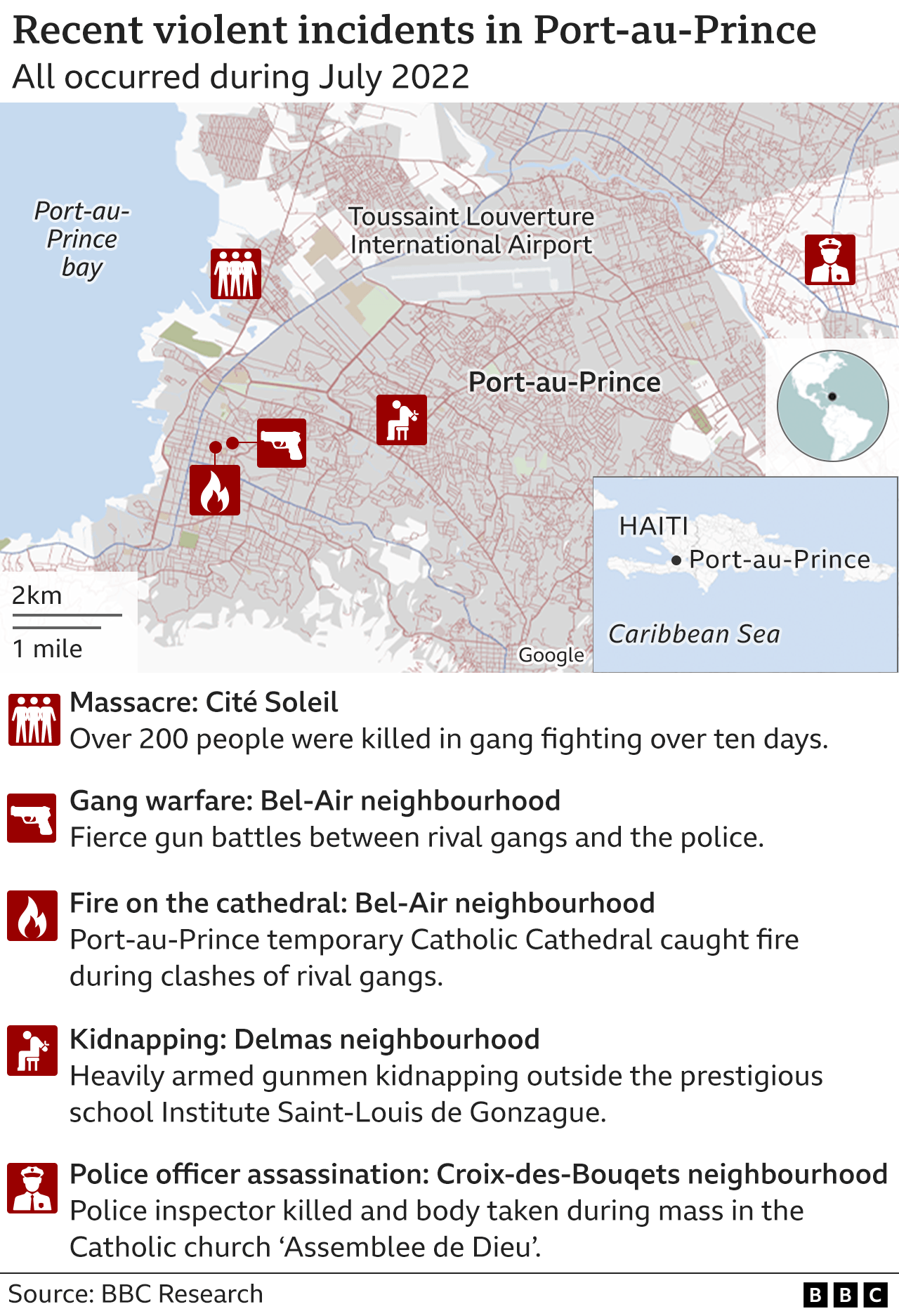
Deaths are frequent, with more than 200 people killed in gang violence in Port-au-Prince in the space of just 10 days in July, according to figures from the UN.
Police took a wounded civilian to the pavement as the bullets bounced off the armored car, another victim of the terrible daily shootings that blight Port-au-Prince, the capital of Haiti, and the neighborhood. Here, within Croix-des-Bouquets, a gang-controlled area, the SWAT team of Haiti has rammed into a gun battle that has already destroyed a public bus.
In the past 72 hours, the Haitian police have succeeded in killing a leader of the 400 Mawozo gangs and rescued six hostages from them, they say. But the gang – one of the dozens terrorizing the capital – has not been dislodged from these streets.
“Can you see that red sign ‘SMS’? That’s them,” said a SWAT officer, indicating the gunmen’s position. Like his team, he did not want to be named, citing their safety. He pointed down the road towards a small shack, as dozens of people flooded from a side alley into the street.
“Get away,” he said to the crowd, over the armored car’s loudspeaker. “You’re too exposed. It’s dangerous.”
It is a common scene of injury, gunfire, and panic in one of the dozens of neighborhoods controlled by gangs Seventeen American and Canadian missionaries appear to descend into a full-blown war between police and increasingly well-equipped and organized criminal groups.
And this is a familiar routine: Police probe into gang areas to show their reach, and gangs respond with intense volleys of bullets.
Police SWAT stand watch following an anti-gang operation in Croix-des-Bouquets.
Social media video from inside the area shows gangs using a bulldozer covered with steel plates to act as armor demolishing homes, presumably those of rivals. Other houses had been burned, with other videos showing dozens of locals fleeing the area on foot at night, during the peak of the fighting.
Flies blanket the rain-sodden concrete floor of the sporting amphitheater stage, where children as young as four months struggle to sleep, exposed to the elements. One has bruises from a fall, another a painful and ugly rash, but they are alive.
Here, Natalie Aristel angrily shows us her new, unpalatable home.
“Here’s where I sleep in a puddle,” she said, pointing at the water. “They burned my house and shot my husband seven times,” she says, referring to gang members.
“I can’t even afford to go see him [in the hospital]. In this park, even if they brought some food, there’s never enough for everyone. The kids are dying.”
Others are missing. “I have four kids, but my first is missing and I can’t find him,” another woman said. “We’ve been totally abandoned by the state and have to pay to even use a toilet,” another added.
A young boy added: “My mother and father have died. My aunt saved me. I want to go to school but it was torn down.”
Locals speak of a perfect storm of calamities — and warn the country increasingly feels on the verge of societal collapse.
People in this neighborhood built a wall on a public road last month to keep out gangs who were kidnapping residents for ransoms.
What remains of the country’s emergency interim government, created last year after the assassination of President Jovenel Moïse, is beginning to crumble and steeped in accusations of inactivity. His successor, Prime Minister Ariel Henry, has pledged to combat insecurity and hold new elections but so far has shown little progress toward either goal.
Meanwhile, analysts calculate inflation in the country at 30%. Gas is scarce and the subject of angry queues at stations. The UN has warned gang violence may put the youngest children in areas of active fighting at the risk of imminent starvation, as their parents cannot access food or go to work.
One Haitian security forces source speaking to CNN estimated that gangs control or influence three-quarters of the city.
Frantz Elbe, Director General of the Haitian National Police, rejects the assertion. “It is not a general problem in the metropolitan area,” he told CNN, declining to give a percentage.
Kidnappings are rampant and indiscriminate — one of few thriving industries in Haiti. Seventeen American and Canadian missionaries were kidnapped last year after visiting an orphanage in Croix-des-Bouquets and only released after a ransom was paid to the 400 Mawozo gangs.
Police, often outgunned, are doing what they can, Elbe tells CNN.
“The gangs are changing the way they fight. It used to be with knives, and now it is with big weapons. The police need to be well-equipped. With the little we have, we will do what we can to fight the gang members,” he said.
Director General of the Haitian police force Frantz Elbe.
The challenge they face is exposed by a brief checkpoint set up in Croix-des-Bouquets, where a truck has been dragged across the main road by the gangs and torched.
Police bring in an armored military bulldozer to push the wreckage to the roadside, which is already littered with other truck carcasses. The bulldozer operator, asked if he works under fire, replies: “Often.”
SWAT police set up a perimeter, scanning nearby rooftops. Locals and the vehicles they travel in are stopped and checked. One man says the situation is “bad, very bad,” before another gives him a stern glance.
He suddenly changes tone: “We know nothing.”
Fear is the currency of this war, though it is unclear if he fears speaking to the press, or the police, or what the gang may learn he said later.
To flee this fear, however, requires enduring more. A short boat journey from the mainland is the island of La Gonave, a hub for human traffickers.
The lackadaisical tempo and blue water of one tiny inlet on La Gonave belie its poverty. Heat, trash, hunger, and the business of leaving dominate this world.
One, a smuggler who introduced himself as Johnny, calmly explained how his business works.
The journey is often one-way for the boat, so each endeavor requires the boat to be bought outright, at a cost of about US $10,000, he says. To cover that cost, Johnny needs at least two hundred customers, who will huddle in its disheveled hull.
Shreds of netting appear to plug any gaps between in the hull, and loose wooden planks will make up the boat’s interior. Johnny shows where the pump and motors will eventually go.
“If we die, we die. If we make it, we make it,” he said.
He added he hoped to pack his boat with 250 passengers, as he considered it in “good” condition.
The ultimate destination is the United States, with Cuba and the Turks and Caicos islands sometimes accidental stops along the way.
And it is from these three places that the International Organization for Migration has reported surging numbers of forced repatriations of Haitians in the first seven months of this year, with 20,016 so far, compared to 19,629 for all of 2021.
Some Haitians appear to be getting closer to the journey’s end, with the US Coast Guard interdicting 6,114 Haitians between October and late June — four times as many as between October 2020 and October 2021. In the past weekend alone, more than 330 migrants from Haiti were rescued by the US Coast Guard near the Florida Keys.
A boat in La Gonave, Haiti.
The numbers are as staggering as the risks. Previous journeys from this inlet have ended in tragedy. Johnny is unclear on the timing of the last boat, but precise about the potential losses: One recent trip he organized led to the deaths of 29 people.
“The boat had an engine problem,” he said. “Water got inside the boat. We called for help, but they took too long. The boat was sinking while I was trying to save people. When help came, it was too late.”
While CNN cannot independently confirm Johnny’s account of the system, two other locals who said they were involved in trafficking described similar details independently. Authorities in the neighboring Caribbean nations the Bahamas and Turks and Caicos have repeatedly reported finding the remains of would-be migrants after boats capsized in their waters.
Despite the risks, many Haitians are still desperate for a way out. Locals on La Gonave told CNN that at least 40 people who aimed to attempt the boat trip were already on the island and the rest would follow from the mainland once Johnny said the boat was ready.
One potential passenger, a university graduate who was once a teacher, described why he would risk all to take the voyage.
“I worked as a teacher, but it did not work out. Now, I am driving a motorcycle every day in the sun and the dust. How will I be able to take care of my family when I have one?”
He said he saved a year’s money to make the journey and did not fear the rickety conditions of the boat. “I can be eaten by a shark or make it to America.”
Packed with close to 400 parishioners, Sunday mass on 24 July was like any other at the Assembly of God on the outskirts of Haiti’s capital, Port-au-Prince, Pastor Samuel Lucien says.
Warning: This article contains descriptions from the beginning which some readers may find upsetting.
The 45-year-old led a unit that regularly patrols territory controlled by one of the capital’s most feared gangs, called 400 Mawozo.
“I tried to seek cover but there were so many bullets, such heavy fire. I’ve never heard anything like it before in my life. It was like a warzone,” recalls Pastor Lucien.
After murdering Inspector Laleau, the gunmen left the church, taking his body with them.
Later that evening, 400 Mawozo shared a video showing the gang’s leader next to Laleau’s tortured body, threatening to kill everyone in his policing unit.
Outgunned
Even before 400 Mawozo had posted its gruesome warning, police officers knew they had become targets.
“It hurts us to see how they are treating police officers, how they are killing policemen,” says Lionel Lazarre, head of the police union.
​​Outmanned and outgunned by the well-armed gangs, officers, who earn less than $100 (£82) a month on average, are demanding the government do more to back them up.
“We need more support and more equipment urgently,” insists Mr. Lazarre. “We urgently need the government to make this their priority.”
While Mr. Lazarre says he still believes that the Haitian police can solve the current security crisis, murders like that of Inspector Laleau are a brutal sign of the control that gangs now exert in Haiti’s capital.
Ghost town
An estimated 60% of Port-au-Prince is now classed as “lawless” by human rights groups.
The city, similar in size to sprawling Los Angeles, has been paralyzed by a battle for power and territory between dozens of gangs.
Once buzzing with nightlife, the city center now looks and feels like a ghost town. The shops are shut and many residents have abandoned their homes out of fear of being caught in the crossfire.
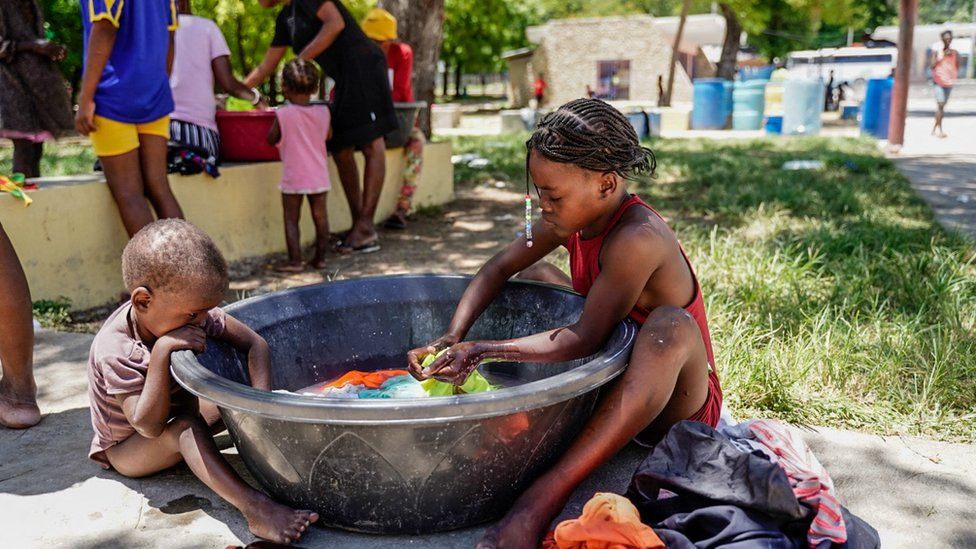
On the outskirts, huge swathes of the community are living hand to mouth, without electricity or access to clean water.
Bloody July
While gang-related violence had been on the rise since the assassination in July 2021 of President Jovenel Moïse by mercenaries, it has reached shocking new levels in recent weeks.
In collaboration with local journalist Harold Isaac, the BBC has mapped five major incidents which illustrate the levels of violence residents faced all in the space of one month this year.
27 July: G9 launched an assault on G-Pèp in Port-au-Prince’s city centre, close to the presidential palace. A turf war over the Bel Air neighborhood ensues.
27 July:Â During the turf war, the city’s temporary cathedral is set ablaze. The original cathedral was destroyed in 2010 during an earthquake.
A city wracked by violence
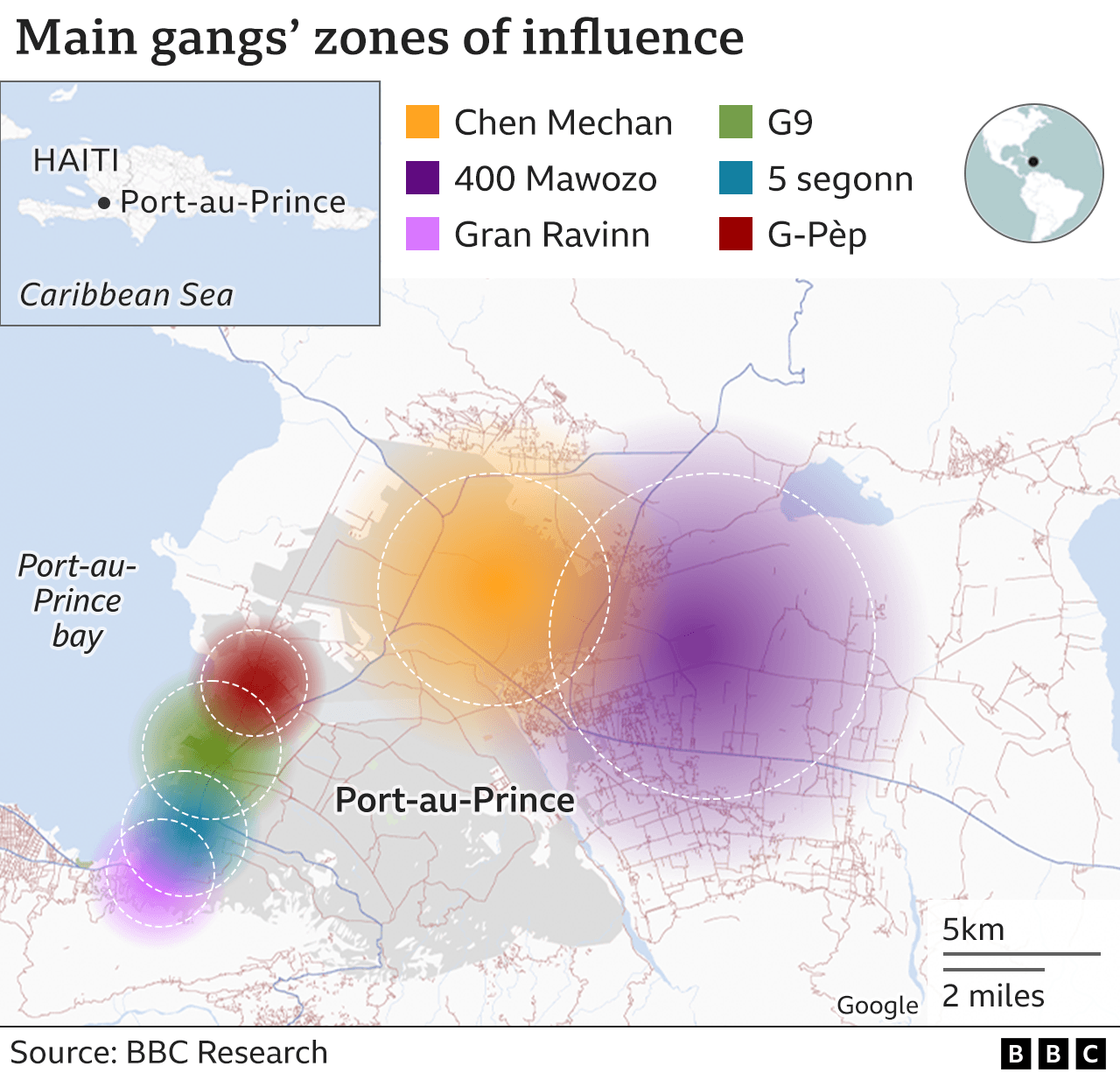
With the help of Harold Isaac, the BBC has also mapped which gangs control which parts of the city, as of July 2022.
Relentless turf wars between the groups mean many of the boundaries are in constant flux.
The G9, an alliance made up of nine gangs, controls the city’s major coastal ports and oil terminals, giving it a stranglehold over much of the city’s economy. It may not be the gang to command the most territory, but it arguably is the one with the biggest economic power.
US officials allege that Barbecue and the G9 were behind a brutal massacre in 2018, in which at least 71 people were killed in the La Saline neighborhood of the capital.
The gang which commands the biggest swathe of the territory is 400 Mawozo.
Last year, it became infamous for kidnapping 17 North American missionaries, including children.
The influence of 400 Mawozo is not limited to the capital either. It controls the road to Haiti’s border with the Dominican Republic as well as access to the north of the country.
Access to Haiti’s south is in the hands of 5 Segonn (5 Seconds), a gang that has boasted on social media of seizing entire buses full of people traveling out of Port-au-Prince.
A community in shock
Since the murder of Inspector Laleau, no church service has been held in the Assembly of God.
Pastor Lucien says the community is still in shock: “People are still too scared to attend church.”
“Everybody knows the risks, that something could happen,” he says. “But we never imagined it would happen in a church, let alone our church.”
Haitian Prime Minister Joseph Jouthe said on Wednesday during his first public appearance since his appointment by presidential decree that he would focus on fighting insecurity and inequality while boosting the economy.
Jouthe, a trained civil engineer, who was appointed this week by President Jovenel Moise, is considered an experienced policymaker. He was environment minister and interim finance minister, and also worked for the humanitarian agencies.
“We’re living today in a very precarious socio-economic situation which could lead at any time to a humanitarian disaster, our country is in agony,” he said.
“My government reiterates its commitment to continue working to improve public finances in order to increase gross domestic product (GDP), reduce inflation, increase public revenues and, above all, fight corruption.”
Jouthe called on Haitians, the divided political class and international organizations to stand by him at a time of economic crisis.
The US Embassy in Haiti said in a statement it would work with Moise and Jouthe but urged them to improve security and economic growth, and organize “free, fair and credible legislative elections as soon as technically feasible”.
Economic repercussions of a three-month countrywide lockdown are still unfolding in what was already the Western Hemisphere’s poorest nation, where around two-thirds of adults are estimated to be unemployed or underemployed.
Moise has been ruling Haiti by decree since January because the mandates of lower house deputies and most senators formally expired when no elections were held.
Jouthe replaces Jean Michel Lapin, who was acting prime minister since Moise appointed him in March last year until his resignation in July. Despite several attempts, his appointment was never approved.