Somalia’s government-owned media has been playing a song that some people say encourages bad behavior. The song was performed by the Somali police band.
It brings back old feelings of dislike towards Ethiopia because of the agreement they made with Somaliland on January 1st.
The song talks about a war that happened between Ethiopia and Somalia in 1977, almost 50 years ago.
The song says, “If you don’t want peace, we will give you a chance to remember what we did to you in 1977. ”
During the fighting, soldiers from Somalia went far into Ethiopia and took control of a large area before the Ethiopian army, which had better weapons, pushed them back.
Both sides say they won.
The song titled Remember What We Did to You in 1977, along with two other songs about Ethiopia, have been shared a lot on social media by Somalis.
Somaliland became its own country in 1991, but other countries do not officially accept this.
Somaliland might lease some of its coastline to Ethiopia. Somalia is upset about this because it feels like Ethiopia is trying to take its land.
Lately, the President of Somalia, Hassan Sheikh Mohamud, and the prime minister said that their families have fought against Ethiopia for a long time to protect their country. They feel they have to continue the fight.
President Mohamud said that the person causing division among our people is like an enemy. We have been fighting with them for a long time, but we are all still the same people. We should resist them.
The leaders of the country say that Ethiopia is a danger to its security.
Tag: Hassan Sheikh Mohamud
-

Tension between Somalia and Ethiopia evokes memories of 1977
-
Somali army pushes militants out of key town
The Somali army and allied militias have driven al-Shabab fighters out of a strategic town in the country’s centre that the Islamist militant group had held for six years.
The government has retaken control of dozens of villages and towns in recent months.
Al-Shabab is facing serious challenges as a result of American airstrikes, African Union troops, the Somali army, and an allied militia.
According to the mayor of Adan Yabal, the town was taken without incident.
The jihadist group had used it as a training base and a hub for its operations across central Somalia.
After President Hassan Sheikh Mohamud’s election in May, he declared all-out war against al-Shabab.
Now he says the effort to clear the group out of Hirshabelle and Galmudug states is in its final stages.
Despite losing territory the militant group has been carrying out frequent deadly bombing raids – especially in the capital, Mogadishu.
-
The US blacklists suspected Somali terrorist funders
The US has blacklisted eight Somalis accused of providing financial and other material support to the Islamist al-Shabab group.
According to Washington, they are part of a network that has smuggled weaponry from both domestic and foreign sources.
This comes a day after the Somali authorities warned businesses in the capital, Mogadishu, against paying taxes to the al-Qaeda affiliate.
Al-Shabab frequently extorts businesses in Mogadishu raising tens of millions of dollars for their militant activities in Somalia and neighbouring countries.
President Hassan Sheikh Mohamud has declared an all-out war against al Shabab and sought international support to defeat the militants.
Last week, the information ministry suspended dozens of social media accounts and websites for allegedly publishing al-Shabab propaganda.
-
Somalia president attains PhD in Peace, Governance and Development
President of Somalia is officially an academic “Dr.” after the completion of his PhD programme on Tuesday, October 11.
President Hassan Sheikh Mohamud, who returned to the presidency in keenly contested poll this year completed his PhD Program of Peace, Governance and Development at PEACE University.
“We are thrilled to welcome you to our Alumni ranks! @HassanSMohamud,” the University said.
Mohamud lost his re-election bid in 2016 to immediate past Mohammed Abdullahi Farmaajo. Years on, he staged a comeback to defeat Farmaajo to stage a successful comeback.
With a background in education, the former peace activist’s election campaign was focused on ensuring Somalis are united and are at peace with the rest of the world – something he did not fail to mention immediately after he was sworn in, the BBC said in a profile of the president in May 2022.
Hassan Sheikh is said to have joined the Centre for Research and Dialogue in 2001 as a researcher in post-conflict reconstruction – a body sometimes criticised as being too closely affiliated to the West – and has worked as a consultant to various UN bodies and the transitional government.
President @HassanSMohamud receives a PhD in Peace, Governance and Development from the United Nations Peace University #DalsanNewsDesk #Somalia pic.twitter.com/4UNNmKk3rV
— DalsanTV (@DalsanTv) October 11, 2022
Congratulations to President @HassanSMohamud, now PhD.
Dr Hassan Sheikh Mohamud setting a good example for leadership and younger generations.
Education is a lifelong process.
— Rashid Abdi (@RAbdiAnalyst) October 12, 2022
-
Al-Shabab: Islamists kill 10 in Somali hotel – reports
10 people have been killed after al-Shabab militants stormed a hotel in the Somali capital, Mogadishu, security officials say.
Police said attackers detonated two explosives outside the hotel before entering the building and opening fire.
They were reported to be holed up on the top floor of the Hotel Hayat, hours after the attack began.
A special police unit is said to have rescued dozens of guests and staff from the hotel.
“The security forces continued to neutralise terrorists who have been cordoned inside a room in the hotel building. Most of the people were rescued, but at least eight civilians were confirmed dead so far,” said an official, Mohamed Abdikadir.
Earlier, a website affiliated to al-Shabab said a group of militants had “forcibly entered” the hotel and were “carrying out random shooting”.
The Hayat is described as a popular location for employees of the federal government to meet.
Nine people were injured and carried away from the hotel, the head of Mogadishu’s Aamin ambulance services, Abdikadir Abdirahman told Reuters news agency earlier.
Unverified images circulating on social media appeared to show smoke billowing from the hotel while shouting and loud bangs can be heard.
“Two car bombs targeted Hotel Hayat,” a police officer told the Reuters news agency in a statement. “One hit a barrier near the hotel, and then the other hit the gate of the hotel. We believe the fighters are inside the hotel.”
An affiliate of al-Qaeda, al-Shabab has engaged in a long-running conflict with the federal government.
The group controls much of southern and central Somalia but has been able to extend its influence into areas controlled by the government based in Mogadishu.
In recent weeks fighters affiliated with the group have also attacked targets along the Somalia-Ethiopia border, which has raised concerns about a possible new strategy by al-Shabab.
The attack on Friday marks the first in the capital by the group since Somalia’s new president, Hassan Sheikh Mohamud, was elected in May.
Source: BBC
-
Somalia’s new president elected by 327 people
Somalia’s former leader Hassan Sheikh Mohamud has been elected president after a final vote that was only open to the country’s MPs.
He defeated the current president, Mohamed Abudallahi Farmajo, who has been in office since 2017.
The ballot was limited to Somalia’s 328 MPs due to security concerns over holding a wider election, and one of them did not cast a vote.
Mr Mohamud received 214 votes, defeating Mr Farmajo who won 110 votes.
Three MPs are reported to have spoiled their ballots.
The unusual circumstances highlight Somalia’s security issues as well as the lack of democratic accountability.
The result marks a comeback for Hassan Sheikh Mohamud, who served as Somalia’s president between 2012 and 2017 before he was defeated by Mr Farmajo.
The elections – which were hotly contested and went to a third round – were delayed for almost 15 months due to infighting and security issues.
Mr Mohamud was sworn in shortly after the final results were announced, prompting supporters in the capital to cheer and fire guns into the air. He will serve for the next four years.
In the vote on Sunday, hundreds of parliamentarians cast their ballots at a fortified aircraft hangar in the capital Mogadishu.
Explosions could be heard nearby as voting was taking place, but police said no casualties were reported.
As the incoming president, Mr Mohamud will have to deal with the impact of an ongoing drought in which the UN says 3.5 million Somalis are at risk of severe famine.
But the big task he faces is to wrest control of much of Somalia from al-Shabab. The al-Qaeda-linked Islamist militant group continues to dominate large parts of the country and carries out frequent attacks in Mogadishu and elsewhere.
The country is also being affected by food and fuel inflation sparked by the war in Ukraine
The government is backed in its fight against al-Shabab by the African Union, in the shape of some 18,000 troops and the United Nations.
The instability is one of the reasons why Somalia has been unable to hold direct elections. Somalia has not had a one-person-one-vote democratic election since 1969.
That vote was followed by a coup, dictatorship and conflict involving clan militias and Islamist extremists.
This is only the third time that the indirect election for president has been able to take place in Somalia itself. Previous ones were held in neighbouring Kenya and Djibouti.
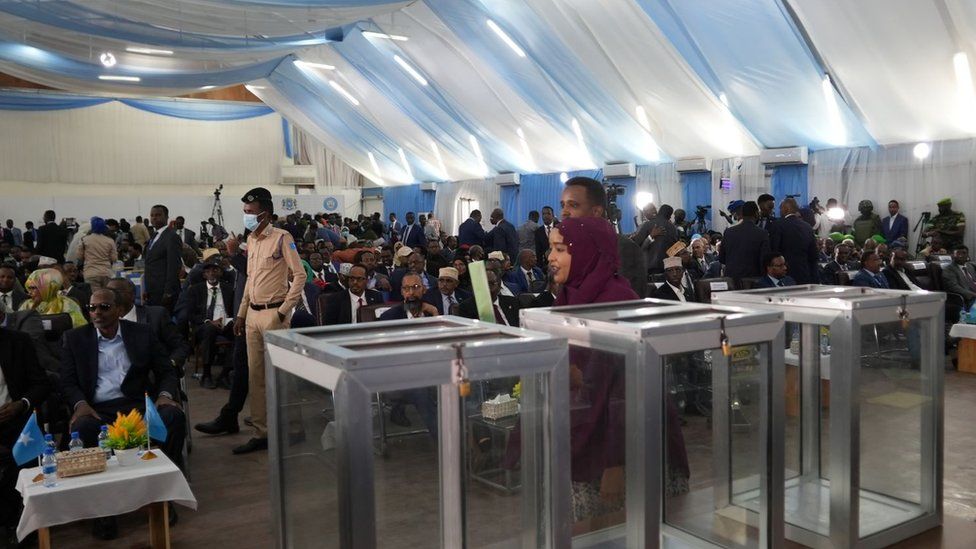 IMAGE SOURCE, BBC/ MOHAMUD ABDISAMAD
Image caption, Voting took place in an airport hangar on SundayThis vote was supposed to have happened last year when Mr Farmajo’s four-year term ended. But political differences and instability delayed the poll and the president remained in power.
The MPs who chose the new president were themselves elected by delegates nominated by the country’s powerful clans.
They gathered in a large airport hangar in the well-guarded Halane Camp. This is the main military base of the AU’s mission in Somalia (Atmis), as well as the home of diplomatic missions and aid agencies.
The voting, done by secret ballot, was delayed for hours due to lengthy security checks.
Past elections were marred by allegations of vote-buying with candidates reportedly offering money in exchange for support.
The only female candidate, former Foreign Minister Fawzia Yusuf Adam, was eliminated in the first round of voting.
What has al-Shabab said?
In previous elections, al-Shabab threatened and even kidnapped clan elders after condemning them for participating in what it saw as an un-Islamic poll.
This time around, its response to the elections has been more muted, with fears that its members or sympathisers may have secretly sought parliamentary seats in a bid to undermine the system from within.
The fear was publicly expressed by neighbouring Djibouti’s President Omar Guelleh in 2020, when he was quoted as saying: “I fear we will end up with a parliament indirectly controlled by al-Shabab because they’ll have bought the support of some of the MPs.”
Some analysts felt Mr Guelleh was exaggerating the possibility of al-Shabab gaining a foothold in parliament, but there is no doubt that it is a major political force in Somalia.
Source: BBC