Tag: Henry Kissinger

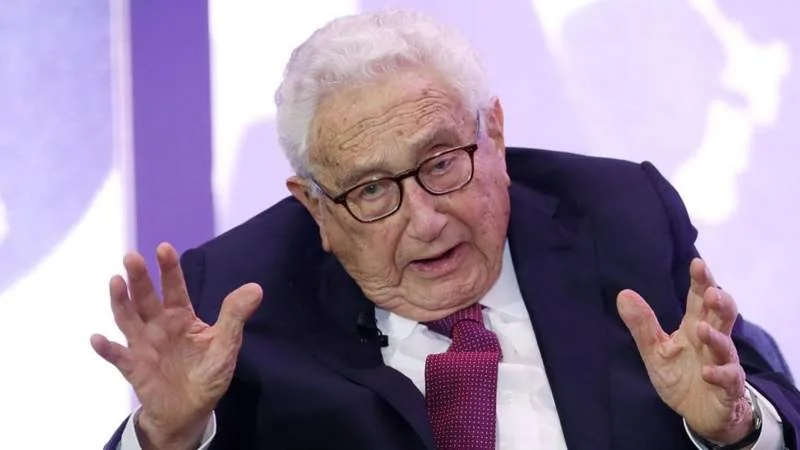
  • Henry Kissinger, former US Secretary of State dies at age 100

    Henry Kissinger, former US Secretary of State dies at age 100

    Henry Kissinger, a former top US official who made big decisions in the Cold War, has passed away at 100.

    He was the top diplomat and national security adviser for the United States during the Nixon and Ford administrations.

    Even after he stopped being in charge in the 1970s, many leaders still asked for his advice for many years.

    The ex-diplomat, who was born in Germany, passed away at his house in Connecticut.

    Former US President George W Bush paid respects, saying the US had “lost one of the most reliable and unique voices on foreign affairs”.

    Former UK Prime Minister Tony Blair said that Kissinger was really good at diplomacy and genuinely cared about protecting the free world.

    President Nixon’s daughters, Tricia and Julie, said that Kissinger’s life story was very special and very American.

    The statement said that people will remember Henry Kissinger for all the good things he did to make peace better. “However, we will always remember his personality. ”

    He was born in Germany in 1923. His family left Germany and went to the US in 1938 to escape the Nazis. His dad was a teacher. He always kept his Bavarian accent.

    He became a citizen of the United States in 1943 and then served in the US Army for three years. After that, he worked in the Counter Intelligence Corps.

    After finishing college and getting a PhD, he taught about how countries relate to each other at Harvard.

    In 1969, President Nixon chose him to be in charge of protecting the country, which allowed him to have a lot of influence on US foreign policy.

    During his time as national security adviser and secretary of state from 1969 to 1977, he helped the US stop fighting in the Vietnam War, start talking to China, and bring peace in the Yom Kippur War between Egypt, Syria, and Israel. The hard work led to the creation of shuttle diplomacy.

    Isaac Herzog, the president of Israel, who is in a war with Hamas, praised Kissinger’s work on the peace deal with Egypt. He wrote on social media that “the whole world still benefits from the important work he did”.

    In China, where many people liked Kissinger a lot, news about his death quickly became popular on Weibo, a social media site.

    China News said he was a good friend of the Chinese people in his obituary.

    China Central Television praised him as an important diplomat and a key figure in US-China relations, calling him a “legend” and a “living fossil”.

    Over the years, people criticized Kissinger for focusing on competing with the Soviet Union instead of human rights, and for supporting harsh rulers like Augusto Pinochet in Chile.

    People were still mad about some of his decisions, even after he died. Rolling Stone wrote about Henry Kissinger saying he was a war criminal loved by America’s ruling class, who has died. And the left-leaning Huffpost called him “The Beltway Butcher” on their website.

    Kissinger didn’t care about criticism.

    “Their ignorance is shown by that,” the old and rough-voiced leader told CBS in an interview just before turning 100 years old.

    In 1973, he won a Nobel Peace Prize with Le Duc Tho from North Vietnam. Le Duc Tho didn’t want the prize.

    The award caused two people on the Nobel committee to quit.

    After Kissinger stopped working for the government in 1977, he kept talking a lot about public issues. Twelve US presidents asked for his advice, from John F Kennedy to Joe Biden, and lawmakers also wanted his opinion.

    Notably, Kissinger is the only American who has spoken directly with every Chinese leader from Mao Zedong to Xi Jinping.

    He was on the boards of different companies and wrote 21 books about foreign policy and security.

    Even at the age of 100, Kissinger continued to live a busy life. In July, he made a surprise trip to Beijing to meet with Chinese President Xi Jinping. Despite the current tensions between China and the US, Kissinger was warmly welcomed and honored during his visit.

    The White House was upset about the visit and the National Security Council spokesperson, John Kirby, was sad that a regular person had the chance to meet with Chinese leaders while the US government did not.

    In July 2022, when he was 99 years old, Kissinger was asked during an interview with ABC on a book tour if he regretted any of his decisions.

    “I’ve been thinking about these problems my whole life. ” “I enjoy doing it and it’s also my job,” he said. “I made the best suggestions I could at that time. ”

    He is no longer alive, but his wife Nancy and two children, Elizabeth and David, and five grandchildren are still here. They were married for almost 50 years.
  • Kissinger meets Xi after US climate envoy Kerry’s visit to China ended

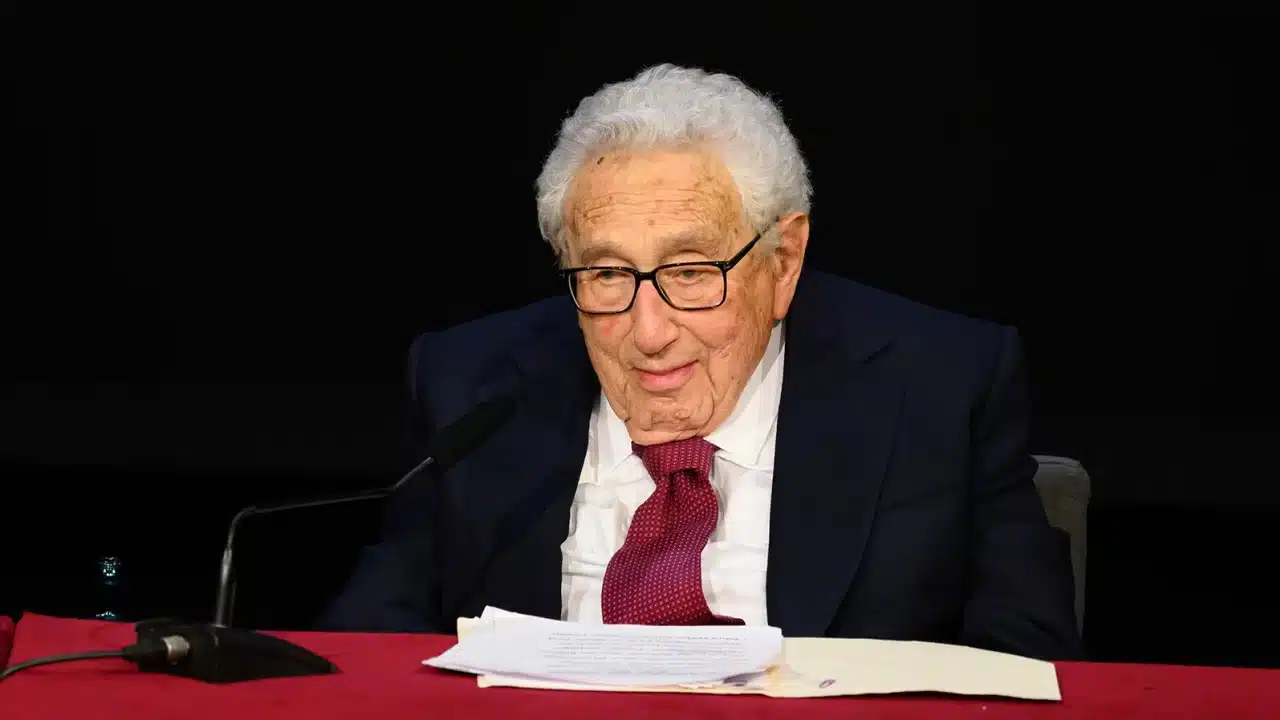
    Kissinger meets Xi after US climate envoy Kerry’s visit to China ended

    Henry Kissinger, the 100-year-old former US Secretary of State, met with Chinese President Xi Jinping on Thursday, a day after US climate envoy John Kerry concluded his tour to relaunch climate negotiations with China. Kissinger is in Beijing this week on an unexpected visit.

    According to official broadcaster CCTV, Xi and Kissinger met at the Diaoyutai official Guesthouse, a diplomatic facility in western Beijing where Chinese leaders frequently host foreign visitors.

    Following Kissinger’s meetings with Wang Yi, China’s top diplomat, and Li Shangfu, its defence minister, who has been subject to US sanctions since 2018 because of China’s acquisition of Russian weapons, the two men will meet.

    Kissinger’s meeting with Xi is indicative of how highly he is regarded by China’s leadership.

    His previously unannounced visit overlapped with Kerry’s high-profile visit to Beijing, which saw US and China resume climate talks that had been frozen for nearly a year.

    Noticeably, Kerry, who is also a former US Secretary of State, was not granted an audience with Xi, despite being a serving member of President Joe Biden’s current administration and anticipation by some observers beforehand that such a face to face could be on the cards.

    Kissinger, who said he was in Beijing “as a friend of China,” played a key role in paving the way for the US to establish diplomatic ties with Communist China half a century ago during the Nixon administration.

    The former diplomat has visited China more than 100 times since 1971, when he paid a secret visit to Beijing to pave the way for Nixon’s “ice-breaking” trip the following year, CCTV reported.

  • Kissinger’s call for peace talks with Russia draws criticism from Kyiv

    The Ukrainian government has rejected calls by seasoned US diplomat Henry Kissinger that the time had come for a negotiated peace with Russia in order to lessen the likelihood of a devastating world war as “appeasing the aggressor”

    The idea was put forth in an opinion piece written by former US Secretary of State Henry Kissinger and published in the Spectator magazine. Kissinger was the mastermind behind the detente policy toward the Soviet Union during the Cold War under disgraced US President Richard Nixon and later President Gerald Ford.

    “I have repeatedly expressed my support for the allied military effort to thwart Russia’s aggression in Ukraine,” Kissinger wrote.

    “But the time is approaching to build on the strategic changes which have already been accomplished and to integrate them into a new structure towards achieving peace through negotiation,” he wrote.

    “The preferred outcome for some is a Russia rendered impotent by the war. I disagree,” Kissinger continued.

    Former Secretary of State Henry Kissinger.
    Former Secretary of State Henry Kissinger in 2019 [File: Jaime R. Carrero/Reuters]

    “For all its propensity to violence, Russia has made decisive contributions to the global equilibrium and to the balance of power for over half a millennium. Its historical role should not be degraded. Russia’s military setbacks have not eliminated its global nuclear reach, enabling it to threaten escalation in Ukraine,” he added.

    Kissinger, who has met Russian President Vladimir Putin multiple times, proposed at the World Economic Forum in Davos in May that Ukraine should let Russia keep Crimea, which it annexed in 2014, and that Russia withdraw to the front lines before its February 2022 invasion.

    “Mr. Kissinger still has not understood anything … neither the nature of this war, nor its impact on the world order,” Ukrainian presidential aide Mykhailo Podolyak said on Telegram.

    “The prescription that the ex-Secretary of State calls for, but is afraid to say out loud, is simple: appease the aggressor by sacrificing parts of Ukraine with guarantees of non-aggression against the other states of Eastern Europe,” he said.

    Ukraine has said that it does not believe that Putin — who has said that he is prepared for a long war in Ukraine — is serious about peace, and that there can be no peace until every Russian soldier leaves its territory, including Crimea.

    Podolyak added: “All supporters of simple solutions should remember the obvious: any agreement with the devil — a bad peace at the expense of Ukrainian territories — will be a victory for Putin and a recipe for success for autocrats around the world.”

    Kremlin officials were not available for comment late on Sunday.

    In May, Ukrainian President Volodymyr Zelenskyy denounced suggestions that Ukraine should cede control of territory to Russia in order to secure peace, comparing such a move with the appeasement of Adolf Hitler’s Nazi Germany.

    Those “great geopoliticians” who suggest this are disregarding the interests of Ukrainians, “the millions of those who actually live on the territory that they propose exchanging for an illusion of peace”, Zelenskyy said at the time.

    “Whatever the Russian state does, you will always find someone who says, ‘let’s take its interests into account’,” Zelenskyy said.

    CIA Director William Burns said in an interview published on Saturday that while most conflicts end in negotiation, the CIA’s assessment was Russia was not serious yet about a real negotiation to end the war.