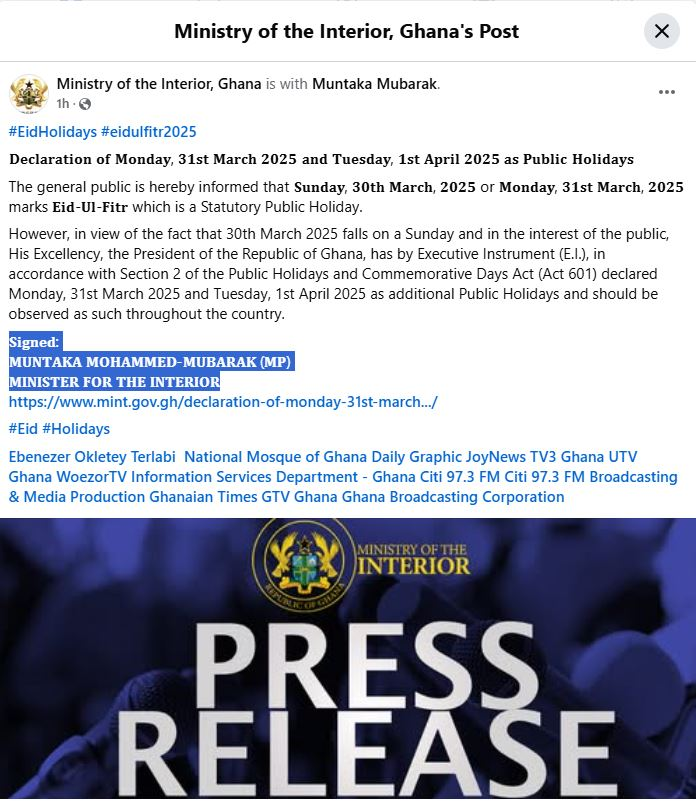
The government has declared Monday, March 31 and Tuesday, April 1 public holidays in Ghana to mark the celebration of Eid-ul-Fitr.
The Minister for the Interior, Muntaka Mohammed, announced the holidays in a statement issued on Saturday, March 22, explaining that the decision follows the observance of Eid-ul-Fitr, which falls on Sunday, March 30.
Since the statutory holiday coincides with a Sunday, President John Dramani Mahama, in accordance with Section 2 of the Public Holidays and Commemorative Days Act (Act 601), has designated “Monday, March 31, and Tuesday, April 1, as additional public holidays through an Executive Instrument (E.I.).”
The minister urged the public to observe the holidays accordingly and adhere to the official declaration.
The decision aims to allow the Muslim community to fully participate in Eid-ul-Fitr festivities, which mark the end of Ramadan, a period of fasting, prayer, and reflection for Muslims worldwide.
The move follows the government’s efforts to amend the Public Holidays Act. President Mahama had hinted at the possibility of an additional holiday before the 2024 general elections, emphasizing that the Eid period involves deep spiritual reflection, community gatherings, and acts of charity, requiring ample time for observance.
“The additional holiday will give Muslims ample time to fulfil their religious duties,” the president stated in March.
The declaration has been met with support from the Coalition of Muslim Organisations Ghana (COMOG).
COMOG spokesperson Mohammed Shaibu Shamsu commended the government for the initiative, highlighting the challenges many Muslims previously faced with having only one day to celebrate Eid-ul-Fitr.
The Member of Parliament for Madina, Francis-Xavier Sosu, has introduced a new bill aiming to amend the country’s Public Holidays Act 2001, Act 601.
The proposed amendment includes the addition of two Islamic public holidays, Tashreeq (a day after the Eid-al-Adha Festival) and Shaqq (a day before the Eid-al-Fitr).
The bill was submitted to the Clerk of Parliament on November 29, 2023, and is currently in the processing stage.
According to Sosu, the amendment aims to create a more progressive, productive, and inclusive society by extending the public holidays for Muslims from one day to two days for each Islamic festivity.
“The right of every Ghanaian to freedom of religion is a fundamental one. In Article 21(c) every Ghanian has the freedom to practice any religion and to manifest any religion. Being the 2nd dominant religion in Ghana, Ghanaian Muslims must have equal opportunities when it comes to the celebration of religious festivals.”
“After 40 days of mandatory religious obligation of fasting, practitioners of Islamic Religion deserve an additional day for rest and to prepare for full activities,” he said.
“The religious significance of these holidays is to afford Muslims the opportunity to fully manifest and observe their faith, and offer gratitude to Allah for all that He has done, granted them, and continues to do; as well as for them to fully place and restore their trust in Allah and His abundant care, Grace and wisdom,” he added.
Mr. Sosu highlighted that the existing system was deemed unfair and discriminatory, limiting the expression of the Islamic faith in accordance with constitutional guarantees and international laws.
“When passed, this Act will go a long way to promote religious tolerance and help realise, promote and guarantee a more open, progressive, inclusive and secure society,” he added.
People from diverse backgrounds and ethnicities came together to be identified as Ghanaians on March 6, 1957, when the Gold Coast gained independence from the British.
Since then, some relevant occasions (religious and civic) have been earmarked as statutory public holidays to remind citizens of their past as well as provide an opportunity for patriotic citizens to be celebrated.
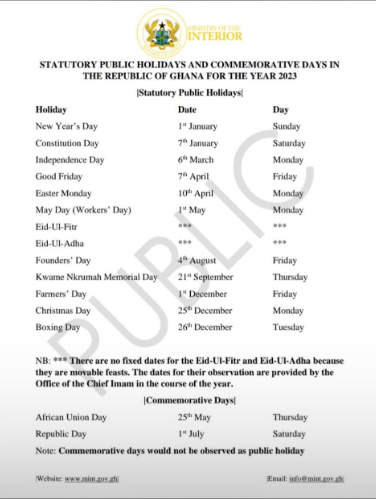
Throughout the year, 13 public statutory holidays are celebrated by Ghanaians.
In this article, we will explore the various statutory holidays observed in Ghana and their importance.
New Year’s Day is celebrated on January 1 every year. New Year’s Day is celebrated worldwide to mark the beginning of a new calendar year.
Constitution Day is marked every January 7. Constitution Day marks the anniversary of the adoption of the Fourth Republican Constitution of Ghana on January 7, 1993.
Ghana celebrates its Independence Day on every 6th March after breaking colonial ties in 1957. Ghanaians use this occasion to reflect on the nation’s history, pay homage to its forefathers and leaders who fought for independence, and reaffirm their commitment to the principles of democracy, unity, and progress.
Good Friday, a Christian holiday is earmarked on the Friday before Easter Sunday. It commemorates the crucifixion of Jesus Christ and his death at Calvary. It has no fixed date as it is observed on the Friday that follows the first full moon that occurs on or after March 21st.
Easter, another Christian holiday, commemorates the resurrection of Jesus Christ, which is the central and most significant day of the Easter festival.
May Day, a civic holiday celebrated every May 1 allows workers to come together in solidarity to celebrate their achievements, and advocate for improvements in labor laws and workplace conditions.
Muslims in Ghana get to celebrate two religious days; Eid-Ul-Fitr and Eid-Ul-Adha. Their days are not set as they are dependent on the sighting of the moon.
Founders’ Day is commemorated on August 4. This provides an opportunity to recognize and pay tribute to individuals such as Kwame Nkrumah, George Padmore, J.B. Danquah, and other leaders who played significant roles in Ghana’s struggle for independence and its early post-independence development.
Kwame Nkrumah Memorial Day is celebrated every September 21 to mark the birthday of Ghana’s first president and his contributions to the nation’s history and his role in leading Ghana to independence from British colonial rule on March 6, 1957.
Farmers’ Day: Ghanaians on every first Friday in December honor and appreciate the significant contributions of farmers and fishermen to the country’s economy and well-being.
Christmas Day: Over 30 million Ghanaians join the Christian community on December 25 to mark the birth of Christ Jesus.
Boxing Day, celebrated a day just after Christmas, December 26, enables citizens to continue celebrating and spending time with family and friends.
Real Madrid defender Antonio Rudiger is currently in Ghana, enjoying a well-deserved vacation after a demanding season that involved commitments for both club and country,
The German international arrived in Ghana over the weekend and has been seen spending quality time with friends during his break.
During his stay, Rudiger was spotted in the company of Ghanaian player Kingsley Schindler, as they both relished their off-season leisure time.
Prior to visiting Ghana, Rudiger also made a trip to his home country, Sierra Leone, where he engaged in charitable activities through his foundation, the Antonio Rudiger Foundation.
Rudiger in Ghana for a vacation
Notably, in 2022, the generous player utilized his World Cup bonus to fund the surgeries of eleven children in Sierra Leone, showcasing his commitment to making a positive impact in the lives of others.
While Rudiger was instrumental in Chelsea’s victorious UEFA Champions League campaign, he couldn’t replicate that success with Real Madrid as they fell short of reaching the final in the previous season.
Rudiger first visited Ghana in 2021 when he was with Premier League side Chelsea. The player came to Ghana after the 2020 Euros where he represented the German national team.
You and your guy have been together for a while. You’ve met each other’s friends, you’ve spent holidays together, and even traveled together.
Yet, he isn’t moving the relationship forward.
How long should you wait for him to figure out what he really wants? Whether he wants a relationship with you — a serious one.
The truth is you’re asking the wrong question.
The question you want to ask is: “Is he worth waiting for?”
Sure, you like him and find him attractive, but are you ever going to get what you really want?
Long-lasting, soul-satisfying love doesn’t just show up because you’re willing to wait to see if his behavior will change. If he wants a relationship with you, there will be signs. Even if the relationship he wants is a little ways away.
You don’t know if or when this man is going to step up for you. But you don’t have to remain in the dark.
Seven Q’s to ask yourself determine if he wants a relationship (& is worth the wait)
1. How does he utilize resources?
You can always tell what and who is important to a man by how he spends his resources. Everyone is limited by time, money, and energy.
So, if he is spending most of his resources on other people in his life, but not you, that can be a big warning sign.
You may have made the relationship super convenient for him in the beginning. You teach people how to treat you.
From the moment you met your boyfriend you showed him what was and wasn’t acceptable behavior. It could be that he was looking for some companionship and you went along with his desires leaving your needs and wants unfulfilled.
If your boyfriend is spending most of his time, his money, and his energy on something other than you, you may want to cut your losses and move on so you can find a man who is a much better match for you.
2. Does he make plans for the future with you?
In your current relationship if you’re wondering, “How long should I wait for him,” you’ll want to take note of how your boyfriend communicates about the future with you.
Does he share what your life together will be like when there is a deeper commitment between you? Does he make plans for the future with you, like a vacation, a concert, or tickets to the theatre?
A man who wants to claim you and take you off the market will ask for exclusivity. He will show you his intentions by discussing future aspirations with you and making plans for the future with you.
These discussions have to lead to execution so that after a couple of years in the relationship you ought to have a treasure trove of memories and photographs of the two of you and your lives together.
If he is all talk without follow-through, you may be with a man who thinks you’ll settle for the hope of a future without actually creating one with you.
3. Does he include you in his life?
Has he introduced you to his friends, his co-workers, and family? Are there photographs of you in his home? Does he spend Valentine’s Day, Christmas, and your birthday with you?
A man in love wants to show off the object of his desire. He’ll introduce you to the people in his life that are important to him.
If you are segregated to only spending time alone with him and not with the other people close to him, then your concerns are warranted and it’s time for you to think about moving on.
4. Does he honor his word?
As you consider whether to stay or go and wonder how long should you wait for him, you’ll want to pay close attention to whether or not he honors his word with you.
Does he show up at your place to take you out on time? Does he follow through on the dates he arranges for the two of you? When he makes an agreement with you does he honor it?
If he is constantly making excuses for why he cannot follow through, or he is always asking that you be understanding and take a backseat to all his other commitments, it’s time for you to evaluate whether you are a priority for him.
5. Do you share goals and values?
You can wait for him to step up, but if the two of you aren’t on the same page about what you want from life, then your wait isn’t going to be worth it. Long-lasting relationships don’t just happen.
Life will inevitably bring you challenges, and it is so much easier to navigate those challenges when the two of you are on the same page.
Are you clear about what is important to you? Do his actions show you that he shares those values?
It’s great that you feel good when you are with him, that you feel loved by him, and that the two of you are compatible. The problem with feelings is that they change.
The Romance Stage of a relationship inevitably leads to the Power Struggle Stage. You can’t avoid it.
But you can navigate through it more easily when the two of you are committed to putting the relationship first.
Look over your past together and see if he has shown you through his actions that he wants the same life that you want.
If you find that his actions haven’t given you a clear indication that he wants what you want, then you should consider moving on.
6. Are your needs met?
This is really the lynchpin because only you can tell if you’ve gone into sacrifice. By asking yourself, “How long should I wait for him,” it’s possible you’re feeling angry and resentful which is a key signal that you’ve given up your needs for too long.
It’s likely that your needs have gone unmet for so long that it feels par for the course at this point. Have you tolerated the situation for so long that you’ve made it very convenient for him?
Your needs are not a long laundry list of everything you desire in a relationship. Instead, separate your needs from your wants because needs are not negotiable.
However, wants are. It’s very important for you to know the difference so that you’re able to make requests and ask for what you need and cannot do without.
Communicating with your boyfriend authentically will allow you to see how he responds to your request for things to change.
If he can make the changes you require, great! You should consider staying in a relationship with him.
However, if he is incapable or unwilling to make the changes you desire it might be time to throw in the towel.
7. Does the cost seem to outweigh the benefit?
The sunk cost fallacy is when you continue doing what you’ve been doing because of a previous investment of resources (time, energy, or money) even though the cost outweighs the benefit. Simply stated, just because you’ve invested time and energy into this relationship doesn’t mean that you should continue to do so if it is not meeting your needs.
You may dread having to end the relationship and start dating again, but that discomfort doesn’t outweigh the fact that the relationship doesn’t appear to be going anywhere. He’s not suddenly going to wake up and realize that he should start showing you how important you are to him.
He’s showing you who he is and what is important to him by his behavior. Instead of worrying about how long you should wait for him to get his act together, start asking for what you desire and see if he can deliver it to you.
There is nothing lonelier than being in a relationship that isn’t working for you. Ultimately, only you can make the decision to stay or go.
Just make sure you aren’t sticking with your current boyfriend because of the time you’ve spent together.
How long is too long to wait?
Love isn’t a mystery. When you like someone and you want to be in a committed relationship, you don’t have to make things complicated.
There is a natural flow to a relationship that happens when the two of you are clear about what you want and able to communicate about the relationship.
Things get complicated when one or both of you aren’t sure what you want. It’s perfectly okay to take time at the beginning of the dating process to discover who someone is and if you want to make a deeper commitment.
Going slowly at the beginning allows you to discover if you two are a good match before committing your heart too deeply.
Approaching your relationships in a more conscious way is more likely to get you the type of relationship you truly desire.
Once the two of you make a commitment of exclusivity the relationship should move forward toward a deeper level of commitment.
If it doesn’t, then maybe you both don’t want the same things out of life and the relationship itself.
Someone with extreme eating or exercise habits may be experiencing an ED. Symptoms can vary depending on the condition, including binging or purging food, restricting food, overexercising, and more.
Heather Russo, LMFT, CEDS-S, chief clinical officer with Alsana, an eating disorder recovery program, tells us that holidays are especially triggering for people in recovery from an ED because many traditions and celebrations are food and relationship-focused.
“An eating disorder can be triggered by difficult relationship dynamics as well as the shame and self-criticism that may result from struggling with a mental health disorder,” Russo says.
She explains that facing large amounts of food on the table or recognizing that you’ll have to eat in front of others can cause worry and anxiety. “On top of this, the stress of wondering how to respond if someone comments on how you look or what you’re eating can feel heightened this time of year,” Russo says.
Julia, a member of the Alsana team who received treatment for an eating disorder and is currently in recovery, says the foods used to celebrate can be challenging for people experiencing eating disorders.
“There’s also an amplification of diet culture from everyone around us, echoing anxieties that certain foods are ‘bad,’ ‘sinful,’ ‘guilty,’ ‘unclean,’ ‘toxic,’ ‘cheat,’ ‘junk,’ ‘garbage,’ etc.”
Julia adds that complicated family dynamics, “clean your plate” generational expectations, and New Year’s anticipatory diet talk are also especially challenging for recovery.
According to Russo, food cues and relationship dynamics can send someone with an ED into a reactive state, making them feel vulnerable to unhealthy coping mechanisms and compulsive behaviors. Depending on the eating disorder, this may mean:
Binging, or extreme overeating
Purging
Not eating prior to or after an event
“That’s why it’s important to recognize how these cues impact you and have a plan when an event or situation brings them to the surface, even if that means leaving a holiday gathering,” she says.
Our experts’ advice may help you prepare for stressful moments, get a plan in place, and stay present during your gatherings.
Managing Anticipatory Anxiety Leading Up to the Holidays
“Anticipatory stress is a real thing,” says Kiana Shelton LCSW with Mindpath Health.
This is the type of anxiety someone may feel ahead of certain events or activities. However, according to Shelton, mindfulness is a great way to combat this anxiety.
“Recognizing you are feeling anxious and going over your plan can be a great way to stay grounded. It’s also a great opportunity to wrap tools around these specific stressors,” she says.
Russo adds that being proactive with stress management is key. She suggests some activities that may help ease feelings of anticipatory anxiety, such as:
Getting plenty of rest. Set a good sleep schedule and stick with it best you can.
Participating in activities you enjoy — spending time outside, taking a walk, or reading a good book.
Practicing mindfulness, meditation, or yoga.
Creating a go-to playlist to listen to when you feel anxious or overwhelmed.
Making sure to schedule time for self-care every day. This can look different for everyone. Maybe it means applying a face mask, making a call to a good friend, or heading to the spa for a massage.
For Julia, planning ahead has proved a powerful strategy.
“I used to go into events or gatherings hoping I would just suddenly and magically put my eating disorder on a shelf and hope for zero triggers — and then feel like a failure when I wasn’t able to refrain from disordered behaviors.”
Instead, she suggests thinking of a trigger or challenge that may come up, being specific with where, when, and how, and then pair that possibility with a small, recovery-minded action.
“For example, if you anticipate a family member saying, ‘[something triggering or uncomfortable],’ that would be your cue to try taking a few intentional breaths or excuse yourself to practice a predetermined coping skill.”
Build a Support System
Julia says surrounding yourself with support is also a vital step.
“If possible, connect with an eating disorder-specialized professional, such as a therapist or dietician, so they can help you navigate this time of year with your unique situation in mind.”
Although navigating insurance, waitlists, and more can be frustrating and even exhausting, Julia stresses that it’s worth the effort. “There are resources out there to help with access to care, and even just confiding in a trusted loved one to support with making those first calls,” she says.
“There are quite a few virtual support groups now, and it can be healing to connect with a community as another way to surround yourself with support. All support groups are a little bit different, so try checking out a few until you find one that feels like a good fit.”
Keeping Care Plans in Place
According to Russo, the most important thing that you can do for your health this season is to keep your standing appointments with your care team if you have one.
Although this time of year is often so busy, it can be tempting to put a pause on your recovery, but Russo tells us that’s risky. “I encourage my clients to continue to meet with their dietitian and attend therapy as usual. If you’re going home for the holidays, make a meeting with your care team via phone or video chat a priority.”
Shelton reminds us that maintaining healthy behaviors during the holidays can take a little bit of work.
“Remembering to eat regularly — which includes eating before attending a gathering — will prevent you from being too hungry at the event. Also, eating mindfully, such as remembering to put the fork down between bites, can keep you focused while you’re eating,” she says.
Navigating Comments About Food
Comments about the amount of food on your plate are very common during holiday gatherings.
According to Russo, discussions around food can go sideways and create more stress.
“These kinds of comments are best redirected to another subject or addressed directly.
She suggests saying things like:
“Thanks for your concern. I’m feeling equipped to manage my food today,”
“I’m adhering to my meal plan today. I’m all set, thanks.”
Russo adds that it’s okay to remind loved ones that what you’re eating is not open for discussion but is being well managed by you and your care team.
Of course, many questions or comments may come from well-meaning people in your life. Shelton points out that within the Black, Indigenous, and People of Color (BIPOC) community, questions about what and how much food is on your plate are often signs of endearment.
She tells us while it’s important to consider the person making the uncomfortable or triggering comments, some of these go-to phrases below can be very effective:
“I’m happy with what’s on my plate; it all looks so good.”
“Thanks for thinking of me. I have enough right now.”
It may be helpful to practice these sayings or jot them down in your phone before the event, that way it won’t feel brand-new and you can easily pull them out in the moment.
Staying present and focusing on connection during gatherings
While food may be one of the main attractions at these holiday gatherings, Shelton tells us it’s important to remember that coming together with family and friends is the main reason.
“Connect with those around you, and make it a point to reach out to all in the room. This socialization can help keep you present and actively aware of the true reason for gathering,” she says.
According to Russo, being patient with yourself is also important, even if you feel out of control.
“Practice gratitude in the moment –— it can make you happier. In other words, your attitude can influence your outlook, especially when you’re feeling triggered.”
Here are some steps she suggests:
Take a pause from the situation, even if that means moving to a different room — then sit down and close your eyes.
Take deep breaths and think about the things (and people) you’re thankful for daily.
Try to remember what’s valuable to you and how you want to engage with the moment, as well as any others that might come your way during the holiday season.
If you find yourself activated during your social event, remember your plan.
Shelton encourages clients to put their plans in the note section of their phones.
“Since we live in a digital age, and many have their phone on them, it can be an easy way to take a quick glance at your plan and remember your coping strategies,” she says.
Setting Boundaries and Honoring Your Needs
Shelton says meeting your own needs is one of the greatest forms of self-love, and sometimes no is the best answer. “Depending on how safe you feel, sharing more with the host about why you cannot attend may combat any potential feelings of shame or guilt for not attending,” she says.
It’s also important you don’t lean into people-pleasing behaviors.
“If you don’t think attending a holiday event or gathering makes sense for where you are at in your recovery, don’t go,” Russo says.
She adds that it’s best to avoid playing the shame game if you opt-out — this could lead to a spiral, which can only make things more difficult. “Your focus should remain on your recovery and life-affirming events, even if that means setting boundaries for which festivities you attend.”
Aftercare Post-Holidays
Just like it’s important getting in touch with your support system, dietitian, or therapist before the holidays, it’s also important to touch base after they end.
“If you find yourself dysregulated or struggling to return to your daily routine, aftercare may look like seeking professional support,” Shelton says. She also mentions that a call with the NEDA Helpline could prove helpful.
Russo agrees, saying aftercare might include following up with your care team and using your meal plan as the foundation of your recovery.
“This means not skipping breakfast because you plan on having a big holiday lunch. You’ve gained valuable lessons in treatment, so even if you’re feeling overwhelmed by all the hustle and bustle, try to stick to what you know but give yourself some flexibility.”
Russo stresses to her clients that recovery is not linear. “Try not to look at slip-ups as deviations from your path but rather vital opportunities to grow in your recovery.”
She tells us that because eating disorders can stem from feeling out of control, especially when it comes to self-regulating emotions, it makes sense that underlying psychological issues like low self-esteem can be contributing factors.
Julia adds that taking perfectionism out of recovery is important.
This can look like making the recovery action as small as it needs to be realistic. “It can be simply to experiment with a recovery strategy to see if it works in this situation — because even if it doesn’t ‘work,’ being willing to give it a try is still a success.”
She suggests staying away from “all or nothing” thinking. Instead of viewing an event as either a “success” or “failure,” see it as somewhere in the middle.
“What worked well? What didn’t? It’s okay to give yourself compassion to learn from both. Progress, not perfection.”
It’s also important to keep track of the small victories.
“Every time you make a call to get connected with support, every time you attempt a new recovery skill (even if it doesn’t work the way you wanted), every time you face a challenge and practice courage and self-compassion — it’s important to notice and give yourself some credit. This is hard work,” Julia says.
Being mindful of your friends or family members with an eating disorder during the holidays can make a big difference. In fact, you can even ask them how you may be a part of their support system if they are comfortable with that.
“If you have a loved one that is in recovery, remember to be compassionate to their continued healing,” Russo says.
“Reinforce that you are there for them and will continue to support them in every way — whether that means frequent check-ins to talk about their recovery or emotional state or providing space if they want to share about the work they’re doing with their therapist and dietitian.”
Shelton adds that being an “emotional wingman” can also make a big difference. This can include:
Making a code word to check in with your loved one
Offering non-food centering activities, such as board/card games
Engaging in simple activities, like taking a walk
“When loved ones know they have even one person in their corner to offer additional support on these days, it can be extremely helpful,” Shelton says.
Keep in mind, some people gathered around your table may be privately dealing with an eating disorder, and Julia suggests avoiding comments or questions on food or bodies (or giving nutrition or diet advice) as a general best practice.
“The most effective way to support is encouraging your loved one to connect with a professional specializing in eating disorders,” she says.
“The next most effective way to support is to join a family/friend support group or two, so that you can continue to learn how best to offer support.”
Holidays can be especially stressful for people living with eating disorders. Feeling pressure or unease around friends and family during meal-based events can also be triggering.
Staying present, being prepared to face difficult comments around food, and scheduling care for yourself are important.
For those supporting others, Julia says, “Educating yourself on eating disorders is incredibly powerful, and often support groups are a great place to get reading recommendations and plug into other resources.”
Julia says she’s experienced the holiday season both in an ED and in recovery, and encourages people to keep fighting to get the support they need.
“It gets better…I can tell you recovery is worth it. The holidays used to be such a dreaded couple of months with a pile of complicated mixed feelings, including shame, failure, hope, hopelessness, stress, fear, and sadness — it doesn’t have to be that way. Holidays now feel much simpler and more joyous.”
Keep your support system in place and make plans before, during, and after the holidays, which can include seeing your therapist and dietitian. You can also contact the NEDA Helpline or other hotlines for support.
Labour has called on Boris Johnson to clarify who paid for his Caribbean holiday over the New Year.
According to the MPs’ register of interests, the accommodation – which cost £15,000 – was covered by David Ross, the co-founder of Carphone Warehouse.
But a spokesman for Mr Ross has told the Daily Mail he did not pay for the stay and only helped to arrange it.
Downing Street said the trip had been properly registered.
The register also shows earnings Mr Johnson received last year before becoming PM, including more than £327,000 for seven speaking engagements, one of which was a three-hour speech where he was paid £122,899.74.
The prime minister took the holiday to St Vincent and the Grenadines with girlfriend Carrie Symonds between Boxing Day 2019 and 5 January 2020.
Labour’s shadow minister for the cabinet office, Jon Trickett, said Mr Johnson “must come clean” about the holiday accommodation, adding that if he does not, Parliament’s standards watchdog “should step in”.
“The public deserves to know who is paying for their prime minister’s jaunts,” Mr Trickett added.
The entry in Mr Johnson’s register of interests says Mr Ross donated accommodation “for a private holiday for my partner and me, value £15,000”.
But a spokesman of Mr Ross told the Daily Mail: “Boris wanted some help to find somewhere in Mustique, David called the company who run all the villas and somebody had dropped out.
“So Boris got the use of a villa that was worth £15,000, but David Ross did not pay any monies whatsoever for this.”
Mr Ross was one of Mr Johnson’s aides in City Hall and was appointed to the Olympics organising committee.
But he resigned from the roles, and his company, over a share scandal in 2008.
It emerged Mr Ross had used millions of pounds worth of Carphone Warehouse shares as collateral against personal loans without informing the company’s other directors – a potential breach of City rules at the time.
Mr Ross has been a long-standing donor to the Conservative Party, pledging £250,000 in the last election campaign.
A Downing Street spokesperson said: “All transparency requirements have been followed, as set out in the Register of Members’ Financial Interests”.
Mr Johnson faced criticism over his holiday for not returning sooner, after the US killing of Iranian general Qasem Soleimani raised tensions in the Middle East.
It is the first trip abroad that Mr Johnson has declared since going to Saudi Arabia in September 2018.
Only one other MP has declared a free holiday in the last year.
Mr Johnson also declared payments he had received prior to becoming prime minister, including book royalties and hundreds of thousands of pounds for speaking engagements.
In the first six months of 2019, Mr Johnson earned more than £327,000 for the seven speaking engagements, which lasted a total of 17.5 hours.
He was also paid £22,916.66 a month for his column in the Daily Telegraph newspaper, which was published weekly.
The Ministry of Interior has published a list of all Ghanaian holidays for the year 2020.
The list comprises 13 statutory public holidays and two commemorative days.
See the entire list below;
STATUTORY PUBLIC HOLIDAYS
New Year’s Day – 1 January Wednesday
Constitution Day – 7th January – Tuesday
Independence Day – 6 March – Friday
Good Friday – 10 April – Friday
Easter Monday – 13 April – Monday
May Day (Workers’ Day) – 1st May – Friday
Eid-Ul-Fitr*
Eid-Ul-Adha*
Founders’ Day – 4 August – Tuesday
Kwame Nkrumah Memorial Day – 21 September- Monday
Farmer’s Day – 4 December – Friday
Christmas Day – 25 December – Friday
Boxing Day – 26 December – Saturday
NB: * There are no fixed dates for the Eid-Ul-Fitr and Eid-Ul-Adha because they are movable feasts. The dates for their observation are provided by the Office of the Chief Imam in the course of the year.