The Supreme Court is expected to deliver its verdict today, Wednesday, December 18, on two pivotal lawsuits questioning the constitutionality of the Human Sexual Rights and Family Values Bill, commonly referred to as the anti-gay bill.
The ruling is anticipated to have far-reaching consequences for the country’s legal framework and human rights landscape, following months of contentious public debate and political division.
Supporters and critics of the bill are eagerly awaiting the decision, with both sides voicing their strong positions on the matter.
The proposed law, which seeks to criminalize activities related to LGBTQI advocacy, has been heavily criticized by human rights organizations, who argue that it infringes on freedoms such as expression and association.
However, the bill has received significant backing from religious and traditional groups, who view it as essential to protecting Ghana’s cultural and family values from the perceived imposition of foreign ideologies.
Should the bill become law, it would impose penalties on those who promote or financially support LGBTQI activities, and extend criminal liability to individuals offering indirect support, intensifying the debate about the rights of the LGBTQI community in the country.
While proponents believe the bill is crucial for preserving societal morals, opponents argue it violates basic human rights and contradicts the principles of equality under the law.
The legal challenges were brought by Richard Dela Sky, a journalist and lawyer, and Amanda Odoi, a lawyer and advocate for inclusion, who assert that the bill’s passage was unconstitutional. They argue that Parliament failed to meet the required quorum, as stipulated in Articles 102 and 104 of the Constitution, during the legislative process.
The plaintiffs maintain that the lack of a valid quorum during the bill’s passage renders it legally invalid and unconstitutional.
Whether worn for pleasure, for performance or as a powerful statement, shoes have long been used as symbols of status in human society. But even though not all shoes are made for walking, they can still fetch millions of dollars at auction. Take a look at some of the most expensive shoes in the world—from luxury stilettos and sneakers to coveted collectibles.
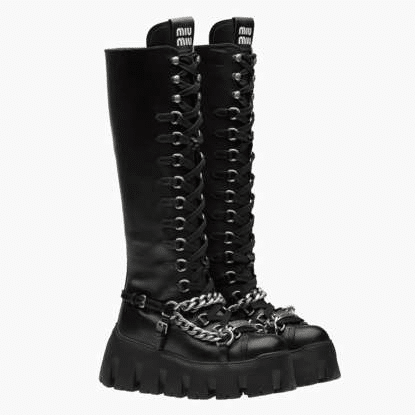
These leather boots from Miu Miu are some of the most expensive shoes available
Founded by Miuccia Prada in 1992, Miu Miu is famed for its subversive and contemporary takes on traditional feminine clothing. However, the brand still retains the high prices of its parent company, the Prada Group. These leather boots, complete with an oversized rubber sole and decorative metal chain, cost US$2,050.
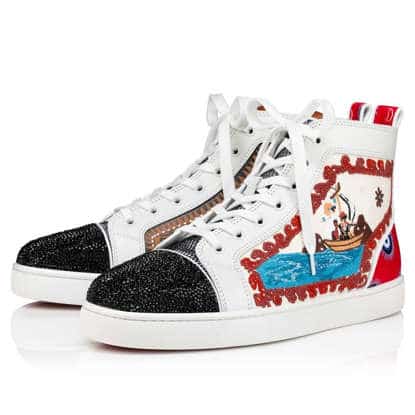
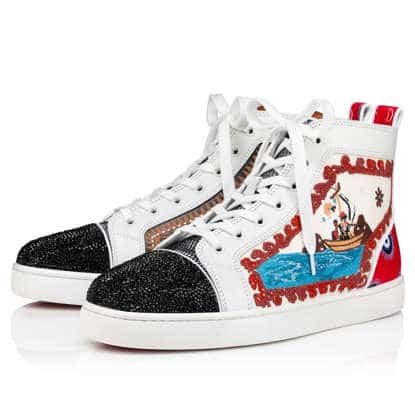
The No Limit Greek high-top sneaker from Christian Louboutin is one of this season’s most costly shoes
Expelled from school at 16, Christian Louboutin didn’t always have a smooth journey to becoming a star shoe designer. Yet, his footwear label is now one of the most recognizable (and expensive) in the world. These No Limit Greek high-top sneakers are no exception. Made from calf leather, suede, mesh and a graphic evil-eye-inspired print, the shoes also feature the unmistakable Louboutin red sole and ornate embroidery inspired by Ancient Greece. The price? A princely US$2,495.
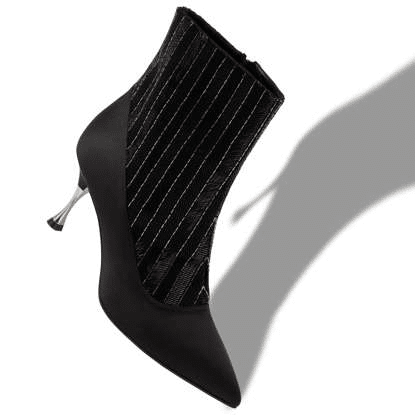
The expensive Zuelana boots from Manolo Blahnik cost more than US$2,500
Famed for his passion for heels and his commitment to hand-made models, Manolo Blahnik has been a favourite designer of Hollywood stars and fashion editors since the 1970s. Inspired by his love of Sicily and his admiration for the elegant and austere work of author Giovanni Verga, these black satin and sequin boots call to mind restrained femininity and modern menswear. The simplicity of this shoe clearly comes at a price, though—retailing at US$2,595, to be exact.
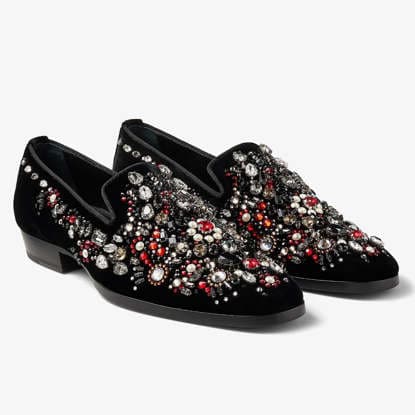
These jewelled Jimmy Choo evening shoes could set you back over US$4,000
From Princess Diana to Carrie Bradshaw, Jimmy Choo has designed shoes for some of the most recognizable faces in fashion. Although the renowned shoemaker doesn’t design custom footwear for everyone, style aficionados can own a pair of his creations for a price. The SAUL evening slip-on shoes are made from velvet and feature jewelled crystal mix detailing. The glamour comes at a price, though—any potential customer will need to foot a bill of US$4,595.
The self-lacing Nike Air MAG from ‘Back to the Future Part II’ is worth at least US$100,000
Twenty-two years after their appearance in Back to the Future Part II, the Nike Air MAG finally became available to buy in 2011. Although the initial model didn’t feature the futuristic patented sneaker’s auto-lacing technology, a pair still boasts an average resale value of US$8,593. A second model (complete with the auto-lacing system) was released in 2016 with 89 pairs produced and raffled off in aid of the Michael J. Fox Foundation. One pair of this model later sold for over US$100,000 at auction.
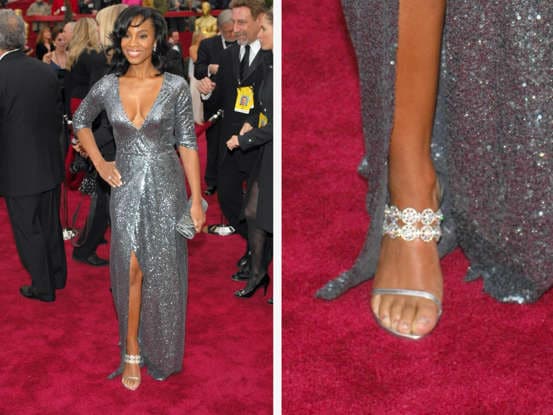
The expensive Diamond Dream Stilettos by Stuart Weitzman are valued at an incredible US$500,000
Stuart Weitzman is renowned in showbiz circles for his luxurious footwear designs. So, it’s no surprise that his Diamond Dream Stilettos are among the most expensive shoes in the world. Created for Dreamgirls star Anika Noni Rose, who wore them to the 2007 Academy Awards (pictured), the shoes are embellished with 30-carat diamonds arranged in two decorative platinum bands. In total, 1,420 individually cut diamonds are used—bringing the value of this pair of heels to a whopping US$500,000.
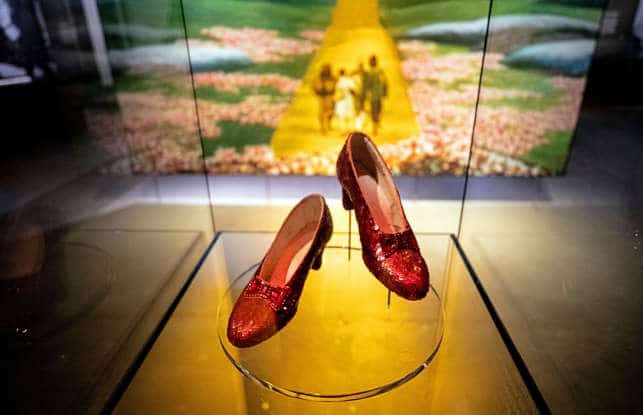
A pair of Judy Garland’s original ruby slippers from ‘The Wizard of Oz’ are now worth at least US$510,000
Arguably the most iconic shoes in Hollywood history, the ruby slippers worn by Dorothy in The Wizard of Oz now carry a hefty price tag. Five pairs are still known to exist—one is displayed at the National Museum of American History, while another has its home at the Academy Museum of Motion Pictures (pictured). Another pair was sold at auction for US$510,000 in 2011. Meanwhile, a fourth pair that was stolen (and then recovered) was estimated to be worth up to US$3 million.
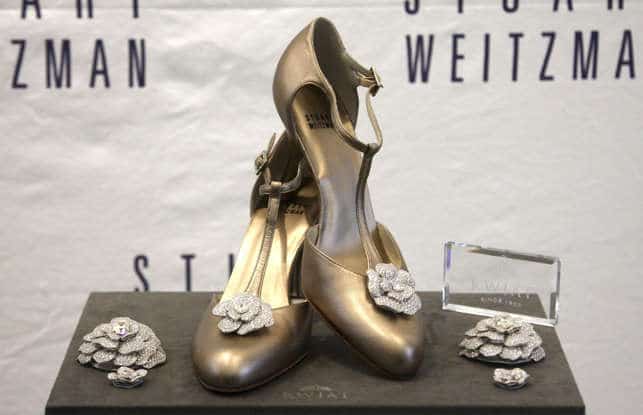
Stuart Weitzman’s diamond-encrusted Retro Rose Pump could cost you US$1 million
Stuart Weitzman is no stranger to designing some of the fanciest—and most expensive—shoes in the world. In 2008, he created yet another masterpiece: the Retro Rose Pump. The vintage-inspired, diamond-encrusted stilettos were estimated to be worth US$1 million at the time. The designer selected Oscar-nominated screenwriter Diablo Cody to wear the shoes on the red carpet. However, Cody refused to wear them, calling the offer “a lame publicity stunt.”
Source: MSN.COM
DISCLAIMER: Independentghana.com will not be liable for any inaccuracies contained in this article. The views expressed in the article are solely those of the author’s, and do not reflect those of The Independent Ghana
Lawyer Moses Foh-Amoaning, Executive Secretary of the National Coalition for Proper Human Sexual Rights and Family Values has said that he is in full support of the General Legal Council’s decision to put on hold the call to the Bar of YouTuber Elorm Ababio, a.k.a Ama Governor.
According to him, one does not become a lawyer just because s/he has passed an examination but also because the person is of good character, as stated in the 1992 Constitution of Ghana.
In a Neat FM interview monitored by GhanaWeb, Foh-Amoaning intimated that calling Ama Governor to the Bar means that the Council will be condoning her LGBTQ+ preferences, which she has wildly professed contrary to the laws of the country.
“In Ghana, if you take a look at Act 32, to be called a lawyer, it is not just that you have passed your exams; you must be of a said good character.
“We know that in Ghana, it is not good behaviour for persons of the same sex to have sexual intercourse and for them to marry. So, if you are engaged in such an activity, we know you are not of good character, so you can’t be called to the Ghana Bar,” he said in Twi.
Foh-Amoaning also warned that Ghana had to be careful because proponents of LGBTQ+ activities are trying very hard to indoctrinate their values in the country.
Elorm Ababio, a student who just completed the Ghana School of Law (GSL), will not be called to the Ghana Bar due to a petition filed against her by a “concerned citizen”.
The complaint, according to the letter signed by Justice Cynthia Pamela A. Addo JA, Secretary, General Legal Council (GLC), stated that Ama Governor is seen in widely circulated videos engaging in what it describes as “conduct unbecoming of an applicant to be called to the Bar”.
The Complainant, the GLC Secretary, indicated, also submitted a flash drive [pen drive] which contains selected video files and hyperlinks of Ama Governor to relevant website publications.
Ama Governor’s conduct is said to violate Regulation 21(c) of the Legal Profession (Professional and Post-call Law Course) Regulations, 2018 L.I. 2355.
The said Regulation states: “A student of the school qualifies to be called to the Bar if that student has […] (c) satisfied the Council that the student is of good character.”
The Council, Justice Cynthia Pamela A. Addo JA said had thus decided:
“1. To constitute a three-member Committee to investigate the complaint and advise Council accordingly.
“2. To suspend the decision to call you [Ama Governor] to the Bar pending the outcome of the investigation.
“I have been directed by the Chairperson of the General Legal Council to inform you of this matter and to advise you to expect to be contacted by the Committee in due course.”
“You will be given a fair hearing on the complaint before a decision is arrived at,” Justice Cynthia Pamela A. Addo JA’s letter dated November 3 concluded.
A former Chief Justice of Ghana, Justice Sophia Akuffo, has called for a focus to also be placed on discussions of subjects related to refugees in the country when issues of human rights are being discussed.
The former head of the judiciary explained that issues concerning refugees should be given attention because a lot of them also concern human rights.
She made this known when she addressed the maiden public lecture series of the Central University’s Faculty of Law on Reflections on the Law on Wednesday, November 2, 2022.
“Many times, we forget that refugee-ism also raises a lot of human rights issues. And when we are talking about human rights, we must never forget about refugees,” she said.
The public lecture was on the topic, “The Enforcement of Human Rights in Africa.”
To guarantee a seamless delivery of the Livelihood Empowerment Against Poverty (LEAP) cash grant to beneficiary households in Ghana, the Ministry of Gender, Children, and Social Protection has organized workshops on the LEAP payment process and performance for key stakeholders in Volta and Eastern Regions.
The LEAP programme disburses cash grants to beneficiary households to reduce poverty by smoothening consumption and promoting human capital development.
The workshop ensured stakeholders at the national, regional, and district levels have an enhanced understanding of the Programmes Payment processes, objectives, guiding principles, and goals.
As part of the LEAP payment process, the LEAP Management Secretariat will employ zoning strategies to engage sub-national level structures tasked with implementing LEAP at various levels.
It is expected that stakeholders in the LEAP Payment process will understand payment targets, measure the performance of the payment delivery chain and obtain inputs to renew the payment contract.
Participants from the Greater Accra, Oti, Volta, Western, Central, and Eastern Regions were drawn from the Ministry of Finance, Controller and Accountant Generals Department, and the Department of Social Welfare.
The rests are representatives from Ghana Interbank Payment and Settlement Systems (GHIPSS) and Participating Financial Institutions (PFI).
The World Bank funded the stakeholders’ engagement workshop under the Ghana Productive Safety Net Project (GPSNP).
The Deputy Minister of Information, Fatimatu Abubakari, has opened up about her childhood, describing how she used to work with her mother in a chop bar as an 8-year-old girl.
She explained that it was from working in such a place at a very young age that she was exposed to human relations and interacting with people from all walks of life.
She added that unbeknownst to her, she was preparing herself for a life in communication and law, which today is her life.
Speaking at the Power of a Girl Conference organized by Power To Girls GH to mark this year’s International Day of the Girl Child, the deputy minister said that she didn’t start out big.
“I was born in Moshi Zongo in Kumasi and I attended Foundation of Jesus Preparatory School in Kumasi, and also Bukrom MA JHS in Kumasi, and then I attended Kumasi Academy, also in Kumasi before I came to University of Ghana for my first degree in psychology and subsequently for my law degree. And then I went to the Ghana School of Law and then I’m back on the road, thinking about my LLM and by the grace of God, hopefully start a PhD program.
“All that I want you to take from all these things I’m mentioning is that I never started big. I didn’t even start as the most intelligent person in my school; I took baby steps, starting with my passion,” she said.
Fatimatu Abubakari added that in the days that she worked in her mother’s chop bar, she endeared the hearts of many people because of how opinionated and knowledgeable she was, even as a little girl.
She added that eventually, she was nicknamed ‘lawyer,’ a tag that has followed her till today and as such, she encouraged parents not to shut up their outspoken and opinionated children because it could just be the thing they need to be properly set up in life.
“… when I was younger, I was a born advocate – I was a talkative. I didn’t know anything about communication but my mom had a chop bar at Kumasi and I started working at the chop bar at age 8.
“So, I talk to everybody and anybody. I was very social growing up so they just gave me a nickname, ‘lawyer,’ because anything you want explanation for, if you called Fati, I have answers for everything and I know there are sisters or daughters here that when they start talking, they will say ‘You, shut up. Everything you have answers to it,’ ‘Ei this girl is a talkative o.’ it’s good to express yourself and maybe, it is even going to lead you to a career,” she explained.
The Deputy Minister of Information also talked about other passions that she developed as a child that have continued to guide her life and provide a source of income for her.
This year’s Power of a Girl Conference was themed: ‘Girl Force, Unscripted and Unstoppable’.
Ghanaiansare presently facing unprecedented economic hardship. Days ago, our Finance Minister , the authority around which our economy revolves, has suggested that “Ghana needs a miracle”. Doesn’t that indicate the direness of our economic downturns? Some may have decided to live in denial, but we have surely moved from being on a “treadmill” to getting on a slippery slope and going down hill.
Indeed we need a miracle, perhaps the reason our decision makers have remained entrenched in their position about building a ” cathedral” for “God” who has uncountable homes here in Ghana, Africa, the world and most importantly has our hearts to live in. Yes we have been made to believe God desperately needs a home. More urgent that classrooms for schools under trees. God will always bless Ghana.
But in fairness, do you agree that God may firstly consider doing a miracle in the well endowed and poverty-stricken Central AfricanRepublic a “more Christian” or religious country before Ghana gets her share of economic recovery miracles? Or may be it is true,just like most preachers have suggested,”Ghana is chosen”,and as God’s favorite,we will receive our miracle regardless of the long queue of more Christian and religious nations because of “grace” and “favor”.
How much more entitled can we even feel? Expecting God to fix problems created by us? The right thing would have been for our soft spoken minister to have fallen on his own sword for others to inject fresh ideas but..
Some have likened today’s hardship to that which was documented in 1983-1984.These economic decline goes with a domino effect.Of the many negative ripple effects, Ghana faces the threat of Human Capital Flight/ Brain Drain. Human Capital Flight is the emigration or immigration of professionals and educated from one country to the other.
Imminent is a significant exodus of Ghanaian Youths and younger adults to destinations in America, Europe,Australia,parts of Africa and more.Although the said destinations may have their challenges (sting of COVID-19 and Russia and Ukraine War), they remain preferable as the fate of our country and our economic recovery lies in a balance.
There is currently a passport booklet shortage but records indicate close to about 100,000 applications are pending.On a daily basis more people besiege passport offices all over the country.Ghana may soon join Ethiopia,Nigeria,Kenya,China.Mexico,Malaysia,Iran as part of the countries with huge brain drain.
Countries that receive these hordes of professional Ghanaians eventually experience “Brain Gain”. Ghana loses a lot of its quality human Capital to other nations.Many Ghanaians who have travelled out have naturalized over time and some hold dual citizenship.As nationals of other countries also walk into the country and are able to acquire Ghanaian passports and Ghanacards through inappropriate means, Ghanaians could also afford themselves the experience of migration.
In a world where technology and innovation is bolstering economic growth,Ghana may face more stagnation,higher cost of living and a further dip in economic growth through brain drain.
Saint Augustine has said before that “the world is a book,and those who do no travel read only one page”.However, as Ghana goes through changes should she lose her beautiful children to the world ? Who takes care of poor, ageing unprepared Ghana when her children who are her social security are being chased away from her?
Long Live Mother Ghana
Author: Charles Dumenu
Source: The Independent Ghana
DISCLAIMER: Independentghana.com will not be liable for any inaccuracies contained in this article. The views expressed in the article are solely those of the author’s, and do not reflect those of The Independent Ghana