
Tag: Iberian peninsula

  • Portugal fights wildfires during the third heatwave of the year

    Portugal fights wildfires during the third heatwave of the year

    In Portugal, thousands of hectares of wildfires are burning, and firefighters are struggling to put them out despite the extreme heat.

    Over 1,400 people had to be evacuated due to a fire that was near the southern town of Odemira overnight on Monday.

    Injuries sustained while fighting the fires total at least nine firemen.

    Much of the Iberian peninsula is likely to experience temperatures above 40C (104F) this week.

    Although three large fires that charred hundreds of hectares of land in Spain over the weekend have been put out, weather alerts are still in effect for much of the nation.

    The highest recorded temperature of the year so far for Portugal was 46.4C (116F) on Monday in Santarém.

    Strong winds caused the fire at Odemira to spread southward into the steep heart of the Algarve, Portugal’s most popular tourist destination, on Saturday.

    About 6,700 hectares (16,600 acres) of land have been damaged so far, and 19 towns, four hotels, and a campground have all been evacuated.

    Helder Guerreiro, the mayor of the municipality, has described the situation as “critical, difficult, and complex.”

    Other significant fires in the country’s middle forced the closure of various sections of highway, notably the A1 between Lisbon and Porto.

    To assist with fighting fires in the two areas, sixteen waterbombing aircraft have been sent.

    More than 120 municipalities in Portugal have been classified as having the highest wildfire danger by the authorities.

    On Saturday and Sunday, fires in Spain charred more than 1,000 hectares (2,470 acres) of land near the southern Spanish coastal cities of Cadiz and Huelva as well as in the northern Catalonia region.

    The heatwave that will hit the Iberian peninsula this week will be the third to do so this summer.

    It was brought on by a significant body of hot, dry air from North Africa, according to Ruben del Campo of Spain’s State Meteorological Agency, and would be “generally more intense, more widespread, and a little longer-lasting” than the two that struck in July.

    The likelihood of hot, dry weather, which is prone to start wildfires, is increasing due to climate change.

    Since the start of the industrial age, the world has already warmed by around 1.1C, and temperatures will continue to rise unless governments drastically reduce emissions.
  • Swimmers scream in terror after seeing two sharks off Spanish beach

    Swimmers scream in terror after seeing two sharks off Spanish beach

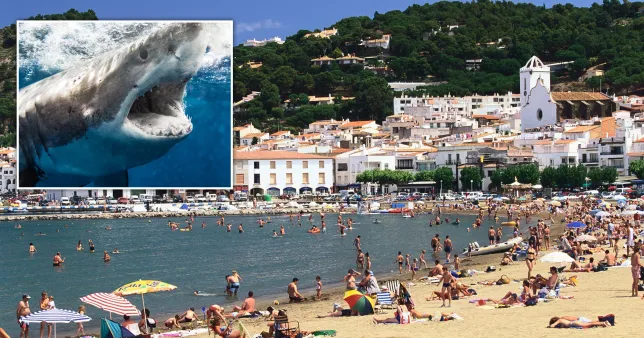
    Upon spotting two sharks near to the coast, lifeguards at a well-known Spanish beach warned swimmers to leave the water.

    The two predators had arrived on Monday at the picturesque El Port de la Selva beach on the Costa Brava in the extreme northeast of Catalonia, where they startled swimmers.

    The first to spot ominous fins piercing the water’s surface were people canoeing away from the beach. They immediately notified the neighbourhood lifeguards, who then raised the red flag.

    Agents from Civil Protection took a look around after everyone had left to see if they could locate the creatures, which were believed to be blue sharks.

    The swimmers went back into the ocean when they were unable to find any sign of them.

    That is, until the sharks were spotted once more barely 30 minutes later.

    Locals and visitors splashed their way out of the water once more, but authorities

    On June 21, one was seen on camera leaving a pier on the island of Arousa, which is located on the other side of the Iberian peninsula from El Port de la Selva in the Galician province of Pontevedra.

    On the Costa Brava in Catalonia, Spain, El Port de la Selva is a municipality in the Alt Empord comarca.
    This year, there have been numerous sightings around the Spanish coast, including this one in El Port de la Selva (Image: Getty Images).

    Within a week, a shark had been spotted four times in the waters around Spain.

    Among the others was a fully developed, seven-foot blue shark that sparked fear south of the well-liked vacation spot Alicante.

    Despite having a frightening appearance, blue shark attacks on people are extremely uncommon.

    One was spotted in the water over the weekend at Le Barcarès, a French community located not far up the coast from El Port de la Selva.

    In a statement to The Times, lifeguard chief David Simian said: “Lifeguards got a boat out and realised it was a shark.

    It was a blue shark, which poses no danger to people.