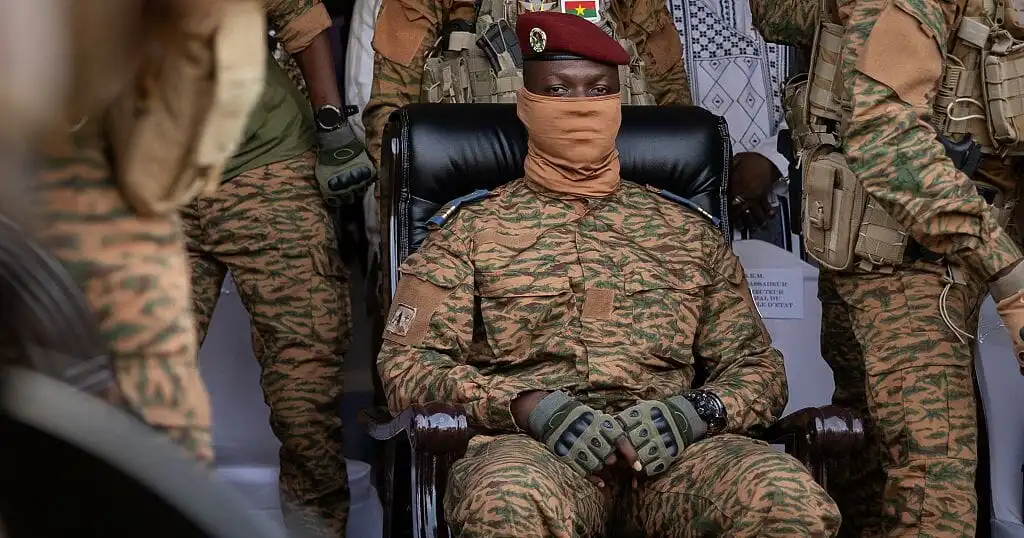
Tag: Ibrahim Traoré

  • Traoré gives assurances over relations with France despite troop exit

    Traoré gives assurances over relations with France despite troop exit

      Burkina Faso’s military leader, Ibrahim Traoré, has said there has been no break in diplomatic relations with France.

      It comes after he asked the former coloniser to withdraw its forces. He also denied Russian Wagner mercenaries, a private army of Russian President Vladimir Putin, were active in the country.

      He said: “We’ve heard everywhere in the press that Wagner is in Ouagadougou. That’s also how we heard about it. I’ve asked some people who say, ‘Oh really? Where are they?’ 

      “We’ve since heard that they’re even in a hotel somewhere, we’re surprised to hear about that.”

      “There’s a general state of mind whereby if you deal with Wagner, everyone runs away from you, so it’s something which has been created in order that everyone shuns us – well congratulations, good job.”

      Former colonial power France had special forces based in Ouagadougou, but its presence had come under intense scrutiny as anti-French sentiment in the region grows, with Paris withdrawing its ambassador to Burkina Faso over the junta’s demands.

      Last month Paris confirmed the special forces troops, deployed to help fight a years-long jihadist insurgency, would leave within a month.

      However, Ibrahim Traoré insisted diplomatic relations were unharmed.  

      “The French embassy is here,” He said. “French nationals are here, just as ours is there, so diplomatically nothing has changed. 

      “This is about an agreement over military presence, and as they have said, our sovereignty is up to us, so that’s what we are expressing through our denunciation of this agreement. So there is no breaking off of diplomatic relations, or hatred of any particular country.”

      Protests demanding the departure of French troops have continued in the country despite assurances they would leave anyway.

      Thousands of civilians, troops and police have been killed in Burkina Faso, more than two million people have fled their homes and around 40 percent of the country lies outside the government’s control.

      Anger within the military at the mounting toll sparked two coups in 2022, the most recent of which was on September 30, when 34-year-old Traoré, seized power.

      Source: Africa News
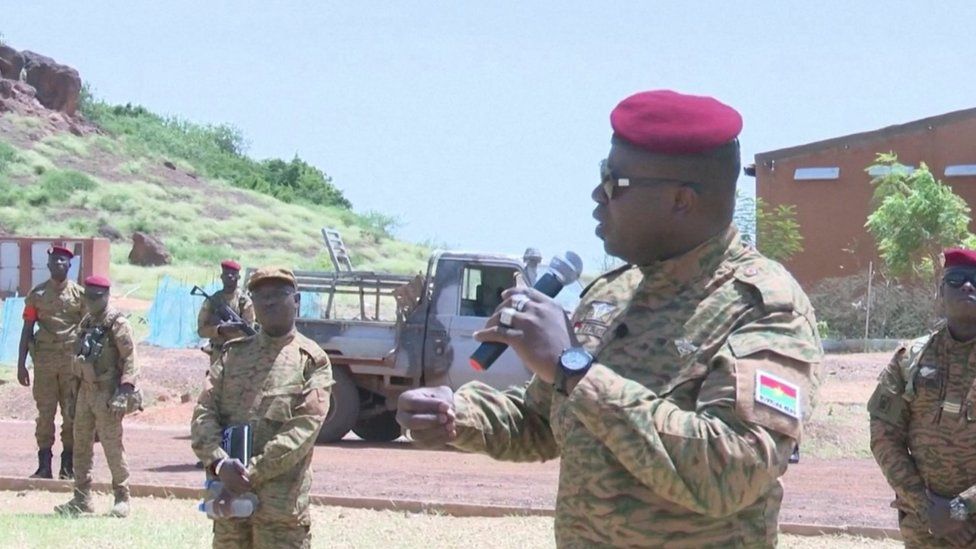
    • Akufo-Addo and 11 African leaders twice as old as new Bukinabe president

      Burkina Faso as of October 3 had a new president despite last holding an election in November 2022.

      Ibrahim Traore, rose to the high office of president and Supreme Leader of the Armed Forces after leading a coup that ousted his former boss Lt. Col. Sandaogo Damiba.

      Traore, at the age of 34 became the world’s youngest president, two years behind the democratically-elected Chilean president, Gabriel Boric.

      The new Burkinabe president would hardly have made it to the presidency if he tried getting there via the ballots.

      A testament to this is the fact that whereas Africa boasts a young population, it has managed to produce some of the oldest leaders.

      At 34 years, Traore is in some case younger that children of some African presidents.

      This article looks at some African leaders whose age is double or more than twice that of their newest counterpart in the arid West African country suffering a Sahel security crisis.

      List of African leaders who are twice as old as Ibrahim Traore

      a. Joao Lourenco of Angola – 68 years

      b. Cyril Ramaphosa of South Africa – 69 years

      c. Abdelmajid Tebboune of Algeria – 76 years

      d. Muhammadu Buhari of Nigeria – 77 years

      e. Alassane Ouattara of Ivory Coast – 78 years

      f. Nana Addo Dankwa Akufo-Addo of Ghana – 78 years

      g. Denis Sassou Nguesso of Republic of Congo – 78 years

      h. Yoweri Museveni of Uganda – 78 years

      i. Theodore Obiang Nguema of Equatorial Guinea – 80 years

      j. Emmerson Mnangagwa of Zimbabwe – 80

      k. Hage Geingob of Namibia – 81 years

      l. Paul Biya of Cameroon – 87 years

    • Burkinabés rally in support of new Burkina Faso leader

      Burkinabés gathered in the capital of Burkina Faso on Thursday to show their support for the country’s new junta leader, as rumours swirled of internal divisions in the army.

      Ibrahim Traore was declared president on Wednesday after a two-day standoff that ousted Lieutenant-Colonel Paul-Henri Damiba, who had seized power only in January.

      Traore was at the head of a core of disgruntled junior officers — but there were rumours just a few days later of discussions among some other army generals over potentially replacing him.

      A crowd of several hundred people, mostly young men, gathered in front of the national radio and television centre in the city.

      “We have learned that the generals are in consultation to appoint one of them in place of Captain Traore. It will not do! Not today, not tomorrow,” said one of those rallying, trader Amadou Congo.

      Rumours circulating in Ouagadougou claimed there was a division between the junior officers represented by Traore and the high-ranking officers who moved in the same circles as Damiba.

      After an hour of protesting a soldier sought to calm the crowd, and the new government denied rumours of a split.

      “Information which has been circulating since this morning on social networks about generals meeting… is unfounded” according to a statement released by the communication ministry.

      Calm has generally returned to the streets of Ouagadougou since last Friday’s coup and the turbulent weekend that followed.

      Traore graduated as an officer from Burkina Faso’s Georges Namonao Military School — a second-tier institution compared to the prestigious Kadiogo Military Academy of which Damiba and others in the elite are alumni.

      Some of the protesters were waving Burkina or Russian flags — with speculation rife that Burkina’s new leader may follow other fragile regimes in French-speaking Africa and forge close ties with Moscow at the expense of France.

      Source: Africanews

    • Ibrahim Traoré appointed President of Burkina Faso

      Captain Ibrahim Traoré has been appointed president of Burkina Faso.

      His appointment on Wednesday comes less than a week after the latest coup in the West African country, the second in less than nine months.

      “The President of the Patriotic Movement for Safeguarding and Restoration (MPSR) will serve as Head of State and Supreme Commander of the National Armed Forces. He is the guarantor of the independence of the judiciary. If the President is unable to act, his powers are exercised by the First Vice-President and, if necessary, by the Second Vice-President”, said Captain Kiswendsida Farouk Azaria Sorgho, spokesperson for the Patriotic Movement for Safeguarding and Restoration (MPSR), speaking on national television.

      Burkina Faso plunged into turmoil last weekend when Lieutenant-Colonel Paul-Henri Sandaogo Damiba — who had seized power in January — was toppled by newly emerged rival Ibahim Traoré who headed a faction of disgruntled junior officers.

      Earlier this week, delegates from the Economic Community of West African States (ECOWAS) visited the country on a fact-finding mission and held meetings with religious and traditional leaders as well as the new military ruler.

      Source: Africanews

    • Who is Ibrahim Traoré, the leader of the coup in Burkina Faso?

      Captain Ibrahim Traoré, the head of Burkina Faso’s new junta and the youngest leader in the country, is a combat-tested soldier who has grown increasingly critical of his predecessor’s “unsuccessful policies” against the Islamic State and al-Qaeda extremists.

      Capt Traoré toppled Lt Col Paul-Henri Damiba on 30 September, marking the country’s second military coup this year that could slow down an eventual transition to civilian rule.

      Capt Traoré, 34, began his military career in 2009 and has served in various contingents in Burkina Faso’s volatile eastern and northern theatres.

      He was among a group of soldiers who backed Lt Col Damiba’s 24 January coup against democratically-elected President Roch Kaboré. However, eight months later, divisions emerged in the junta known as the Patriotic Movement for Preservation and Restoration (MPSR).

      Various tactics applied by Lt Col Damiba’s interim military administration – including reforms to a pro-army self-defence force, the appointment of military governors to violence hotspots, and heightened operations in the north and east – have failed to curb deadly militant attacks against civilians and security forces.

      According to conflict data analysts ACLED Info, Burkina Faso replaced neighbouring Mali as the epicentre of militant violence this year, leading to protests demanding Lt Col Damiba’s resignation.

      While the counter-coup was surprising, Burkina Faso’s army has long grappled with mistrust and disaffection since the failed coup of 2015 that led to the disbandment of an elite force.

      The morale of security forces has been further blighted by persistent insurgent attacks and poor working conditions, particularly in volatile borderlands.

      In the immediate aftermath of Capt Traoré’s power grab, a war of words ensued between his faction and that of Lt Col Damiba, raising fears of a violent power struggle.

      Lt Col Damiba’s resignation on Sunday put Capt Traoré firmly in charge of a fragmented army struggling to face a brutal insurgency that continues to destabilise vast parts of Burkina Faso and the wider Sahel.

    • Burkina Faso coup: Ecowas blasts military takeover

      The country’s neighbours have blasted Friday’s alleged coup, calling it “inappropriate” for army rebels to take control when efforts were being made to impose civilian authority.

      The removal of leader Lt Col Paul-Henri Damiba was deemed “unconstitutional” by regional organization Ecowas.

      This is the second time this year the country’s army has seized power.

      Both times, the coups’ leaders said they had to step in because national security was so dire.

      Burkina Faso controls as little as 60% of its territory, experts say, and Islamist violence is worsening.

      Flanked by rebel soldiers in fatigues and black facemasks, an army captain announced on national TV on Friday evening that they were kicking out junta leader Lt Col Paul-Henri Damiba, dissolving the government and suspending the constitution.

      Ibrahim Traoré said Lt Col Damiba’s inability to deal with an Islamist insurgency was to blame.

      “Our people have suffered enough, and are still suffering”, he said.

      He also announced that borders were closed indefinitely, a nightly curfew was now in place from 21:00 to 05:00, and all political activities were suspended.

      “Faced with the deteriorating situation, we tried several times to get Damiba to refocus the transition on the security question,” said the statement signed by Traoré.

      “Damiba’s actions gradually convinced us that his ambitions were diverting away from what we set out to do. We decided this day to remove Damiba,” it said.

      Since the takeover, there has been no word on the whereabouts of the ousted leader.

      Lt Col Damiba’s junta overthrew an elected government in January citing a failure to halt Islamist attacks, and he himself told citizens “we have more than what it takes to win this war.”

      But his administration has also not been able to quell the jihadist violence. Analysts told the BBC recently that Islamist insurgents were encroaching on territory, and military leaders had failed in their attempts to bring the military under a single unit of command.

      On Monday, 11 soldiers were killed when they were escorting a convoy of civilian vehicles in Djibo in the north of the country.

      Earlier on Friday, Lt Col Damiba urged the population to remain calm after heavy gunfire was heard in parts of the capital.

      A spokesman for the ousted government, Lionel Bilgo, told AFP news agency on Friday that the “crisis” was, in essence, an army pay dispute, and that Lt Col Damiba was taking part in negotiations.

      But since Friday evening Lt Col Damiba’s whereabouts are unknown. France is a traditional ally, but French diplomatic sources have told RFI radio that Lt Col Damiba is not with them nor is he under their protection.

      The United States said it was “deeply concerned” by events in Burkina Faso and encouraged its citizens to limit movements in the country.

      “We call for a return to calm and restraint by all actors,” a State Department spokesperson said.

      The Economic Community of West African States (Ecowas) has condemned the move, stating it “reaffirms its unreserved opposition to any taking or maintaining of the power by unconstitutional means”.

      President of Burkina Faso Lieutenant Colonel Paul-Henri Damiba visits 14th Inter-Arms Regiment soldiers in Djibo, Burkina Faso
      IMAGE SOURCE, REUTERS Image caption, Lt Col Damiba urged the population to remain calm after heavy gunfire was heard in parts of the capital on Friday

      In January, Lt Col Damiba ousted President Roch Kaboré, saying that he had failed to deal with growing militant Islamist violence.

      But many citizens do not feel any safer and there have been protests in different parts of the country this week.

      On Friday afternoon, some protesters took to the capital’s streets calling for the removal of Lt Col Damiba.

      The Islamist insurgency broke out in Burkina Faso in 2015, leaving thousands dead and forcing an estimated two million people from their homes.

      The country has experienced eight successful coups since independence in 1960.