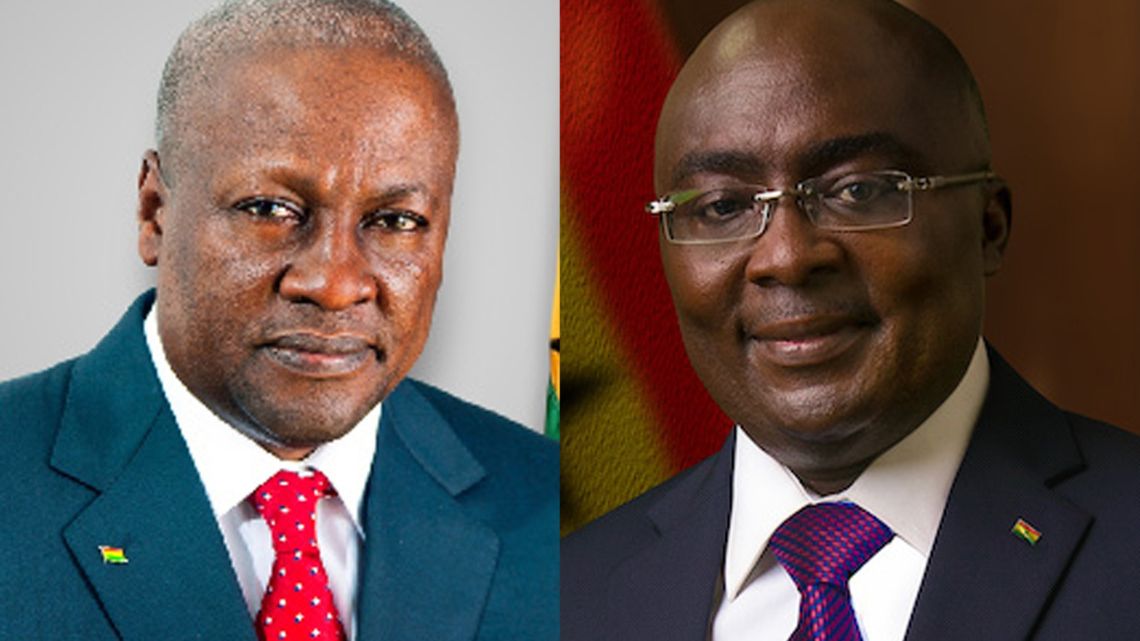
Tag: IEA

  • Returning to IMF would erode your legacy – IEA Fellow to President Mahama

    Returning to IMF would erode your legacy – IEA Fellow to President Mahama

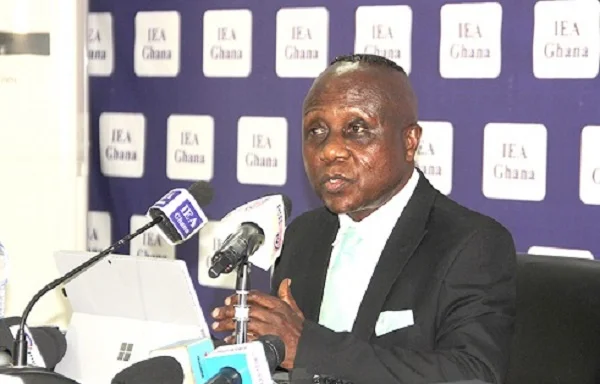
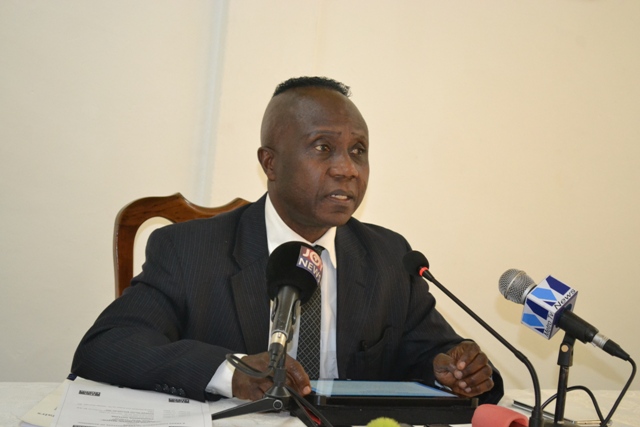
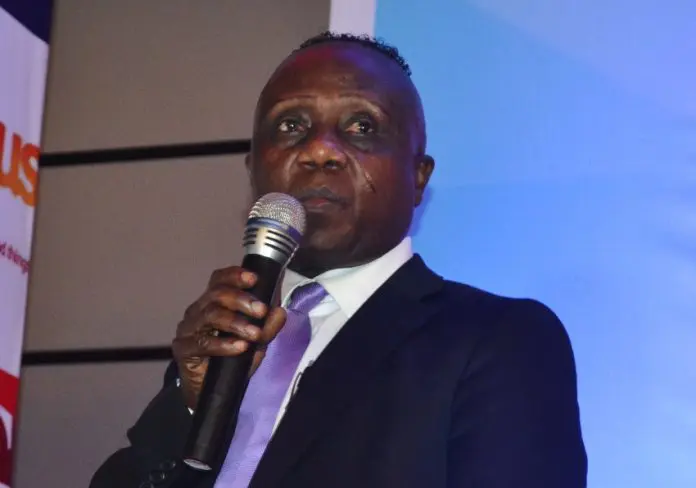
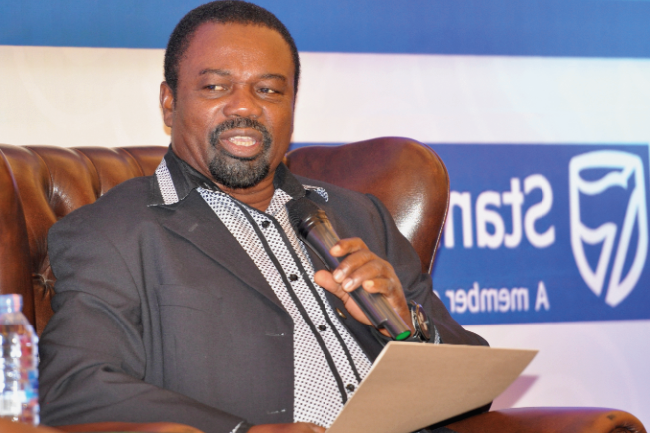
    A senior fellow at the Institute of Economic Affairs (IEA), Dr. Vladimir Antwi-Danso, has urged President John Dramani Mahama to implement strategies that will prevent the country from depending on the International Monetary Fund (IMF).

    Engaging the media, he emphasized that President Mahama must adopt bold and corrective measures if he hopes to leave a long-term legacy.

    “The president has given indication that it is a legacy term. If it’s a legacy term then I suspect he must put things right so we don’t go back. It is a routine ritual, this is the 17th and there is no indication that this is going to be the end. It is because of the spending spree especially during election years,” he said.

    He has advised the government to prioritize local production as a strategy to boost economic growth.

    He warned that failure to adopt this approach could lead to further depreciation of the local currency in December.

    Speaking at a press briefing in Accra on Tuesday, May 27, he noted that the appreciation of the Ghanaian cedi could be temporary.

    “Our forex appreciating and the cedi also appreciating is not the answer; you must do more. You must try and be an export economy. That is the only way you stabilize your economy. That is the only way you make the other currency lower.

    “What we are doing is that we are not stablising permanently. We will relapse. By December I believe that we will relapse. And this is coming from a technical point of view and not political. What I am saying is that it is not yet hurray,” he stated.

    Meanwhile, President John Dramani Mahama has revealed that the cedi’s continuous appreciation is having a positive impact on the government’s efforts to settle its colossal debt.

    Speaking at a high-level presidential session at the 60th Annual Meeting of the African Development Bank (AfDB) and the 51st Annual Meeting of the African Development Fund (ADF) in Abidjan, the President indicated that about GH₵150 billion has been slashed as a result of the local currency appreciating.

    “Also, increasingly, one of the push factors for the debt is the value of the local currency; our debts continue to multiply because the cedi continues to grow weaker, and so we need more cedi because our public debt is stated in cedis, the weaker the cedi becomes against the foreign currencies, the higher it pushes up the debt.”

    “Fortunately, some measures we put in place have recently begun to show results, and the cedi has been strengthening, and so we have reduced our total debt over the last five months by almost 150 billion Ghana cedis,” he noted.

    In April and May this year, the local currency has appreciated by 19% as per information released by the Bank of Ghana (BoG).

    As of Friday, May 26, the average interbank rates used by commercial banks for transactions at the close of business showed the US dollar buying at GH₵10.39 and selling at GH₵10.40.

    The British pound is buying at GH₵14.09 and selling at GH₵14.11. The euro is currently being bought at GH₵11.82 and sold at GH₵11.83.
  • Mining laws must be revised for greater economic benefits – Sophia Akuffo

    Mining laws must be revised for greater economic benefits – Sophia Akuffo

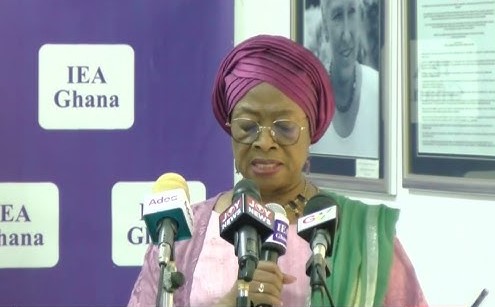
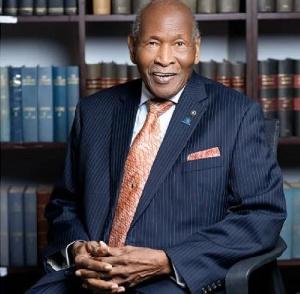
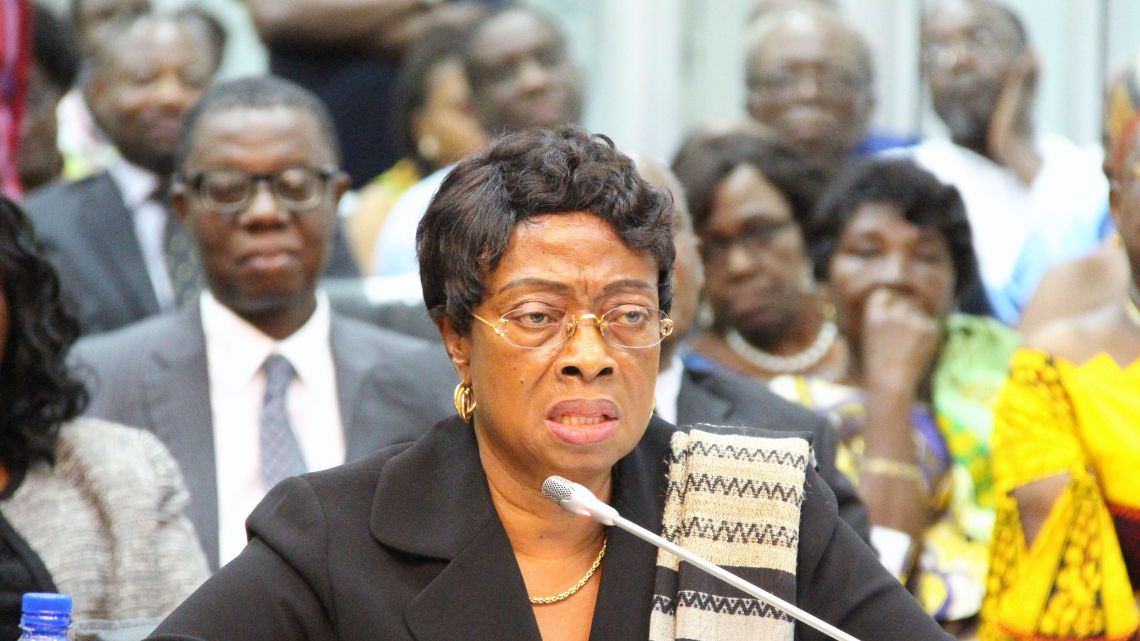
    Former Chief Justice and Distinguished Fellow of the Institute of Economic Affairs (IEA), Justice Sophia Akuffo, has called for a thorough reassessment of Ghana’s mining agreements to secure greater economic benefits for the country.

    She contends that the current arrangements resemble outdated colonial-era contracts, allowing foreign companies to amass significant profits while Ghana receives only a fraction of the returns.

    Addressing a press conference on maximizing the benefits of Ghana’s natural resources, Justice Akuffo stressed the urgency of policy reforms to promote local value creation and foster economic growth.

    “There is a need to set up a small committee of about five experienced Ghanaian experts in the natural resources sector to review and recommend necessary amendments to all natural resource laws in Ghana to optimize the benefits of natural resources to the country,” she stated.

    She further recommended a revision of the “Minerals and Mining Act, 2006 (Act 703),” advocating for provisions that would transfer the management of certain mineral resources to local authorities.

    “The Act should contain a provision that moves the management of some mineral resources to local governments such that District Assemblies are directly involved in the management of these resources,” she proposed.

  • Plugging tax loopholes is key to Ghana’s economic recovery – John Kwakye to Mahama

    Plugging tax loopholes is key to Ghana’s economic recovery – John Kwakye to Mahama

    Director of Research at the Institute of Economic Affairs (IEA), Dr. John Kwakye, has urged the Mahama-led government to address tax evasion loopholes and eliminate unnecessary spending.

    Dr. Kwakye highlighted that these steps would compensate for any revenue shortfalls resulting from the proposed tax cuts.

    In a statement on X (formerly Twitter) on Sunday, February 16, he said,“Plugging tax loopholes and cutting expenditure waste will be enough to compensate for intended tax eliminations.”

    President John Dramani Mahama also emphasized the need to strengthen Ghana’s Fiscal Responsibility and Public Financial Management Acts, stressing the importance of curbing waste and tackling corruption.

    During his address at the Africa Business Forum 2025 in Addis Ababa, Ethiopia, on Monday, February 17, Mahama reaffirmed the critical role these reforms play in ensuring the country’s financial health.

    “We need to cut out waste and reduce corruption. These are some of the critical issues that must be addressed.”

  • Declare an immediate national emergency to rescue Cedi – IEA director to Akufo-Addo

    Declare an immediate national emergency to rescue Cedi – IEA director to Akufo-Addo

    Director of Research at the Institute of Economic Affairs (IEA), Dr. John Kwakye, has urged the government to declare an immediate national emergency to stabilize the cedi.

    According to Dr. Kwakye, a strong appreciation of the cedi is highly improbable, making it essential to gather collective expertise to address the issue.

    “The rate of depreciation of the cedi is alarming. We know that cedi significant cedi appreciation is nearly always unlikely. The government or the next government must declare an immediate national emergency to rescue the cedi, pooling together all minds,” he wrote on his X page.

    The Institute of Economic Affairs (IEA) has revealed that the cedi has depreciated by approximately 74% against the U.S. dollar over the last three years.

    The local currency declined by 30.0% in 2022, followed by a 27.8% drop in 2023, and has so far fallen nearly 29% against the dollar in 2024.

    The IEA described this decline as “significant by all standards.”

    They further cautioned that the cedi may face additional pressures through the year. Firstly, uncertainties surrounding the upcoming elections are likely to drive demand for the dollar as a safe asset.

    Secondly, the future of Ghana’s IMF program remains uncertain amid the elections, which could heighten demand for dollars due to potential policy shifts under a new administration.

    Lastly, unresolved debt negotiations with non-Eurobond commercial creditors could delay future IMF disbursements and reduce foreign exchange inflows, tightening foreign currency supply in the economy.

    “Indeed, the Minister of Finance [ Dr. Mohammed Amin Adam] has announced that the IMF Board will carry out the third review of Ghana’s programme on December 2, 2024. This seems quite belated since staff completed their own review in early October [2024]”, the IEA added.

    The fourth is a subdued cocoa crop coupled with possible availability of limited syndicated loan in the face of COCOBOD’s expressed intention to shift to domestic financing of the crop.

  • Planned sale of Newmont’s Akyem Gold Mine violates legal norms – IEA

    Planned sale of Newmont’s Akyem Gold Mine violates legal norms – IEA

    The proposed sale of Newmont’s Akyem Gold Mine to China’s Zijin Mining Group for $1 billion has drawn fierce criticism from the Institute of Economic Affairs (IEA).

    The IEA contends that the transaction threatens Ghana’s economic interests and breaches key provisions of the mine’s lease agreement, set to expire in January 2025.

    In a press release dated Monday, October 21, 2024, the IEA raised concerns about the legality of the sale, noting that the original lease requires government approval for any ownership transfer, a requirement they assert has not been met.

    They called for prioritizing Ghanaian investors, echoing President Akufo-Addo’s stance on keeping the nation’s mineral wealth local.

    The IEA pointed to significant shortcomings in the original mining contract, such as insufficient royalties and taxes, and urged Parliament to block the sale.

    They highlighted the necessity of national ownership in the mining sector to ensure sustainable economic benefits for Ghana. 

    “If Newmont wishes to sell the mine, it must sell it to Ghanaian investors so that the wealth generated would remain in Ghana for the development of the country”

    The organization warned that permitting the sale would echo colonial-era agreements that favored foreign entities while leaving Ghana with minimal financial gain.

    They further argued that allowing Zijin to purchase the mine for $1 billion—funds that would go to Newmont—while merely paying royalties and taxes to Ghana would severely undercut the country’s financial interests.

    To remedy the situation, the IEA recommended that if Newmont is intent on selling the mine, it should be sold to Ghanaian investors to ensure that the resulting wealth remains in the nation.

    They also proposed a public-private partnership (PPP) involving the government and local businesses to facilitate the acquisition if needed.

    “Allowing Zijin to buy the mine for US$1.0 billion, which would accrue to Newmont, and presumably allowing Zijin to pay only royalties and taxes to Ghana, would…substantially shortchange the country,” it added.

    Additionally, the IEA called for an amendment to Article 257(6) of the Constitution, which currently vests control of Ghana’s natural resources in the President.

    They argued that these resources should instead be held by the state, with all major contracts requiring ratification by Parliament.

    “If Newmont wishes to sell the mine, it must sell it to Ghanaian investors so that the wealth generated would remain in Ghana for the development of the country”

    “The natural resources should rather be vested in the state and every contract should require Parliamentary ratification as per Article 268(1) of the Constitution.”

  • Newmont and Zijin agreement detrimental to Ghana’s interests – IEA

    Newmont and Zijin agreement detrimental to Ghana’s interests – IEA

    The Institute of Economic Affairs (IEA) has voiced concerns over the $1.0 billion sale of Newmont’s Akyem Gold Mine Project in Ghana to China’s Zijin Mining Group, labeling the deal as flawed in various ways, harmful to Ghana’s interests, and unacceptable.

    The institute stressed the need for Ghana to overhaul its approach to mineral contracts, advocating for greater ownership of its resources to generate jobs, wealth, and technical capacity for Ghanaians.

    “The IEA notes that the project lease was signed between the Ghana Government and Newmont on 19th January 2010 and has an expiry period of 15 years, that is valid until 19th January 2025. According to the terms, the lease is transferable within the duration period, subject to mutual agreement between the Government and Newmont. The lease is also subject to extension after its expiry date by mutual agreement. The lease has not yet expired and therefore, any decision by Newmont to sell the mine must be on a transfer basis and must be for the unexpired term only and subject to Government agreement”, it said in a statement.

    “At the end of the expiry period, Newmont is obliged to hand over the mine back to Government, the truthful owner of the gold under the assigned land. Any company that wants to operate the mine after the expiry date of the lease must sign a new agreement with Government”, it added. 

    The IEA also highlighted that no agreement has been finalized between Newmont and the government regarding the transfer of the mine to Zijin for the remaining duration of the lease, which ends on January 19, 2025.

    Furthermore, it stated that it has no knowledge of Newmont triggering the extension clause or of any government approval for such an extension.

    “The IEA wishes to point out that apart from Newmont, no other company has an original locus or right in the extension of the Lease”.

     Ghanaian Firms that Bid for Mine were Rejected

    “The IEA has learned that some Ghanaian entities also bid for the mine, but were allegedly outbid by Zijin. Allowing a foreign company to take over the mine would, however, be contrary to the President’s own position as he stated in his State of the Nation Address (SONA) in February this year: “We will engage with Newmont to give priority to Ghanaian investors who will want to acquire this mine to ensure that our mineral resources better benefit the Ghanaian people.”

    The question that the IEA asked is “What has changed now for the President to set aside his own principle and reject Ghanaian investors in favour of a foreign company?”

    Again, it said even Canada, where Zijin is also seeking to invest in the domestic critical minerals sector, and planning initially to buy a 15% stake in Canadian copper company, Solaris Resources, has decided to limit Zijin’s stake in the interest of Canadian national security.

    The IEA also emphasised that Ghana’s natural resources represent the low-hanging fruits for the acceleration of the country’s development and eradication of its endemic poverty.

    Therefore, to achieve these goals, Ghana should maximise the benefits from these natural resources and this can only be done by jettisoning colonial-type mineral contracts skewed in favour of foreign companies.

    The IEA reiterated that Ghana cannot afford to continue to sell its birthright cheaply to foreign companies—as it has been doing its entire history—only to descend on the companies’ capitals to beg for aid.

    “The usual excuse given by Ghanaian officials that the country lacks the requisite capital and expertise locally for exploiting its natural resources and, therefore, has to depend on foreign investors and compensate them accordingly is no longer tenable. Other countries with similar conditions as Ghana’s have been able to negotiate much better terms for the exploitation of their natural resources”, it alluded.

    IEA proposes 2 recommendations

    Finally, it proposed two fundamental proposals to help introduce sanity into the governance of Ghana’s natural resources and to reduce corruption.

    The first is to amend Article 257(6) of the Constitution that vests Ghana’s natural resources in the President on behalf of, and in trust for, the people, which seems to give him a carte blanche to sign the resources away at will.

    The second is to introduce in the Constitution or the Minerals and Mining Act, 2006 (Act 703) a provision that prohibits the government from signing contracts above a specified monetary value six months to the end of their four-year term. This will prevent incumbent administrations from signing eleventh-hour contracts in favour of their families, friends or cohorts, or for personal gain.

  • Cheddar pulls out from IEA’s presidential encounter 

    Cheddar pulls out from IEA’s presidential encounter 

    The Institute of Economic Affairs (IEA) has announced the cancellation of its Presidential Evening Encounter with Nana Kwame Bediako, widely known as Cheddar, founder and leader of the New Force Movement.

    Cheddar, who was scheduled to appear on Wednesday, September 18, withdrew from the event without providing a reason.

    Cheddar was slated to appear at 6 pm, but the IEA was informed of his withdrawal shortly before the scheduled time.

    The IEA had previously released its schedule for presidential encounters and debates on Friday, September 13. Following Cheddar, Alan Kyerematen was scheduled to appear on September 24.

    The institute has also set October 22 and November 19, 2024, for its first and second presidential debates, respectively.

  • No Mahama, no presidential debate – Miracles Aboagye

    No Mahama, no presidential debate – Miracles Aboagye

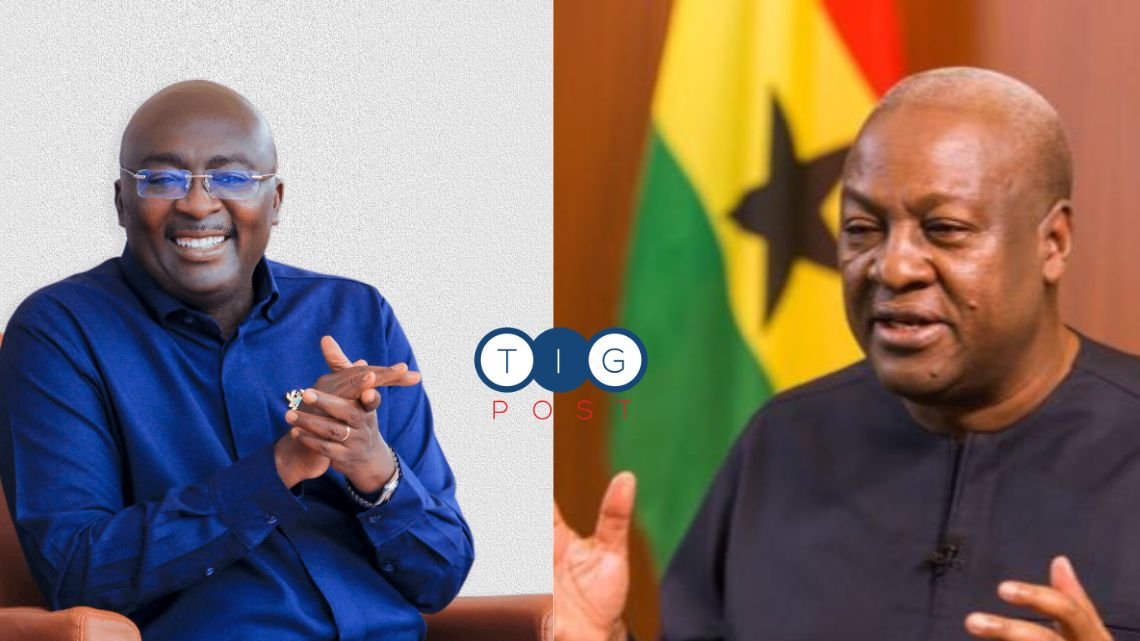
    Spokesperson for Dr. Mahamudu Bawumia’s 2024 presidential campaign, Dennis Miracles Aboagye, has announced that the Vice President will only participate in the upcoming presidential debate organized by the Institute of Economic Affairs (IEA) if his main rival, former President John Dramani Mahama, is also present.

    The IEA has scheduled two presidential debates ahead of the 2024 general elections, set for October 22 and November 19.

    Speaking in an interview on Citi FM’s Eyewitness News, Mr Aboagye emphasized that while Dr. Bawumia is ready to engage in debates on national issues, he believes Mahama’s participation is essential for a comprehensive discussion.

    “Dr. Bawumia is eager to participate, but there is no debate if Mahama is absent. The December polls will be a contest between Dr. Bawumia and Mahama, and both must engage to provide voters with a balanced discourse,” Aboagye stated.

    The IEA outlined its debate schedule in a statement, detailing two presidential debates, one vice-presidential debate, and five evening encounters with the candidates ahead of the December 7 elections.

    The vice-presidential debate is slated for November 5, while the evening encounters will kick off on Wednesday, September 18, with the last one scheduled for October 15.

    The National Democratic Congress (NDC) and its flagbearer, John Dramani Mahama, have expressed a preference to focus their campaign efforts on engaging with the electorate.

    The NDC has argued that its resources are better spent promoting its policies to voters rather than participating in debates with the ruling party’s candidate, who, they claim, has failed to deliver on economic promises.

    As the date for the first debate approaches, the participation of key contenders remains uncertain, with Dr. Bawumia’s involvement hinging on Mahama’s presence. The outcome of these deliberations will determine the structure of the debates as Ghana heads towards a critical election.

  • IEA set to hold first 2024 Presidential debate on October 22

    IEA set to hold first 2024 Presidential debate on October 22

    Institute of Economic Affairs (IEA) has set the dates for two presidential debates on October 22 and November 19, 2024.

    These events are part of several political engagements planned ahead of the December 7 elections.

    In a recent statement, the IEA revealed that, in addition to the two presidential debates, a vice presidential debate is scheduled for November 5, 2024, along with five “Evening Encounters” designed to engage political leaders.

    The first of these encounters will take place on Wednesday, September 18, with the final one set for Tuesday, October 15.

    However, the National Democratic Congress (NDC) has indicated that their presidential candidate will not participate, citing concerns over the trustworthiness of the IEA as the organising body.

  • IEA’s presidential debate comes off on Oct 22

    IEA’s presidential debate comes off on Oct 22

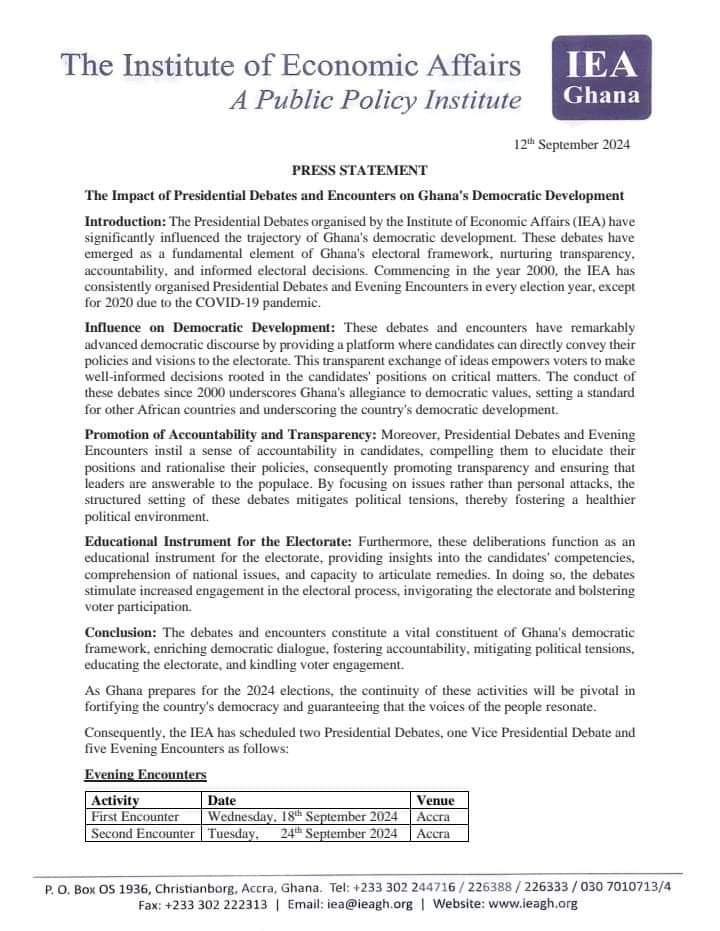
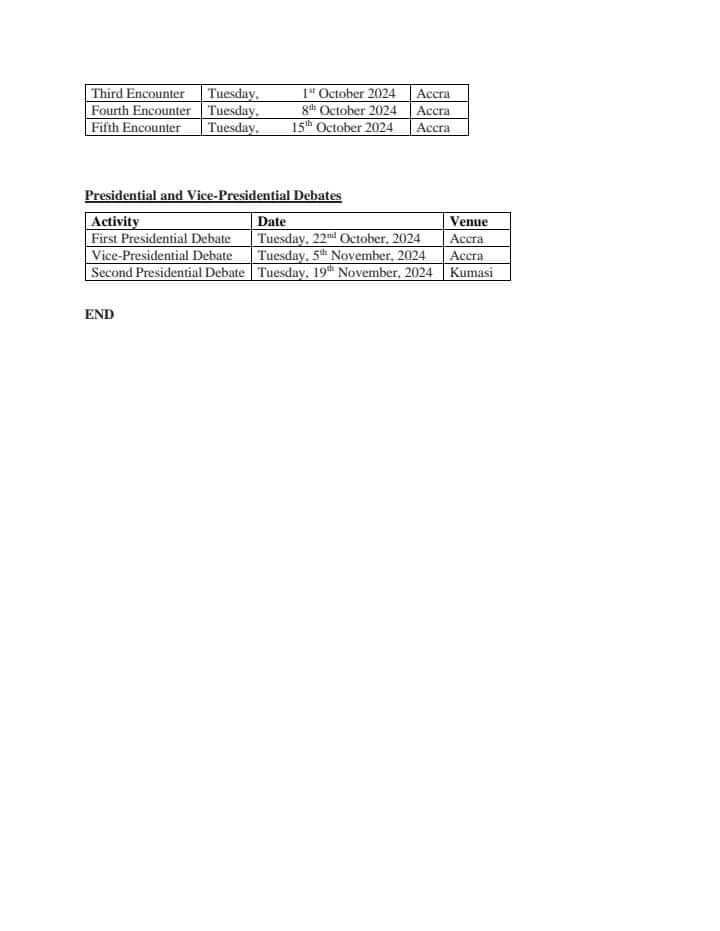
    The Institute of Economic Affairs (IEA) has unveiled its schedule for the upcoming presidential debates, setting October 22 and November 19, 2024, as dates for the first and second debates, respectively. Additionally, a Vice Presidential Debate is planned for November 5, 2024.

    In preparation for the December 7 elections, the IEA will also host five Evening Encounters. The series will commence on Wednesday, September 18, and conclude on Tuesday, October 15.

    However, the National Democratic Congress (NDC) has announced that their flagbearer will not participate in the debates, citing concerns over the credibility of the organizers.

    Below is IEA’s full notice.

  • Another economic crisis looms, govt is over-borrowing from local market – IEA warns

    Another economic crisis looms, govt is over-borrowing from local market – IEA warns

    The Institute of Economic Affairs (IEA) has raised concerns over the Ghanaian government’s excessive borrowing from the domestic debt market, particularly at the short end, where investor demand remains high.

    The think tank warns that this aggressive borrowing could trigger another economic crisis if not closely monitored and controlled.

    In its July-August 2024 Economic Outlook, the IEA revealed that Ghana’s domestic debt surged by GH¢32.7 billion, a 12.7% increase, from GH¢257.3 billion to GH¢290.0 billion within the year leading up to June 2024.

    In contrast, the external debt component saw only a modest rise of US$0.9 billion, or 0.3%, from US$30.1 billion to US$31.0 billion over the same period.

    While the government’s reliance on domestic borrowing is understandable—given its lack of access to the international bond market—the IEA cautioned that such borrowing must be carefully managed to avoid exacerbating the country’s debt situation.

    As of June 2024, Ghana’s total public debt reached GH¢742.0 billion, marking a year-to-date increase of GH¢133.6 billion, or 22.0%. In dollar terms, this equated to US$50.9 billion, down from US$52.2 billion at the end of December 2023, largely due to the depreciation of the cedi impacting the domestic debt component.

    Despite the surge in domestic borrowing, the debt-to-GDP ratio decreased slightly to 70.6% in June 2024, from 72.3% at the end of 2023. This was attributed to an increase in nominal GDP. However, under the International Monetary Fund’s (IMF) Economic Credit Facility (ECF) programme, Ghana’s public debt is projected to rise to 82.5% of GDP by the end of 2024, according to the IMF’s Executive Board review in June 2024.

    The IEA expressed surprise at this high projection, given that the debt restructuring efforts and fiscal consolidation under the ECF were initially expected to bring Ghana’s debt down to a sustainable level of around 56% by 2028.

    “It is not clear whether this sustainable target is still attainable,” the IEA concluded.

  • NPP all set for 2024 IEA presidential debate – Kodua Frimpong

    NPP all set for 2024 IEA presidential debate – Kodua Frimpong

    New Patriotic Party (NPP) has expressed its commitment to engage in the upcoming presidential and parliamentary debates organized by the Institute of Economic Affairs (IEA).

    According to the party’s General Secretary, Justin Kodua Frimpong, the NPP is ready to participate in the debates scheduled ahead of the 2024 general elections.

    The IEA recently established a 9-member Presidential Debate Committee, chaired by Justice Sophia Akuffo, to manage interactions with political parties and ensure that the debates remain focused on substantive, issue-driven discussions that resonate with the electorate.

    In a conversation with Eyewitness News, Justin Kodua highlighted the significance of these debates as a vital opportunity for political parties to communicate their visions and policies to the public.

    Reflecting on past elections, where the NPP chose not to participate in similar debates in 2014 and 2016, Kodua emphasized that the party is now eager to showcase its accomplishments and provide voters with a clear comparison of each party’s offerings.

    “The reason why we are interested in this debate is for us to be able to espouse what our flagbearer has been going around the country and talking about in terms of his vision for the country in the next four years.

    So, if for instance in 2014 and 2016, there were reasons why the party didn’t attend but this time around the party is ready for any debate because we feel that as a nation we have made progress and also the election between the NPP and the other political parties, Ghanaians need to know what each political parties offer the best and credible manifesto,” he stated.

    The opposition National Democratic Congress (NDC) has shown hesitation about taking part in the upcoming debates organized by the Institute of Economic Affairs (IEA), expressing concerns over the lack of prior consultation.

    The Mahama 2024 campaign team has strongly criticized the IEA for announcing the debates without first engaging the NDC, deeming this approach unacceptable.

    Nevertheless, the IEA is determined to move forward with the debates, even if the NDC decides not to participate.

    Dr. Humphrey Ayim-Darke, a key member of the Presidential Debate Committee, highlighted the IEA’s proven track record of organizing successful debates, regardless of the involvement of all political parties.

    He stressed the significance of voter engagement and reiterated the IEA’s willingness to engage in further discussions with any interested political party.

  • Mahama will not participate in IEA’s presidential debate – Campaign team

    Mahama will not participate in IEA’s presidential debate – Campaign team

    Deputy Spokesperson for John Mahama’s campaign team, Beatrice Annan, has firmly announced that the National Democratic Congress (NDC) flagbearer will not participate in any presidential debate organized by the Institute of Economic Affairs (IEA).

    Madam Annan explained that the flagbearer, John Mahama, is unwilling to share a stage with the flagbearer of the New Patriotic Party (NPP) Vice President Dr. Mahamudu Bawumia, who has previously labelled Mahama as incompetent and failed to engage the media on the current state of the economy.

    She stated, “I want to make it clear that John Mahama will not partake in any IEA debate. Our candidate will not share a platform with a candidate who has disparaged him. The NPP has a pattern of using unprintable terms against Mahama, and we will not accept this. His achievements are evident and do not require a debate for validation.”

    The Institute of Economic Affairs (IEA) has set October and November as the dates for the presidential debates for selected flagbearers.

    A Presidential Evening Encounters slated for September will precede the debates which will be held in Kumasi and Accra.

    A Presidential Debates Committee is being constituted “to determine the ground rules to govern the debates and evening encounters, and also solicit questions from Ghanaians.”

    The IEA debunked the notion that it was doing the bidding of any political party, stressing that it “will continue to provide a neutral platform for healthy contest of ideas.”

    The information was disclosed after the Mahama 2024 Campaign issued a sharp rebuke to the Institute of Economic Affairs (IEA) Ghana following its announcement of a presidential debate ahead of the December elections.

    In a statement, the campaign criticized the IEA for failing to engage or inform the National Democratic Congress (NDC) before making the announcement. The NDC, one of Ghana’s major political parties, says it was taken by surprise by the IEA’s plans.

    Watch the video below:

  • We hope that you participate in the presidential debate – IEA to NDC

    We hope that you participate in the presidential debate – IEA to NDC

    Director of Research at the Institute of Economic Affairs (IEA), Dr. John Kwakye, has expressed hope that the National Democratic Congress (NDC) will join the upcoming presidential debate set for October and November this year.

    This follows sharp criticism from the Mahama 2024 Campaign, which rebuked the IEA for announcing the debate without first extending a formal invitation to the NDC.

    Joyce Bawah Mogtari, the spokesperson for the Mahama 2024 Campaign, criticized the IEA, arguing that the organization does not have the legal mandate to organize election-related events.

    She stressed that the IEA’s decision to proceed without consulting the NDC casts doubt on its motives.

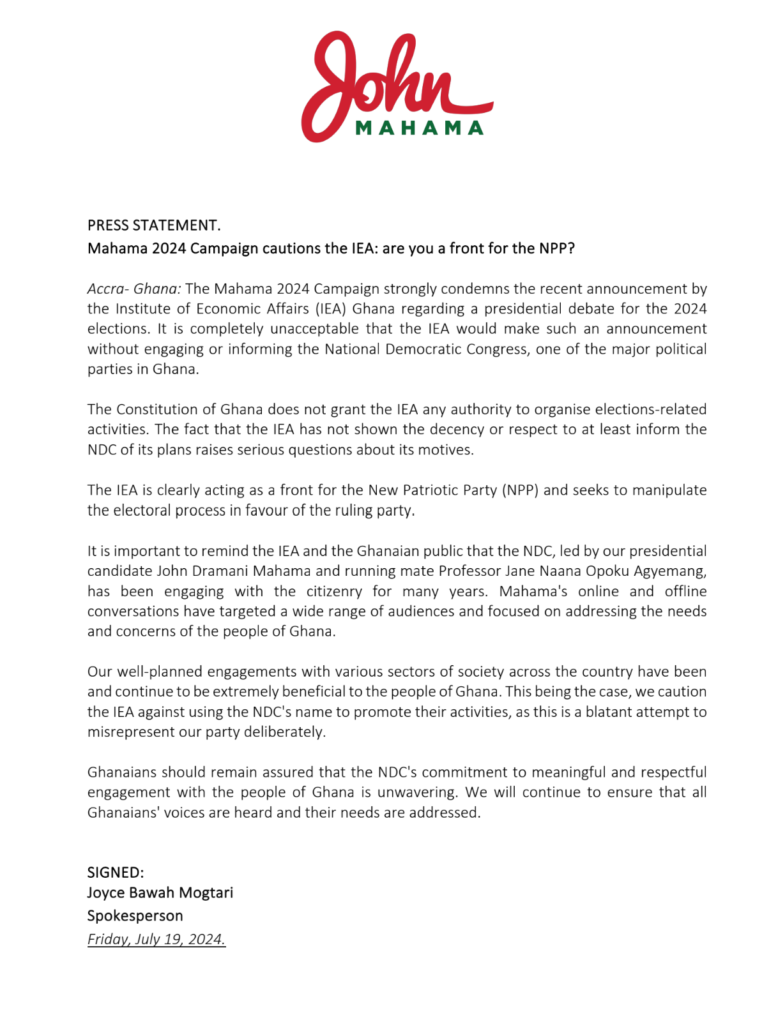
    “The Mahama 2024 Campaign strongly condemns the recent announcement by the Institute of Economic Affairs (IEA) Ghana regarding a presidential debate for the 2024 elections. It is completely unacceptable that the IEA would make such an announcement without engaging or informing the National Democratic Congress, one of the major political parties in Ghana.

    “The Constitution of Ghana does not grant the IEA any authority to organize election-related activities. The fact that the IEA has not shown the decency or respect to at least inform the NDC of its plans raises serious questions about its motives,” she said in a statement.

    In response, Dr. Kwakye clarified that the IEA is currently in talks with the NDC following the debate announcement.

    “Because our announcement of the presidential debate came after the NPP presidential candidate had made a similar request, the NDC accused us of doing the bidding of the NPP, but it was just a mere coincidence. We have issued a rejoinder to that effect, denying the same,” Dr. Kwakye said in an interview with TV3.

    He explained that the timing of the announcement, which followed a similar request by the New Patriotic Party’s (NPP) presidential candidate, led to accusations from the NDC that the IEA was biased towards the NPP.

    “We can’t say everything in the media, but we hope that the NDC will participate in the debate,” he concluded.

  • Presidential debates are fundamental to nurturing Ghana’s democracy – IEA

    Presidential debates are fundamental to nurturing Ghana’s democracy – IEA

    The Institute of Economic Affairs (IEA) has defended its decision to organize presidential debates, asserting that these debates play a crucial role in strengthening Ghana’s democracy.

    In response to criticisms from the Mahama 2024 campaign team, the IEA emphasized that the debates are intended to foster democratic dialogue and should be viewed as a positive contribution to the electoral process.

    The Mahama campaign had criticized the IEA’s recent announcement about the presidential debates, accusing the think tank of favoring a particular political party and alleging a lack of engagement with the National Democratic Congress (NDC).

    In its statement, the IEA clarified that its goal is to ensure a focus on issues during the elections and reiterated its commitment to hosting Presidential and Vice-Presidential Debates ahead of the 2024 General Elections.

    “The Debates will provide a common platform for the Presidential Candidates and Vice- Presidential Candidates to discuss various aspects of the nation’s development process. It will be a form of policy dialogue engagement during which the Candidates will have the opportunity to present their viewpoints, plans and programmes, and also point out weaknesses in the policies of their co-contestants and present alternatives to those policies and programmes.

    “The Electorate on the other hand, will receive firsthand information on the programmes and plans of each candidate. Our moderators will pose questions to the Candidates based on submissions received from the public on various thematic areas including the Economy, Governance, Natural Resources, Agriculture, Education, Health, Labour, Gender, Children, Youth, and other Social Issues. The timelines for the Debates will be announced at the launch of IEA’s Election Activities. The Institute encourages all Candidates to take advantage of the Debates to inform Ghanaians of their policies to address the country’s challenges.”

    But John Mahama’s team said “The Constitution of Ghana does not grant the IEA any authority to organise elections-related activities. The fact that the IEA has not shown the decency or respect to at least inform the NDC of its plans raises serious questions about its motives,”.

    Joyce Bawah Mogari, spokesperson for Mr. Mahama, issued a statement accusing the IEA of operating as a front for the New Patriotic Party (NPP). She claimed that the think tank’s actions are an attempt to manipulate the electoral process in favor of the ruling party.

    “It is important to remind the IEA and the Ghanaian public that the NDC, led by our presidential candidate John Dramani Mahama and running mate Professor Jane Naana Opoku Agyemang, has been engaging with the citizenry for many years. Mahama’s online and offline conversations have targeted a wide range of audiences and focused on addressing the needs and concerns of the people of Ghana.

    “Our well-planned engagements with various sectors of society across the country have been and continue to be extremely beneficial to the people of Ghana. This being the case, we caution the IEA against using the NDC’s name to promote their activities, as this is a blatant attempt to misrepresent our party deliberately.

    “Ghanaians should remain assured that the NDC’s commitment to meaningful and respectful engagement with the people of Ghana is unwavering. We will continue to ensure that all Ghanaians’ voices are heard and their needs are addressed.”

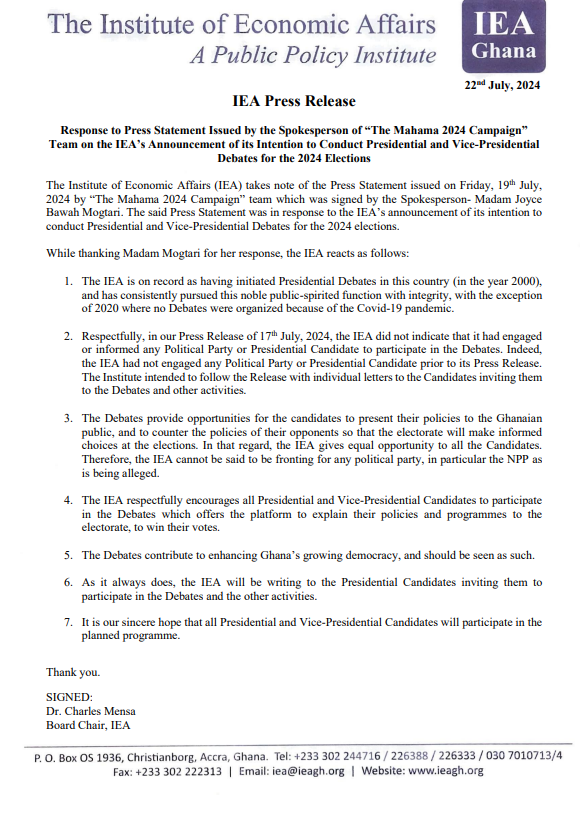
    But the IEA in a statement issued on Monday July 22 indicated that “Respectfully, in our Press Release of 17th July 2024, the IEA did not indicate that it had engaged or informed any Political Party or Presidential Candidate to participate in the Debates, Indeed, the IEA had not engaged any Political Party or Presidential Candidate before its Press Release.”

    “The Institute intended to follow the Release with individual letters to the Candidates inviting them to the Debates and other activities.”

    The Institute noted that the debates provide opportunities for the candidates to present their policies to the Ghanaian public, and to counter the policies of their opponents so that the electorate will make informed choices at the elections.

    “In that regard, the IEA gives equal opportunity to all the Candidates Therefore, the IEA cannot be said to be fronting for any political party, in particular the NPP as is being alleged. The IEA respectfully encourages all Presidential and Vice-Presidential Candidates to participate in the Debates which offers the platform to explain their policies and programmes to the electorate, to win their votes.”

    “The Debates contribute to enhancing Ghana’s growing democracy and should be seen as such. As it always does, the IEA will be writing to the Presidential Candidates inviting them to participate in the Debates and the other activities. It is our sincere hope that all Presidential and Vice-Presidential Candidates will participate in the planned programme,” it stated.

  • We are not working in the interest of one party – IEA

    We are not working in the interest of one party – IEA

    The Institute of Economic Affairs (IEA), a public policy think tank, has addressed allegations of bias from the opposition National Democratic Congress (NDC) regarding its plans to organize a Presidential Debate for this year’s General Elections.

    The IEA clarified that its announcement of the debate was not intended to favor any particular party.

    The IEA’s decision to host the debate, especially between the candidates of the NDC and the New Patriotic Party (NPP), came shortly after NPP’s presidential candidate, Dr. Mahamudu Bawumia, challenged NDC’s John Mahama to a debate.

    In response, John Mahama’s campaign team accused the IEA of acting on behalf of the NPP. However, in a press release dated July 22, 2024, and signed by Dr. Charles Mensa, Chairman of the IEA Board, the think tank emphasized that it is merely continuing its longstanding tradition of organizing such debates since 2000, and is not serving the interests of any single party.

    “The IEA is on record as having initiated Presidential Debates in the country in the year 2000, and has consistently pursued this noble public-spirited function with integrity, with the exception of 2020 where no Debates were organized because of the COVID-19 pandemic.

    Respectfully, in our press release of 17th July 2024, the IEA did not indicate that it had engaged or informed any political party or Presidential to participate in the debates. Indeed the IEA had not engaged any Political Party or Presidential Candidate prior to it’s press release. The institute intended to follow its release with individual letters inviting them to the debates and other activities,” the release said.

  • You’ve not shown us the decency or respect – Mahama’s team chides IEA over presidential debate

    You’ve not shown us the decency or respect – Mahama’s team chides IEA over presidential debate

    The Mahama 2024 Campaign has issued a sharp rebuke to the Institute of Economic Affairs (IEA) Ghana following its recent announcement of a presidential debate ahead of the December elections.

    In a statement, the campaign criticized the IEA for failing to engage or inform the National Democratic Congress (NDC) before making the announcement. The NDC, one of Ghana’s major political parties, was taken by surprise by the IEA’s plans.

    The campaign’s spokesperson, Joyce Mogtari, emphasized in a press release that the Constitution does not grant the IEA any authority to organize election-related activities.

    “The Constitution of Ghana does not grant the IEA any authority to organize elections-related activities. The fact that the IEA has not shown the decency or respect to at least inform the NDC of its plans raises serious questions about its motives,” Mogtari stated.

    The Mahama 2024 Campaign, in its Friday release, accused the IEA of lacking the decency and respect to inform the NDC of its debate plans, which they believe raises questions about the institute’s intentions.

    Furthermore, the campaign alleged that the IEA is “acting as a front for the New Patriotic Party (NPP) and seeks to manipulate the electoral process in favor of the ruling party.”

    Highlighting Mr. Mahama’s commitment to addressing the needs and concerns of the Ghanaian people, the statement mentioned that his campaign conversations have targeted a wide range of audiences.

    The campaign accused the IEA of using the NDC’s name to promote its activities, describing this as a blatant attempt to misrepresent the party.

    The Mahama 2024 Campaign concluded by assuring Ghanaians of the NDC’s dedication to meaningful and respectful engagement with the public, ensuring that all voices are heard and their needs addressed.

    Meanwhile, the flagbearer of the New Patriotic Party (NPP), Vice President Dr Mahamudu Bawumia has dared former President Mahama to a debate on the economy.

    The NDC has however criticised the Vice President of prioritising a presidential debate over ensuring the recovery of the economy.

  • IEA has not officially informed NDC about a presidential debate – Mahama’s campaign team

    IEA has not officially informed NDC about a presidential debate – Mahama’s campaign team

    The 2024 Campaign team for the National Democratic Congress (NDC), John Dramani Mahama has expressed strong disapproval of the Institute of Economic Affairs (IEA) following its recent announcement of a presidential debate for the 2024 elections.

    The IEA has revealed plans to organize both Presidential and Vice-Presidential Debates in the lead-up to Ghana’s 2024 General Elections.

    However, in a statement issued on Friday, July 19, Joyce Bawah Mogtari, the spokesperson for the Mahama 2024 Campaign, criticized the IEA for not extending an official invitation to the NDC before making the announcement.

    Madam Mogtari labeled this oversight as “completely unacceptable.”

    “The Mahama 2024 Campaign strongly condemns the recent announcement by the Institute of Economic Affairs (lEA) Ghana regarding a presidential debate for the 2024 elections. It is completely unacceptable that the lEA would make such an announcement without engaging or informing the National Democratic Congress, one of the major political parties in Ghana.”

    The Mahama 2024 Campaign Team has asserted that the IEA lacks the authority to organize activities related to the elections.

    “The Constitution of Ghana does not grant the IEA any authority to organise elections-related activities. The fact that the IEA has not shown the decency or respect to at least inform the NDC of its plans raises serious questions about its motives.”

    The Mahama Campaign has accused the IEA of attempting to manipulate the electoral process in favor of the NPP.

    They argued that Mr. Mahama and his running mate, Professor Jane Naana Opoku Agyemang, have been actively engaging with the public for many years.

    “The IEA is clearly acting as a front for the New Patriotic Party (NPP) and seeks to manipulate the electoral process in favour of the ruling party.

    “It is important to remind the lEA and the Ghanaian public that the NDC, led by our presidential candidate John Dramani Mahama and running mate Professor Jane Naana Opoku Agyemang, has been engaging with the citizenry for many years. Mahama’s online and offline conversations have targeted a wide range of audiences and focused on addressing the needs and concerns of the people of Ghana.”

  • IEA prepares for 2024 presidential debate

    IEA prepares for 2024 presidential debate

    The Institute of Economic Affairs (IEA) has announced the organization of a debate among some of the political parties intending to contest in the upcoming 2024 elections.

    This debate, according to the IEA, is essential for voters to critically assess both presidential and vice-presidential candidates, thereby enabling informed decision-making.

    The call for debates comes amidst ongoing disagreements between the New Patriotic Party (NPP) and the opposition National Democratic Congress (NDC) regarding the necessity of holding such debates.

    Professor Alexander Bilson Darku, a senior fellow at the IEA, emphasized the importance of these debates in an interview with Citi News. He revealed that preliminary engagements have already commenced with various political parties to ensure a debate is held before the December 7 elections.

    “Let me make this very clear from the beginning. The need for debate is the right of the people. The people of Ghana ought to know what their presidential candidate, and for that matter, the party they represent, have in stock for them,” Professor Darku stated. He added, “We are at a very early stage now, talking to them [the political parties]. We have our timetable, and very soon, it will be known to the public as to the programme that the IEA has outlined to make this all-important presidential debate come on.”

    Professor Darku assured that the debates would be scheduled at a time beneficial for both the participating parties and the nation. He refrained from delving into specific details but affirmed that the timing would be advantageous.

    Additionally, Professor Darku mentioned that the selection of participating parties and candidates would follow the Afrobarometer criteria.

    “It has established a threshold, and we will use that threshold to invite the parties that meet the threshold to participate in the debate. This might be four or five parties, and their presidential candidates and vice-presidential candidates will be invited to participate in the debate.”

  • Date for 2024 presidential debate to soon be disclosed – IEA

    Date for 2024 presidential debate to soon be disclosed – IEA

    The Institute of Economic Affairs (IEA) has emphasized the necessity of holding a debate before the 2024 elections, involving key political parties planning to participate.

    IEA argues that such debates are essential for voters to evaluate both presidential and vice-presidential candidates, thereby making informed choices.

    This position by IEA comes amid evident disagreements between the New Patriotic Party (NPP) and the opposition National Democratic Congress (NDC) over the importance of debates.

    A senior fellow at IEA, Professor Alexander Bilson Darku, revealed in an interview with Citi News that discussions have begun with various political parties to arrange a debate before December 7.

    Let me make this very clear from the beginning. The need for debate is the right of the people. The people of Ghana ought to know what their presidential candidate, and for that matter, the party they represent, have in stock for them and so we are at a very early stage now talking to them [the political parties].

    “We have our timetable and very soon it will be known to the public as to the programme that the IEA has outlined to make this all-important presidential debate come on. I don’t think we should go into the specifics, but I am telling you we will have it at a very good time that would be beneficial to the parties involved and the timing that would be beneficial for the nation.”

    Professor Alexander Bilson Darku further mentioned that the participating parties and their candidates will be carefully selected and streamlined.

    “We are using the Afrobarometer criteria. It has established a threshold, and we will use that threshold to invite the parties that meet the threshold to participate in the debate.

    “This might be four or five parties, and their presidential candidates and vice presidential candidates will be invited to participate in the debate.”

  • Mahama-Bawumia debate imminent as IEA announces preparations

    Mahama-Bawumia debate imminent as IEA announces preparations

    Institute of Economic Affairs (IEA) has announced significant progress in its preparations to revamp its signature Presidential and Vice-Presidential debates.

    Additionally, the IEA encouraged candidates to utilize these debates as a platform to articulate their visions for Ghana in anticipation of the 2024 election.

    “The IEA is far advanced in its preparations to reorganize its flagship Presidential and Vice-presidential Debates.

    The Institute encourages the candidates to take advantage of the debates to inform Ghanaians of their policies to address the country’s challenges,” the Director of Research at the Institute of Economic Affairs (IEA), Dr John Kwakye disclosed in a tweet on Saturday.

    However, Dr. Mahamudu Bawumia, the NPP’s presidential candidate, has challenged former President John Dramani Mahama of the NDC to a live presidential debate.

    Speaking to a large crowd of supporters in Bunkpurugu, North East Region, Dr. Bawumia expressed his readiness to discuss his vision and policies for Ghana.

    While eager for a debate with Mahama, Dr. Bawumia expressed doubts about its likelihood, suggesting that Mahama might be avoiding such a direct engagement.

    “I am looking forward to a debate with John Mahama on the economy, on the country on the governance,’ Dr. Bawumia said.

    “But I am afraid that he is running away from a debate. His people say he doesn’t want to debate. I have never heard of an opposition leader who doesn’t want to debate. But he knows I will expose the emptiness of his policies.”

    Dr. Bawumia also remarked that former President Mahama and his team have not effectively communicated their plans for a 24-hour economy to the people of Ghana.

    He suggested that Mahama’s reluctance to engage in a debate stems from a fear of being exposed on this issue.

  • The term of BoG Governor must overlap that of the President to ensure continuity – IEA

    The term of BoG Governor must overlap that of the President to ensure continuity – IEA

    The Institute of Economic Affairs (IEA) is urging substantial revisions to the Bank of Ghana Act 2016, with a particular focus on extending the tenure of the Central Bank Governor.

    This move is aimed at ensuring continuity and shielding the position from the influence of presidential terms.

    During a Stakeholders’ Forum titled “Reviewing the Bank of Ghana’s Act to Promote Transparency, Accountability, and Effectiveness,” Senior Scholar Prof. Alexander Bilson Darku presented the IEA’s viewpoint.

    He stressed the necessity of protecting the Central Bank from excessive governmental interference, particularly concerning the Governor’s tenure and conditions of service.

    Prof. Darku asserted that the proposed amendments would bolster Ghana’s economic stability by enhancing the independence and operational effectiveness of the Bank of Ghana.

    “Maintaining the autonomy of the Governor is paramount for ensuring the transparency, accountability, and overall effectiveness of the Central Bank,” he noted.

    The forum delved into several critical aspects, including the composition of the Bank of Ghana’s board, the Governor’s appointment process, and the regulatory framework governing lending limits to the government.

    A consensus emerged on the importance of aligning the Governor’s term with that of the President to promote continuity and effective governance.

    “There was a consensus on the necessity for Ghana to carefully consider aligning the term of the Bank of Ghana Governor to overlap with that of the President to ensure continuity and effectiveness in governance,” Prof. Darku explained.

    The IEA’s call for amendments highlights the need for a more insulated and stable leadership at the Bank of Ghana, aiming to foster a regulatory environment that can withstand political pressures and maintain its focus on economic stability and growth.

  • Establish a fiscal body to monitor excessive spending – IEA to government

    Establish a fiscal body to monitor excessive spending – IEA to government

    The IEA has strongly supported the establishment of an autonomous Fiscal Council (FC) in Ghana.

    It has recommended that the government implement comprehensive measures to break the recurring pattern of fiscal mismanagement and reliance on IMF rescue packages.

    In a recent statement, the IEA highlighted the pressing need for a strong fiscal framework to stabilize the economy and rebuild policy trustworthiness. Moreover, the IEA contended that such a council would prevent the government from exceeding its planned expenditure.

    Ghana’s fiscal administration has long struggled with persistent shortfalls, where spending surpasses income.

    The IEA noted that these shortfalls have historically been funded through substantial borrowing, both domestically and internationally, resulting in macroeconomic instability characterized by continuous inflation, currency devaluation, and a mounting debt burden.

    “The cycle of borrowing to cover deficits, followed by economic crises and subsequent IMF bailouts, has become an all-too-familiar narrative for Ghana. It’s a vicious cycle that undermines long-term economic stability,” the IEA stated in their press release.

    In light of these challenges, the IEA argued for the creation of an FC as a critical reform measure. An FC would serve as an independent oversight body, providing unbiased analysis and recommendations on fiscal policy, thus ensuring adherence to fiscal rules and promoting sustainable economic management.

    “The establishment of a Fiscal Council is essential for providing objective and expert oversight over fiscal policy. It will ensure that fiscal decisions are based on sound analysis and long-term considerations rather than short-term political expediency,” the IEA emphasized.

    Referring to effective frameworks in advanced nations, the IEA highlighted the advantages of establishing an autonomous fiscal oversight entity.

    Examples such as the UK’s Office for Budget Responsibility (OBR) and Sweden’s Fiscal Policy Council (FPC) have illustrated the pivotal role independent fiscal institutions can play in fostering economic stability. These bodies assess government fiscal strategies and offer transparent, reliable projections, serving as valuable models for emulation.

    “These international examples highlight how a well-functioning Fiscal Council can foster fiscal discipline and long-term sustainability, something that is critically needed in Ghana,” it noted.

    The IEA’s press release outlines specific recommendations for establishing a successful FC in Ghana. These include ensuring the council’s independence by having its members appointed through a rigorous, competitive process involving Parliament and the Public Services Commission.

    “The Fiscal Council must be independent and composed of professionals with proven expertise in economics, public finance, and related fields. Its funding should be secured through Parliament to avoid any undue influence from the executive,” it recommended.

    The IEA emphasized that implementing these reforms would not only enable Ghana to steer clear of the recurring reliance on IMF bailouts but also foster a culture of fiscal accountability and economic durability.

    “Implementing these reforms can pave the way for a more stable and self-sustaining economic future for Ghana. It is a critical step towards entrenching fiscal discipline and regaining international confidence in Ghana’s economic management,” the IEA concluded. The call for a Fiscal Council reflects a broader recognition of the need for structural reforms to address Ghana’s fiscal challenges. With the right framework in place, Ghana can achieve greater economic stability, reduce its dependency on external bailouts, and build a foundation for sustainable growth

  • IEA urges BoG to implement currency board instead of Central Bank system

    IEA urges BoG to implement currency board instead of Central Bank system

    The Institute of Economic Affairs (IEA) suggests that the Bank of Ghana (BoG) should consider adopting a currency board instead of the current central bank system.

    According to the IEA, this change would help ensure the stability of the Cedi as a legal tender by ensuring that circulating Cedis are fully supported by Forex reserves.

    In a statement issued on Monday, May 20, the IEA put forward several proposals for the government to address the declining value of the Cedi.

    One of these proposals from the IEA is that the currency board should refrain from providing loans to the government or banks.

    The IEA is hopeful that implementing these measures will lead to a reduction in Cedi depreciation and inflation.

    “An alternative to full dollarization is to adopt a currency board system in place of the central bank system. In that case, the cedi would be maintained as legal tender. However, the currency board would ensure that cedis in circulation are fully backed by FX. The cedi would also be pegged to the dollar at a fixed rate. Further, the currency board would not lend to the Government or banks.

    “With these conditions in place, cedi depreciation and inflation would be minimised. However, the currency board has limitations, including the potential loss of independent monetary policy and loss of lender-of-last-resort function.”

    The IEA emphasized that stabilizing the Cedi is a multifaceted endeavor, necessitating unified efforts to accomplish this formidable objective.

    “Some of the measures may reinforce others while some may preclude others. We are proposing them for consideration by our economic managers and to prompt debate on what is obviously one of the most important national challenges.

    “We do not believe that stabilising the cedi is rocket science. We only need to take concerted actions to achieve that ever-elusive goal. Not acting while the cedi continues to bleed is not an option!.”

  • Ghana cedi is close to collapsing – IEA

    Ghana cedi is close to collapsing – IEA

    The Institute of Economic Affairs (IEA) has expressed concern about the ongoing instability of Ghana’s currency, the Cedi.

    According to the IEA, the Cedi has depreciated by 99.99% from 1983 to 2024, placing blame on successive economic managers for their failure to effectively address the Cedi’s challenges.

    The IEA criticized policymakers for their reactive approach, waiting until the situation worsens before taking action, and emphasized the need for proactive measures to strengthen the Cedi.

    In a press statement dated Monday, May 20, the IEA also raised concerns about Ghana’s reliance on the International Monetary Fund (IMF) and development partners for stabilizing the Cedi, describing this approach as “unsustainable.”

    The IEA contends that Ghana’s multiple engagements with the IMF have not resulted in lasting stability for the Cedi.

    They caution that the Cedi is confronted with a substantial threat, urging immediate measures to address this risk.

    “Since Ghana adopted a flexible exchange rate regime from 1983 when the cedi was pegged to the dollar at a rate of 2.75, the currency has continued on a declining path with only short intermittent periods of stability-to May 16, 2024, when the official rate is quoted as GHS13.77=USD1.00 (or 137,700 old cedis=1 US dollar). On a cumulative basis, the cedi has depreciated by 99.99% from 1983 to 2024. It has to be noted that, mathematically, any quantity that depreciates (or devalues) by 100% falls to zero or virtually vanishes.

    “…This tells us that the cedi is under an existential threat and requires urgent actions to rescue it from that threat. Unfortunately, over the years, our economic managers have failed to address the cedi problem head-on. The problem is that our policymakers have consistently failed to take the requisite measures to buttress the cedi. Almost invariably, they wait till the situation begins to get out of control before they adopt firefighting, albeit unsustainable, measures.

    “For instance, presently, we seem to be waiting for the IMF’s and other developing partners’ funding before restoring some stability to the cedi. This approach, however, is not sustainable, as history has taught us. We have been to the IMF seventeen times, but that has not brought any lasting stability to the cedi.”

  • Fortify the cedi’s value with our natural resources – IEA tells gov’t

    Fortify the cedi’s value with our natural resources – IEA tells gov’t

    The Director of Research at the Institute of Economic Affairs (IEA), Dr. John Kwakye, has urged the government to explore avenues for acquiring full ownership of Ghana’s natural resources to use them as backing for the Cedi, thereby strengthening its value.

    Dr. Kwakye highlighted that leveraging resources like gold to support the Cedi could elevate it to one of the most robust trading currencies globally, especially as the government seeks solutions to combat the currency’s devaluation.

    Several trade unions and associations have expressed concerns about the depreciation of the Cedi, citing its negative impact on their businesses.

    Currently, the dollar is trading at GH¢14.90 on the forex market, a significant increase from the GH¢10.97 rate observed in the same period in May 2023.

    According to Bloomberg, the Cedi’s depreciation is being worsened by a decrease in cocoa earnings, with exports declining by approximately $500 million in January and February 2024 due to adverse weather conditions and the swollen shoot disease.

    Speaking on the Citi Breakfast Show with host Bernard Avle on Wednesday, Dr. Kwakye argued that relying on external support to strengthen the Cedi and the economy is not sustainable, as shortfalls often occur and are typically negative.

    “The underlying fundamental structure of the economy hasn’t changed and I have always said that relying on external loans to support your currency is not sustainable because you will eventually have to pay back and when you begin paying back, there will be outflows and so it looks like we are now just waiting for the IMF’s $360 million to be stronger for a while and return to our struggling state.

    “The Cedi is vulnerable and we can only stop the fall temporarily and the depreciation will resume again.”

    “Your reserves support your currency and so our national reserves support the Cedi and so wherever your reserves are coming from, for example, in gold, what we need to understand is that we need to own our own reserves of gold and we need to take ownership and increase the reserves.

    “If we take ownership of our resources, we can use them to back our currency to strengthen it,” the economist added.

  • Ghanaian political contestants must be assessed based on UK candidate standards – Analyst

    Ghanaian political contestants must be assessed based on UK candidate standards – Analyst

    The Director of Research at the Institute of Economic Affairs (IEA), Dr. John Kwakye, has advocated for Ghanaian flagbearers to be evaluated using standards akin to those applied to politicians in the United Kingdom (UK), believing this approach would enhance the expected quality.

    Referring to a recent UK report by the Constitution Unit, Dr. Kwakye highlights the public’s demand for stronger mechanisms to ensure political integrity. The report indicates widespread support for independent regulators capable of launching investigations into ministerial misconduct.

    Dr. Kwakye suggests a similar grading system for Ghanaian political contestants, underscoring the importance of transparency and accountability in governance.

    Despite observing promising policies from Ghana’s presidential candidates for the 2024 elections, Dr. Kwakye expresses skepticism about their ability to deliver on these promises.

    He questions whether proposals such as economic transformation, lean government, fiscal discipline, and natural resource ownership will materialize if the candidates are elected.

    Dr. Kwakye’s remarks on his platform reflect a cautious optimism about the candidates’ policies, juxtaposed with concerns about their implementation.

    “I am going to refocus our paradigm for natural resource management. For the most part, Ghana has not maximised the benefits of our natural resources.

    “Since the days of the Portuguese in the 15th century, gold has always been taken out of Ghana. We haven’t benefitted much from our natural resources; I am going to change that paradigm. I am going to bring a bigger focus on ownership of our natural resources. 

    “It is as if right now we don’t own our natural resources. I believe that if we do the exploration; and we are going to empower our universities and the geological service department to do the exploration, once we explore that we have seven gold belts that we haven’t yet discovered. Once we have explored and we know that the gold is here, the new policy is going be that the ownership of those resources will be one hundred per cent owned by Ghanaians,” he stated. 

  • Dollarising Ghana’s economy to will tackle Cedi depreciation – Dr Kwakye

    Dollarising Ghana’s economy to will tackle Cedi depreciation – Dr Kwakye

    Director of Research at the Institute of Economic Affairs (IEA), Dr. John Kwabena Kwakye, has proposed adopting the dollar as Ghana’s currency to stabilize the economy.

    “Stabilising the economy is not rocket science. If we feel we cannot maintain the Cedi, let us abandon it and adopt the dollar. Let us dollarise the economy,” he said.

    “Dollarisation” is when a country begins to recognize the U.S. dollar as a medium of exchange or legal tender alongside or in place of its domestic currency.

    Dr. Kwakye suggested that dollarization should be a temporary measure until the economy rebounds, after which Ghana can reintroduce its currency.

    Dollarization occurs when a country recognizes the U.S. dollar as legal tender alongside or instead of its domestic currency due to instability.

    Advantages include lower administrative costs and a sounder financial sector, while disadvantages include loss of monetary autonomy and vulnerability to foreign influence.

    He also proposed converting the central bank into a currency board, where the local currency is pegged to a foreign reserve currency, allowing for a fixed exchange rate.

    Dr. Kwakye criticized the government for failing to implement alternative strategies, opting instead to collateralize assets for loans under the IMF program, limiting policy flexibility.

    He expressed concern over recent exits of foreign companies from Ghana, such as Glovo and reports about Société Générale (SG) Ghana, citing the loss of competitiveness and its adverse impact on the economy.

    In response, Mr. Yaw Sampah, a private legal practitioner and finance analyst, disagreed with Dr. Kwakye’s proposal to dollarize the economy.

    He advocated for policies to diminish the dollar’s significance in Ghana, aiming to reduce speculative demand and promote the use of the local currency.

    Mr Sampah emphasized the need to discourage dollar pricing in various sectors, suggesting that the dollar should only be used for international transactions to strengthen the local currency’s value.

  • Those managing Ghana’s economy are like those of Manchester United – IEA director jabs

    Those managing Ghana’s economy are like those of Manchester United – IEA director jabs

    The Director of Research at the Institute of Economic Affairs (IEA), John Kwakye, has drawn a noteworthy analogy between Ghana’s economic management and Manchester United’s struggling performance.

    He expressed his discontent, stating that both entities appeared inept in tackling their respective challenges.

    Mr Kwakye’s remarks surfaced on X, reads “It seems to me that the managers of Ghana’s economy are like the managers of Manchester United. Both seem clueless in addressing the problems confronting them, although the solutions are far from rocket science.”

    His observation coincided with a period of significant economic turbulence in Ghana. Challenges included the departure of multinational firms due to high taxes, power shortages, currency depreciation, fuel price hikes, and soaring living expenses.

    To mitigate these economic woes, the government sought a $3 billion bailout from the International Monetary Fund (IMF) on July 1, 2022.

    Subsequently, IMF representatives engaged with Ghanaian authorities from July 6 to July 13, 2022, culminating in a staff-level agreement by December 2022.

    On May 17, 2023, the IMF’s executive board greenlit Ghana’s $3 billion loan facility. The first installment of $600 million was disbursed to the Bank of Ghana (BoG) on May 19, 2023.

    The IMF program aims to restore macroeconomic stability and ensure debt sustainability, among other objectives, as outlined by the government.

  • A ‘lazy man’s approach – IEA Director blasts Ghana’s reliance on IMF, World Bank to fortify the Cedi

    Director of Research at the Institute of Economic Affairs (IEA),Dr. John Kwakye, criticised the government’s heavy reliance on foreign aid to support the local currency during a press briefing at the IEA headquarters.

    He raised concerns about the sustainability of Ghana’s economic strategy, particularly its dependence on funds from institutions like the International Monetary Fund (IMF) and the World Bank, labeling this approach as a “lazy man’s approach.”

    Dr. Kwakye highlighted the risks associated with such borrowing, including Eurobonds and cocoa syndicated loans, and warned of increased pressure on the Ghanaian cedi when these loans come due for repayment.

    Citing statistics from the recent Monetary Policy Committee meeting of the Bank of Ghana (BoG), he noted that the Cedi depreciated by 6.8 percent against the US dollar in the year leading up to March 20, 2024.

    “The Governor admitted that the foreign exchange market came under some pressure, both seasonal and non-seasonal, in February and early March. He reported that in the year to March 20, 2024, the Ghana cedi recorded a depreciation of 6.8 percent against the US dollar. He, however, stated that the cedi “continues to recover its value.” But the question is, by what measure?

    “Certainly, not in nominal terms, because since he spoke on 25th March, the cedi has continued to depreciate, reaching nearly GH¢13 to the dollar. Let us repeat right here that relying on funds from the IMF, World Bank, Eurobonds, cocoa syndicated loans, etc. to bolster the cedi, as we have been doing, is not only a lazy man’s approach. To say the least but also clearly unsustainable, as the pressure would be back on when the loans fall due for repayment.”

    “The way to stabilise the cedi on a durable basis is to increase our FX earnings through greater ownership of, and value addition to, our natural resources, to reduce our import demand through domestic industrialization and to entrench fiscal and monetary discipline,” citinewsroom.com quoted him to have said during the press briefing.

  • Stable power in last 7 days a result of investments made in the past – IEA

    Stable power in last 7 days a result of investments made in the past – IEA


    The Institute of Economic Affairs (IEA) has attributed Ghana’s current energy sector stability to investments made by previous administrations.

    Following President Akufo-Addo’s State of the Nation Address (SONA) to Parliament on Tuesday, February 27, Dr. John Kwakye, Director of Research at IEA Ghana, stressed the need for further action to tackle ongoing energy sector challenges.

    While President Akufo-Addo highlighted consistent power stability during his seven-year term, Dr. Kwakye acknowledged this stability as a result of past investments and contractual agreements made by previous administrations.

    Dr. Kwakye opted not to engage in debates over who specifically resolved the “DUMSOR” menace, acknowledging that power stability over the past seven years surpassed previous years.

    “The President mentioned his government’s success in ending the ‘DUMSOR’ menace and managing ‘to keep the lights on in the last seven years.’ We are not going to get into the unproductive debate as to who ended ‘DUMSOR’,” he stated.

    He further emphasized that stable power over the past seven years was achieved at a considerable budgetary cost, some of which stemmed from previous contractual agreements.

    While acknowledging the government’s achievements in eradicating power outages, Dr. Kwakye underscored the importance of comprehensively addressing sporadic power issues, commonly known as ‘Dumsor.’

    He recommended tackling legacy debts and enhancing the efficiency of the Electricity Company of Ghana (ECG) as part of the solution.

    “The solution should include how to deal with the legacy debts, improving the efficiency of the Electricity Company of Ghana (ECG), including by reducing the industry-high distribution losses, improving bill collections, stemming illegal connections, and moving to legitimate cost-recovery tariffs,” he said.

    Dr. Kwakye further proposed hiring expert managers to address the challenges faced by the struggling power company, emphasizing the need for efficient management under state ownership.

    “The President mentioned his government’s success in ending the “DUMSOR” menace and managing “to keep the lights on in the last seven years.” We are not going to get into the unproductive debate as to who ended “DUMSOR.

    “The fact that power has been much more stable in the last seven years than the previous four years, however, is evidently clear. It is also a fact that the subsequent stability benefited from previous investments in the power sector. What we also know is that the stable power has been achieved at considerable budgetary cost some of which emanated from previous contractual agreements,” he said.

  • Ghana must embrace US model to curb corruption – John Kwakye

    Ghana must embrace US model to curb corruption – John Kwakye

    The Director of Research at the Institute of Economic Affairs (IEA), Dr. John Kwakye, has urged the government to consider adopting the US Inspector General (IG) system as a strategic measure to combat corruption more effectively.

    In response to the address by Dr. Mahamudu Bawumia, the New Patriotic Party’s flagbearer, on his vision for Ghana on February 7, Dr. Kwakye emphasized the importance of preventing corruption at its roots.

    He suggested that implementing the US Inspector General system would serve as a proactive approach to corruption prevention.

    In his article titled “Dr. Bawumia’s Speech: Turning an Impossibility into the Possibility?” Dr. Kwakye proposed that an independent Inspector General, reporting directly to Parliament, should be embedded in every Metropolitan, Municipal, and District Assembly (MMDA).

    This Inspector General would monitor all financial transactions within the MMDA, significantly reducing the occurrence of corruption.

    “In terms of preventing corruption before it occurs, we have suggested that Ghana adopt the US Inspector General (IG) system. The IG, who will be independent and report directly to Parliament, will be embedded in every MMDA and monitor all financial transactions within the MMDA. This will contribute to prevent most corruption from taking place. Since we are poor at prosecuting corruption, it would be best to prevent it from occurring in the first instance.”

    Additionally, he called on the government to enhance the capabilities and resources of existing anti-corruption institutions such as the Office of the Special Prosecutor (OSP), Economic and Organized Crime Office (EOCO), Commission on Human Rights and Administrative Justice (CHRAJ), and the National Intelligence Bureau (NIB).

    Strengthening these institutions, according to Dr. Kwakye, is crucial for them to fulfill their roles effectively in investigating and prosecuting corruption, serving as a deterrent to potential wrongdoers.

    However, he emphasized that addressing corruption must begin with robust measures at the highest levels of government.

    “Notwithstanding, I believe the accountable institutions—OSP, EOCO, CHRAJ, NIB—have an important role to play in fighting corruption. I will, therefore, call for them to be strengthened and resourced to carry out their mandate of investigating and prosecuting corruption to serve as a deterrent to potential culprits. But it has to be said that the surest way of fighting corruption is to start from the top.”

  • Dr. Kwakye blasts BoG, Finance Minister and Bawumia for disregarding GH¢60.81 billion loss in 2022

    Dr. Kwakye blasts BoG, Finance Minister and Bawumia for disregarding GH¢60.81 billion loss in 2022


    Senior Economist and Director of Research at the Institute of Economic Affairs (IEA) Dr. John Kwakye, has voiced criticism against the NPP flagbearer, Dr. Mahamudu Bawumia, for characterising the GH¢60.81 billion losses incurred by the Bank of Ghana in 2022 as merely “technical.”

    In a published write-up, Dr. Kwakye emphasised that these significant losses reported by the Central Bank during the specified financial year would inevitably lead to cuts imposed on various operations.

    Highlighting the tangible impacts, the IEA Director underscored how these losses are already affecting prevailing economic conditions in the country, including exchange rate stability and inflationary pressures.

    “Dr. Bawumia said BoG’s action was responsible and that it was temporary, as the bank had advanced money to the government in only two of the past seven years. The Minister of Finance had expressed similar sentiments in the past, which was not surprising because the government was the direct beneficiary of the monetary financing,” he said.

    Dr Kwakye continued, “However, as central bankers, we know that the most inflationary source of financing the budget is high-powered money coming directly from the central bank vault. It is not the fact that BoG advanced money to the government that is the issue, for the Bank’s Act provides for such advances up to 5% of the previous year’s revenue.

    It is the magnitude of the advance—over 50% of the previous year’s revenue—that is disturbing. It is no wonder inflation peaked at 54.1% in 2022—and depreciation ballooned to 54.2% in November 2022, before falling to 30.0% in December 2022. Meanwhile, as government debt to BoG was also discounted under the DDEP, the Bank made a whopping loss of GH¢61 billion and a record negative equity of GH¢54 billion in 2022.”


    He further contended that despite attempts by the Finance Minister and Central Bank Governor to downplay the extent of the losses, the country’s balance sheet suffered a severe blow.

    “Both the Minister and the Governor seem to have played down the loss as only a technical one. However, the fact is that the bank’s balance sheet has been severely impacted, and this would force it to cut back on some of its important operations so as to save costs,” Dr Kwakye said.

  • BoG to stop some operations owing to GHC60bn loss – IEA Director

    BoG to stop some operations owing to GHC60bn loss – IEA Director

    Director of Research at the Institute of Economic Affairs (IEA), Dr. John Kwakye, has criticized the characterization by New Patriotic Party flagbearer Dr. Mahamudu Bawumia of the GH¢60.81 billion losses posted by the Bank of Ghana for the year 2022 as merely “technical losses.”

    According to the economic researcher, these losses will inevitably result in cuts to essential operations of the Bank as it seeks to mitigate costs.

    In a piece titled “Dr. Bawumia’s Speech: Turning an Impossibility into the Possibility?”, Dr. Kwakye highlighted the immediate effects of these losses, particularly noting the fluctuating inflationary figures experienced by the country.

    “Dr. Bawumia said BoG’s action was responsible and that it was temporary, as the Bank had advanced money to Government in only two of the past seven years. The Minister of Finance had expressed similar sentiments in the past, which was not surprising because Government was the direct beneficiary of the monetary financing.

    “However, as central bankers, we know that the most inflationary source of financing the budget is high-powered money coming directly from the central bank vault. It is not the fact that BoG advanced money to Government that is the issue, for the Bank’s Act provides for such advances up to 5% of the previous year’s revenue. It is the magnitude of the advance—over 50% of the previous year’s revenue—that is disturbing. It is no wonder inflation peaked at 54.1% in 2022—and depreciation ballooned to 54.2% in November 2022, before falling bank to 30.0% in December 2022. Meanwhile, as Government debt to BoG was also discounted under the DDEP, the Bank made a whopping loss of GHS61 billion and a record negative equity of GHS54 billion in 2022.”

    Dr. Kwakye contended that despite attempts by Finance Minister Ken Ofori-Atta and the Bank of Ghana to downplay the significance of the loss, the country’s balance sheet has been significantly affected.

    “Both the Minister and the Governor seem to have played down the loss as only a technical loss. However, the fact is that the Bank’s balance sheet has been severely impacted, and this would force it to cut back on some of its important operations so as to save costs.”

  • BoG’s GH¢60.81bn loss to trigger cuts in essential operations – John Kwakye

    BoG’s GH¢60.81bn loss to trigger cuts in essential operations – John Kwakye

    The Director of Research at the Institute of Economic Affairs (IEA), Dr. John Kwakye, has voiced criticism against the New Patriotic Party flagbearer, Dr. Mahamudu Bawumia, for characterizing the GH¢60.81 billion losses reported by the Bank of Ghana in 2022 as merely technical losses.

    The economic researcher contends that these losses will necessitate reductions in crucial operations of the Bank as it seeks to manage costs.

    In an article titled “Dr. Bawumia’s Speech: Turning an Impossibility into the Possibility?”, Dr. Kwakye pointed out that one immediate consequence of these losses is the fluctuating inflationary figures witnessed in the country.

    Dr. Kwakye disputed Dr. Bawumia’s assertion that the Bank of Ghana’s actions were responsible and temporary.

    “Dr. Bawumia said BoG’s action was responsible and that it was temporary, as the Bank had advanced money to Government in only two of the past seven years. The Minister of Finance had expressed similar sentiments in the past, which was not surprising because Government was the direct beneficiary of the monetary financing.

    “However, as central bankers, we know that the most inflationary source of financing the budget is high-powered money coming directly from the central bank vault. It is not the fact that BoG advanced money to Government that is the issue, for the Bank’s Act provides for such advances up to 5% of the previous year’s revenue. It is the magnitude of the advance—over 50% of the previous year’s revenue—that is disturbing. It is no wonder inflation peaked at 54.1% in 2022—and depreciation ballooned to 54.2% in November 2022, before falling bank to 30.0% in December 2022. Meanwhile, as Government debt to BoG was also discounted under the DDEP, the Bank made a whopping loss of GHS61 billion and a record negative equity of GHS54 billion in 2022.”

    “Both the Minister and the Governor seem to have played down the loss as only a technical loss. However, the fact is that the Bank’s balance sheet has been severely impacted, and this would force it to cut back on some of its important operations so as to save costs.”

    He highlighted that while it is not unusual for the Bank to advance money to the government, the magnitude of the advance—exceeding 50% of the previous year’s revenue—is concerning.

    This, according to Dr. Kwakye, contributed to the spike in inflation and depreciation in 2022.

    Despite attempts by the Finance Minister, Ken Ofor-Atta, and the Bank of Ghana to downplay the losses as technical, Dr. Kwakye emphasized that the Bank’s balance sheet has been significantly impacted. He argued that this impact would compel the Bank to scale back on crucial operations in order to cut costs.

  • Barari DV lithium deal gets backing from Central Regional House of Chiefs 

    Barari DV lithium deal gets backing from Central Regional House of Chiefs 

    Central Regional House of Chiefs has thrown its support behind the Ewoyaa Lithium project, countering initial opposition from various civil society actors and organizations, including the Institute of Economic Affairs (IEA). 

    The decision to endorse the project, which has been met with skepticism from certain quarters, marks a significant development in the ongoing discourse surrounding the extraction of lithium resources in the region.

    President of the Central Regional House of Chiefs, Odeefo Amoakwa Buadu VIII, emphasized the crucial role of green minerals like lithium in the global transition toward cleaner energy. He asserted the imperative need to capitalize on the resource found in the region, stating, “As a Regional House of Chiefs, we want to take advantage of this opportunity. We must make a decision and do so on time. So, we have decided to take advantage and mine it for the benefit of our people.”

    Acknowledging that the lithium agreement with Barari DV Ghana Limited, a subsidiary of the Australian-based Atlantic Lithium Company, may not be flawless, Odeefo Amoakwa Buadu VIII asserted that it represents an initial step in harnessing the resource. He expressed confidence that challenges identified in the agreement could be addressed.

    In an interview following an engagement with the Ministry of Lands and Natural Resource at Cape Coast in the Central Region, the President of the Central Regional House of Chiefs added that while those opposed to the deal may have valid reasons for their resistance, the House believes it will ultimately serve the best interest of its people.

    The approval from the chiefs serves as a crucial green light for the commencement of the extraction of the country’s lithium deposits, pending the ratification of the agreement by Parliament. This development follows mounting opposition to the inaugural lithium lease, which covers a span of 15 years.

    The agreement with Barari DV, a subsidiary of Atlantic Lithium Company Limited, includes new and enhanced terms aimed at ensuring optimal benefits for the country from the mineral. This encompasses an increased royalty rate, state and local participation, and value addition to the mined mineral.

    Deputy Minister in charge of Mines, George Mireku Duker, who led officials of the ministry, including the Minerals Commission, in engaging the traditional rulers, explained that the government was committed to granting a license to the company while ensuring the ultimate interest of the indigenous people of Ewoyaa and Ghanaians.

    He highlighted the integral role of lithium in the global fight against climate change, emphasizing that Ghana is well-placed to contribute significantly to this fight with the discovery of lithium. Additionally, he outlined the employment and socio-economic benefits the Central Region is poised to enjoy with the exploitation of the commodity.

    Chief Executive Officer of the Minerals Commission, Martin Ayisi, reassured the chiefs of his outfit’s commitment to ensuring that mining activities benefit host communities. 

    As the debate surrounding the lithium project continues, the endorsement from the Central Regional House of Chiefs introduces a new dimension to the ongoing dialogue and decisions surrounding the exploitation of lithium resources in the country.

  • Enhance export earnings to stabilize the exchange rate – Dr Kwakye

    Enhance export earnings to stabilize the exchange rate – Dr Kwakye

    Director of Research at the Institute of Economic Affairs Dr. John Kwabena Kwakye has urged the government to address the country’s exchange rate issues by boosting its export activities.

    This statement was made in response to a discussion about the nation’s capacity to secure the second installment of the loan from the International Monetary Fund.

    He said: “The solution is to increase export earnings and maximise the benefits from natural resources.”

    Previously, Professor Peter Quartey, the Director of the Institute of Statistical, Social, and Economic Research (ISSER), conveyed optimism about the nation’s capability to reach an agreement with bilateral creditors by February.

    He asserted that such an arrangement would contribute to the stabilisation of the exchange rate.

    “For us to get the second tranche [funds], it is dependent on us getting into an agreement with external creditors.

    “If that happens, then certainly we are likely to see some stability in the exchange rate market and that drives inflation and a lot of activities on the business front. So, if the exchange rate is relatively stable, we are likely to see some gains,” he was quoted by myjoyonline.com.

  • Man U reminds me of Ghana, we have everything but can’t perform – IEA’s John Kwakye fumes

    Man U reminds me of Ghana, we have everything but can’t perform – IEA’s John Kwakye fumes

    Director of Research at the Institute of Economic Affairs, John Kwakye, drew a parallel between the Ghanaian government’s approach and the current struggles of the Premier League football club, Manchester United.

    Drawing attention to the ongoing discussions about Manchester United’s lacklustre performance, Kwakye remarked that, similarly, Ghana possesses all the necessary resources for prosperity but laments that these resources are not being effectively utilised.

    He attributed the country’s underperformance to issues of poor leadership and governance.

    John Kwakye wrote on X: “Man U reminds me of Ghana. As a country, we have abundant resources and talent. Yet we can’t perform. And it’s all because of bad leadership. The NPP and NDC are like “Konongo Kaya.” They can’t do the job, yet they won’t allow anyone else to do it. It is a hopeless situation!”

    Previously, the economist characterised the 2023 Christmas period as the most costly in Ghana’s history.

    Through a series of posts on X, where he expressed concern about the state of Ghana’s economy, Dr. Kwakye pointed to the noticeable decrease in both economic and social activities as evidence supporting his assertion.

    “When inflation skyrocketed to 54% in December 2022, it took prices to record highs. While it has decelerated since then, prices have continued to rise, though at lower rates. This Xmas will go down as the most expensive in our history! The relatively low activity is a testimony to that,” he posted.

    Acknowledging the recent economic challenges in Ghana, President Nana Addo Dankwa Akufo-Addo asserted in his 2023 Christmas message that the country is on a path to recovery, attributing this positive shift to prudent management by his government.

  • Perhaps the corner has turned for a few, but not for the majority – IEA

    The Director of Research at the Institute of Economic Affairs (IEA), Dr. John Kwakye, has contested President Akufo-Addo’s claim that Ghana’s economy has turned the corner toward recovery.

    Despite the government citing indicators like the decline in inflation as signs of recovery, Dr. Kwakye contends that the ongoing Christmas festivities reflect a different economic reality.

    In a social media post, he expressed, “This is an Xmas to forget. Dry, dull and boring. Millions of Ghanaians can’t afford even one decent meal as a chicken costs 100gh. Yet we are told inflation is low and the economy has turned the corner. Really? Maybe it’s turned the corner for a few but not the majority.”

    Dr. Kwakye’s post follows President Akufo-Addo’s assertions in his 2023 Christmas message, highlighting the recent decline in inflation, a relatively stable exchange rate, and overall economic growth as signals of a rebound.

    President Akufo-Addo stated, “We continue to attract investments in our economy both domestic and foreign, reinforcing our position as the gateway to Africa and remain a beacon of democracy, peace, and stability in Africa. The country is not yet completely out of the woods, but there is a growing sense of confidence that with hard work and determination, Ghana will make it, and collectively, we will secure our futures.”

    “…The country is not yet completely out of the woods but there is a growing sense of confidence that with hard work and determination, Ghana will make it and collectively, we will secure our futures,” he added.

  • Ghana is not completely out of the woods – IEA

    Ghana is not completely out of the woods – IEA

    The Director of Research at the Institute of Economic Affairs (IEA), Dr. John Kwakye,  has cast doubt on President Akufo-Addo’s assertion that Ghana’s economy is on the path to recovery.

     Despite the government citing indicators such as a decline in inflation as signs of recovery, Dr. Kwakye argues that the ongoing Christmas festivities reveal a different economic reality.

    In a social media post, Dr. John Kwakye, shared his honest thoughts about the current Christmas season.

    He described it as one to forget, characterized by a lack of excitement and dullness. Dr. Kwakye pointed out the financial challenges faced by many Ghanaians, emphasizing that a significant number can’t afford even a basic meal, like a chicken that costs 100gh.

    Contrary to official statements highlighting economic improvements, Dr. Kwakye questioned whether the claimed turnaround truly benefits everyone.

    He suggested that, despite reported progress, a large portion of the population continues to face economic hardships.

    “This is an Xmas to forget. Dry, dull, and boring. Millions of Ghanaians can’t afford even one decent meal as a chicken costs 100gh. Yet we are told inflation is low and the economy has turned the corner. Really? Maybe it’s turned the corner for a few but not the majority,”Dr Kwakye’s post read.

    Dr. Kwakye’s comments serve as a counterpoint to President Akufo-Addo’s 2023 Christmas message, wherein the President highlighted the recent decline in inflation, a relatively stable exchange rate, and overall economic growth as indicators of a rebound.

    President Akufo-Addo stated, “We continue to attract investments in our economy both domestic and foreign, reinforcing our position as the gateway to Africa and remaining a beacon of democracy, peace, and stability in Africa. The country is not yet completely out of the woods, but there is a growing sense of confidence that with hard work and determination, Ghana will make it, and collectively, we will secure our futures.”

  • Ghana has more than $10 trillion worth mineral reserve – IEA

    Ghana has more than $10 trillion worth mineral reserve – IEA

    Director of Research at the Institute of Economic Affairs (IEA), Dr. John Kwakye, has indicated that Ghana’s unexploited mineral resources are valued at over US$10 trillion, as per research conducted by the Central Intelligence Agency (CIA) of the United States.

    He emphasized that this substantial untapped wealth underscores the importance for Ghana to assert direct control over the nation’s mineral resources.

    In an interaction with the media, he said, “We believe that Ghana is not poor, we are rich. CIA has a database on some of minerals, the tonnage of our natural resources underground and if you take them, you add them and multiply by the world prices, we came up with a figure that is more than $10 trillion.”

    The IEA is therefore advocating for adequate resourcing of the Ghana Geological Survey Authority (GGSA) to facilitate comprehensive mapping of the country’s mineral resources, ensuring effective utilization.

    The GGSA is tasked with conducting geological surveys, mapping, and providing geoscientific information to the public and private sectors.

    “Our geological survey, why can’t we resource them on an annual basis? I expect that the budget will have a line item that says that the Geological Survey takes so much. Let’s resource them so that they can do the mapping of the mineral data for us so that we don’t have to rely on a foreign company coming in and saying because I brought in my own capital, you have to accept these terms.”

    “So we can find the money. In fact, we can even use part of our oil money, the funds that we have created the stabilisation fund, the heritage fund. We can dip into it and use it,” he stated.

    This comes at a time when Ghana has signed a lithium deal with Barari DV Ghana Limited, one that has been condemned by the IEA.

    The think-tank argues that the terms and conditions do not inure to the benefit of Ghanaians, hence must not be ratified by Parliament when the agreement is presented by the Lands Minister, Samuel Abu Jinapor.

    The mining lease, granted for 15 years to Barari, a subsidiary of Atlantic Lithium Limited, an Australian company listed on the Australian Securities Exchange (ASX) and the Alternative Investment Market (AIM) of the London Stock Exchange, covers an area of 42.63 km² in and around Ewoyaa in the Mfantseman Municipality of the Central Region.

    The $250-million project, located in Ewoyaa, Mfantseman Municipality in the Central Region, is set to commence production by 2025.

    The deal includes a 10% royalty and 13% free carried interest by the state, surpassing the existing 5% and 10%, respectively, for other mining agreements.

    Barari DV Ghana Limited is also required to contribute 1% of its revenue to a community development fund for the upliftment of the mining area.

    The Lands Minister notes that the lease demands the construction of a mining refinery in Ghana for the processing of lithium by the Australian company.

  • Provide GSA the needed funds to map Ghana’s mineral resources – IEA to govt

    Provide GSA the needed funds to map Ghana’s mineral resources – IEA to govt

    The Institute of Economic Affairs (IEA) is advocating for adequate resourcing of the Ghana Geological Survey Authority (GGSA) to facilitate comprehensive mapping of the country’s mineral resources, ensuring effective utilization.

    The GGSA is tasked with conducting geological surveys, mapping, and providing geoscientific information to the public and private sectors.

    Director of Research at IEA, Dr. John Kwakye, in an interview with the media emphasized the importance of allocating specific funds in the government’s annual budgets to support GGSA’s mandate.

    This approach aims to prevent situations where foreign companies may impose conditions on the country due to their provision of similar services.

    “Our geological survey, why can’t we resource them on an annual basis? I expect that the budget will have a line item that says that the Geological Survey takes so much. Let’s resource them so that they can do the mapping of the mineral data for us so that we don’t have to rely on a foreign company coming in and saying because I brought in my own capital, you have to accept these terms.”

    “So we can find the money. In fact, we can even use part of our oil money, the funds that we have created the stabilisation fund, the heritage fund. We can dip into it and use it,” he stated.

    This comes at a time when Ghana has signed a lithium deal with Barari DV Ghana Limited, one that has been condemned by the IEA.

    The think-tank argues that the terms and conditions do not inure to the benefit of Ghanaians, hence must not be ratified by Parliament when the agreement is presented by the Lands Minister, Samuel Abu Jinapor.

    The mining lease, granted for 15 years to Barari, a subsidiary of Atlantic Lithium Limited, an Australian company listed on the Australian Securities Exchange (ASX) and the Alternative Investment Market (AIM) of the London Stock Exchange, covers an area of 42.63 km² in and around Ewoyaa in the Mfantseman Municipality of the Central Region.

    The $250-million project, located in Ewoyaa, Mfantseman Municipality in the Central Region, is set to commence production by 2025.

    The deal includes a 10% royalty and 13% free carried interest by the state, surpassing the existing 5% and 10%, respectively, for other mining agreements.

    Barari DV Ghana Limited is also required to contribute 1% of its revenue to a community development fund for the upliftment of the mining area.

    The Lands Minister notes that the lease demands the construction of a mining refinery in Ghana for the processing of lithium by the Australian company.

  • IEA disapproves of colonial-style lithium agreement with Ghana’s Barari DV

    IEA disapproves of colonial-style lithium agreement with Ghana’s Barari DV

    In a press conference, the Institute of Economic Affairs (IEA) has called for Ghana to assume comprehensive and meaningful control over the management of its lithium resources.

    The IEA expressed apprehension regarding Ghana’s lithium mining agreement with Barari DV Ghana Limited, emphasizing the necessity for parliamentary ratification to establish its legal effectiveness as an agreement exploiting the nation’s natural resource.

    The think tank argued that the terms of the agreement “not different in principle and substance from any of Ghana’s previous colonial-type agreements.”

    The IEA suggested “The Republic of Ghana should set up a Ghana Lithium Company (GLC),” asserting that this model would not only provide job opportunities, wealth, and community development but also afford Ghana complete control over its national asset throughout the entire lithium value chain.

    Additionally, the IEA highlighted the potential for Ghana to generate up to USD 296 billion from lithium carbonate production over a 12-year period.

    In conclusion, the IEA urged Ghana to take definitive control of its wealth, emphasizing the need to manage national assets effectively.

  • IEA urges parliamentary caution on lithium contract for modern agreement

    IEA urges parliamentary caution on lithium contract for modern agreement

    The Lithium Mining Agreement between the Government of the Republic of Ghana and Barari DV Ghana Limited, which was signed on October 20, 2023, has raised serious concerns, according to the Institute of Economic Affairs (IEA).

    For a period of 15 years starting on the date of the agreement, the rights to mine lithium and “other associated minerals” were granted, along with the lease of a specific plot of land at Ewoyaa in the Mfantsiman Municipality in the Central region.

    The concerns captured in a statement included “The IEA believes that being a contract to exploit Ghana’s natural resource, the Agreement, as per Article 268 of the 1992 Constitution, requires ratification by Parliament in order to be legally effective. The IEA is pleased to note a statement issued by the Minority in Parliament on 24th October, 2023, that the Agreement requires prior approval of Parliament”.

    Again “the IEA firmly believes that the terms of the Agreement, which the Minister of Lands and Natural Resources and the Chief Executive Officer of the Minerals Commission, have touted as favourable to Ghana and surpassing those of other lithium leases around the world, is not different in principle and substance from any Ghana’s previous colonial-type agreements, which over the years, have yielded very little to the overall benefit of the average Ghanaian”.

    Additionally, it said “in modern best-practice, the exploitation or extraction of mineral resources is covered by either a joint-venture agreement – whereby the host country takes an agreed ownership in the mining company – or a service contract – whereby the host country contracts the mining company, selected through a transparent and competitive bidding process, to mine the mineral and be reimbursed for its cost of production plus a profit margin”.

    The think tank, therefore, advised Parliament to exercise caution and patience to secure a modern, best practice-based arrangement that will guarantee maximum benefit for the people of the Republic Ghana, “instead of the usual colonial-type lease that benefits foreign companies’, masquerading as investors, and their local cohorts”.

    It went on to say that in order to help Ghana maximize the benefits of its wealth in natural resources, it has long supported favorable mining fiscal regimes for the nation.

    The IEA specifically noted that it has disapproved of colonial-style contracts that are biased in favor of foreign businesses.

    “The IEA recognises Ghana’s natural resources as the low-hanging fruits that can be leveraged to accelerate the development of the country and eradicate poverty within a generation. It is inexcusable that we continue to sell our birthright cheaply only to descend on Western capitals to seek reparation for the slave trade or beg for aid. President Paul Kagame could not have put it more eloquently when he said: If the Owners of Natural Resources Go around Begging, Then You Should Know There’s Something Wrong with Their Minds.”

    “Yes, Ghana is rich, let us finally take full and meaningful control of the management of our wealth”, it added.

  • IEA forecasts a comeback in global electricity demand in 2024

    IEA forecasts a comeback in global electricity demand in 2024

    The International Energy Agency (IEA) has reported that the ongoing energy crisis and economic downturn are likely to result in a deceleration of global power demand growth in 2023. The projected growth rate for energy consumption in 2023 is expected to be slightly less than 2%, down from 2.3% in 2022 and the five-year pre-COVID 19 average of 2.4%.

    Nevertheless, the IEA anticipates a rebound in 2024, with the growth rate projected to rise to 3.3% as the global economic outlook improves.

    To address the increasing energy demands in the future, the IEA emphasizes the necessity of developing more renewable energy capacity. The agency foresees that renewable energy sources will play a vital role in covering the expected growth in energy consumption for both 2023 and 2024. In fact, renewable energy is set to surpass one-third of the total global power supply for the first time in the upcoming year.

    However, one concern highlighted by the IEA is the decline in hydropower. Between 2020 and 2022, hydropower has fallen by approximately 2% compared to figures from 1990 to 2016. This decrease represents a significant drop of around 240 terawatt-hours, which is equivalent to the annual energy consumption of Spain.

    This decline underscores the importance of diversifying renewable energy sources and investing in their development to meet the increasing power demand while mitigating environmental impacts.

    “Anticipating challenges on hydropower related to climate change, and planning accordingly, will be crucial for the efficient and sustainable use of hydro resources,” the IEA said.

    According to the International Energy Agency (IEA), the growth of renewable energy is expected to play a crucial role in reducing global emissions. The increase in emissions observed in countries like China and India is likely to be balanced out by emission declines in other nations due to the expanding deployment of renewable energy and the ongoing shift from coal to natural gas.

    Notably, the European Union (EU) has made significant progress in reducing emissions from power generation, accounting for 40% of the total global decline, as per data from the IEA. In the first half of the current year, the EU witnessed a notable 6% decrease in power demand. This reduction was attributed to energy-intensive industries, such as aluminum, steel, paper, and chemical industries, cutting back their energy usage in response to higher prices. Additionally, a relatively mild winter had a limited impact on demand reduction, as stated by the IEA.

    While wholesale electricity prices have substantially dropped from the records set in the previous year due to the disruption caused by Russia’s invasion of Ukraine, average prices in Europe are still more than double their 2019 levels. India’s average prices have surged by 80%, and Japan’s by more than 30%, showcasing the continuing challenges faced by these regions in managing energy costs.

    Overall, the IEA’s findings underscore the importance of the continued growth of renewable energy sources to combat emissions and stabilize electricity prices in different parts of the world.

    Prices in the United States, however, have retreated almost to 2019 levels. The country’s demand is expected to decline by 1.7% in 2023 due to slowing economic growth, and to rebound in 2024 to 2%, down from the 2.6% recorded in 2022.

    In China, demand is expected to grow 5.3% in 2023 and 5.1% in 2024, after a moderate 3.7% rise in 2022, the IEA data showed. Increased use of cooling to cope with summer heatwaves is expected to drive the demand growth there this year.

    India’s consumption is expected to rise by 6.8% in 2023 and 6.1% in 2024 – when it is expected to surpass that of Japan and Korea combined – but down from the 8.4% rise recorded in 2022.

    The growth is expected to come from increased use of household appliances, a rise in electrical machinery usage, an increase in electric vehicles, and greater demand for cooling.

  • Expose those who commit actual crimes, don’t set people up – IEA to Anas

    Expose those who commit actual crimes, don’t set people up – IEA to Anas

    Director of research at the Institute of Economic Affairs (IEA), Dr. John Kwakye, has cautioned investigative journalist, Anas Aremeyaw Anas against setting up people to commit crimes in a way to expose them.

    Dr Kwakye says setting people up to commit a crime is unacceptable and should be condemned.

    His comments come after Anas said that he would be releasing a documentary on corruption in Ghana before the 2024 general elections.

    Anas said this exposé will shake the foundation of the country.

    He said these while answering questions in an interview on whether Anas was a ‘terrorist’ as was recently said by a High Court judge.

    Anas defended his methods and talked about corruption in Africa.

    He said “The work that I am doing now might be the last before we get into the [2024] elections. But already the signs are very clear and I can tell you that the foundation would be shaken once again.”

    “There are a couple of international ones that are about to be released. But this one, talking to you as a Ghanaian, I mean the foundation of Ghana would be shaken,” he is reported to have said.

    Commenting on this in a tweet, Dr Kwakye said “If Anas isn’t interested in cashing in on the elections, he should wait to publish his documentary after not before.

    “Anas shouldn’t think that he can hold the whole country to ransom. No one is without blemish in this world. He himself isn’t an angel. Anas should work to catch people who commit actual crimes. He shouldn’t set people up to commit crimes. That’s unacceptable and should be condemned.

  • Third force needed to eliminate duopoly of NPP, NDC – Dr John Kwakye

    Third force needed to eliminate duopoly of NPP, NDC – Dr John Kwakye

    The Director of Research at the Institute of Economic Affairs (IEA) Dr John Kwakye has asserted that Ghana needs a vibrant third force to eliminate the duopoly of New Patriotic Party (NPP) and the National Democratic Congress (NDC).

    The NPP and the NDC have dominated political power since the inception of the Fourth Republic in 1992.

    Although other political parties such as the Convention Peoples Party(CCP), Peoples National Convention (PNC) Prphressive Peoples Party (PPP) and others have participated in elections in the Fourth Republic they have not been able to garner the needed votes to enable them to form a government.

    This has led the NPP and NDC to dominate the space at the presidential and parliamentary levels.

    In a tweet, Dr John Kwakye described the NPP and the NDC as incompetent parties in the management of the economy.

    He said “We need a third force in Ghanaian politics to uproot the incompetent NPP-NDC duopoly.”

    We need a third force in Ghanaian politics to uproot the incompetent NPP-NDC duopoly.

    — J. K. Kwakye (@JohnKwabenaKwa1) February 26, 2023

  • Sam Okudzeto alleges China is sending it’s prisoners to Ghana for mining

    Sam Okudzeto alleges China is sending it’s prisoners to Ghana for mining

    Ghanaian statesman and lawyer, Sam Awuku Okudzeto, is of the view that Ghana should exploit their own minerals as well as control their mining sectors rather than hand it over to investors.

    He made this statement during a constitutional reform event which took place on February 14, 2023 at the Institution of Economic Affairs (IEA).

    Okudzeto said that China for example is deliberately exploiting the minerals in Ghana so they can create an avenue where Ghanaians will become dependent on them.

    According to him, China is able to get gold from Ghana by intentionally importing their prisoners into the country.

    Mr. Okudzeto further explained that, after the prisoners are brought into the country, they then transfer the gold to Togo and the Chinese pick it from Togo and export it to their country.

    He stated, “We were allowing China to send prisoners to come to Ghana and they collect the gold. Now if you ask the Mineral Commission they will tell you it’s not true and I tell them you can’t fool a person like me. The truth is that, that gold, they take to Togo and they fly it to China”.

    He thinks the reason why some investors are able to take control and exploit the minerals from other countries is because of how flexible the country’s policy is thus, there is the need to change a policy when the initial policy is not working on one’s behalf, he said.

    Sam Okudzeto, who is an member of the Council of State said that some countries have been able to maintain their mining sectors as a result of the power they hold over their mining sectors. He then pinpointed these countries and they include Congo, Qatar, Saudi Arabia and South Africa.

    “Have you been to Johannesburg. It is called the city of gold. How were all those sky scrapers and the rest you saw there, where did it come from. Because we forget in South Africa, mining is done by the South African even if they are white.

    “The money remains in their country, the money does not go out. Here you are you allow somebody to take your money and sell the thing in dollar and you are going out to go and borrow dollar,” he posited.

    Source: Ghanaweb

  • IMF fingerprints all over 2023 budget, debt exchange programme – John Kwakye

    Director of Research at the Institute of Economic Affairs (IEA), Dr John Kwakye, has averred that government’s announcement of a debt exchange programme was influenced by the International Monetary Fund (IMF).

    He further asserted that the 2023 budget statement presented by the Finance Minister, Ken Ofori-Atta was also geared towards securing a financial bailout from the IMF.

    Dr Kwakye in a tweet said, “IMF’s fingerprints are all over the 2023 Budget and the debt exchange presented by the Minister.”

    The finance minister, at a press conference in Accra on Monday, December 5, 2022, said under the debt exchange programme all domestic bondholders will exchange their instruments for new ones.

    Existing domestic bonds as of December 1, 2022, will be exchanged for a set of four new bonds maturing in 2027, 2029, and 2037.

    The annual coupons on all of these bonds will be set at 0% in 2023, 5% in 2024 and 10% from 2025 until maturity.

    Meanwhile, Ghana is targeting an amount of $3 billion over a three-year period from the IMF once an agreement on a programme is reached.

    The new amount requested as a loan is double the government’s initial target of $1.5 billion.

    The IMF programme is aimed at restoring macroeconomic stability and safeguarding debt sustainability among many others.

    IMF’s fingerprints are all over the 2023 Budget and the debt exchange presented by the Minister.

    — J. K. Kwakye (@JohnKwabenaKwa1) December 4, 2022

  • What Kufuor saw in Malaysia in 2005 that changed his mindset about Ghana’s presidency

    At the invitation of the then Prime Minister of Malaysia, Dr. Mahathir Mohamed, Ghana’s former president, John Agyekum Kufuor, experienced something in the southeastern Asian country that forever changed his mindset about presidential tenures.

    Narrating how that came to be, during his engagement with the Institute of Economic Affairs (IEA) on Reviewing the 1992 constitution recently, Kufuor said that on arriving in the country he came face-to-face with two realities.

    He said that after learning that Malaysia got its oil palm seedlings from Ghana, he arrived in the country to an even more eye-opening discovery of how well the country had utilized the ‘gift’ it got from his very own country.

    “I was invited to Malaysia by Dr. Mahathir Mohamed, who was Prime Minister; I was president and it must have been 2005-2006 and it was a great eye opener to me. I had learnt that Malaysia took the oil palm seedling from here (Ghana) there. I got to Kuala Lumpur, the plane, as it was coming to land, you’ll see miles and miles of palm trees all over, and very modern agriculture.

    “And then when I got there, probably, they just wanted to show me something, they took me to where they had refined palm oil into some oil that will be used even as engine oil. And then they used the husks for fertilizer for the palm trees, so every bit of palm.

    “So, I said these people got this thing from us and we do not know how to do this. See what they are doing with it themselves. Then, at a point, he invited me to his offices in New Kuala Lumpur; the office is like a mosque, he took me to the rooftop, and Dr Mohammed, perhaps not taller than 5 feet… and then from there, I saw the layout of the city: the streets – beautiful, and the development,” he said.

    President John Agyekum Kufuor also explained that having been quite surprised at the expanse of development and innovation that the Malaysians had used the oil palm seedlings for in their country, he asked Dr. Mohamed how they did it.

    In response, he said the Malaysian Prime Minister asked him a question that jolted his mind so much, he came to the realization that there is the need for Ghana to relook at its constitutional arrangement for the tenure of its presidency.

    “So, I gasped and said, ‘Oh, Mr. Prime Minister, since when have you been doing this?’ So, the man looked me up and down. The question he asked me was, ‘What’s your term of office?’

    “I said, 4 years. So, he said back, what can you do in four years? By then he had exceeded 10 years and I’m not suggesting we go that way, but definitely, 4 years, he made the point forcefully that you don’t really create so much in 4 years,” he added.