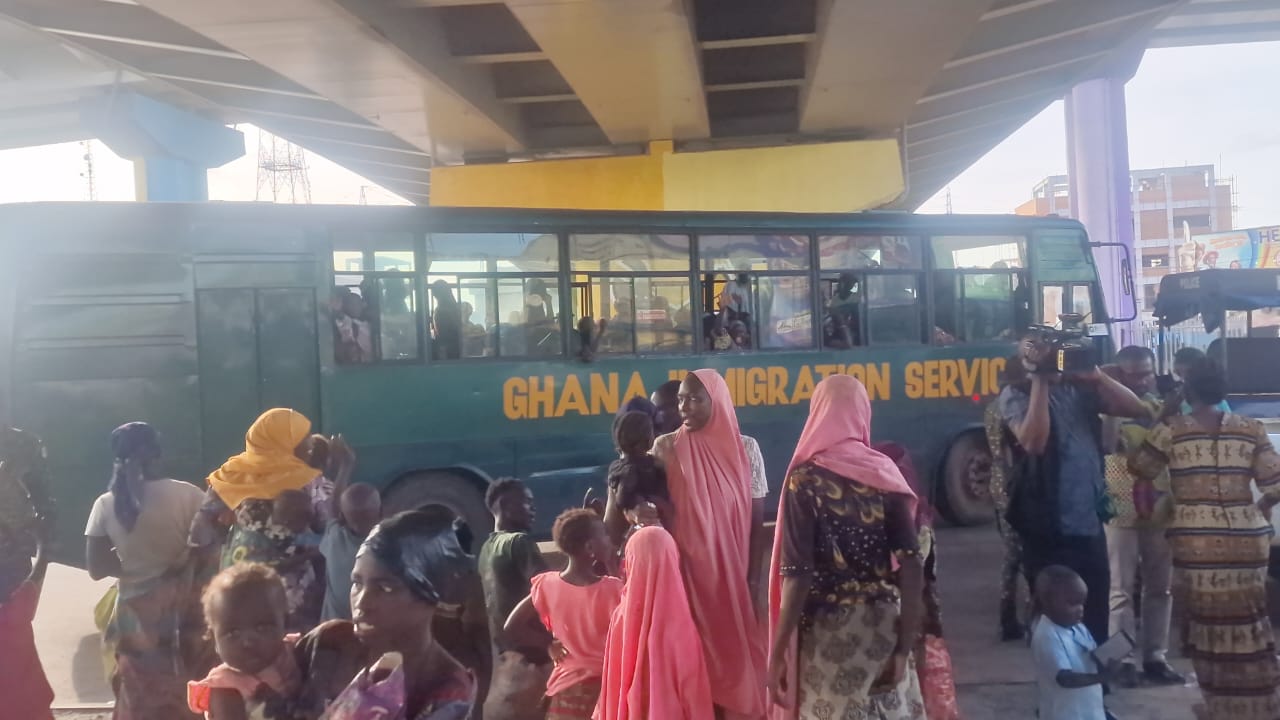
Street children and their guardians have been removed from the streets of the Capital, Accra, particularly at Kaneshie and Abossey Okai.
The operation, which took place in the early hours of Friday, May 16, was led by the Ghana Immigration Service aimed at decongesting the streets as well as curbing child exploitation as part of the Mahama-led administration’s agenda to improve urban mobility.
The victims who usually solicit for alms, believed to be foreign nationals, were packed in immigration vehicles.

In a related development, the Accra Metropolitan Assembly (AMA) is expected to remove traders selling on the streets and pavements in Accra on Tuesday, May 20.
Before the exercise, vehicular movement in the area was at a standstill, as some traders sold their items in the middle of the streets, preventing pedestrians and vehicles from barely moving freely.
Meanwhile, transport operators in Ghana have issued a stern warning to the government and the Ghana Police Service, demanding immediate enforcement of the Road Traffic Regulations, 2012 (L.I. 2180), particularly those relating to trading on roads and pavements.
They have given authorities until Monday, May 19, to act or face a nationwide protest. According to the operators, the growing encroachment of roads and pavements by traders poses serious safety risks and disrupts the free flow of traffic.
Under Ghana’s Road Traffic Regulations, 2012 (L.I. 2180), specific provisions prohibit trading activities that obstruct pedestrian and vehicular movement.
These regulations are designed to ensure the safety and free flow of traffic on public roads and pavements.
Under Regulation 117 of the Road Traffic Regulations, 2012 (L.I. 2180), it is an offence for any person to engage in trading activities in certain areas that pose a risk to public safety or obstruct the smooth flow of traffic.
According to the law, a person shall not sell goods, display goods, offer goods for sale, or deliver goods as part of a sale on or alongside a road. A person shall also not sell or display goods on a pedestrian walkway. In addition, a person is prohibited from selling, displaying, offering for sale, or delivering goods within thirty metres of a railway level crossing.
The law further prohibits such activities under a road traffic sign that indicates a blind corner or a rise. It is also an offence to engage in these trading activities within an intersection. Lastly, the law forbids trading on or alongside any road, including areas around a toll booth and a toll plaza.
Any person who violates the above restrictions commits an offence. Upon summary conviction, the person is liable to pay a fine not exceeding fifty penalty units or serve a term of imprisonment not exceeding three months, or both.
This regulation is designed to safeguard the safety of all road users and ensure that trading activities do not interfere with traffic or endanger lives.
Ghana Immigration Service cracks down on illegal beggars at Abossey Okai#SMS
— THE SOCIAL MEDIA SHOW (@Tsocialshow) May 16, 2025
Kwesi Arthur | Blacko | Kwesi Arthur | ebony pic.twitter.com/EEjFjdHYWV