India wants to send a person to the Moon by 2040, as stated by the government.
The country wants to build a space station by 2035 as part of its space goals.
On Tuesday, Prime Minister Narendra Modi shared his plans and asked scientists to research and explore Venus and Mars.
In August, India became the first country to send a spacecraft and land it on the Moon’s south pole. Then, in September, it launched a rocket to study the Sun.
The Indian Space Research Organisation (Isro) is developing a project called Gaganyaan. Its goal is to send astronauts into space and bring them back to Earth safely, landing in Indian waters. On Saturday, the space agency will perform an important trial in the mission.
This will be followed by another trial flight that will take a robot to outer space. After that, the last mission with humans will happen before the end of 2024.
Tag: Indian Space Research Organisation
-
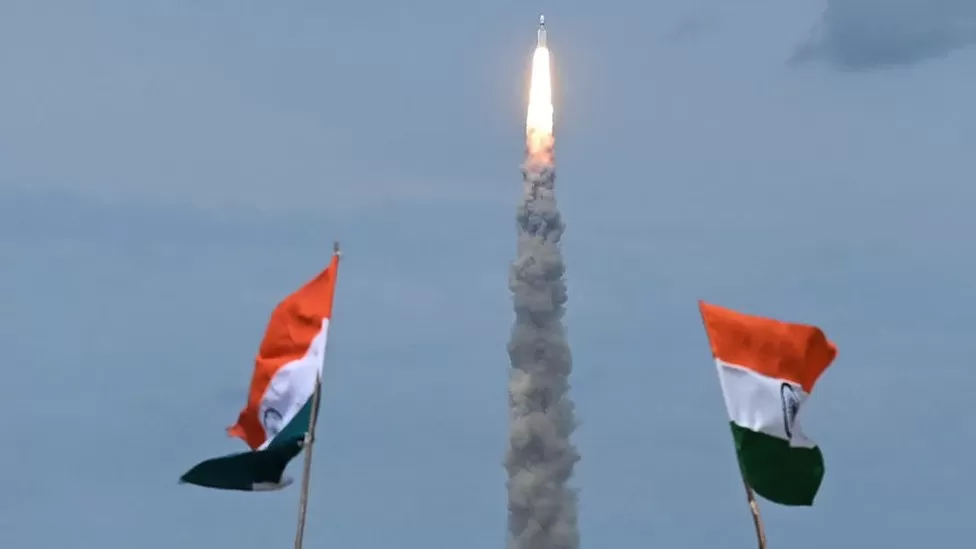
Indian officials hope to deploy astronauts to moon by 2040
-
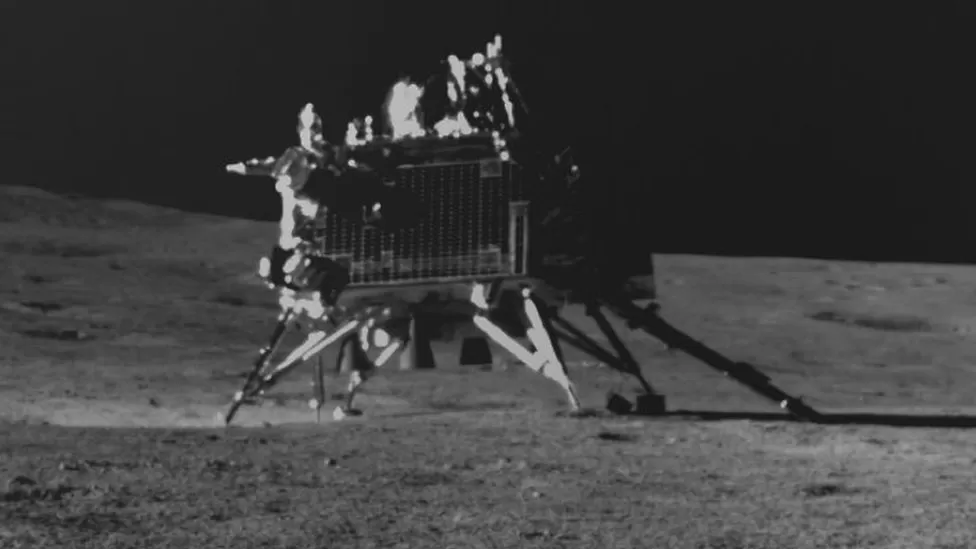
Restoration of India lander doubtful as lunar darkness approaches
Indian space scientists are saying it’s unlikely that the Moon lander will wake up as a new lunar night starts.
The Indian space agency Isro has not agreed if they will keep trying to communicate with the lander and rover. They said that the lander and rover finished everything they were supposed to do and even more.
Isro wished that the Vikram lander would start working again on or after 22 September when a new day on the moon started.
A day and night on the Moon each takes a little more than 14 days on Earth.
The spacecraft landed near the Moon’s south pole on August 23rd. It had a rover called Pragyaan inside. They worked for two weeks collecting information and pictures. Then, they were turned off when it became nighttime on the moon.
They picked a specific landing date that matched the lunar daybreak because they needed sunlight to charge and work properly.
The Indian Space Research Organisation (Isro) said at first that the lander and the rover would only work for 14 days on Earth. However, they later hoped that the batteries would recharge and the modules would wake up again when the sun rises on the moon.
But as more time passed without a signal from the lander, scientists told the BBC that the chances of it waking up were getting less and less likely.
G Madhavan Nair said on Friday that it’s very unlikely that the Vikram lander will start working because it hasn’t sent any messages yet.
“He said the equipment is not made to handle the very cold weather on the Moon, where temperatures at night can drop to as low as -200C to -250C (-328F to -418F). ”
Mylswamy Annadurai, the leader of India’s initial Moon expedition, said to the BBC that they will continue trying to reach the Vikram lander occasionally, but they will have to lessen their efforts.
We cannot keep resources locked up for too long to activate the Moon lander. We need to transfer them to monitor Aditya L-1, which is India’s first mission to study the Sun. “Now we have to keep an eye on Aditya and focus our attention on him,” he said.
“We need to recognize that it exists and continue forward,” he said.
Isro has been giving regular information about the lander and rover’s actions and discoveries, and they have also shared pictures taken by them.
It also said the mission achieved all of its goals. A few days ago, the person in charge of the Chandrayaan-3 project said that the lander did an unplanned hop experiment on the Moon and went beyond what it was supposed to do.
India achieved a significant milestone with its Chandrayaan-3 mission by becoming the first country to successfully land a spacecraft near the southernmost part of the moon.
It also became part of a special group of countries that successfully landed softly on the Moon. This group includes the US, the former Soviet Union, and China. -
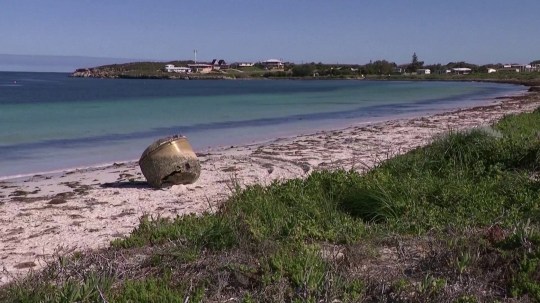
Unknown ‘UFO’ discovered on Australian beach identified
The mysterious eight-foot-wide metal dome that washed up on an isolated Australian beach has now received an explanation from authorities.
On July 15, the enormous cylinder was found on a beach close to Green Head, a tiny coastal community of only 300 people located 155 miles north of Perth, Western Australia.
Locals who were curious about the copper-colored canister reported it, and police set up a cordon so that scientists and state fire officials could perform studies.
A local informed the Australian Broadcast Network (ABC) how a couple who were floating at sea discovered the dome and “dragged it out with their four-wheel drive.”
The Western Australia Police Force reported that the device was taken to a “undisclosed location” after authorities received the go-ahead that it doesn’t represent a risk to people.
Locals in Green Head, online investigators, and X-Files devotees were perplexed by the unusual cylinder.
Some speculated that the huge cylinder, which was around the height of a person, might have been made by aliens, possibly using ‘biologics’ that are not human.
Others believed the Malaysia Airlines flight that vanished over the Indian Ocean in 2014 was caused by the waste system on board a Boeing 777 or perhaps by a piece of that aircraft.
It was found dented on one end and covered in barnacles, indicating that it had spent some time in the ocean before washing up on shore.
The ‘unidentified item’ was, according to police, at best likely space trash.
Contrary to rumours, there is no proof that the object is associated with a commercial aircraft, according to the force.
However, the Australian Space Agency has finally established its real origin, which is, to be fair, somewhat extraterrestrial. if necessary. Actually not at all.
A spokeswoman added, “We have concluded the object found on a Western Australian beach is most likely debris from an expended third-stage of a Polar Satellite Launch Vehicle (PSLV).”
‘The PSLV is an Indian Space Research Organisation (ISRO) medium-lift launch vehicle.
“The debris is still in storage, and the Australian Space Agency is working with ISRO, who will provide further confirmation to determine the appropriate course of action, including taking into account obligations under the United Nations space treaties,” says the statement.
Countries are required by a 1968 UN agreement to return recovered space trash to the country that owned it.
Officials from the space agency have urged anyone who discovers any additional debris to report it to their local authorities.
The PSLV, often known as the “workhorse,” is a 145-foot-tall rocket that serves as India’s preferred means of launching satellites into orbit.
According to the IRSO, the third stage of the six-stage vehicle is a “solid rocket motor that provides the upper stages with high thrust after the atmospheric phase of the launch.”
Given that the Earth’s atmosphere is becoming more and more like a giant space garbage dump, a strange piece of metal could wash up on a beach close to you today.
According to NASA, there is a lot more debris in the vicinity of Earth that is “too small to be tracked but large enough to threaten human spaceflight and robotic missions.”
The organisation calculates that there are approximately 23,000 objects larger than a baseball hurtling around the planet at velocities of up to 17,500 mph.