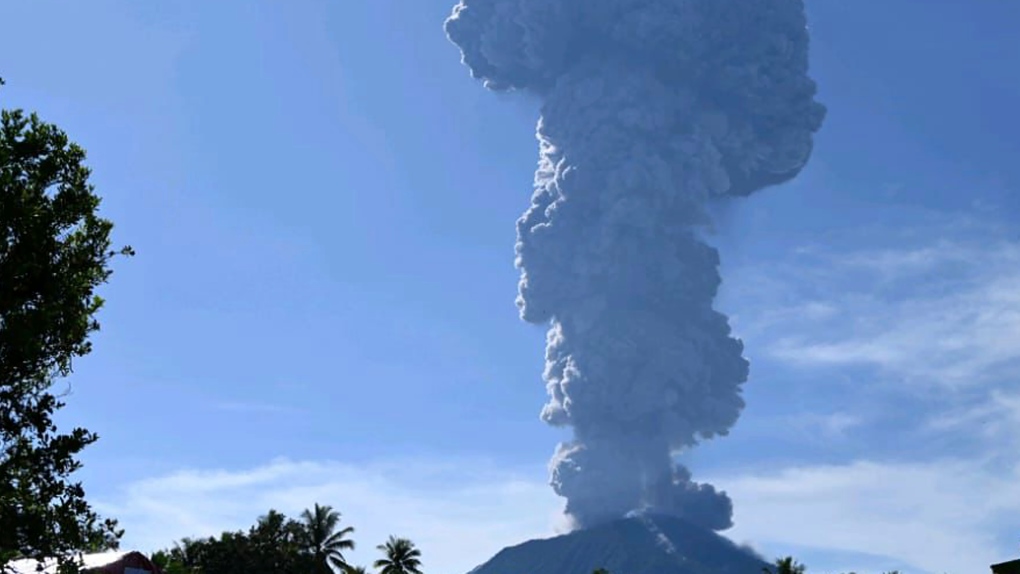
The 1,325-meter volcano on Halmahera island is releasing a lot of ash and dark clouds into the air every day since last Friday.
Muhammad Wafid, the boss of Indonesia’s Geology Agency, said, “The alert level for Mount Ibu has been raised from 3 to 4 because the monitoring shows that there is more volcanic activity. ”
Authorities told people not to do anything near the crater within 7 kilometers and to be careful because there might be a lava eruption.
There are many people living in that area. The local government has set up tents for people to go if they need to leave, but they haven’t told anyone to leave yet.
There have been more earthquakes and volcanic activity from Mount Ibu.
Indonesia is made up of many islands and has 270 million people. There are also 120 volcanoes that are currently active. It might have a lot of volcanoes because it’s located on the “Ring of Fire,” a horseshoe-shaped line of earthquake faults around the Pacific Ocean.
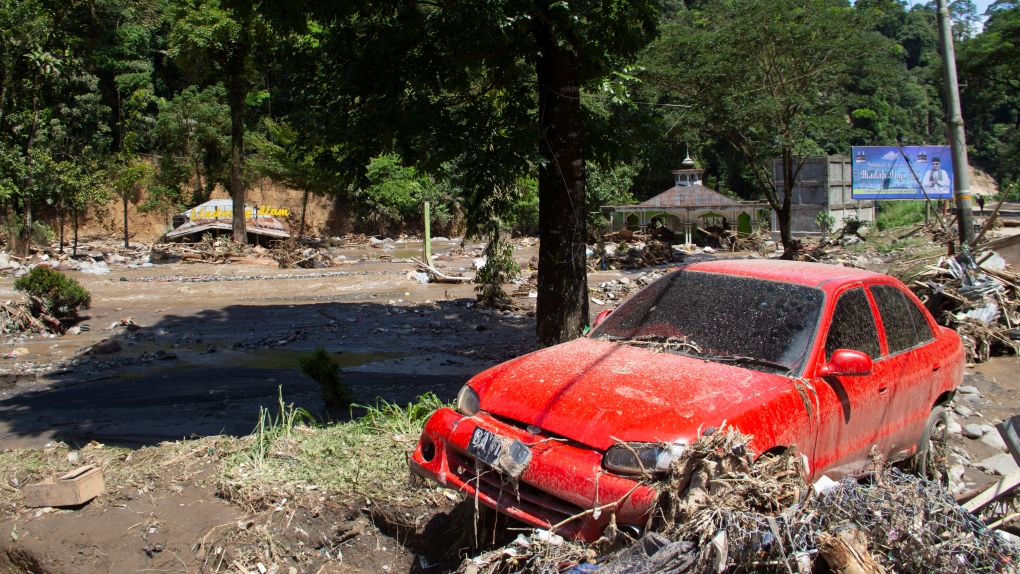
Heavy rains during the monsoon season, along with a big mudslide from a cold lava flow on Mount Marapi, made a river overflow and destroy villages in West Sumatra province. This happened late at night on Saturday. The floods took away people and covered more than 100 houses and buildings, said Abdul Muhari, a spokesperson for the National Disaster Management Agency.
Cold lava, also called lahar, is a mixture of volcanic stuff and rocks that flow down a volcano when it rains.
On Sunday afternoon, rescuers found 19 bodies in the village of Canduang in Agam district, and 9 more bodies in the nearby Tanah Datar district, according to the Indonesian National Search and Rescue Agency.
The agency reported that eight people were found dead in mud during the flash floods in Padang Pariaman, and one person was found dead in Padang Panjang. Rescuers are looking for 18 people who are missing.
Flooding on Saturday night blocked the main roads near Anai Valley Waterfall in Tanah Datar district. This made it difficult to get to other cities. Padang Panjang Police Chief Kartyana Putra said this on Sunday.
The disaster happened two months after a lot of rain caused floods and landslides in West Sumatra’s Pesisir Selatan and Padang Pariaman districts. At least 21 people died and five are still missing.
Last year, Mount Marapi, which is 2,885 meters tall, erupted and 23 climbers died because they were surprised by the eruption on a weekend. The volcano has been at the third level of alert since 2011. This means there is more volcanic activity than usual. People need to stay at least 3 kilometers away from the volcano. This is for the safety of climbers and villagers.
Marapi is famous for erupting suddenly, and it’s hard to tell when it will happen because the volcano is shallow and close to the top. Its eruptions aren’t caused by deep magma movement, and they make the ground shake on seismic monitors.
Marapi has been erupting since January 2023, but no one got hurt. There are over 120 active volcanoes in Indonesia and this is one of them. The country is at risk of earthquakes because it’s on the Pacific “Ring of Fire,” a circle of volcanoes and fault lines around the Pacific Ocean.
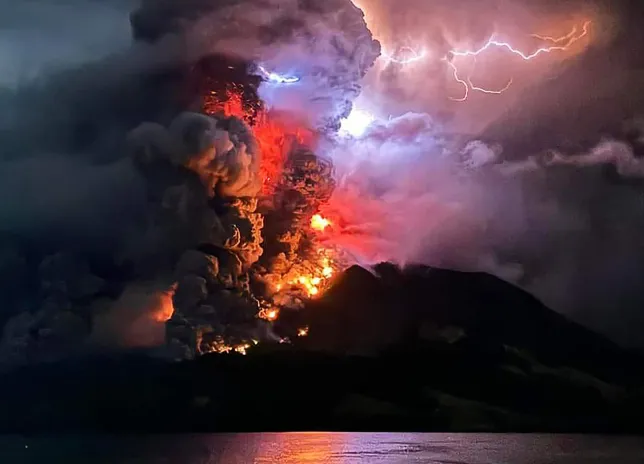
Over 2,100 people had to leave the island of Sulawesi in Indonesia because Mount Ruang started erupting on Wednesday.
The volcano is dangerous because it has hot ash, falling rocks, and clouds of gas. People living nearby might also be at risk of a tsunami. This is according to AP.
Experts are worried that a section of the volcano might fall into the ocean and cause a big wave, known as a tsunami. This has happened before in 1871.
Tagulandang island might be in danger if a collapse occurs. The people who lived there were moved to Manado, which is six hours away by boat, according to the Disaster Mitigation Agency in Indonesia.
People who lived near the volcano were brought to safety by a boat.
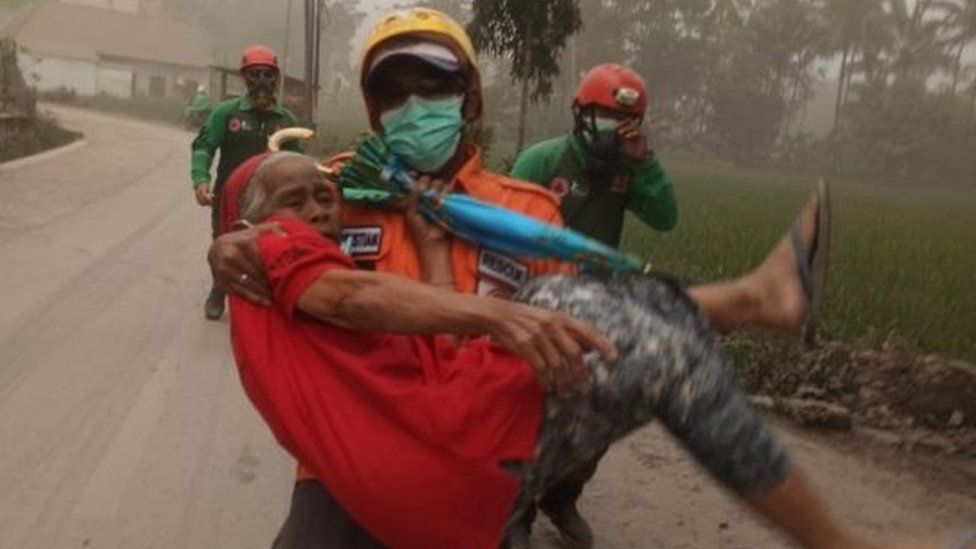
The houses, roads, and buildings were covered in gray ash and the roofs were damaged by volcanic debris.
A map shows where Mount Ruang is on the Sangihe Islands in North Sulawesi.
The agency said on Friday that there was a lot of thick white smoke coming out of the main crater.
More than 11,000 people were asked to leave their homes because ash was spreading towards Manado and North Minahasa, as reported by the Indonesian Transportation Ministry.
People were told to stay at least 3. 7 miles away from the mountain that is 2,370 feet tall.
Scientists watching the volcano saw at least five big explosions on Wednesday, so the danger center gave its highest level III alert.
A big airport in Manado city near the volcano was closed because of ash from the volcano.
Ambar Suryoko, who is in charge of the regional airport, said: ‘We are still keeping an eye on what’s happening with the eruption of Mount Ruang and working with other people involved to get ready for any actions we need to take to keep flights safe, secure, and comfortable. ‘
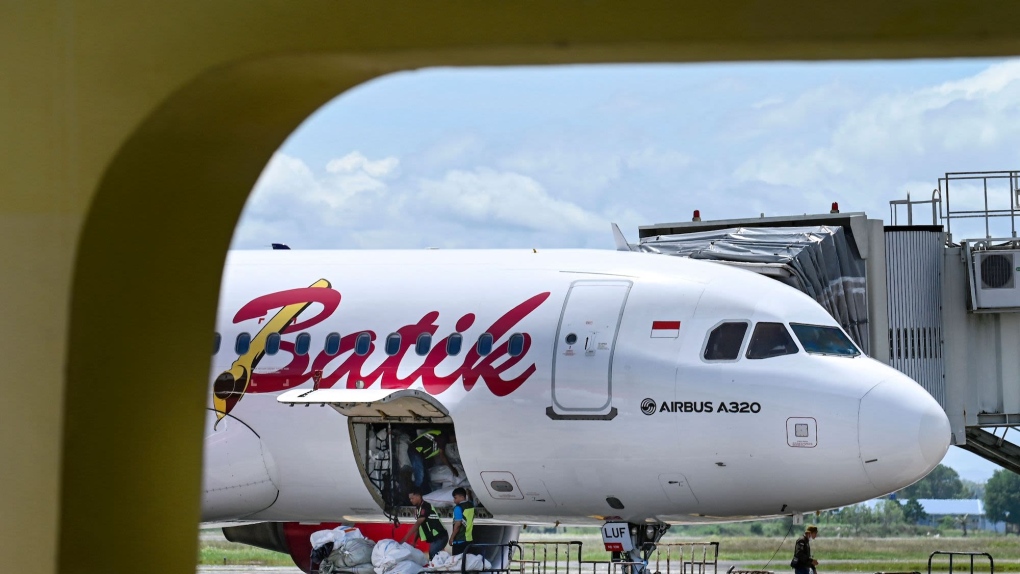
Indonesia’s transportation department to look into a situation where two Batik Air pilots fell asleep during a flight. This information comes from the civil aviation director-general M Kristi Endah Murni, according to the state news agency Antara.
The pilot and co-pilot fell asleep at the same time for 28 minutes during a flight from Kendari to Jakarta on January 25. This caused the plane to go off course.
No one on the plane, including 153 passengers and four flight attendants, were hurt during the flight. The plane was not damaged either, according to the KNKT preliminary report.
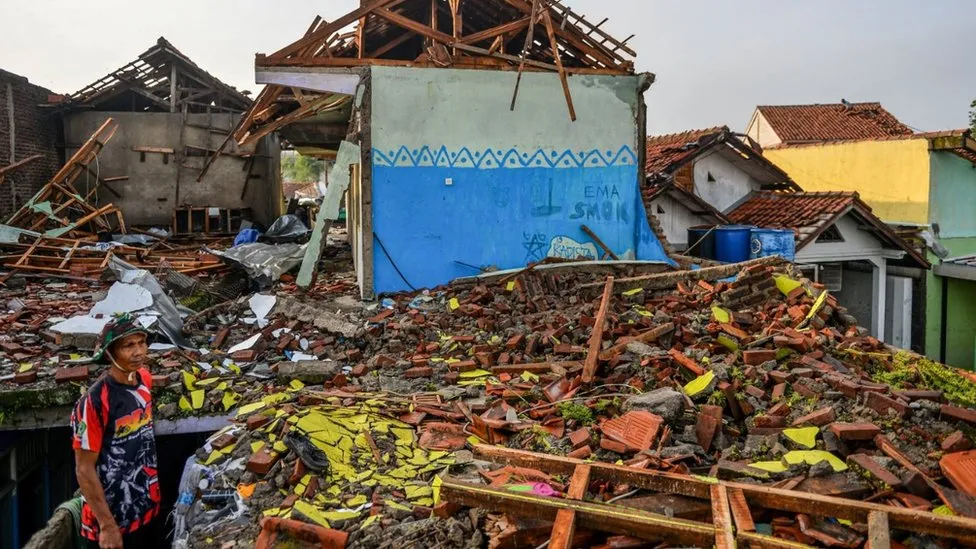
Strong winds destroyed buildings in the town of Sumedang in West Java province.
Videos on social media show things flying in the air, roofs getting taken off buildings and part of a store falling down.
A weather expert at the government’s BRIN research center said the winds were strong enough to be called a tornado.
“My dad was on the terrace when he saw plastic flying and spinning out of nowhere. ” Shortly after, a powerful wind came close to my house,” said Kay Tiara, who lives in Sumedang, in an interview with Reuters.
“The roof of my house quickly flew off. ” My family and I went inside my house to stay safe,” she said.
Indonesia’s agency for helping with disasters said that no one was seriously hurt. We don’t know how long the winds lasted.
Erma Yulihastin, a scientist who studies weather at BRIN, told the media that she thinks the wind needs to be at least 65kmph (40 mph) for it to be called a tornado.
However, the weather and geography council in Indonesia did not officially say it was.
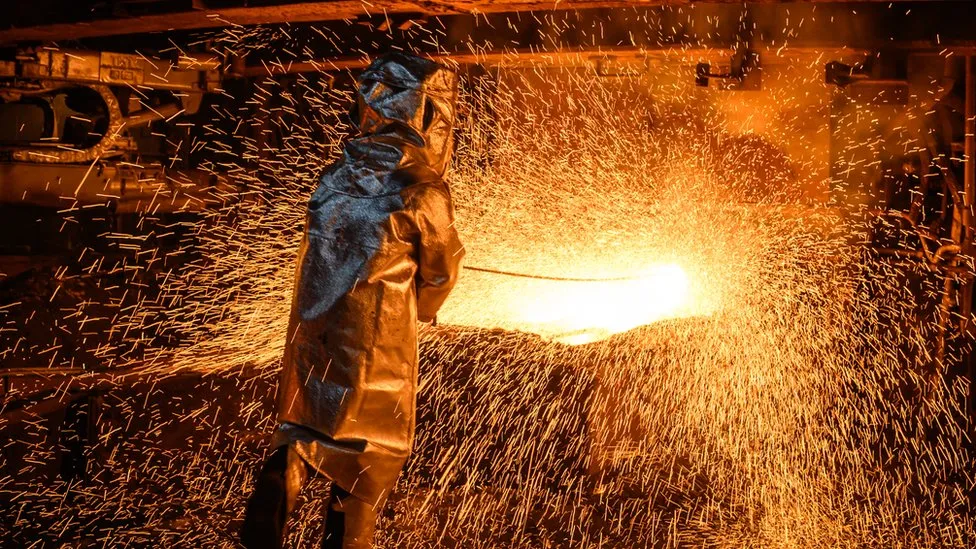
An explosion at a nickel plant on Sulawesi island, Indonesia, claimed the lives of at least 13 workers and left dozens injured, with some in critical condition.
The plant, funded by Chinese investment, witnessed the explosion during repair work on a furnace, causing a flammable liquid to ignite and triggering blasts in nearby oxygen tanks.
Indonesia, a leading global nickel producer crucial for electric car batteries and stainless steel, faced subsequent explosions due to the proximity of multiple oxygen tanks.
The fire was eventually extinguished, and the Morowali Industrial Park (IMIP), a Chinese-owned nickel enterprise, has pledged to cover treatment costs for the victims.
The incident, which resulted in serious injuries to nearly half of the foreign workers, underscores the challenges in the nickel industry.
As China intensifies its efforts to develop an affordable electric vehicle sector, its investment in Indonesian nickel plants has surged.
This metal has become increasingly vital to Indonesia’s economy, rich in natural resources. Following the Indonesian government’s 2020 ban on exporting unprocessed ore, there has been a significant influx of foreign investment, leading to a rapid increase in mining activities in the nation’s more isolated areas.
This surge in production, however, has been marred by a series of fatal accidents. Earlier in the year, a Chinese and an Indonesian worker lost their lives at a nickel plant within the same industrial complex during a riot that erupted amidst a worker protest.
In a separate incident a few months prior, a fire at this plant resulted in the death of one worker and injuries to six others.
These repeated incidents have heightened concerns about the safety standards at facilities financed and operated by Chinese firms, raising questions about worker welfare and operational protocols in this rapidly expanding industry.
TikTok and Indonesian company GoTo have agreed to work together to bring back TikTok’s online shopping in Indonesia.
The company, which is owned by a Chinese company called Bytedance, wants to invest more than $1. 5 billion in the long run in Indonesia’s largest online shopping website, Tokopedia.
In October, the TikTok Shop closed in Indonesia because of new rules in the country’s biggest economy in Southeast Asia.
TikTok is used by about 125 million people in Indonesia.
TikTok is going to buy a little more than 75% of Tokopedia and combine its business in Indonesia with TikTok Shop.
“The partnership will start with a test period done with input and oversight from the regulators,” the two companies said in a statement they released together.
GoTo and TikTok will help Indonesian businesses sell more products and improve how they make and sell things.
The Indonesian government banned online shopping on social media to protect smaller sellers and people’s personal information.
Many of the 270 million people in Indonesia use social media a lot. They were TikTok’s largest online shoppers until the ban started in October.
The ban was announced after Indonesia’s President Joko Widodo warned about being cautious with e-commerce in September. Rules can be helpful, but things can go wrong without them.
Internet shopping in Indonesia has grown a lot in the last few years. E-commerce sales in Indonesia will increase a lot, from 2018 to next year it will be 689 trillion Indonesian rupiah which is equal to $44 billion and £35 billion. This information is from the central bank of Indonesia.
TikTok Shop has been getting more customers since it started two years ago in Indonesia’s online shopping market. This market is mostly controlled by platforms like Tokopedia, Shopee, and Lazada.
The rules in Indonesia were another problem for TikTok. The app is also being looked at in the US, European Union, and the UK. The UK Parliament has banned the app from its network because of security concerns.
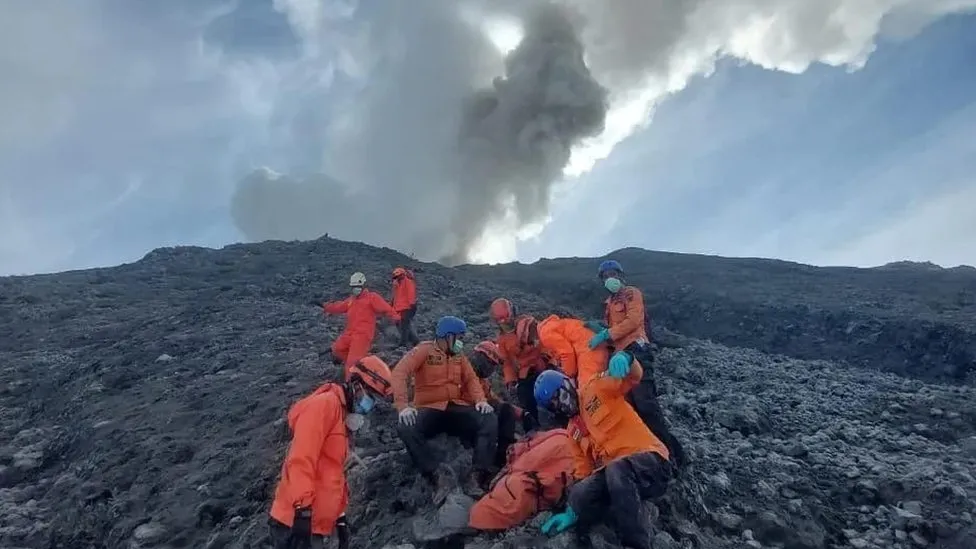
The search for 10 hikers on Mount Marapi started again on Tuesday, after being stopped because it was unsafe.
Marapi was still erupting and many rescuers were climbing on slippery ground to find the missing people.
On Sunday, the volcano erupted and sent a big cloud of ash 3km (9,800ft) into the air. This ash covered the nearby villages.
75 people who were hiking were in the area when the volcano erupted. Many of them have been taken away from the area and got help for their burns.
Rescuers are using times when the weather is not too bad to search for the 10 missing people, Syahlul Munal told the media in Indonesia.
“We need to go fast,” he said.
Mr Munal, who helps with the rescue team, said they found two bodies in different places on Tuesday.
Mount Marapi is a very active volcano in Indonesia and is very popular for people who like to go hiking. It is also called the “Mountain of Fire. ” Some paths were closed and then opened again in June because of ash explosions in January and February. In 1979, Marapi had a very bad eruption and 60 people died.
Ahmad Rifandi, who works at the monitoring station in Marapi, said that he saw five eruptions from midnight to 08:00 local time (01:00 GMT) on Tuesday.
“Marapi is still erupting a lot. ” He said we can’t see how tall the column is because a cloud is covering it.
On Sunday, a video showed a big cloud of ash from a volcano spreading in the sky. The ash covered cars and roads.
On Monday, people took turns moving the people who passed away and the people who were hurt down the difficult mountain ground and onto ambulances with loud sirens.
“Some people got burned because it was really hot, and they have been brought to the hospital,” said Rudy Rinaldi, who is in charge of the disaster response agency in West Sumatra.
A hiker named Zhafirah Zahrim Febrina asked her mom for help in a video from the volcano. The 19-year-old student, who goes by the nickname Ife, looked surprised, with dirty, burnt skin and messy hair covered in grey ash.
“Mom, please help Ife. ” “This is what Ife is going through at the moment,” she said.
She went on a hike with 18 friends and is now in the hospital getting help.
Rani Radelani, her mom, told AFP that her daughter went through a lot of difficulty.
“She feels upset in her mind because she saw her burns and had to deal with the pain all night,” she said.
Marapi is on Sumatra, which is the westernmost and third biggest island of Indonesia. It is 2,891 meters (9,485 feet) tall.
The Indonesian islands are on the Pacific Ring of Fire, which is an area with lots of volcanoes and earthquakes because of the plates in the Earth’s crust.
Rescuers say they found eleven hikers dead near the crater of Indonesia’s Marapi volcano after it erupted over the weekend.
Three individuals were saved on Monday. The search for 12 missing people has been stopped because of a small volcanic eruption.
At the time the volcano erupted, there were 75 hikers in the area, but most of them were safely taken away.
Mount Marapi, a volcano in Indonesia, threw ash 3 kilometers (9,800 feet) into the air on Sunday.
Officials have put in place the second-highest alert level and told people not to go within 3km of the volcano.
Abdul Malik, who is in charge of the Padang Search and Rescue Agency, said that the three people who were saved near the crater were “not feeling well and had some burns. ” Forty-nine climbers were saved from the area on Monday. Some of them were also hurt from burns.
On Sunday, a video showed a big cloud of ash from the volcano spreading in the sky, and ash covering cars and roads.
Rescuers helped bring the dead and injured people down the difficult mountain and onto ambulances with loud sirens.
“Some people got burned because it was really hot, and they have been taken to the hospital,” said Rudy Rinaldi, who leads the West Sumatra Disaster Mitigation Agency.
One of the hikers who was saved was in pain and said “God is great” while being carried by a rescuer. This was reported by AFP news agency.
Jodi Haryawan, who speaks for the local team that looks for and saves people, told the news that it would be too risky to keep looking for people while the volcano was erupting.
Mount Marapi is a really tall mountain in Indonesia on an island called Sumatra. It is 2,891 meters (9,485 feet) high.
The Indonesian islands are located in a place where lots of earthquakes and volcanoes happen because the plates under the Earth’s surface come together there.
Indonesia’s football federation (PSSI) announced on Wednesday their support for Saudi Arabia’s bid to host the 2034 World Cup, despite PSSI president Erick Thohir having mentioned just a week earlier that discussions were underway with Australia regarding a potential joint bid for the tournament.
“Indonesia supports Saudi Arabia’s bid to host theFIFA World Cup in 2034,” Thohir said in a statement.
“Indonesia continues to prepare for its bid to host the FIFA World Cup after 2034, as well as other FIFA competitions.”
FIFA has initiated a call for bids from countries in Asia and Oceania to host the 2034 tournament, with the submission deadline set for October 31.
Just last week, Thohir revealed that he had engaged in discussions with his Australian counterpart regarding a potential bid, one that might encompass not only Australia but also Malaysia and Singapore.
Football Australia had previously expressed their interest in investigating the feasibility of submitting a bid to host the tournament.
According to a recent research, Jakarta, the capital of Indonesia, is the most polluted city in the world, and the president of the nation could have the cough to prove it.
President Joko Widodo has been suffering from a cough for weeks, according to ministers in the Southeast Asian nation, who also speculated that it may be tied to the growing air pollution in the 10 million-person city.
The information was announced just days after Swiss business IQAir published statistics demonstrating that Jakarta’s air quality had gotten significantly worse in recent weeks, ranking it as the worst in the world.
“President Joko Widodo has requested that action be taken in the form of concrete measures to combat air pollution within a week. After a parliamentary discussion between ministers on Monday in Jakarta, Indonesia’s Minister of Tourism and Creative Economy Sandiaga Uno told reporters that the man had been coughing for almost four weeks and claimed he had never felt this way.
According to CNN affiliate CNN Indonesia, Uno stated that physicians were still determining the source of Widodo’s cough but added that it might be connected to the deteriorating air quality.
The president was reportedly noted to be suffering from a cough the next day by Health Minister Budi Gunadi Sadikin, who also stated that his ministry was speeding up examinations in the general populace to determine whether lung and respiratory illnesses like asthma had increased in severely polluted areas.
We are keeping an eye on the situation, Budi told the media.
He continued, “All reports about how air pollution affects public health will be coordinated to the relevant ministries and official agencies for examination.
According to experts, industry, coal-fired power plants, and traffic jams all contribute to the air pollution that has long plagued the Greater Jakarta area.
A group of 32 locals filed a civil case in 2019 against Widodo, often known as Jokowi, and a number of his cabinet colleagues, claiming he had not acted to reduce air pollution and maintain their right to clean air.
Two years later, the Central Jakarta District Court ruled in their favour, giving them a landmark win. It claimed that the government had broken the nation’s environmental protection rules and urged senior authorities to take more steps, including the creation of a national ambient air quality standard.
However, according to statistics provided by IQAir, a Swiss company that specialises in air quality technologies, the capital’s air quality has gotten notably worse in recent weeks, worsening to the worst in the world.
After reaching “unhealthy” air pollution readings nearly every day, Jakarta topped the company’s list of dirty cities on August 9. Since May, it has constantly been classified among the top 10 most polluting cities worldwide, according to IQAir.
In order to debate the deteriorating air quality and demand immediate government action, Widodo presided over a cabinet meeting on Monday.
He attributed the pollution to “excessive road traffic, a long dry season, and energy sources – mainly those using coal” and recommended solutions including requiring automobile emissions tests and promoting remote work as a way to lessen the issue.
A pollution fee, he added, was under consideration.
The Greater Jakarta Area’s air quality has been extremely poor for the past week, according to Widodo. In order to cut emissions, he continued, “Supervision must be exercised in the industrial and electricity generation sectors, and we also must educate the people).
After the discussion, Tourism Minister Sandiaga Uno told reporters that the government was considering “concrete steps” to enhance Jakarta’s air quality over time.
“If we look at Beijing’s success in doing that, I am very confident that with the collaboration of local governments and businesses, we can also improve the air quality in Jakarta – it will have a long-term impact on public health,” he said, referring to China’s success in doing the same in its capital.
The government’s position has been praised by experts.
Bridget Welsh, a political analyst from the University of Nottingham, declared that air pollution is a significant issue in Southeast Asia.
Welsh stated that although there have been improvements in Jakarta in areas like public transport, these need to be intensified along with better enforcement against (fossil fuel) burning and controlled automobile use.
Although the government intended to move the capital to Nusantara, in the East Kalimantan province on the island of Borneo, she claimed that this move was still years away and would not resolve the pollution issue.
Moving to a different capital “will only temporarily offset the issue,” Welsh added. It is impossible to understate the enormous costs of Indonesia’s air pollution to human health.
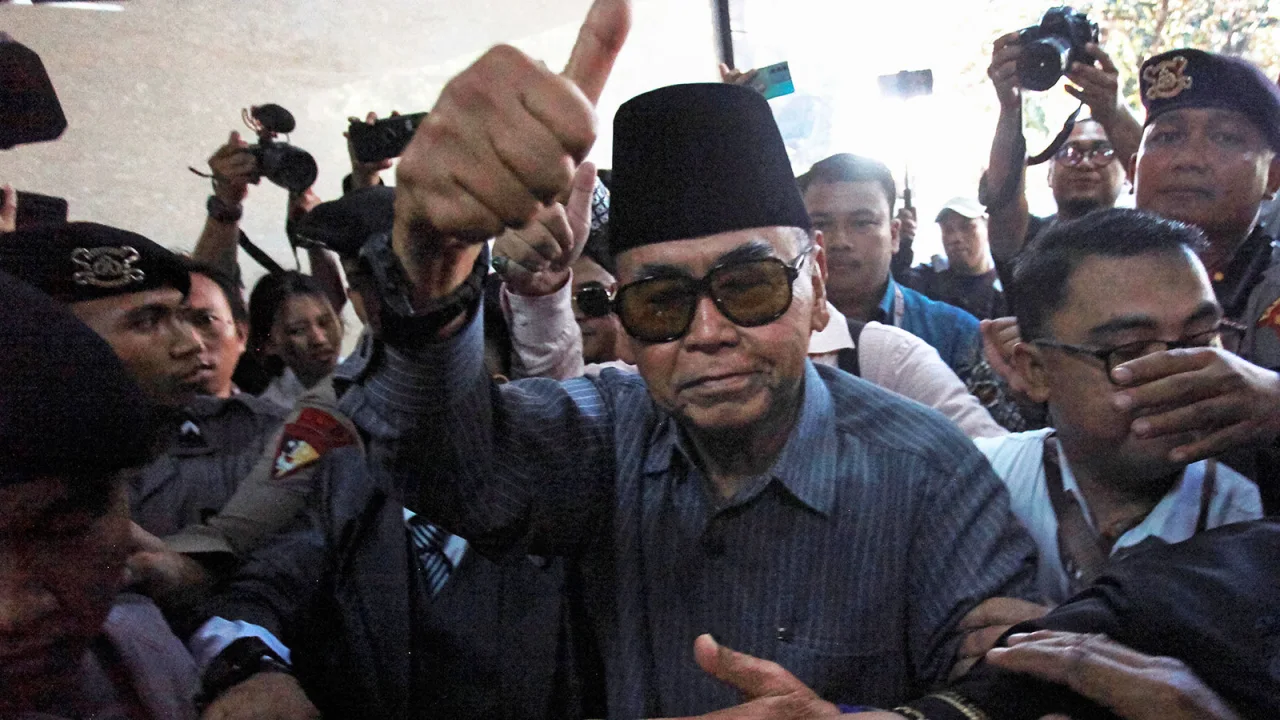
Following a backlash from religious fundamentalists in the largest Muslim-majority country in the world over his decision to permit women to lecture and pray alongside males, a Muslim cleric was detained in Indonesia on blasphemy and hate speech charges.
According to Indonesian National Police officer Djuhandhani Rahardjo, Panji Gumilang, 77, who manages the Al-Zaytun boarding school in the Jakarta neighbourhood of Indramayu in West Java, was detained on Tuesday.
The nearly 5,000-student school has in the past come under fire from the public due to its unconventional practises, such as allowing men and women to worship together and permitting women to become imams. Its prayer sessions do not adhere to gender segregation, in contrast to other Indonesian Islamic boarding schools, which infuriates hardline groups.
According to Djuhandhani, investigators “took legal action” on Tuesday. He continued, “(Panji will be) held in the detention facility of the Criminal Investigation Agency for twenty days.”
Police claimed they were responding to public complaints, although they could not describe what Panji had said or done that amounted to blasphemy.
Al-Zaytun was being looked into by Indonesia’s Islamic Clerical Council in June for “misguided religious practises,” according to CNN affiliate CNN Indonesia. Panji could spend up to 10 years in prison if proven guilty of blasphemy and hate speech.
Hendra Effendy, Panji’s attorney, urged his followers to remain composed.
“He is, after all, a well-known person with millions of fans… With everything going on, we have no idea what might occur, he told CNN Indonesia.
A supporter of Panji who wished to remain anonymous out of fear of retaliation told CNN that Panji’s detention was “unjust” and indicative of the nation’s shift towards the religious right.
The fan questioned, “So he went against (the curve), does he deserve to be punished for his compassion?”
Women are not allowed to lead mixed-gender prayers or give sermons at the majority of mainstream Islamic schools around the world. Men and women are also typically separated during prayers.
With 231 million Muslims, Indonesia is the country with the greatest Muslim majority in the world.
It is nominally secular and officially recognises six religions, including Islam, Protestantism, Catholicism, Hinduism, Buddhism, and Confucianism, despite the country’s overwhelmingly Muslim population.
Islam has historically been practised in the nation in a liberal and pluralistic manner. But in recent years, religious conservatism has increased.
In some areas of the country, such as the semi-autonomous Aceh province, strict Islamic laws are already in effect. There, gambling and alcohol are prohibited, and a variety of offences, such as adultery and homosexuality, are punishable by public flogging.
According to Human Rights Watch researcher Andreas Harsono, Panji was “supportive” of Muslim women becoming imams and leading others in prayer, which “isn’t normal in Indonesian society.”
He has advocated for gender equality in Islam, which has incensed conservatives. Nothing is wrong with him (a Muslim cleric) advocating for women’s rights, but there is a serious problem with blasphemy laws, he continued.
Rights organisations claim that Indonesia’s tolerance and commitment to religious freedom are “under threat” and that blasphemy laws are being “increasingly weaponized” against religious minorities and anyone who are thought to have criticised Islam.
Basuki Tjahaja Purnama, an ethnic Chinese Indonesian known as Ahok and Jakarta’s first non-Muslim governor in 50 years, was involved in one of the most well-known blasphemy trials.
He was put on trial for blasphemy in 2017, after upsetting radical Muslims by using a Quranic verse during his 2016 re-election campaign.
He issued a public apology but was nonetheless sentenced to two years in prison, a decision that many Indonesians and other observers questioned and denounced. The case was generally viewed as a test of Indonesian tolerance for differing religious beliefs and the right to free expression.
Human Rights Watch’s Andreas noted that blasphemy cases have been sharply rising over time. The use of these laws by Indonesian officials against religious minorities in the guise of “religious harmony” has become increasingly poisonous.
In reference to contentious changes to its penal code that are expected to be adopted by 2025, he said, “It is becoming an increasingly Islamized state and there will be many more consequences… for people whose views are considered to be against the Islamic establishment.”
One fan, who had embarked on a 12-hour boat and plane journey to attend the game, accused the organizers of false advertising.
Over 60,000 tickets had been sold for the sold-out match between Indonesia and the World Cup champions, Argentina, with Messi’s face prominently featured in the event’s advertisements.
However, on Thursday, fans in the football-loving country were informed that their beloved hero would not be participating.
“I’m feeling sad and disappointed, mixed emotions,” 31-year-old shop owner Surya Wijaya Ang told AFP from the remote island of Banda Neira in the eastern province of Maluku.
“This was the biggest chance for me to see Messi play in person.”
On Thursday the Argentina side beat Australia in another friendly in the Chinese capital Beijing, with head coach Lionel Scaloni confirming that Messi would not make the Indonesian leg of their Asian tour.
Having become a major fan of Messi during the star’s time at Barcelona, Ang has amassed a collection of around 200 jerseys adorned with his name.
He is planning to take a boat to the eastern Indonesian city of Ambon before catching a four-hour flight to Jakarta to attend the match.
Ang sold seven shirts from his wider jersey collection to pay for the 1.2 million rupiah ($80) match ticket, a steep price in the lower-middle-income country.
‘Marketing strategy’
The Messi fanatic is aggrieved and said organisers had seemingly promised an appearance by the superstar.
“Messi is an icon and you can say that 90 percent of the tickets were sold because of Messi,” he said.
“This was a marketing strategy for them.”
Other Indonesians took to social media to convey disappointment, with one offering to sell two tickets “because Messi is not coming”.
A video posted on Twitter showed a fan singing a guitar ballad with the lyrics: “Why don’t you come to Indonesia? Why you don’t come, oh Mr Messi?”
Another wrote: “This is the end of my idolising him… we won’t beg him to come.”
Indonesian football has been enduring a year of crises with a deadly stadium crush and losing the rights to host the FIFA Under-20 World Cup.
Despite having his Messi hopes dashed, Ang said he would travel to the capital for the game anyway.
“I’ve come this far, so I will still be going,” he said.
“Maybe I will see Lionel Scaloni,” he added, laughing.
The New Zealand pilot Philip Mehrtens who is being held captive by separatist rebels in Indonesia’s troubled Papua area has made an appearance in a video claiming to be “alive and well,” but fears are growing for his safety as conflict with Indonesian security forces escalates.
Mehrtens speaks calmly to the camera in both Indonesian and English for the whole of the one and a half minute film while seated between two unarmed Papuan men and wearing a black T-shirt and shorts.
It’s been over three months since they (separatist fighters) abducted me from Paro, Mehrtens stated. “Good afternoon, today is Monday, April 24, 2023,” he added. I am still alive and healthy, as you can see. I’ve been eating and drinking good,” he said.
“I live with the people here – we travel together as required, we sit together, we rest together.”
He then called on the Indonesian authorities to stop ongoing airstrikes in the Nduga Regency where he is being held, saying the attacks could put his life as well as others at risk.
“Indonesia’s been dropping bombs in the area over the last week,” Mehrtens said. “Please, there is no need, it is dangerous for me and everybody here. Thank you for your support.”
In a statement accompanying the video, the West Papua National Liberation Army (TPNPB) called on the New Zealand government to mediate and initiate negotiations for Mehrtens’ release and urged Indonesian authorities to stop its military operations in Papua.
“We emphasize that the pilot’s release must go through negotiations – not through military operations,” the group’s spokesperson Sebby Sambom said.
“Therefore, Indonesian President Joko Widodo must stop military operations in Ndugama immediately – if not (it will) endanger the life of the New Zealand pilot.”
Fighting and unrest continue to escalate in the impoverished but resource-rich region of Papua, where the Indonesian military maintains a heavy and controversial presence.
Designated as a terrorist group by the Indonesian government, TPNPB has periodically released updates about Mehrtens – who was captured by fighters in February after landing a commercial Susi Air charter flight at Paro Airport.
They have not disclosed Mehrtens’ location.
Indonesian security forces previously said they would refrain from any action that could endanger Mehrtens’ life but launched a military search operation for the pilot that resulted in clashes.
Last week separatist rebels claimed they killed at least 13 Indonesian military soldiers – a figure dismissed as “fake news” by Indonesian military chief Admiral Yudo Margono who confirmed one fatality and said four soldiers had gone missing while the rest had returned to their posts.
In a statement following the attacks, the rebels said they shot dead 13 Indonesian military and police officials and were in possession of 12 bodies, without providing proof.
CNN has reached out to Indonesian army officials for further comment about the latest hostage video and updates on the search mission for Mehrtens.
New Zealand’s Prime Minister Chris Hipkins said he had received reports of the increased military confrontations and again called on the separatist group to release Mehrtens, reported CNN affiliate RNZ.
Eid al-Fitr, the “festival of breaking the fast” that follows the holy month of Ramadan, is a time when Muslims congregate in Indonesia and Malaysia.
Relieved to be allowed to celebrate freely following the lifting of most COVID-19 restrictions that had stifled past festivities, Muslims in Indonesia and Malaysia have congregated in large numbers to usher in the Eid al-Fitr festival, which marks the end of the holy fasting month of Ramadan.
To commemorate the conclusion of Ramadan, hundreds of worshippers gathered at the historic harbour of Sunda Kelapa in North Jakarta, the country with the largest proportion of Muslims in the world, for morning prayers on Saturday.
“I’m very happy that we’re free (of COVID curbs) now,” Laila, 35, who goes by one name like many Indonesians, told the Reuters news agency.
Another worshipper, 30-year-old Adit Chandra, said: “I hope it gets better from here on, and that we can gather together with our families after the last three years of not being able to go back to our hometown.”
Chandra is among the more than 120 million Indonesians – nearly half the country’s population – who plan to travel from major urban centres to their hometowns for Eid al-Fitr.
In neighbouring Malaysia, devotees also celebrated with families.
“We can visit the extended family, and do so without suspicious feelings … during the pandemic we were cautious,” said Khairul Soryati, a 39-year-old resident of the capital, Kuala Lumpur.
Muhd Nur Afham, 31, who works in Singapore said he could finally celebrate with family in Malaysia this year after not being able to travel during the pandemic.
“I’m grateful … last time we only met through video call,” he said.
Authorities in both countries have, however, urged the public to remain cautious amid reports of rising COVID cases.
After a protest from an Indonesian official against Israel’s participation, FIFA has revoked Indonesia’s ability to host the Under-20 Men’s World Cup later this year.
“FIFA has decided, due to the current circumstances, to remove Indonesia as the host of the FIFA U-20 World Cup 2023,” FIFA said in a statement, without providing further clarification. “A new host will be announced as soon as possible, with the dates of the tournament currently remaining unchanged.”
Sanctions could also be imposed on the Football Association of Indonseia (PSSI), according to the statement.
The youth competition was slated to take place in six Indonesian cities from May 20 to June 11 and feature a total of 24 teams. First time qualifiers are Israel.
Indonesia, a Muslim majority nation of more than 270 million people, does not have formal diplomatic relations with Israel and supports the cause of the Palestinians.
Anti-Israeli sentiment runs high among conservative Muslims in Indonesia and earlier this month, protesters marched in the capital Jakarta demanding the government ban Israel from playing in the tournament.
Indonesian President Joko “Jokowi” Widodo appealed to the public in a televised address on Monday, reiterating Indonesia’s support for the Palestinians but also stressing the country must follow FIFA regulations, according to state news agency Antara.
“Do not link sports issues with political affairs,” he reportedly said.
PSSI president Erick Thohir said he pleaded Indonesia’s case to FIFA president Gianni Infantino on Wednesday, which included showing him a letter from the Indonesian President.
“I have tried my best. We must accept FIFA’s decision to cancel the holding of the event that we are both looking forward to,” Thohir said in the statement. “Because we are members and FIFA considers that the current situation cannot be continued, we must submit.”
FIFA said it will continue to work with Indonesia and the PSSI “in the transformation process of Indonesian football following the tragedy that occurred in October 2022,” referring to the East Java stadium disaster.
“A new meeting between the FIFA president and the PSSI president for further discussions will be scheduled shortly,” the statement said.
After a deal to purchase arms from theIndonesian troops fell through, four Papuan men were killed and their bodies were mutilated.
According to a court document and local media reports, a military court in Indonesia’s unrest-plagued Papua region has imprisoned four soldiers for their roles in the brutal killing and mutilation of four civilians.
The four were found guilty of premeditated murder on Wednesday by a court in the provincial capital of Jayapura for the killing of the four men who attempted to purchase weapons from the soldiers in August 2022.
According to a court document seen by Reuters, two of the four soldiers were given life sentences in prison, a third was given a 20-year sentence, and a fourth was given a 15-year sentence.
The four, who appeared in court wearing military uniforms, were also fired from their positions in the Indonesian military, according to a local media outlet in Papua, Jubi News.
Jubi News reported on Thursday that a total of six soldiers and four civilians were charged with the killings. One of the six soldiers died before receiving a verdict and another received a life sentence last month. The trial of the four civilians was continuing, according to the news organisation.
According to reports, the four Papuan men were killed last year after a deal to buy weapons from the Indonesian troops went awry. After their deaths, the mutilated bodies of the four were placed in sacks which were then thrown into a river near the city of Timika on the southern coast of Papua.
Papua police said that one of the four people killed was linked to the West Papua National Liberation Army (TPNPB), a rebel group which has fought for decades to win independence from Indonesia. A spokesperson for the TPNPB last year called on the government to hold the perpetrators of the killing accountable or risk further violence.
Indonesia maintains a heavy military presence in Papua, where small groups of rebel fighters have for decades waged a low-level, but increasingly deadly, battle for independence.
Indonesia’s military has also faced accusations of human rights abuses in Papua, which it has denied, but investigations into such allegations are rare.
The TPNPB on Wednesday released images that they say showed a New Zealand pilot that they took hostage last week. The group said that pilot, Philip Mehrtens, would not be freed until Indonesian authorities acknowledge the independence of the region.
According to reports, the four Papuan men were killed last year after a deal to buy weapons from the Indonesian troops went awry. After their deaths, the mutilated bodies of the four were placed in sacks which were then thrown into a river near the city of Timika on the southern coast of Papua.
Papua police said that one of the four people killed was linked to the West Papua National Liberation Army (TPNPB), a rebel group which has fought for decades to win independence from Indonesia. A spokesperson for the TPNPB last year called on the government to hold the perpetrators of the killing accountable or risk further violence.
Indonesia maintains a heavy military presence in Papua, where small groups of rebel fighters have for decades waged a low-level, but increasingly deadly, battle for independence.
Indonesia’s military has also faced accusations of human rights abuses in Papua, which it has denied, but investigations into such allegations are rare.
The TPNPB on Wednesday released images that they say showed a New Zealand pilot that they took hostage last week. The group said that pilot, Philip Mehrtens, would not be freed until Indonesian authorities acknowledge the independence of the region.
Sebby Sambom, a spokesman for the TPNPB, shared photographs and videos of a man wearing a denim jacket, surrounded by a group of about a dozen fighters, some armed with guns and bows.
“The Papuan military that has taken me captive to fight for Papuan independence, they ask for the Indonesian military to go home to Indonesia and if not, I will remain captive for my life,” Mehrtens said at one point in the TPNPB video.
Separatist fighters in Indonesia’s Papua region have kidnapped a New Zealand pilot.
The 37-year-old Mr. Mehrtens was taken into custody after his aircraft, carrying five passengers, was attacked after landing in the isolated mountain province of Nduga.
He is “safe,” according to his kidnappers, the West Papua National Liberation Army (TPNPB), who have spoken to BBC Indonesia.
However, they claim that they won’t let him go until West Papua’s independence is recognised.
Sebby Sambom, a TPNPB spokesman, told BBC Indonesia that the five additional passengers, including a child, had been freed because they were native Papuans.
Indonesian authorities say they are deploying a search and rescue team. But police noted it was logistically difficult because the remote area can only be reached by air.
Meanwhile New Zealand’s Prime Minister Chris Hipkins said the country’s embassy in Jakarta was “working on the case”. The foreign ministry had earlier said it was “well aware” of the situation.
The small passenger plane, which belongs to Indonesia’s Susi Air, had departed from the Mozes Kilangin airport in Central Papua early on Tuesday, and was meant to return a few hours later after dropping off the passengers in Nduga.
A TPNPB spokesman told BBC Indonesian that Mr Mehrtens had been moved to a stronghold district for the group in a remote area, and he would be used as “leverage” in political negotiations.
“The pilot is safe. That is our responsibility… We take him as our hostage in a remote area,” said Mr Samborn.
But he added the group would hold Mr Mehrtens captive until countries “like New Zealand and Australia” took responsibility for their role in the ongoing historical conflict and violence in Papua.
Papuan rebels seeking independence from Indonesia have previously issued threats and even attacked aircraft they believe to be carrying personnel and supplies for Jakarta.
The resource-rich region has been caught in a battle for independence since it was brought under Indonesia’s control in a UN-supervised vote in 1969.
Conflicts between indigenous Papuans and the Indonesian authorities have been common since, with pro-independence fighters mounting more frequent attacks since 2018.
The region is a former Dutch colony divided into two provinces, Papua and West Papua. It is separate from Papua New Guinea, which was given independence by Australia in 1975.
The plaintiffs want damages that reflect Holcim’s contribution to the climate change that has made island life increasingly difficult.
When the first tidal wave struck Pari Island back in 2018, Arif Pujianto’s entire home was flooded for more than 24 hours, contaminating the well from where he sourced his drinking water, rusting his motorbike and leading timber panels to fall off the walls.
The 51-year-old fisherman was forced to abandon his belongings and flee with his wife and son to the other side of the Indonesian island, part of the famed Thousand Islands that lie off Java’s northwestern coast, staying with a friend overnight.
“I was afraid,” Pujianto told Al Jazeera. “I became a refugee on my own land.”
The low-lying island of Pari, about 40km (25 miles) north of Jakarta, is on the front lines of the world’s climate crisis. Extreme flooding is killing off trees and driving away tourists; chaotic weather has devastated fishing hauls; and rising sea levels are submerging the island of 1,500 residents.
On average, Pari lies about 1.5 metres (4.9 feet) above sea level.
“I am angry with the situation,” says Pujianto, who now uses rainwater to desalinate his well. “I want to protect my land. I think about the future of my son, my family.”
On Wednesday, Pujianto and three other plaintiffs on Pari announced that they had formally lodged a lawsuit against the Swiss-based cement producer Holcim for its alleged role in the climate crisis. In July 2022, they submitted a request for conciliation in Zug, Switzerland – where Holcim has its headquarters – but with no agreement reached, they have decided to sue the company in the Swiss civil court.
Low-lying Pari island sits off the northern coast of Java and was a popular destination with tourists [Peter Yeung/Al Jazeera]
Supported by the Indonesian Forum for the Environment (WALHI), Swiss Church Aid (HEKS) and the European Center for Constitutional and Human Rights, the plaintiffs are demanding that Holcim, the world’s largest manufacturer of building materials, reduce its carbon dioxide emissions by 43 percent by 2030.
They are also demanding the company co-finance adaptation measures on Pari such as mangrove plantations and, significantly, that it pays “loss and damage” for its role in the climate crisis.
According to a HEKS-commissioned study by the Climate Accountability Institute in the United States, Holcim emitted more than 7 billion tonnes of carbon dioxide between 1950 and 2021 – the equivalent of 0.42 percent of all global industrial emissions in human history.
The Pari claimants are seeking a total of 14,700 Swiss francs ($16,000), about $4,000 each, which has been calculated as proportional to Holcim’s contribution to overall climate damage.
“Holcim has been aware of the high emissions created by cement production and its impacts on the climate for at least 30 years,” says Lorenz Kummer, a campaigner at HEKS. “Nonetheless, over that time, the company more than doubled its emissions and those damaging effects are being felt by the people of Pari.”
A spokesperson for Holcim said in a statement that climate action was a “top priority” for the company and that it was “taking individual action and supporting global multilateral frameworks for collective impact to be part of the solution.”
The statement added: “We do not believe that court cases focused on single companies are an effective mechanism to tackle the global complexity of climate action.”
Arif Pujianto says he is worried about the increasing frequency of floods in Pari and wants to protect the island from more harm [Peter Yeung/Al Jazeera]
The Pari islanders’ case against Holcim, one of the first to be initiated by affected parties from the Global South, is part of a growing movement for “loss and damage” and could be the catalyst for more climate litigation.
The case marks the first time a Swiss company is being held accountable in the courts for its role in climate change.
“This kind of litigation shows that policymakers aren’t doing enough to address the needs of the people impacted,” says Noah Walker-Crawford, a researcher specialising in climate litigation at University College London.
“If the claimants were to win, it would set a massive precedent. It would make those responsible for the damage pay.”
‘Global justice’
Campaigners argue it is a matter of “global justice” that people living mostly in developing countries receive compensation as they have been disproportionately affected by climate-related damages and losses – through flooding, heat waves, storms, droughts and more – largely caused by industrialised countries and global corporations.
According to an analysis in July, the US has since 1990 inflicted more than $1.9 trillion in damages to other, mostly poor, countries as a result of its greenhouse gas emissions – through heatwaves, crop failures and other consequences.
At the United Nations Climate Change Conference (COP27) in November, European leaders acknowledged their role in the climate crisis and agreed to set up a “loss and damage” fund to help the most vulnerable but no concrete investment has yet been established, nor a mechanism by which the funds can be dispersed.
Bobi says he joined the case because he is worried no one will be able to live on the island in the future [Peter Yeung/Al Jazeera]The island is now hit by several floods every year and fishermen say their catch has been affected [Peter Yeung/Al Jazeera]
Several legal challenges have been brought over climate as time runs out for at-risk communities.
A Peruvian farmer and mountain guide are taking action against the German energy firm RWE, whose case is ongoing, while Friends of the Earth Netherlands won a landmark court ruling in 2021 that ordered oil giant Shell to reduce its carbon dioxide emissions by 45 percent in 10 years.
According to the latest report by the Intergovernmental Panel on Climate Change (IPCC), risks caused by sea level rise including erosion, flooding and salinisation are expected to “significantly increase” by 2100 along all low-lying coasts.
Data from Indonesia’s National Disaster Mitigation Agency shows that in 2021, there were 5,402 disasters, including 1,794 floods – up from the 3,814 disasters and 784 floods in 2019.
Yonvitner, a professor of fisheries and marine science at Indonesia’s IPB University, warns that if emissions continue on their current trajectory, “disaster” will strike the archipelago’s 17,000 islands and the 150 million people who live near the sea.
“This is a gravely serious issue,” he told Al Jazeera. “Not only Pari but all across the country’s coastal area, there is a significant influence of the climate crisis.”
‘Not normal’
WALHI and HEKS say 11 percent of Pari island has already been submerged over the last decade and that by 2050, most of it will be underwater.
“Indonesia is the largest archipelagic state in the world,” said Parid Ridwanuddin, officer for coastal, marine and small islands for WALHI. “If we continue on the same trajectory, in the future, many islands will disappear. Pari is in serious danger.”
Asmania and some other women have started growing vegetables because the flooding and changing climate has kept tourists away and destroyed their seaweed farm [Peter Yeung/Al Jazeera]
The inhabitants of Pari, which before the COVID-19 pandemic welcomed more than 1,000 tourists every month to its idyllic beaches, live naturally low-carbon lives, actively protecting corals and mangroves. Coconuts, bananas and papaya all grow on the island, and the mangroves teem with fish, crabs and even crocodiles.
“We’re close to nature here,” said Bobi, a 50-year-old fisherman who is one of the islanders involved in the case. “I cry when I imagine the future. Many houses will be destroyed. Nobody will be able to live here.”
“Industries should not only earn money and extract resources, they have to consider sustainability because we only have one planet, no alternative,” he added.
Suleiman, the island’s community leader, says tidal floods that previously occurred once every five years now strike the island several times annually, with three such floods occurring in 2022. Two boats, he says, sank at sea during rough weather.
“Weather changes are normal, they’re part of the season,” he said. “But when things became more serious, when houses were destroyed, I realised this is not normal.”
Asmania, who is also involved in the Pari litigation, says income for her guesthouse has halved since large-scale flooding on the island began.
“After the tidal waves hit the island, many tourists cancelled their reservations,” the 40-year-old said.
Asmania, who like many Indonesians has only one name, says the extreme weather destroyed her seaweed farm so she and several other women have been forced to grow crops on Pari, which is just 2.6km (1.6 miles) long and 430 metres (0.27 miles) at its widest point.
Before the pandemic, more than 1,000 tourists visited the island’s beaches and mangroves every month [Peter Yeung/Al Jazeera]
Edi Mulyono, another claimant and the sixth generation of his family on the island, has been a fisherman for three decades. He says that when previously he could catch in excess of 100kg (220 pounds), he is now lucky to return with 20kg (44 pounds).
As the sun begins to rise above the rows of coconut trees and clear blue waters along Pari, Mulyono is preparing his battered wooden boat for another day at sea.
“I could predict the weather before,” he said. “Across the 12 months of the year, there were seasons for different kinds of fish, like tuna and squid. But now it’s become chaotic. The Earth is getting old. It is in crisis.”
Since last year, 200 children have died in Indonesia from acute kidney injury, and The Gambia and Uzbekistan have both reported numerous cases of acute kidney injury linked to cough syrup.
In an Indonesian court that has begun hearing their class-action lawsuit against governmental organizations and pharmaceutical companies, the families of Indonesian children who died after ingesting tainted cough syrup have demanded compensation.
Authorities in Indonesia reported that two hazardous ingredients, ethylene glycol and diethylene glycol, which are present in some syrup-based paracetamol medications, have been linked to 200 pediatric acute kidney injury deaths since last year.
In response to the deaths and injuries of the children, 25 families have filed lawsuits against the Indonesian health and finance ministries, the nation’s drugs regulator, and at least eight pharmaceutical firms.
Al Jazeera’s Jessica Washington, reporting from Jakarta, said the 25 families are suing 11 parties, including Indonesia’s ministry of health, the country’s food and drug agency, as well as pharmaceutical manufacturing companies and suppliers.
“Today they are calling for accountability for what happened to their children,” Washington said, adding that the families are seeking compensation for the children who died and those left with debilitating injuries.
“A very difficult day for these families as they have to reflect on what happened to their children after they consumed cough syrup that was contaminated with ethylene glycol and diethylene glycol, substances typically found in a manufacturing capacity in paints and dyes that can only be consumed safely in very small doses,” Washington said.
The two ingredients are used in antifreeze, brake fluids and other industrial applications, but also as a cheaper alternative in some pharmaceutical products to glycerine, a solvent or thickening agent in many cough syrups. The substances can also be toxic and can lead to acute kidney injury.
Solihah, 36, who was at the court in the Indonesian capital Jakarta on Tuesday, said her 3-year-old daughter was diagnosed with an acute kidney injury after consuming a syrup medication and died a few days later. She said she wanted the government to be held accountable.
“If my daughter had not consumed the drug, maybe she would still be here,” she said, her voice breaking with emotion.
“I hope all parties involved are held responsible for the conditions of the children who died and are still sick.”
Representatives of the finance ministry and five pharmaceutical companies named in the lawsuit did not respond to requests for comment. Another three companies could not be reached. The country’s drugs regulator said it would respect the ongoing legal process, while the health ministry declined to comment.
Authorities in Indonesia have banned a number of cough syrups and mounted legal action against several pharmaceutical companies whose products allegedly contained the dangerous ingredients.
In October, the World Health Organization said the deaths of dozens of children in The Gambia from kidney injuries may be linked to contaminated cough and cold syrups made by an Indian drug manufacturer.
Indian health authorities said later that they had halted all production of New Delhi-based Maiden Pharmaceuticals after a WHO report that its cough and cold syrups exported to The Gambia may be linked to the deaths of children.
In December, India again launched an investigation into the death of 18 children in Uzbekistan after they consumed an Indian-manufactured cough syrup. India’s health ministry said the Central Drugs Standard Control Organisation (CDSCO)– – the country’s drug regulatory authority – was communicating with its counterpart in Uzbekistan over the incident.
According to Indonesia’s navy chief, a warship has been deployed to the North Natuna Sea to monitor a Chinese coast guard vessel that has been active in a resource-rich maritime area claimed by both countries.
Laksamana Madya Muhammad Ali, the chief of the Indonesian navy, told Reuters on Saturday that a warship, maritime patrol plane, and drone had been deployed to monitor the Chinese vessel.
“The Chinese vessel has not conducted any suspicious activities. However, we need to monitor it as it has been in Indonesia’s exclusive economic zone (EEZ) for some time,” he said.
Ship tracking data shows the Chinese vessel, CCG 5901, has been sailing in the Natuna Sea and particularly near to Indonesia’s Tuna Block gas field and Vietnam’s Chim Sao oil and gas field since December 30, the Indonesian Ocean Justice Initiative told Reuters.
China’s CCG 5901 is the world’s largest coast guard vessel and is nicknamed the “the monster” due to its size. The United Nations Convention on the Law of the Sea (UNCLOS) gives vessels navigation rights through an EEZ.
But the presence of the well-known Chinese vessel may signal increasing Chinese assertiveness and comes after Vietnam and Indonesia concluded an agreement on the boundaries of their EEZs in the area. Indonesia also recently approved a development plan for the Tuna gas field, involving an estimated investment of more than $3bn to commence production.
In 2017, Indonesia renamed the northern reaches of its exclusive economic zone as the North Natuna Sea. This was part of a push back against China’s maritime territorial ambitions and claims in the South China Sea. Indonesia maintains that under UNCLOS, the southern end of the South China Sea – since renamed North Natuna Sea – is its exclusive economic zone.
Vessels from Indonesia and China shadowed each other for months in 2021, near a submersible oil rig that had been performing tests in Indonesia’s gas-field development area. At the time, China urged Indonesia to stop the test drilling, claiming the activities were taking place in its territory.
China claims the Indonesian maritime area is within its expansive territorial claim in the South China Sea, which is marked by a U-shaped “nine-dash line”. That Permanent Court of Arbitration in the Hague found the nine-dash line to have no legal basis in 2016.
Since General Soeharto’s coup in the middle of the 1960s, there have likely been more than 500,000 violent deaths.
The violent anti-Communist purge of the 1960s and human rights violations like the disappearance of student protesters in the late 1990s are just two examples of “gross human rights violations” that Indonesian President Joko Widodo has apologized for occurring in his nation.
In the middle of the 1960s, after a failed Communist coup, when then-General Soeharto and the military seized power, violence broke out across all of Indonesia, killing more than 500,000 people.
During the bloody episode in Indonesia’s history that ushered in the dictator Soeharto’s decades-long rule, one million or more people were imprisoned on suspicion of being communists.
“With a clear mind and a sincere heart, I as the leader of this country, admit that gross human rights violations have happened in several incidents and I regret they happened very much,” Widodo said in a speech at the state palace in the capital Jakarta on Wednesday.
The president, commonly known as Jokowi, cited 11 other incidents, spanning a period between 1965 and 2003 – prior to his tenure as leader – including the shooting deaths and abduction of students during protests in 1998 that brought down Soeharto.
“I have sympathy and empathy for the victims and their families,” Widodo said.
He said the government was trying to “rehabilitate” the rights of victims “without negating the judicial resolution”, though he did not specify how that would be achieved.
Students leading the protests in 1998 were abducted and disappeared and there were also many victims among the ethnic-Chinese community, a minority in Indonesia, who were resented for their perceived wealth.
Widodo also acknowledged rights abuses in Indonesia’s restive easternmost province of Papua, including a 2003 army and police operation that left dozens of civilians dead and where officers were accused of murder, torture and abduction.
Papua has been the scene of a decades-old rebellion aimed at gaining independence from Indonesia, which took control of the former Dutch colony in the 1960.
Human rights groups said Widodo’s expression of regret, like several other Indonesian leaders before him, did not go far enough as acknowledgement and expression of regret were not sufficient without crimes being legally resolved in court and perpetrators tried.
Indonesia’s late President Abdurrahman Wahid had also apologised for the 1960s bloodshed, while President B.J. Habibie formed a team to investigate the violence in 1998.
Rights activists also noted that cases had been thrown out by the Attorney General’s Office, which is tasked with investigating rights violations.
“The recognition is not enough. It should not have been only regret, but also apology,” Usman Hamid, director of Amnesty International Indonesia told Agence France-Presse.
Any expression of regret must also include a reaffirmation that “serious crimes of the past need to be resolved rightly and justly through judicial means,” he said.
The Rohingya are a persecuted ethnic minority in their original home in Myanmar (Burma).
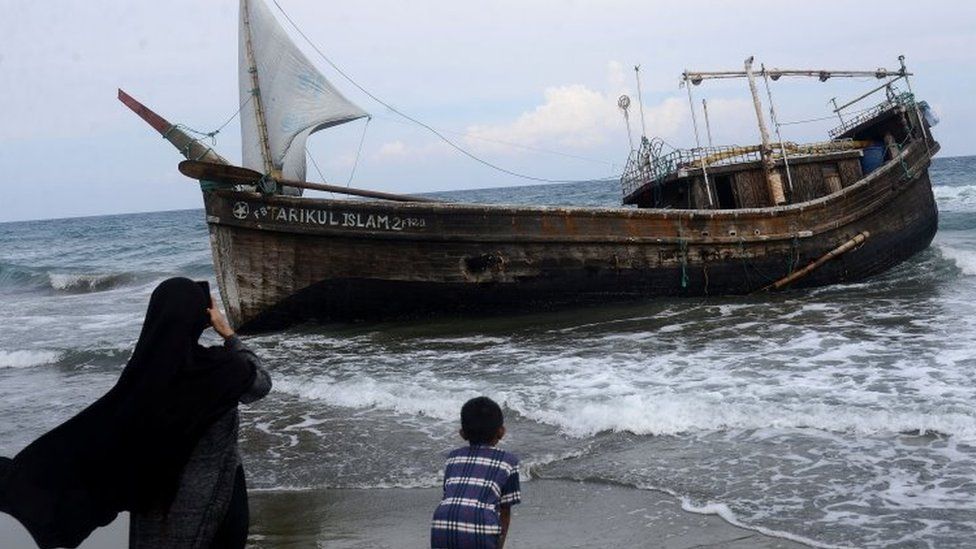
The wooden boat with 57 men on board landed on Sunday morning in Aceh province, local police spokesman Winardy told AFP news agency.
“The boat had a broken engine and it was carried by the wind to a shore in Ladong Village in Aceh Besar [district],” the spokesman said.
“They said they have been drifting at sea for a month.”
A local immigration official told AFP the refugees would be temporarily placed at a government facility.
Other media reports say 58 men arrived in Aceh.
It was not immediately known where the migrants had sailed from, though many live in refugee camps in Bangladesh, about 1,200 miles (1,900km) away.
Image caption,The boat that carried the refugees had a broken engine, Indonesian officials say
Last week, the UN urged countries around the Andaman Sea in South East Asia to assist a small fishing boat carrying at least 150 Rohingya refugees which had been drifting without power for two weeks after leaving Bangladesh.
People on the boat who were contacted via satellite phone said at the time that a number of passengers, including children, had already died. They said that food and water supplies had run out.
The UN on Sunday expressed fear that the fishing boat might have sunk.
Many Rohingya Muslims fled to Bangladesh in 2017 to escape a campaign of genocide launched by Myanmar’s military.
In recent months, they have been trying to escape from overcrowded refugee camps in southern Bangladesh by taking high-risk sea journeys at this time of year, after the monsoon in the region has passed.
Their numbers have grown because of deteriorating conditions in the camps, while more Rohingya who are still in Myanmar are also trying to leave following the military coup there last year.
At least five boats are known to have left in the past two months.
Sri Lanka Navysays , 104 people were discovered on board a trawler suspected of leaving Myanmar on its way to Indonesia.
An official said that the Sri Lankan navy rescued 104 Rohingya refugees who were stranded off the Indian Ocean Island nation’s northern coast.
A large number of mainly Muslim Rohingya suffer hardships in cramped refugee camps in Bangladesh after they escaped violence by the Myanmar military. The UN said the military operation was carried out with “genocidal intent,” and it was investigating Myanmar officials.
Many Rohingya in Bangladesh and Myanmar risk their lives every year by attempting to reach Southeast Asian countries such as Malaysia and Indonesia on rickety vessels. Their numbers have surged following deteriorating conditions in the camps and last year’s military coup in Myanmar.
The boat was first detected by the Sri Lanka navy when it was 3.5 nautical miles (6.5km) from the shore.
The Sri Lankan navy boat towing the trawler [Sri Lanka Navy/Screengrab via Reuters]
A search and rescue operation was launched to eventually tow the vessel to the island nation’s northern harbour on Sunday night, navy spokesman Captain Gayan Wickramasuriya said.
“The people have been handed over to the police,” Wickramasuriya told Reuters news agency. “The police will present them before a magistrate who will decide the next step.”
A navy statement said 104 Myanmar nationals were found on board the small trawler suspected to have originated from Myanmar and was heading to Indonesia when it ran into engine trouble in rough seas.
Wickramasuriya said 39 women and 23 minors were among the rescued people. An 80-year-old man, as well as a woman and her two children, all suffering from minor sickness, were admitted to hospital.
In 2017, more than 730,000 Rohingya fled to neighbouring Bangladesh following the Myanmar military crackdown that witnesses said included mass killings and rape.
Myanmar authorities say they were battling an armed rebellion and deny carrying out systematic atrocities. But rights groups and media have documented killings of civilians and the burning of villages during the crackdown.
Tourism operators in Indonesia are still trying to recover from the devastating impacts of the Covid-19 pandemic. Now the country’s parliament has passed new laws that some fear could turn tourists away once again – because having sex out of wedlock is set to be outlawed.
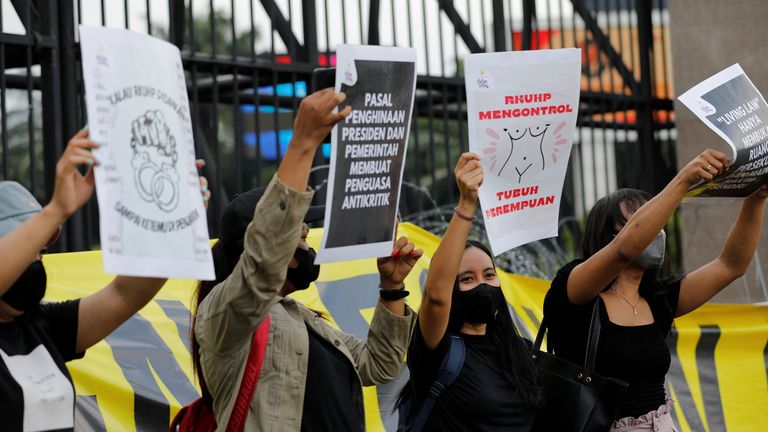
The controversial laws, which critics have been labelled a “disaster” for human rights, also ban unmarried couples from living together and restrict political and religious freedoms. There were protests in Jakarta this week, and the laws are expected to be challenged in court.
The new criminal codes are set to take effect in three years and apply to Indonesians and foreigners living in the country, as well as visitors.
It has been widely reported in nearby Australia, where some newspapers have dubbed it the “Bali bonk ban”.
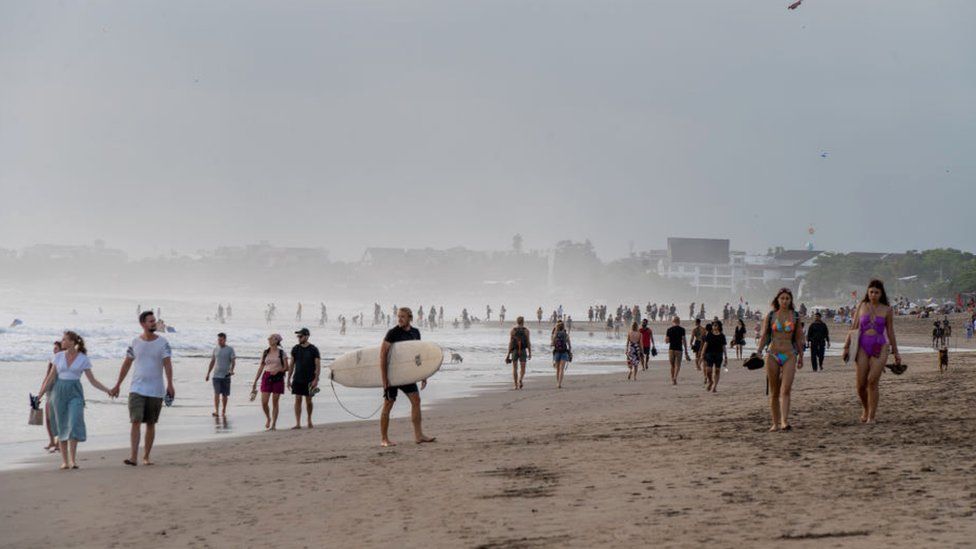
Indonesia’s economy heavily relies on tourism from Australia, which was Indonesia’s number one tourist source before the pandemic. Thousands of people fly to the tropical island of Bali every month to bask in its warm weather, indulge in cheap Bintang beers and rave at all-night beach parties.
Bali weddings are quite common, and thousands of Australia’s graduate students fly to Bali every year to celebrate finishing high school.
For many young Australians, a trip to Bali is seen as a rite of passage. Others go there a few times a year for quick, cheap getaways.
But as soon as news trickled through that the raft of new laws were becoming reality, after being mere rumours for years, doubt over future trips set in.
On Facebook pages dedicated to tourism in Indonesia, users tried to make sense of the changes and what they mean for foreign visitors.
Some said they would start travelling with their marriage certificates, while others who were not married said they would go elsewhere if the laws meant they would not be allowed to share a hotel room with their partner.
“You will be bribing your way out”, said one user on the group Bali Travel Community.
“Good way to ruin the tourism industry of Bali,” wrote another, while others agreed it was “scare tactics” that would be impossible to enforce.
Under the new criminal codes – of which there are 600 – unmarried couples caught having sex can be jailed for up to a year and those found living together could be jailed for up to six months.
Critics say holiday-makers could also become ensnared.
“Let’s say an Australian tourist has a boyfriend or a girlfriend who is a local,” Andreas Harsono, a senior researcher at Human Rights Watch told the Australian Broadcasting Corporation (ABC).
“Then the local parents or the local brother or sister reported the tourist to the police. It will be a problem.”
Visitors have been told not to worry too much, because police will only investigate if a family member makes a complaint – such as a parent, spouse or child of the suspected offenders.
But that is dangerous in itself, Mr Harsono said, as it opens the door to “selective law enforcement”.
“It means that it will only be implemented against certain targets,” he told ABC radio.
“It might be hotels, it might be foreign tourists… that will allow certain police officers to extort bribes or certain politicians to use, let’s say, the blasphemy law, to jail their opponents.”
‘Australians shouldn’t be worried’
While much of the chatter online reflected the Aussie attitude of “no worries, mate”, there is still a strong undercurrent of concern.
Australians are acutely aware of how serious getting in trouble with the Indonesian authorities can be – even for relatively minor offences.
A spokesperson for Indonesia’s justice ministry tried to calm concerns by suggesting that the risk was less for tourists because anyone making the police complaint would most likely be an Indonesian national.
“That means Australian [tourists] shouldn’t be worried,” Albert Aries was quoted as saying on Australian news website WAToday.com.
Image caption,The new law affects Indonesians and foreigners, but police will only investigate if they receive a complaint from a family member
But Bali cannot afford to have another blow to its tourism sector. Its recovery from the pandemic is slow, and many businesses and families are still trying to get back what they lost.
In 2019, a record 1.23 million Australian tourists visited Bali, according the Indonesia Institute, a Perth-based non-government organisation.
Compare that to 2021 – when just 51 foreign tourists visited the island for the entire year because of the pandemic, Statistica’s records show.
Indonesia’s tourism is strengthening though – in July 2022, the Indonesian National Statistic Bureau recorded over 470,000 foreign tourists arrivals in the country – the highest number since the easing of Covid-19 restrictions in October last year.
Phil Robertson, the Deputy Asia Director at Human Rights Watch tweeted that the new laws will “blow up Bali’s tourism”.
‘I really depend on tourism’
A tour guide called Yoman, who has worked in Bali since 2017, told the BBC the impact from the new laws could be “very severe” right across Indonesia, but especially on the holiday island.
“I am very, very worried, because I really depend on tourism,” he said.
Bali has a history of events – both man-made and natural disasters – that have affected visitor numbers to the island.
“The Gulf war, Bali bombing, volcano eruptions, Mount Semeru (volcano), Mount Rinjani (volcano) and then Covid. Bali tourism is easily affected,” Yoman said.
But the Indonesian government has brought in initiatives to try and lure foreigners back to its idyllic shores.
Just a few weeks ago, it announced a tempting new visa option, allowing people to live on the island for up to 10 years.
And of course it is not just tourists from Australia who could be affected.
Canadian travel blogger Melissa Giroux, who moved to Bali for 18 months in 2017, told the BBC she was “shocked” the law actually came through, after years of talk.
“Many tourists will prefer to go elsewhere instead of risking going to jail once the law is enforced,” said Ms Giroux, who pens the blog A Broken Backpack.
“And I’m not even thinking about the single people who come to Bali to party or the ones who fall in love during their travels.”
Indonesia’s parliament on Tuesday approved a new criminal code that will make sex outside of marriage punishable by up to a year in prison.
It is part of a raft of changes that critics say erode political freedom.
The new criminal code will not come into effect for another three years and also includes a ban on insulting the president and expressing views that run counter to state ideology.
Small groups held protests outside the parliament in Jakarta this week.
The code – which will apply to both Indonesians and foreigners – includes several “morality” laws and makes it illegal for unmarried couples to live together and have sex.
ADVERTISEMENT
A person’s partner or parents can report them for the offence of having sex outside of marriage. Adultery will also be an offence for which people can be jailed.
However the new criminal code also affects other areas of public life and rights groups say it amounts to a crackdown on democratic rights.
The new code includes defamation articles that make it illegal for people to insult the president or express opinions against the national ideology.
But legislators said there were in-built defences for free speech and protests made in the “public interest”.
They also praised the achievement of passing a new criminal code, one which had not been thoroughly revised since Indonesia became independent from Dutch rule.
A previous draft of the code was set to be passed in 2019 but sparked nationwide protests with tens of thousands taking part in demonstrations.
Many, including students, took to the streets and there were clashes with police in the capital Jakarta.
Some parts of Indonesia already have strict religion-based laws on sex and relationships.
The province of Aceh enforces strict Islamic law and has punished people for gambling, drinking alcohol and meeting members of the opposite sex.
Indonesia is about to change its criminal code, making sex outside of marriage punishable by up to a year in prison, a move that critics say will limit freedoms and police morality.
Indonesia is on the verge of ratifying major changes to its criminal code that would criminalise extramarital sex and make it illegal for unmarried couples to live together.
If officials ratify sweeping changes to the country’s criminal code on Tuesday, people who have sex outside of marriage could face up to a year in prison.
In addition to criminalising adultery, the revised code would prohibit unmarried couples from cohabiting.
The law, if passed, would apply to Indonesian citizens and foreigners alike, including tourists to the hotspots of Bali and the islands off Lombok.
Insulting the president and spreading views counter to the secular national ideology, known as the Pancasila, will also be outlawed.
Legal experts and civil society groups say the changes are a “huge setback” for the southeast Asian nation.
“The state cannot manage morality. The government’s duty is not as an umpire betweenconservative and liberal Indonesia,” said Bivitri Susanti, a law expert from the Indonesia Jentera School of Law.
Deputy speaker of the House of Representatives, Sufmi Dasco Ahmad, and Bambang Wuryanto, head of the parliamentary commission overseeing the revision, told Reuters that parliament would hold a plenary session on Tuesday to ratify the new code.
Previous plans to ratify the new draft code in September 2019 were brought to a halt by nationwide demonstrations. Tens of thousands of protesters took to the streets and the protests turned violent, with police dispersing crowds using tear gas and water cannons.
Image: People protest against new laws in Indonesia banning adultery.
The revisions to the code, which dates back to the colonial era, have been decades in the making. While the changes have sparked mass protests in recent years, the response has been considerably more muted this year.
Daniel Winarta, a University of Indonesia student, was among a small crowd of protesters that gathered outside parliament in the capital of Jakarta on Monday.
“On cohabitation, for example, it’s clearly a private matter,” he said. “We will keep rejecting this.”
Indonesia’s population is predominantly Muslim, with sizeable groups of Hindus, Christians and people of other faiths. Most Indonesian Muslims practice a moderate version of Islam, but recent years have seen a rise in religious conservatism that has crept into politics.
Under the revised code, only close relatives such as a spouse, parent or child can report complaints related to extramarital sex or cohabiting.
Only the president can file a complaint about being insulted, but such a crime will carry a three-year jail sentence.
It will take three yearsafter the code is ratified for it to come into effect to give the government time to draft related regulations.
Indonesia’s Mount Semeru volcano has erupted, spewing ash into the sky and forcing evacuations on the country’s main island, Java.
The volcano’s warning level was raised to the highest level, indicating that its activity had increased.
Although no injuries have been reported, nearly 2,000 people have been evacuated from the area surrounding the volcano.
As “hot avalanches” of lava poured from Semeru, people were advised to stay at least 8 kilometres (5 miles) away.
The threat level has been raised from three to four, which means the danger now threatens people’s homes, according to a spokesman for Indonesia’s Center for Volcanology and Geological Hazard Mitigation (PVMBG).
According to the organisation, a bridge that was being rebuilt following a previous eruption had been severely damaged.
Volcanic ash mixed with monsoon rain was falling on nearby villages and 1,969 people, including children and seniors, had been evacuated, the National Disaster Mitigation Agency (BNPB) said.
At least six villages had been affected, it added.
IMAGE SOURCE,REUTERS Image caption, Residents of six villages were evacuated by rescuers
Videos of the event showed the sky turning black as a massive plume of ash blocked the sunlight.
Japan issued a tsunami warning for its southernmost islands after the eruption, but meteorologists said no tidal changes had been observed.
Mount Semeru, in East Java province, began erupting at about 02:46 local time (19:46 GMT), authorities said.
Indonesia sits on the Pacific “Ring of Fire” where tectonic plates collide, causing frequent volcanic activity as well as earthquakes.
Semeru – also known as “The Great Mountain” – is the highest volcano in Java at 3,676m (12,060ft) and one of the most active. Its last erupted exactly one year ago, killing at least 50 people and leaving streets filled with mud and ash.
The eruption also follows a series of earthquakeson the west of Java island, located about 640 km (400 miles) east of Indonesia’s capital Jakarta, including one last month that killed more than 300 people.
A volcanoon Indonesia’s densely populated island of Java has erupted, spewing a huge column of ash into the air and prompting evacuations of villages in the area.
Indonesia’s disaster mitigation agency (BNPB) warned residents on Sunday living near Mount Semeru in East Java province – located around 640km (400 miles) southeast of the capital Jakarta – not to conduct any activities within 8km (4.9 miles) of the volcano and to keep away from riversides in the area due to risks of lava flow.
The agency said it has raised the volcano’s alert status to the highest level.
“Most of the road accesses have been closed since this morning. Now it’s raining volcanic ash and it has covered the view of the mountain,” Bayu Deny Alfianto, a local volunteer told the Reuters news agency by phone.
Several hundred people have begun moving to temporary shelters or evacuating for safe areas, said Joko Sambang, who heads the BNPB’s office in Lumajang, East Java province.
Mount Semeru, Indonesia’s highest volcano, began erupting at 2:46am local time (19:46 GMT on Saturday), according to the BNPB.
Videos posted on social media showed huge clouds of grey ash in areas near the volcano.
Catch up on our coverage of the region, all in one place.
Abdul Muhari, a spokesman for the BNPB, said the eruption was caused by monsoon rains eroding and collapsing the lava dome on top of the 3,676-metre (12,060-foot) Mount Semeru.
Japan’s Meteorology Agency meanwhile said it was monitoring for the possibility of a tsunami after the eruption. There was no immediate comment from the BNPB on Japan’s warning of a tsunami threat.
A sudden eruption of Mount Semeru last year killed at least 51 people, injured more than 100, and thousands of houses and buildings were damaged.
With 142 volcanoes, Indonesia has the largest population globally living in close proximity to a volcano, including 8.6 million within 10km (6 miles).
The Indonesian archipelago of more than 270 million people sits along the Pacific “Ring of Fire”, a horseshoe-shaped series of geological fault lines, and is prone to volcanic activity and earthquakes.
At least 162 people were killedand 700 others injured after a 5.6 magnitude earthquake struck the Indonesian island of Java on Monday, the Associated Press reports.
West Java Governor Ridwan Kamil told the outlet that “the majority of those who died were children,” adding that more than 13,000 people have been displaced by the earthquake. Additionally, at least 25 people were still trapped under collapsed buildings.
“There are still many residents trapped at the incident sites, we assume that the injured and dead victims will continue to increase over time,” Kamil said.
According to a statement from the National Disaster Management Agency (BNPB), the earthquake impacted West Java at 1:21 p.m. local time, hitting the Cianjur region, which is located about 47 miles southeast of the Indonesian capital, Jakarta, the hardest.
The Cianjur district counts 2,272 houses, four government buildings, several schools, and a hospital among the area’s damaged infrastructure.
A government official in the Cianjur regency told the Washington Post, “The majority who died were hit by buildings. Some were hit on the head. All you can hear here is ambulance sirens everywhere.”
The news arrives months after a 6.2-magnitude earthquake killed at least 25 people and injured hundreds of others in West Sumatra province.
In January 2021, another 6.2-magnitude earthquake killed more than 100 people and injured nearly 6,500 in West Sulawesi province.
An earthquakeon the main Indonesian island of Java has killed scores of people and injured hundreds, say officials.
The 5.6 magnitude quake struck Cianjur town in West Java, at a shallow depth of 10km (6 miles), according to US Geological Survey data.
Scores of people were taken to hospital, with many treated outside.
Rescuers have worked through the night to try to save others thought to still be trapped under collapsed buildings.
The area where the quake struck is densely populated and prone to landslides, with poorly built houses reduced to rubble in many areas.
The exact number of people killed so far remains unclear. Indonesia’s National Disaster Mitigation Agency (BNPB) has said their official death toll was 103, adding that another figure given by regional governor Ridwan Kamil – 162 – remains unverified.
BNPB said another 390 people were wounded and that 7,000 people had taken shelter in various locations in the area.
Mr Kamil has claimed that a total of 13,000 had been displaced by the disaster, and that more remained “trapped in isolated places”. He said officials were “under the assumption that the number of injured and deaths will rise with time”.
Image source, ReutersImage caption, A collapsed school building in Cianjur
Image source, ReutersImage caption, A damaged classroom in Cianjur
Herman Suherman, the head of administration in Cianjur town, said most injuries were bone fractures sustained from people being trapped by debris in buildings.
“The ambulances keep on coming from the villages to the hospital,” he was quoted by AFP news agency as saying earlier in the day. “There are many families in villages that have not been evacuated.”
Many of the injured were treated outside in a hospital car park after the hospital was left without power for several hours following the quake, West Java’s governor said.
On Monday night, Mr Kamil wrote on Twitter that it could take up to three days for power to be fully restored to the area. He added that mobile phone reception remained poor and was causing “a lot of problems” for officials.
The tremor could also be felt in the capital Jakarta about 100km away, where people were evacuated from high-rise buildings.
Office workers rushed out of buildings in the civic and business district during the tremor, which started at 13:21 Western Indonesian time (WIT) on Monday, the agency said.
“I was working when the floor under me was shaking. I could feel the tremor clearly. I tried to do nothing to process what it was, but it became even stronger and lasted for some time,” lawyer Mayadita Waluyo told AFP.
An office worker named Ahmad Ridwan told news agency Reuters: “We are used to this [earthquakes] in Jakarta, but people were so nervous just now, so we also panicked.”
Earthquakes are common in Indonesia, which sits on the “ring of fire” area of tectonic activity in the Pacific. The country has a history of devastating earthquakes and tsunamis, with more than 2,000 killed in a 2018 Sulawesi quake.
Local officials have reported that , an earthquake struck the main Indonesian island of Java, killing more than 40 people and injuring hundreds more.
According to US Geological Survey data, the 5.6 magnitude quake struck Cianjur town in West Java at a shallow depth of 10km (6 miles).
The tremor was felt about 100 kilometres away in Jakarta, where people in high-rise buildings were evacuated.
Officials are warning of potential aftershocks and say the death toll may rise.
The area where the quake struck is densely populated and prone to landslides, with poorly-built houses. Rescuers have been trying to evacuate people from collapsed buildings, and managed to save a woman and her baby, according to local reports.
“Victims kept coming from many areas. Around 700 people were injured,” he told Kompas TV.
Gempa bumi dengan magnitude (M)5,6 dirasakan warga Jakarta dan sekitarnya. Pusat gempa berada di darat 10 km barat daya Kabupaten Cianjur, Provinsi Jawa Barat. Fenomena ini terjadi pada Senin (21/11), pukul 13.21 WIB. Dua warga meninggal dunia. pic.twitter.com/ziXZ590unX
Earlier, AFP news agency quoted him as saying most injuries were bone fractures sustained from people being trapped by debris in buildings.
“The ambulances keep on coming from the villages to the hospital,” he said.
“There are many families in villages that have not been evacuated.”
Videos on social media showed the destruction to houses and shops.
Dozens of buildings had been damaged in Cianjur region, the National Disaster Mitigation Agency said in a statement. They include a hospital and an Islamic boarding school.
In Jakarta, office workers rushed out of buildings in the civic and business district during the tremor, which lasted for about a minute.
“I was working when the floor under me was shaking. I could feel the tremor clearly. I tried to do nothing to process what it was, but it became even stronger and lasted for some time,” lawyer Mayadita Waluyo told the AFP news agency.
An office worker named Ahmad Ridwan told Reuters: “We are used to this [earthquakes] in Jakarta, but people were so nervous just now, so we also panicked.”
Earthquakes are common in Indonesia which sits on the “ring of fire” area of tectonic activity in the Pacific. The country has a history of devastating earthquakes and tsunamis, with more than 2,000 killed in a 2018 Sulawesi quake.
An idyllic paradise of palm trees and pineapples, sun, sand and serenity is what comes to mind when you think of Bali.
But this week the Indonesian island is hosting what could well be the most strained edition of the G20, or Group of 20 nations.
The annual summit – which includes 19 advanced and emerging economies and the EU – was created after the Asian financial crisis in 1999. And it considers itself something of a superpowers club that manages future crises.
And this time, there are plenty on the discussion block – the Russia-Ukraine war, brewing US-China tensions, soaring inflation, the ever-looming threat of a global recession, nuclear threats from North Korea, and perhaps most alarming of all, a rapidly warming earth.
Amid all this, host and Indonesian President Joko Widodo hopes to play chief dealmaker. Can he do it?
An era of living dangerously
When we spoke ahead of the G20 meeting,Mr Widodo seemed sanguine about what has been described as the most diplomatically delicate and stressful G20 ever.
US President Joe Biden and China’s leader Xi Jinping are set to meet on Monday – and the clash of the world’s two largest economies has Mr Widodo worried.
“There can be no peace without dialogue,” he told me in an exclusive interview at the presidential palace in Jakarta.
“If President Xi Jinping and President Joe Biden can meet and talk, it would be very good for the world, especially if they are able to come to an agreement about how to help the world recover.”
Like many Asian countries, Indonesia has benefited from decades of free trade and multilateralism. The US has always been Indonesia’s most important global strategic partner, but over the last decade, China has consistently ranked as one of its top two foreign investors.
That’s made navigating the relationship between the two giants tricky, to say the least.
Image caption, “There can be no peace without dialogue,” says Joko Widodo – popularly known as Jokowi
An era in which China and the US aren’t getting along is a far more dangerous one than Indonesia and other Asian countries have been accustomed to.
Observers say that that growing tensions between Washington and Beijing increase the risk of conflict in the Indo-Pacific.
Meanwhile there are also fears of the possible use of nuclear weapons, either in Ukraine or on the Korean peninsula, where Pyongyang has fired a record number of missiles this year.
“The use of nuclear weapons for any reason, cannot betolerated,” Mr Widodo, also known as Jokowi, says. “The increasing potential for nuclear use is… very dangerous for peace and for world stability.”
Getting people to talk
A key issue for Mr Jokowi personally has been food security – particularly as the war in Ukraine has been responsible, in his view, for rising prices, something that directly impacts Indonesia’s 275 million people.
He politely termed Russia’s invasion of Ukraine a “headache”, something that has been “taking up his mind”.
Securing a steady and consistent resumption of grain exports is one of the reasons why – ahead of the meeting – he’s crisscrossed the globe, meeting with Presidents Vladimir Putin and Volodymyr Zelensky to convince them to come to the meeting.
He had hoped they could talk. “I think it would be great if they [Presidents Vladimir Putin and Volodymyr Zelensky] could sit at the same table – to solve the problems that exist, because the problems that we are dealing with now are on all fronts,” Mr Widodo said.
Mr Putin is not coming, Russian diplomats have since said, but Mr Zelensky could attend virtually.
Jokowi’s swansong
The G20 is as much Indonesia’s coming out party as it is Mr Widodo’s swansong – he is in the final stretch of his presidency, and in 2024 he will have to stand down after two terms in power.
When I first met him in 2012, as the then Jakarta governor he was a younger and more idealistic. Branded the first “outsider” to become president in Indonesia’s history, he was elected as a man of the people, a democrat’s democrat.
Since then he’s had to govern a vast archipelago of 17,000 islands, a country that from west to east stretches the distance between London and Baghdad, with hundreds of different languages and ethnicities in between.
IMAGE SOURCE,GETTY IMAGES Image caption, Mr Widodo wants to cement his economic legacy in Indonesia – but it may be out of his hands
It’s a challenge I’ve written about before and over the last few years I’ve seen Jokowi, man of the people, transform into Jokowi the president. Now a pragmatist, he’s become a coalition-builder; someone who knows he has to compromise to not just survive but also thrive. Critics say he is no longer the democrat he used to be. Human rights groups and environmental campaigners have both said that he has consistently put the economy ahead of democratic interests.
Although he remains extremely popular by international standards, his approval ratings have fallen recently, partly because of rising prices.
Yet the country has weathered the current economic slowdown better than others, described by the International Monetary Fund as a “good performer” among regional economies.
It is obvious Mr Widodo is keen to preserve and grow the economic legacy he is leaving behind for Indonesia.
“What we would like to see in 2045 is that Indonesia’s golden era will truly be realised,” he says towards the end of our conversation. “By 2030, we expect Indonesia to become the number seven economy in the world.”
It is a lofty ambition, and one that will resonate with many of his citizens. But it’s also one that may be out of his hands.
Indonesia’s future depends on a stable global economic environment – something Mr Widodo hopes to come closer to securing at next week’s G20 summit.
Indonesia’s capital, Jakarta, faces such challenges due to climate change that the plan is to build a new capital city more than 1,000 kilometres away.
Jakarta is sinking.
Notorious for traffic gridlock and poor air quality, Indonesia’s sprawling capital faces such a perfect storm of climate and environmental challenges that the government has decided to move it somewhere safer.
Increasingly severe rainfall and flooding, rising sea levels, and land subsidence have conspired to make the Southeast Asian megacity a challenging place for its more than 10.5 million people to live.
A quarter of the city — located on the western tip of the densely populated island of Java — could be underwater by 2050.
So, the Indonesian government is bidding farewell to Jakarta and plans to relocate to a new capital: Nusantara — a purpose-built city more than 1,000km (620 miles) away in Borneo island’s East Kalimantan province.
As world leaders gather for the COP27 summit in Egypt and thrash out ways and timeframes to avert what UN Secretary-General Antonio Guterres told them was the “collective suicide” of climate change, Jakarta’s fate vividly demonstrates how people in the developing world are already suffering from, and adapting to, a climatically-changed reality.
Indonesian national police rescue residents from flooding that inundated Jakarta in February 2021 [Bagus Indahono/EPA]
Relocating a capital city is a daunting task although plans appear to be advanced, according to the official ibu kota negara (the nation’s capital) website.
President Joko Widodo plans to host Indonesia’s 79th independence day celebrations in Nusantara in August 2024, where core infrastructure for an initial 500,000 residents will have been completed, according to the website.
Bambang Susantono, a former Indonesian transport minister who is leading the new capital city development project, is upbeat about the gargantuan task.
Creating a new city from “scratch” was an advantage, Susantono wrote on his LinkedIn page recently, as it allowed control over the master plan, quality of engineering work, and the application of the latest technology.
“In Nusantara, we do climate change adaptation at scale,” he wrote, pointing out that 65 percent of the city will remain tropical forest.
“Given these facts, I believe Nusantara will be a prime example of how cities and countries can respond to climate change,” he wrote.
Critics are not so sure.
Goodbye, Jakarta. Welcome to Nusantara
Indonesian President Joko Widodo gestures with Governor of East Kalimantan Isran Noor during their visit to the planned location of Indonesia’s new capital [File: Akbar Nugroho Gumay/Antara Foto via Reuters]
Climate change did not cause Jakarta to sink — that is due to unsustainable groundwater depletion that has resulted in subsidence — but the city is being swamped by rising sea levels, which have been caused by planet-warming greenhouse gases.
Whether to move or not is “a big question for many”, said Edvin Aldrian, professor of meteorology and climatology at the Agency for Assessment and Application of Technology BPPT Indonesia.
Building a new capital might also amount to “only moving the problem”, said Aldrian, who also teaches at the University of Indonesia, Bogor Agricultural Institute and Udayana University in Bali.
Moving will not stop the increasingly extreme rainfall and flooding, which is “getting heavier and heavier” either in Jakarta or, in the future, in Nusantara, he adds.
“I’m afraid that there are many floods already in Kalimantan.”
Aldrian has warned that about 40 percent of Jakarta lies below sea level and the northern part of the city is sinking at a rate of 4.9cm (almost 2 inches) each year.
Subsidence is due mainly to the city’s use of groundwater sucked up through water wells. Although heavy rains should replenish underground aquifers and shore up Jakarta’s foundations, urban sprawl creates a concrete boundary that prevents the aquifers from being replenished, while the streets often flood.
And “while the capital’s land surface is sinking, the sea is rising,” he added.
Below, groundwater is being depleted, but three bodies of water above ground threaten the city, as he explains:
Torrential rain over the city has become more common, causing an increase in severe floods. Added to that, heavy rain in higher terrain nearby flows down into Jakarta, flooding the city’s canals and waterways. And then there is the sea, where rising waters threaten the city, particularly at high tide.
The New Year’s Eve storm of 2020 that turned Jakarta into a mucky swimming pool in just a few hours demonstrates for Aldrian the challenges posed by climate change.
Rain clouds were estimated to have formed for many kilometres above the city, whereas a normal height for cloud cover would be about 3 to 4km, he says. When the rain fell, it was like nothing he had ever seen.
Some areas saw rainfall at an intensity of 377mm (almost 15 inches) in a day, inflicting some of the worst flooding ever to hit Jakarta.
“You can’t do anything. You are isolated in your home…. Cars can’t move, electricity and communications are down, and drinkable water supplies have become contaminated by overflowing drains and sewers,” he told Al Jazeera.
“The problem is not during the flood it is afterwards”, he adds, explaining that all the costs are in cleaning up the mess.
Asia’s sinking megacities
What has occurred in Jakarta is also affecting other megacities in South and Southeast Asia, where, according to a recent study led by Singapore’s Nanyang Technological University, coastal cities are sinking faster than in other parts of the world.
Indonesian youths play in flood water in a neighbourhood in Jakarta after overnight rains caused rivers to burst their banks, inundating thousands of homes and paralysing parts of the city’s transport networks [File: Achmad Ibrahim/Reuters]
Vietnam’s economic hub Ho Chi Minh City, Myanmar’s Yangon, Bangladesh’s port city of Chittagong, China’s Tianjin, and the Indian city of Ahmedabad are among the cities most steadily subsiding under the weight of their populations and the effect of urbanisation.
Like Jakarta, they too are contending with rising sea levels.
Learning from Jakarta’s challenges, Nusantara’s city planners want to create a green city that can cope with and mitigate the effects of climate change.
Widodo announced the plan to relocate the capital from flood-prone Java to a 2,560-square-kilometre (almost 990 square miles) site on the forested island of Borneo in 2019.
Work is already underway and a completion date of 2024 has been set for the first of four phases of development: the relocation of key administrative elements, including the president’s office, according to a report on the move by scholars Anuar Nugroho and Dimas Wisnu Adrianto.
The second phase is a decade-long process, from 2025-35, to develop a foundational capital city area, followed by a third phase, from 2035-45, to develop the overall infrastructure — physical and socioeconomic.
The final phase is to establish Nusantara’s reputation globally as a “World City for All”, according to Nugroho and Adrianto, and an “economic Super Hub driving the economy of the nation” with the creation of 4.8 million jobs by 2045.
Plans for the city available on the ibu kota negara (the nation’s capital) website look and sound impressive: Eco-friendly construction of all high-rise buildings; 80 percent of travel in the city will involve public transport or “active mobility”, such as walking and cycling; and all important facilities will be located within 10 minutes of a public transport hub.
Residents will also have access to recreational green space as well as social and community services within 10 minutes of their homes. Zero poverty is to be achieved by 2035, and there will also be 100 percent digital connectivity for all residents and businesses.
A computer-generated image released in 2022 showing the design illustration for Indonesia’s future presidential palace in East Kalimantan [Nyoman Nuarta/handout via AFP]
Renewable energy will provide all energy needs, and the city will achieve net zero emissions by 2045. Ten percent of the city’s area will be devoted to food production, 60 percent of the city’s waste will be recycled by 2045, and 100 percent of wastewater will be treated by the city’s water management system by 2035.
With such a list of envy-inducing initiatives, the city also aims to be among the top 10 cities on the Global Liveability Index by 2045.
Computer-generated images depict the future city as covered in trees with water features, wide pedestrian avenues, electric vehicles on carless roads, and futuristic buildings that appear to borrow a virtual world aesthetic.
Such a green city does not come cheap.
The cost of building the new capital is estimated to be more than $34bn and three international firms — United States-based engineers AECOM, global consulting firm McKinsey and Japanese architects and engineers Nikken Sekkei — have been brought in to help design its high-tech and environmentally-friendly elements, according to news reports.
Indonesia will build the new city with state funds and is seeking investors.
But the issue of who should pay for the damage created by the climate crisis – such as the inundation of megacities like Jakarta due to rising sea levels – has emerged as a key issue at COP27.
People in the most vulnerable countries in the world have done little to contribute to the change in their climates, but are suffering the effects earlier and more severely than countries whose industries and consumption patterns are responsible for the lion’s share.
“It evokes the question,” Bethany Tietjen of the Climate Policy Lab at Tufts University wrote last week in The Conversation.
“Why should countries that have done little to cause global warming be responsible for the damage resulting from the emissions of wealthy countries?”
Jakarta is still sinking
Critics point out that the new city is being built on an island with vast tracts of rainforest that are a crucial carbon sink and there are fears the new capital might eventually face some of the same issues as the old capital.
Building a state-of-the-art capital on Borneo also does not solve the crises faced by the millions who will remain in Jakarta.
“It’s a very ambitious plan,” said Tiza Mafira, head of Climate Policy Initiative (CPI) Indonesia.
Mafira says while she is in favour of the country’s administrative and political centre being separated from its business hub, moving away will not solve the issues facing Jakarta, which still must be tackled.
Improved spatial planning, safeguarding groundwater, and, basically, re-thinking Jakarta as a city, is the no small task that is required, Mafira said.
“In order to solve that root of the problem, you would need to rethink, re-green Jakarta,” she told Al Jazeera.
“It is possible to re-green Jakarta,” she added.
“It would take some transition. You would not only have to re-green whatever area is left to re-green, but you would also need to reassess the function of some areas,” she adds.
“Some areas would need some hard decisions. If a mall was built that wasn’t supposed to be built, then it would have to go … and be replaced with a park, for example.”
What also might need re-thinking is the decision to build in Kalimantan.
“It’s literally a forest … you would have to cut down an existing forest in order to build this capital city,” Mafira said.
There is also the real possibility that Nusantara turns out to be more of a white elephant in Borneo than a green-city alternative to Jakarta.
Mafira speaks of capital cities that end up being “a seat of administration, but nobody really wants to live there”.
Myanmar’s capital, Naypyidaw, comes easily to mind.
“There has to be a whole cultural and social shift that will make it actually a comfortable place to live, that people would want to move to,” Mafira said.
Otherwise, “they end up moving back and forth between their home and that capital city”, she said, noting the possible effect on climate through increased air traffic as people commute between their homes in Jakarta and their jobs in the new capital.
‘We have to be hopeful’
Chisa Umemiya, research manager at the Institute for Global Environmental Strategies in Japan, emphasises community involvement as the essential ingredient in the success of decision-making around climate change.
Umemiya wonders about the extent of the Indonesian government’s consultation with local communities on the project.
“My point is that from a community inclusion point of view, it’s really essential to have such a discussion,” she told Al Jazeera, drawing parallels with earlier research she conducted on forest preservation in Thailand.
On an international level too, Umemiya says, solutions to climate change need to include the input of local communities.
Particularly communities in the developing world, she says, as the climate change debate has too often and or too long been “framed around the needs or interests of developed countries”.
“Of course, reducing emissions is the solution. But who does that? To me, responsibility lies mostly in developed country and not developing country,” she said.
“I really see a gap there, to involve more views coming from the community level and especially from developing countries, and especially from Southeast Asia, where climate impact is enormous.”
Tiza Mafira, of the CPI, echoes that sentiment, noting that climate change has long affected people in the developing world — Jakarta’s problems have been evident for years — but the crisis is just now being acknowledged because richer countries are also beginning to experience the effects.
“We’re only now starting to see a larger level of ambition because it now has begun to affect, glaringly, the industrialised and developed countries,” she said.
“I can’t remember who said it, but I’m echoing the sentiment that we’ll see accelerated ambitions at COP [the UN’s climate change Conference of the Parties] once the industrialised countries are truly suffering the consequences of the climate crisis,” she added
“And it’s unfortunate that it has to come to that, because we could have prevented this sooner.”
On Jakarta’s future and successfully mitigating the effect of climate change, Aldrian says: “Of course, we have to be hopeful.”
According to local reports, a python killed and swallowed a woman in Indonesia’s Jambi province.
Jahrah, a rubber tapper in her fifties, had arrived at a rubber plantation on Sunday morning.
She went missing after failing to return home that night, and search parties were dispatched to find her. A day later, villagers discovered a python with a large stomach.
Locals later killed the snake and found her body inside.
“The victim was found in the snake’s stomach,” Betara Jambi police chief AKP S Harefa told local media outlets, adding that her body appeared to be largely intact when it was found.
He said the victim’s husband had on Sunday night found some of her clothes and tools she had used at the rubber plantation, leading him to call on a search party.
After the snake – which was at least 5m (16ft) long – was spotted on Monday, villagers then caught and killed it to verify the victim’s identity.
“After they cut the belly apart, they found it was Jahrah inside,” Mr Harefa told CNN Indoneisa.
Though such incidents are rare, this is not the first time someone in Indonesia has been killed and eaten by a python. Two similar deaths were reported in the country between 2017 and 2018.
Pythonsswallow their food whole. Their jaws are connected by very flexible ligaments so they can stretch around large prey.
One expert had earlier told the BBC that pythons typically eat rats and other animals, “but once they reach a certain size it’s almost like they don’t bother with rats anymore because the calories are not worth it”.
“In essence, they can go as large as their prey goes,” said Mary-Ruth Low, conservation & research officer for Wildlife Reserves Singapore.
That can include animals as large as pigs or even cows.
Indonesia’s police chiefsays, six individuals, including police officers and organisers, are being investigated for their roles in a crash at a football stadium that claimed at least 131 lives.
The maximum punishment for the crime of criminal negligence causing death is five years.
The disaster happened last week when police fired tear gas at fans who invaded the pitch after a defeat.
Hundreds tried to flee through the exits, which caused a deadly stampede.
The incident has led to public anger, with much of it directed at the police and their use of tear gas. The local police chief in Malang, where the incident took place, was fired and nine other officers were suspended.
Those now facing charges include three police officerswho had tear-gassed fans, the head of the home club Arema FC’s organizing committee, and one of the club’s security officers.
Two of the police officers had ordered their colleagues to fire tear gas, national police chief Listyo Sigit Prabowo told local media. The third knew about FIFA’s safety regulations that prohibit the use of tear gas at matches but did not prevent it from being used, he added.
Authorities have said that some 2,000 officers – including several police units and soldiers – were at the stadium that night.
Videos from the incident, which took place on Saturday night in East Java, showed Arema FC fans running onto the pitch after the final whistle marked the home team’s 2-3 defeat and police firing tear gas in response.
More than 320 other people were injured as supporters were trampled on and suffocated in crushes as they fled the gas. Indonesia’s deputy minister of children and women affairs said the victims included children between three and 17 years.
Footage online showed fans clambering over fences to escape. Separate videos appeared to show lifeless bodies on the floor.
“We [saw] these different police forces running around the pitch, brutally kicking people, hitting people. This is completely unacceptable behaviour,” Jacqui Baker, a policing expert, told the BBC after the incident.
The stampede is one of the worst stadium disasters ever. In the UK, 97 Liverpool fans died in a crash at the Hillsborough stadium in Sheffield in 1989. They were attending the club’s FA Cup semi-final against Nottingham Forest.
At least 125 people have died in a crush at an Indonesian football match that has become one of the world’s worst stadium disasters.
Hundreds were also hurt in aftermath of home team Arema FC’s loss to bitter rivals at the overcrowded stadium late on Saturday in Malang, East Java.
The crush took place after police tear-gassed fans who invaded the pitch.
As panic spread, thousands surged towards Kanjuruhan stadium’s exits, where many suffocated.
Fifa, the world’s governing football body, states that no “crowd control gas” should be carried or used by stewards or police at matches.
The organisation’s president Gianni Infantino said it was “a dark day for all involved in football and a tragedy beyond comprehension”.
One eyewitness told the BBC that police had fired numerous tear gas rounds “continuously and fast” after the situation with fans became “tense”.
Next to one exit gate a hole smashed through the wall testifies to the desperation to escape the crush that developed.
Image caption, A hole next to the exit gates that were closed testifies to the desperation of those inside
There are candles next to the gate, put there by supporters to remember the victims.
The doors themselves are slanted outwards, a sign of the sheer level of force from the inside.
‘It had gotten anarchic’ – Police
Indonesian officials at one stage put the death toll in the disaster as high at 174 people, but this was later revised downwards.
President Joko Widodo has ordered that all matches in Indonesia’s top league must be stopped until an investigation has been carried out.
IMAGE SOURCE,AFP VIA GETTY IMAGES
Image caption, Police fired tear gas, leading to a crowd crush and cases of suffocation
Videos from the stadium show fans running on to the pitch after the final whistle marked the home team’s 2-3 defeat, and police firing tear gas in response.
“It had gotten anarchic. They started attacking officers, they damaged cars,” said Nico Afinta, police chief in East Java, adding that two police officers were among the dead.
“We would like to convey that… not all of them were anarchic. Only about 3,000 who entered the pitch,” he said.
Fleeing fans “went out to one point at the exit. Then there was a build-up, in the process of accumulation there was shortness of breath, lack of oxygen”, the officer added.
Videos on social media show fans clambering over fences to escape. Separate videos appear to show lifeless bodies on the floor.
IMAGE SOURCE,EPA
Image caption, Damaged police vehicles lay on the pitch inside Kanjuruhan stadium
The Indonesian football association (PSSI) said it had launched an investigation, adding that the incident had “tarnished the face of Indonesian football”.
Violence at football matches is not new in Indonesia, and Arema FC and Persebaya Surabaya are long-time rivals.
However Persebaya Surabaya fans were banned from buying tickets for the game because of fears of clashes.
Chief Security Minister Mahfud MD posted on Instagram that 42,000 tickets had been sold for the match at Kanjuruhan stadium, which has a stated capacity of 38,000.
President Widodo called for this to be the “last soccer tragedy in the nation” after ordering that all Liga 1 games should be paused pending an investigation.
‘It was bang, bang, bang’ – Eyewitness
Muhamad Dipo Maulana, 21, who was at the match, told BBC Indonesian that after the game had ended a few Arema fans went on the pitch to remonstrate with the home team players but were immediately intercepted by police and “beaten”.
More spectators then took to the pitch in protest, the supporter said, adding that the situation became “tense”.
“Police with dogs, shields, and soldiers came forward,” Mr Dipo told the BBC.
He said he had heard more than 20 tear gas shots towards spectators at the stadium.
IMAGE SOURCE,BBC INDONESIAN
Image caption, Muhamad Dipo Maulana said he saw people suffocating while trying to get out of the stadium
“There was a lot, like bang, bang, bang! The sound was continuous and fast. The sound was really loud and directed to all the stands,” he added.
Mr Dipo said he saw people in disarray, panicking and suffocating while trying to get out of the stadium. There were many children and old people who were affected by the tear gas, the eyewitness added.
One of worst football disasters
The stampede is one of the worst of a tragically long line of stadium disasters.
In 1964, a total of 320 people were killed and more than 1,000 injured during a stampede at a Peru-Argentina Olympic qualifier in Lima.
In 1985, 39 people died and 600 were hurt at the Heysel stadium in Brussels, Belgium, when fans were crushed against a wall that then collapsed during the European Cup final between Liverpool (England) and Juventus (Italy).
In the UK, a crush developed at the Hillsborough stadium in Sheffield in 1989, resulting in the deaths of 97 Liverpool fans attending the club’s FA Cup semi-final against Nottingham Forest.
At least 125 people are dead after a crowd stampede erupted Saturday night during a soccer match at Kanjuruhan Stadium in Malang, Indonesia.
As reported by the New York Times, local officials initially confirmed the death toll to be 174, but have since reduced the number. Supports of Persebaya Surabaya and Arema FC clashed following the match, prompting police to fire tear gas, which triggered a stampede that left many trampled and suffocated.
More than 300 people were injured, in what is one of the deadliest events in sporting history. The tragedy is only eclipsed by a 1964 stampede that left 328 people killed during a Peru-Argentina Olympic qualifier in Lima.
“The football world is in a state of shock following the tragic incidents that have taken place in Indonesia at the end of the match between Arema FC and Persebaya Surabaya at the Kanjuruhan Stadium,” FIFA President Gianni Infantino said in an official statement.
He continued, “This is a dark day for all involved in football and a tragedy beyond comprehension. I extend my deepest condolences to the families and friends of the victims who lost their lives following this tragic incident.
“Together with FIFA and the global football community, all our thoughts and prayers are with the victims, those who have been injured, together with the people of the Republic of Indonesia, the Asian Football Confederation, the Indonesian Football Association, and the Indonesian Football League, at this difficult time.”
A British headteacherwho groomed at least 131 children worldwide using social media while working at a school in Iraq has been jailed for 20 months.
Using Facebook Messenger, Nicholas Clayton, 38, of The Wirral, made contact with kids as young as 10 and requested their images with the intention of sexually abusing them.
He was apprehended after paying a 13-year-old Cambodian boy to come to Malaysia so they could meet and asking the boy for pictures of his bare upper torso.
When he returned to the UK, the National Crime Agency (NCA) detained him after receiving information about the communication.
Investigators found Clayton had been messaging hundreds of boys from across the globe, spanning the Philippines, Sri Lanka, Singapore, Thailand, Indonesia, Iraq, Morocco, Turkey and others over a period of just three months.
He appeared at Liverpool Crown Court on 23 August where he admitted three counts of sexual communication with a child under 16 years and one charge of inciting the sexual exploitation of a child.
On Tuesday, he was sentenced to 20 months imprisonment and made the subject of a sexual harm prevention order for 15 years.
New Facebook plans will ‘hide similar predators’
The case has prompted fresh calls for a “robust” Online Safety Bill, with the NSPCC warning plans by Meta, which owns Facebook, to introduce end-to-end encryption will “blindfold” authorities to similar predators.
Andy Burrows, head of child safety online policy at the charity, said: “Clayton’s case highlights the ease with which offenders can contact large numbers of children on social media with the intention of grooming and sexually abusing them.
“Private messaging is the frontline of child sexual abuse online. It’s therefore concerning that Meta plans to press on with end-to-end encryption on Facebook Messenger, which will blindfold themselves and law enforcement from identifying criminals like Clayton.
“The UK government can show global leadership in tackling online child abuse by delivering without delay a robust Online Safety Bill that embeds child protection at the heart of every social media site.”
New Culture Secretary Michelle Donelan has previously said there are no plans to water down the proposals for new internet safety laws, which Mr Burrows welcomed as “really encouraging”.
Hazel Stewart, from the NCA, said: “Nicholas Clayton abused his position of trust as a headteacher by attempting to sexually contact and exploit children, using technology to access hundreds of potential victims across the globe.
“Clayton was very cautious and careful in his communications, making them appear to be innocent, but as NCA investigators we could see the patterns of predatory grooming he was using on vulnerable children.
“Protecting children from sex offenders is a priority for the NCA, and we continue to pursue criminals in the UK and internationally to ensure abusers like Clayton are held to account.”
Facebook ‘taking our time to get it right’
A Facebook spokesperson said: “We have no tolerance for child exploitation on our platforms and are building strong safety measures into our plans.
“We’re focused on preventing harm by banning suspicious profiles, defaulting under-18s to private or ‘friends only’ accounts, and more recently introduced restrictions that stop adults from messaging children they’re not connected with.
“We’re also encouraging people to report harmful messages to us so we can see the contents, respond swiftly and make referrals to the authorities. As we roll out this technology we’re taking our time to get it right and working with outside experts to help keep people safe online.”
Researchers found the buried 31,000-year-old body of a young person that shows evidence of leg amputation.
The find pushes back the origin of this complicated surgery by more than 24,000 years.
After the procedure the person was cared for by their ancient community for years until their death, archaeologists say.
Dr Melandri Vlok, who examined the body, said it was “quite clear” surgery had been carried out.
A detailed examination of the ancient body, details of which are published in the journal Nature, took place when the person was a child. Growth and healing of their leg bone suggests they recovered and lived for another six to nine years, probably dying in their late teens or early twenties.
The grave itself was excavated in a cave called Liang Tebo, in East Kalimantan, Indonesian Borneo, a place that has some of the world’s earliest rock art.
One of the three researchers who found and excavated the grave, Dr Tim Maloney from the Griffith University in Australia, said he was simultaneously “excited and terrified” to reveal the ancient bones.
Image source, Tim MaloneyImage caption, As well as the left foot being absent, the leg bones show signs of healing
“We very carefully brushed away the deposits and recorded the lower half of the remains. We could see that the left foot was absent, but also that the remaining bone fragments were unusual,” he told BBC News.
“So we were excited at the range of possibilities, including surgery, that had caused this.”
The excavation team subsequently asked Dr Vlok, who is based at the University of Sydney, to examine the remains. “With a discovery like this”, she said, “it’s a mixture of excitement and sorrow, because this happened to a person.
“This person – a child – experienced so much pain, even if it was 31,000 years ago.”
Dr Maloney explained that, because this person showed signs of having been cared through their recovery and for the rest of their life, the archaeologists are confident that this was an operation, rather than any kind of punishment or ritual.
“To allow them to live in this mountainous terrain, it’s highly likely that the rest of their community invested in their care,” he explained.
Durham University archaeologist Prof Charlotte Robertson, who was not involved in the discovery but reviewed the findings, added that they challenged the view that medicine and surgery came late in human history.
Image source, Jose Garcia/Griffith University Image caption, An artist’s impression of the person during their life 31,000 years ago
“It shows us that caring is an innate part of being human,” she told the BBC. “We can’t underestimate our ancestors.”
Amputations, she pointed out, require a comprehensive knowledge of human anatomy and surgical hygiene, and considerable technical skill.
“Nowadays, you think about amputation in western context, it’s a very safe operation. The person is given anaesthesia, sterile procedures are used, there is control of bleeding and pain management.
“Then you’ve got 31,000 years ago, someone is performing an amputation on this person and it’s successful.”
Dr Maloney and his colleagues are now working to investigate what kind of stone surgical tools could have been used at that time.
An Indonesian teenager has described – for the first time – his terrifying swim to safety after a fish leapt out of the sea and speared him through the neck.
Warning: This article contains an image some readers may find distressing.
Muhammad Idul revealed how the force of the needlefish impaling itself in his neck threw him from his boat and into the water, prompting a desperate swim to shore and a sprint to hospital some 90 minutes’ drive away.
The fact the 16-year-old is still alive, smiling and able to tell his tale is thanks to his quick-thinking friend, a bit of luck – and some very careful surgeons.
The injury has turned Muhammad into a bit of a star, after pictures of the fish in his neck went viral and were shared around the globe.
But, speaking exclusively to BBC Indonesian five days after the shocking accident, he says it was just meant to be a late-night fishing trip with a school friend, Sardi.
“Sardi’s boat sailed off first, and I went later in another boat,” he recalled. “About 500 metres [half a mile] off the beach, Sardi turned on the flashlight.
“A needlefish suddenly jumped out of the water and stabbed my neck.”
Muhammad fell off the boat into the dark water below. The fish’s long, slender – and sharp – jaws pierced right through his neck, from just under his chin to the base of his skull.
What’s more, the fish was still thrashing, pushing the teenager around in the water as it tried to escape.
Muhammad grabbed the fish and held it tight, hoping he could stop it making the injury worse.
“I asked Sardi to help – he stopped me from trying to remove the fish to prevent bleeding,” he said.
The boys somehow managed to swim back to the beach with Muhammad holding the 75cm-long fish clasped in his arms and still stuck in his neck.
Muhammad’s father Saharuddin rushed him to a hospital in Bau-bau, about an hour-and-a-half from their village in South Buton, South East Sulawesi.
But while doctors there were able to cut the fish so just its head remained in his body, they could not remove the beak from Muhammad’s neck because they did not have the right equipment.
For that, they needed to travel further afield, to a provincial hospital in Makassar, the capital of South Sulawesi.
Even at the bigger Wahidin Sudirohusodo Hospital, however, staff were stunned at what they had been presented with.
Its director Khalid Saleh said it was the first case of its kind, and required five specialists to carefully remove what remained of the fish in an hour-long surgery.
Five days later, Muhammad is keen to get home: his neck is bandaged, and it doesn’t hurt any more. He still can’t move it to the right, but he is smiling.
He could have to wait a little longer, however.
“We’re monitoring his condition. He might be discharged in a few days but he can’t go back to his village yet because he needs more check-ups,” Khalid Saleh explained.
The incident has also not dampened Muhammad’s love of fishing.
“I just need to be more careful next time. Needlefish can’t tolerate light – that was why it jumped out of the water and stabbed me,” he said.