Tag: Instagram

  • Iran unrest: What’s going on with Iran and the internet?

    Activists in Iran are expressing concern about widespread internet outages and residents being unable to access social media.

    Anger has circulated online after over a week of protests sparked by the death of a Kurdish woman in police custody.

    Internet monitoring group NetBlocks said Instagram and WhatsApp – two of the major communication tools that Iran usually allows – had been restricted.

    WhatsApp said it was working to keep Iranian users connected.

    The two Meta-owned apps have millions of Iranian users and have become increasingly popular after authorities blocked other platforms in recent years, including Facebook and Twitter.

    Telegram, YouTube and TikTok have also periodically been closed down.

    The latest intermittent blackouts follow the eruption of nationwide protests over Mahsa Amini’s death. The 22-year-old had been detained for allegedly failing to adhere to hijab (headscarf) rules.

    NetBlocks reported that the internet was partially reconnected on Thursday night but that on Friday it was suffering a “nation-scale loss of connectivity” again.

    “People in Iran are being cut off from online apps and services,” Instagram chief Adam Mosseri tweeted, adding that “we hope their right to be online will be reinstated quickly”.

    But others accused Meta of being complicit in disconnecting users.

    Meta has a team of Persian-speaking reviewers who look at and remove content that violates their rules.

    If a post that has broken Meta’s community standards has been reported by users or flagged by technology, it will be taken down.

    Some shared their evidence that content supporting the Iranian protests had been blocked by Meta.

    People also reported not being able to access their WhatsApp accounts even when trying to use a VPN and proxy.

    Ordinarily, website access is heavily restricted by government filters and only those with VPNs can access uncensored content from overseas websites. But this ban seems different.

    So what is really going on?

    The internet blackouts largely come from Iran’s biggest mobile phone operator being offline. Iran Mobile Communications Company has more than 60 million customers.

    Earlier in the week, the communications minister blamed security reasons for the disruption.

    But Isik Mater from NetBlocks told the BBC: “The internet is one of the biggest tools that the Iranian authorities have got in their hands when unrest breaks out on the streets.”

    She says because there is no private broadcast network in Iran, the internet is the “only place” where protesters can share their voice.

    Mahsa Amini
    IMAGE SOURCE,MAHSA AMINI FAMILY Image caption, Mahsa Amini died after she collapsed at a morality police detention centre

    Miss Amini’s death has unleashed anger over issues including personal freedoms and economic challenges in Iran.

    Protesters – many of whom are women who have been waving and burning their veils – say they fear an escalating crackdown.

    “We are worried that the world will forget about Iran as soon as the regime shuts down the internet – which is already happening,” one activist, who wanted to remain anonymous, said.

    Most of the protests and campaigns are organised by people over social media and if they cannot get connected then it becomes much more difficult to mobilise.
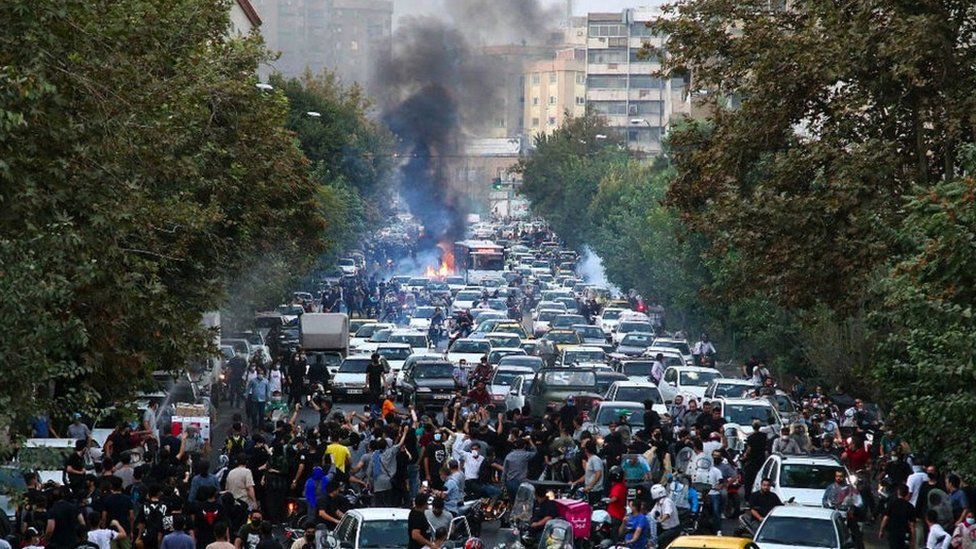
    Protesters block a street in Tehran
    IMAGE SOURCE,GETTY IMAGES Image caption, Protests over Mahsa Amini’s death have spread across Iran

    Shayan Sardarizadeh from the BBC’s disinformation unit said: “Shutting down internet connections nationwide is the nuclear option for Iranian authorities, only triggered when they fear protests are on a scale that pose an existential threat to the regime.

    “It is an effective tool that severely harms the ability of protesters to organise, communicate and inform the outside world, but it also carries a huge cost for the Iranian economy, businesses and public services.

    “However, Iranian authorities have shown time and again that when faced with a choice between a severe hit to the economy and cracking down on political unrest at any cost, they will always choose the latter.”

    Clamping down heavily on protesters and internet blackouts has worked to suppress people in Iran in the past.

    But fears are growing that the situation could escalate to something like 2019 protests that erupted over petrol price rises, the bloodiest in the Islamic republic’s history.

    During those protests, the internet was cut off for days at a time.

    Iranian President Ebrahim Raisi has said protesting is allowed in the country but “rioting” will not be tolerated.

    “Protests have always happened in Iran. The protesters are heard. However, protests must be distinguished from rioting,” he said.

    Source: BBC


  • ‘Marketed at children’: Cannabis sweets widely sold on social media

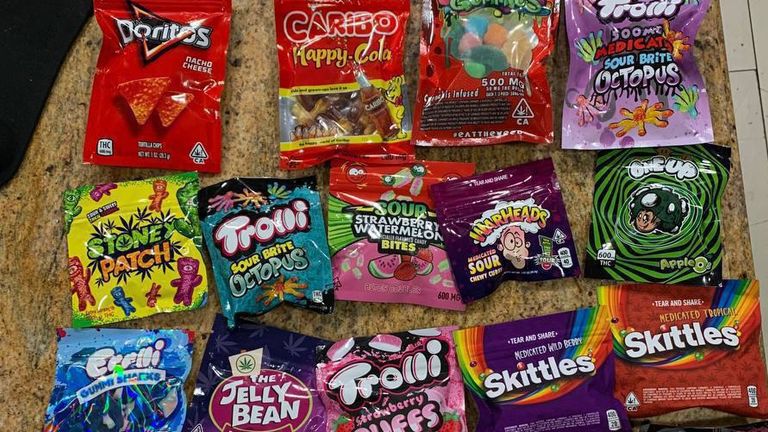
    Sky News has reported that cannabis candies marketed and promoted on social media platforms like Instagram and Tik Tok are packaged to resemble packages of Haribo and Skittles.

    On Telegram, one dealer is promoting a variety of cannabis candies in colorful packages with false branding.

    At least six children have been sent to the hospital after eating cannabis sweets, according to the police, who claim that the packaging makes them appealing to kids. One kid was only eight years old.

    There are also concerns that drugs are used to lure children into trafficking drugs by county lines gangs, which are based in big cities but use youngsters to deliver and sell drugs to users in towns and rural areas. Police in the east of England said that a third of people arrested in relation to cannabis edibles are under the age of 18.

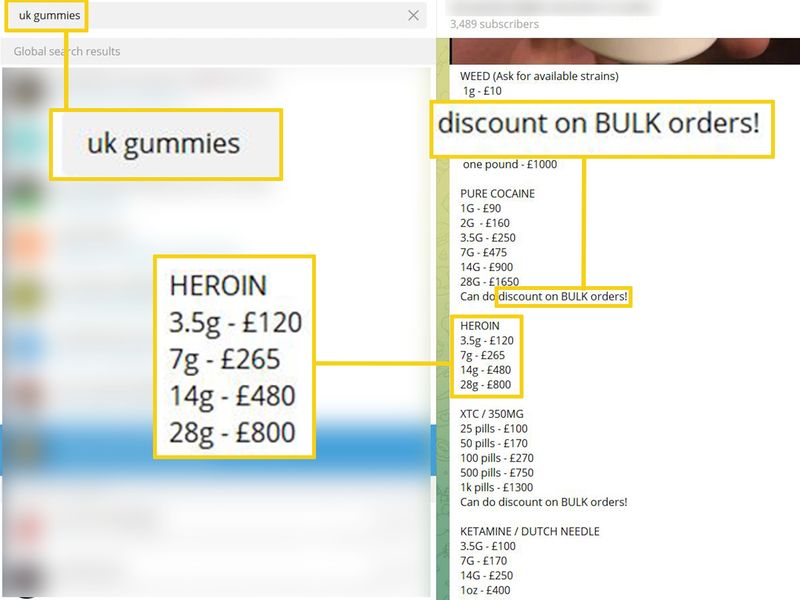
    The sweets are routinely promoted and sold alongside class A drugs including heroin, cocaine, and LSD, as well as large quantities of marijuana.

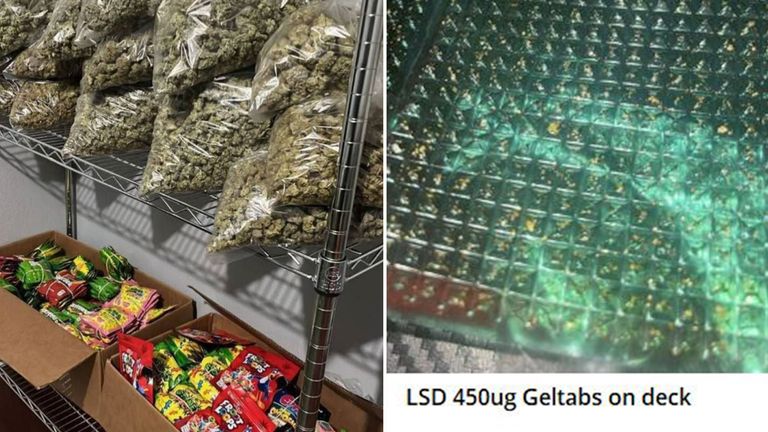
    One Telegram channel posted images of large bags of marijuana above boxes of gummies, as well as sheets of the Class A drug LSD
    Image: One Telegram channel posted images of large bags of marijuana above boxes of gummies, as well as sheets of the Class A drug LSD

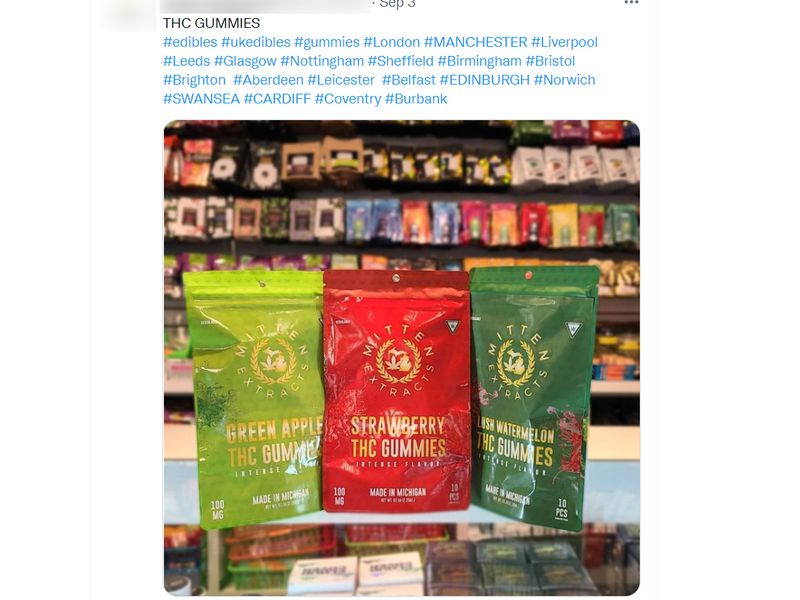
    Sky News found dealers are operating openly on the five most popular social media sites: Facebook, Instagram, TikTok, Twitter, and Snapchat. They are also using the messaging services Whatsapp and Telegram, and the latter is the most popular platform for dealers to provide prices and initiate sales.

    The story came to light after a dealer added a Sky News journalist on Instagram to an account selling cannabis sweets.

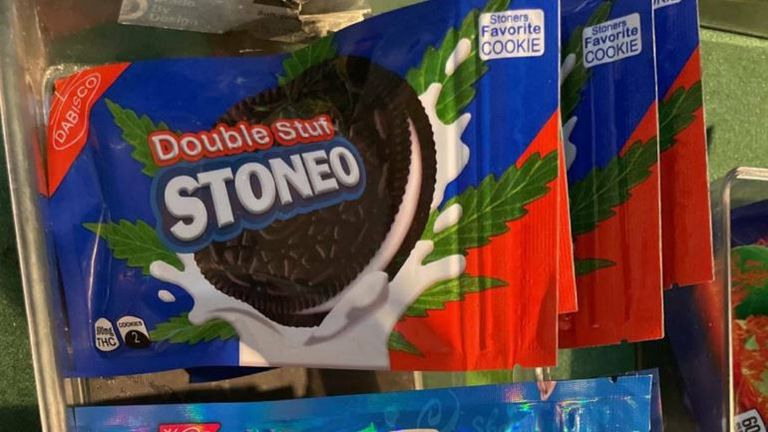
    The sweets are known as gummies and have no connection to the legitimate brands named on some of the packagings.

    Some of the cannabis sweets on sale are homemade
    Some dealers are adding illegal substances to the sweets themselves

    Some products using CBD, a chemical found in cannabis, are on sale legitimately in shops across the country, but these sweets are illegal and contain high levels of THC – which is the chemical that gives a user a high.

    Many appear to have been brought into the UK from California, where drug laws are different.

    Ordering in bulk is encouraged, and dealers offer discounts on big orders of gummies and harder drugs.

    Image: This seller is advertising class A drugs like heroin and offering bulk discounts on other hard drugs, while also offering ‘gummies’ elsewhere in the channel. The chat appears under searches for ‘uk gummies’. Pic: Telegram

    Searching on Telegram for the word “gummies” brings up many groups where the sweets can be bought for just £5. One group has 62,000 subscribers and two others have almost 30,000 and 16,000 subscribers each.

    Typing in the word “edibles” on the Facebook marketplace in the UK resulted brought up items containing drugs. Around a third of the first 40 results were advertised as containing cannabis.

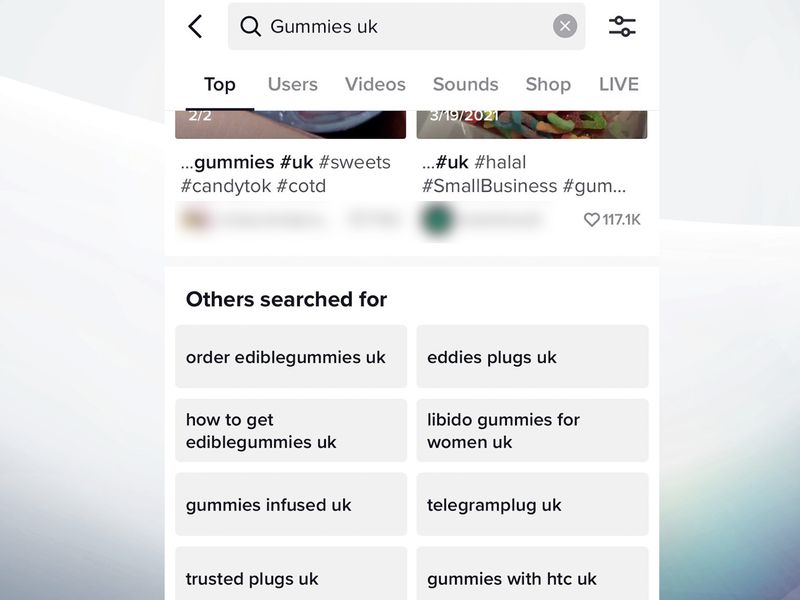
    Those looking for “gummies uk” on TikTok were shown results mostly showing legal sweets but the app offers suggestions that point users to sweets offered by dealers.

    These suggestions include searching “how to get ediblegummies uk” and “telegrampluguk” (plug being a term for a dealer or someone who can connect you to a dealer) and “gummies with htc uk” (htc being a spelling variation of THC).

    Image: TikTok’s suggested searches pointed users to other drug content. Pic: TikTok

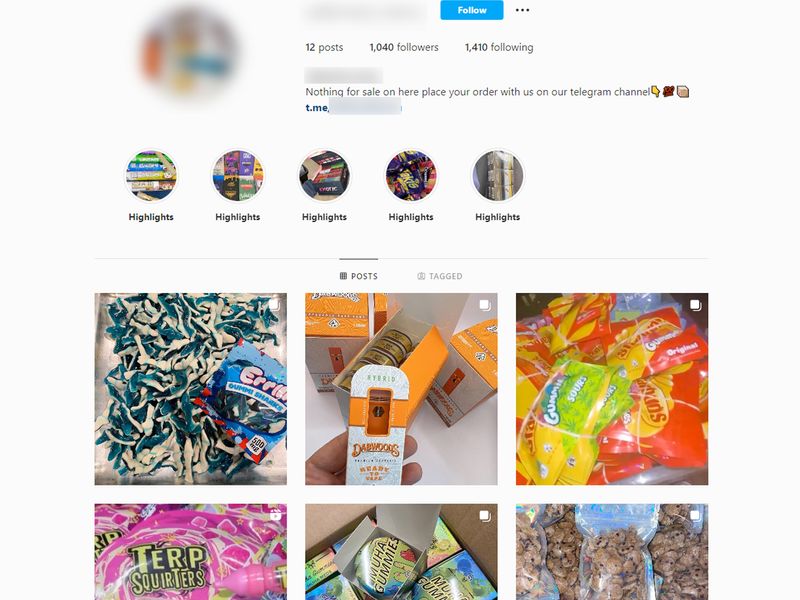
    A network of dealers appears to be operating on some of the social sites. For example on Instagram, looking at the accounts following or being followed by a seller leads you to discover more sellers.

    Cannabis sweets are a problem for police forces across the UK. Almost all police forces in England, Scotland, Wales, and Northern Ireland have had an issue with the sweets in their area, and 80% issued a statement or confirmed this to Sky News.

    Image: One dealer’s Instagram page

    The Eastern Region Special Operations Unit (ERSOU) has a unit that manages the threat of serious and organized crime across eastern England and covers Bedfordshire, Cambridgeshire, Hertfordshire, Norfolk, Suffolk, Kent, and Essex.

    Intelligence from ERSOU shared with Sky News suggests boys and girls under 18 are consuming cannabis edibles, primarily those of secondary school age.

    A third of those arrested in relation to cannabis edibles in the eastern region are under the age of 18.

    The likeness of some big name brands are used by dealers to market their edibles
    Image: The likeness of some big name brands are used by dealers to market their edibles

    Detective Chief Inspector Rob Burns, from ERSOU, says that cannabis edibles are illegal and have side effects, such as loss of consciousness.

    He said: “The way they are branded to look like sweets suggests they are being marketed at children, but worryingly also means that they could easily fall into the wrong hands.

    holding hero image

    “We also know that gangs involved in county lines will use an array of tactics to target vulnerable young people, and reporting suggests social media is used to advertise the sale of cannabis edibles, potentially to appeal to younger people who are using multiple social media platforms.”

    He added that anyone with information on the sale of these items or who thinks a child is being exploited to sell them should contact the police.

    The social media companies mentioned in this article all told Sky News they have strict policies prohibiting the buying or selling of any drugs, including sweets containing THC. They say they actively monitor this issue on their platforms using a mix of both technology and humans to review content.

    Meta, which owns Instagram, Facebook, and Whatsapp, said it removed 98% of this content proactively in the last quarter and that it was working with the police and youth organizations to improve their moderation.

    Image: Accounts selling gummies were also found on Twitter

    Most of the accounts and search terms flagged during the Sky News investigation have now been banned.

    The companies behind the sweets and snacks whose branding is copied by drug makers have previously spoken out against the look-a-like packaging, and some took legal action.

    Sky News has blurred the names of accounts to avoid giving publicity to the sellers.

  • Serena Williams shares sweet photo with daughter Olympia, bestie Meghan Markle

    Serena Williams turned her appearance on Meghan Markle‘s new podcast Archetypes into a family affair.

    On Tuesday, the tennis superstar, 40, shared a black-and-white photo on Instagram of her posing with her 4-year-old daughter Olympia and Markle, 41, while teasing her interview on Markle’s podcast.

    “I loved talking about so many important topics with my dear friend Meghan as her first guest on #archetypes for @spotify,” she captioned the snap. “It’s out now and worth the listen, especially if you’re ambitious ❤️”

    In the premiere episode, the duo discussed the double standard society sets for women who chase their dreams.

    In the opening of the episode, which dropped Tuesday, Markle said that the nuns of Immaculate Heart, the all-girls Catholic school in Los Angeles she attended from sixth through twelfth grades, always empowered the students to go after what they wanted.

    “This feminist ideology trickled down into nearly every aspect of my education. It’s probably safe to say into every aspect of my life,” she explained. “This message to me and my classmates was clear: our futures as young women were limitless. Ambition? That was the whole point!”

    “So I don’t remember ever personally feeling the negative connotation behind the word ‘ambitious’ until I started dating my now-husband,” she said.

    Pool/Samir Hussein/WireImage

    Reflecting on life in the limelight as Prince Harry’s partner, she continued, “and apparently ambition is a terrible, terrible thing, for a woman that is — according to some. So, since I’ve felt the negativity behind it, it’s really hard to un-feel it. I can’t unsee it, either, in the millions of girls and women who make themselves smaller — so much smaller — on a regular basis.”

    Introducing Williams as “someone who embodies the spirit of ambition,” the two addressed the negative light society views ambitious women.

    “Often women are definitely put in these different boxes when we are ambitious or when we do have goals or when we reach our goals, it’s a negative connotation on how we reach the goals,” Williams said.

    Noting that the notion even applies to “little girls in a school room,” Markle pointed out that if a young girl “is ambitious or raises her hand more,” she’s likely to be labeled “bossy” because of her gender, to which Williams agreed.

    Markle and Williams first met at the Super Bowl in 2010 and immediately hit it off. They also appeared together at the 2014 Super Bowl, competing in DIRECTV’s Celebrity Beach Bowl. They played former NFL pros for the prize but made sure to make some time for fun on the sidelines.

    Since then, the Duchess of Sussex and Williams have supported each other, including Markle watching her friend play at Wimbledon and the U.S. Open.

    Source: People.com

  • Fadda Dickson celebrates Instagram verification with beautiful photos

    Fadda Dickson Narh, the managing director (MD) of Despite Media Group, has been verified on Instagram.

    In celebration of his verification, Fadda Dickson has dropped new stunning and stylish photos on his page.

    In the photos, Fadda Dickson is seen wearing a colourful Fendi top and shorts with Fendi sneakers to match.

    He also had a nicely woven hat that matched the blue and red trims on the Fendi outfit.

    Sharing the photos on Tuesday, 14 July 2020, Fadda Dickson just communicated with the hashtags “#Verified #nofakeaccounts #trusttheprocess.” 


    View this post on Instagram


    #Verified #nofakeaccounts #trusttheprocess

    A post shared by Fadda Dickson (@faddick) on

    Following his photos, congratulations and praises have been pouring in for Fadda Dickson.

    Okay FM’s, Abeiku Santana (abeikusantana), said:

    “Congratulations daddy @faddick. It is blue tick.”

    cpt._pretty agreed to trust the process:

    “❤️❤️❤️❤️❤️ Yes we are gonna trust the process.”

    akuapem_hemaa said:

    “The forever green the 16 year old boy with the dopest swag❤️❤️❤️❤️.”

    mcdaniels.ka said:

    “Father, you are just the word too much. I tap into your blessings and more of it. I really respect you, sir. God continue to bless you.”

    Fadda Dickson is one of the most revered media gurus in Ghana. With his role as Despite Media’s MD, he controls one of the biggest media conglomerates in Ghana that comprises Peace FM, HELLO FM, Okay FM, Neat FM, Peacefmonline, and United Television (UTV).

    Fadda Dickson Narh married his wife, Kate Dickson Narh, years ago with whom he has two lovely boys: Irvine Kofi Narh and Fadda Dickson Narh Jnr.

    He is a fashionista and owned his sense of fashion during the recent nuptials of his godson, Kennedy Asante Osei, and his wife, Tracy.

    Source: yen.com.gh

  • Instagram’s CEO is managing one of the world’s biggest social networks from his garage

    (CNN)“I don’t normally work from my garage,” Adam Mosseri said when asked what it’s like to run one of the biggest social media platforms in the world from his San Francisco home.

    For years, Instagram has been synonymous with travel and experiences. Its users fill their feeds with carefully filtered and cropped photos of exotic locations and colorful venues. But now, from his plywood-lined garage, Mosseri, Instagram’s CEO, is telling his users to do what he’s doing: stay at home.
    Over the past week the company launched a dedicated “Stay at Home” tab featured prominently in the Stories section at the top of its feed. As the name suggests, the feature offers a way for users to share updates on their stay-at-home life at a time as people in vast parts of America and across the world have essentially been not to go outside except for essentials to limit the spread of the coronavirus. And it might actually help raise awareness of the need to stay in. Mosseri revealed Tuesday that the “Stay at Home” Instagram stories were so popular it almost crashed the site in the hours after it went live.
    The fact that a well-intentioned new feature nearly took down the entire service is a reminder of just how many fires Instagram and Mosseri are working to put out at once amid the coronavirus outbreak. Among other pressing issues, he and his team must: keep their servers up and running while much of the world is forced to shift their lives online; try to encourage people on the platform to maintain social distancing; combating inaccurate and potentially dangerous misinformation about the coronavirus at a time when there is apparently an unprecedented amount of traffic on the site; and do all this while working outside the office.
    “Having our workforce, particularly our moderators, work from home, is creating all sort of challenges that we need to work through,” Mosseri said in an interview with CNN Business over Skype on Tuesday from inside the garage that is now his de facto command center.
    “Just generally, the amount of output we should be able to expect on a per person basis is just going to go down,” he said. “There is no way around that, which is why it is so important we get creative and make sure that we continue to make sure we keep people stay safe on the platform.” Mosseri added that the company still needs to stay on top of a range of challenges like content related to child exploitation and terrorism.
    For years, Instagram’s parent company, Facebook, has been trying to combat the spread of misinformation on its platforms. The coronavirus presents a whole new challenge as people around the globe are desperate for just about any information.
    Instagram’s struggles in dealing with the anti-vaccine movement might not inspire much confidence in the company’s ability to get ahead of false information about the coronavirus.
    But over the past few weeks and months it has brought in new rules and features specifically for the coronavirus crisis. Some of those features — like not recommending accounts that spread medical misinformation when people search terms related to the virus (which the company says will roll out in the coming days) — are steps critics of anti-vaccine accounts have been calling for for some time.
    Mosseri said the company’s focus has been getting users accurate information about the virus — links to official government agencies have appeared at the top of users’ Instagram feeds around the world. The company, like other social media platforms, has taken other steps to highlight information from the World Health Organization.
    “I actually think search in general on platforms like ours gets way too much attention because it is not something people do that often. It is more important that people get good information when they come to the app in the first place,” he said.
    Like other companies, Instagram and Facebook instructed employees to work from home before it became mandatory in many states. “We need to take care of our people if we are going to be able to help address the crisis and live up to our responsibility,” Mosseri said.
    But new rules to tackle coronavirus misinformation and other initiatives, like banning ads for the sale of face masks (to help ensure they are available for medical workers in most need of them), require new protocols, staff training and sometimes new systems to implement, all of which is more difficult to do with staff working remotely.
    As a result, Mosseri said Facebook and Instagram staff that don’t normally work on moderation are volunteering to help.
    Twitter and YouTube also warned that the shift to working from home and reliance on automated content moderation may lead to more mistakes.
    The heightened anxiety felt by users will likely only amplify errors. For example, last Tuesday there were widespread reports of Facebook suddenly marking posts from users about everything from the coronavirus to their pets as violating the platform’s rules. The problem was fixed within a few hours and Facebook said it had nothing to do with the changes in its workforce
    With false claims about purported cures and preventative steps that can be take against the virus circulating online, ensuring the spread of accurate information is now literally a matter of life or death.
    Source: cnn.com
  • Instagram steps up effort to curb Coronavirus disinformation

    Instagram said Tuesday it was ramping up efforts to promote reliable content about the Coronavirus pandemic and stop the spread of misinformation on the image-centric social network.

    The move by the Facebook-owned service with more than one billion users worldwide comes amid a scramble by social networks to deliver verified information and stamp out hoaxes.

    “People who search for information related to the Coronavirus or COVID-19 on Instagram will start to see an educational message connecting them to resources from the World Health Organization and local health ministries,” Instagram said in a blog post.

    “We are working quickly to make this available globally over the coming weeks.”

    Instagram said it would also add “stickers” that signify verified Coronavirus information and would remove content about health claims “unless posted by a credible health organization.”

    The social network also said it would offer links to donations for nonprofit organizations and offer tips for social distancing.

    The initiative follows similar efforts by Facebook on its core social platform as well as on its Messenger and WhatsApp services and by other platforms such as YouTube and Twitter.

    More than two billion people use at least one of Facebook’s “family” of applications daily.

    Source: France24