Owners of vehicles damaged by the collapse of A&C Mall’s solar panel parking structure during Tuesday’s rainstorm are eligible for compensation, as the mall’s insurers will cover repair costs upon submission of invoices.
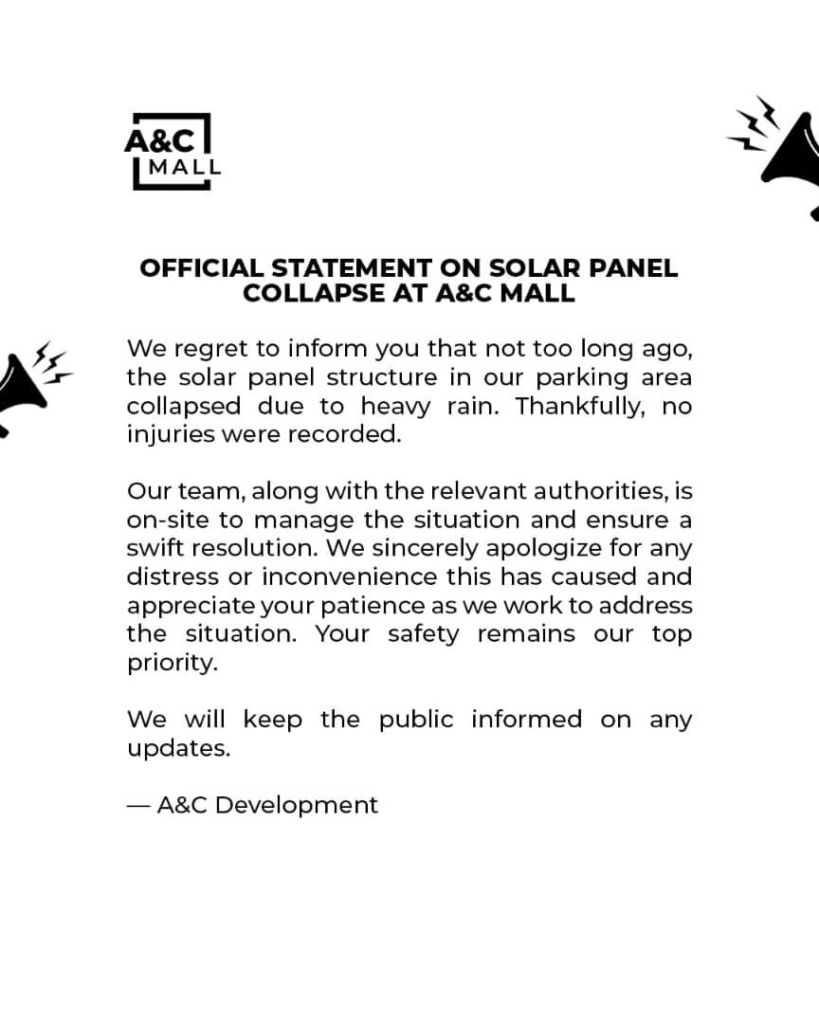
A&C Mall has assured the public that no casualties were recorded following the incident, which occurred during a heavy downpour in East Legon, Accra. In an official statement, management explained that the parking structure gave way due to the force of the storm and strong winds.
“We regret to inform you that not too long ago, the solar panel structure in our parking area collapsed due to heavy rain. Thankfully, no injuries were recorded,” the statement read.
The collapse left extensive damage, with over 50 vehicles reportedly affected. Videos shared on social media depict cars trapped beneath the wreckage, prompting swift intervention from emergency response teams and relevant agencies.
Owners of affected vehicles that got damaged as a result of Tuesday's rainstorm are to fix their vehicles and present invoices for onward payment by insurers of the A&C shopping mall.#News360pic.twitter.com/eyeQWmrWi9
Mall authorities have pledged to ensure a smooth resolution, working closely with affected vehicle owners and insurers to facilitate repairs.
“We sincerely apologize for any distress or inconvenience this has caused and appreciate your patience as we work to address the situation. Your safety remains our top priority,” the statement added.
A&C Mall has committed to providing regular updates as assessments and recovery efforts continue.
The Ghana National Fire Service (GNFS) has disclosed that firefighters in the country do not have any insurance coverage for injuries sustained while on duty.
According to the service’s Public Relations Officer, Alex King Nartey, officers who get hurt while responding to fires or carrying out emergency rescues must cover their own medical expenses, as no structured insurance policy is in place to support them.
He further explained that personnel can only seek reimbursement after footing their medical bills, but the process is often slow and unpredictable.
“We don’t have any health insurance….When firefighters get injured at the scene of a fire, they use their own resources to take care of themselves and later apply for a refund to be paid to them. So if at that moment you don’t have money, you would have to go and borrow money from people to be able to take care of yourself.”
His comments come in response to criticisms from the Ashanti Regional Minister, Dr. Frank Amoakohene, following a fire outbreak at Adum in Kumasi on Saturday, March 22.
The fire, which engulfed a commercial building near the Adum Central Business District, caused extensive damage, destroying shops and valuable goods worth thousands of cedis. The cause of the blaze remains under investigation.
Firefighters from the GNFS arrived at the scene to contain the flames and prevent them from spreading. However, during an assessment visit, Dr. Amoakohene expressed frustration after spotting what he believed to be an empty fire tender at the location. He demanded answers from the firefighters, questioning why the vehicle was there if it had no water.
Reacting to the minister’s remarks, King Nartey criticized the approach, suggesting that a simple show of appreciation would have been more appropriate.
“A simple thank you would have sufficed. You could have easily spoken to the commanding officer at that time and got updates, but to create a scene with a camera on you to demoralize the efforts of the firefighters is not right,” he told GHOne TV.
He further highlighted the struggles firefighters endure due to the lack of insurance coverage.
The GNFS is yet to comment on whether any measures will be put in place to address this issue.
The government has revealed that removing the cap on the National Health Insurance Levy (NHIL) is expected to generate around GH¢9.9 billion, with part of the funds set aside to cover the financial gap left by the suspension of the USAID program.
A statement from the Presidency conveyed President John Dramani Mahama’s concerns over the estimated $156 million shortfall caused by the USAID suspension, cautioning that it could negatively impact key health and social intervention programs.
Speaking in Parliament on Tuesday, March 18, Finance Minister Dr. Cassiel Ato Forson reassured legislators that measures to address these concerns have been incorporated into the 2025 budget.
“The National Health Insurance Authority will be receiving in total, an amount of GH¢9.9 billion for the year 2025. This is because of the uncapping. The uncapping of the National Health Insurance Levy has made available additional resources worth GH¢4.2 billion to the National Health Insurance Authority.
“This is indeed enough for the National Health Insurance Authority to be able to include in their priorities, the funding gap as created by the USAID suspension.”
The Ghana National Fire Service (GNFS) has entreated the government to provide insurance cover to cater for the immediate medical care of firefighters and rescuers who get injured in the line of duty.
Deputy National Public Relations Officer of the Ghana National Fire Service, DO III Desmond Essoun Ackah, made this plea on behalf of the Service during an appearance on UTV.
“We do well to prevent casualties during fire outbreak and also the incident itself. Now, what government has provided is the workman compensation. Because it’s laborious, you need to receive medical care first then bring receipts before you apply for this is looked at before you can pay.
“It is cumbersome. So now, we are pleading with the government to provide us a direct insurance cover so we can immediately take care of our officers injured while on duty,” he said.
This follows the recent tragic incident at West Legon in Accra where four firefighters got seriously injured after a building on fire collapsed on them.
The fire incident occurred on Wednesday, January 24, 2024, around 2 pm, and spread quickly to the roof of the building, which was made of wood and metal sheets. Thick smoke was seen billowing from the building, attracting the attention of passers-by and residents.
The Ghana National Fire Service (GNFS) has indicated that its officers who got trapped after the roof of a burning building they were dousing collapsed on them are currently out of danger.
Theo Jones, who lives in Maesteg, Bridgend county, has a sickness in his brain. He needs to go to the hospital in Cardiff for treatment, but his parents say that the insurance company is taking too long to approve it.
They are worried that his condition will get worse and he won’t be able to go back home. AXA Partners insurance company has been requested to give their thoughts.
Theo got sick on September 13th while on a vacation in Portugal with his family. Two days later, he had to go to Faro Hospital in an ambulance.
His parents were first told that he had a sickness in his stomach, but a scan called an MRI showed that he had a problem in a part of his brain called the cerebellum.
His mom, Sarah Jones, said that their wonderful talkative and energetic boy can no longer speak, sit, or walk.
She said that the doctors told her that they thought a virus was hurting Theo’s brain.
Sarah said she talked with University Hospital Wales in Cardiff, and they agreed to move Theo there.
The doctors told Theo’s parents that he could go on a trip, but he would have to travel by a special plane for people with medical needs.
“She said that we just need to take him there now. ”
Sarah, her husband, and their five-month-old daughter are currently in Portugal. They need to move out of their place in early October.
She said the insurance company told them that Theo was a very important case, but they hadn’t given them any new information since getting a medical report on Tuesday.
Sarah said she had to ask her taxi driver to help her understand some of the documents because the company didn’t have a translator at that time.
She said that AXA wants to wait for two more days to see if Theo’s condition gets better.
However, she didn’t understand why they were waiting for him to get worse when he’s already been given permission to travel because he’s currently in a stable condition.
I am unable to talk to the people who are making these choices. She said that they are a mysterious group within AXA that nobody can seem to access or understand.
It’s a very bad dream. We have the cover now, they have taken the blame. They are not doing anything right now.
Martin Lewis has issued a warning to vacationers about a rental car trap that results in consumers paying exorbitant insurance fees.
The money-saving expert claimed in his newsletter that horror stories offered to clients when they pick up their cars induce them to pay for “excess cover insurance.”
“Car hire usually comes with basic insurance,” he claimed. “However, at the pick-up desk, they almost always try to push you to get ‘excess cover insurance,’ which can cost up to £25/day, using scare stories of huge bills for just a scratch – or sometimes implying you have to do it.”
It is preferable to purchase insurance in advance, which might run drivers as little as £2 per day.
Mr. Lewis further cautioned that the pick-up desk might try to claim that the pre-purchased insurance won’t be effective while pressuring Britons to submit a £1,000 refundable deposit.
As long as you have one, it’s not a problem, he said. Just remain composed and carry on.
Compare the Market, Go Compare, Money Saving Expert, and other comparison websites all have affordable auto insurance options.
If they reserve with vehicle rental companies or outlets located outside the airport, drivers could save up to £200.
Mr. Lewis cautioned against renting items like satnavs or child car seats because they can cost more to rent than to purchase outright.
Holidaymakers can also check a child’s car seat for free with several flights.
As time passes, your life changes and your insurance cover must reflect the new developments.
Henk Meintjes, Chief Specialist of Risk Propositions at Liberty, discusses the eight points in your life when you need to review your risk cover.
Most people have their first experience of risk insurance when they start working. The company may provide some form oflife or disability insurance.
Along the way, you may end up with additional life insurance to cover your mortgage when you buy a house.
What many people seldom do, however, is a full review of their insurance needs, especially when experiencing significant life changes or reaching certain milestones.
Perhaps you were fortunate enough to meet with a financial adviser and sign up for basic insurance.
But did you know that you should be meeting with your financial adviser once a year to review your overall finances, including your risk cover?
Here are 9 reasons why you should reassess your cover:
You start working
Make sure you have the right risk cover to protect your future income. At this point, it’s your most important asset. This includes insurance that pays a lump sum if you are disabled or impaired or that pays recurring amounts to replace your salary.
If you don’t have dependents, you may not require significant life cover, but consider selecting an option that allows you to increase your life cover at a later stage without underwriting.
If your company does not provide a pension or provident fund, make sure you start investing in a retirement annuity.
Even if you are contributing to a company fund, remember that you can invest up to 27,5% of your income tax-free for retirement.
You change jobs or are promoted
Rather than spending all your extra cash, increase your monthly savings by the same percentage your salary increases by.
This will ensure that you’re on track for retirement. If you start working for a new company, review their employee benefits to find out if you are in a better or a worse position.
It’s important to review any disability and income protection to ensure that it’s in line with your new income.
If you don’t already have critical illness cover, consider the fact that critical illness claims are increasing for people over the age of 30.
You lose your job (worst-case scenario)
Understand your options. You may need to draw from your pension, which will impact your retirement. Find out if any of your policies include retrenchment cover – either as a stand-alone benefit, which will pay you a monthly amount, or to waive your insurance or investment premiums.
Avoid the knee-jerk reaction of cancelling your risk cover. This would leave you extremely vulnerable financially should something happen to you. In addition, you may not be able to get cover at the same premium again after you have cancelled your cover, particularly if your health status has changed.
You get married or have a life partner
If you’re in a long-term relationship or you recently got married, it’s a good idea to review your life cover amount to suit your changing lifestyle. You need to ensure that your partner can take care of themselves when you’re gone, especially if your partner depends on you financially.
This is also a good time to sit down and discuss your financial priorities. You need to agree on what you both hope to achieve over the next five, 10 and 20 years. Remember to update your Will and the beneficiary details on all your insurance policies to include your spouse.
You have children
Reassess your cover to provide for your children, and particularly for their education. It may also be advisable to include a testamentary trust. Should you pass away, the proceeds of your policies or assets can be paid into the trust until your children become adults. You also need to update your policies, your pension and your provident fund beneficiary nomination forms accordingly.
Now is the time to start a savings plan for your children’s education.
One of the breadwinners stops working to raise children
This will change your family budget and lifestyle. When reviewing your finances, ensure that the stay-at-home parent has retirement provisions, as well as risk cover. Although the parent may not be earning an income, they are the primary caregiver, and this would become a cost to the family if the parent was no longer able to care for the children.
You get divorced
Update the beneficiaries of your policies if you no longer want your ex-spouse to be named as a beneficiary.
If you were covered on your spouse’s insurance policies, you’ll need to apply for your own separate policies. Remember to consider medical aid and short-term cover.
Assess the impact the divorce has had on your income and assets. If you receive a lump sum from your ex-spouse’s retirement fund, make sure you preserve the benefits because you will still be retiring one day.
You retire
It’s important to undergo a full financial assessment and have a proper plan in place for retirement. A full review of your risk insurance is important as your needs will change significantly. If, for example, you had income protection, you could use those premiums to increase critical illness cover. Assess how much life cover you still require. If your children are no longerfinancial dependants, the need for cover may be reduced, but you still have to consider factors such as spousal support and estate duty.
You’ve just bought a house
Did you or your partner buy a new home? Buying property is one of the most significant financial commitments you’ll ever make and raises various financial implications like property maintenance expenses, bond repayments, water and lights bills, levies, renovation, and construction costs. If your partner can’t afford these costs when you’re gone, it’s crucial to ensure that your life cover amount is enough to cover these expenses over and above the living expenses that your family will be left with.
DISCLAIMER: Independentghana.com will not be liable for any inaccuracies contained in this article. The views expressed in the article are solely those of the author’s, and do not reflect those of The Independent Ghana
Whether you’re in your 20s or your 50s, personal financial planning around wealth building and risk cover are critical. Here’s what you should consider at key stages of your adult life.
How much money is enough for you to be secure? When it comes to investing in your future, a little can go a long way. It all depends on when you start budgeting for the life you want to live.
“People in their 20s, 30s, 40s and 50s have different savings needs,” says David Cumming, Wealth Manager at Standard Bank. “It would help to consult a financial planner about your investments because there is no generic answer.”
Saving and achieving returns on your money doesn’t guarantee financial freedom when you retire. Setting aside enough today will determine your lifestyle in retirement, as well as the age you’ll be able to retire.
Do you know how much you will be able to live off and how long your capital will last? According to Cumming, reaching your retirement goal is predominantly reliant on three things: time, real return and contributions.
Student loan debt, car repayments, bond deposits and wedding costs are just some of the financial obligations that can delay saving for retirement. But the trick is to start as soon as you can and to save as much as possible.
financial tips for your life stage
This guide includes savvy tips for all stages of your adult life:
Smart financial moves in your 20s
Financial discipline in your youth yields significant advantages later in life, and the sooner you start building your wealth, the better. Consider minimising your debt and your expenses, while maximising savings. You can do this by living with your parents while you save for a deposit on your own house, instead of moving into a rental property and paying a landlord.
Retirement may seem far away, but the earlier you start saving, the more compound interest you will accrue. Automated deposits are easy and effective because they take money directly from your pay cheque and put it where you need it – into a savings account. This will help you become accustomed to saving early on.
Savings and investing in your 20s
Short and medium-term savings:
Savings for a car
Savings for a home
Savings accounts
Tax-free savings account
Unit trusts
Long-term savings and investments:
A retirement annuity can benefit you massively if you start early.
The percentage saved from your salary when you’re 20 years old will increase exponentially, compared to the percentage of your salary saved from when you are 35.
If you begin investing in your 20s, you can build an investment portfolio with a higher risk tolerance for higher gains over time – this can have a significant impact on your ability to begin building wealth in your 20s and beyond.
Property investment affords you the benefit of assets that appreciate over time, plus the long-term advantage of low repayments in relation to higher inflation in future.
Insurance in your 20s
Consider getting cover for younger people who do not yet have dependents, including:
Medical cover or a hospital plan to cover unexpected health expenses.
Disability cover to ensure you’re earning an income even if you can no longer work.
Vehicle and asset cover to replace your car and household contents.
Smart financial moves in your 30s
In your 30s, you might be moving up in your career, starting a business, buying a home, getting married or growing your family. By now, you probably have a financial plan in place, either with the help of a financial planner or through your own research. Being in your 30s still gives you enough time to plan and save for the future. By focusing on a few key points, you can manage your finances better and ensure that you keep the future in mind.
Here are three key tips for maintaining financial control:
Budgeting is just as important as managing your expenses; at this time in your life, commitments such as buying a property and covering family-related costs will continue to mount.
Reducing expenditure on flashy cars, clothes, and entertainment will allow more to be invested in your property or savings.
As your assets and family grow, estate planning and a Will are essential. You also need to focus on fostering strong financial discipline in your children and establishing shared financial goals with your spouse.
Savings and investing in your 30s
Short and medium-term savings:
Set up an emergency fund to avoid unexpected expenses from throwing you off budget
Save for your children’s education
Savings accounts
Tax-free savings account for you children
Unit trusts
Long-term savings and investments:
If you haven’t begun saving for your retirement, now is the time to commit to an annuity and make regular payments. Commit as much as you can to your RA – your future self will thank you.
There are only 30-something years and fewer pay cheques than in your 20s until retirement at 65.
Your investment portfolio can still accommodate higher risk tolerance, resulting in high gains over time.
If you can, pay off a higher rate on your home loan to save you years in interest, and give you more cash to invest.
Insurance in your 30s
Beyond medical cover and disability, life cover is essential if you are concerned about ensuring loved ones and dependents are covered should you pass away.
If you are a homeowner, building and household contents cover is vital.
Funeral cover is an addition that should not cost you too much but will benefit your family a great deal.
Smart financial moves in your 40s
In your 40s, the reminder to save and invest for the future should be top of mind. You’re heading into your peak earning years, but your time horizon is shrinking. As your expenses and commitments mount, budgeting becomes more important. You are probably still paying off your bond, and you may also have to cover family-related costs:
If you have dependents, life cover is vital.
Saving for your children’s education is a priority.
Your Will needs to be reviewed regularly to ensure your estate planning is up-to-date and takes into account life changes such as marriage, children, divorce and changes to your assets and investments.
Savings and investing in your 40s
Short and medium-term savings:
Set up an emergency fund and aim to have at least three months of expenses covered
Review your education savings for your children, as increases in education prices are often higher than average inflation
Savings accounts
Tax-free savings account
Unit trusts
Long-term savings and investments:
If you haven’t begun saving for your retirement, start immediately.
There are at least 25 years and a limited amount of pay cheques until retirement at 65.
Use any bonuses you receive to boost your retirement savings.
How to build wealth in your 40’s? You may wish to consider a portfolio allocation and management method aimed at balancing risk and return.
Consider additional property investment.
Insurance in your 40s
In addition to medical and disability cover, life cover is critical in ensuring your loved ones and dependents are covered should you no longer be around to look after them.
If you are a homeowner, building and household contents cover should be a priority.
Funeral cover is an important addition to these policies.
Smart financial moves in your 50s
Many people get serious about planning for their retirement in the 50s. Financial planning in this decade is hugely important. This is the time to take a thorough look at your future and make some decisions. Review your financial plan to ensure you are on track. It’s important to assess your tolerance for risk-taking and to avoid making bad money choices. Although you may be taking care of older parents, don’t forget about saving for your own retirement.
It’s also wise to review your estate planning regularly, ensuring all information is up to date and accurate.
Savings and investing in your 50s
Short and medium-term savings:
Your 50s should be a time for reaping the rewards of your hard work. Consider savings for the following:
Holidays
Grandchildren
Paying cash for a vehicle
Long-term savings and investments:
If you haven’t begun saving for your retirement, start now by scaling back all expenses to supplement your contributions. You have approximately 15 years until retirement at 65, so use any available funds to boost your retirement savings.
Review your risk exposure in your investment portfolio as you have more to lose at this stage, and it could take longer to recoup losses from risky investments.
You should be aiming to pay off property, so you have fewer expenses leading up to retirement.
Insurance in your 50s
Maintain your medical insurance, as it’s costly to join a plan at this age after interrupted cover.
Ensure your home, its contents and your vehicle are insured, and the premiums up to date.
Funeral cover is a good addition, albeit later in life.
Source: standardbank.co.za
DISCLAIMER: Independentghana.com will not be liable for any inaccuracies contained in this article. The views expressed in the article are solely those of the author’s, and do not reflect those of The Independent Ghana
Finding affordable healthcarewithout insurance may seem daunting, but there are more options than you may think. Here are more than 18 resources that can provide assistance.
It’s no secret that accessing healthcare can be very expensive. If you don’t have insurance, those costs are even higher. In fact, 85% of uninsured people in the United States reported that paying for healthcare was difficult in 2022.
Fortunately, there are resources that can help you find and pay for medical care without insurance. You can find care at low or no cost with a variety of programs designed to help people without health insurance get the care they need.
Yes, you can get medical care if you don’t have health insurance.
In the United States, hospital emergency rooms are required to provide treatment regardless of insurance or ability to pay.
Additionally, there are many medical facilities that provide routine care to people who don’t have insurance. You will be asked to pay for any care you receive, but there are ways to find healthcare at a lower cost.
There are a variety of options for seeking care if you don’t have insurance. Many of these options are designed to be affordable. In some cases, you might be able to get certain healthcare services for free.
You can find low cost or free care in several locations:
Community health centers
Community health centers are nonprofit health clinics that offer low cost or free care. Often, fees are set on an income-based sliding scale, and staff will work with you to determine your costs.
The exact services offered by a community health center depend on the location but generally include:
preventive healthcare
basic healthcare
family planning services
vaccinations
chronic condition management
Some communityhealth centers also offer prescription medications and dental care. You can search for community health centers near you by checking here.
State or county departments of health
Your state or county department of health might cover certain healthcare services for eligible residents. Often, this includes access to preventive care, such as vaccines or screenings.
You might need to register in advance and prove that you reside in the county or state to receive free care.
You can search for your local department of health here.
Urgent care and walk-in clinics
Urgent care centers and walk-in clinics offer care without an appointment. Often, these facilities offer reduced cost care for people who don’t have insurance. Some urgent care centers list costs for standard services on their websites.
You can also call ahead to talk with a representative about fees and possible cost reductions for people without insurance.
Pharmacy care clinics
Pharmacies, including the pharmacies inside major national chains such as Walmart, often provide preventive care services for free. These services are normally provided during health clinics held on specific days.
Services offered can vary but typically include:
blood pressure screenings
blood sugar readings
vital sign checks
screenings for certain conditions
You can check with your local pharmacy about any upcoming clinics, or search online for pharmacy clinics in your area.
Teaching hospitals
If you have a teaching hospital in your area, you might be able to receive care at a reduced rate. The exact care you can access at a reduced rate depends on the hospital and the needs of the medical students.
You can call the teaching hospital and ask whether they offer any reduced cost care.
Employer-sponsored wellness programs
Some employers offer wellness programs to their employees. In many cases, this includes preventive healthcare, such as annual vaccines and healthcare screenings.
You can check in with your human resources department if you’re not sure what healthcare benefits are part of your employer’s wellness program.
The National Association of Free & Charitable Clinics
You can use the National Association of Free & Charitable Clinics website to search for health clinics and pharmacies in your area that offer free or low cost services.
The association is dedicated to caring for people who are uninsured or underinsured. There are more than 1,400 clinics and pharmacies in the association.
If you need assistance paying for care, you have a handful of options:
Charity care
Some states offer charity care that reduces the cost of medical care for people who meet income requirements. If you qualify, you can receive low cost or free medical care.
In certain states, people are screened automatically. In other states, you will need to apply for the program.
Medicaid
Medicaid is a federal program that provides healthcare for people who meet income requirements. Each state oversees its own Medicaid program. Income limits and exact coverage vary by state.
You can find your state’s Medicaid website here.
Children’s Health Insurance Program (CHIP)
The Children’s Health Insurance Program (CHIP) is a federal program that provides healthcare for children. Just like Medicaid, qualifying for the program depends on income level. Each state sets its own income limits and coverage varies.
You can read about CHIP in your state here.
The Hill-Burton program
The Hill-Burton program provides funds to participating hospitals and healthcare facilities in exchange for offering a set amount of free or low cost care to people who meet income requirements.
You will need to apply for the Hill-Burton program with the admissions or business department of the healthcare facility. You can find a directory of Hill-Burton facilities here.
Aunt Bertha
Aunt Bertha is a social and human services database you can search to find programs in your area. This includes programs that can help you pay for healthcare.
You can enter your ZIP code and a category to find programs that will meet your needs.
Keeping prescription costs low is a great way to lower your overall healthcare costs. Here are some options:
Prescription drug manufacturer programs
The makers of many prescription drugs offer programs to help people afford their medications. You can often join these programs to get your medication at low or no cost. You might need to meet certain income requirements to qualify.
You can use RXAssist to search a database of manufacturer programs.
GoodRx
GoodRx is a website that will show you the prices of your medication at stores in your local area. It can also show prices at online and mail-order pharmacies. By comparing pharmacies, you can find the lowest price.
Plus, GoodRx will even help you find coupons and manufacturer discounts.
Pharmacy memberships
Walmart, CVS, and other pharmacies have membership programs that can save you money. By signing up for these programs, you can get access to discounts on your medication. You can also earn discounts to use on other pharmacy purchases.
Grants for charitable organizations can cover your medical costs. Some examples include:
The PAN Foundation
The PAN Foundation helps uninsured people who have received a diagnosis of a life threatening, chronic, or rare disease pay for their medical care. You can see a list of conditions the foundation currently provides assistance for on its website.
If you have a condition listed on the site, you can instantly check your eligibility and can then apply online for a grant.
The HealthWell Foundation
The HealthWell Foundation helps uninsured people with certain medical conditions pay for their medical expenses. You can see their list of covered conditions on its website.
If you have a condition covered on the site, you can apply for a grant that will cover your medical expenses.
Good Days
Good Days is an organization that can help people with chronic and acute conditions pay for their medical treatments. You can check out the list of covered conditions here.
Applications for assistance are available in both English and Spanish.
0 seconds of 0 secondsVolume 0%
There are a few additional options you can explore to get access to lower cost or free healthcare. If you haven’t already, consider doing the following:
Ask the hospital or doctor’s office about installment payment programs.
Search for programs specific to a health condition you have.
Apply for low cost health insurance on the Health Insurance Marketplace.
If you’re a veteran, apply for VA benefits.
Sign up for clinical trials in your area to help researchers study new treatments.
Consider telehealth for conditions that don’t need in-person care.
You can learn more about accessing medical care without insurance by reading answers to common questions.
When can I enroll in Medicaid?
If you qualify for Medicaid, you can enroll at any time. Check out your state’s Medicaid website for income limits and other details.
What if I can’t pay an emergency room bill?
In an emergency, getting care is your No. 1 priority. But this can leave you with a bill that is outside of your budget, especially if you don’t have insurance.
However, medical bills are often negotiable. In many cases, you can call the hospital’s billing department to work out a plan.
If you’re unable to work out a plan with the hospital, there are nonprofit organizations that can help you apply for debt forgiveness.
Will healthcare professionals treat me if I don’t have insurance?
It’s illegal for healthcare professionals to refuse care in an emergency.
This isn’t the case for nonemergency care. Most healthcare professionals will list payments they accept on their websites.
If private pay is listed, you can get treatment without insurance. If it’s not, it’s best to call in advance to make sure the healthcare professional accepts patients who don’t have insurance.
You have options for receiving medical care even when you don’t have health insurance. There are several sources you can turn to for care, prescriptions, payment help, and more. Some programs are limited to certain states or certain health conditions.
Additionally, you will need to meet income requirements to qualify for some of these programs. If you don’t, options like telehealth and urgent care can help you cut costs.
You can also look into getting affordable insurance through the Health Insurance Marketplace.
The third edition of Ghana Insurance Awards was held on Saturday, August 26, 2020, at the Kempinski Hotel in Accra.
The event was to celebrate the leadership and achievements of insurance industry players.
It is also to promote the growth of the industry through progressive competition, innovation and adherence to the highest professional standards.
In an interview with the Events Director, Richard Abbey Jnr, he said, “in line with Xodus Communication’s vision of rewarding industry excellence and creating recognition space, the awards is to foster good corporate governance as well as stimulate distinctive innovations and sustainable growth in terms of insurance premium combined with business profitability”.
The awards categories cut across life and non-life companies, reinsurers, brokerage firms, health insurers, actuarial firms among other insurance service providers.
The National Insurance Commission (NIC) has directed insurance companies to stop issuing insurance policies for motorcycles and tricycles used for commercial purposes.
“The Commission hereby directs all insurance companies to desist from issuing insurance policies to cover motorcycles and tricycles used for all commercial purposes, except courier and delivery services,†the Commission noted in a statement.
According to the Insurance Commission, usage of motorcycles and tricycles to carry fare-paying passengers are illegal.
“We wish to bring your attention that regulation 128 of the Road Traffic Regulations, 2012 (Legislative Instrument 2180) prohibits the usage of motorcycles and tricycles to carry fare-paying passengers and also prohibits the DVLA from licensing motorcycles and tricycles to be used to carry fare-paying passengers.â€
The Commission further added that “henceforth, accident victims who were fare-paying passengers on motorcycles or tricycles will not qualify for compensation from the Motor Compensation Fund.
Mr. Ernest Frimpong, the Managing Director of Loyalty Insurance Company Limited, has made a call to insurance policyholders/insureds/claimants to report accidents or insurance claims to insurance companies on time to speed up investigations, processing, settlement and payment of insurance claims in a fair and prompt manner.
Mr. Frimpong indicated that the delay in reporting insured incidents to insurance companies is one of the reasons payment of insurance claims sometimes delay. He indicated that in recent times, some insurance companies, including Loyalty Insurance, have made claims payment a marketing tool and therefore would do whatever is within their capacity to pay claims in a swift manner.
Mr. Frimpong pointed out that as part of the general conditions of insurance policies, insureds or claimants are required to give notice in writing to the insurance company immediately an event giving rise to a claim occurs. Even before a formal written communication to the insurance company, a notice of the unfortunate insured incident can be reported to the insurance by either a phone call or email.
Regarding Motor Insurance, in the event of an accident, the insured must immediately forward to the insurance company full details of the accident in writing and any communication or court documents received by the insured. Insureds should desist from taking unilateral decisions on fixing their vehicles or engaging negligent third parties without the involvement of their insurance company.
Insureds may present an estimate(s) from their preferred garage(s) but, they should allow their insurance companies to seek a second opinion on the estimate(s). This speeds up the claims settlement and payment process.
Insureds should, therefore, desist from authorizing repairs without the involvement and approval of their insurance company. Insureds should also endeavour to make the accident vehicle available for inspection by the insurance company.
Claimants are also required to notify the Police as soon as possible of all accidents, including thefts of or malicious damage to their insured vehicle.
Mr. Frimpong disclosed to the B&FT that Loyalty Insurance, for example, will do whatever is within its power to delight its clients and remain a loyal partner at all times, bearing in mind that each contact with an insured is an opportunity to improve the confidence and trust in Loyalty Insurance and the Insurance Industry as a whole.
He further stated that the settlement and payment of claims is one of the ways to meet and even exceed the expectations of the clients of insurance companies.
This posture by insurance companies is very important because the ability of an insurance company to meet its financial obligations as and when they fall due speaks volumes of its financial strength, solvency, and operational efficiency and viability.
The Pharmaceutical Importers and Wholesalers Association (PIWA) says it has given the National Health Insurance Authority (NHIA) a 14 working-day ultimatum to furnish them with the list of health facilities it had paid to enable its members to access their one-year arrears.
According to a statement issued by the Executive Secretary of PIWA and sighted by GhanaWeb, contrary to claims by the NHIA that it had authorized disbursement, some health facilities across the country have denied any payment from the NHIA following their locked-up funds in a number of facilities.
Executive Secretary for PIWA, Joe Fiifi Yamoah, noted; “Failing this, we would advise ourselves on the next line of action to take to ensure that these health facilities settle their indebtedness to all our members.â€
“We therefore request that the Ministry of Health, Ghana Health Service and the National Health Insurance Scheme to provide us with the list of payments they claim to have made to health facilities to enable us claim our over one year arrears so as not to compel us to take legal action against the affected health facilities,†the statement said.
The statement added that members of PIWA have constantly been faced with the threat of laying off staff and closure of businesses which is detrimental to the nature of their business with some placing in bids to access the African Continental Free Trade Agreement (ACFTA) which is expected to kick off this year.
“Since the NHIS itself is under the Ministry of Health, we would want the Minister of Health and the Director-General of the Ghana Health Service (GHS) to aid us in unraveling the truth to avoid any friction between us and the NHIS,†it further added.
The association also says there was an existing three-month waiting period within which health facilities processed their claims for onward submission to the NHIA for payments and for the NHIA to admit they owed six months arrears was totally unacceptable.
“Any delay in our payments adversely affects the credibility we have with our bankers and suppliers both locally and foreign which does not augur well for the growth of any business,†it held.
Earlier last month, the Chamber of Pharmacy Ghana served notice to its members that it would no longer continue to supply drugs and medicines on credit to National Health Insurance accredited health facilities.
According to the Chamber, it will withdraw its services following indebtedness by the service providers and will only rescind its decision until their debts are paid in full.
The Ghana Shippers Authority (GSA) in collaboration with the National Insurance Commission (NIC) has held a sensitisation forum for insurance companies and brokers.
It was to elicit their views on a draft protocol for the placement of Cargo Insurance locally.
The forum forms part of stakeholder engagements to finalise the Cargo Insurance placement protocol for implementation.
The Chief Executive of the GSA, Ms Benonita Bismarck, underscored the importance of implementing the protocol for shippers in Ghana.
She noted that the implementation of the protocol would ensure that shippers in the country have a stake in selecting their preferred insurance companies for doing business with.
The protocol would also contribute to improving doing business through relatively low premiums, prompt payment of claims, among others.
The Head of Freight and Logistics Department of the GSA, Mr Fred Asiedu-Dartey, who deputized for the GSA’s CEO, assured the stakeholders of the Authority’s commitment to ensure that cargo insurance was procured locally.
The Deputy Commissioner of the NIC, Mr Michael Kofi Andoh, took participants through the draft protocol detailing the legal framework and benefits to insurers, shippers and the economy.
He appealed to the insurance industry to make sure that shippers get value for money when they place insurance for their import or export cargo.
The forum provided opportunity for further inputs from key stakeholders like the insurance companies and insurance brokers.
Mrs Gertrude Ohene-Asienim, the Chairperson of the Institute of Chartered Ship-brokers (West Africa) and a Technical Partner for the Project, explained the rationale for insurance companies to build the necessary capacity, both financial and technical to ensure quality marine insurance products for the benefit of shippers.
The National Insurance Commission (NIC) has refuted claims circulating on social Media that it has increased the cost of motor insurance policy by 100 percent as a result of the implementation of the Motor Insurance Database.
The National Insurance Commission, NIC, this week announced that it has stopped the issuance and use of the old motor insurance stickers effective January 20, 2020. But shortly after the announcement, some motorists reacted that the cost of insurance policies have gone up.
Speaking at a press briefing, the Commissioner of the National Insurance Commission, Justice Yaw Ofori explained that some insurance companies were under-valuing their policies but with the introduction of the digital platform known as the Motor Insurance Database all companies have been compelled to adjust their rates to the original cost.
“The rates have not been increased. I believe that some of the companies are now complying with the directive not to undervalue their product because the new digital platform will reject anybody trying to undervalue a policy to beat the competition,†he explained.
Mr. Ofori stated that the regulator will not allow insurance companies to abuse the rules in an attempt to attract more customers.
He warned that undervaluing insurance policy makes companies financially vulnerable when there is an accident and customers come for their claim.
Meanwhile, the MTTD of the Ghana Police Service says it is ready to enforce the new Motor Insurance Database.
Superintendent Daniel Sasu Mensah is Head of Operations at the MTTD told journalists the police are ready to implement the directive.
The change was announced in a statement issued by the NIC to the public to among other things ensure the safety of the general public and curb the phenomenon of fake motor insurance stickers.
The Commission, which is the regulatory and supervisory body of the insurance services sector maintained that the objective of the introduction of the Motor Insurance Database is to curb the menace of vehicles with fake motor insurance stickers plying the roads, thus endangering lives and property.
The NIC has, therefore, urged the public to check the insurance status of vehicles by Dial *920*57# before boarding such cars.
The regulatory and supervisory body of the insurance services sector, National Insurance Commission (NIC) says it has begun the implementation of the Motor Insurance Database (MID) policy to clamp down on the menace of vehicles with fake motor insurance stickers plying on roads.
According to a statement by the Commission and copied to GhanaWeb, the implementation of the policy which commenced on January 1, 2020, will also the ensure safety of lives and property.
The National Insurance Commission, NIC has canceled the issuance of manual motor insurance stickers in the country.
NIC in a letter signed by Commissioner of Insurance, Justice Yaw Ofori directed all insurance companies which provide motor insurance to end the issuance of manual insurance stickers.
The companies stated that insurance and brokerage firms are to sign onto the NIC motor insurance database or risk facing sanctions.
Part of the letter read on Joy FM said, “This comes to remind you that with effect from today, January 20, 2019, all motor insurance policies will have to be captured in the MID (portal of the NIC).
Given that the current manual stickers are no longer legal with effect from today companies can only use the MID portal for their motor insurance business with immediate effect.
Flaunting this directive will be considered illegal and the commission will apply the fullest sanctions, to that effect all non-life insurance companies are directed to return all unused manual stickers in their possession to the NIC before the close of day which is Friday, January 24 for a refund.
The NIC will issue a press statement to inform the public accordingly.”
The Upper East Regional Chapter of the Private Healthcare Providers Association has dismissed claims that they were paid five months arrears this year.
According to them, President Akufo-Addo’s comment that the government has settled five months arrears owed healthcare providers under the National Health Insurance Scheme for the year 2019 is not true.
The President at the recent media engagement said the government has paid NHIS claims up to the month of May 2019.
But members of the region said none of their members has been paid the said claims.
The immediate past regional president of Private Healthcare Providers Association Thomas Moh in an interview with Citi FM said the President was misled.
“This most of the Private Healthcare Providers have received only one-month payment and they are some who have not received even one month this year, and if anyone doubts I can give you the number of private healthcare providers and find out from them, so it is not true.”
Private healthcare providers give Gov’t 2-weeks ultimatum to pay NHIA debt
Private healthcare providers in the country in August gave the government a 2-week ultimatum to pay the National Health Insurance Authority (NHIA) debts owed them.
According to the private companies, known as the Responsive Healthcare Service Providers Association of Ghana and the Private Health Facilities Association of Ghana, the debts owed them accrued over a 10-month period.
The Association said the inability of the government to meet their demands will force them to drag the NHIA to court.
According to executives of both groups, their members have been dragged to court by the Ghana Revenue Authority (GRA) and the Social Security National Insurance Trust (SSNIT) due to their inability to fulfill their obligations to these regulatory agencies while their monies are locked up with the NHIA.
The Executive Director for the Responsive Healthcare Services of Ghana, Joseph Christian Amoah who addressed a news conference in Kumasi said;
“Our members are being taken to court by GRA, SSNIT and other regulatory authorities. We are in the procurement business and we deduct from source and for 10 months to a year a provider is not reimbursed and as a result of this ill act, it happens that our members are financially bankrupt. Some are ill, others are dead, others are threatening to shut down. It does not enhance the private government partnership in health. We are giving the government two weeks to advise NHIA to pay for for us. We will perhaps meet with our counsel and test the law.â€
Prudential Life Insurance Ghana has, in partnership with the Lashibi Funeral Home and Crematorium, launched a product to protect its customers and their loved ones in the event of the death of a relative.
The new product, “Dignity Farewell Plan”, is a comprehensive funeral policy packaged to help Ghanaians “plan stress-free funerals that offer dignity to the deceased and comfort to the bereaved”.
The Chief Executive Officer of Prudential Life, Mr Emmanuel Mokobi Aryee, said the Dignity Farewell plan is “a service-based solution which, in addition to an agreed cash pay-out, allows policyholders to pre-select basic and optional services required to give their loved ones a befitting send off” should the inevitable occur.
The Dignity Farewell Plan has also been created to relieve customers and their beneficiaries of the financial pressures that comes with funerals in the country.
The benefits that can be taken out on the policy ranged between GH¢20,000 to GH¢100,000 in cash and services provided by the Lashibi Funeral Home Crematorium
The policy is opened to anybody up to the age of 50.
Funerals, he said, presented difficult times for families adding that what the company sought to do with the introduction of the Dignity Farewell Plan was to ensure that its clients were “always prepared for such moments and only worry about preserving the memory of their loved ones when the unthinkable happens”.
The Managing Director of the Lashibi Funeral Home and Crematorium, Dr Andrews Arkutu, expressed his delight in partnering with Prudential Life to come out with such a product, adding that the initiative will offer the general public, especially the middle class, an opportunity to pre-plan for a befitting farewell for a loved one should the person be called to glory.
The Board Chairman of Prudential Life Company, Prof. Agyemang Badu Akosa, also entreated the general public to sign-up to the policy, saying that “dignity is in how you exit this earth no matter who you are.”
The National Insurance Commission (NIC) has released a list of 137 insurance, reinsurance and broking companies that are in good standing as of September 2019.
The list comprises 20 life insurance companies, 28 non-life insurance companies, and three reinsurance companies as well as 86 insurance brokers, reinsurance brokers and loss adjusters.
The National Insurance Commission (NIC) says 95 percent of insurance companies have submitted their plans to recapitalise their operations.
This follows an August 30th, 2019 deadline set by the NIC for the insurance industry to present their plans following the increment in the minimum capital requirement for insurance companies.
“Most of the insurance companies have submitted. There were some who could not meet it due to certain peculiar issues. They needed a little bit of extension. About 95% of all the insurance companies and the brokerage companies have submitted,†Head of Supervision at the NIC, Seth Eshun said.
The NIC increased the capital for insurance companies from GH¢15 million to GH¢50 million and that of Reinsurance companies from GH¢40 million to GH¢125 million. That for Insurance Broking companies was also been increased from GH¢300,000 to GH¢500,000.
The companies have up to June 30, 2021, to recapitalize.
According to Mr. Seth Eshun, his outfit is compiling all information received by the various companies.
“We are in the midst of compiling all that information that we have received from all those firms and after that, the commission will make a decision on the next steps on that.â€
The NIC also revealed that there are 142 regulated insurance firms made up of 24 life insurance companies, 3 reinsurance companies, 29 non-life insurance companies, and 85 insurance brokers with the total assets of the insurance sector as of 2018 is in excess of GH¢6 billion.