Tag: interest rates

  • Cedi and inflation improving on paper, not in real life – Minority

    Cedi and inflation improving on paper, not in real life – Minority

    A member of the Minority in Parliament, Bosome-Freho, Nana Asafo-Adjei Ayeh, has argued that the recent improvements in Ghana’s key economic indicators, such as the appreciation of the Cedi, the decline in inflation and others, have not translated into better living conditions for Ghanaians.

    Addressing the media on Wednesday, February 4, the Member of Parliament  (MP) for Bosome-Freho, Nana Asafo-Adjei Ayeh, indicated that all these economic indicators are only visible on paper.

    “The only thing the NDC has done well is their records on paper. They have been very tactical with everything on paper. I won’t even be surprised if inflation goes to zero because everything looks good on paper.

    “The cedi is depreciating on paper, inflation is going down on paper, and interest rates are reducing on paper. But the reality on the ground is different. They can celebrate the inflation rate on paper, but as far as we are concerned, the inflation that is affecting our pockets and daily lives is far worse than it was in 2023,” he said.

    His comment is a reaction to the recent drop in Ghana’s inflation rate for January 2026. Ghana recorded its 13th consecutive decline in inflation, with the rate easing from 5.4% in December to 3.8% in January 2026, according to the latest data from the Ghana Statistical Service (GSS).

    The Statistical Service has attributed the development to a slower rise in the prices of essential food items, largely due to improved availability. Ghana ended 2025 with an inflation rate of 5.4 per cent, a 0.9 percentage decline from 6.3 per cent recorded in November 2025.


    The downward trend of inflation has been attributed to easing food prices. Food inflation fell to 4.9 per cent in December, down from 6.6 per cent in November, as price increases for several key food items slowed.


    Also, food inflation was been attributed as a major driver in the falling inflation rate, providing some relief to households after months of heightened cost-of-living pressures.


    Charcoal and staple foods such as plantains and bread have been identified as major contributors to the country’s cost-of-living pressures, which pushed up the November 2025 inflation rate.
    According to the last Consumer Price Index breakdown, other factors that affect inflation are basic household goods and utility-related expenses.


    The breakdown highlighted charcoal as the number one inflation driver after its year-on-year contribution increased to 9.2%. The second-largest contributor, smoked herrings, recorded a 7.6% increase in inflation. Unripe plantain, placed third, recorded 6.8%, making it the third biggest contributor to food inflation in November.


    The inflation rate for November 2025 saw a decrease from the 8.0% recorded in October to 6.3% in the same period, according to the Ghana Statistical Service (GSS). This marks the eleventh month in a row since October 2021.


    Addressing the media on Wednesday, December 3, the Government Statistician, Dr. Alhassan Iddrisu, mentioned that broad-based improvements in both food and non-food inflation, supported by stabilising market conditions, significantly caused the decline.


    In October, the GSS announced an 8.0% inflation rate, down from 9.4% recorded in September. The 1.4 percentage point drop from the previous month marks the lowest level since June 2021, sustaining ten consecutive months of consistent decline.


    It also indicates a sharp improvement from the 23.8% recorded in December 2024. Addressing the media in Accra, Government Statistician, Dr. Iddrisu Alhassan, attributed the continuous drop in inflation to the stringent fiscal measures adopted in efforts to stabilise Ghana’s economy.


    “For the first time since June 2021, Ghana has achieved single-digit inflation. This means that the rate at which prices of goods and services are increasing has slowed significantly. We’ve seen improvements across food, transport, and housing categories — key indicators of household welfare,” Dr. Alhassan noted.


    Last month, a report by the Bank of Ghana (BoG) indicated that the government spent less than budgeted between January and July. According to the Bank of Ghana’s September 2025 Monetary Policy Report, the government spent GH¢131.1 billion, which is below the planned amount of GH¢152.6 billion.


    Thus, government spending accounted for 9.4% of GDP, falling short of the target of 10.9%. The report noted that government spending was 14.1% below target but 9.3% higher than during the same period the previous year.

    The BoG attributed the gains to tighter fiscal discipline and improved expenditure control.


    It further stated that, except for compensation of employees, all major spending categories came in below target. Salaries and wages for public sector workers recorded GH¢44.9 billion from the projected amount, while spending on infrastructure and development projects stood at GH¢10 billion, much lower than expected.


    Ghana’s economy is expected to experience significant growth in 2026. Presenting the 2026 Budget Statement and Economic Policy on Thursday, November 11, the Finance Minister, Cassiel Ato Forson, projected a 4.8% increase in the country’s Gross Domestic Product (GDP) for 2026.


    He also forecasted that inflation would drop to 8% by the end of the year. “Right honourable Speaker, for the year 2026, we will achieve the following at a minimum: real GDP growth of at least 4.8%, driven by continued expansion in infrastructure, service sectors, and agriculture as well. … Mr. Speaker, at least 4.9%, and end the inflation for next year will be at least 8% ± 2,” he added.


    The Minister noted that the projected growth would be driven by continued development in infrastructure, the services sector, and agriculture. Ghana recorded a 6.3% Gross Domestic Product (GDP) in the second quarter of 2025.


    The IMF projects a decrease in global inflation while predicting slower economic growth in 2025 for the U.S. and other regions. The total value of all commodities bought and sold on Ghana’s Commodity Exchange (GCX) in 2024 amounted to GHS24.23 million, according to the Bank of Ghana’s (BoG) 2024 Financial Stability Review.


    The report attributed the gains to strong demand for maize and soybean contracts, which boosted overall market performance. “The Ghana Commodity Exchange (GCX) experienced remarkable growth, reinforcing its role in agricultural trade and market efficiency. Trading volume surged by 107.4 per cent to 5,161.03 metric tonnes in 2024. The total trade value soared by 114.8 per cent, from GH₵11.29 million in 2023 to GH₵24.23 million.


    This growth was driven by several factors, including increased market participation, the strategic use of commodity aggregation funds, a faster settlement cycle (T+1, a day after the transaction date), improved warehouse infrastructure, and enhanced trader confidence.

    Additionally, settlement values grew by 113.3 per cent to GH₵23.31 million, reflecting enhanced liquidity and improved transactional efficiency,” the report stated.

  • Demand for T-bills plummets interest rates to 17%

    Demand for T-bills plummets interest rates to 17%

    Surging investor appetite for treasury bills has driven interest rates to new lows, with the 91-day bill dropping sharply to 17.71%, according to the latest auction results from the Bank of Ghana.

    The decline in rates follows an oversubscription of government’s T-bill issuance, with total bids reaching GH¢10.30 billion—far exceeding the GH¢5.73 billion target. However, the Treasury accepted only GH¢6.22 billion, rejecting GH¢4.56 billion worth of bids.

    The 91-day bill saw the biggest interest, attracting bids worth GH¢6.009 billion, with GH¢4.43 billion accepted. The 182-day bill recorded bids of GH¢2.89 billion, but only GH¢842 million was taken. Meanwhile, the one-year bill had bids totaling GH¢1.404 billion, out of which GH¢947 million was accepted.

    Interest rates on all tenors declined significantly, with the 182-day bill falling to 18.96% from 22.98% the previous week. The yield on the 364-day bill also dipped to 19.98%, marking a 271-basis point drop.

    This sharp decline in rates is a major win for the government as it reduces domestic interest payments, easing pressure on public finances.

    With investors continuing to favor treasury bills, market watchers anticipate further rate adjustments in the coming weeks.

  • Interest rates rise despite slight oversubscription

    Interest rates rise despite slight oversubscription

    The latest treasury auction recorded a marginal oversubscription, marking the first time in three weeks the government met its target.

    This follows the IMF’s staff-level agreement on the third review of Ghana’s Economic Facility Programme, which came after the successful restructuring of Eurobonds.

    At the close of the auction, the government surpassed its 4.565 billion cedis target by just over 1 percent. All bids were accepted, with the majority coming from the 91-day bill, bringing in about 3.88 billion cedis, which accounted for 84 percent of the total bids.

    For the 182-day bill, about 500.68 million cedis were submitted, while the one-year bill saw bids totaling 225.96 million cedis.

    Interest rates, however, continued their upward trend, with marginal increases on the yield curve.

    The 91-day bill rate rose by 16 basis points to 25.61 percent, while the 182-day bill increased slightly to 26.90 percent, up from 26.8 percent. The interest rate on the 364-day bill, however, fell by 7 basis points to 28.58 percent.

    Looking ahead, the government aims to raise 4.03 billion cedis in its next Treasury Bill auction, focusing on 91-day, 182-day, and 364-day maturities, as part of its strategy to address market conditions and secure short-term funding.

  • Ghana Chamber of Commerce and Industry bemoans high interest rates

    Ghana Chamber of Commerce and Industry bemoans high interest rates

    The Chief Executive Officer of the Ghana Chamber of Commerce and Industry (GNCCI), Mark Badu-Aboagye, has expressed concern over the high interest rates in the country, emphasizing that they are crippling the private sector, particularly small and medium-sized enterprises (SMEs).

    Speaking on Joy News’ PM Express Business Edition, Badu-Aboagye stressed the need for better financing strategies to drive economic growth.

    “If you want to do proper banking, give money to the private sector. You need to assess their profile, their credit readiness, and their project viability. You follow up, monitor, and get your money back,” he stated.

    He noted that the dominance of government borrowing in the financial sector has reduced banks’ incentive to lend to private businesses.

    “If government decides it’s not borrowing as much, the money sitting with the banks will compel them to give it to the private sector,” Badu-Aboagye added.

    However, he acknowledged the challenges that businesses, especially SMEs, face in securing loans, largely due to high interest rates.

    “SMEs want money. Our economy depends on SMEs. Try getting money as an SME, and they give you 30% interest. How do you expect an SME to borrow at 30-40%, make a profit, and also pay you back?” he questioned.

    According to him, while businesses in Ghana are generally productive, external factors such as high interest rates and taxes make it difficult for them to operate profitably.

    “At the micro level, businesses are productive. It’s when you bring in interest rates and taxes that they start running at a loss,” he concluded.

  • BoG makes no profit from high interest rates – Governor to Togbe Afede

    BoG makes no profit from high interest rates – Governor to Togbe Afede

    Bank of Ghana (BoG) has denied allegations of profiting from elevated interest rates.

    In a statement released on its official X account, formerly Twitter, the Central Bank clarified that the increased interest rates actually escalate the expenses related to open market operations, ultimately leading to financial losses for the bank.

    “Bank of Ghana does not benefit from high interest rates. On the contrary, high interest rates raise the cost of open market operations and lead to central bank losses.

    But it is a necessary price to pay to bring down inflation,” the Bank of Ghana said on May 18, 2024.

    This reaction follows criticism from businessman and the Agbogbomefia of the Asogli State, Togbe Afede XIV, who accused the Bank of Ghana of unfairly benefiting from its policy of maintaining high interest rates, as outlined in an opinion piece.

    Togbe Afede XIV expressed concerns that these interest rates, which he deemed as “unnecessarily high,” could exacerbate challenges faced by the local currency if appropriate actions are not taken to address the issue.

    He further warned that the performance of the cedi is likely to suffer from ripple effects on the prices of goods and services, consequently impacting the overall cost of living.

    “The truth is, all these variables are related. While the policy rate is an important tool of monetary policy, its misuse, as in our case, can have damaging effects.

    As long as interest rates are kept unnecessarily high, our currency, the cedi, will continue to suffer adverse consequences, with pass-through effects on other prices, including transport fares, utility tariffs, and fuel prices.

    Persistent cedi depreciation has been a key factor in our energy (including power) sector problems. We have always felt the need to adjust prices, not because consumers were not paying enough, but because the cedi has been depreciating,” Togbe Afede XIV wrote.

    He added, “BOG concluded that their monetary policy rate decision underscores their commitment to balancing economic stability amid persistent ‘inflationary risks’ and supporting the sustainable growth of the economy.

    But economic stability and sustainable high growth will remain elusive as long as interest rates stay astronomically high.

  • Gov’t fails to secure GHC3.372 billion treasury bill target, interest rate drop

    Gov’t fails to secure GHC3.372 billion treasury bill target, interest rate drop

    Interest rates saw a decrease across the yield curve in the recent treasury bill auction, signaling a shift in investor sentiment.

    The government experienced a marginal undersubscription, garnering GH¢3.341 billion instead of the targeted GH¢3.372 billion.

    Here’s a breakdown of the key changes:

    “91-day bill’s yield dropped by 20 basis points to 25.64%, 364-day bill’s yield decreased to 28.49%, conversely, the 182-day bill’s yield rose by 25 basis points to 28.14%.”

    Analysts anticipate further drops in yields following the expected receipt of the third tranche of the $360 million bailout from the International Monetary Fund.

    The auction saw significant interest in the 91-day bill, with GH¢2.356 billion tendered and fully accepted.

    Similarly, GH¢818.32 million was received for the 182-day bill, meeting demand.

    The 364-day bill garnered GH¢166.24 million in sales.

  • Interest rates fall, gov’t exceeds T-bills target by 41%

    Interest rates fall, gov’t exceeds T-bills target by 41%

    Interest rates continued their downward trend for the 12th consecutive week in 2024, aligning with analysts’ forecasts and the disinflation process.

    Results from the treasury bills (T-bills) auction by the Bank of Ghana (BoG) indicated falling interest rates.

    The 91-day bill decreased by 50 basis points to 25.99%, while the yield on the 182-day bill dropped to 28.49% from the previous week’s 28.99%.

    Similarly, the 364-day bill declined by 50 basis points to 29.09%.

    The T-bills auction was oversubscribed by 41.15%, reaching GH¢4.77 billion, but the government accepted GH¢4.75 billion. The 91-day bill was the most popular, with about GH¢2.50 billion tendered and an uptake of about GH¢2.48 billion.

    The 182-day bill received bids worth GH¢1.34 billion, all of which were accepted.

  • T-bills auction sees a 26.7% drop in interest rates as govt secures GHS4.83Bbn

    T-bills auction sees a 26.7% drop in interest rates as govt secures GHS4.83Bbn

    Interest rates have seen a consistent decline over the past ten weeks, with demand for treasury bills remaining robust despite potential risks.

    As anticipated by analysts, interest rates have decreased to reflect the downward trend in inflation rates.

    The yield on the 91-day bill dropped by 25 basis points to 26.74%, while the 182-day bill eased to 29.24% from the previous week’s 29.49%.

    Similarly, the yield on the 364-day bill decreased by 16 basis points to 29.84%.

    Additionally, the government accepted all bids totaling GH¢4.83 billion, marking a 12% oversubscription.

    For the 91-day bill, bids worth GH¢2.72 billion were tendered, representing 56.3% of total bids, all of which were accepted.

    Similarly, all bids totaling GH¢919.40 million for the 182-day bill were accepted.

    The same scenario occurred for the 364-day bill, with all bids totaling GH¢1.18 billion being accepted.

    Sharp Decline in Yields in February 2024

    Yields experienced a significant decrease in February 2024, driven by strong liquidity in the money market, which outweighed any potential risks from the unexpected increase in January 2024 inflation.

    The yield on the 91-day bill decreased by 131 basis points month-on-month to 27.3%, while the 182-day bill saw a decline of 135 basis points to 29.8%. Similarly, the yield on the 364-day bill fell by 150 basis points to 30.3%.

  • Ghana holds top spot for highest interest rates in Africa – Latest report

    Ghana holds top spot for highest interest rates in Africa – Latest report

    Ghana has maintained the top position for the highest interest rates in Africa over the last two years.

    Despite a decline in rates after receiving the first tranche of the IMF loan and completing the debt exchange program, recent reports indicate that rates for the 91-day and 182-day Treasury bills remain relatively high at about 29.24% and 31.88%, respectively.

    Even with decreases of 6.12% and 4.10% in yields for the 91-day and 182-day bills in 2023, current interest rates hover around 32%, placing Ghana at the forefront of African countries with the highest rates.

    Egypt closely follows as the second-highest, with rates of 25.68% for the 91-day bill and 25.95% for the 182-day bill.

    Meanwhile, Cape Verde and the Seychelles have recorded the lowest interest rates in Africa.

  • Interest rates for treasury bills surge to 32.8%

    Despite concerns about the potential costliness of government maturities, interest rates on treasury bills continue to rise, persisting throughout most of the year.

    Although the government has experienced oversubscriptions in recent times, there was a slight undersubscription observed this week.

    Currently, interest rates range between 28.79% and 32.82%.

    In the most recent treasury bill auction held on September 29, 2023, the government secured GH¢2.49 billion. The results indicated a marginal undersubscription of GH¢70.12 million compared to the target of GH¢2.570 billion.

    As per the Bank of Ghana’s report, all bids submitted in this week’s auction were accepted, but the overall target fell short.

    Specifically, the 91-day bill received a total subscription of GH¢1.88 billion, GH¢484.17 billion was accepted for the 182-day bill, and GH¢131.16 million was accepted for the 364-day bills.

    The government has set its next auction target at GH¢2.109 billion.

  • Interest rates at 31%, Treasury bills oversubscribed by GHS343m

    Interest rates at 31%, Treasury bills oversubscribed by GHS343m

    In the most recent treasury bill auction held on September 8, 2023, the government exceeded its set target.

    The government was able to raise GH¢2.94 billion, surpassing the initial goal of GH¢2.601 billion, as interest rates continue to surge.

    There is growing concern over the recent spike in interest rates because it implies that the government will need to allocate more resources to meet its financial obligations when the bills mature.

    According to data from the Bank of Ghana, all bids submitted in this week’s auction were oversubscribed, exceeding the target by GH¢343.71 million.

    Currently, interest rates are fluctuating between 27.78% and 31.97%.

    The 91-day and 182-day bills carry interest rates of 27.78% and 29.11%, respectively.

    The interest rate for the 364-day bills has risen to 31.97%.

    The 91-day bill received total subscriptions amounting to GH¢2.20 billion, with GH¢289.19 billion accepted for the 182-day bill, and GH¢415.78 million accepted for the 364-day bills.

    For the upcoming auction, the government has set a target of GH¢3.75 billion.

  • Increased interest rate yields consistent oversubscriptions of treasury bills

    Increased interest rate yields consistent oversubscriptions of treasury bills

    Subscriptions for treasury bills in the government’s most recent auction on September 1, 2023, have experienced a significant surge.

    The government not only met but exceeded its target of GH¢3.064 billion, raising a total of GH¢3.53 billion as interest rates continue to climb.

    Over the past two weeks, the government has consistently exceeded its treasury bill targets, even though they were set at ambitious levels.

    All bids submitted in this week’s auction were accepted, resulting in an oversubscription of GH¢462.83 million above the target amount. Presently, interest rates range between 27.36% and 31.65%.

    However, the ongoing rise in interest rates may pose challenges for the government in meeting its maturity obligations.

    Specifically, interest rates for the 91-day and 182-day bills have increased to 27.02% and 28.6%, respectively.

    For the 364-day bills, interest rates have surged to 31.65%.

    In terms of subscription, the 91-day bill received a total of GH¢2.63 billion, while GH¢650.63 billion was accepted for the 182-day bill, and GH¢237.08 million was accepted for the 364-day bills.

    Looking ahead, the government’s target for the next auction has been adjusted to GH¢2.601 billion.

  • Non-oil export affected by hikes in interest rates – NEPC says

    Non-oil export affected by hikes in interest rates – NEPC says

    A major hindrance to the smooth growth of non-oil exports in Nigeria is the limited access that exporters have to banks’ financial services.

    Dr. Ezra Yakusak, the Chief Executive Officer of the Nigerian Export Promotion Council, highlighted this challenge during a capacity-building event organized for bankers on non-oil export commodities at the council headquarters in Abuja.

    According to Yakusak, the high-interest rates imposed by banks and their low disbursement of credit facilities to finance non-oil export trade are significant obstacles faced by the nation’s non-oil export business sector.

    The recent increase in the benchmark interest rate to 18.75 per cent by the Monetary Policy Committee of the Central Bank of Nigeria has further exacerbated the issue.

    The CEO emphasized that these unfavorable lending conditions negatively impact the nation’s non-oil exports.

    To foster the growth of this sector, it is crucial for financial institutions to address these challenges and provide more accessible and supportive financial services to exporters.

    The event themed, “Enhancing non-oil export growth through effective export procedures, documentation and logistics” was part of the Council’s effort at strengthening collaboration in promoting export competitiveness to achieve the economic diversification agenda of the federal government.

    In his welcome address, the CEO of NEPC highlighted the significant role that the non-oil export sector plays in Nigeria’s economic development. He emphasized that this sector offers excellent opportunities for more Nigerians to participate in the global market and earn foreign exchange.

    However, the CEO pointed out that many exporters lack the necessary financial resources to establish modern export-related industries and produce high-quality products. To address this requirement, banks play a crucial role in providing financial support to boost the issuance and processing of NXP forms, which contributed to a total export value of $4.8 billion in 2022.

    In his welcome address, the CEO of NEPC highlighted the significant role that the non-oil export sector plays in Nigeria’s economic development. He emphasized that this sector offers excellent opportunities for more Nigerians to participate in the global market and earn foreign exchange.

    However, the CEO pointed out that many exporters lack the necessary financial resources to establish modern export-related industries and produce high-quality products. To address this requirement, banks play a crucial role in providing financial support to boost the issuance and processing of NXP forms, which contributed to a total export value of $4.8 billion in 2022.

    Ezra also argued that bankers stress the significance of banks in non-oil export commerce and the need for them to develop their export knowledge and skills in order to complement one another more effectively when promoting export business.

  • Interest rates hit 30.30% as government records marginal oversubscription

    Interest rates hit 30.30% as government records marginal oversubscription

    Government has witnessed a slight oversubscription of the treasury bills auction, while interest rates continued their upward trend in the money market.

    According to the Bank of Ghana’s auction result, the government received approximately ¢2.34 billion in total.

    The target for this auction was around ¢2.28 billion.

    For the 91-day bill, bids tendered amounted to ¢1.493 billion, and all of these bids were accepted.

    Similarly, all bids for the 182-day T-bills, totaling about ¢503.58 million, were accepted as well.

    From the auction of the 364-day bill, the government obtained about ¢345.14 million.

    However, it’s worth noting that the interest rates on the 364-day bill rose by 0.26% to 30.30%.

    The yield on the 91-day bill also increased to 25.24% from the previous rate of 24.92%. Meanwhile, the yield on the 364-day bill stood at 27.14%, which was higher than the previous 26.80%.

    The escalating interest costs are a significant concern as the government will have to allocate more funds for servicing the debt instrument.

  • Joe Jackson describes debt exchange for cocoa bills as “another haircut”

    COCOBOD’s invitation to holders to voluntarily exchange their short-term cocoa bills for fresh ones is just another haircut, according to Director of Business Operations at Dalex Finance, Joe Jackson.

    This, in his opinion, is yet another example of the government’s inability to cover its expenses.

    He clarified that the government is using the call to exchange as a means of spreading out the maturities that are due in August over a five-year period because it is unable to pay them off by the due dates.

    “Just like we did with domestic bonds, the government and COCOBOD have come up to say, we can’t pay our bills. Remember that the last Cocoa Bill was issued in February 2023 at a rate of 32.22 percent per annum and this was supposed to have been paid in August, but it will not be paid and any interest and the principal will be rolled up into one figure,” he was quoted by citinewsroom.com.

    The payment of both principal and interest will be done starting in 2024 through to 2028.

    “Let’s say you have Cocoa Bills worth GH¢68 and interest worth about GH¢32 which adds up to GH¢100, 5 percent of that will be paid in 2024, 20 percent in 2025, 25 percent in 2026, 25 percent in 2027, and 25 percent in 2028 which means that the monies that you should have received this year plus interest, will be spread over the five years starting in 2024. This is another haircut,” he elaborated.

    Joe Jackson however blamed the Ghana COCOBOD for the default of its bills.
    “This is truly a COCOBOD problem. COCOBOD has badly managed its affairs, and it hasn’t even published its accounts since 2020, and it is the one that took the money supposedly to purchase cocoa but unfortunately doing other things that are not in its original remit,” he lamented.

    While many have bemoaned COCOBOD’s high employee size, the organization’s operations have received a number of critiques.

    The corporation invited owners of its short-term debt securities (cocoa bills) to swap them for longer-term debt securities on July 14, 2023.

    “COCOBOD is offering Eligible Holders accrued and unpaid interest (“Accrued Interest Payable”) on their Eligible Bills validly tendered and accepted by the COCOBOD, calculated from and including the last interest payment date up to, but excluding, the Settlement Date, which amount will be paid to such Eligible Holders in the form of capitalized interest (rounded down to the nearest GHS1.00) added to the principal amount of the New Bonds and distributed across the New Bonds in the same proportion as the Exchange Consideration Ratios (as defined),” parts of the release read.

  • T-bill auction oversubscribed by 19.58% with interest rates at 26.4%

    T-bill auction oversubscribed by 19.58% with interest rates at 26.4%

    In spite of the increasing interest rates, the latest treasury bills auction conducted by the government witnessed a remarkable oversubscription of 19.58%.

    The auction successfully raised a total of GH¢2.13 billion from the 91-day and 182-day bills.

    According to the results released by the Bank of Ghana, all the bills tendered during the auction were accepted.

    Interest rates have climbed to 24.68% for the 91-day bill and 26.4% for the 182-day bill.

    The initial target set for the auction was GH¢1.778 billion.

    On the other hand, no bids were submitted for the 364-day bills.

    For the 91-day bill, bids worth GH¢1.81 billion were accepted, while the 182-day bill accepted bids worth GH¢313.59 million.

    Despite the upward trend in interest rates, the government has set an ambitious target of GH¢2.664 billion for its next auction.

  • Ghana ahead of Egypt, 15 African countries with high interest rates

    Ghana ahead of Egypt, 15 African countries with high interest rates

    Ghana now has higher interest rates than Egypt and 15 other nations in Africa.

    With 24.39% and 26.03% for the 91-day and 182-day treasury bills, respectively, Ghana outperformed Egypt in the Weekly Fixed Income Update compiled by several investment firms, making it the highest among the top 15 African economies.

    Egypt, on the other hand, came in second place among the top 15 African nations with rates for 91-day and 182-day Treasury bills of 23.41% and 24.02%, respectively.

    Interest rates in Ghana drastically decreased when the Domestic Debt Exchange Programme (DDEP) was finished in March 2023. Since that time, the prices have consistently increased to roughly 30% (364-day bill).

    The 91-day T-bill and 182-day T-bill also had declines of 10.97% and 9.95%, respectively, during the same time period in March.

    Despite this, Ghana now has the highest interest rates in the world, with an average lending rate of almost 38%, making it one of the most expensive countries in Africa.

    Since then, several economists and market observers have issued warnings about a potential rise in interest rates, particularly at a time when the government is looking for more money to fund its initiatives.

    The Bank of Ghana’s Monetary Policy Committee will meet for the 113th time on the appointed date to decide the next policy rate from the present 29.5 percent in order to reduce inflationary pressures.

  • T-bills: Govt fails to meet GHS500m target as interest rates surge

    T-bills: Govt fails to meet GHS500m target as interest rates surge

    Government’s latest treasury bill auction results indicate that it fell short of its auction target by GH¢519.76 million.

    The auction generated GH¢2.39 billion, which was 17% below the target of GH¢2.93 billion. The target included a sell buy-back of GH¢1.01 billion, set to mature and be rolled over on July 6, 2023, according to the Bank of Ghana.

    Also, the auction held on June 30 only involved the 91-day and 182-day bills. Interest rates have been on the rise in recent weeks, reaching 23.95% for the 91-day bill and 25.79% for the 182-day bill.

    The majority of the subscriptions came from the 91-day bill, with all bids tendered being received by the government. The 91-day bill received bids totaling GH¢1.90 billion, while the 182-day bill received bids amounting to GH¢486.73 billion.

    In the upcoming auction, the government aims to raise GH¢1.57 billion from the 91-day, 182-day, and 364-day bills.

  • Forex rates show a dollar selling at GHS11.80, BoG interbank rate at GHS10.98

    Forex rates show a dollar selling at GHS11.80, BoG interbank rate at GHS10.98

    The Ghana Cedi is now trading against the dollar at a purchasing price of 10.9712 and a selling price of 10.9822, according to the Bank of Ghana’s interbank exchange rates for Wednesday, June 13, 2023.

    At a forex bureau in Accra, the dollar is being bought at a rate of 11.50 and sold at a rate of 11.80.

    Against the pound sterling, the cedi is trading at a buying price of 13.7041 and a selling price of 13.7189.

    At a forex bureau in Accra, the pound sterling is being bought at a rate of 14.20 and sold at a rate of 14.80.

    The euro is trading at a buying price of 11.7926 and a selling price of 11.8043.

    At a forex bureau in Accra, the euro is being bought at a rate of 12.00 and sold at a rate of 12.70.

    The South African Rand is trading at a buying price of 0.5622 and a selling price of 0.5628.

    At a forex bureau in Accra, the South African Rand is being bought at a rate of 0.30 and sold at a rate of 0.90.

    The Nigerian naira is trading at a buying price of 42.3119 and a selling price of 42.4250.

    At a forex bureau in Accra, Nigerian Naira is being bought at a rate of 12.00 Naira for every 1 Cedi and sold at a rate of 19.00.

    For the CFA, it is trading at a buying price of 55.5693 and a selling price of 55.6245.

    At a forex bureau in Accra, CFA is being bought at a rate of 17.00 CFA for every 1 Cedi and sold at a rate of 21.00 CFA for every 1 Cedi.

    Our forex bureau rates are provided by Afriswap Bureau De Change in Osu, Accra.

    Note that these rates may be different at a forex bureau near you. Our forex bureau rates are provided by Afriswap Bureau De Change in Osu, Accra.

  • GHS300m oversubscription in T-bills despite high interest rates

    GHS300m oversubscription in T-bills despite high interest rates

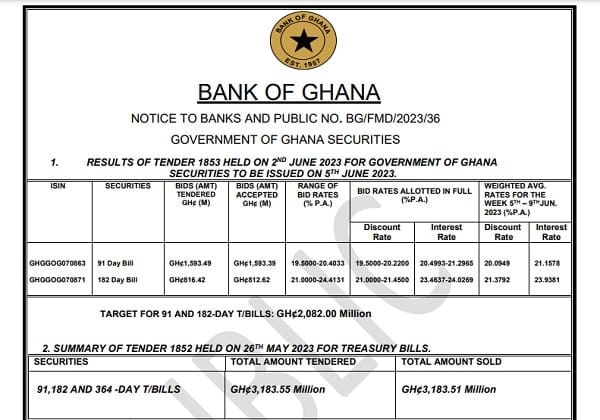
    The recent treasury bill auction held on June 2, 2023, yielded positive results as the government successfully raised an impressive sum of GH¢2.40 billion.

    This indicated an oversubscription of GH¢324.01 million from the target of GH¢2.08 billion.

    This will be the first time in four weeks that the government has surpassed its treasury bills target.

    Interest rates are still high nonetheless, increasing from 19% to almost 23%.

    The majority of the subscriptions came from the 91-day bills which received GH¢1.59 billion at an increased interest rate of 21.15%.

    The 182-day bill received bids worth GH¢816.62 million at an interest rate of 23.93%.

    The assumption was that due to the finalization of Ghana’s IMF deal, investor confidence will rise and lead to the government achieving its target or even surpassing it.

    But even after that, treasury bills were being undersubscribed.

    It is however not far-fetched to make the assertion that investor confidence is gradually being restored.

  • Ghana records 15.1% fall in interest rates since January 2023

    Ghana records 15.1% fall in interest rates since January 2023

    Ghana’s interest rates have significantly decreased by 15.1%, the largest decrease in Africa since January 2023.

    Yields on the money market were as high as 35% at the beginning of the year, but the government was compelled to cut interest rates to reduce the cost of borrowing drastically.

    This is the sharpest decline in Sub-Sahara Africa in 2023.  

    For the 91-day Treasury bill, the yield has dropped by 15.11% to 20.26%. That of the 182-day T-bill has also seen a sharp decline by 13.15% to 22.83%.

    But the yields in Ghana are still among the highest on the continent. Egypt is one of the few countries in Africa with yields higher than Ghana.

    Meanwhile, Analysts are optimistic the $710 million in loans approved by parliament will likely slow down the rise in yields on the money market.

    The Parliament of Ghana last week approved seven loans, totaling $710 million, to support critical sectors of the economy. The loans are expected to finance various government initiatives as well as facilitate the government’s bid to secure an IMF board agreement.

    At the last auction on Friday, May 5, 2023, the T-bills sale was oversubscribed, as the treasury raised ¢2.57 billion, exceeding the gross target by 40.01%.

    According to the auction by the Bank of Ghana, the government accepted a significant ¢2.56 billion from the bids submitted by the investors, largely the banks.

    Yet again, the majority of the bids came from the 91-day T-bills as ¢1.62 billion were tendered. All the bids were consequently accepted.

    Also, almost all the ¢380.75 million of bids submitted for the 182-day T-bills were accepted.

  • Interest rates likely to fall – IMF predicts

    Interest rates likely to fall – IMF predicts

    Interest rates in major economies are expected to fall to pre-pandemic levels because of low productivity and ageing populations, according to a forecast.

    The International Monetary Fund (IMF) said increases in borrowing costs are likely to be “temporary” once high inflation is brought under control.

    The Bank of England has been raising interest rates since December 2021, taking them from 0.1% to 4.25%.

    This has raised mortgage payments for many homeowners.

    Central banks in the UK, the US, Europe and other nations have been lifting interest rates to combat the rate of price rises, otherwise known as inflation.

    In the UK, inflation is at its highest for nearly 40 years because of rising energy prices and soaring food costs. A number of factors are fuelling inflation, including Russia’s invasion of Ukraine which has helped drive up energy costs.

    However, in a blog the IMF said that “recent increases in real interest rates are likely to be temporary”.

    It added “When inflation is brought back under control, advanced economies’ central banks are likely to ease monetary policy and bring real interest rates back towards pre-pandemic levels.”

    The IMF did not say, however, exactly when interest rates were set to fall back to lower levels.

    The Washington-based financial institution said ageing populations would be one factor likely to lower inflation.

    Explaining why older people affect inflation, George Godber, fund manager at Polar Capital, said that they tend to spend less.

    “The amount that you spend relative to your income is highest when you’re in your 20s, 30s and 40s – often that’s maybe young families, when you’ve got households forming, you’ve got couples coming together, they tend to spend the most when they decorate and buy a car or whatever, and you as you get older in life you slow down your consumption,” he told the BBC’s Today programme.

    “There’s less heading to Glastonbury and nights out on the town, there’s more sitting at home and watching the Antiques Roadshow, so therefore your spending patterns sort of reduce and you save more and so an ageing population tends to be disinflationary.”

    Andrew Bailey, governor of the Bank of England, said recently that in the UK, the share of adults aged between 20 and 59 years-old has fallen to below 65% in the past decade “and it is set to decline further in the coming years”.

    He said that this has been driven by a decline in birth rates as well as people living for longer.

    The IMF also said low productivity – the measure of how many goods and services are produced – would bring inflation down.

    In a speech last month, Mr Bailey said that prior to the financial crisis in 2008, UK productivity had been boosted by the country’s manufacturing sector.

    “But following the financial crisis, manufacturing productivity growth fell back sharply. This fall in manufacturing productivity is the main cause of the slowdown,” he said.

    Just prior to the Covid pandemic, the UK’s interest rate was 0.75% but the Bank of England cut it twice in March 2020 to 0.1% as the country entered lockdown.

    The rate of inflation has risen steadily over the past couple of years and hit 10.4% in February – more than five times higher than the Bank of England’s 2% target.

    Following the decision to raise UK interest rates again in March, the Bank of England said that it expected inflation “to fall sharply over the rest of the year”.

    This is due to the government’s continuing help with household heating bills through the Energy Price Guarantee scheme as well as falling wholesale gas prices.

    However, Mr Bailey declined to say whether he believed that interest rates had reached a peak.

  • Australia raises interest rates, worsening mortgage woes

    The Reserve Bank of Australia (RBA) has raised interest rates to a decade high, putting mortgage holders under even more strain as it seeks to calm soaring prices.

    The RBA raised the benchmark rate, which determines how much commercial banks charge for loans, by a quarter percentage point to 3.1 percent on Tuesday.

    The increase, combined with six previous increases since May, adds more than $1,000 Australian dollars ($672) to the monthly cost of an average mortgage.

    The move follows a smaller-than-expected quarter-percentage-point increase in October, which deviated from counterparts such as the United States Federal Reserve’s aggressive stance.

    According to RBA Governor Philip Lowe, inflation remains too high at 6.9 percent, far above the target range of 2-3 percent.

    “Global factors explain much of this high inflation, but strong domestic demand relative to the ability of the economy to meet that demand is also playing a role,” Lowe said in a statement.

    Lowe said he expected inflation to rise to 8 percent during the final quarter before easing next year.

    “The board expects to increase interest rates further over the period ahead, but it is not on a pre-set course,” he said. “It is closely monitoring the global economy, household spending and wage and price-setting behaviour.”

    He added that the central bank remains “resolute in its determination to return inflation to target” and will do “what is necessary to achieve that”.

    The RBA noted that the labour market remains tight, with unemployment at 3.4 percent in October — the lowest since 1974 — and many firms struggling to hire workers.

    Still, there are signs the rate hikes are already cooling the economy.

    Australia’s inflation slowed to 6.9 percent in October, while home prices fell for a seventh straight month in November, a drag on household wealth that could curb consumer confidence and consumption over the months ahead.
  • Interest rates in the United States have risen to a new 14-year high

    The US Federal Reserve has approved another sharp increase in interest rates as it struggles to contain rapidly rising prices.

    The Federal Reserve announced a 0.75 percentage point increase in its key interest rate, bringing it to its highest level since early 2008.

    The bank believes that raising borrowing costs will cool the economy and reduce price inflation.

    However, critics are concerned that the moves will precipitate a severe downturn.

    The latest increase takes the bank’s benchmark lending rate to 3.75% – 4%, a range which is the highest since January 2008.

    Many other countries are moving along with the US to raise borrowing costs, as they grapple with their own inflation problems.

    In the UK, the Bank of England started raising rates last year but has so far opted for smaller hikes than the Fed. The Bank of England is expected to announce its own 0.75 percentage point hike on Thursday – the biggest such move since 1989.

    The sharp rise in borrowing costs has already started to cool some parts of the economy, such as housing.

    But economists say more economic slowdown is necessary if inflation is to return to the 2% level considered healthy.

    “There is always the hope of painless, immaculate disinflation,” said economist Willem Buiter, a former member of the Monetary Policy Committee of the Bank of England who is now an independent economic advisor. “Unfortunately there are very few historical episodes that fit that picture”.

    “This is not going to be a pleasant year,” he added.

    The Fed has been raising interest rates since March, steering borrowing costs higher at the fastest pace in decades.

    Federal Reserve chairman Jerome Powell warned that rates were likely to move up again.

    “We still have some ways to go and incoming data since our last meeting suggest that the ultimate level of interest rates will be higher than previously expected,” he said at a press conference following the announcement.

    “We will stay the course until the job is done,” Mr Powell added.

    Inflation – the rate at which prices rise – hit 8.2% in the US last month, continuing to fall after reaching 9.1% in June – the highest rate since 1981.

    A decline in energy prices has helped ease the pressures, but the cost of groceries, medical bills, and many other items is still rising.

  • After the decline of the pound, the bank will “not hesitate” to boost interest rates

    The pound hit a record low versus the US dollar, prompting the Bank of England to declare that it will “not hesitate” to raise interest rates in order to combat inflation.

    The Bank stated that it was “closely monitoring developments” and will decide on any course of action in November.

    Its statement came after the Treasury said it would publish a plan to tackle debt in a bid to reassure investors.

    In Asia currency market trade on Tuesday, the pound rose by more than 1% to top $1.08.

    On Monday, some UK lenders said that they were halting new mortgage deals.

    Halifax, the UK’s largest mortgage lender, said it would temporarily withdraw all mortgage products that come with a fee due to the market volatility.

    Virgin Money and Skipton Building Society have also stopped offering mortgage products to new customers.

    Experts said a rise in the cost of long-term borrowing due to the market turmoil meant the cost to lenders of offering new mortgage deals was too expensive.

    Sterling fell to an all-time low earlier against the US dollar after Chancellor Kwasi Kwarteng pledged further tax cuts at the weekend on top of Friday’s mini-budget where he announced the biggest tax cuts in 50 years.

    The pound had been sliding as global markets reacted to the sharp increase in government borrowing required to fund the cuts.

    A weak pound makes it more expensive to buy imported goods and risks pushing up the rising cost of living even further. Imports of commodities priced in dollars, including oil and gas, are also more expensive.

    UK inflation, the rate at which prices rise, is already rising at its fastest rate for 40 years.

    Some economists had predicted the Bank of England would call an emergency meeting in the coming days to raise interest rates in a bid to stem the fall, as well as calm rising prices.

    But the Bank of England instead said it was “monitoring developments in financial markets very closely” and would make a full assessment at its next meeting on 3 November.

    Investors are now predicting that interest rates could more than double by next spring to 5.8% from their current 2.25%, to curb high inflation, which is expected to be fuelled by the huge tax cuts announced in Friday’s mini-budget.

    ‘Not affordable’

    Samuel Tombs, chief UK economist at Pantheon Macroeconomics, said if interest rates rise as predicted, the average household refinancing a two-year fixed rate mortgage in the first half of next year would see monthly payments jump to £1,490 from £863.

    “Many simply won’t be able to afford this,” he said.

    A late afternoon double dose of attempted reassurance – firstly from the Treasury, and then from the Bank of England.

    What’s new from the Treasury is a timeline with dates attached. There will be a series of statements from various cabinet ministers about ideas we heard about on Friday.

    And then in just under two months, a parliamentary moment. What’s being described as the “Medium Term Fiscal Plan” – and the Office for Budget Responsibility’s number crunching.

    In short, what the Treasury is attempting to say is this: don’t panic, we know what we’re doing.

    Well, let’s see what the markets do next.

    The market volatility following Mr Kwarteng’s mini-budget has also been linked in part to the government’s decision not to publish a forecast of expected UK growth and government borrowing from independent forecaster the Office for Budget Responsibility.

    Martin Weale, Professor of Economics at King’s College London and former member of the Bank of England’s Monetary Policy Committee, which votes on interest rates, told BBC Radio 4’s PM programme that people “are concerned that the government has no plan for bringing the national debt under control.”

    “Sterling has fallen because market traders have been frightened by the government’s policies, and I think they got further frightened by the sense over the weekend that this was only the first installment of some tax cuts.”

    But Lord David Frost, Conservative peer and former chief Brexit negotiator, said the reaction on global markets was “an overreaction”.

    “I don’t think anything has gone wrong, actually, Liz Truss promised change, a different economic approach to get us back to growth and away from stagnation.”

    He said as part of this change in approach, interest rates would rise and the government would need to provide additional support via tax cuts, and whilst it would need to reduce spending medium term, the details of that would come in November.

    The government said its financial plan set for 23 November would include full growth and borrowing forecasts from the Office for Budget Responsibility.

    It also pledged to set out further details on the government’s spending rules, including how it will try to decrease debt.

    Paul Dales, the chief UK economist at Capital Economics, said given the pound had fallen back since the statements from the Bank and the Treasury the markets “may well need more reassurance and some actual action”, saying a change in policy from the government or an interest rate hike from the Bank at an emergency meeting before 3 November may be necessary.

  • Bank of England: Reactions to Bank’s announcement

    The increase in interest rates to 2.25% has, as expected, sparked a lot of debate in both the corporate and political spheres.

    The Liberal Democrats have weighed in despite Downing Street’s refusal to speak on the topic, claiming it is “a matter for the independent Bank of England.”

    ‘Homeowners are being punished’

    The party’s Treasury spokeswoman Sarah Olney said the interest rate rise would be a “hammer blow to struggling homeowners who are being punished by the government’s failure to control inflation”.

    “This monster rate rise could have been avoided if Conservative ministers bothered to take action sooner on energy bills and the rising cost of living,” she added.

    ‘This will dampen consumer confidence’

    There was sympathy from the British Chambers of Commerce, which said the Bank faced “an increasingly tricky balancing act”.

    “The interest rate is a very blunt instrument to control inflationary pressures that are largely driven by rocketing energy costs and global supply chain disruption,” said its head of research David Bharier

    “The Bank’s decision to raise rates will increase the risk for individuals and organizations exposed to debt burdens and rising mortgage costs – dampening consumer confidence.”

    ‘Fiscal statement must get firms investing’

    Never mind today’s news – companies are already looking ahead to tomorrow’s mini-budget, says the Confederation of British Industry.

    “Against the backdrop of stubbornly high inflation, another hefty rise in interest rates was largely expected,” said lead economist Alpesh Paleja.

    “With signs of an economic downturn coming down the track, firms will be looking to the fiscal statement to help perk up confidence and get more firms investing and growing.”

    Source: Sky news