Apple will let people in the EU use different app stores on their Apple devices from March.
Right now, people with an iPhone or iPad can only get apps from the company’s App Store.
Apple says its rules keep users safe.
However, some people say that it unfairly controls the market, forces customers and developers to use only its services, and charges developers a fee of up to 30%.
This means that if developers don’t follow Apple’s rules or don’t want to pay fees, they can’t reach the millions of people who use Apple products.
The UK will not make the changes right now. But they are working on a new law that might make Apple follow the same rules.
Epic, the company that makes Fortnite, took their popular game off the App Store because they didn’t agree with the store’s rules. You can’t find it on the App Store since 2020, but you can still play it on the internet.
In theory, this change could allow iPhone users in Europe to download the Fortnite app from a different app store.
The change happens as the EU’s Digital Markets Act starts working. The new law is meant to make sure big companies that control things like search engines and app stores play fair and don’t give unfair advantages to smaller businesses.
Apple also said it will let people in the EU choose a different web browser instead of using Safari when they first open it.
However, it said that even though it was making strict rules for new apps and stores, it thought that this might make it easier for customers to be at risk of getting viruses, scams, and fraud from apps from other places.
“Today, we are making changes to follow the rules of the Digital Markets Act in the European Union. This will help keep EU users safe from privacy and security risks that come with this regulation,” Apple stated.
The big US tech company sells expensive products and says they provide extra security.
Android apps can now be found in more different stores. However, malware is more common on Android devices than on Apple ones.
The new EU rules and UK proposals both aim to keep markets open and fair so that many companies can do well and compete with each other.
Tag: iPhones
-

Apple to permit competing app shops on iPhones in EU
-
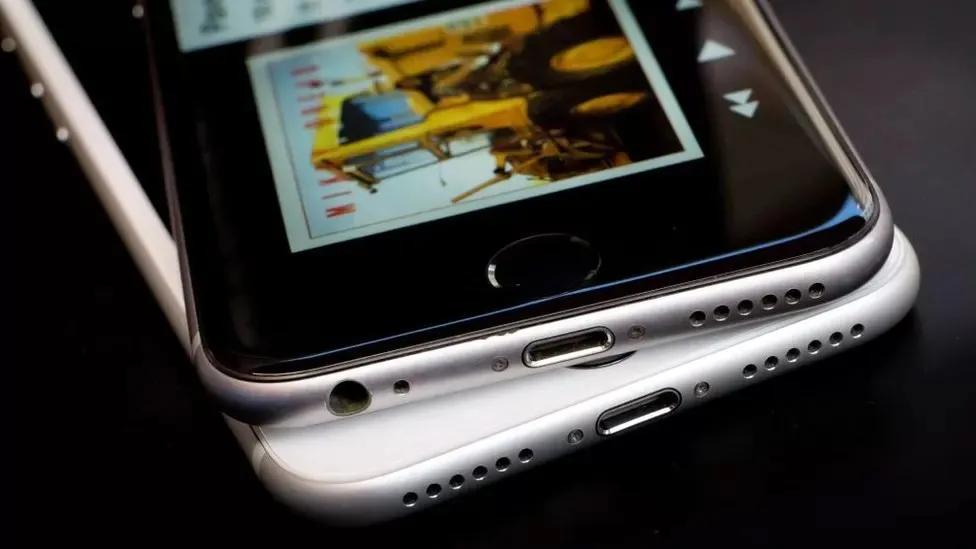
Apple settles lawsuits alleging it purposefully slowed down iPhones
Apple has started paying money for a lawsuit about slowing down some iPhones in the US.
People who made complaints will get a share of a $500 million (£394 million) agreement, which comes out to about $92 per claim.
In 2020, Apple agreed to end the lawsuit. They said they didn’t do anything wrong but they didn’t want to keep spending money on the court case.
In the UK, there is another case trying to get £1. 6bn in money as compensation.
In December 2017, Apple admitted that they intentionally made some iPhones run slower as they got older, which confirmed what many people had suspected for a long time.
It was mentioned that as batteries got older, they didn’t work as well, which made the phones last longer.
However, Apple was accused of slowing down the performance of some iPhones without informing its customers. This caused a lot of anger, so Apple offered a discounted battery replacement to solve the problem.
It caused the US to take legal action. At first, they thought people might get $25 each, but now it looks like they might get about $100 each.
Apple tried to stop a big lawsuit in the UK last November, but they did not win.
Justin Gutmann brought a case in June 2022 that involves about 24 million people who use iPhones.
Apple said the lawsuit is not true and they would never do anything to purposely make their products stop working or give a bad experience to customers just to make them buy new products.
Unlike the US agreement, which only covered iPhone 6 and 7, the UK lawsuit also includes people who had iPhone 8, 8 Plus and X and is asking for money for them. -
BOST buys iPhones worth GHS284,400 for 18 top executives
Bulk Energy Storage and Transportation Limited Company (BOST) has issued a clarification regarding the cost of acquiring 18 iPhones in May 2022, following reports circulating in certain media outlets.
In a statement dated September 30, 2023, BOST confirmed the purchase of the specified number of iPhones but emphasized that the figure mentioned in the trending document was significantly inaccurate compared to the actual expenditure.
The reported amount of over 28.5 million cedis was deemed “both erroneous and mischievous.” Instead, the accurate sum paid amounted to 234,000 cedis, which subsequently increased to GHC285,412.00 after accounting for taxes.
This means that each individual phone was acquired at a rate exceeding 15,800 cedis. BOST further emphasized that the transaction underwent the requisite tender processes and has been officially approved as above board in official audit reports.
“The amount is captured in the financial reports of the company and the Auditor General who audits the company, at least over the past three years, vetted the decision and the value and made no adverse findings about same,” the statement added.
It also clarified the reasons for which the specific quality and brand of phones were bought, among others;
“The reason for the purchase of the devices was to equip the team to stay in touch with the management information and business intelligence systems of the company for efficient decision making.
“In the petroleum storage and transportation space, a split second can make the difference between success and failure. The results so far attest to the efficiency of the systems put in place which includes the access points for key members of the team to access processed information for efficient decision making,” it added.
FOR IMMEDIATE RELEASE RE: BOST BUYS EIGHTEEN (18) IPHONES AT TWENTY-EIGHT MILLION GHANACEDIS (GHS28 MILLION)
Accra-September 30, 2023-The Bulk Energy Storage and Transportation Limited Company has noted with dismay a section of a procurement report making rounds in the traditional and social media space claiming the company bought 18 iPhones at a cost of Twenty-Eight Million, Five Hundred and Forty-One Thousand, Two Hundred and Sixty-One Ghana Cedis (GHS28,541,261.00) for some critical officers of the company.
We would like to respond to the misinformation as follows:
1. The company bought eighteen (18) pieces of iPhone 13 Pro Max phones for our corporate executives in May 2022.
2. The total cost of the phones stood at Two Hundred and Thirty-Four Thousand Ghana Cedis (234,000.00) grossed up for taxes at Two Hundred and Eighty-Five Thousand, Four Hundred and Twelve Ghana Cedis, Sixteen Pesewas (GHS285,412.16).
3. The amount is captured in the financial reports of the company and the Auditor General who audits the company, at least over the past three years, vetted the decision and the value and made no adverse findings about same.
4. The reason for the purchase of the devices was to equip the team to stay in touch with the management information and business intelligence systems of the company for efficient decision making.
In the petroleum storage and transportation space, a split second can make the difference between success and failure. The results so far attest to the efficiency of the systems put in place which includes the access points for key members of the team to access processed information for efficient decision making.
5. The Twenty-Eight Million, Five Hundred and Forty-One Thousand, Two Hundred and Sixty-One Ghana Cedis (GHS28,541,261.00) in the report may be due to a typographical error of placing the dot(.) two steps to the right which on the face of the document converted the GHS285,412.61 to GHS28,541,261.00
6. The public is hereby entreated to ignore the claim that the company bought eighteen (18) phones at 28 million. It is both erroneous and mischievous.
7. The information is available on the website of the Public Procurement Authority through the link below https://tenders.ppa.gov.gh/contracts/12301
8. We would urge our stakeholders who stumble upon bits and pieces of information on the company to reach out to the Corporate Communications Department for any clarification before proceeding to make such statements which in the end could amount to misleading the public. This is unpardonable in a right to information regime where Ministries, Departments and Agencies, MDAs, are by law required to provide information stakeholders may require for their purposes.
9. May God bless our homeland Ghana
-
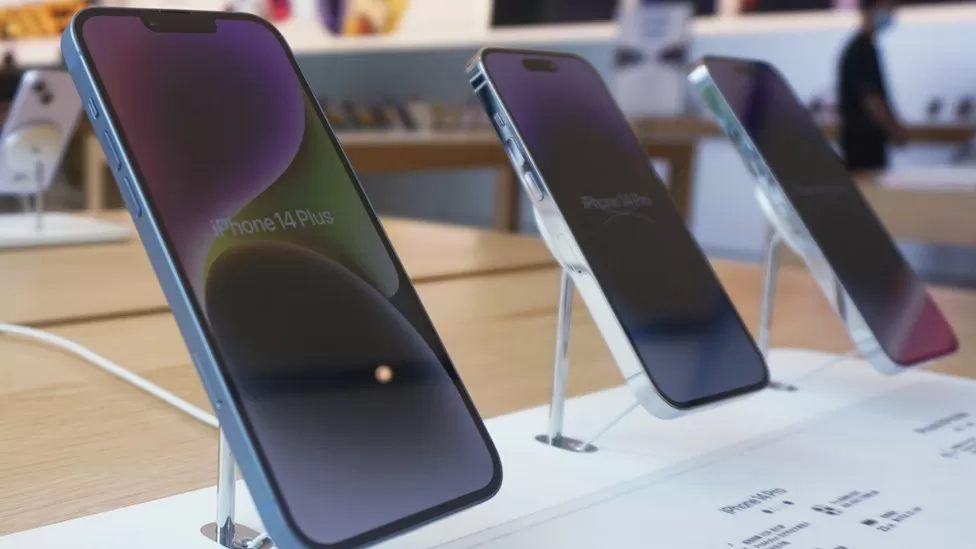
Apple shares decline following news of iPhone ban in China
Apple’s stock has gone down for two consecutive days due to news that Chinese government employees are not allowed to use iPhones.
The value of the company’s stocks in the stock market has decreased by more than 6%, which is almost $200 billion or £160 billion, in the last two days.
China is the third-biggest market for the technology giant. It made up 18% of the total money the company earned last year.
Most of Apple’s products are made in China by its largest supplier Foxconn.
The Wall Street Journal recently said that officials working for the Chinese government have been told not to bring iPhones to work or use them for their job.
The next day, Bloomberg News said that the ban may also apply to employees working at businesses owned by the government or supported by the government.
According to sources, officials were told not to use iPhones by their bosses recently. Other devices from foreign brands also had limitations placed on them.
Some agencies had already banned iPhones, according to the paper. But now, it seems like more agencies have decided to ban them as well.
It is unclear how well the instructions were shared with Chinese officials.
The reports were shared before the iPhone 15 is released on September 12th.
On Chinese social media, some individuals claiming to work for government-owned companies said they were instructed to stop using Apple devices before September ends. Someone made a joke that they were poor and could not afford to buy a new phone. They wondered what they should use for work.
China is a very important country for Apple, and they make iPhones there. But now Apple is also making more iPhones in India.
The Chinese government has not made an official statement in reply to the reports.
Apple did not quickly reply to the BBC’s request for a comment.Knock-on effect means that when one thing happens, it can cause other things to happen as a result.
Apple is the most valuable company in the world, worth about $2. 8 trillion on the stock market.
In addition to Apple’s stock dropping, the stocks of some companies that supply Apple were also affected.
Qualcomm, the largest provider of smartphone chips, went down by over 7% on Thursday, while SK Hynix, a company from South Korea, saw its shares decrease by around 4% on Friday.
Tensions between the United States and China about technology have been increasing steadily, with both sides putting limitations.
This year, the countries Washington, Japan, and the Netherlands made it harder for China to get certain chip technology.
China responded by limiting the amount of two important materials used in the semiconductor industry that they would export.
Beijing is getting ready to create a new investment fund worth $40 billion to help strengthen its chip manufacturing industry.
Last week, when the US Commerce Secretary Gina Raimondo was in Beijing, the Chinese tech company Huawei surprised everyone by revealing its new Mate 60 Pro smartphone.
On Friday, the company started selling the Pro+ version of the phone in advance.
The company TechInsights from Canada said that the phone has a new processor called 5G Kirin 9000s. This processor was made specifically for Huawei by China’s biggest chip-making company called SMIC.
TechInsights analyst Dan Hutcheson said that it shows how much China’s semiconductor industry has improved in terms of technology.
Investment firm Jefferies stated in a research note that this is a significant technological advancement for China.
This week, a US congressman named Mike Gallagher, who is in charge of a group in the House of Representatives that deals with China, asked the Commerce Department to put more limits on sending products to Huawei and SMIC.
Security update means making changes or improvements to protect a computer system or network from threats or attacks.
On Thursday, Apple came out with an urgent software update for many older and newer devices.This was because they found a security problem that unknown hackers were taking advantage of.
The update was released because some experts found that hackers were breaking into Apple devices using a new and unknown method.
Apple also discovered a similar vulnerability on its own, so it quickly released updates to improve security for its customers.
This is the 15th time this year that Apple has had to release big security updates. -
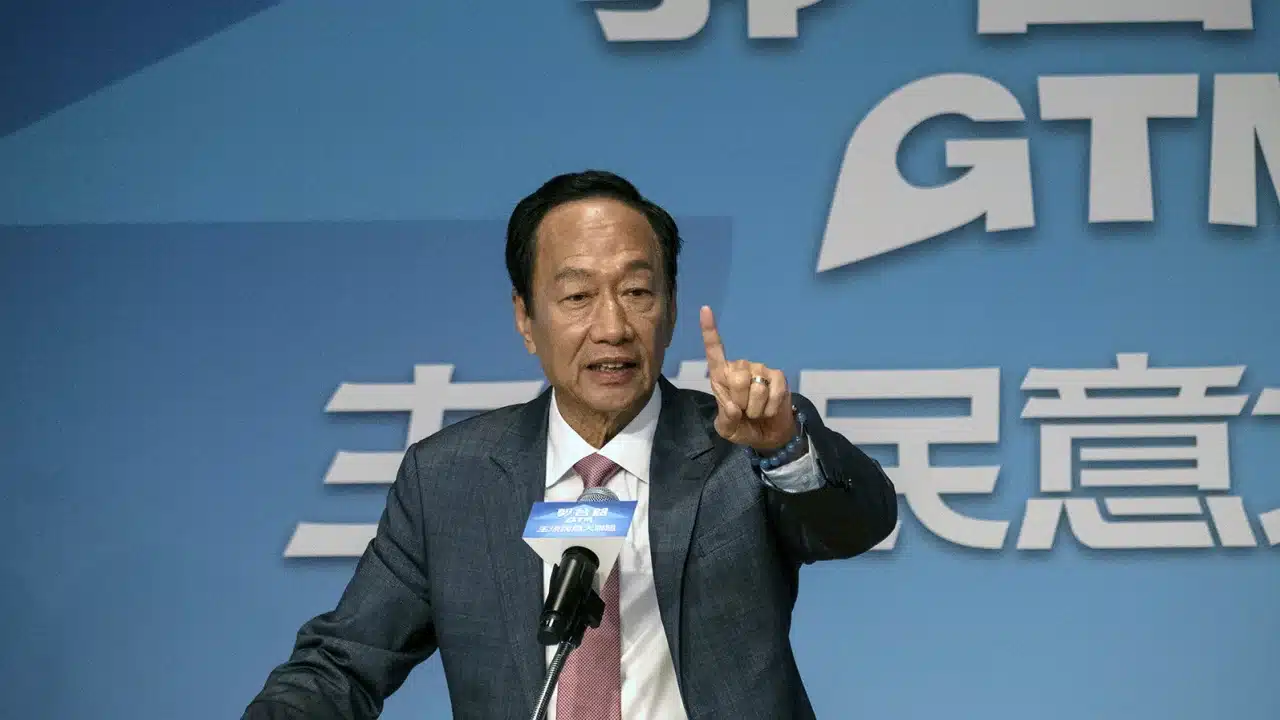
iPhone CEO’s decision to run for president shakes up Taiwan’s election campaign
A billionaire who made his own wealth and is in his seventies, and has little experience in politics, has decided to join one of the most important presidential elections of 2024. This has caused a big change in the race, which could have significant effects even outside the country.
Terry Gou, the person who started the biggest company that makes iPhones called Foxconn, said on Monday that he wants to be the president of Taiwan again. A lot of other people who like China are already running for president, but Terry Gou wants to challenge the Democratic Progressive Party (DPP), who want Taiwan to be separate from China.
Tsai Ing-wen is the current president, but she can’t run for another term because there is a limit. The DPP has been in power for eight years under her leadership. If the party wins for a third time, it would be something that has never happened before in the 27 years of democracy on the island.
The upcoming election, scheduled for January, is happening at a tense time between Taiwan, an island with 24 million people, and China, a powerful neighboring country. China believes that Taiwan is its rightful territory and is willing to use force if needed to take control.
Tensions are very high between China and an island because China’s leader, Xi Jinping, is sending more and more warships and fighter jets to the island, making people worried.
Many people are increasingly worried about the possibility of China attacking another country, especially after Russia invaded Ukraine. Despite this, China has refused to criticize Russia and has actually become closer to them.
There hasn’t been such a big possibility of a conflict during a Taiwan election since 1996. Back then, China shot missiles at Taiwan to scare voters from supporting a candidate who wanted Taiwan to be separate from China. That decision ended up going very wrong, but the candidate still won.
With the increasing possibility of an invasion, Taiwan’s foreign policy, particularly its relationship with China, has become a major concern in the presidential race. This is in addition to other important topics like the economy and the rising cost of living.
Candidates who are against the ruling party, including Gou, criticize the DPP for causing problems with Beijing and increasing disagreements. They say that this election is a decision between wanting conflict or wanting harmony.
Meanwhile, the DPP’s candidate, Vice President Lai Ching-te, has described the election as a decision between a government that values people’s freedom and a government That is run by a single ruler with strict control over everything.
Don’t let fear or the higher risk of authoritarianism make you give up or go backwards. He said that we have to be brave and strong in order to keep developing Taiwan’s democracy. He said this while he was traveling through the United States last month, even though Beijing criticized the trip.
Lai is a politician who used to be a doctor and went to Harvard. He belongs to a group in the DPP called “deep green,” which supports independence more openly.This has made him a problem for Beijing, who often criticized him as a “separatist” and “troublemaker. ” In 2017, Lai angered Chinese officials by describing himself as someone who works practically towards Taiwan’s independence.
Since Lai became the DPP nominee, he has changed his opinions and now supports maintaining the current state of relations between the two sides of the Taiwan Strait. This choice has been favored by most people according to opinion polls, although the younger generation on the island is increasingly supporting complete freedom from China.
Gou needs to gather around 290,000 signatures by November so he can be a candidate on the ballot. In the past few months, he has organized events similar to political campaigns all over Taiwan to gain support for his bid.
His campaign is focused on one main idea: in order to prevent a war with China, the DPP needs to be removed from power.
Gou is proud of his many years of experience in dealing with Chinese officials. He believes that Taiwan should follow a “one-China framework” and begin discussions with Beijing right away.
He became successful in his business because there was improvement in the relationship between Taiwan and China.
Foxconn started its first factory in Shenzhen in 1988. It has been really important for China’s changes and growth because it brought new businesses, money, and technology to China’s young economy. The big electronics company now has large factories that hire many people in different parts of China.
Gou’s successful business empire in Taiwan has made him extremely wealthy, with a net worth of approximately US$7 billion. This has also boosted his confidence to make significant commitments.
Gou announced on Monday that he plans to run for office. He promises to make Taiwan’s economy grow faster and avoid the same problems as Ukraine.
“He said that if you give me four years, I guarantee to bring 50 years of peace to the Taiwan Strait. ”
This is a strong statement to make, especially for a businessman who has previously had good relations with China’s ruling Communist Party. Gou is the only person who has met and greeted Xi by shaking hands. In 2014, the Chinese leader welcomed him at the Diaoyutai State Guesthouse when he visited Beijing.
However, some people think that because Foxconn has invested a lot of money in China, Gou may be influenced by China’s demands. Gou has strongly denied this idea.
Gou said that if the Chinese Communist Party threatened to take away Foxconn’s assets if people didn’t obey them, he would agree with them and ask them to go ahead and do it.
He quit being the leader of Foxconn in 2019 to concentrate on attempting to become president, but gave up when he didn’t receive the nomination from Kuomintang (KMT), Taiwan’s main opposing party.
After the KMT rejected Gou for the second time this year, he has decided to participate in the election as an independent candidate. This has caused conflict among the opposition, as there are already two candidates who support having stronger and more stable relations with Beijing.
Hou Yu-ih, the mayor of New Taipei City, is the selected candidate of the KMT political party. Ko Wen-je, a popular ex-mayor of Taipei, is participating in the election under the Taiwan People’s Party.
The KMT is very sorry about Gou’s bid and wants him to support Hou. They are worried that if Gou runs, it will divide the votes of people who are friendly to Beijing.
However, Gou has supported his choice by portraying himself as the only person capable of bringing together the divided opposition against Lai, who is currently ahead in the polls.
“I want to bring together the opposition group,” he said on Monday, asking Hou and Ko to meet and talk about the best plan to beat DPP.
According to Wen-Ti Sung, a political scientist from the Taiwan Studies Program at Australia National University, in the near future, Gou is expected to split the votes of opposing parties which will make things easier for Lai.
Sung warned that it is difficult to predict the long-term effects.
Gou’s dream is to make the other two opponents either quit or support him, so he can be the only person challenging Lai. However, very few experts in Taiwan think that this is a realistic idea.
After Gou announced his decision, Hou, the KMT candidate, told reporters that he still wants to be president and is focused on doing what the party wants him to do.
Ko’s party said it understands that Gou has the right to run for office, but they are focusing on Ko’s campaign.
Apart from getting 290,000 votes by November, Gou also has to announce his running mate before September 17, as per Taiwan’s Central Election Commission rules.
“Gou is in a hurry, and time is not on his side,” Sung explained. -
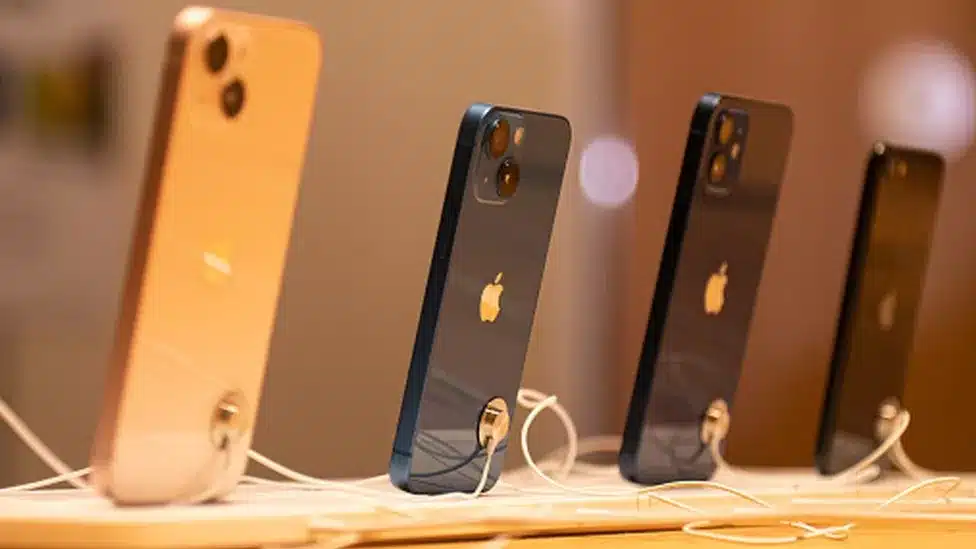
Foxconn to manufacture iPhones in India by 2024
Apple’s major supplier, Foxconn, is set to commence iPhone manufacturing in the southern Indian state of Karnataka by April of next year.
According to the state government, the project is expected to generate approximately 50,000 job opportunities.
Foxconn, based in Taiwan, is responsible for manufacturing the majority of Apple’s iPhones. Since 2017, the company has been producing older iPhone models at a facility located in the neighboring state of Tamil Nadu.
Recently, Foxconn acquired 1.2 million square meters of land near Bengaluru city in Karnataka, signaling its expansion plans. Bloomberg reported that the company intends to invest $700 million in a new factory in the state. However, the Karnataka government stated that the overall value of the project amounts to $1.59 billion.
The government announcement mentioned that the land for the factory would be handed over to Foxconn by July 1. The Reuters report stated that Foxconn aims to manufacture 20 million iPhones annually at the Karnataka plant.
Apple’s decision to diversify its supply chains and manufacture its flagship model in India is part of its strategy to reduce reliance on China amid increasing trade tensions between Beijing and Washington.
While most iPhones are currently made in China, Apple has been assembling some models in India through various suppliers, including Foxconn. However, India accounts for only 5% of total iPhone production.
Apple has faced challenges in the Indian market due to strong competition from more affordable South Korean and Chinese smartphones. In a bid to strengthen its presence in India, Apple CEO Tim Cook inaugurated the country’s first two Apple stores during his visit in April.
-

Sales of Apple have fallen the most since 2019
Apple sales decreased at the end of 2022 as consumers made less purchases due to the pressure of the rising cost of living.
In the three months leading up to December, sales at the industry giant for the iPhone decreased by 5% from the corresponding time in 2021.
The fall was worse than anticipated and the largest since 2019.
The announcement of the update coincided with widespread warnings from businesses of a sudden slowdown in the economy, particularly in the computer industry, which experienced a boom during the pandemic.
Apple boss Tim Cook said the firm was navigating a “challenging environment”.
He blamed the sales decline on supply shortages due to Covid-19 disruption in China – where its phones are manufactured – and a strong dollar, as well as wider economic weakness stemming from rising prices, the war in Ukraine and lingering effects from the pandemic.
“As the world continues to face unprecedented circumstances … we know Apple is not immune to it,” he said on a conference call with investors.
Apple said the sales declines occurred throughout the world and hit most of its products.
Sales of its popular iPhones were down more than eight per cent, and sales of Mac computers dropped 29 per cent.
The declines hit the firm’s profits, which fell 13 per cent to $30bn (£24bn).
Paolo Pescatore, analyst at PP Foresight, said the firm, like many electronics makers, is struggling to make the case that users should upgrade given “what is perceived to be incremental improvements on previous models”.
“More so when everyone is tightening their belts,” he added.
Globally the number of smartphones shipped sank 12 per cent last year, according to market analysis firm Canalys.
Apple executives said they expected their services business, which includes Apple Pay and Apple News, to continue to drive growth, noting that there are now more than 2 billion active Apple devices around the world.
“When we look at the behaviour of our installed base, we think it’s very promising,” said chief financial officer Luca Maestri, while warning investors that the firm was expecting sales to continue to decline in the months ahead.
Other big tech companies also said they were feeling pressure in updates to investors.
Amazon, which has been struggling to re-ignite its e-commerce business, said sales at its online stores dropped 2% in the final three months of 2022, compared with a year earlier.
Overall, Amazon’s sales in the three month period rose nine per cent to $149.2bn (£121bn), lifted by stronger growth in its cloud computing business.
But its profits dropped sharply, falling to near zero from $14.3bn (£11bn) a year ago, a change that chief financial officer Brian Olsavsky warned investors was likely to continue in coming months.
At Alphabet, parent company of Google and YouTube, sales were up just one per cent in the three months to December, compared with 2021, as firms cut back on advertising – the company’s main source of revenue – in the face of economic uncertainty.
-
Foxconn: Apple invests in Lordstown Motors, an electric truck company
Foxconn, which manufactures iPhones for Apple, says it is increasing its investment in a US electric pick-up truck company that could compete with Tesla’s Cybertruck.
The technology behemoth is investing up to $170 million (£147.8 million) in the loss-making start-up Lordstown Motors.
The large cash infusion comes as the company plans to increase production of its first model, the Endurance.
Lordstown recently began production of the vehicle at a former GM plant in the US state of Ohio.
The world’s largest contract manufacturer of electronics purchased a more than 18% stake in Lordstown, making it the company’s largest investor.
“Since announcing our first transaction with Foxconn more than a year ago, it has been our objective to develop a broad strategic partnership that leverages the capabilities of both companies,” Lordstown’s executive chairman Daniel Ninivaggi said.
“Foxconn’s latest investment is another step in that direction,” he added.
The two companies also said they would jointly develop an electric vehicle together, although they did not give further details of the plan.
The tie-up came after the world’s biggest electric carmaker Tesla, which is owned by multi-billionaire Elon Musk, was earlier this month reported by the Reuters news agency to be planning to start mass production of its Cybertruck at the end of 2023.
That would be two years after the original target for the highly-anticipated pick-up truck that Mr Musk unveiled in 2019.
Taiwan-based Foxconn’s investment is the latest cash injection into Lordstown as it continues to run at a loss.
Separately on Monday, figures for the three months to the end of September showed a net loss of $154.4m, wider than the $95.8m loss the company reported for the same time last year.
Shares in Lordstown rose by almost 18% in extended trading in New York after the announcements.
Last week Foxconn agreed a deal with Saudi Arabia’s sovereign wealth fund to produce electric vehicles in the kingdom.
The joint venture will operate under the brand name Ceer, which sounds like the Arabic word for “drive”.
Ceer will license technology from Germany’s BMW and aims to start selling its electric vehicles from 2025.
The deal is part of Saudi Arabia’s push to move its economy away from its dependence on fossil fuels.
Last month Foxconn’s chairman Liu Young-way said he hopes the company will one day make cars for Tesla as it ramps up electric vehicle manufacturing operation.
Speaking at the company’s annual Tech Day, he said the firm aimed to replicate its success in manufacturing consumer devices as it expands into making electric vehicles for major motor industry brands. -
Brazil bans sales of iPhones without USB power adapters
Brazil says it is banning the sale of iPhones which do not include a power adapter.
In a statement on Tuesday, Brazil’s Ministry of Justice and Public Security said it has fined Apple 12.275 million reais (£2.04m).
Brazilian consumer agency Senacon said Apple’s decision not to include power adapters with new iPhones discriminates against consumers by selling an “incomplete product”.
Apple will appeal against the ban.
The company told Reuters in a statement it would work with Brazilian authorities to “resolve their concerns,” but added it has previously won several court rulings in Brazil on the issue.
“We are confident that our customers are aware of the various options for charging and connecting their devices,” Apple said.
The fine and ban on sales of iPhones without USB power adapters was announced a day before Apple showcased its new iPhone 14, 14 Pro and Apple Watch Ultra.
São Paulo’s consumer protection agency fined Apple £2m last year, saying the sale of iPhone 12 and every model since then, violates consumer law because they don’t come with chargers.
Pulling the plug
Apple stopped including power adapters and headphones in iPhone boxes with the launch of iPhone 12 in 2020.
It said the move, which came after first ditching power adapters from new Apple Watch boxes, would help reduce Apple’s carbon footprint, by making packaging smaller.
“Sometimes it’s not what we make, but what we don’t make that counts,” said Lisa Jackson, Apple’s vice-president of environment, policy and social initiatives, at Apple’s 2020 September keynote.
She added there were already more than two billion official Apple power adapters out in the world.
Senacon, which launched its case against the move last year, said Apple’s arguments for removing USB power adapters from iPhone boxes on sustainability grounds were “not enough”.
It said there was no evidence that removing chargers had environmental benefits.
According to Brazil’s Justice Ministry, Senacon said the company could have considered alternatives to reducing its environmental impact that would not place the burden on consumers – such as adopting USB-C cables and chargers to reduce e-waste.
The European Union provisionally agreed on plans to enforce a common USB-C charging cable for portable electronic devices earlier this year.
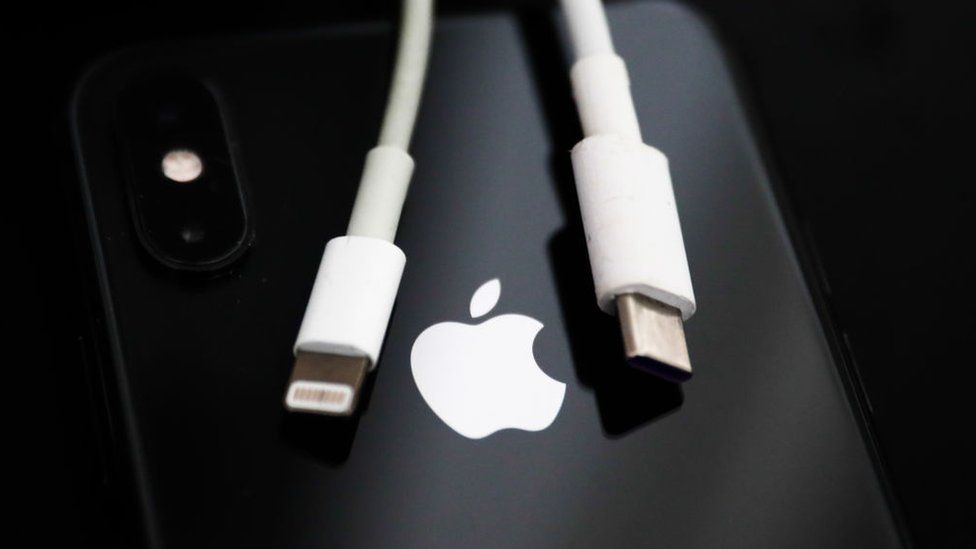
Image caption, Apple has been criticised for exclusive charging products like the iPhone lightning cable
‘Incomplete product’
Senacon also said the sale of new iPhones without power adapters was an example of Apple effectively forcing consumers to buy a second product after purchasing a new iPhone.
It said a power adapter should form part of the product because it is required to operate the phone and is an “incomplete product” without it.
The organisation added the move has transferred responsibility to third-party providers, as well as consumers, because iPhones without power adapters have not fallen in price.
Source: BBC
-
Apple shipped 2.5 million iPhones in China in March following virus slump
Apple Inc (AAPL.O) shipped roughly 2.5 million iPhones in China in March, a slight rebound after one of its worst months in the country ever, according to government data published on Friday.
Smartphone companies are hoping for a strong recovery in demand in China, where the deadly coronavirus is subsiding, just as it spreads overseas and looks set to trigger a global recession.
Mobile phone shipments in China in March totalled 21 million units, according to data from the China Academy of Information and Communications Technology (CAICT), a government think tank.
That was a more than three-fold increase from February, yet still down roughly 20% compared with March 2019.
Chinese retailers largely resumed operations by early March, with brick-and-mortar outlets re-opening and e-commerce logistics getting back in gear after the virus and tough containment measures brought much of the economy to a standstill in the first two months.
Apple shipped roughly 500,000 phones in China in February, according to the CAICT.
Many smartphone makers are now hoping that sales in China can cushion declines in overseas markets in coming months.
In its quarterly earnings call, the then-CFO of Xiaomi Corp (1810.HK) said that the Chinese market had recovered to roughly 80% of its normal levels.
The company later wrote a letter to the government of India, one of its largest markets, requesting that it consider smartphones an essential commodity and therefore exempt from shipping restrictions.
Earlier this month several Chinese online retailers slashed prices on iPhone 11 models. Apple has let third-party sellers in China offer discounts in the past in order to spur demand.
The company announces its quarterly earnings results on April 30.
Source:Â reuters.com