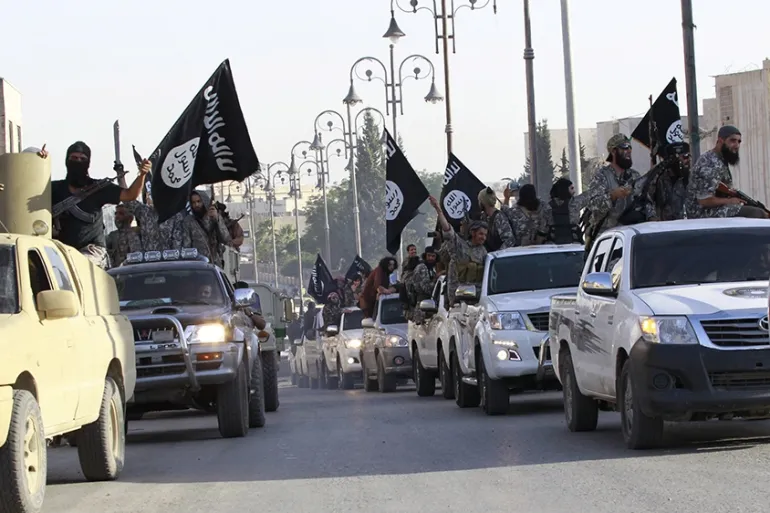
The death of the ISIL leader, Abu Hussein al-Husseini al-Qurashi, who was killed by Turkey in April, has been confirmed by the group.
The Islamic State of Iraq and the Levant (ISIL or ISIS) has announced Abu Hafs al-Hashimi al-Qurashi as his successor.
The group revealed on Thursday that their leader was eliminated during direct clashes with the Hayat Tahrir al-Sham faction in Idlib province, located in the rebel-held northwestern region of Syria.
The announcement was delivered by an ISIL spokesperson through a recorded message on the Telegram messaging app, though the exact date of his demise was not provided.
In April, Turkish President Recep Tayyip Erdogan had announced that Turkish intelligence had successfully targeted the leader in Syria.
After a swift ascent in 2014, during which it captured extensive territories in Iraq and Syria, ISIL faced a series of military campaigns that led to the collapse of its self-proclaimed “caliphate.”
The group’s rule was characterized by acts of brutality such as beheadings and mass shootings.
Its hold on Iraq was defeated in 2017 and in Syria two years later, although sleeper cells continue to carry out assaults in both countries.
Abu Hafs al-Hashimi al-Qurashi has become the fifth leader of the organization since its inception.
Francis, 86, says that a “forgotten genocide” is happening in the DRC as he starts his journey through two African countries.
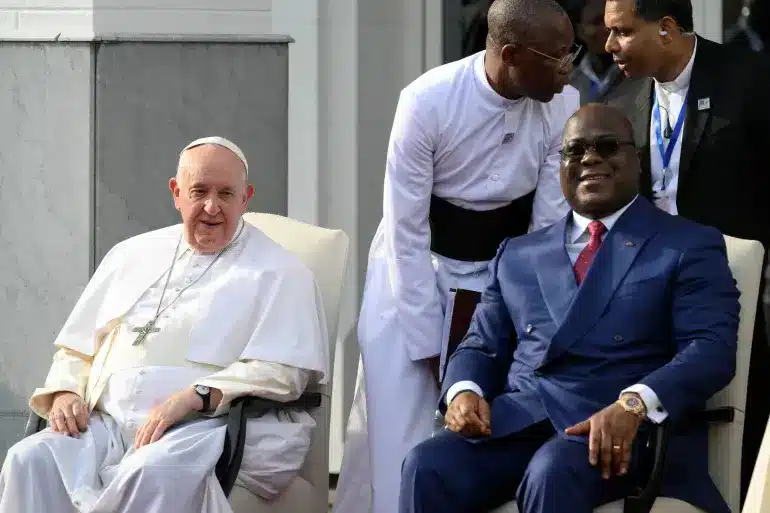
Pope Francis, who recently arrived in the Democratic Republic of the Congo as part of a trip to two African countries, has demanded that foreign nations stop stealing Africa’s natural resources for the “poison of their own greed.”
Since Pope John Paul II visited the Democratic Republic of the Congo in 1985, when it was still known as Zaire, Pope Francis, 86, is the first pope to make such a trip.
“Hands off the Democratic Republic of the Congo! Hands off Africa!” Francis said on Tuesday to applause in his opening speech to Congolese government authorities and the diplomatic corps in the garden of Kinshasa’s national palace.
Calling Congo’s vast mineral and natural wealth a “diamond of creation”, Francis demanded that foreign interests stop carving up the country for their own interests and acknowledge their role in the economic “enslavement” of the Congolese people.
“Stop choking Africa. It is not a mine to be stripped or a terrain to be plundered,” said history’s first Latin American pope, who has long railed at how wealthy countries have exploited the resources of poorer ones for their own profit.
Residents of Kinshasa welcome Pope Francis on his apostolic journey, in Kinshasa, the Democratic Republic of Congo, on January 31, 2023 [Justin Makangara/Reuters]
Francis pointed the finger at the role colonial powers such as Belgium played in the exploitation of Congo until the country, which is 80 times the size of Belgium, gained its independence in 1960. He also said neighbouring countries are playing a similar role today.
The 86-year-old didn’t identify Belgium or any neighbouring country by name, but he spared no word of condemnation, saying there was a “forgotten genocide” under way.
“The poison of greed has smeared its diamonds with blood,” Francis said.
“May the world acknowledge the catastrophic things that were done over the centuries to the detriment of the local peoples, and not forget this country and this continent.”
Pope Francis is welcomed by residents of Kinshasa on January 31, 2023 [Simone Risoluti/Vatican Media/Handout via Reuters]
Al Jazeera’s Malcolm Webb, reporting from Kinshasa, said hundreds if not thousands of people on the roads followed the pope’s motorcade on motorbikes to the presidential palace from the airport.
“The roads were lined up with church groups and schoolchildren from the many Catholic-run church schools run over here in Congo,” he added.
“The Catholic church runs about 60 percent of health and education services here … it’s what makes the Catholic Church such a significant institution here [in Congo],” Webb added.
About half of Congo’s population of 90 million are Roman Catholics.
The six-day trip, which also includes a stop in South Sudan, was originally scheduled for July 2022, but was postponed because of Francis’s knee problems, which were still so serious on Tuesday that he could not stand to greet journalists in the plane heading to Kinshasa and was forced to use a wheelchair on the ground.
Fighting in DRC
Francis was also supposed to have included a stop in Goma, in eastern Congo, but the surrounding North Kivu region has been plagued by intense fighting between government troops and the M23 rebel group, as well as attacks by fighters linked to the ISIL (ISIS) armed group.
The fighting has displaced some 5.7 million people, a fifth of them last year alone, according to the World Food Programme.
Congo accuses Rwanda of backing the M23 rebel group fighting government troops in the east. Rwanda denies this.
“As well as armed militias, foreign powers hungry for the minerals in our soil commit, with the direct and cowardly support of our neighbour Rwanda, cruel atrocities,” said Congolese President Felix Tshisekedi, speaking just before the pope on the same stage.
The pope said the Congolese people were fighting to preserve their territorial integrity “against deplorable attempts to fragment the country”. The pope did not name Rwanda in his address or take sides in the dispute.
Instead of travelling to Goma, Francis will meet with a delegation of people from the east who will travel to Kinshasa for a private encounter at the Vatican embassy on Wednesday.
The plan calls for them to participate in a ceremony in which they jointly commit to forgiving their assailants.
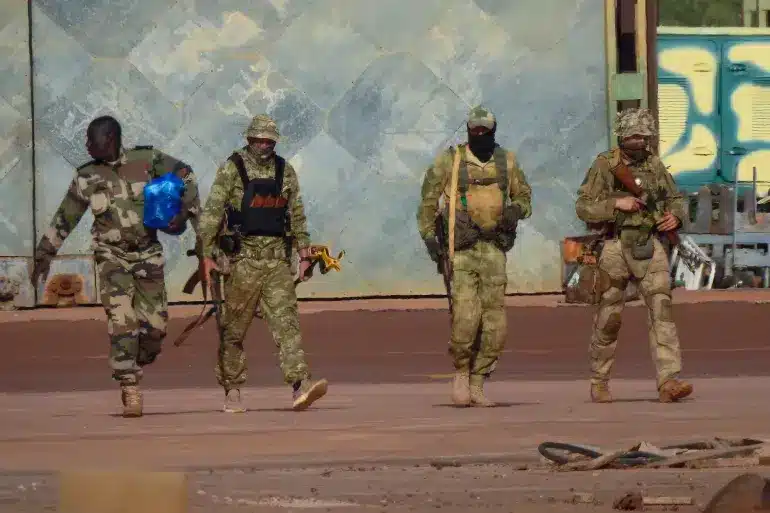
On Tuesday, UN experts demanded an impartial investigation into alleged war crimes and crimes against humanity committed in Mali by government forces and the Wagner Group, a Russian private military contractor.
Mali, whose government seized control in a military takeover in 2021, has previously claimed that Russian forces stationed there are not mercenaries but rather trainers assisting local troops with equipment purchased from Moscow.
According to Western powers, Wagner Group contractors are among the Russian forces in Mali.
“Since 2021, the experts have received persistent and alarming accounts of horrific executions, mass graves, acts of torture, rape and sexual violence, pillaging, arbitrary detentions and enforced disappearances perpetrated by Malian armed forces and their allies,” said the statement from the independent experts.
Mali’s army spokesperson did not immediately respond to a request for comment.
Russian President Vladimir Putin said last year that the Russian state had nothing to do with military contractors working in Mali, adding that the African country had the right to work with private Russian firms.
Mali is engaged in a fight against armed groups linked to al-Qaeda and ISIL (ISIS) who have waged a decade-long conflict that has spread to neighbouring countries.
Tuesday’s statement mentioned the Wagner Group by name, and described credible reports of the involvement of military personnel believed to belong to the group in a massacre of hundreds of people in March.
Survivors have said that white mercenaries suspected to be Russians took part in the massacre in Moura, a market town in central Mali. The incident sparked international uproar and prompted the UN to open an earlier investigation.
Mali’s army has denied any wrongdoing in Moura and said it killed 203 militants there during what it described as a military operation.
The Wagner Group has attracted international attention over its prominent role in fighting during Russia’s invasion of Ukraine.
Last week, the United States designated Wagner as a “transnational criminal organisation” responsible for widespread human rights abuses.
Burkina Faso is dealing with rebel fighters associated with al-Qaeda and ISIL.
Two suspected attacks in Burkina Faso have killed at least 18 people, including 16 army supporters, according to security sources on Friday.
The attacks on Thursday in the country’s north and northwest were the latest to target a civilian auxiliary force that aids the military in its seven-year fight against rebels.
Burkina Faso, located in West Africa, is one of the world’s poorest and most volatile countries.
It has been grappling with violence spearheaded by rebel fighters affiliated with al-Qaeda and ISIL (ISIS) groups since 2015, which has killed tens of thousands and displaced nearly two million people.
The country is now the epicentre of a conflict that spilled over from Mali.
Thursday’s “first attack targeted an advance party of Volunteers for the Defence of the Fatherland [VDP] in Rakoegtenga”, a town in the northern province of Bam, a VDP official said.
Six auxiliaries and a woman died in the attack, the official said.
About 10 people were wounded, including some seriously, who were “evacuated to Ouagadougou for appropriate care”, he said.
The VDP official said the second attack killed about 10 vigilantes and a person in Nayala province in the northwest in the afternoon when a convoy they and soldiers were escorting was ambushed on the Siena-Saran road.
Security sources confirmed two “jihadist attacks” but gave no precise death toll, referring only to “a number of losses”.
The VDP, set up in December 2019, comprises civilian volunteers who are given two weeks of military training and then deployed alongside the army, typically carrying out surveillance, information-gathering or escort duties.
A surge in violence
Commentators worry that the poorly trained volunteers are easy targets for rebel fighters – and may dangerously inflame ethnic friction without proper controls.
Last week, about 60 women, girls and babies were abducted in the northern Djibo region while gathering wild fruit and other food, investigators said.
Violence targeting security forces and civilians has increased in recent months, especially in northern and eastern regions bordering Mali and Niger.
The escalating toll unleashed two military coups last year, launched by officers angered at failures to stem the bloodshed.
The latest strongman is Captain Ibrahim Traore, who on September 30 overthrew Lieutenant Colonel Paul-Henri Sandaogo Damiba.
In the northern province of Soum in Burkina Faso, gunmen reportedly kidnapped 50 women on January 12 and 13.
The women were abducted by armed men while collecting wild fruit west of the town of Aribinda, about 15 kilometres (9.32 miles) from the village of Liki.
“Searching has started with the aim of finding all these innocent victims safe and sound,” the government statement on Monday said.
According to local officials, the army and its civilian auxiliaries have carried out unsuccessful sweeps of the area.
One of the world’s poorest countries, Burkina Faso has been struggling to contain violent activity by armed groups with links to al-Qaeda and ISIL (ISIS) that spread from neighbouring Mali in 2015 despite costly international military efforts to contain it.
Thousands of civilians and members of the security forces have died and some two million people have been displaced, and forced to live in makeshift camps.
Last June, Mahamadou Issoufou – former president of Niger and a representative of the Economic Community of West African States (ECOWAS) – said authorities in the capital Ouagadougou control just 60 percent of the country.
Disgruntled army officers carried out two coups in 2022 in a show of anger at failures to roll back the conflict, with each military leader promising to prioritise security.
French diplomats have saidBurkina Faso has engaged the services of private Russian mercenary group, the Wagner Group, as part of efforts to tackle the conflict. Nana Akufo-Addo, president of neighbouring Ghana also alleged the same thing in December.
Prime Minister Mohammed Shia al-Sudani says foreign forces are still needed in a training capacity to combat ISIL(ISIL) in his first interview as an Iraqi leader.
Iraqi Prime Minister Mohammed Shia al-Sudani defended the presence of US troops in his country in his first interview since taking office in October, according to the Wall Street Journal.
The stance runs counter to that of several Iran-aligned groups that comprise the Shia-dominated Coordination Framework, the political bloc that nominated the prime minister last year. Al-Sudani was later appointed by President Abdul Latif Rashid, whose election ended a year-long political impasse fueled by scholar and political leader Muqtada al-Sadr.
In the interview published on Sunday, al-Sudani did not give a timeline for US and NATO forces – who are currently serving in a training capacity – to leave Iraq, despite calls from some political allies for a full withdrawal.
“We think that we need the foreign forces,” al-Sudani said. “Elimination of ISIS needs some more time.”
The US invaded Iraq in 2003 amid its global “war on terror”, with troop numbers reaching a peak of about 170,000 soldiers in 2007 before forces were withdrawn in 2011. They were redeployed to Iraq in 2014 in response to the rise of ISIL (ISIS), as the armed group overran a large swath of territory across Iraq and Syria.
However, combat operations largely fizzled in the wake of ISIL’s territorial defeat in 2019. Two years later, Washington officially ended the US-led combat mission in Iraq and transitioned to an advisory role assisting Iraqi forces. The US currently has about 2,000 troops stationed in the country, with NATO housing several hundred troops there, all in non-combat roles.
Meanwhile, rocket attacks launched by Iran-aligned armed groups on bases housing foreign troops and other foreign installations have remained relatively frequent.
In the interview published on Sunday, al-Sudani said there was no intention to resume foreign combat operations in the country, but noted foreign forces provide important logistical support in combatting ISIL pockets in Syria.
“Inside Iraq we do not need combat forces,” he told the newspaper. “If there is a threat for Iraq, it is the penetration of the [ISIL] cells through Syria,” he said.
His statements underlined the difficult tack the prime minister has sought in his dealings with the US and with Iran, which, beyond having substantial sway in domestic Iraqi politics, is also a key provider of natural gas and electricity to the country. The prime minister hailed Iran and Iraq’s close economic and security ties during a visit to Tehran in November.
He told the Wall Street Journal that he would like Iraq to have similar relations with Washington to those enjoyed by Saudi Arabia and other Persian Gulf oil and gas producers, adding that he planned to send a high-level delegation to Washington for talks with US officials next month in hopes of an eventual meeting with US President Joe Biden.
“I don’t see this as an impossible matter, to see Iraq have a good relationship with Iran and the US,” al-Sudani said.
The election is seen as a test of democracy because opposition candidates are allowed to run after a four-year absence.
Voters inBenin will go to the polls for a parliamentary election seen as a test of democracy, with opposition parties returning to the ballot after boycotting or being barred from the most recent presidential and legislative elections.
Benin’s image as a bastion of democracy and stability in West Africa has suffered under President Patrice Talon, who broke a pledge not to run for re-election and oversaw a crackdown on the opposition since taking office in 2016.
Seven parties are competing in the vote, including the Les Democrates party linked to Talon’s predecessor and rival Thomas Boni Yayi.
Boni Yayi’s supporters led protests in 2019 after opposition parties were blocked from the legislative vote for failing to meet strict new eligibility criteria.
“I will vote for this party [Les Democrates] for the rebalance of power,” civil society activist Isidore Odountan, 31, told Reuters news agency in the largest city Cotonou.
Preliminary results, which are expected on January 11, may also be an indicator of the strength of the various political forces jostling to succeed Talon. The next presidential election is due in 2026 when the next parliamentary vote will also be held.
Talon does not belong to any party but is supported by the two parties currently in power in parliament – the Bloc Republicain and Union Progressiste le Renouveau.
There is no immediate sign the vote will see protests like in 2019 or those that broke out in 2021 against Talon’s decision to seek re-election, said political analyst Expedit Ologou, head of Beninois think tank Civic Academy for Africa’s Future.
“The atmosphere seems calm, peaceful, friendly, fraternal in most areas of the country,” he told Reuters.
Under Talon, the political protests have been met with deadly police violence, while politicised prosecutions and other legal tactics have been used to stifle the opposition, US democracy watchdog Freedom House said in its 2022 report.
Talon has denied targeting political opponents or violating human rights.
With more parties on the ballot, turnout should return to normal levels of about 60 percent after slumping to just 27 percent in 2019, Ologou said.
Regional security may be higher up in voters’ concerns in this election as Benin, alongside neighbouring Togo and Ivory Coast, has seen increasing attacks from armed groups linked to al-Qaeda and ISIL (ISIS) as violence creeps south from the Sahel countries of Mali, Burkina Faso and Niger.
The insecurity and higher living costs linked to the war in Ukraine pose a threat to Benin’s recent economic gains, the International Monetary Fund warned last July.
Benin’s agriculture-dependent economy has rebounded since the coronavirus pandemic, growing more than 7 percent in 2021 and the first half of 2022. But the country of 12 million remains one of the poorest in the world with one-fifth of the population living on less than $1.90 per day, according to the World Bank.
Beyond the opposition’s drive to reclaim seats in parliament, Sunday’s election will affect the future of some of the other institutions in the small country, which sits between Nigeria and Togo.
The mandate of the Constitutional Court ends this year and, three years before the 2026 presidential ballot, the court’s composition is crucial as it oversees decisions on elections.
Four judges are appointed by lawmakers while the other three are chosen by the president.
Talon, a wealthy businessman, was elected in 2016 and re-elected in 2021.
The raids come after a string of ISIL assaults, including a deadly bombing close to a checkpoint in Kabul.
According to a senior Taliban government spokesman, eight ISIL (ISIS) fighters have been killed and a number of others have been arrested in a series of raids targeting prominent figures in a wave of attacks in Kabul.
The raids in the capital city and western Nimroz province the day before were directed at ISIL members who were responsible for the recent attacks on Kabul’s Longan Hotel, Pakistan’s embassy, and the military airport, according to Taliban spokesman Zabihullah Mujahid on Thursday.
Eight ISIL fighters, including foreign nationals, were killed and seven others arrested in Kabul, while a separate operation in western Nimroz province resulted in two more ISIL arrests, Mujahid said.
“These members had a main role in the attack on the [Logan] hotel and paved the way for foreign [ISIL] members to come to Afghanistan,” the spokesperson said in a tweet.
ISIL claimed responsibility for a deadly bombing near a checkpoint at the Afghan capital’s military airport on Sunday. The group said that attack was carried out by someone that also took part in the Longan Hotel assault in mid-December.
ISIL had published a photo of the attacker, identifying him as Abdul Jabbar, saying he withdrew safely from the attack on the hotel after he ran out of ammunition. It added he detonated his explosives-laden vest targeting the soldiers gathered at the checkpoint.
Mujahid said light weapons, hand grenades, mines, vests and explosives were confiscated by the Taliban’s security forces during the raids on an ISIL hideout in the Shahdai Salehin neighbourhood of Kabul. Residents reported sounds of several explosions and an hours-long gun battle.
ISIL’s regional affiliate – known as the Islamic State in Khorasan Province (ISIS-K) – is a key rival of the Taliban and has increased its attacks in Afghanistan since the Taliban takeover in 2021. Targets have included Taliban patrols and members of Afghanistan’s Shia minority.
The Taliban swept across the country in August 2021, seizing power as United States and NATO forces were in the last weeks of their final withdrawal from Afghanistan after 20 years of war.
The trial is expected to last seven months, with the judgement delivering its verdict after hearing from approximately 370 witnesses.
Ten men are on trial in Belgium on charges of involvement in two suicide bombings that killed 32 people and injured over 300 in Brussels in 2016.
The ISIL (ISIS) armed group claimed responsibility for the attacks, in which three of the group’s alleged perpetrators – Khalid el-Bakraoui, Ibrahim el-Bakraoui, and Najim Laachraoui – were killed.
Presiding Judge Laurence Massart will confirm the identities of all parties to the case, including the defendants and lawyers representing approximately 1,000 people affected by the attacks, on Monday.
She will then address the jury, selected from a pool of 1,000 Belgians last week in a process lasting 14 hours.
The event will take place at the Court of Assizes – the one which deals with the country’s biggest criminal cases and was also NATO’s former headquarters in Belgium.
Link to Paris attacks
The Brussels bombings trial has clear links to the French trial over the November 2015 Paris attacks.
Six of the Brussels bombings accused were sentenced to jail terms of between 10 years and life in France in June, but the Belgian trial will be different in that it will be settled by a jury, not judges.
People pay their respects at the monument for the victims of the 2016 suicide bombings in central Brussels [File: Yves Herman/Reuters]
The twin bombings at Brussels Airport and a third bomb on the city’s metro on March 22, 2016 killed 15men and 17 women – Belgians, Americans, Dutch, Swedish, British, Chinese, French, German, Indian, Peruvian and Polish, many based in Brussels, the home to EU institutions and military alliance NATO.
Nine men are charged with multiple murders and attempted murders in a “terrorist” context, with potential life sentences, and all 10 with participating in the activities of a “terrorist group”.
They include Mohamed Abrini, who prosecutors say went to the airport with two suicide bombers but fled without detonating his suitcase of explosives, and Osama Krayem, a Swedish national accused of planning to be a second bomber on the Brussels metro.
Salah Abdeslam, the main suspect in the Paris trial, is also an accused, along with others prosecutors say hosted or helped certain attackers.
One of the 10, presumed killed in Syria, will be tried in absentia.
In accordance with Belgium court procedure, the defendants have not declared whether they are innocent or guilty.
Prosecutors are expected to start reading from the 486-page indictment on Tuesday before hearings of about 370 experts and witnesses can begin.
The trial is expected to last seven months and is estimated to cost at least 35 million euros ($36.9m).
An estimated 11,000 foreign children and women remain in the refugee camps of Roj and al-Hol in northeastern Syria.
The Australian government has returned four Australian women and their 13 children from a Syrian refugee camp to the state of New South Wales, according to home affairs minister Clare O’Neil.
The repatriation is part of a plan to bring back from Syria dozens of Australian women and children who are relatives of dead or imprisoned ISIL (ISIS) fighters and have been held at the al-Hol and Roj detention camps in Kurdish-controlled northeastern Syria for several years.
Australia first repatriated eight children and grandchildren of two dead ISIL fighters from a Syrian refugee camp in 2019 but has held off repatriating any others until now.
“The decision to repatriate these women and their children were informed by individual assessments following detailed work by national security agencies,” O’Neil said in a statement on Saturday.
The women and children left the Roj refugee camp in northern Syria on Thursday afternoon and crossed the border into Iraq to board a flight home, the Sydney Morning Herald and state broadcaster ABC reported on Friday.
O’Neil said at all times the focus has been on the safety and security of “all Australians” as well as those involved in the repatriation, with the government having “carefully considered the range of security, community and welfare factors in making the decision to repatriate”.
The repatriation followed similar moves by the United States, Italy, Germany, France, the Netherlands, Belgium, the United Kingdom, and Canada, O’Neil said.
She said allegations of illegal activity would continue to be investigated by state and federal law enforcement authorities.
“Any identified offences may lead to law enforcement action being taken,” O’Neil said, adding that New South Wales was providing “extensive support services” to assist the group to reintegrate into Australia.
In a statement on Saturday attributed to the repatriated women, the group said they were “deeply thankful” to be back in Australia and they expressed regret for the “troubles and hurt” caused by their actions, particularly to their families.
Asking for privacy and space to reconnect with their loved ones, the women expressed hope that “all Australian children and their mothers will soon be repatriated from the camps in Syria”.
Human Rights Watch researcher Sophie McNeill said the repatriation was a “long overdue step”.
“For years, the Australian government has abandoned its nationals to horrific conditions in locked camps in northeast Syria,” McNeill said.
“Australia can play a leadership role in counterterrorism through these orderly repatriations of its nationals, most of them children who never chose to live under ISIS,” she said.
In a statement congratulating Australian Prime Minister Anthony Albanese for his “strong leadership” on the repatriation plan, the humanitarian organisation Save the Children said that an estimated 11,000 foreign children and women remain in the Roj and al-Hol camps.