At least 103 people died in two bomb blasts near the tomb of Iranian general Qasem Soleimani on the fourth anniversary of his killing by the US, according to Iran’s state media.
The state broadcaster Irib reported that many people were hurt when bombs exploded during a procession near the Saheb al-Zaman mosque in the southern city of Kerman.
The deputy governor of Kerman said it was a terrorist attack.
Videos showed dead people on a road and ambulances going quickly to the place.
It was not known who caused the explosions and no groups claimed responsibility right away.
Arab groups and Sunni terrorist organizations like Islamic State have claimed responsibility for attacks on security forces and Shia religious sites in the country.
Soleimani was a very important person in Iran, second only to the Supreme Leader, Ayatollah Ali Khamenei. He was killed by a US drone in Iraq in 2020.
On Wednesday, something happened that made tensions in the area higher. The deputy leader of a group called Hamas, which is supported by Iran, was killed by what seems to be a drone from Israel in Lebanon.
Video shown on state TV showed many people gathered on the edge of the general’s hometown of Kerman when two explosions happened.
The Iranian media said that the first explosion happened at 2:50 pm local time (11:20 GMT), about 700 meters (2,300 feet) from the Garden of Martyrs cemetery near the Saheb al-Zaman mosque.
The second incident happened about 15 minutes later, about 1 kilometer away from the cemetery, according to them.
The Tasnim news agency, which is connected to the Revolutionary Guards, reported that sources said two bags carrying bombs were exploded by remote control.
“We were walking to the cemetery when a car suddenly stopped behind us and a trash can with a bomb inside exploded,” a person who saw it happen told Isna news agency.
“We heard a boom and saw people dropping to the ground. ”
The local emergency services department said that 103 people died and 141 were hurt in the explosions, as reported by the state media. Some of the injured people were very badly hurt, they said.
The Iranian Red Crescent reported that among the people who died, there was at least one paramedic who went to help with the first explosion and got hurt by the second one.
It looked like Soleimani’s tomb was not harmed.
He was in charge of the Revolutionary Guards’ overseas operations and had a big role in making decisions for Iran in other countries.
He was in charge of secret missions for the Quds Force and gave help and support to governments and armed groups like Hamas and Hezbollah.
Former US President Donald Trump ordered the killing of Soleimani in 2020 and called him the top terrorist in the world.
Tag: Islamic State
-
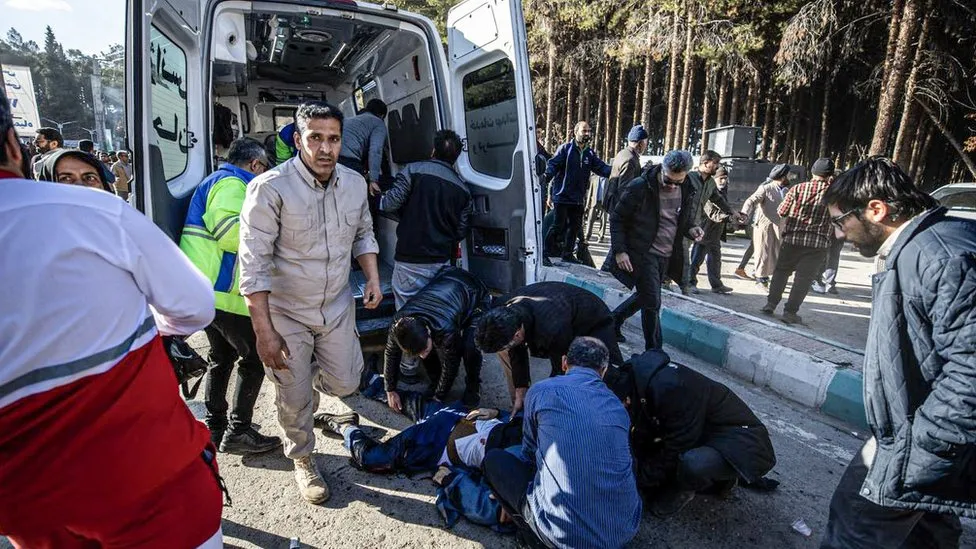
At least 103 people have died as result of bomb explosions – State TV
-

Israel must seize and keep control of all of Gaza – Former head of CIA
Former CIA Director General David Petraeus has said that Israel must “clear and control all of Gaza” to fulfill its stated mission of destroying Hamas and rescuing the hostages.
Petraeus, a retired American general who served in Afghanistan and Iraq, likened the war to the war against the so-called Islamic State.
“If you look at the case of [Iraqicity] Mosul and the destruction of the Islamic State and I think Hamas can be compared to that, although it’s an imperfect comparison, if that is the model, you have to destroy Hamas, you cannot reconcile with them.
Mosul was retaken by the Iraqi army with the supportof US-led coalition warplanes in 2017 in a massive military operation that reduced large areas to rubble and killed many people. thousands of civilians.
Petraeus said that after the current war, Gaza will have to be rebuilt.
However, once Hamas is destroyed, it is possible that Israel will”take on this task”due to the lack of alternatives, the general added. Petraeus also told the BBC that the fear that Israel’s military operation in Gaza could scare future generations was”very legitimate”.
-
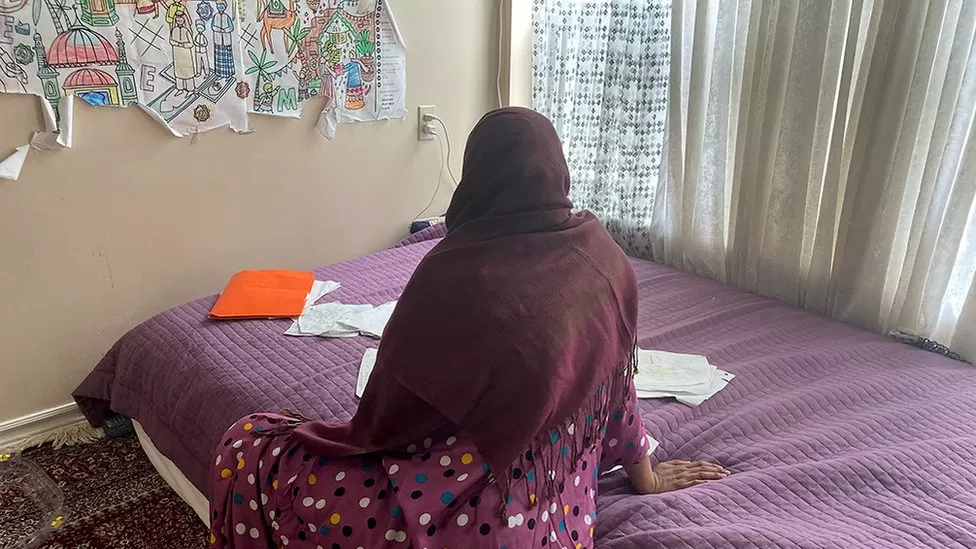
Islamic State ‘Beatle’ ex-wife breaks silence
Even though there was a lot of news about the violence done by the Islamic State (IS) group, Dure Ahmed says she didn’t know about it when her British husband El Shafee Elsheikh was doing awful things.
He was involved with a group of IS terrorists who kidnapped, hurt, and killed Western captives.
The mother of two children says that she wasn’t influenced to have extreme beliefs, but that she was just a naive person who was deeply in love.
She said yes to answering questions from the BBC and Canadian broadcaster, CBC. She said, “I don’t want anyone to feel sorry for me. ”
Ahmed believes that there will be negative consequences for speaking out in public, but she wants to bring attention to the difficult situation of women and children who are trapped in Syrian camps and are likely family members of people suspected of being involved with IS. She was kept in that camp for over three years.
She says she has to come to terms with the fact that the time she spent with Elsheikh was a part of her life, whether she wants to accept it or not.
Ahmed says that Elsheikh did not tell her he had joined IS before she left to be with him. She says she didn’t know about the group’s terrorist beliefs when she went from Canada to Syria in 2014. She says she hardly recognized the controlling and violent person her ex-husband had turned into.
Some captives gave Elsheikh and his IS cell members a nickname because they spoke with British accents. The men were accountable for killing many hostages, most of whom were had their heads cut off. They recorded and shared the videos of the killings on social media.
During Elsheikh’s trial in 2022 in the US, lawyers said that his actions caused the deaths of four Americans. These Americans included journalists James Foley and Steven Sotloff, as well as aid workers Kayla Mueller and Peter Kassig. They claimed that he was involved in the killings of four people: two British aid workers, David Haines and Alan Henning, and two Japanese journalists, Haruna Yukawa and Kenji Goto.
No one has ever found the bodies.
Elsheikh, who is from west London, is currently in a high-security prison in the US, where he has been sentenced to life imprisonment for eight counts. The UK took away his citizenship before he was found guilty.
However, there are still questions about what his wife, Ahmed, knew about the activities of IS while he is in jail.
Ahmed went to Syria to join Elsheikh two months after their IS group committed murders that made people angry worldwide. It happened right after IS did many bad things when they took control of the northern Iraqi city of Mosul. They also started killing a lot of people from Iraq’s Yazidi religious group.
While Ahmed was away, she had two sons. She and her sons were part of a group of women and children who returned to Canada in April.
The person who is 33 years old was arrested when they arrived because authorities suspected they may be involved in terrorism. They were later released from custody, but they have to follow certain rules while they are out on bail. On Monday, the conditions were looked at in a court in Brampton, Ontario.
The lawyer for the government said that Ahmed was very involved in the ideas of IS and it is very probable that she knew about her husband’s involvement with the group before moving away from Canada in 2014.
The Crown and Ahmed’s legal team suggested they both agree to certain rules and conditions. These rules would involve her being monitored by GPS and having to stay at home between 10:00 pm and 06:00 am. The judge stated that he will announce his decision on 19 October.
We talked to Dure Ahmed two times. The most recent time was last week in Toronto, where she was more open and spoke more easily. However, we actually first met in the detention camp in Syria in November of last year. She agreed to talk to us about a British child who was missing. This is for a podcast series called Bloodlines that will be on BBC-CBC soon.
At first, we did not know who her husband was – but, after looking into it more, we found out about their relationship. Then we wanted to find out about Elsheikh’s radicalization, the people he harmed, and his fellow IS “Beatles”.
Ahmed and Elsheikh met in Toronto in 2007. (Rewritten) In 2007, Ahmed and Elsheikh became friends when they met in Toronto. She was seventeen years old, and he was nineteen years old. We wanted to know how they had initially become friends when they were teenagers living in Canada.
“She giggled about smoking marijuana. ” “He didn’t believe in God and it had nothing to do with the Islamic State. ”The two friends stayed in contact after Elsheikh,whose parents are refugees from Sudan, came back to London. In 2010, they got married in a Muslim ceremony. However, they mostly had a long-distance relationship because Ahmed stayed in Toronto while she was studying for an English degree.
He didn’t like being around other people. He is very shy and keeps to himself a lot. So, she says he had all the qualities that could make someone become radicalized and go down a dangerous path.
In 2012, Elsheikh went to Syria to fight in the war happening there – then he decided to join IS. He kept telling his wife to come with him.
‘Please come and have a look. She said it as if going back was an easy thing to do.
Elsheikh refused to tell her about his activities in Syria,according to her. She also says she didn’t know where exactly he was living in the country.
Disbelieving it was better to not know than to know.
But, while she thought about going on the trip, she says that members of the Canadian Security Intelligence Service,alsoknown as CSIS, asked her questions about her husband.
“They [CSIS] clarified that in Syria, there are events occurring that are more complex than I previously believed. “”But, they didn’t let me watch a video. “
Ahmed says she had nothing to say to CSIS and she told Elsheikh that agents had reached out to her. CSIS told the BBC that they cannot provide details about any particular case.
Ahmed, who was 24 years old and had no job after finishing school, finally went on a trip. She says she did not see the terrible acts of the IS be headings that were being talked about a lot at that time. “It may be difficult to believe, but it’s genuinely true. “
We told her that she was smart and had taken a course on the Middle East. We thought she would know about the problematical Muslims around the world.
She said that she kept away from what was going on in Syria. She told us that her study was about the ancient Egyptian writings called hieroglyphics, not about what is happening right now.
According to Ahmed, Elsheikh planned everything – all she had to do was “get on a plane” to Turkey.
I just brought a small bag with me. Three sets of pants and two shirts.
In all the time we have been reporting on IS, we have noticed that the majority of women are unwilling to discuss why or how they became involved with the group. Everyone has their own story.
Some people experienced abuse at home, some were tricked or forced to travel and work-against their will. Some people joined eagerly because they wanted to have exciting experiences. Some people went with their husbands and children. Some of them were kids too.
And then, of course, there were many women who strongly believed in and followed the IS ideology.
Ahmed says he did not support IS. In the responses she gave us, she liked to portray herself as an innocent person who believes in love stories. When we talked to her in the Syrian detention camp, she strongly criticized IS – even though it was dangerous to do so in that location.
Elsheikh and Ahmed lived in Raqqa, the main city of the Islamic State group in Syria. There, they witnessed many killings happening at a popular roundabout in the town center. It became a regular occurrence to see severed heads being shown in public after these killings.
When we talked to Ahmed in the Syrian camp, he mentioned that his daily life consisted of doing regular activities with his female friends, like going out to eat or taking kids on rides at the amusement park.
When we spoke again in Toronto, she said that Elsheikh’s important position did not give them a luxurious lifestyle while they were under IS rule. She said that her house in Raqqa made her feel like she was in prison because they hardly ever went outside. No phones or internet – only she, her children, and Elsheikh’s other wife. Many people had more than on espouse. We inquired if they had Yazidi slaves at home. She replied that they did not.
She said her husband liked to keep things to himself a lot. “We couldn’t even open the curtains. “
She said that she thinks her children are fortunate to be alive, considering the harm Elsheikh caused her when she was pregnant.
Ahmed says she attempted to escape many times, but she had no choice but to come back because she didn’t have any family or support from the IS group. She finally left him when he ended their marriage, and went to find a safe place to live with her sons in a women’s guest house.
We mentioned that she had told us more information during our second interview. We asked if she was only saying these things now because it was easier for her since she was back in Canada and could go to jail.
“If I have to pay, I will have to pay no matter what. ” -
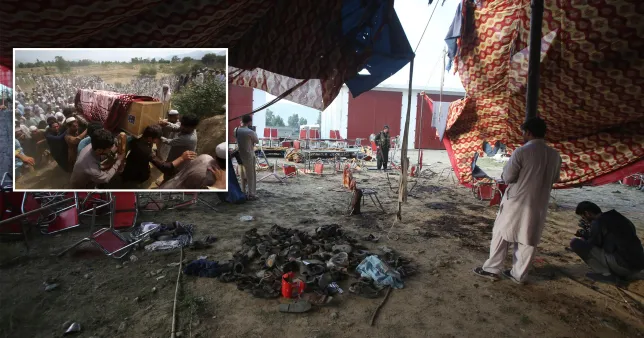
Islamist State admits responsibility for suicide bombing in Pakistan that left 54 people dead
54 people were killed in a suicide attack in Pakistan, and Islamic State has taken responsibility for it.
At a pro-Taliban cleric’s Sunday election gathering, a bomb exploded.
The blast injured close to 200 individuals.
Earlier today, hordes of mourners carried colourfully draped coffins to graveyards.
In a statement posted to its Amaq website, IS, also known as the Islamic State in Khorasan Province, claimed responsibility for the bombing.
It claimed that the attack was a part of the group’s ongoing campaign against democratic ideals that it sees as hostile to Islam.
There were at least five children among those murdered in the explosion.
The attack seems to be a reflection of differences among various Islamist organisations. In the Afghan bordering province of Khyber Pakhtunkhwa, the groups are very active.
The Jamiat Ulema Islam party, which has ties to the Afghan and Pakistani Taliban, was the target of the bombing.
-

Uganda school attack: Islamic State group allegedly kills 40
Rebels associated with the Islamic State group have carried out a devastating assault on a school in western Uganda, resulting in the deaths of approximately 40 individuals, primarily students.
The tragic incident took place at Lhubiriha Secondary School in Mpondwe, where a group of boys residing in the school’s dormitories were among those killed.
Currently, eight individuals remain in critical condition following the attack.
The responsibility for the Friday assault has been attributed to the Allied Democratic Forces (ADF), a Ugandan organization operating from the Democratic Republic of Congo (DRC).
NB: Some people may find details in this story distressing.
Many of the bodies were transferred to Bwera Hospital, national police spokesperson Fred Enanga said.
A dormitory at the school was burnt and a food store was looted during the incident, he added.
Some of the boys were burnt or hacked to death, and others, especially the girls, were abducted, Major General Dick Olum from the Ugandan army told the media.
Some of the bodies are said to have been badly burnt and DNA tests will need to be carried out to identify them.
The attackers are said to have torched the students’ mattresses and are also thought to have detonated bombs in the region.
Members of the wider community possibly among the dead. A number of students remain unaccounted for.
Soldiers are pursuing ADF insurgents towards the DRC’s Virunga National park – Africa’s oldest and largest national park which is home to rare species, including mountain gorillas.
Militias including the ADF also use the vast expanse, which borders Uganda and Rwanda, as a hideout.
“Our forces are pursuing the enemy to rescue those abducted and destroy this group,” defence spokesperson Felix Kulayigye said on Twitter.
Uganda and the DRC have held joint military operations in the east Congo to prevent attacks by the ADF.
Security forces had intelligence that rebels were in the border area on the DRC side for at least two days before Friday night’s attack, Major General Olum said.
The deadly episode follows last week’s attack by suspected ADF fighters in a village in the DRC near to the Ugandan border. Over 100 villagers fled to Uganda but have since returned.
The attack on the school, located less than two kilometres (1.25 miles) from the DRC border, is the first such attack on a Ugandan school in 25 years.
In June 1998, 80 students were burnt to death in their dormitories in an ADF attack on Kichwamba Technical Institute near the border of DRC. More than 100 students were abducted.
The ADF was created in eastern Uganda in the 1990s and took up arms against long-serving President, Yoweri Museveni, alleging government persecution of Muslims.
After its defeat by the Ugandan army in 2001, it relocated to North Kivu province in the DRC.
The group’s principal founder, Jamil Makulu, was arrested in Tanzania in 2015 and is in custody in a Ugandan prison.
ADF rebels have been operating from inside the DRC for the past two decades.
In 2021, suicide bombings in Uganda’s capital Kampala and other parts of the country were blamed on the ADF.
-
Iraq: Nine police die in bomb attack and gun attack
An explosion and gunfire attack in northern Iraq claimed the lives of at least nine police officers.
On Sunday, the attack occurred close to the oil-rich city of Kirkuk, which is located about 290 kilometres (180 miles) from Baghdad.
The Islamic State organisation has taken ownership.
Three Iraqi soldiers were killed by a roadside bomb on Wednesday near Baghdad, and IS has already claimed responsibility for the attack.
According to officials speaking to AFP, the attack on Sunday started when a bomb targeted a truck carrying police close to the village of Chalal al-Matar.
After the explosion, there was “a direct attack with small arms.”
“An assailant has been killed and we are looking for the others,” the official added, saying that two policemen were also wounded in the attack.
An official from the Ministry of the Interior in Baghdad confirmed the attack.
IS once held 88,000 sq km (34,000 sq miles) of territory stretching from eastern Iraq to western Syria and imposed its brutal rule on almost eight million people.
But Iraqi forces declared victory over the Islamist group in December 2017, after its troops drove IS militants from the Syrian border zone where the Islamists’ final strongholds had been.
The group was driven from its last territory in 2019, but the UN warned in July that it remained a persistent threat.
It is estimated to have between 6,000 and 10,000 fighters in Syria and Iraq, who are based mostly in rural areas and continue to carry out hit-and-run attacks, ambushes and roadside bombings.
In its report, the UN observed that despite “significant leadership losses,” the group has been able to “exploit security gaps and conditions conducive to the spread of terrorism to recruit and to organise and execute complex attacks”.
Source: BBC.com
-
Lafarge, a cement company, has pleaded guilty to helping ISIS
Lafarge, a French cement company, has pled guilty in the United States to aid the Islamic State and other terrorist organisations.
The company agreed to pay a $777.8 million (£687.2 million) penalty for payments made to keep a factory operational in Syria after the crisis broke out in 2011.
Prosecutors said it was the first time a firm in the United States pled guilty to aiding terrorists.
Lafarge said it “deeply regretted” the events and “accepted responsibility for the individual executives involved”.
The cement manufacturer, which was bought by Switzerland’s Holcim in 2015, said their behaviour had been in “flagrant violation” of Lafarge’s code of conduct.
The firm opened its plant in Jalabiya near the Turkish border in 2010 following a $680m investment.
US prosecutors said that Lafarge’s Syrian subsidiary had paid Islamic State and another terror group, al Nusra Front, the equivalent of $5.92m to protect staff at the plant as the country’s civil war intensified. Executives likened the arrangements to pay “taxes”, they said.
Lafarge eventually evacuated the plant in September 2014, when Islamic State took control of the town and the factory. But before its departure, the deals helped the company do $70.3m in sales, prosecutors said.
Lafarge had previously admitted bribes were paid after an internal investigation. But US Deputy Attorney General Lisa Monaco said on Tuesday that the company’s actions “reflect corporate crime that has reached a new low and a very dark place.”
“Business with terrorists cannot be business as usual,” she added.
In a statement, Lafarge’s new owner Holcim said none of the conduct involved Holcim, “which has never operated in Syria”.
It added that former Lafarge executives involved in the bribery had concealed it from Holcim, as well as external auditors.
Eric Olsen, who ran Lafarge and Holcim until 2017, stepped down from his role following an investigation into Lafarge’s activities in Syria.
At the time, Mr Olsen said he had not been involved in any wrongdoing and was standing down to bring “serenity” to the company.
The Department of Justice said that senior executives at Lafarge were involved in the arrangements and aware they risked running afoul of authorities.
IMAGE SOURCE, AFP Image caption, The dealings with armed groups took place before Lafarge merged with Holcim Executives had attempted to require Islamic State not to include the name “Lafarge” on documents memorializing and implementing their agreements and many involved in the scheme also used personal email addresses, rather than their corporate email addresses, to carry out the conspiracy, the Department said.
Lafarge executives also backdated the termination agreement to Aug. 18, 2014, a date shortly after the United Nations Security Council had issued a resolution calling on member states to prohibit doing business with Islamic State, to falsely suggest that negotiations with Islamic State had not occurred after the UN resolution, the Department said.
The dealings by Lafarge were eventually made public in 2016 on a website run by a Syrian opposition group.
Breon Peace, US Attorney for the Eastern District of New York – where the case was brought – said the conduct “by a Western corporation was appalling and has no precedent or justification”.
“The defendants paid millions of dollars [to Islamic State], a terrorist group that otherwise operated on a shoestring budget, millions of dollars that [Islamic State] could use to recruit members, wage war against governments, and conduct brutal terrorist attacks worldwide, including against U.S. citizens,” he said at a press conference announcing the guilty plea.
Lafarge also faces charges of complicity in crimes against humanity in France over its activities in Syria, but the company denies the claims.
-
DRC: 14 civilians killed in attack attributed to ADF rebels
Fourteen civilians were killed on Saturday in a new attack attributed to ADF rebels in the volatile eastern Democratic Republic of Congo (DRC) region of Ituri, local officials said on Sunday.
According to Jacques Anayey Bandingama, president of the youth of the Banyali Tchabi chiefdom, where the attack took place, machete-wielding rebels burst into the village of Kymata at around 7.30pm.
In addition to the 14 people “killed with machetes”, two people were injured and two children are missing, “certainly kidnapped” by the attackers who also set fire to the village, he added.
The president of the Nyali Tchabi community, Faustin Mboma Babanilau, deplored the lack of military presence in this region where many armed groups are active: “At the chiefdom office, there are only two soldiers, go figure.
Presented by the jihadist organisation Islamic State (EI) as its branch in Central Africa (ISCAP in English), the Allied Democratic Forces (ADF) group is accused of being responsible for the massacre of thousands of civilians in eastern Congo and of having committed attacks in Uganda.
Since November 2021, DR Congo and Uganda, where the ADF was founded, have been fighting together against this armed group. But the attacks attributed to it have increased in recent months in the eastern DRC.
The Congolese government placed Ituri province and its neighbour North Kivu under a state of siege in May 2021 but has failed to curb the violence since.
Source: Africanews
-
Suellen Tennyson, kidnapped US Catholic nun freed in Burkina Faso
The US Catholic nun who was abducted by armed men in April in Burkina Faso has been released, according to the local bishop of Kaya, in the country’s north-east.
“Sister Suellen is currently in a safe place and in good health,” Bishop Theophile Nare said in a statement.
Suellen Tennyson, 83, was taken hostage from a local parish in the middle of the night, leaving behind her glasses and blood pressure medication.
The identity of the kidnappers is not known.
However, several militant groups have carried out attacks in Burkina Faso.
Bishop Nare said he did not have any information on the circumstances leading to Sister Suellen’s release. The FBI had put out a missing person notice after the kidnapping.
Several militant groups allied to al-Qaeda and Islamic State operate in the Sahel region and are known to carry out attacks and kidnappings against civilians in Burkina Faso and neighbouring countries.
Regional nations continue to launch several offensive operations against the militant groups.
-
Canadian spy, Shamima Begum smuggled school girl to Syria
A Canadian intelligence agent helped Shamima Begum get into Syria after she escaped the UK and joined the Islamic State.
According to documents obtained by the BBC, he claimed to have smuggled other Britons to fight for IS and given Canada Ms. Begum’s passport information.
The loss of Ms. Begum’s citizenship is being contested by her attorneys on the grounds that she was a victim of trafficking.
Canada and the UK declined to respond to questions about security.
Ms Begum was 15 when she and two other east London schoolgirls – Kadiza Sultana, 16, and 15-year-old Amira Abase – traveled to Syria to join the IS group in 2015.
At the main Istanbul bus station, the girls met Mohammed Al Rasheed, who would facilitate their journey to IS-controlled Syria.
A senior intelligence officer, at an agency that is part of the global coalition against IS, has confirmed to the BBC that Rasheed was providing information to Canadian intelligence while smuggling people to IS.The BBC has obtained a dossier on Rasheed that contains information gathered by law enforcement and intelligence, as well as material recovered from his hard drives, which provide extraordinary detail about how he operated.
He told authorities that he had gathered information on the people he helped into Syria because he was passing it to the Canadian embassy in Jordan.
Rasheed, who was arrested in Turkey within days of smuggling Ms Begum to IS, told authorities he had shared a photo of the passport the British schoolgirl was using.
The Metropolitan Police were searching for her, although by the time Canada received her passport details, Ms Begum was already in Syria.
The dossier shows that Ms Begum was moved to Syria through a substantial IS people-smuggling network that was controlled from the group’s de-facto capital in Raqqa.
Rasheed was in charge of the Turkish side of this network and facilitated the travel of British men, women, and children to IS for at least eight months before he helped Ms Begum and her two friends.Ms Begum told the BBC’s forthcoming I’m Not A Monster podcast: “He organized the entire trip from Turkey to Syria… I don’t think anyone would have been able to make it to Syria without the help of smugglers.
“He had helped a lot of people come in… We were just doing everything he was telling us to do because he knew everything, we didn’t know anything.”
Rasheed kept information about the people he helped, often photographing their ID documents or secretly filming them on his phone.
One recording shows Ms Begum and her friends getting out of a taxi and into a waiting car not far from the Syrian border.
-
Islamic State says it kidnapped Red Cross staff in Nigeria
The Islamic State (IS) militant group has claimed it has kidnapped a Red Cross employee in Nigeria’s north-eastern Borno State on Tuesday.
In a brief statement on Wednesday, the group said the aid worker was taken at a fake checkpoint on the road linking the towns of Kareto and Gubio in Borno.
It gave no details about the purported abductee’s identity nor made a demand or threat.
So far, no mainstream media reports have been observed on this alleged incident. The Red Cross Society has also not commented.
IS had declared war on aid agencies in Africa in August and its leadership reiterated the message in October, accusing humanitarian workers of implementing anti-Islam agendas.
IS released its latest claim via its account on the messaging app RocketChat.
The alleged attack comes a day after another Islamist militant group, Boko Haram, claimed responsibility for an attack on 28 November that killed dozens of farmers in Borno.
The two jihadist groups are active in north-east Nigeria and the Lake Chad region.
Source: bbc.com