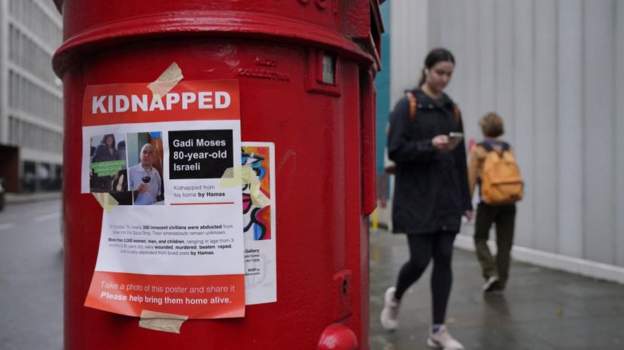
In the UK, More noteworthy Manchester Police has said it laments any offense caused after online entertainment pictures seemed to show its officials pulling down banners of Israelis who are being kept prisoner by Hamas.
Colleague Boss Constable Wasim Chaudhry said “we share concerns raised in regards to the expulsion of banners in the North Manchester region and can affirm an examination is in progress”.
The banners have been set up around the nation, and follow a format seen across the world. They show the names and faces of the 240 prisoners held by Hamas shooters.
Other web-based entertainment film showed Metropolitan Cops eliminating hijacked banners from the front of a drug store in north London.
In a proclamation the Met said “we thoroughly comprehend the worries raised, however we accept the officials were acting sincerely”.
It said it eliminated them to forestall any heightening as it accepted the banners had been placed on the drug store “as a counter” for remarks made on the web.
Adam Ma’anit from Brighton – whose 18-year-old cousin Maayan was killed, and her dad Tsachi seized – said the police conduct was “sad”.
“My cousin’s face is on those banners,” he said.
“He needed to watch his little girl killed. We simply need to bring him home. It seems like an additional affront to have the banners with his face pulled down in the city of the UK.”
An investigation has started after a local area cop was shot eliminating banners of grabbed Israelis.
The recording was caught in Prestwich, More noteworthy Manchester, a region known for its enormous Jewish people group.
More prominent Manchester Police’s main constable conceded the power “failed to understand the situation”.
Stephen Watson said he was “exceptionally worried” about the recording and the power’s proficient principles division was investigating it.
It comes as a relative of an Israeli man among the 239 prisoners snatched by Hamas censured the Metropolitan Police after banners were likewise eliminated in London.
The Prestwich film, which arose on Monday late evening including a PCSO, was shared via virtual entertainment, provoking inescapable analysis.
Mr Watson let BBC Radio Manchester know there was “no malevolent goal” yet conceded the power had “answered gravely”.
He said: “It runs completely in opposition to the guidelines that we have given to our officials concerning managing this.
“There were a progression of objections about the banners and the PCSO, under guidance, eliminated the banners so there’s nothing noxious in the purpose of the official.
“We have answered seriously to a grievance and I think we fail entirely to understand the situation.” Israel has been making a tactical move in Gaza since the Hamas goes after that killed 1,400 individuals in southern Israel.
The Hamas-run wellbeing service has expressed in excess of 8,000 individuals have been killed.
In a proclamation, Right hand Boss Constable Wasim Chaudhry said he shared the worries about the banners’ expulsion and affirmed an examination was in progress.
“The activity required the previous evening, because of grumblings, is in opposition to direction that the power had proactively given to staff according to flyposting,” he said.
“We will keep on working with nearby specialists and the local area to guarantee banners can be shown. We lament any offense caused.”
It is difficult to understand what is happening in Gaza because the Israelis are controlling communication carefully.
Earlier this morning, it appeared that the Israelis temporarily closed one of the two main roads in Gaza from north to south. A video showed a car driving towards an Israeli tank on the road. The car quickly reversed direction when the tank started shooting, and then there was an explosion.
Why are the Israelis doing this. They may be trying to surround Gaza City because the military sees it as the main hub of Hamas.
If they try to do that, then the military will have to fight inside people’s houses.
With that being said, I’m not completely certain if the Israeli military has enough troops to completely block off a place as large and complicated as Gaza City. Hamas is deeply rooted in the city and has built a network of tunnels. It seems like they have been getting ready and considering what Israel might do. This is going to be a difficult task for the Israelis.
Based on a survey, as many as one in three Israelis are considering leaving the country, despite the fact that tens of thousands of residents continue to participate in weekly demonstrations against the government‘s extremely contentious plans to alter the justice system.
In this group is Professor Chen Hofmann. Every Friday evening, they have a dinner as a family to begin the Jewish Sabbath. His wife and their kids also attend. The conclusion is now a sizable anti-government rally.
The doctor at the recurring Saturday night demonstration in central Tel Aviv adds, “It’s not our ritual to go and protest in the streets, but we’re compelled to because we feel like we’re losing our nation.
The top Israeli radiologist is now relocating to a hospital in the UK and is attempting to get other family members, who are all European citizens, to think about leaving as well.
“I’m going to London for a sabbatical, and this will be my laboratory to see if I can live outside of Israel,” he says. We’ll find a new place to live if things are that awful and get worse every day.
On Tel Aviv’s Kaplan Street, there is rage at the passage of legislation that will restrict the Supreme Court’s authority among the crowds honking horns and waving Israeli flags.
Demonstrators think it imperils democracy. Israel’s hard-line ruling coalition, meanwhile, claims that its efforts strengthen democracy by addressing a judicial system where elected officials are too frequently overruled.
Many protesters acknowledge that they, or others close to them, have considered emigrating, even though they still hold out hope that new legislation can be overturned.
A mother at the demonstration, Sarah, declares, “I will not raise my children in a country which is not democratic. It would be heartbreaking.”
“We won’t stay here if I can’t be certain that my daughter’s rights as a young woman are guaranteed.”
Israeli relocation specialists claim to have seen a surge in business during the last few months. Rising living costs and the anticipated negative economic effects of the government’s judicial initiatives are further motivating factors for those desiring to emigrate.
According to Shay Obazanek, CEO of one significant company, Ocean Relocation, “We have seen a dramatic increase in the demand for information: we want to move to another country, how do we start the process?” “Those with foreign passports who can travel should seek advice.”
Ruth Nevo, a migration professional headquartered in Portugal, has started working with Israeli clients. It’s gone from zero for years to something like 25 queries every day, she says.
Additionally, the inquirers are well educated. I’m referring to professionals in law, justice, law enforcement, academia, and information technology who are all deeply concerned about what is happening.
According to global trends, the majority of those who consider emigrating for political reasons do not really do so. Many Americans who had vowed to go abroad before and after Donald Trump’s election in 2016 gave up their plans.
However, the recent political unrest in Israel has exposed significant social gaps and sparked concern over changing demographics.
Due to their relatively high birth rates and socially conservative attitudes, religious nationalists and ultra-Orthodox Jews make up the foundation of the current coalition administration. They also represent segments of the population that are rapidly expanding.
Secular Israelis perceive a threat to their liberal lives as they become a minority in their own nation. They now worry that the legal system will be unable to defend their civil rights.
Professor Alon Tal, chairman of the public policy department at Tel Aviv University, believes that during the past six months, a gradual demographic shift suddenly became quite obvious.
He draws attention to the fact that in Israel, secular Jews continue to pay the majority of taxes and do the majority of the required military service, frequently for years in the reserves. The ultra-Orthodox community benefits from long-standing army exemptions.
A possible emigration, according to Professor Tal, might be disastrous and have a disproportionately negative influence on important industries like high technology, health, and education.
“We could see a collapse, an economic collapse,” he says. “The truly talented people who carry on their shoulders the innovation and the economic development that this country is so dependent on, when they decide they’ve had enough and they don’t want to live in a country that no longer represents them.”
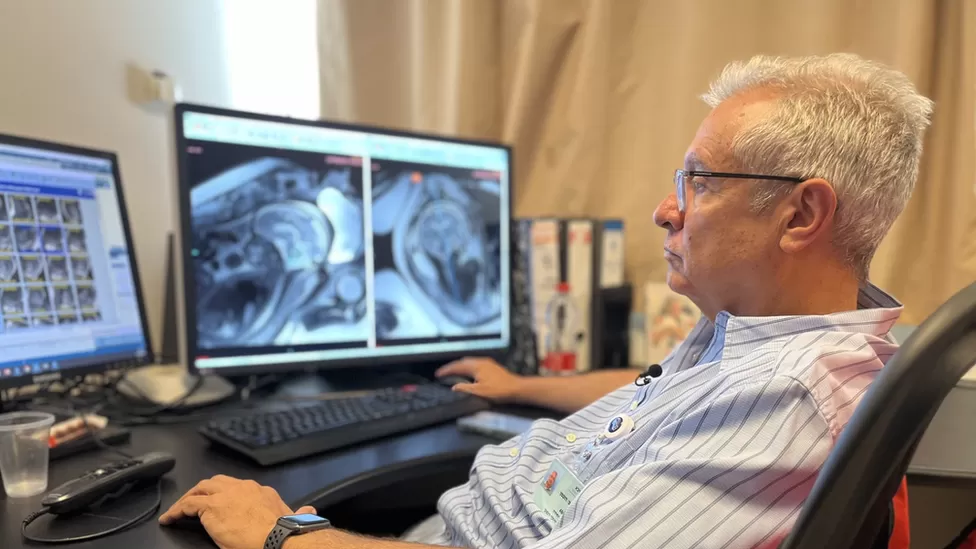
Professor Hoffmann is studying the MRI scans of expectant mothers at the Sheba Medical Centre, just outside of Tel Aviv. He is one of only four Israeli authorities in foetal neuroradiology.
In a recently released study, more than one-third of young Israeli doctors and medical students stated they intended to leave the country in the near future. The professor acknowledges feeling confused and adds that he knows many other seasoned medical professionals who, like him, want to move abroad.
He adds, “Even now, there is a medical shortage. Therefore, if even 5% of them don’t return, it will be a catastrophe.
The national anthem begins to play as we return to the weekly demonstrations in central Tel Aviv.
The protesters consider themselves ardent patriots. Many are former or current members of the Israeli military.
Some people claim that they won’t leave no matter what.
Ruth, a doctor who attends the demonstrations every week and has previously worked abroad, says, “I’m really worried, but I’m staying because I feel solidarity.”
She continues, “I have a duty to fight for this.” “For me, this is akin to a second tour in the army. Now, we resemble an army.
The battle to persuade the administration to abandon its plan to restructure the judiciary rages on amid deafening cries of “democracy.”
Yet another problem is also being silently developed as more Israelis begin to prepare their evacuation strategies.
FIFA has finalized plans that will enable Israelis and Palestinians to attend matches at the FIFA World Cup Qatar 2022, which gets underway on 20 November.
This follows a meeting with representatives from FIFA World Cup Qatar 2022 LLC (Q22), the operational arm for tournament delivery, and from Israel’s Ministry of Foreign Affairs and Ministry of Culture and Sport conducted by Qatar’s commitment to FIFA’s hosting requirements.
Direct charter flights will be temporarily operated between Ben Gurion Airport in Tel Aviv and Hamad International Airport in Doha by an airline with existing landing rights in Qatar for the duration of the FIFA World Cup, subject to Israel’s security requirements and operational capabilities. More details will be announced in due course. Visitors will need a registered Hayya (the fan ID required for entry into Qatar during the tournament) and a valid flight ticket to travel to and from Qatar.
Consular services for Israeli citizens will be provided in coordination with the Israeli Ministry of Foreign Affairs through a designated privately-operated international travel company based in Doha. Palestinians will have access to consular services at the Palestinian embassy in Doha.
Commenting on the announcement, FIFA President Gianni Infantino said: “We are delighted that an agreement has been reached for Israeli and Palestinian fans to visit Qatar and attend matches during the FIFA World Cup. With this deal, Israelis and Palestinians will be able to fly together and enjoy football together. I would like to thank our Israeli, Palestinian and Qatari counterparts for helping to make this happen. Football has the power to bring people together, it transcends all boundaries, crosses all borders, and fosters unity like nothing else. The World Cup is the ultimate symbol of football’s unifying power, and today’s historic announcement provides a platform to improve relations across the Middle East”.
A spokesperson for Q22 said: “Since winning the rights to host the FIFA World Cup 2022, we have always said that all ticket holders will be able to attend matches in Qatar. The announcement today illustrates our commitment to respecting FIFA’s policies and hosting requirements including the right of everyone to attend matches. This also includes the requirement that Palestinian ticket holders and media can travel on these chartered flights with no restrictions as they have an equal right to enjoy the tournament, which is made extra special by it being the first World Cup to be hosted in the Arab and Muslim world. The FIFA World Cup Qatar 2022 is on course to leave a positive legacy on Qatar, the Middle East, and the Arab world, and with 2.9 million of the three million tickets now sold, we look forward to welcoming fans from around the globe.”
Director General of the Israeli Ministry of Foreign Affairs, Alon Ushpiz, said: “Today’s announcement will allow Israeli citizens to freely travel to Qatar and attend matches at the World Cup. We have successfully secured all guarantees, including access to consular services for Israelis during their stay in Qatar. As the first World Cup ever hosted in the Middle East, it promises to be a celebration of football and an opportunity for Israelis to build connections and share cultural experiences with people from across our region and the wider world.”