Tag: Itamar Ben-Gvir

  • Divisive Israeli minister criticized for visiting significant Jerusalem holy site

    Divisive Israeli minister criticized for visiting significant Jerusalem holy site

    Itamar Ben-Gvir, Israel’s minister of national security, visited the Noble Sanctuary, also known as Haram al-Sharif to Muslims and the Temple Mount to Jews, on Thursday. The visit drew criticism from the Palestinian Authority and Israel’s neighbours.

    Ben-Gvir said on the website that was briefly known as Twitter, “This morning I ascended to the Temple Mount, our temple that was demolished because of gratuitous hatred. Since becoming a minister at the end of last year, far-right minister Ben-Gvir has made three trips to the location where the al-Aqsa mosque is located. Many prior clashes between Israelis and Palestinians began as tension at the sacred place.

    Jews observe Tisha B’Av, a day of sorrow, on Thursday to remember the tragedies that have befallen them, particularly the demolition of the two ancient temples that once stood on the Temple Mount, the holiest place in Judaism.

    The Palestinian Authority and the Jordanian government, which has been in charge of Jerusalem’s sacred sites since 1924 and sees itself as the protector of the city’s Muslims and Christians’ religious freedoms, both denounced his visit. The governments of Egypt and Turkey both denounced the trip.

    Ben-Gvir’s travel, according to the Jordanian Foreign Ministry, “represents a provocative and blatant breach of international law and the historical and legal status of Jerusalem and its sacred sites.” The Palestinian Authority described the visit as a step towards “imposing forcible changes on its historical and legal reality, as an integral part of the process of judaizing Jerusalem.”

    Ben Gvir set the recent political unrest in Israel in the context of his visit in a statement issued by his party, Jewish Power.

    We must always keep in mind that, on this day and in this location, we are all brothers, Ben-Gvir remarked. “Right, left, spiritual, nonreligious. We are one and the same. A terrorist does not distinguish between us or separate us when he peers through the glass. Unity and support for Israel are crucial.

    The most crucial location for the Israeli people is here, where we must return and demonstrate our ability to rule.

    Protests over the government’s proposed judicial reforms have rocked Israel for 29 weeks in a row. A bill passed this week prohibiting the court from overturning government judgements due to “unreasonability” will be challenged, the Israeli Supreme Court announced on Wednesday, and hearings will take place in September.

    The contentious legislation was approved by a vote of 64-0, with all members of the governing coalition voting in favour. All opposition MPs left the room during the vote.

    One of Israel’s most contentious politicians, Ben-Gvir, has been found guilty of anti-Arab racism in the past and has stated that he thinks the current situation at Israel’s holy sites has to be rectified.

    Only Muslims are permitted to pray inside the Al-Aqsa mosque compound, according to the so-called Status Quo agreement that dates back to the Ottoman occupation of Jerusalem; non-Muslims are only permitted to enter during specific hours. After Israel conquered them in the 1967 war, other states and Israel came to an agreement to keep Muslim pilgrims’ access to these sacred sites open.

    Jewish prayer access to the Temple Mount has been advocated by some religiously nationalist Jewish organisations. There have been multiple incidents of Jewish tourists praying in the contested region, which has angered Muslim officials and resulted in Israeli police forcibly removing them.

  • Israeli police ordered to remove Palestine flags from public places

    Israeli police ordered to remove Palestine flags from public places

    Waving the Palestinian flag, according to far-right security minister Itamar Ben-Gvir, is an endorsement of terrorism.”

    Itamar Ben-Gvir, Israel’s new far-right Minister of National Security, has ordered police to remove Palestinian flags from public areas because they constitute “terrorism.”

    Israeli law does not forbid Palestinian flags, but police and soldiers are allowed to take them down if they pose a threat to the peace.

    Sunday’s directive from Ben-Gvir, who heads the ultranationalist Jewish Power party in Benjamin Netanyahu’s new far-right government and as national security minister oversees the police, appears to signal a hardline and uncompromising attitude towards Palestinian expressions of identity and free speech and pro-Palestinian demonstrations.

    The display of the Palestinian flag in Israel has, in practice, long been clamped down on by Israeli authorities, with Palestinians regarding such moves as an attempt to suppress Palestinian identity.

    Ben-Gvir’s orders came after a mass anti-government protest in Tel Aviv on Saturday, where some demonstrators waved the Palestinian flag.

    Protesters labelled the recently sworn-in government of Prime Minister Benjamin Netanyahu as “fascist” and advocated for equality and coexistence between Palestinians and Israelis.

    Writing on Twitter, Netanyahu on Sunday said the presence of the Palestinian flag at the Tel Aviv protest was “wild incitement”.

    Ben-Gvir’s directive also follows the release last week of a long-serving Palestinian prisoner, convicted of kidnapping and killing an Israeli soldier in 1983, who waved a Palestinian flag while receiving a hero’s welcome in his village in northern Israel.

    Longest serving Palestinian prisoner, Karim Younis, is welcomed at his village, after he was freed from Israeli jail
    Younis was convicted in 1983 for the killing three years earlier of an Israeli soldier, Avraham Bromberg, in the occupied Golan Heights [Ammar Awad/Reuters]

    Ben-Gvir, in a statement, said waving the Palestinian flag is an act in support of “terrorism”.

    “It cannot be that lawbreakers wave terrorist flags, incite and encourage terrorism, so I ordered the removal of flags supporting terrorism from the public space and to stop the incitement against Israel,” Ben-Gvir said.

    Palestinian citizens of Israel account for about one-fifth of the population and most are descendants of Palestinians who remained within the state after its formation in 1948, an event known to Palestinians as the Nakba, or catastrophe.

    The majority of the population of pre-1948 historic Palestine had been Palestinians.

    They have long debated their place in Israel’s politics, balancing their Palestinian heritage with their Israeli citizenship, with the vast majority identifying as or with the Palestinians.

    Many Palestinians, both in Israel and in the occupied territory, are fearful of the new government’s policies towards them, in light of the strong presence of far-right settler groups within it, with Ben-Gvir in particular previously convicted of inciting racism towards Arabs.

    In some of its first moves over the past few days, the Israeli government rescinded the travel permit of the Palestinian foreign minister Riad al-Malki on Sunday and decided to withhold $39m in revenues from the Palestinian Authority on Friday.

    The decisions were part of an effort to penalise Palestinians for asking the International Court of Justice to give an opinion on the Israeli occupation, which is illegal under international law.

    Source: Aljazeera.com
  • Palestinian anger over holy site visit by far-right Israeli minister

    Palestinian anger over holy site visit by far-right Israeli minister

    A far-right Israeli minister’s visit to a contentious holy site in Jerusalem has been denounced by Palestinians as a “unprecedented provocation.”

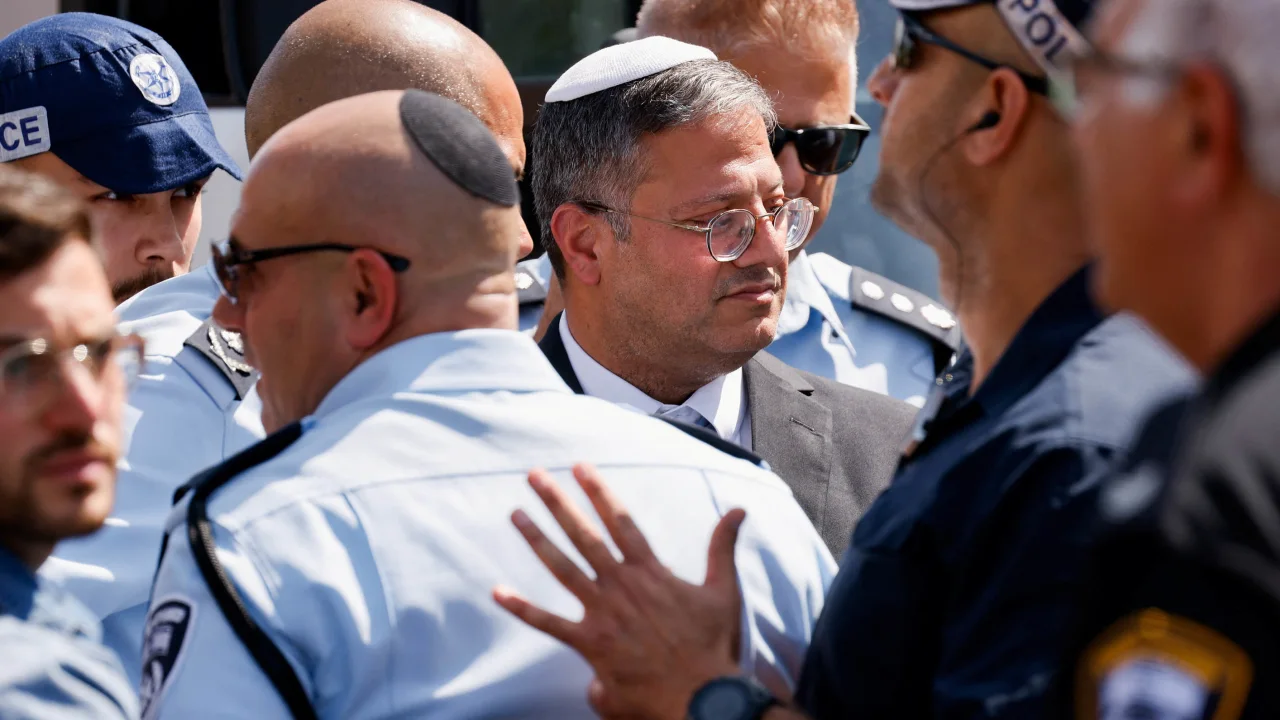
    Itamar Ben-Gvir, the minister of national security who has argued for a tougher stance against the Palestinians, toured the area while being guarded by law enforcement.

    Israel and the Palestinians are profoundly divided by competing claims to the site.

    With the election of Israel’s new nationalistic cabinet, tensions have increased.

    Since the administration, led by Prime Minister Benjamin Netanyahu, was sworn in five days ago, Mr. Ben-visit Gvir’s was his first public appearance.

    “The Temple Mount is open to everyone,” he tweeted, accompanied by a photograph of him surrounded by a security cordon with the golden Dome of the Rock in the background.

    Ahead of November’s election, Mr Ben-Gvir said that he would demand that Benjamin Netanyahu introduce “equal rights for Jews” there.

    However, Mr Netanyahu has sought to reassure Israel’s allies that he will not allow any changes. A clause in his coalition deals states that the status quo “with regard to the holy places” will be left intact.

    Mr Ben-Gvir was given the go-ahead for the visit after consulting Mr Netanyahu and security officials.

    Following the 15-minute walkaround, the Palestinian foreign ministry denounced what it described as “the storming of al-Aqsa mosque by the extremist minister Ben-Gvir and views it as unprecedented provocation and a dangerous escalation of the conflict”.

    Palestinian Prime Minister Muhammad Shtayyeh called for “thwarting the raids that aimed at turning the al-Aqsa Mosque into a Jewish temple”, saying Mr Ben-Gvir’s visit was “a violation of all norms, values, international agreements and laws, and Israel’s pledges to the American president”.

    A spokesman for the Palestinian militant Islamist group, Hamas, which governs the Gaza Strip, called it a “crime” and vowed the site “will remain Palestinian, Arab, Islamic”, AFP news agency reported.

    In his tweet, Mr Ben-Gvir sent a message of defiance to Hamas, declaring: “No Israeli government that I’m a member of is going to bow to a despicable and murderous terror organisation… and if Hamas thinks that I’ll be deterred by its threats, it needs to accept that times have changed and that there’s a government in Jerusalem.”

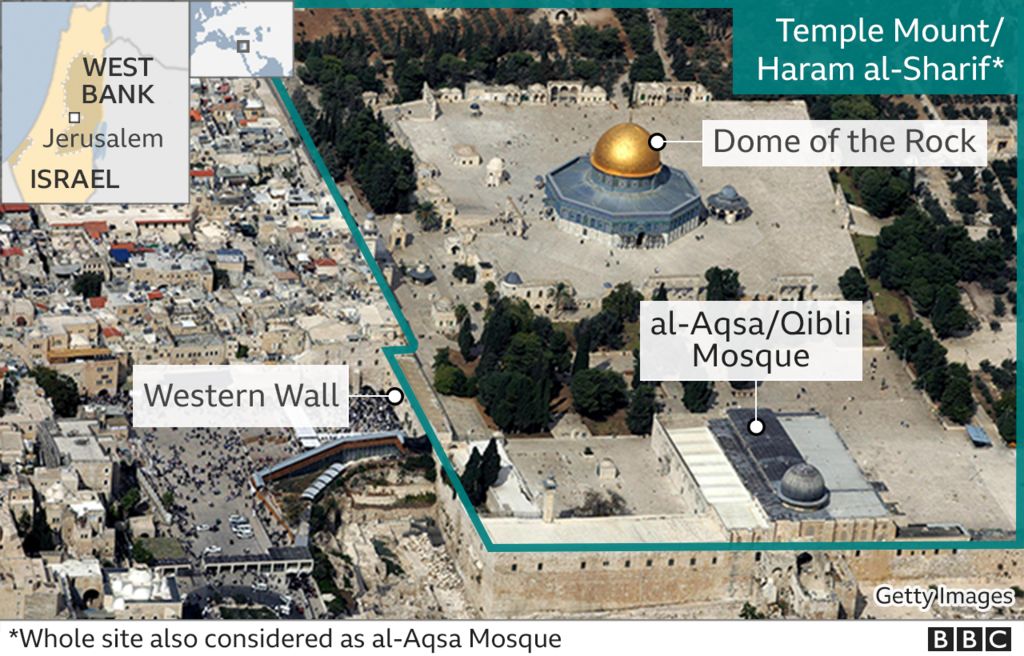
    Jerusalem holy site map

    Tensions between Israel and Palestinians which escalated into violence at the site in May 2021 saw Hamas fire rockets towards Jerusalem, triggering an 11-day conflict with Israel.

    A visit to the site in 2000 by Israeli right-winger Ariel Sharon, then opposition leader, infuriated Palestinians. Violence which followed escalated into the second Palestinian uprising, or intifada.

    The Temple Mount/Haram al-Sharif is the most sensitive site in the Israeli-Palestinian conflict. Situated in East Jerusalem, it was captured by Israel from Jordan in the 1967 Middle East war. Under a delicate set of arrangements, Jordan was allowed to continue its historical role as custodian of the site, while Israel assumed control of security and access.

    Muslim prayer continued to be the only form of worship allowed there, although a bar on Jewish visits was lifted. Palestinians argue that in recent years, steps have been taken that undermine the status quo, with Orthodox Jewish visitors often seen praying quietly without being stopped by Israeli police.

    The number of visits by Jews has swelled in the past few years, something Palestinians claim is part of a surreptitious attempt to take over the site.

  • Itamar Ben-Gvir: Far-right Israeli leader expected to join a new coalition

    The far-right Jewish Power party in Israel has formed a coalition with Benjamin Netanyahu’s Likud party.

    Its leader, Itamar Ben-Gvir, will become national security minister as part of the agreement.

    The ultra-nationalist politician is well-known for his anti-Arab remarks and has a history of racism convictions.

    It comes after Likud and its religious and far-right allies won a majority in an election earlier this month, completing Mr Netanyahu’s dramatic comeback.

    “We took a big step tonight toward a full coalition agreement, toward forming a fully, fully right-wing government,” Mr Ben-Gvir said in a statement after the deal was agreed.

    Negotiations with other potential coalition partners are continuing.

    Mr Ben-Gvir is a controversial figure in Israel. He was a follower of the late, explicitly racist, ultra-nationalist Meir Kahane, whose organisation was banned in Israel and designated as a terrorist group by the United States.

    In the past, he has called for the deportation of citizens considered “disloyal”.

    While he has attempted rebrand himself as a more conventional politician, he still takes an extremely hard line on security issues.

    This year has seen increased tension between Israelis and Palestinians, with gun and knife attacks targeting Israelis, and Israeli military raids killing Palestinian gunmen and civilians in the occupied West Bank.

    On Wednesday, a teenager was killed and 14 people were injured in two suspected bomb attacks at Jerusalem bus stops. Mr Ben-Gvir visited the site of the first explosion.

    “Even if it’s in the West Bank, lay siege to them and go from house to house in search of guns and restore our deterrence power,” he said during the visit.

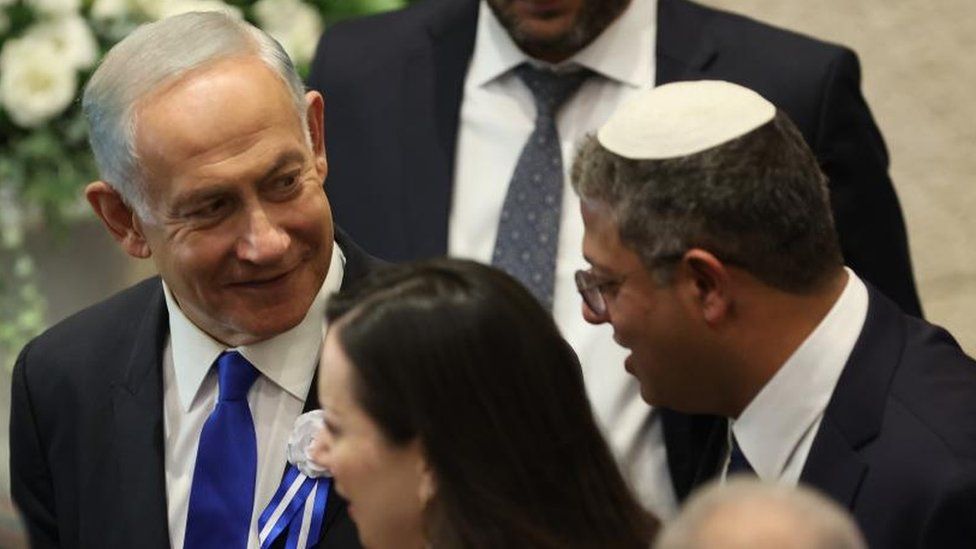
    Benjamin Netanyahu and Itamar Ben-Gvir
    IMAGE SOURCE,EPA Image caption, Benjamin Netanyahu (L) has made a remarkable political comeback

    The election ended an unprecedented period of political deadlock in Israel that began in 2019, when Mr Netanyahu – who was prime minister at the time – was charged with bribery, fraud and breach of trust, which he denies.

    He was eventually ousted from power in 2021 after 12 straight years leading the government, promising at the time: “We’ll be back!”

    He appears to have made good on the promise, winning a clear majority with his political allies just over a year later.

    However, with coalition talks still ongoing, the final make-up of his government is not yet clear.