Tag: Japan

  • Dozens of sea turtles found stabbed off Japanese island

    At least 30 green sea turtles have been found dead off a beach of a remote Japanese island, with many having been stabbed in the neck.

    Locals on Kumejina island made the discovery last Thursday, after a low tide revealed the bodies.

    At least one fishing operator admitted to wounding the animals to remove them from fishing nets, said news site the Mainichi.

    Police are investigating animal cruelty claims.

    “I disentangled some of the [turtles] and released them into the sea, but I couldn’t free [the] heavy ones so I stabbed them to get rid of them,” an unnamed fishing operator told a close source, said a report by the Mainichi.

    Local media reported police had deployed officers to the scene last week, but it’s not clear if any action has been carried out.

    Green sea turtles are listed as an endangered species by Japanese authorities and global conservation groups.

    They’re known to frequent the seaweed and kelp beds off Kumejina – one of the tiny islands about 2,000km south of the Japanese mainland – where there are also active conservation efforts.

    Marine biologists and other workers from the island’s Sea Turtle Museum had rushed to the beach after the turtles were discovered, but most had already become motionless by then.

    Several had stab wounds at the base of their necks, while others were also slashed in their flippers. Pictures released by the museum show the animals floating in shallow water.

    “I have never seen anything like this before,” one museum employee told The Asahi Shimbun.

    “It is extremely difficult to process this.”

    Source: BBC

  • Shinzo Abe: Japanese mourners pay last respects to ex-PM at funeral

    Thousands of mourners lined the streets of Tokyo to pay their last respects to ex-Japanese prime minister Shinzo Abe.

    A hearse bearing Abe’s body made its way past several landmarks before arriving at the Kirigaya funeral hall in the Shinagawa ward of Tokyo.

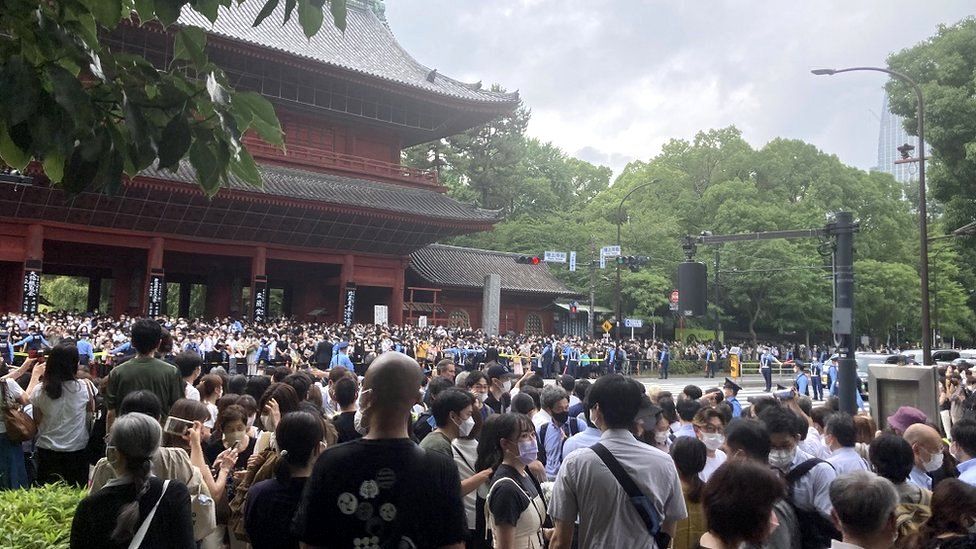
    The private funeral, which was only open to friends and close family, took place at the Zojoji temple earlier.

    The 67-year-old was shot dead last Friday while delivering a campaign speech in Nara in southern Japan.

    Across Tokyo, flags are flying at half mast and outside the temple, a long line of mourners stretched over two blocks, many of them carrying bouquets of flowers.

    Some stood with their heads bowed in prayer, some were in tears and others shouted “Thank you Abe” or “Goodbye Abe” as the motorcade drove past.

    The late prime minister’s widow and chief mourner, Akie Abe, sat in the front seat of the hearse which carried Abe’s body.

    Many mourners told the BBC that Abe gave them a sense of safety and security – one woman said that during the early days of Covid, she felt the Abe-led government had dealt with the crisis effectively.

    The hearse went past the headquarters of Abe’s Liberal Democratic Party (LDP) and made its way to the prime minister’s residence, where Prime Minister Fumio Kishida and other lawmakers received the motorcade.

    It then passed by the parliament building, where Abe first entered as a lawmaker in 1993, before arriving at the funeral hall.

    Throngs of people show up to pay their last respects to the former Japanese PM Shinzo Abe at Zojoji Temple in Tokyo on 12 July, 2022.
    Image caption, Many turned up outside the Zojoji Temple in Tokyo, where the funeral was held

    Abe was Japan’s longest-serving post-war prime minister and one of its most influential politicians.

    Police said the gunman targeted him due to grievances he had with a religious group that he believed Abe was a part of.

    The attack sent shockwaves through a nation where incidences of gun violence are extremely rare.

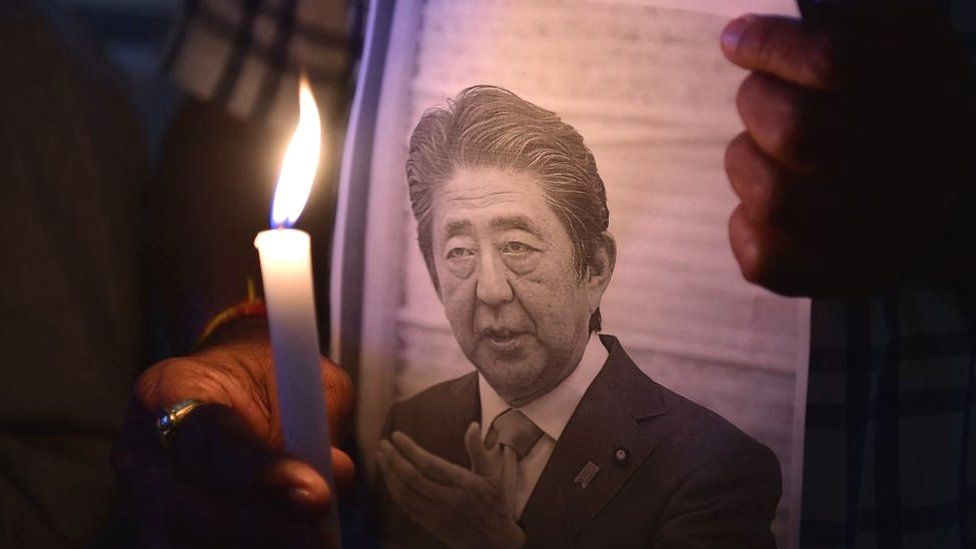
    A vigil held on Monday evening drew hundreds of dignitaries as well as thousands of ordinary Japanese citizens who came to lay flowers.

    “I came here to offer flowers because I think he gave the Japanese something to be proud about,” said Emi Osa.

    Abe was delivering a campaign speech in support of a candidate for Japan’s upper house election when he was shot twice.

    Footage of the attack showed the gunman, 41-year-old Tetsuya Yamagami, using a makeshift weapon made of metal and wood and held together by duct tape.

    Abe suffered two bullet wounds to his neck and damage to his heart during the attack. He was said to be conscious and responsive in the minutes after the attack, but doctors said no vital signs were detected by the time he was transferred for treatment.

    Police are still investigating what the gunman’s motives were and whether he acted alone.

    Members of the Japan information and study centre hold a candlelight vigil to pay tribute to the late former prime minister of Japan Shinzo Abe, at Ahmedabad Management Association in Ahmedabad on July 9, 2022, after Abe was shot dead during a campaign speech on July 8 in Nara.
    IMAGE SOURCE,GETTY IMAGES Image caption, Hundreds showed up to pay their last respects to the former prime minister of Japan

    The shooting left Japan, a country unaccustomed to gun crimes and political violence, profoundly shaken. On average, there are fewer than 10 gun-related deaths in the country each year.

    Guns are extremely difficult to acquire, and mandatory training, extensive background checks and psychological evaluation are required before permits are granted.

    Abe’s death drew an outpouring of shock from prominent world leaders, with UK Prime Minister Boris Johnson condemning the shooting as a “despicable attack”.

    US President Joe Biden called Prime Minister Kishida to express his “outrage, sadness and deep condolences”, and called the assassination “a tragedy for Japan”.

    Source: BBC

  • Japan ex-PM Shinzo Abe assassinated

    Japan’s former prime minister Shinzo Abe has died in a hospital after he was shot at a political campaign event, say local media.

    Mr Abe was shot at twice while he was giving a speech in the southern city of Nara on Friday morning.

    He immediately collapsed and was rushed to the nearest hospital. Pictures taken at the scene showed him bleeding.

    Security officials at the scene tackled the gunman, and the 41-year-old suspect is now in police custody.

    In an emotional press conference earlier, prime minister Fumio Kishida told reporters that Mr Abe was in a “very grave condition”.

    “Currently doctors are doing everything they can,” said Mr Kishida who appeared to be holding back tears, adding that he was “praying from his heart” that Mr Abe would survive.

    He also condemned the attack, saying: “It is barbaric and malicious and it cannot be tolerated.”

    The Fire and Disaster Management Agency confirmed that Mr Abe had a bullet wound on the right of his neck, and also suffered subcutaneous bleeding under the left part of his chest.

    It is unclear if both shots hit him, or if a bullet hit him on the neck and travelled elsewhere.

    National broadcaster NHK said Mr Abe was “conscious and responsive” while he was transported to the hospital, citing police sources.

    But it also quoted a senior member of Mr Abe’s party as saying the 67-year-old’s situation was “worrisome”. Mr Abe’s younger brother told reporters that the former PM was receiving a blood transfusion.

    Ex-Tokyo governor Yoichi Masuzoe had earlier said in a tweet that Mr Abe was in a state of cardiopulmonary arrest. The term is often used before a death is officially confirmed in Japan.

    Eyewitnesses see man with large gun

    Mr Abe was giving a stump speech for a political candidate in Nara at a road junction when the attack happened.

    Eyewitnesses said they saw a man carrying what they described as a large gun and firing twice at Mr Abe from behind.

    Security officers detained the attacker, who made no attempt to run, and seized his weapon which was reportedly a handmade gun.

    The suspect has been identified as Nara resident Tetsuya Yamagami. Local media reports say he is believed to be a former member of Japan’s Maritime Self-Defense Force, Japan’s equivalent of a navy.

    Mr Abe’s speech came as part of a campaign for his former party, the Liberal Democratic Party, as upper house elections in Japan are due to take place later this week.

    Ministers across the country were later told to return to Tokyo immediately, according to local reports.

    On Japanese social media, the hashtag “We want democracy, not violence” was trending, with many social media users expressing their horror and disgust towards the incident.

    Source: BBC

  • Shinzo Abe: Japan ex-PM ‘in grave condition’ after shooting

    Japan’s former prime minister Shinzo Abe is said to be in grave condition after he was shot at a political campaign event.

    Mr Abe was shot at twice while he was giving a speech in the southern city of Nara on Friday morning.

    He immediately collapsed and was rushed to the nearest hospital. Pictures taken at the scene showed him bleeding.

    Security officials at the scene tackled the gunman, and the 41-year-old suspect is now in police custody.

    In an emotional press conference a few hours later, prime minister Fumio Kishida told reporters that Mr Abe was in a “very grave condition”.

    “Currently doctors are doing everything they can,” said Mr Kishida who appeared to be holding back tears, adding that he was “praying from his heart” that Mr Abe would survive.

    He also condemned the attack, saying: “It is barbaric and malicious and it cannot be tolerated.”

    The Fire and Disaster Management Agency confirmed that Mr Abe had a bullet wound on the right of his neck, and also suffered subcutaneous bleeding under the left part of his chest.

    Aerials from the scene where former Japan PM Abe was shot

    It is unclear if both shots hit him, or if a bullet hit him on the neck and travelled elsewhere.

    National broadcaster NHK said Mr Abe was “conscious and responsive” while being transported to the hospital, citing police sources.

    But it also quoted a senior member of Mr Abe’s party as saying the 67-year-old’s situation was “worrisome” and that he was getting a blood transfusion.

    Ex-Tokyo governor Yoichi Masuzoe had earlier said in a tweet that Mr Abe was in a state of cardiopulmonary arrest. The term is often used before a death is officially confirmed in Japan.

    Eyewitnesses see man with large gun

    Mr Abe was giving a stump speech for a political candidate in Nara at a road junction when the attack happened.

    Eyewitnesses said they saw a man carrying what they described as a large gun and firing twice at Mr Abe from behind.

    Security officers detained the attacker, who made no attempt to run, and seized his weapon which was reportedly a handmade gun.

    The suspect has been identified as Nara resident Tetsuya Yamagami. Local media reports say he is believed to be a former member of Japan’s Maritime Self-Defense Force, Japan’s equivalent of a navy.

    Mr Abe’s speech came as part of a campaign for his former party, the Liberal Democratic Party, as upper house elections in Japan are due to take place later this week.

    Ministers across the country were later told to return to Tokyo immediately, according to local reports.

    On Japanese social media, the hashtag “We want democracy, not violence” was trending, with many social media users expressing their horror and disgust towards the incident.

    Source: BBC

  • Work on N-8 highway halts after angry workers attack Japanese contractors

    The ongoing work on the National Trunk Road (N8) that stretches from Assin Fosu to Assin Praso has been suspended by contractors of Japanese construction firm Shimizu Dai Nippon Joint Ventures, following an attack on its staff by irate labourers hired by the firm.

    The decision of the angry workers according to reports was in solidarity with a colleague whose contract had expired and thus was asked to exit the company.

    It is reported that the workers embarked on a two-day sit-down strike after which they mobbed up on the third day in their numbers to the residence of the Japanese contractors for their action.

    The accused workers were alleged to have jumped the wall and forcibly broke into the room of one of the contractors whose name was given as “Gozwe” to drag him out of his room before subjecting him to harassment.

    Chairman of the Municipal Works Department of Assin Fosu, Eric Mensah, narrating the incident to Angel News reporter, Kwame Owusu Asante Shadrack, said the workers suspected the victim, Gozwe, was the one who masterminded the dismissal of their colleague after the expiration of his contract.

    He added that the victim had his leg broken in the process as a result of the assault on him.

    The Chairman noted that the assault infuriated the Shimizu Dai Nippon Joint Ventures to suspend its activities on road construction indefinitely.

    In this light, the managers of the construction firm have reiterated that they will pay the employees three months’ salary and proceed to sack them from their labour post since they cannot continue working with them, says the Municipal Works Department of Assin Fosu, Mr. Mensah.

    He used the medium to condemn the behavior of the irate workers stressing that the Municipal Assembly is expected on Monday, January 17, 2022, to sit on the matter and bring the perpetrators to order since their approach is unlawful.

    Confirming the matter, District Commander of Assin Fosu, Chief Superintendent Cephas Arthur said the police swiftly intervened to avert the clash and has since augmented the strength of the security in the area with police personnel from the Region to ensure full protection of the residence of the contractors.

    Chief Supt. Cephas Arthur, therefore, admonished the workers to be law-abiding and use the appropriate channels to register their displeasure because they would not go scot-free if found guilty by the law.

    Source: angelonline.com

  • Japan finds COVID-19 variant in three people with no record of travel to UK

    Japanese doctors have detected a fast-spreading variant of the new coronavirus first discovered in Britain in three people who had not travelled there, the Health Ministry said on Monday.

    The three, aged from their 20s to their 60s and living in Shizuoka prefecture, about 200 km (125 miles) west of Tokyo, first had symptoms in early January, the ministry said.

    A health ministry official said that the authorities are looking into how the three became infected but that there was no proof yet that the variant first detected in Britain was spreading in Shizuoka now.

    Japan has so far detected 45 cases of new variants of the virus that were first spotted in Britain, South Africa and Brazil, he said.

    Japan earlier this month expanded a state of emergency declared in the Tokyo area to seven more prefectures to curb COVID-19 cases.

    The country has recorded about 335,000 cases of infection so far, including 4,500 deaths, public broadcaster NHK said.

    Source: reuters.com

  • Ghana, Japan sign US$1m Tema Motorway grant agreement

    The government of Ghana has signed a US$1,000,000 (109 million Yen) grant assistant agreement with Japan for phase two of the Tema Motorway roundabout project.

    The grant will be used for the construction of flyovers at the arterial roads in Tema to alleviate traffic congestion and improve the business environment.

    The project builds on the magnificent high-quality phase one Tema roundabout project which was financed with a grant of US$56 million (six billion Yen) secured from the Japanese government and commissioned by President Akufo-Addo on June 5.

    The phase one comprised a two-tier intersection, a tunnel in the east-west direction, four kilometres of improved roads, four pedestrian bridges, one at each approach to the intersection, and the construction of several drainage structures.

    Japanese Ambassador to Ghana, Himeno Tsutomu said: “These Grant Assistance are the showcase of the strong Japan-Ghana friendship and partnership.”

    He noted that it was the wish of the people and the government of Japan that these projects will make a valuable contribution in the area of road infrastructure.

    Deputy Minister for Foreign Affairs and Regional Integration, Charles Owiredu, said the phase two of the project, which is scheduled to commence in the fourth quarter of this year, would see the transformation of the parallel two-tier interchange into a three-tier one to further improve the turnaround time at the interchange.

    Besides the Tema Motorway Roundabout project, the Deputy Minister said the Japanese government is also supporting Ghana in the construction of a new bridge across the Volta River on the Eastern corridor, among other ongoing projects in the country.

    “It is my hope that the projects, when completed, would ensure safe, efficient road transportation and contribute to the efficient flow of goods and services,” he added.

    Source: Daily Guide Network

  • Japan donates $2.2m to fight locust invasion in South Sudan

    The Japanese government has donated $2.2 million to the fight against locust invasion in South Sudan.

    In a statement on Wednesday, Japan’s Foreign Ministry said the funds are meant to mitigate damage caused by the desert locusts.

    “In South Sudan, there are concerns that the country will face a serious food crisis due to the locusts’ damage in addition to the damage caused by the flood since last year. It is expected that the provision of relief assistance will improve the nutritional condition of approximately 49,900 people,” read the statement.

    Sudan will also receive $1.7 million grant aid while Uganda will get $600,000.

    A swarm of crop-eating locusts descended on South Sudan’s Magwi County, bordering Uganda in February, according to then Agriculture and Food Security Minister, Onyoti Adigo.

    In response, the country representative of the United Nations Food and Agriculture Organisation said the institution immediately placed together 1,000 back sprayers to counter the invasion.

    Late in February, the US announced $8 million to support regional operations to control locusts in Ethiopia, Kenya and Somalia.

    Source: allafrica.com

  • Japan MPs pass record coronavirus budget

    Japan’s powerful lower house of parliament approved an emergency budget worth nearly $300 billion Wednesday, doubling the scale of measures to pep up the world’s third-biggest economy after the coronavirus tipped it into recession.

    Consumer spending has slowed to a crawl despite Japan’s relatively low infection numbers and the death toll from the pandemic, prompting the first economic downturn since 2015.

    In response, lawmakers approved a second exceptional budget of 31.91 trillion yen ($297 billion), including subsidies for smaller businesses and cash handouts for medical workers.

    The budget bill will be sent to the upper house and is widely expected to be enacted as early as Friday.

    The cash – to be raised by issuing bonds – will also be used to help finance rescue programmes and loans for struggling businesses.

    The government said the size of the package, including loans and investments in addition to actual fiscal spending, is worth about 117 trillion yen, nearly the same size as the first extra budget enacted on April 30.

    Combined with that initial stimulus package, Japan’s total measures amount to 230 trillion yen when loan schemes are taken into account.

    That is a whopping 40 per cent of GDP – trumpeted by Prime Minister Shinzo Abe as the world’s biggest virus programme – and pushes Japan’s debt-to-GDP ratio up to 257 per cent, noted Naoya Oshikubo, a senior economist at SuMi TRUST.

    “It will be worth it to drive the recovery,” said Oshikubo.

    “The two supplementary budgets alone should push up real 2020 GDP by three points. In addition, the state of emergency has now ended across Japan and the economy is set to improve,” added the economist.

    Rescue measures include subsidies to help small companies pay rent, subsidies for companies paying leave allowances to their employees, grants to medical workers and grants to help drug and vaccine development.

    Japan had recorded 17,251 coronavirus infections and 919 deaths as of Tuesday – a fraction of the toll seen in global hotspots.

    But a spike in infections prompted Abe to declare a nationwide state of emergency, handing regional governors the power to ask people to stay indoors and call for businesses to close.

    He lifted the emergency declaration last month but said it would take “quite a long time” for the country to fully return to normal.

    The first extra budget that passed on April 30 included cash handouts for every resident and money to help boost the production of much-needed masks for medical workers.

    Source: france24.com

  • Man charged over deadly fire at Kyoto animation studio

    Police in Japan has charged a man 10 months after he allegedly set fire to an animation studio in Kyoto, killing 36 people.

    Shinji Aoba, 42, had been in hospital since the arson attack in July 2019. He was so badly burned that police had been unable to question him until now.

    Dozens of more people were injured during the fire, which Mr Aoba has reportedly confessed to starting.

    Kyoto Animation was well-known for series like K-On and Violet Evergarden.

    The incident was described at the time by Japan’s Prime Minister Shinzo Abe as “too appalling for words”.

    A police statement said Mr Aoba has been moved from a Kyoto hospital to police headquarters, but his injuries have left him unable to walk.

    Eyewitnesses say he used petrol from two large containers to set fire to the ground floor of the animation studio. The building was filled with animation materials and was rapidly engulfed in flames.

    Many of the 36 who died were young animators trapped on the upper floor.

    Some reports have suggested he bore a grudge against the studio, accusing it of plagiarising his own work.

    Source: bbc.com

  • Experts warn against masks for young toddlers

    Japan’s Paediatric Association has advised parents not to put masks on children under the age of two because they can make breathing difficult and increase the risk of choking.

    In a notice on its website, the group also said because children had narrow air passages, their hearts would be put under additional strain by trying to breathe through a mask.

    The US Centers for Disease Control also says children under the age of two should not wear cloth face coverings.

    Source: bbc.com

  • Japan set to lift coronavirus emergency as cases slow

    Japan was poised to lift its nationwide state of emergency over the coronavirus on Monday, gradually reopening the world’s third-biggest economy after new cases slowed to a crawl.

    Compared to hard-hit areas in Europe, the United States, Russia and Brazil, Japan has been spared the worst of the pandemic, with 16,581 cases in total and 830 deaths.

    Yet with infections threatening to run out of control, Prime Minister Shinzo Abe declared an initial state of emergency for Tokyo and six other regions on April 7 – later expanding it to cover the entire country.

    Businesses and schools were urged to shut and people were requested to remain home but Japan’s “lockdown” was far softer than in other parts of the world and there was no punishment for anyone flouting the rules.

    Citizens largely heeded the orders, with most of Tokyo’s famously packed streets falling quiet, and the number of new infections has fallen from a peak of around 700 per day to just a few dozen nationally.

    There does not appear to be one single reason why the pandemic has hit Japan less hard than other comparable countries, and trying to pinpoint possible causes has become a favourite sport on social media.

    High levels of hygiene and general health, removing shoes indoors, widespread masks, bowing as a greeting rather than shaking hands or kissing: all have been advanced as possible reasons but analysts agree there has been no silver bullet.

    Recession and deflation

    Japan has come under fire for a relatively low level of testing with around 270,000 carried out, the lowest per capita rate in the group of seven advanced economies, according to Worldometer.

    But Japanese authorities insist that mass testing was never their strategy, as cases remained low enough to rely on aggressive contact tracing to contain clusters.

    Nevertheless, testing has been ramped up in recent weeks as authorities warn of a possible next wave of the virus that could overwhelm their previous strategy.

    Medical facilities are also being boosted after horror stories of coronavirus victims being unable to find a suitable hospital bed – mainly for administrative reasons as only certain establishments are designated to deal with the virus.

    Although the human toll has been less severe than in other parts of the world, the economy – already struggling from the effects of natural disasters and a consumption tax hike – has suffered.

    The world’s third-largest economy has plunged into its first recession since 2015, data published last week showed, shrinking by 0.9 percent in the first quarter.

    With economic activity slowing to a crawl, the spectre of deflation is looming again, with consumer prices in March logging their first drop in more than three years.

    In a bid to stem the damage, Abe has ordered a mass handout of 100,000 yen ($930) per person, part of a stimulus package worth around $1 trillion.

    Coronavirus has also taken its toll politically, with polls showing support for Abe falling rapidly – a recent survey for the Asahi Shimbun suggested backing had dropped to 29 percent – the lowest since he took office in 2012.

    He performed a rare u-turn on the cash handouts – initially announcing an entirely different policy – and is seen to have bungled another signature move involving the distribution of two masks per household, which attracted widespread mockery.

    Source: france24.com

  • Carlos Ghosn: US ex-Green Beret and son arrested over escape from Japan

    US authorities have arrested a former special forces soldier and his son for allegedly helping ex-Nissan boss Carlos Ghosn flee Japan last December.

    Former Green Beret Michael Taylor, 59, and his son Peter, 26, were detained in Massachusetts on Wednesday.

    Japanese prosecutors issued warrants for their arrest in January.

    Mr Ghosn, who was detained in Japan on charges of financial misconduct in 2018, made a dramatic escape from house arrest last year.

    He denies the charges against him.

    Despite being monitored 24 hours a day, on 29 December he managed to fly to Beirut, Lebanon, via Turkey.

    Details of the Taylors’ alleged involvement in the escape are unclear. But Japanese prosecutors have said the two were in Japan at the time and helped Mr Ghosn evade security checks as he left.

    Earlier this month prosecutors in Turkey charged seven people over the escape. The suspects – four pilots, two flight attendants, and an airline executive – are also accused of helping Mr Ghosn flee.

    Full details of the escape have never been fully explained. Mr Ghosn, who holds Brazilian, French and Lebanese nationalities, ran Renault and Nissan as part of a three-way car alliance.

    He is accused of misreporting his compensation package, but has insisted he can never get a fair hearing in Japan.

    Since his arrival in Lebanon, he has told reporters he was a “hostage” in Japan, where he was left with a choice between dying there or running.

    Source: bbc.com

  • Japan’s economy slips into recession amid coronavirus woes

    Japan has fallen into recession as the financial toll of the coronavirus continues to escalate.

    The world’s third-biggest economy shrank 3.4% in the first three months of 2020 compared to a year ago, its biggest slump since 2015.

    The coronavirus is wreaking havoc on the global economy with an estimated cost of up to $8.8tn (£7.1tn).

    Last week, Germany slipped into recession as more major economies face the impact of sustained lockdowns.

    Japan didn’t go into full national lockdown but issued a state of emergency in April severely affecting supply chains and businesses in the trade-reliant nation.

    The 3.4% fall in growth domestic product (GDP) for the first three months of 2020, follows a 6.4% decline during the last quarter of 2019, pushing Japan into a technical recession.

    Stimulus package announced
    Consumers have been hit by the dual impact of the coronavirus and a sales tax hike to 10% from 8% in October.

    While Japan has lifted the state of emergency in 39 out of its 47 prefectures, the economic outlook for this current quarter is equally gloomy.

    Analysts polled by Reuters expect the country’s economy to shrink 22% during April to June, which would be its biggest decline on record.

    The Japanese government has already announced a record $1 trillion stimulus package, and the Bank of Japan expanded its stimulus measures for the second straight month in April.

    Prime minister Shinzo Abe has pledged a second budget later this month to fund fresh spending measures to cushion the economic blow of the pandemic.

    Other economies see gloom

    Last week, the Asian Development Bank (ADB) warned the global economy could face a hit of between $5.8tn and $8.8tn due to the coronavirus pandemic.

    The US economy, the world’s largest, suffered its sharpest decline in the first quarter of 2020 since the Great Depression, falling 4.8%.

    China, the world’s second-largest economy, saw economic growth shrink 6.8% in the first three months of the year, its first quarterly contraction since records began.

    Both of those economies haven’t yet been confirmed as having fallen into a technical recession, which is defined as two consecutive quarters of negative growth, but most economists expect them to in the coming months.

    Source: bbc.com

  • COVID-19: Japanese city urges citizens to donate raincoats

    The Japanese city of Osaka is urging its residents to donate plastic raincoats to help hospitals that are running short of personal protective equipment.

    Mayor Ichiro Matsui said some health workers had resorted to wearing rubbish bags when treating patients.

    “If doctors get infected, we can never beat coronavirus,” Mr Matsui said, adding that there was a severe shortage of protective gear.

    A notice on the Osaka city website said any colour and style of raincoat was acceptable as long as they were meant for adults, Reuters news agency reported.

    Osaka has nearly 900 cases, making it the second hardest-hit after Tokyo, according to media reports.

    A state of emergency was imposed in Tokyo and six other areas, including Osaka, last week. Japan has confirmed more than 8,000 cases and 166 deaths.


    Source: BBC 

  • Japan expected to declare state of emergency

    Parts of Japan are expected to go into a state of emergency in the coming days. That’s according to Japanese media, as the number of confirmed infections continues to rise despite measures to contain the virus.

    Prime Minister Shinzo Abe is expected to announce the move later on Monday though it’s thought it won’t come into effect that same day. It likely won’t be for the entire country but for big cities such as Tokyo and Osaka only.

    The decision would give the government the power to implement stricter measures to ask people to stay at home or to close businesses. It will not, though, give Mr Abe the power to impose full lockdowns like we’ve seen in China, or some European countries, where there are heavy fines for breaking the rules.

    Japan has had more than 3,600 confirmed infections and 85 deaths. There’s particular concern for Tokyo, where the number of people with confirmed infections has been sharply rising and now exceeds 1,000.

    Source: bbc.com

  • Japan expected to declare state of emergency over coronavirus

    Japanese Prime Minister Shinzo Abe will declare a state of emergency as early as Tuesday in a bid to stop the coronavirus spreading across the country, the Yomiuri newspaper reported, as the cumulative number of infections topped 1,000 in Tokyo alone.

    Abe will likely announce his plans to declare the emergency on Monday, the paper said, while Kyodo news agency said new measures would likely come into force on Wednesday.

    Pressure had been mounting on the government to make the move as the pace of infections continues to accelerate – particularly in the capital – even though it remains slow for now compared with the United States, countries in Europe and China, where thousands have died.

    Sounding alarm over the high rate of cases that couldn’t be traced, Tokyo Governor Yuriko Koike indicated last week that she would favour a state-of-emergency declaration as a means to help her urge residents to adhere to stronger social-distancing measures.

    Under a law revised in March to cover the coronavirus, the prime minister can declare a state of emergency if the disease poses a “grave danger” to lives and if its rapid spread could have a huge impact on the economy.

    Japan’s top government spokesman, Yoshihide Suga, said on Monday that a decision had yet to be made.

    Declaring an emergency would give governors in severely affected regions legal authority to call on people to stay home and businesses to close, but not to impose the kind of lockdowns seen in other countries. In most cases, there are no penalties for ignoring requests, and enforcement will rely more on peer pressure and respect for authority.

    The government is likely to designate the greater Tokyo metropolitan area for the state of emergency, and possibly also Osaka and Hyogo prefectures in western Japan, the Yomiuri reported.

    More than 3,500 people have tested positive and 85 have died in Japan from the COVID-19 disease associated with new coronavirus, according to public broadcaster NHK.

    While that toll is dwarfed by 335,000 infections and more than 9,500 deaths in the United States alone, experts worry a sudden surge could strain Japan’s medical system and leave patients with nowhere to go.

    Kenji Shibuya, director of the Institute for Public Health at King’s College, London, said Abe’s decision on a state of emergency was too late given the explosive rise in Tokyo.

    “It should have been declared by April 1 at the latest,” he said.

    Abe must seek formal advice from a panel of experts before deciding to go ahead and declare a state of emergency. One medical professional on the panel has said a decision to do so was “complex”, involving political, economic and other factors.

    The government’s coronavirus task force – a separate entity from the panel of experts – is scheduled to hold a meeting on Monday evening. Government spokesman Suga said he was not aware of any meeting with the advisory panel of experts itself on Monday.

    Governors in Tokyo and elsewhere have previously asked citizens to stay home on weekends, avoid crowds and evening outings, and work from home. That had some effect, but less than many experts said was needed.

    Restricting movement and businesses under a state of emergency would deal a heavy blow to an economy already struggling to avoid a recession. The government is readying a stimulus package of hundreds of billions of dollars to be rolled out this week.

    Source: France24

  • Cancellation of the Olympics would be ‘unacceptable’

    Japan does not expect to receive a cancellation notice from the International Olympic Committee (IOC), said Olympics Minister Seiko Hashimoto on Thursday according to a Reuters report.

    The Olympics minister said a “cancellation or delay of the Games would be unacceptable for the athletes”.

    Earlier this week, she had said that Tokyo’s contract with the IOC called for the Games to be held within 2020. She said this “could be interpreted as allowing a postponement”.

    Source: bbc.com

  • Japan quarantines 3,500 on cruise ship over new coronavirus

    Japan has quarantined a cruise ship carrying 3,500 people and was testing passengers for the new coronavirus on Tuesday after a passenger who departed in Hong Kong tested positive for the virus.

    Television footage showed images of several quarantine officers entering the Diamond Princess cruise ship at the port of Yokohama on Monday evening to check the health of all 2,500 passengers and 1,000 crew members.

    The move comes after an 80-year-old passenger who disembarked on January 25 in Hong Kong tested positive for the deadly virus.

    Japan’s top government spokesman Yoshihide Suga said on Monday that Japanese authorities would quarantine the vessel, which arrived at Yokohama Bay a day earlier than originally planned.

    A woman in her twenties who was sailing with her mother on the ship told private broadcaster TBS on Tuesday that all passengers “were asked to stay in their rooms to wait for virus tests”.

    She said they had been waiting inside their room since Monday and had no word of when they would be tested as of early Tuesday.

    After the ship arrived in Yokohama on Monday evening, passengers were told their departure from the area would be delayed by 24 hours, a passenger told Kyodo News agency.

    The cruise ship has already been quarantined once, on Saturday at a port in Naha in Japan’s southernmost prefecture of Okinawa.

    But a second quarantine was organised after the man who disembarked in Hong Kong was found to be infected.

    Since Saturday, Japan has been barring foreign nationals who have been to Hubei in recent weeks, as well as holders of Chinese passports issued in Hubei. Arrivals displaying symptoms of the new virus can also be denied entry.

    A total of eight foreigners have been barred from entering so far, Suga said on Monday.

    The health ministry said as of Monday that 20 people in Japan have tested positive for the new virus, of whom four showed no symptoms.

    Japan has flown more than 500 citizens out of Wuhan, the epicentre of the coronavirus.

    Source: AFP

  • Man arrested for calling a telecom company 24,000 times to complain

    A 71-year-old man who allegedly made 24,000 toll-free calls to a telecoms provider to complain that the company had violated his contract has been arrested by police in Japan.

    The man, identified as Akitoshi Okamoto, was taken into police custody on November 26 on suspicion of “fraudulent obstruction of business,” a Tokyo Metropolitan Police spokesman told CNN.

    Police said the man repeatedly called KDDI, a Japanese telecommunications operator, and demanded its staff come to him and apologize for breaking the terms of his service contract.

    Read:Lawyer sues Kenyan telecoms over data expiry

    “He also repeatedly hung up the calls as soon as someone picked up,” the spokesman added.

    In a statement to CNN, KDDI said it had received some 24,000 calls from Okamoto since May 2017. It eventually decided to file a damage report to the police in October this year, as the man increased his frequency of calling its customer service hotline, which it said “seriously interfered with its business.”

    Read:Mobile phone users agitated over increase in telecom tariffs

    Okamoto has denied the charges and told police he was the victim, CNN affiliate TV Asahi reported.

    The Japanese broadcaster said the man believed that KDDI violated his contract because he could not phone into a radio show using a number that the station had provided.

    Anyone who prevents a business from operating normally can be charged with “fraudulent obstruction of business” under Japanese law, and could be sentenced to up to three years in prison.

    Source: cnn.com