NATO’s leader, Jens Stoltenberg, said he is hopeful that Sweden might join their military group by March. Hungary and Turkiye both gave positive signs this week.
Sweden and Finland, who used to stay out of military conflicts, changed their minds when Russia invaded Ukraine in February 2022. They asked to join NATO for protection. Finland joined, and now all 31 countries, including Finland, have to agree for Sweden to join.
“Sweden joining NATO will make the whole group stronger,” Stoltenberg told reporters. He also talked about his discussions with Hungarian Prime Minister Viktor Orban and mentioned new developments in Turkey.
I got a message from Budapest that the parliament will meet again at the end of February. So, we have to wait until then. “But I believe in Hungary and I am sure of it,” Stoltenberg said.
At first, Hungary didn’t explain why they were delaying, and Orban said his government wouldn’t be the last to agree with Sweden. However, the European Commission refused to let Hungary have access to EU funds because they were not being democratic. This made the attitude towards Stockholm become more severe.
Budapest said that Swedish politicians are telling big lies about how Hungary’s government works.
Orban, who disagrees with NATO allies by supporting Russia’s invasion of Ukraine, said on Tuesday that he invited Swedish Prime Minister Ulf Kristersson to Budapest to talk about working together on security and defense.
If there is no emergency meeting, the parliament will meet on Feb. for Sweden’s bid. “Please rewrite this text in simpler words. ”
To let Sweden join, Turkish President Recep Tayyip Erdogan set some rules. One of them is to take a stronger position against groups that Turkey sees as a danger, like Kurdish militants and people involved in a coup attempt in 2016.
On his own, Erdogan wanted to make a deal with the United States to buy fighter jets. This was also related to his approval of something else.
On Tuesday, Turkish leaders voted and approved Sweden’s request to join by 287 votes to 55. The Turkish government finished the process on Thursday by publishing the measure in an official newspaper.
Stoltenberg was glad that on Thursday night Erdogan signed the decision of the parliament, so now all decisions are in place in Turkey.
Sweden is going to join NATO as the 32nd member after Hungary finishes its processes and the U. Sgets approval from all the other countries. “State Department” can be simplified to “government office. “
Tag: Jens Stoltenberg
-

NATO leader optimistic Sweden could be prepared to join by March
-
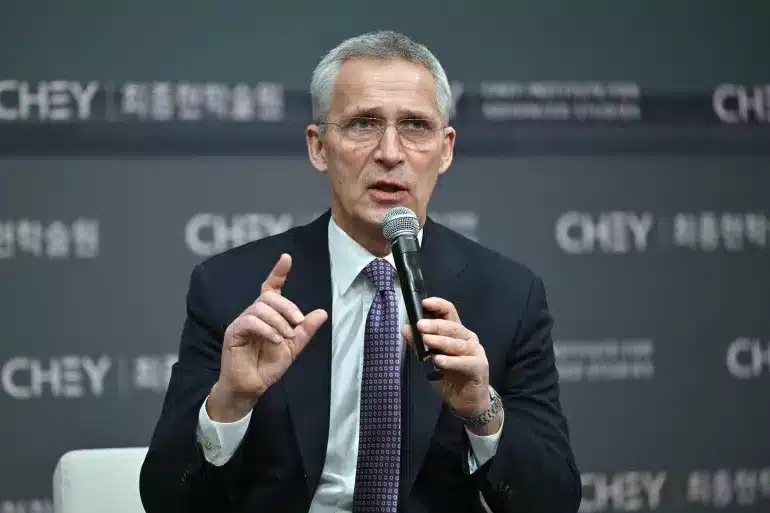
NATO chief requests South Korea “step up” its military assistance to Ukraine
Jens Stoltenberg recommends that Seoul rethink its prohibition on the export of weapons to nations engaged in hostilities.
NATO Secretary-General Jens Stoltenberg has urged South Korea to “step up” its military support for Ukraine, citing other nations that have altered their export laws in response to the Russian invasion.
On Monday, Stoltenberg made the appeal in Seoul, the capital of South Korea.
He is in the city for the first leg of a trip to Asia that will also stop in Japan and is intended to strengthen ties with the democratic allies in the region in light of the conflict in the Ukraine and the escalating rivalry with China.
In meetings with senior South Korean officials, Stoltenberg argued that events in Europe and North America are interconnected with other regions, and that the alliance wants to help manage global threats by increasing partnerships in Asia.
Speaking at the Chey Institute for Advanced Studies in Seoul, he thanked South Korea for its nonlethal aid to Ukraine but urged it to do more, adding there was an “urgent need” for ammunition. Russia calls the invasion a “special operation”.
He pointed to countries like Germany and Norway that had “longstanding policies not to export weapons to countries in conflict” that were revised after Russian President Vladimir Putin ordered the invasion of Ukraine in February last year.
“If we believe in freedom, democracy, if we don’t want autocracy and totalitarian to win then they need weapons,” he said.
South Korea is an increasingly important global arms exporter and has recently signed deals to sell hundreds of tanks to European countries, including NATO-member Poland. But South Korean law bans the export of weapons to countries in active conflict, which Seoul has said makes it difficult to provide arms directly to Kyiv.
South Korea opened its first diplomatic mission to NATO last year.
Stoltenberg said it was unclear when the conflict in Ukraine would end, saying Putin was preparing for “more war” and actively acquiring weapons from countries, including North Korea.
In a statement carried by state media on Monday, North Korea called Stoltenberg’s visit a “prelude to confrontation and war as it brings the dark clouds of a ‘new Cold War’ to the Asia-Pacific region”.
Pyongyang on Sunday denied sending weapons to Moscow, accusing the United States of spreading a “groundless rumor”.
“Trying to tarnish the image of [North Korea] by fabricating a non-existent thing is a grave provocation that can never be allowed and that cannot but trigger its reaction,” said Kwon Jong Gun, director general of North Korea’s Department of US Affairs.
He also called it “a foolish attempt to justify its offer of weapons to Ukraine”.
Earlier this week, US President Joe Biden promised 31 Abrams tanks, one of the most powerful and sophisticated weapons in the US army, to help Kyiv fight off Moscow’s invasion.
-
Ukraine war: Kyiv is not to blame for the Poland missile, according to Zelensky
President Volodymyr Zelensky has stated that he has “no doubts” that Ukraine was not to blame for the Tuesday missile strike in Poland that killed two people.
Mr Zelensky stated that he had been assured by his top commanders that “it wasn’t our missile.”
He also demanded that Ukrainian officials be allowed to visit the blast site and participate in the investigation.
His remarks came as Nato Secretary-General Jens Stoltenberg stated that Kyiv’s air defence missiles were “most likely” to blame.
US Vice President Joe Biden questioned Mr Zelensky’s claim that the missile was not of Ukrainian origin, telling reporters that “that’s not the evidence.”
The missile blast occurred on a farm in Przewodow, just 6km (4 miles) from Poland’s border with Ukraine.
Ukrainian air defence systems were activated on Tuesday when Russia launched what is believed to be its biggest wave of missile strikes since its February invasion.
The attack, which occurred during the G20 summit in Indonesia, caused an international outcry, while news of a missile blast inside Nato member Poland’s territory raised fears of a dangerous escalation in the war.
But Polish President Andrzej Duda said it was “highly probable” that the missile was launched by Ukrainian anti-aircraft defence.
“From the information that we and our allies have, it was an S-300 rocket made in the Soviet Union, an old rocket and there is no evidence that it was launched by the Russian side,” he said.
Mr Stoltenberg told the BBC that he agreed with Poland’s assessment that the incident was probably caused by a Ukrainian air defence missile.
“But the main message is that Russia bears the ultimate responsibility, because this would not have happened hadn’t Russia waged a brutal war of aggression against Ukraine,” he said.
He added that Nato had pledged to supply a “more advanced air defence system” to Ukraine, which is not a member of the alliance but receives extensive military aid.
And Linda Thomas-Greenfield, the US ambassador to the UN, said Russia bore ultimate responsibility for the incident.
“While we still don’t know all the facts, we do know one thing – this tragedy would never have happened but for Russia’s needless invasion of Ukraine and its recent missile assaults against Ukraine’s civilian infrastructure. The UN Charter is clear. Ukraine has every right to defend itself against this barrage,” she said at a meeting of the UN Security Council.
Meanwhile, the top US general has warned that an early military victory for Ukraine remains unlikely, despite a series of successful Ukrainian counter-offensives in the east and south.
Last week, Ukraine recaptured Kherson, the only major city to fall to Russia since it started its invasion in February. And in the east, a Ukrainian offensive launched in September has seen Kyiv’s forces advance into Donestsk and Luhansk.
“The probability of a Ukrainian military victory – defined as kicking the Russians out of all of Ukraine to include what they claim as Crimea – the probability of that happening any time soon is not high, militarily,” Gen Mark Milley – the Chairman of the Joint Chiefs of Staff – told reporters at the Pentagon.
But he said recent Russian losses meant a “political solution” was possible.
Gen Milley, who serves as President Biden’s top military adviser, said the Ukrainian gains had left Russia “on its back” and observed that its losses could see Moscow agree to some sort of a political withdrawal.
But the top US general did not elaborate as to what that agreement would look like.
Speaking to attendees of the G20 summit in Bali earlier this week, President Zelensky laid out a 10-point peace plan that includes nuclear safety guarantees, the withdrawal of Russian troops from Ukraine’s territory, and reparations and justice for “Russia’s aggression against Ukraine”.
But Moscow’s Foreign Minister Sergei Lavrov said Kyiv’s demands were “unrealistic and inadequate”. He added that Ukraine “categorically refuses” negotiations with Russia.
Elsewhere, the eastern Donetsk region has seen heavy fighting in recent days, according to Ukrainian presidential adviser Oleksiy Arestovych.
He said Russian troops from Kherson region had now been “redirected” towards Donetsk and Luhansk.
-
Up to Ukraine to decide what terms for talks with Russia are acceptable: NATO chief
NATO Secretary-General Jens Stoltenberg has said it is up to Ukraine to decide what terms are acceptable for negotiations with Russia to bring an end to the war.
“It is for Ukraine to decide what kind of terms are acceptable. It is for us to support them,” Stoltenberg said during a press conference with members of the Dutch government in The Hague.
“We should not make the mistake of underestimating Russia … They still control large parts of Ukraine … What we should do is strengthen Ukraine’s hand,” Stoltenberg added.
Source: Aljazeera.com