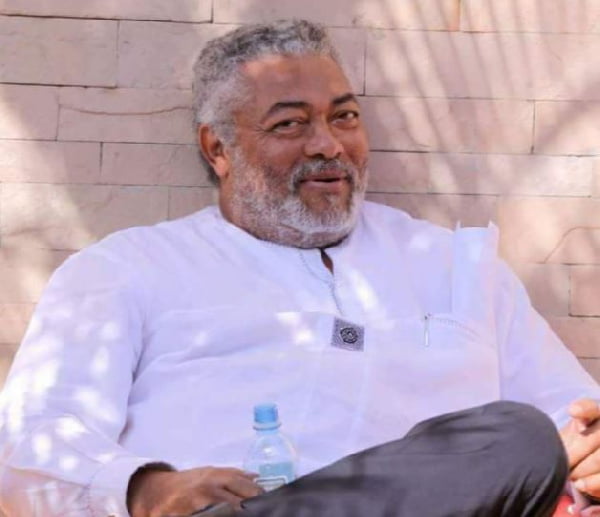
Ghana’s former President Jerry John Rawlings’ legacy has been honoured five years after his death, with one of Nigeria’s indigenous carriers, United Nigeria Airlines, naming an aircraft after him.
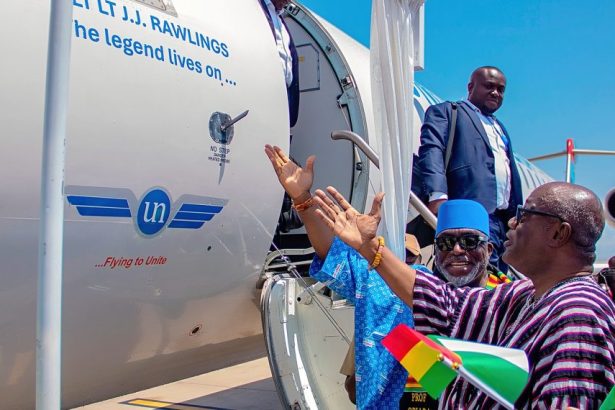
The aircraft named “J.J. Rawlings” completed its first flight to Accra on Monday, November 10, with several dignitaries, including Ghana’s Ambassador to Nigeria, Baba Jamal; Chief Professor Obiora Okonkwo, Chairman and CEO of United Nigeria Airlines; senior Nigerian aviation officials, and other guests, signifying United Nigeria Airlines’ debut route between Abuja and Accra.
A brief inaugural ceremony was held at Terminal 3, Gate C8, upon arrival at the Kotoka International Airport (KIA) to unveil the inscription on the aircraft — “J.J. Rawlings… The legend lives on.”
former Minister and Member of Parliament for Ablekuma South, Fritz Baffour, to unveil the inscription on the aircraft — “J.J. Rawlings… The legend lives on.” upon arrival at Kotoka International Airport.
In his address, Chief Professor Obiora Okonkwo, Chairman and CEO of United Nigeria Airlines, extended condolences to the Rawlings family following the recent passing of former First Lady Nana Konadu Agyeman-Rawlings and requested a minute’s silence in her memory.
He explained that discussions to commemorate the fifth anniversary of President Rawlings’ passing led to the decision to name one of the airline’s aircraft after the former Ghanaian leader, who was also a trained Air Force pilot.
Professor Okonkwo pledged that United Nigeria Airlines would uphold high standards and contribute meaningfully to aviation development in West Africa.
“We are committed to delivering quality and reliability in our operations while strengthening the bond between our two nations,” he affirmed.
Minister for Sports and Recreation, Kofi Adams, expressed appreciation to the airline for honouring the late former President.
“President Rawlings once said he would rather live in the hearts of men than have his name on monuments or streets. Today, that statement has been manifested through the naming of this aircraft,” Mr. Adams said.
He added that the gesture demonstrated the enduring influence of President Rawlings across Africa.
“Because President Rawlings lives in the hearts of men, he has been recognised even beyond his country. When we say the legend lives on, this is a good demonstration of what it means,” he noted.
Mr. Adams also recalled the late President’s passion for flying, linking it to his commitment to Ghana’s rural electrification programme.
“When he flew across Ghana at night and saw lights only in Accra and Kumasi, it inspired him to ensure that electricity reached all corners of the country,” he said.
Representing the Rawlings family, Fritz Baffour conveyed the family’s gratitude to United Nigeria Airlines for the honour, describing it as a lasting tribute.
“This gesture will stay forever Ghana and Nigeria share strong bonds — and when we come together, no one can stand us,” he remarked.
Jerry John Rawlings died on November 12, 2020 after burying his mother.
The late statesman was born in Accra on 22nd June 1947, to a Ghanaian mother from Dzelukope, near Keta, in the Volta Region, and a Scottish father.
He received his education at Achimota School, where he earned his General Certificate of Education ‘O’ Level in 1966.
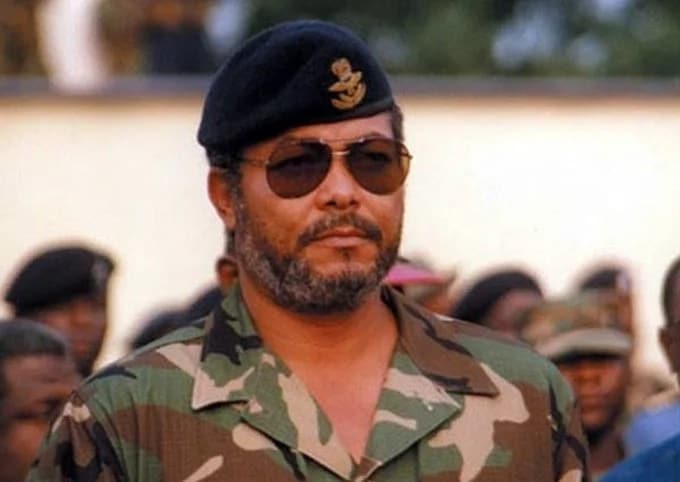
In August 1967, he joined the Ghana Air Force as a Flight Cadet and later proceeded to the Ghana Military Academy and Training School in Teshie, Accra, for officer cadet training.
By March 1968, he had been transferred to Takoradi in the Western Region to continue his aviation training.
He graduated in January 1969 as a commissioned Pilot Officer, earning the prestigious “Speed Bird Trophy” for his exceptional flying skills and airmanship.
In April 1978, he rose to the rank of Flight-Lieutenant, noted for his competence and strong connection with his fellow officers.
During his time in the Ghana Air Force, he observed a decline in discipline and morale, mirroring the corruption within the then-ruling Supreme Military Council (SMC).
As he advanced in rank and interacted more with the country’s elite, he became increasingly aware of the deep social inequalities in Ghana, a realization that made the SMC wary of him.
An avid reader and deep thinker, he often engaged in discussions on political and social change with a close circle of like-minded officers.
On May 28, 1979, Flight-Lieutenant Rawlings and six others were brought before a General Court Martial in Accra, accused of leading a mutiny of junior officers and soldiers on May 15, 1979. His statement during the trial, which outlined the social injustices that motivated his actions, sparked widespread public sympathy and reaction.
Meanwhile, in July 2025 this year, Africa World Airlines (AWA) officially launched a new direct flight route between Accra, Ghana and Burkina Faso’s capital Ouagadougou, marking a significant step in its expansion into the Sahel region.
The inaugural flight was announced at a brief ceremony in Accra, symbolizing AWA’s strategic commitment to enhancing intra-African connectivity and promoting regional trade under the African Continental Free Trade Area (AfCFTA).
Founder of Africa World Airlines and Agbogbomefia of the Asogli State, Togbe Afede XIV, underscored the airline’s dedication to strengthening integration across the continent.
“Our safety record is great. Our reliability is great, and that’s the kind of tradition we expect to continue the service we want to offer our friends from Burkina Faso. Hopefully, through them, we’ll link all of the Sahel to the rest of Africa, in line with President John Mahama’s vision of bringing Burkina Faso and Niger back into the fold,” he stated.
Togbe Afede XIV also acknowledged the concerns of passengers about rising airfares but assured that the airline remains focused on delivering value while prioritizing safety.
“I know that our passengers are concerned about ticket prices. We all need to understand that aviation is a very difficult business—capital intensive, with very small margins. Passengers demand the best of services, and we strive to provide the best value for money as we work to integrate the continent,” he explained.
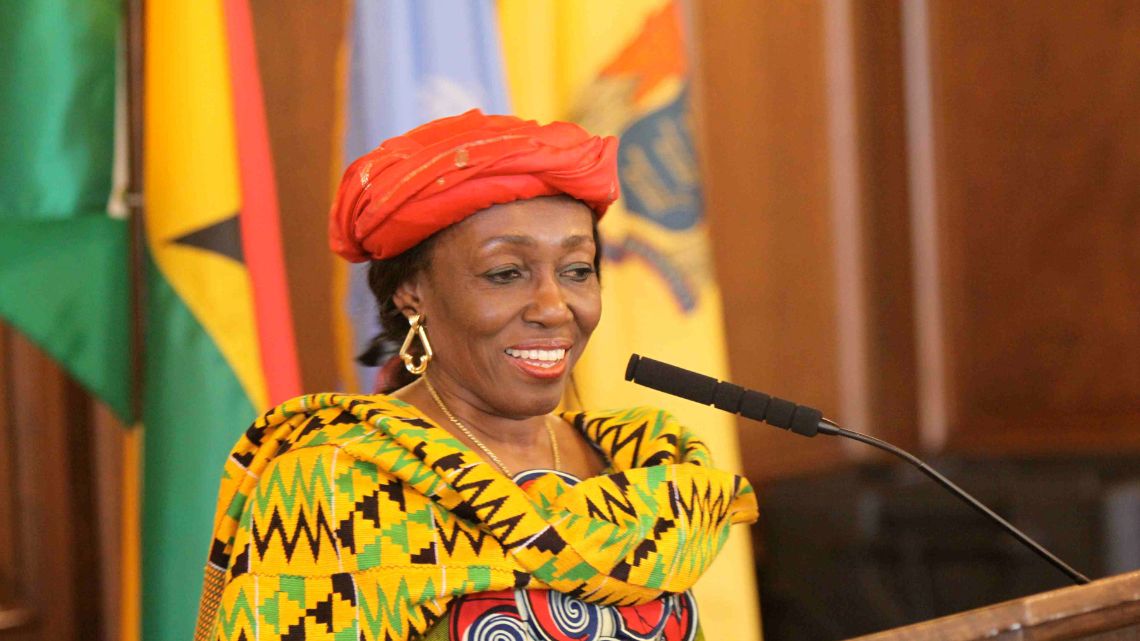
Ghana has lost one of its most remarkable political figures, Nana Konadu Agyeman-Rawlings, whose passing today (Thursday, October 23) brings to an end a defining era in the nation’s political and social landscape.
Known widely as the Iron Lady of Ghanaian politics, she rose to prominence in the 1980s and 1990s through her bold activism and fearless advocacy. Beyond being a former First Lady, she made history as the first woman to contest for the presidency in Ghana—an achievement that solidified her reputation as a pioneer.
Her life reflected unwavering dedication to women’s empowerment and a determination to challenge established norms, leaving behind a lasting legacy as one of the most influential female leaders in Ghana’s post-independence history.
The Longest Serving First Lady
Nana Konadu Agyeman, born on November 17, 1948, in Cape Coast, Central Region, began her education at Achimota School, where she would later meet her husband, Flt. Lt. Jerry John Rawlings.
She pursued Art and Textiles at the Kwame Nkrumah University of Science and Technology (KNUST) and furthered her studies abroad, earning a diploma in Interior Design from the London College of Arts in 1975. Her quest for knowledge continued with a diploma in Advanced Personnel Management and a certificate in Development from GIMPA, underscoring her intellectual curiosity and commitment to personal growth.
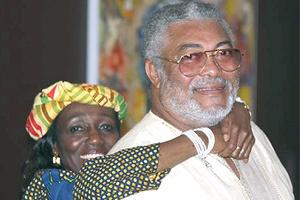
Her marriage to Rawlings in 1977 marked the beginning of her deep involvement in Ghana’s political evolution. As First Lady, she served during two significant phases of Ghana’s governance—first in 1979 under the Armed Forces Revolutionary Council (AFRC) and later from 1981 to 2001 under the PNDC and the Fourth Republic.
Her 20-year tenure as First Lady, the longest in Ghana’s history, provided her with a unique platform to drive social transformation and advocate for national progress.
The Engine of Women’s Empowerment: 31st DWM
Nana Konadu Agyeman-Rawlings is widely recognised as the founder and president of the 31st December Women’s Movement (31st DWM), which she established in 1982.
Far from being a symbolic organisation, the movement became a dynamic grassroots force dedicated to mobilising and empowering women across Ghana, particularly in rural areas, inspired by her conviction that women held the key to breaking the cycle of poverty.
Its achievements were visible and far-reaching, transforming women’s roles from passive beneficiaries of aid to active participants in the country’s political and economic development.
Grassroots Mobilisation: It mobilised an estimated two million women across the country, encouraging their participation in community and national decision-making. The Movement established over 870 pre-schools across the regions to free women to engage in economic activities.
Economic Projects: The 31st DWM supported numerous income-generating activities and small-scale, village-level economic projects, encouraging women to save money for community development.
Education and Health: It ran extensive functional adult literacy programmes to tackle high illiteracy rates among rural women and implemented public health programmes focusing on nutrition and immunisation.
Legal and Political Reform: She was instrumental in advocating for legal changes, including the crucial role she played in the adoption of the Intestate Succession Law (PNDCL 111), which drastically improved the inheritance rights of widows and children—a vital shift away from traditional barriers where women often had no rights of inheritance upon the death of their husbands. Furthermore, through her efforts, Ghana became the first nation in the world to approve the United Nations Convention on the Rights of the Child (UNCRC) in 1991.
Agyeman-Rawlings often framed the movement as an essential political tool: “Before December 31, 1981, they had no power of influence in law or politics… I can see from the self-esteem and near arrogance of the women that now we’ve actually been able to break through this thick wall,” she once noted, highlighting the movement’s mission to empower.
An Unyielding Political Force and Trailblazer
Even after her years as First Lady, Nana Konadu Agyeman-Rawlings continued to be a formidable presence in Ghana’s political space, known for her strong will and unshakable principles.
Her political approach—described by some analysts as femocracy—combined her passion for women’s empowerment with her assertive influence in national affairs. Her rise to the position of First Vice Chairperson of the National Democratic Congress (NDC) in 2009 marked the height of her political engagement within the party.
Tensions, however, surfaced when she challenged the late President John Atta Mills for the NDC’s flagbearership in 2011, a bold move that unsettled the political establishment. This turning point ultimately led her to establish the National Democratic Party (NDP), symbolising her determination to chart an independent path.
In 2016, Nana Konadu made history as Ghana’s first female presidential candidate—a milestone that not only broke barriers but also inspired countless women to aspire to leadership. Although she garnered just 0.16% of the votes, her candidacy embodied courage and the relentless pursuit of gender equality in politics.
Her life reflected endurance, conviction, and an unwavering faith in the potential of Ghanaian women. Through her activism and leadership, she left an indelible mark on the nation, paving the way for generations of women to dream bigger and lead boldly.
The National Democratic Congress (NDC) is set to name its headquarters after the party’s founder, the late former President Jerry John Rawlings.
This was announced by the NDC National Chairman, Johnson Asiedu Nketiah, during the 46th anniversary of the June 4 uprising, held at Agormanya Lasi Park in the Eastern Region.
He said the party’s Functional Executive Committee (FEC) has approved a series of proposals—pending consent from the National Executive Committee (NEC)—to honour Rawlings’ towering influence.
Top among these is the renaming of the party’s national headquarters to “Jerry Rawlings House.”
“Party headquarters across the world are named after their founders. Ghana cannot be an exception. We will begin the process to rename our national headquarters as Rawlings House,” Asiedu Nketiah said as many responded with a roaring applause.
The NDC intends to adjust the constitution to set Rawlings’ birthday-June 22—as an official party day.
Also, there have been proposals to mark the month of June as an “NDC Month.”
The national chairman went on to express his discontent with the current state of Revolutionary Square, located opposite the Jubilee House, calling for the urgent establishment of a team to restore the site to its former glory.
As it stands, there is very little information about the current physical state of the monument, but due to its historical significance to the party’s roots, given its association with Jerry John Rawlings, Asiedu Nketiah wants it attended to and maintained appropriately.
“Please establish a planning committee to advise on how we can get Revolutionary Square back to its original status. If we need to contact the Museums and Monuments Board, it must be done.”
“It doesn’t just represent a monument—it teaches our youth a lesson,” he charged.
The June 4 uprising, led by then Flight Lieutenant Rawlings in 1979, remains a cornerstone of the NDC’s political heritage, symbolising the values of accountability, discipline, and revolutionary change.
The proposed reforms are seen as a major attempt by the party to institutionalise this legacy for future generations.
The June 4 Uprising in Ghana was a military revolt led by the late founder and former president, Flight Lieutenant Jerry John Rawlings, and junior officers, driven by frustration over corruption, poor conditions, and unpaid salaries in the armed forces.
After a failed coup attempt in May, Rawlings was jailed but used his trial to expose the ruling regime’s corruption.
On June 3, he was freed by junior officers, who made him their leader.
The uprising led to the overthrow of the Supreme Military Council, the execution of senior officers, and Rawlings’ leadership of the Armed Forces Revolutionary Council (AFRC), which briefly ruled before transferring power to civilian president Hilla Limann in September 1979.
A well-known cousin of the late President Jerry John Rawlings, Michael Agbotui Soussoudis, has reportedly passed away in South Africa on Tuesday, September 3, 2024.
The specifics surrounding his death remain unclear, though it has been linked to lung failure.
Mr Soussoudis is remembered for his involvement in the Sharon Scranage espionage scandal, which saw classified information passed from Sharon Scranage, a CIA clerk, to him while he served as an intelligence officer under Rawlings’ Provisional National Defence Council (PNDC) regime.
Their relationship began between May 1983 and October 1984, with Soussoudis reportedly seducing Scranage and convincing her to reveal confidential U.S. intelligence.
Scranage, who worked in Ghana at the time, was said to have informed her superiors about the relationship but was only advised to “be careful.”
Through this relationship, Soussoudis obtained the identities of Ghanaians working as CIA informants and plans for a coup against the Ghanaian government.
He passed this intelligence to the late Kojo Tsikata, Ghana’s intelligence chief and another cousin of his.
The affair first came to light in 1983 when a dinner guest at Scranage’s home noticed a revealing photo of Soussoudis.
When Scranage returned to the U.S. in 1985, she failed a polygraph test, leading to the CIA’s discovery of the extent of the classified information she had provided to Soussoudis.
U.S. authorities accused Scranage of giving Soussoudis sensitive documents and the names of nearly all CIA operatives in Ghana. This case is a prime example of a “honey trap” being used to extract intelligence.
After an FBI investigation, Scranage cooperated with authorities and helped them arrest Soussoudis.
He was later released in a trade deal, exchanging him for Ghanaians arrested as CIA spies, who were deported to the U.S. and stripped of their citizenship.
Scranage faced charges for espionage and violating the Intelligence Identities Protection Act. She pled guilty to three of the 18 charges and was sentenced to five years in prison, which was later reduced to two years, of which she served eight months.
After her relationship with Soussoudis was exposed, Scranage helped the FBI lure him to the U.S., where he was arrested at a motel in Virginia. Soussoudis was sentenced to 20 years in prison during a closed court hearing but was released in exchange for eight CIA operatives whose identities had been compromised in Ghana.
Upon his release, Soussoudis was sent back to Ghana, where he was greeted by thousands of supporters in December 1985. The information he obtained from Scranage led to the arrest of eight Ghanaians who had been spying for the CIA. These individuals received harsh sentences, with some facing life imprisonment, and one CIA informant was allegedly killed after being exposed.
In addition, the intelligence Soussoudis gathered helped foil a planned coup, reportedly supported by the CIA, involving a shipment of heavy weapons.
The weapons, along with mercenaries, were on a ship headed for Ghana when the crew mutinied, causing the ship to return to Brazil.
The mercenaries were later arrested, though they eventually escaped and returned to the U.S.
The eight Ghanaians arrested for spying included high-ranking officials such as Naval Captain Oppong, Colonel Bray, Abel Edusei, Adu Gyamfi, and Major John Kwaku Awuakye. These individuals were stripped of their Ghanaian citizenship and relocated to the U.S. in the Virginia and Washington, D.C. area.
According to FBI affidavits and declassified CIA intelligence from 2011, Kojo Tsikata shared the intelligence Scranage provided with Cuba, Libya, and East Germany.
Veteran Ghanaian actress and TV personality Grace Omaboe, widely known as Maame Dokono, has addressed persistent rumors regarding her past and any alleged romantic relationship with the late former President Jerry John Rawlings.
During an event at Silverbird Cinemas in Accra on July 30, 2024, the star of ‘By the Fireside’ firmly refuted claims that she was romantically involved with President Rawlings.
“There’s been talk about me being his girlfriend. Who is spreading these stories? I was never in any such relationship with him,” she stated.
Maame Dokono also shared insights into her political experiences, revealing that it was Nana Konadu Agyemang Rawlings who initially brought her into politics.
She described the hardships she faced due to her political involvement, stating, “Nana Konadu Agyemang Rawlings was the one who introduced me to politics. I joined both major parties and experienced significant challenges when my party did not win. It was tough, so I eventually decided to step away from politics.”
The event also served to celebrate Maame Dokono’s 80th birthday and her 60-year contribution to the Ghanaian film industry.
During the celebration, she announced that her new book, set to be released on August 7, 2024, will delve into various facets of her life, including her experiences with C-sections while delivering her six children, her political journey with Nana Konadu Agyemang Rawlings, and her extensive career in the movie industry.
Watch video below:
I never dated Jerry John Rawlings – Maame Dokono
Paradise | Hawa Koomson | Cheddar | Anita | Scanty | Black Sherif | Sheldon | Madrid | Roque pic.twitter.com/qFWDdER1Ge
— THE SOCIAL MEDIA SHOW (@Tsocialshow) July 31, 2024
The June 4 Revolution, also known as the June 4th Uprising, was sparked by the arrest and trial of Flight Lieutenant, Jerry John Rawlings and other junior military officers by the Supreme Military Council II (SMC II). Rawlings and his peers were charged with mutiny following a failed coup attempt on May 15, 1979.
Rawlings cited several reasons for the failed coup, including the refusal to pay salaries to junior officers, widespread corruption among SMC officials, poor governance, economic hardship, public frustration, and high levels of indiscipline within the Ghana Army.
Major Boakye Djan, a key figure in the uprising, later revealed that they had added a political dimension to their movement to promote African emancipation. This led to the formation of the Free Africa Movement (FAM), which aimed to address the continued influence of colonial powers over Africa, even after Nkrumah’s efforts for liberation.
Boakye Djan highlighted issues such as Ghana’s inability to set prices for its cash crops like cocoa, despite its independence.
Trial Day
Before the trial, Rawlings and some junior officers attempted a coup on May 15, 1979. The coup saw a brief exchange of fire between the plotters and SMC II officers. Major General Odartey Willington managed to reach the Ghana Broadcasting Corporation (GBC) to announce the coup’s failure. He and others involved were subsequently rewarded by the SMC II, while Rawlings and his accomplices were arrested.
The trial took place at Burma Hall in Accra, attracting thousands of civilians. The military tribunal was presided over by Col. Aninful, with Flt. Lt. Atiemo as the prosecutor. When asked if he wanted a separate trial, Rawlings responded, “I want to be with my men,” earning applause. Found guilty, he was imprisoned in a guardroom where he suffered severe finger injuries. During the trial, Rawlings accused the government of corruption and insisted on taking sole responsibility for the coup attempt to free his co-accused.
June 4, 1979
Two weeks after his imprisonment, on June 4, Captain Boakye Djan led an uprising that overthrew the SMC II and freed Rawlings. At the GBC, Rawlings addressed the public to quell rumors of his death.
Major-General Odartey Willington displayed notable defiance by engaging in a prolonged gunfight from an armored vehicle. When he ran out of ammunition, he surrendered at Nima Police Station, where he was killed by military officers. Rawlings later ensured he received a somewhat respectful burial.
This marked the beginning of the uprising. Military installations were searched, and senior officers loyal to SMC II were killed, including Col. Aninful and his family. Many supporters of the previous government fled the country.
The coup plotters established the Armed Forces Revolutionary Council (AFRC) with the following members:
Flt. Lt. Jerry John Rawlings – Chairman Captain Boakye Djan – Official Spokesperson Major Mensah Gbedemah Lt Commander Akpaloo Warrant Officer 2 Obeng Private Owusu Adu Corporal Owusu Boateng Leading Air Craftsman Gaktipo Lance Corporal Ansah Atiemo, among others. The Aftermath of the Revolution
The regime initiated the “House Cleaning Exercise” to combat corruption. This led to the execution of three former military leaders, Lt. Gen. Afrifa, Gen. Acheampong, and Lt. Gen. Akuffo, along with five other senior officers, by special courts. The slogan “let the blood flow” emerged during this period, rallying support for the executions.
Many business entrepreneurs were targeted, and their assets were confiscated. Critics argue that the era was marked by high indiscipline among junior officers, leading to a breakdown of law and order, arbitrary arrests, beatings, abductions, killings, detentions, and the seizure of money and property.
The AFRC ruled from June to September 1979, before handing power to Dr. Hilla Limann. However, Rawlings overthrew Limann on December 31, 1981.
While June 4 is a significant date in Ghana’s history, it remains a painful reminder for those who lost loved ones, businesses, or had to flee the country.
Member of Parliament for the Ningo Prampram Constituency has revealed that he once wanted to join the military.
In an interview on Starr FM, he noted that he admired former President Jerry John Rawlings to the extent that he wanted to walk in his footsteps.
“Growing up, Rawlings was one of my role models, my idol. In fact, my first son (Jeremiah) was named after him, that is how much I adored the man,” he said.
He also noted that one of the factors that triggered his decisions was how Mr Rawlings was being treated at the time. Sam George said he was frustrated when the current President, Nana Akufo-Addo, who was then the Minister for Foreign Affairs, prohibited Mr. Rawlings from accessing the VIP lounge at the Kotoka International Airport and visiting military installations.
“I felt pissed off, so I said I was joining the cadet and when I finished, I was going to enlist in the army to follow Rawlings’ footsteps. I was very displeased with the way he was treated at the time. I thought it was unfair.”
He also mentioned that this informed his decision to join the cadet during his days at the Kwame Nkrumah University of Science and Technology (KNUST) and subsequently, purchased the army recruitment forms in 2005 after he graduated.
“Growing up in Nigeria,…if you live here in Ghana, you don’t understand. Rawlings is seen as a God in Nigeria, held in high esteem. Because the Nigerians had their version of Rawlings in 1979, General Idiagbon who was killed and they thought that Idiagbon was the one who was bringing discipline and started the kind of disciplinary reforms Rawlings started,” he said.
“You talk to Nigerians about Rawlings and he’s seen as a whole standard. So growing up there, it was a thing of pride. And for me to come to Ghana in 2001 when he had just left power and to see the way he was being treated, as a young boy, 17 or 18 years old, it really made my blood boil,” the Lawmaker told Host Bola Ray.
He said he was discouraged from joining the military by his mother after he bought the army recruitment forms.
The family and the JJ Rawlings Foundation Former President Jerry John Rawlings passed away three years ago on Sunday; his loss was described as a “difficult pill to swallow.”
The unexpected death of Ghana’s previous President on Thursday, November 12, 2020, shocked the country.
“The shock and pain of the loss of a husband, father and champion of the masses was very heavy to bear and is indeed still a difficult pill for many to swallow,” said the Foundation and Family in a statement copied to the Ghana News Agency.
“Today marks three years of the loss of a man who endeared himself to millions in our country Ghana, our continent Africa, and across the world.”
Flight Lieutenant Jerry John Rawlings stood for selflessness and a rare form of candour.
He was a strong man whose approach to leadership had redefined what “we ought to espouse as leaders regardless of our fields.”
Former President Rawlings’ leadership style, marked by hands-on courage and a profound understanding of the struggles of the common man, remained his guiding force throughout his life. On the third anniversary of his passing, he is fondly remembered as ‘a man of the people.’
A soldier’s soldier, a patriot, and a champion for the people, Former President Rawlings deeply loved his country. His unwavering commitment to political and social issues affecting Ghana and the broader African continent defined his legacy.
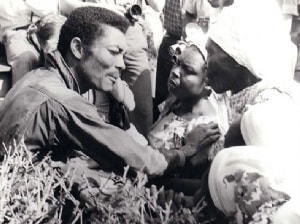
Whether in office or as a private citizen, he consistently demonstrated his dedication to assisting the underprivileged and addressing distressing situations, such as the Buruli ulcer crisis in the 1990s and the iconic photograph of him standing knee-deep in floodwaters at Kwame Nkrumah Circle.
“We cannot forget how one June 4 morning he cut short the celebration to visit the site of the June 3, 2015 disaster also at the Kwame Nkrumah Circle,” it said.
“As the JJ Rawlings Foundation and Family, we join all Ghanaians whose lives were impacted by President Jerry John Rawlings to celebrate his memory.”
The declaration urged Ghanaians to put their love of their country and nationalism above their own interests and political prejudice.
It stated that the former president Rawlings stood for honesty, decency, responsibility, equity, openness, and selflessness.
It challenged Ghanaians to consider his lifelong commitment to those principles and live up to them every day.
“As we celebrate the memory of Chairman Rawlings, we pray that we will unite as a people to lift high the image of our country, pursuing Ghana’s socio-economic revival and development with selflessness and purposeful devotion.”
The nation mourns the loss of retired Major Kwadwo Boakye Gyan, who reportedly passed away on Wednesday, August 30, following a brief illness. His death marks the end of a life intertwined with pivotal moments in Ghana’s history.
Retired Major Boakye Gyan is most notably remembered for his role in the 1979 uprising, a watershed event that led to the overthrow of the Supreme Military Council (SMC II) regime. He played a crucial role as a key member of the Armed Forces Revolutionary Council (AFRC), orchestrating the release of then junior officer Jerry John Rawlings from custody.
During his military career, Major Boakye Gyan went on a self-imposed exile during a significant portion of the Rawlings regime. It was only during the presidency of John Agyekum Kufuor that he returned to Ghana.
Notably, Major Boakye Gyan transitioned into politics and aligned himself with the National Democratic Congress (NDC). His commitment to public service was evident as he stepped into the political arena, becoming the NDC’s 2012 Parliamentary Candidate for the Jaman South Constituency.
In a closely contested election, he stood against the incumbent Member of Parliament, Yaw Afful. Despite his efforts, Major Boakye Gyan faced electoral defeat, marking a chapter of his journey that showcased both the challenges and dynamism of the democratic process.
As the nation reflects on his passing, Major Kwadwo Boakye Gyan’s legacy remains intertwined with Ghana’s historical tapestry. His contributions to the nation, both as a military figure and a political participant, are etched into the annals of the country’s evolution. His passing serves as a moment to remember his accomplishments, his dedication to public service, and the pivotal role he played during a transformative period in Ghana’s history.
In response to recent speculations regarding his potential candidacy as the running mate on John Mahama’s ticket for the 2024 elections, renowned business mogul Sir Sam Jonah reaffirmed his previous stance of declining political positions.
He revealed that during the Jerry John Rawlings administration, he had been approached twice to serve as running mate and subsequently Vice President, but he turned down those offers.
In a statement made to Metro TV’s ‘Good Evening Ghana,’ Sir Sam Jonah emphasized his unwavering commitment to his business ventures and reiterated his lack of interest in entering the complex and unpredictable realm of politics.
“As a matter of fact, if I was interested, I would have been Vice President in 1992 and 1996 when I was offered the position on a silver platter,” he explained.
In his biography authored by AA Taylor, the confirmation of approaches made to Sir Sam Jonah and his subsequent rejection were documented.
Paul Adom-Otchere, on his Good Evening Ghana show, shared excerpts from the book that shed light on the efforts made by Nana Konadu Agyemang Rawlings, the late J.J. Rawlings’s wife and a relative of Sir Sam Jonah, to persuade him to be her husband’s running mate in the 1992 elections.
According to the narrative presented by Adom-Otchere, J.J. Rawlings faced significant pressure from prominent members of the National Democratic Congress, including the Ahwoi brothers, who advocated for Ekow Nkensen Akaah to be selected as Rawlings’s vice presidential candidate.
While Rawlings was not entirely opposed to Akaah, he harbored doubts about his competence and abilities.
The book reveals that Rawlings initially considered Sir Sam Jonah as his top choice, as he possessed qualities that aligned with the upcoming elections. Sir Sam Jonah was seen as a figure who could bridge the divide between Rawlings and the business and elite class, which had been highly critical of his administration.
Additionally, due to Sir Sam Jonah’s Akan background, it was believed that he would secure votes from the Akan communities.
However, Nana Konadu’s charge to pair her relative with her husband for the 1992 elections did not work as Sir Sam Jonah turned down the proposal.
According to the narrative, Sir Sam Jonah communicated his decision to his sister, Nana Konadu via phone but the then first lady did not take it kindly.
After a lengthy conversation, Nana Konadu in quite an unhappy tone told Sir Sam Jonah “Kwesi, I’m very disappointed. An invitation to the second highest position of the land and you treat it so casually? You don’t even reflect on it?”.
The story continues that Sir Sam Jonah, sensing that Nana Konadu Agyemang Rawlings was unhappy with his decision, tried to calm things down by saying “I only put it you like this because you are my sister but when you speak to the chief, I know as my sister, you will put him differently.”
Nana Konadu was, per the excerpt of the book, still not happy with the decision by Sir Sam Jonah and how it was communicated to her.
Adom-Otchere went to recount other happenings between Nana Konadu Agyemang Rawlings and Sir Sam Jonah over the issue.
He stated, “Those who know me well can attest to the fact that I have absolutely no inclination to venture into the murky world of politics.”
“As a matter of fact, if I was interested, I would have been Vice President in 1992 and 1996 when I was offered the position on a silver platter,” he explained.
President Akufo-Addo inaugurated the renovated Kwame Nkrumah Memorial Park in Accra on July 4, 2023.
To showcase the facility to the public, a musical concert called the ‘Re-ignition Concert’ is scheduled for July 7, 2023, featuring performances by Samini, Kofi Kinaata, the High School Band, and others.
The event, hosted by Merqury Quaye, will commence at 8 pm and is free of charge.
President Akufo-Addo stated that 6,000 frontline workers will be available to assist visitors at the memorial park.
The renovation was necessary as the park had not been refurbished since its opening in 1992, under the late Jerry John Rawlings.
In his address, the President highlighted that the park has not only been renovated but also modernized to honor Kwame Nkrumah, Ghana’s first President and a pivotal figure in the country’s independence.
“The Park now has facilities including a presidential library, receptive facility, mini-amphitheater, restaurant, freedom wall, and a digitalised payment and access system. The mausoleum has also been fully refurbished, with the tombstone upgraded, and the museum expanded with an audiovisual tunnel. There is also an upgraded VVIP lounge, expanded recreational area, a modernized gift shop, and a fountain area with synchronised audiovisuals, the first of its kind in West Africa,” he said.
The President continued, “The thirty million cedi (GH¢30million) modernised Kwame Nkrumah Memorial Park is in line with plans by Government to make the Park one of the best tourism and heritage attractions in West Africa. As the outstanding pan-Africanist of his generation, the burial site of Dr. Nkrumah must be appropriate to his status and exceptional contribution to the liberation of Africa from colonialism and imperialism.”
The Kwame Nkrumah Memorial Park, which attracted some ninety thousand visitors annually before the renovation, is now expected to attract over one million tourists annually.
Even though Jerry John Rawlingsis no longer with us, his significance and the tales surrounding him still fascinate and intrigue a large number of people.
One of such stories is how he came to be known, famously, as ‘Junior Jesus.’
For those who are unaware, many Ghanaians started calling the man by this name after he successfully completed his first coup d’état in the year 1979.
For quite a number of people at the time, Jerry John Rawlings had saved the country from a time of many wrongs, including corruption.
As has been explained by one of the mentees of the man touted as the father of the fourth republic of Ghana, the name was to signify two major aspects of the life of Rawlings.
According to Dela Coffie, the ‘Junior Jesus’ tag was principally a reflection of the JJ acronym of Rawlings’ name.
In effect, ‘Junior Jesus’ only stood for the same name as JJ, although that acronym actually stands for Jerry John.
But more significantly, the alias ‘Junior Jesus’ was to mirror the life of what many thought were attributes of Jesus Christ, the son of God.
Dela Coffie explained in a 2021 interview that Rawlings’ coming in at the time was to help get the people of Ghanaout of what was an unjustifiable economic crisis in the country.
He added that this was because incidents like “tax evasion, bribery and corruption, nepotism, social injustice and the entrenchment of the few in government, had been the order of the day, thereby crippling the economy and creating hardships and sufferings for the ordinary man.
“At the time, Ghana was in the throes of food shortages and a dire economic situation that had led to rampant inflation. People had to walk hundreds of miles away to seek medical care, and essentials like key soap, sugar and whatnot which was not available.”
According to a report by online news ports, Opera News, Dela Coffie was of the view that Jerry John Rawlings’ 1979 coup redeemed Ghanaians from such hardships, bringing them relief.
He also explained that because of this, the people put their trust in his leadership and forthrightness, adding that it was for such a milestone in the country’s restoration that he was nicknamed the ‘Junior Jesus,’ while others simply called him the ‘savior.’
“Chairman Rawlings was touched by the cries, hunger and the suffering of the people, especially the ordinary people who could not afford a ball of kenkey. His emergence after the 1979 coup sent a spontaneous jubilation to the people throughout the country. He was hailed and received by Ghanaians for his boldness and forthrightness. Some even called him Junior Jesus and the Saviour,” he is reported to have said.
Jerry John Rawlings went on to become Ghana’s first elected democratic leader in the fourth republic, before he handed over power to John Agyekum Kufuor in 2001.
On November 12, 2020, JJ Rawlings died after a short illness.
The wife of Ghana’s first president in the fourth republic,Jerry John Rawlings, has recalled her early affection for him and how her mother once forced him to wash cars and clean windows at their home.
In the ninth chapter of her book, It Takes A Woman, Dr. Konadu Agyeman-Rawlings spoke about how all of these happened the very first day Jerry Rawlings decided to visit her at home.
According to her narration, she had returned home from school at Achimota with excitement, hopeful that she would get to enjoy some good rest after what she described as “an arduous term in school.”
Things didn’t turn out quick as such for her because, “I was soon reminded that the romanticism of home-life was slightly more ethereal than real. In our home, in spite of the holidays, some things never changed. Saturday mornings were always reserved for general house-cleaning: sweeping, washing, gardening, kitchen chores, tidying the dining room, sitting room, and bedrooms.”
And so, she added, that was what she was all about until there was a ring at the door.
Dr. Nana Konadu Agyeman-Rawlings narrated further that she wanted to get the door but was beaten to it by her mom.
At the door, noticing it was the young Jerry John Rawlings, she tried to eavesdrop on whatever conversation her mother would have with him.
The following is the conversation she said her mother had with Rawlings:
“Good morning, Madam,” he said, greeting Maa with a pleasant smile.
“Morning,” Maa replied, her expression straight-faced and forbidding.
“Sorry to disturb you, Madam. My name is Jerry John. I attend Achimota, and I am looking for Nana Konadu. We are friends from school, and I just want to say hello… please.”
“Young man, Konadu is busy doing her housework. You wouldn’t want to disturb her, would you?”
“No, no Madam, not at all.”
“Good. Then I’ll tell her you were here,” she said as she gestured to close the door.
“Madam… Please… can I wait?”
“Wait? For what?” she snapped, visibly taken aback by his determination.
“For her to finish,” he smiled, pleading with his eyes.
“Young man, in this house, there is no time to chat on Saturday mornings.”
“Yes Madam,” he replied, and then quickly added, “Madam, I can also help clean around the house.”
“Young man, what did you say your name was?”
“Jerry John… Madam.”
“Remove your cap!” she ordered and walked him outside around the house.
At this point, Dr. Nana Konadu Agyeman-Rawlings recalled what her mother told her that she had told Jerry to do.
“I told him to clean all my French windows, which he did – and cleaned then beautifully. After he was done, he asked politely for permission to leave, knowing Konadu and her sisters were still working. But he came again.”
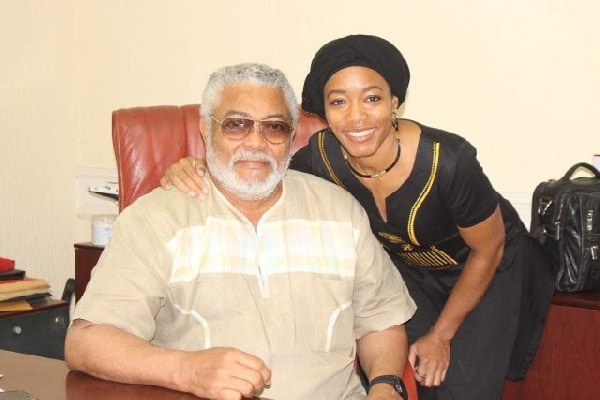
The late president Jerry John Rawlings‘ daughter Zanetor Agyeman Rawlings gave an eloquent address during the celebration of the December 31 revolution that just finished in Accra.
In part addressing the National Democratic Congress (NDC) and criticizing the in power New Patriotic Party government on corruption issues, the physician and MP delivered a speech.
She urged NDC members to reevaluate their core values and return to the principles of responsibility and honesty that her father and other comrades used to build the party.
Only devoted and devoted supporters, she claimed, could ensure the NDC’s electoral success by defending its fundamental interests in elections.
“We must have loyal supporters, committed comrades who cannot be bribed and who cannot be bought because when the time comes, those are the people who you need to protect your ballot boxes, the people you’ll need to protect your pink sheets.
“Because in this current dispensation, when you find that you are not satisfied with the outcome of an election, when you go to court, you must provide evidence of the wrongdoing and that evidence lies in your pink sheets and in your ability to gather evidence.
“And only people with commitment, loyalty, integrity, the highest level of integrity can preserve the truth no matter what,” he stressed in a speech that some people said evoked the spirit of her father who had addressed close to 40 such gatherings before his death in 2020.
She pleaded for NDC members to keep in mind the part that friends played, the foundation they built, and the position they took against the NPP government’s carelessness in the matter of resource management.
“This government today that has decided to take advantage of everything that was bequeath to the people of Ghana,” he said adding that resources of this country were being taken over by people in their personal capacities.
“Leadership is about service and sacrifice and reflecting the values that comrades, we must not pay lip service to principles that don’t mean anything to us,” she added.
The 2022 edition of the anniversary of the 31st December revolution was the 41st in the series. It marked the day on which Rawlings staged his second successive coup to depose the Hilla Limann government and constitute the Provisional National Defense Council, PNDC, government.
As a form of expression of its disgust against the shooting of the military generals in 1979, the Federal Republic of Nigeria under the leadership of then General Olusegun Matthew Okikiola Ogunboye Aremu Obasanjo threatened to cut gas supply to Ghana which had Jerry John Rawlings as head of state.
The angst of Nigeria and its leader against the gruesome killings of military generals, Ignatius Kutu Acheampong, FWK Why Nigeria threatened to cut gas supplies to Ghana in 1979
In a bid to register their disgust over the shooting of the military generals in 1979, the Federal Republic of Nigeria under the leadership of then military ruler, General Olusegun Matthew Okikiola Ogunboye Aremu Obasanjo threatened to cut gas supply to Ghana which at the time was led by Jerry John Rawlings as head of state.
The angst of Nigeria and its leader Obasanjo to the gruesome killings of the military generals, Ignatius Kutu Acheampong, FWK Akuffo, AA Afrifa, and Utuka, among others in 1979 was captured in the book titled ‘The Trial of JJ Rawlings”.
The book which was written by the venerable Kojo Yankah captures a letter by the National Union of Ghana Students, NUGS, to the governments of Nigeria, Ivory Coast, Burkina Faso and Togo criticizing their condemnation of the actions of the Rawlings regime.
“We condemn the threats allegedly issued by the Obasanjo government in Nigeria to cut off supplies to Ghana. The clean up exercise here had set a new precedent in African Politics. The pleas of the Paris-teleguided governments in Ivory Coast, Togo and Upper Volta also show the depth of their hypocrisy and how unfair they’ve been to the suffering people of Ghana.
“When our timber, cocoa, gold, rice, maize and essential imported communities were being smuggled to these countries by the few local enemies of the people of Ghana, these ‘good neighbours’ of ours actively collaborated with them”, parts of the statement read.
The book also highlights the response of the United Kingdom under Prime Minister, Margaret Thatcher to the killing of the military generals.
Margaret Thatcher, the then Prime Minister of the United Kingdom is reported to have indicated her ‘abhorrence’ to the execution of the military generals and said that she had been in touch with US, Canada, and members of the European Economic Community to make representations to the Ghana government about their disdain for the murder of leaders of the deposed military regime.
About June 4 Revolution
The June 4 Revolution, otherwise known as June 4th Uprising was incited by the arrest and trial of Flt. Lt. Jerry John Rawlings and other junior military officers by the leadership of the Supreme Military Council II (SMC II). Jerry John Rawlings and the junior officers were arrested and charged with mutiny for a failed coup attempt on the 15th of May, 1979.
Jerry John Rawlings cited a number of reasons for the failed coup attempt on 15th May, 1979. Firstly, the junior military officers, including Jerry John Rawlings, were refused salaries on countless occasions. Also on the broader scale, issues of widespread corruption among Supreme Military Council officials, poor governance, economic hardship and general frustration on the part of populace as well as high levels of indiscipline within the Ghana Army were among the issues highlighted.
One of the main architects of the uprising, Major Boakye Djan, has in later interviews revealed that they deliberately added a political twist to it to help emancipate the whole of Africa. According to Osahene Boakye Djan, after several secret meetings with John Rawlings, the team decided to establish a secret movement known as the Free Africa Movement (FAM) to drive the uprising. Boakye Gyan noted that although Nkrumah fought for the liberation of the whole African continent, Africa still appeared to be under the rule and control of the colonial masters. Boakye Gyan mentions in an interview that though Ghana was independent, the country was not free enough to determine the prices of cash crops like cocoa and other commodities hence the movement.
Trial Day
Prior to the trial was the failed coup attempt by Rawlings and some junior officers on the 15th of May, 1979. On the morning of the day of the coup, there was exchange of fire between the coup plotters and officers of the SMC II. It took the effort and bravery of one senior military officer, Major General Odartey Willington to get to the Ghana Broadcasting Corporation (GBC) to announce that the attempted coup by junior officers of the force had been foiled.
He, Major-General Odartey Willington, one Major Sulemana, other military officers who embarked on the said action at GBC were subsequently rewarded by the SMC II government and Rawlings and the junior officers arrested for trial.
The trial of Rawlings and the Junior officers took place at Burma Hall in Accra. On the day of the trial, as ABC News Ghana gathers, thousands of civilians trooped into the hall to witness the trial. The president of the military tribunal was Col. Aninful and the prosecutor for the state was Flt. Lt. Atiemo.
Rawlings was asked if he wanted a separate trial. His response was “I want to be with my men,” a comment which sparked wild applause in the hall.
Rawlings was found guilty by the tribunal and was imprisoned in a “guardroom”. It was during this time that all his ten fingers were severely damaged.
A key point in the trial was when Jerry Rawlings turned the tables and began accusing the government of massive corruption. He demanded his colleagues accused of aiding him in the treasonable act be set free insisting that he was solely responsible for the attempted coup.
On the day of 4th June, 1979
As has been stated earlier, Rawlings was found guilty and imprisoned in a guardroom. Two weeks later, on the night of June 4th, Captain Boakye Djan led other officers to overthrow the SMC II government and released Rawlings from prison. He was then sent to GBC and the government overthrow was announced. Rawlings was made to speak to allay fears of his death as had been earlier rumoured.
Notable on the day was a display by Major-General Odartey Willington. He entered an armoured car and single-handedly shot for three continuous hours. When he ran out of cartridges, he dashed to the Nima Police Station to surrender.
Unfortunately, he was killed on the spot by military officers immediately he came out of the armoured truck. He was given a somewhat befitting burial by Rawlings.
That incident marked the beginning of the uprising.
After the incident, all military installations were searched and senior military officers who were on the side of the SMC II were killed. It was on the same day that Col. Aninful, the president of the military tribunal that tried Rawlings and the junior officers on 15th May was killed. His wife and children who were also in the same room were shot. Many sympathizers of the previous government fled the country to seek asylum elsewhere.
The coup plotters then set up the Armed Forces Revolutionary Council (AFRC). The membership was as follows;
1. Flt. Lt. Jerry John Rawlings – Chairman
2. Captain Boakye Gyan – Official Spokesperson
3. Major Mensah Gbedemah
4. Lt Commander Akpaloo
5. Warrant Officer 2 Obeng
6. Private Owusu Adu
7. Corporal Owusu Boateng
8. Leading Air Craftsman Gaktipo
9. Lance Corporal Ansah Atiemo among other people.
The Aftermath of the Revolution
The regime introduced what become known as the “House Cleaning Exercise”. The House cleaning exercise was mainly against corruption. Three former military leaders of Ghana, Lt. Gen. Afrifa, Gen. Acheampong and Lt. Gen. Akuffo were all executed together with five other senior officers deemed to have been corrupt by the Special Courts set up by the government. That was when the infamous slogan “let the blood flow” originated. Supporters of the regime used this slogan to rally military support in killing sympathizers of the previous regime who were deemed corrupt.
Numerous business entrepreneurs were also targeted and had their assets confiscated by the government.
Critics of the regime note that the period witnessed high levels of indiscipline among the junior officers towards senior officers and civilians. The Armed Forces Revolutionary Council (AFRC) soon lost control of the soldiers who had gone on rampage. There was total breakdown of law and order, a situation which led to arbitrary arrests, beatings, abductions, killings, detentions, and seizure of money and personal property by soldiers.
The AFRC ruled from June 1979 to September 1979. Power was handed to Dr. Hilla Limann in September 1979. But Rawlings again overthrew Limann on 31st December 1981. Though June 4 became a noted date in Ghana’s history, it has been said to be a date that brings a lot of pain to people who either lost loved ones, lost businesses or had to flee the country for their dear lives, AA Afrifa, and Utuka, among others in 1979 was captured in the book titled ‘The Trial of JJ Rawlings”.
The book which was written by the venerable Kojo Yankah captures a letter by the National Union of Ghana Students to the governments of Nigeria, Ivory Coast, Burkina Faso and Togo over their condemnation of the actions by Rawlings and his military cohorts.
“We condemn the threats allegedly issued by the Obasanjo government in Nigeria to cut off supplies to Ghana. The clean-up exercise here had set a new precedent in African Politics. The pleas of the Paris-teleguided governments in Ivory Coast, Togo and Upper Volta also show the depth of their hypocrisy and how unfair they’ve been to the suffering people of Ghana.
“When our timber, cocoa, gold, rice, maize and essential imported communities were being smuggled to these countries by the few local enemies of the people of Ghana, these ‘good neighbours’ of ours actively collaborated with them”, parts of the statement read.
The book also highlights the response of the United Kingdom under Prime Minister, Margaret Thatcher to the killing of the military generals.
Margaret Thatcher, the then Prime Minister of the United Kingdom is reported to have indicated her ‘abhorrence’ to the execution of the military generals and said that she had been in touch with US, Canada, and members of the European Economic Community to make representations to the Ghana government about their disdain for the murder of the deposed military regime.
About June 4 Revolution
The June 4 Revolution, otherwise known as June 4th Uprising was incited by the arrest and trial of Flt. Lt. Jerry John Rawlings and other junior military officers by the leadership of the Supreme Military Council II (SMC II). Jerry John Rawlings and the junior officers were arrested and charged with mutiny for a failed coup attempt on the 15th of May, 1979.
Jerry John Rawlings cited a number of reasons for the failed coup attempt on 15th May, 1979. Firstly, the junior military officers, including Jerry John Rawlings, were refused salaries on countless occasions. Also on the broader scale, issues of widespread corruption among Supreme Military Council officials, poor governance, economic hardship and general frustration on the part of populace as well as high levels of indiscipline within the Ghana Army were among the issues highlighted.
One of the main architects of the uprising, Major Boakye Djan, has in recent times revealed that they deliberately added a political twist to it to help emancipate the whole of Africa. According to Osahene Boakye Djan, after several secret meetings with John Rawlings, the team decided to establish a secret movement known as the Free Africa Movement (FAM) to drive the uprising. Boakye Gyan noted that although Nkrumah fought for the liberation of the whole African continent, Africa still appeared to be under the rule and control of the colonial masters. Boakye Gyan mentions in an interview that though Ghana was independent, the country was not free enough to determine the prices of cash crops like cocoa and other commodities hence the movement.
Trial Day
Prior to the trial was the failed coup attempt by Rawlings and some junior officers on the 15th of May, 1979. On the morning of the day of the coup, there was exchange of fire between the coup plotters and officers of the SMC II. It took the effort and bravery of one senior military officer, Major General Odartey Willington to get to the Ghana Broadcasting Corporation (GBC) to announce that the attempted coup by junior officers of the force had been foiled.
He, Major-General Odartey Willington, one Major Sulemana, other military officers who embarked on the said action at GBC were subsequently rewarded by the SMC II government and Rawlings and the junior officers arrested for trial.
The trial of Rawlings and the Junior officers took place at Burma Hall in Accra. On the day of the trial, as ABC News Ghana gathers, thousands of civilians trooped into the hall to witness the trial. The president of the military tribunal was Col. Aninful and the prosecutor for the state was Flt. Lt. Atiemo.
Rawlings was asked if he wanted a separate trial. His response was “I want to be with my men,” a comment which sparked wild applause in the hall.
Rawlings was found guilty by the tribunal and was imprisoned in a “guardroom”. It was during this time that all his ten fingers were severely damaged.
A key point in the trial was when Jerry Rawlings turned the tables and began accusing the government of massive corruption. He demanded his colleagues accused of aiding him in the treasonable act be set free insisting that he was solely responsible for the attempted coup.
On the day of 4th June, 1979
As has been stated earlier, Rawlings was found guilty and imprisoned in a guardroom. Two weeks later, on the night of June 4th, Captain Boakye Djan led other officers to overthrow the SMC II government and released Rawlings from prison. He was then sent to GBC and the government overthrow was announced. Rawlings was made to speak to allay fears of his death as had been earlier rumoured.
Notable on the day was a display by Major-General Odartey Willington. He entered an armoured car and single-handedly shot for three continuous hours. When he ran out of cartridges, he dashed to the Nima Police Station to surrender.
Unfortunately, he was killed on the spot by military officers immediately he came out of the armoured truck. He was given a somewhat befitting burial by Rawlings.
That incident marked the beginning of the uprising.
After the incident, all military installations were searched and senior military officers who were on the side of the SMC II were killed. It was on the same day that Col. Aninful, the president of the military tribunal that tried Rawlings and the junior officers on 15th May was killed. His wife and children who were also in the same room were shot. Many sympathizers of the previous government fled the country to seek asylum elsewhere.
The coup plotters then set up the Armed Forces Revolutionary Council (AFRC). The membership was as follows;
9. Lance Corporal Ansah Atiemo among other people.
The Aftermath of the Revolution
The regime introduced what become known as the “House Cleaning Exercise”. The House cleaning exercise was mainly against corruption. Three former military leaders of Ghana, Lt. Gen. Afrifa, Gen. Acheampong and Lt. Gen. Akuffo were all executed together with five other senior officers deemed to have been corrupt by the Special Courts set up by the government. That was when the infamous slogan “let the blood flow” originated. Supporters of the regime used this slogan to rally military support in killing sympathizers of the previous regime who were deemed corrupt.
Numerous business entrepreneurs were also targeted and had their assets confiscated by the government.
Critics of the regime note that the period witnessed high levels of indiscipline among the junior officers towards senior officers and civilians. The Armed Forces Revolutionary Council (AFRC) soon lost control of the soldiers who had gone on rampage. There was total breakdown of law and order, a situation which led to arbitrary arrests, beatings, abductions, killings, detentions, and seizure of money and personal property by soldiers.
The AFRC ruled from June 1979 to September 1979. Power was handed to Dr. Hilla Limann in September 1979. But Rawlings again overthrew Limann on 31st December 1981. Though June 4 became a noted date in Ghana’s history, it has been said to be a date that brings a lot of pain to people who either lost loved ones, lost businesses or had to flee the country for their dear lives
As a form of expression of its disgust against the shooting of the military generals in 1979, the Federal Republic of Nigeria under the leadership of then General Olusegun Matthew Okikiola Ogunboye Aremu Obasanjo threatened to cut gas supply to Ghana which had Jerry John Rawlings as head of state.
The angst of Nigeria and its leader against the gruesome killings of military generals, Ignatius Kutu Acheampong, FWK Why Nigeria threatened to cut gas supplies to Ghana in 1979
In a bid to register their disgust over the shooting of the military generals in 1979, the Federal Republic of Nigeria under the leadership of then military ruler, General Olusegun Matthew Okikiola Ogunboye Aremu Obasanjo threatened to cut gas supply to Ghana which at the time was led by Jerry John Rawlings as head of state.
The angst of Nigeria and its leader Obasanjo to the gruesome killings of the military generals, Ignatius Kutu Acheampong, FWK Akuffo, AA Afrifa, and Utuka, among others in 1979 was captured in the book titled ‘The Trial of JJ Rawlings”.
The book which was written by the venerable Kojo Yankah captures a letter by the National Union of Ghana Students, NUGS, to the governments of Nigeria, Ivory Coast, Burkina Faso and Togo criticizing their condemnation of the actions of the Rawlings regime.
“We condemn the threats allegedly issued by the Obasanjo government in Nigeria to cut off supplies to Ghana. The clean up exercise here had set a new precedent in African Politics. The pleas of the Paris-teleguided governments in Ivory Coast, Togo and Upper Volta also show the depth of their hypocrisy and how unfair they’ve been to the suffering people of Ghana.
“When our timber, cocoa, gold, rice, maize and essential imported communities were being smuggled to these countries by the few local enemies of the people of Ghana, these ‘good neighbours’ of ours actively collaborated with them”, parts of the statement read.
The book also highlights the response of the United Kingdom under Prime Minister, Margaret Thatcher to the killing of the military generals.
Margaret Thatcher, the then Prime Minister of the United Kingdom is reported to have indicated her ‘abhorrence’ to the execution of the military generals and said that she had been in touch with US, Canada, and members of the European Economic Community to make representations to the Ghana government about their disdain for the murder of leaders of the deposed military regime.
About June 4 Revolution
The June 4 Revolution, otherwise known as June 4th Uprising was incited by the arrest and trial of Flt. Lt. Jerry John Rawlings and other junior military officers by the leadership of the Supreme Military Council II (SMC II). Jerry John Rawlings and the junior officers were arrested and charged with mutiny for a failed coup attempt on the 15th of May, 1979.
Jerry John Rawlings cited a number of reasons for the failed coup attempt on 15th May, 1979. Firstly, the junior military officers, including Jerry John Rawlings, were refused salaries on countless occasions. Also on the broader scale, issues of widespread corruption among Supreme Military Council officials, poor governance, economic hardship and general frustration on the part of populace as well as high levels of indiscipline within the Ghana Army were among the issues highlighted.
One of the main architects of the uprising, Major Boakye Djan, has in later interviews revealed that they deliberately added a political twist to it to help emancipate the whole of Africa. According to Osahene Boakye Djan, after several secret meetings with John Rawlings, the team decided to establish a secret movement known as the Free Africa Movement (FAM) to drive the uprising. Boakye Gyan noted that although Nkrumah fought for the liberation of the whole African continent, Africa still appeared to be under the rule and control of the colonial masters. Boakye Gyan mentions in an interview that though Ghana was independent, the country was not free enough to determine the prices of cash crops like cocoa and other commodities hence the movement.
Trial Day
Prior to the trial was the failed coup attempt by Rawlings and some junior officers on the 15th of May, 1979. On the morning of the day of the coup, there was exchange of fire between the coup plotters and officers of the SMC II. It took the effort and bravery of one senior military officer, Major General Odartey Willington to get to the Ghana Broadcasting Corporation (GBC) to announce that the attempted coup by junior officers of the force had been foiled.
He, Major-General Odartey Willington, one Major Sulemana, other military officers who embarked on the said action at GBC were subsequently rewarded by the SMC II government and Rawlings and the junior officers arrested for trial.
The trial of Rawlings and the Junior officers took place at Burma Hall in Accra. On the day of the trial, as ABC News Ghana gathers, thousands of civilians trooped into the hall to witness the trial. The president of the military tribunal was Col. Aninful and the prosecutor for the state was Flt. Lt. Atiemo.
Rawlings was asked if he wanted a separate trial. His response was “I want to be with my men,” a comment which sparked wild applause in the hall.
Rawlings was found guilty by the tribunal and was imprisoned in a “guardroom”. It was during this time that all his ten fingers were severely damaged.
A key point in the trial was when Jerry Rawlings turned the tables and began accusing the government of massive corruption. He demanded his colleagues accused of aiding him in the treasonable act be set free insisting that he was solely responsible for the attempted coup.
On the day of 4th June, 1979
As has been stated earlier, Rawlings was found guilty and imprisoned in a guardroom. Two weeks later, on the night of June 4th, Captain Boakye Djan led other officers to overthrow the SMC II government and released Rawlings from prison. He was then sent to GBC and the government overthrow was announced. Rawlings was made to speak to allay fears of his death as had been earlier rumoured.
Notable on the day was a display by Major-General Odartey Willington. He entered an armoured car and single-handedly shot for three continuous hours. When he ran out of cartridges, he dashed to the Nima Police Station to surrender.
Unfortunately, he was killed on the spot by military officers immediately he came out of the armoured truck. He was given a somewhat befitting burial by Rawlings.
That incident marked the beginning of the uprising.
After the incident, all military installations were searched and senior military officers who were on the side of the SMC II were killed. It was on the same day that Col. Aninful, the president of the military tribunal that tried Rawlings and the junior officers on 15th May was killed. His wife and children who were also in the same room were shot. Many sympathizers of the previous government fled the country to seek asylum elsewhere.
The coup plotters then set up the Armed Forces Revolutionary Council (AFRC). The membership was as follows;
1. Flt. Lt. Jerry John Rawlings – Chairman
2. Captain Boakye Gyan – Official Spokesperson
3. Major Mensah Gbedemah
4. Lt Commander Akpaloo
5. Warrant Officer 2 Obeng
6. Private Owusu Adu
7. Corporal Owusu Boateng
8. Leading Air Craftsman Gaktipo
9. Lance Corporal Ansah Atiemo among other people.
The Aftermath of the Revolution
The regime introduced what become known as the “House Cleaning Exercise”. The House cleaning exercise was mainly against corruption. Three former military leaders of Ghana, Lt. Gen. Afrifa, Gen. Acheampong and Lt. Gen. Akuffo were all executed together with five other senior officers deemed to have been corrupt by the Special Courts set up by the government. That was when the infamous slogan “let the blood flow” originated. Supporters of the regime used this slogan to rally military support in killing sympathizers of the previous regime who were deemed corrupt.
Numerous business entrepreneurs were also targeted and had their assets confiscated by the government.
Critics of the regime note that the period witnessed high levels of indiscipline among the junior officers towards senior officers and civilians. The Armed Forces Revolutionary Council (AFRC) soon lost control of the soldiers who had gone on rampage. There was total breakdown of law and order, a situation which led to arbitrary arrests, beatings, abductions, killings, detentions, and seizure of money and personal property by soldiers.
The AFRC ruled from June 1979 to September 1979. Power was handed to Dr. Hilla Limann in September 1979. But Rawlings again overthrew Limann on 31st December 1981. Though June 4 became a noted date in Ghana’s history, it has been said to be a date that brings a lot of pain to people who either lost loved ones, lost businesses or had to flee the country for their dear lives, AA Afrifa, and Utuka, among others in 1979 was captured in the book titled ‘The Trial of JJ Rawlings”.
The book which was written by the venerable Kojo Yankah captures a letter by the National Union of Ghana Students to the governments of Nigeria, Ivory Coast, Burkina Faso and Togo over their condemnation of the actions by Rawlings and his military cohorts.
“We condemn the threats allegedly issued by the Obasanjo government in Nigeria to cut off supplies to Ghana. The clean-up exercise here had set a new precedent in African Politics. The pleas of the Paris-teleguided governments in Ivory Coast, Togo and Upper Volta also show the depth of their hypocrisy and how unfair they’ve been to the suffering people of Ghana.
“When our timber, cocoa, gold, rice, maize and essential imported communities were being smuggled to these countries by the few local enemies of the people of Ghana, these ‘good neighbours’ of ours actively collaborated with them”, parts of the statement read.
The book also highlights the response of the United Kingdom under Prime Minister, Margaret Thatcher to the killing of the military generals.
Margaret Thatcher, the then Prime Minister of the United Kingdom is reported to have indicated her ‘abhorrence’ to the execution of the military generals and said that she had been in touch with US, Canada, and members of the European Economic Community to make representations to the Ghana government about their disdain for the murder of the deposed military regime.
About June 4 Revolution
The June 4 Revolution, otherwise known as June 4th Uprising was incited by the arrest and trial of Flt. Lt. Jerry John Rawlings and other junior military officers by the leadership of the Supreme Military Council II (SMC II). Jerry John Rawlings and the junior officers were arrested and charged with mutiny for a failed coup attempt on the 15th of May, 1979.
Jerry John Rawlings cited a number of reasons for the failed coup attempt on 15th May, 1979. Firstly, the junior military officers, including Jerry John Rawlings, were refused salaries on countless occasions. Also on the broader scale, issues of widespread corruption among Supreme Military Council officials, poor governance, economic hardship and general frustration on the part of populace as well as high levels of indiscipline within the Ghana Army were among the issues highlighted.
One of the main architects of the uprising, Major Boakye Djan, has in recent times revealed that they deliberately added a political twist to it to help emancipate the whole of Africa. According to Osahene Boakye Djan, after several secret meetings with John Rawlings, the team decided to establish a secret movement known as the Free Africa Movement (FAM) to drive the uprising. Boakye Gyan noted that although Nkrumah fought for the liberation of the whole African continent, Africa still appeared to be under the rule and control of the colonial masters. Boakye Gyan mentions in an interview that though Ghana was independent, the country was not free enough to determine the prices of cash crops like cocoa and other commodities hence the movement.
Trial Day
Prior to the trial was the failed coup attempt by Rawlings and some junior officers on the 15th of May, 1979. On the morning of the day of the coup, there was exchange of fire between the coup plotters and officers of the SMC II. It took the effort and bravery of one senior military officer, Major General Odartey Willington to get to the Ghana Broadcasting Corporation (GBC) to announce that the attempted coup by junior officers of the force had been foiled.
He, Major-General Odartey Willington, one Major Sulemana, other military officers who embarked on the said action at GBC were subsequently rewarded by the SMC II government and Rawlings and the junior officers arrested for trial.
The trial of Rawlings and the Junior officers took place at Burma Hall in Accra. On the day of the trial, as ABC News Ghana gathers, thousands of civilians trooped into the hall to witness the trial. The president of the military tribunal was Col. Aninful and the prosecutor for the state was Flt. Lt. Atiemo.
Rawlings was asked if he wanted a separate trial. His response was “I want to be with my men,” a comment which sparked wild applause in the hall.
Rawlings was found guilty by the tribunal and was imprisoned in a “guardroom”. It was during this time that all his ten fingers were severely damaged.
A key point in the trial was when Jerry Rawlings turned the tables and began accusing the government of massive corruption. He demanded his colleagues accused of aiding him in the treasonable act be set free insisting that he was solely responsible for the attempted coup.
On the day of 4th June, 1979
As has been stated earlier, Rawlings was found guilty and imprisoned in a guardroom. Two weeks later, on the night of June 4th, Captain Boakye Djan led other officers to overthrow the SMC II government and released Rawlings from prison. He was then sent to GBC and the government overthrow was announced. Rawlings was made to speak to allay fears of his death as had been earlier rumoured.
Notable on the day was a display by Major-General Odartey Willington. He entered an armoured car and single-handedly shot for three continuous hours. When he ran out of cartridges, he dashed to the Nima Police Station to surrender.
Unfortunately, he was killed on the spot by military officers immediately he came out of the armoured truck. He was given a somewhat befitting burial by Rawlings.
That incident marked the beginning of the uprising.
After the incident, all military installations were searched and senior military officers who were on the side of the SMC II were killed. It was on the same day that Col. Aninful, the president of the military tribunal that tried Rawlings and the junior officers on 15th May was killed. His wife and children who were also in the same room were shot. Many sympathizers of the previous government fled the country to seek asylum elsewhere.
The coup plotters then set up the Armed Forces Revolutionary Council (AFRC). The membership was as follows;
1. Flt. Lt. Jerry John Rawlings – Chairman
2. Captain Boakye Gyan – Official Spokesperson
3. Major Mensah Gbedemah
4. Lt Commander Akpaloo
5. Warrant Officer 2 Obeng
6. Private Owusu Adu
7. Corporal Owusu Boateng
8. Leading Air Craftsman Gaktipo
9. Lance Corporal Ansah Atiemo among other people.
The Aftermath of the Revolution
The regime introduced what become known as the “House Cleaning Exercise”. The House cleaning exercise was mainly against corruption. Three former military leaders of Ghana, Lt. Gen. Afrifa, Gen. Acheampong and Lt. Gen. Akuffo were all executed together with five other senior officers deemed to have been corrupt by the Special Courts set up by the government. That was when the infamous slogan “let the blood flow” originated. Supporters of the regime used this slogan to rally military support in killing sympathizers of the previous regime who were deemed corrupt.
Numerous business entrepreneurs were also targeted and had their assets confiscated by the government.
Critics of the regime note that the period witnessed high levels of indiscipline among the junior officers towards senior officers and civilians. The Armed Forces Revolutionary Council (AFRC) soon lost control of the soldiers who had gone on rampage. There was total breakdown of law and order, a situation which led to arbitrary arrests, beatings, abductions, killings, detentions, and seizure of money and personal property by soldiers.
The AFRC ruled from June 1979 to September 1979. Power was handed to Dr. Hilla Limann in September 1979. But Rawlings again overthrew Limann on 31st December 1981. Though June 4 became a noted date in Ghana’s history, it has been said to be a date that brings a lot of pain to people who either lost loved ones, lost businesses or had to flee the country for their dear lives.
According to Kojo Yankah’s account of the events in his book, “The Trial of JJ Rawlings,” it is safe to assume that, while the killings of military officers following the June 4 coup were overwhelmingly popular locally, the international community was less enthusiastic about what they called Jerry John Rawlings and his army officers’ “blood-hunting vendetta.”
Contrary to the groundswell of support the military administration received from Ghanaians who were calling for more blood, the world community strongly condemned the conduct of the military rule, from the media to foreign governments.
The book highlighted the total disapproval of the then United Kingdom, India and Nigeria governments to the shooting of military generals, Ignatius Kutu Acheampong, FWK Akuffo, AA Afrifa, and Utuka, among others in 1979.
Margaret Thatcher, the then Prime Minister of the United Kingdom is reported to have indicated her ‘abhorrence’ to the execution of the military generals and said that she had been in touch with US, Canada, and members of the European Economic Community to make representations to the Ghana government about their disdain for the murder of the deposed military regime.
About June 4 Revolution
The June 4 Revolution, otherwise known as June 4th Uprising was incited by the arrest and trial of Flt. Lt. Jerry John Rawlings and other junior military officers by the leadership of the Supreme Military Council II (SMC II). Jerry John Rawlings and the junior officers were arrested and charged with mutiny for a failed coup attempt on the 15th of May, 1979.
Jerry John Rawlings cited a number of reasons for the failed coup attempt on 15th May, 1979. Firstly, the junior military officers, including Jerry John Rawlings, were refused salaries on countless occasions. Also on the broader scale, issues of widespread corruption among Supreme Military Council officials, poor governance, economic hardship and general frustration on the part of populace as well as high levels of indiscipline within the Ghana Army were among the issues highlighted.
One of the main architects of the uprising, Major Boakye Djan, has in recent times revealed that they deliberately added a political twist to it to help emancipate the whole of Africa. According to Osahene Boakye Djan, after several secret meetings with John Rawlings, the team decided to establish a secret movement known as the Free Africa Movement (FAM) to drive the uprising. Boakye Gyan noted that although Nkrumah fought for the liberation of the whole African continent, Africa still appeared to be under the rule and control of the colonial masters. Boakye Gyan mentions in an interview that though Ghana was independent, the country was not free enough to determine the prices of cash crops like cocoa and other commodities hence the movement.
Trial Day
Prior to the trial was the failed coup attempt by Rawlings and some junior officers on the 15th of May, 1979. On the morning of the day of the coup, there was exchange of fire between the coup plotters and officers of the SMC II. It took the effort and bravery of one senior military officer, Major General Odartey Willington to get to the Ghana Broadcasting Corporation (GBC) to announce that the attempted coup by junior officers of the force had been foiled.
He, Major-General Odartey Willington, one Major Sulemana, other military officers who embarked on the said action at GBC were subsequently rewarded by the SMC II government and Rawlings and the junior officers arrested for trial.
The trial of Rawlings and the Junior officers took place at Burma Hall in Accra. On the day of the trial, as ABC News Ghana gathers, thousands of civilians trooped into the hall to witness the trial. The president of the military tribunal was Col. Aninful and the prosecutor for the state was Flt. Lt. Atiemo.
Rawlings was asked if he wanted a separate trial. His response was “I want to be with my men,” a comment which sparked wild applause in the hall.
Rawlings was found guilty by the tribunal and was imprisoned in a “guardroom”. It was during this time that all his ten fingers were severely damaged.
A key point in the trial was when Jerry Rawlings turned the tables and began accusing the government of massive corruption. He demanded his colleagues accused of aiding him in the treasonable act be set free insisting that he was solely responsible for the attempted coup.
On the day of 4th June, 1979
As has been stated earlier, Rawlings was found guilty and imprisoned in a guardroom. Two weeks later, on the night of June 4th, Captain Boakye Djan led other officers to overthrow the SMC II government and released Rawlings from prison. He was then sent to GBC and the government overthrow was announced. Rawlings was made to speak to allay fears of his death as had been earlier rumoured.
Notable on the day was a display by Major-General Odartey Willington. He entered an armoured car and single-handedly shot for three continuous hours. When he ran out of cartridges, he dashed to the Nima Police Station to surrender.
Unfortunately, he was killed on the spot by military officers immediately he came out of the armoured truck. He was given a somewhat befitting burial by Rawlings.
That incident marked the beginning of the uprising.
After the incident, all military installations were searched and senior military officers who were on the side of the SMC II were killed. It was on the same day that Col. Aninful, the president of the military tribunal that tried Rawlings and the junior officers on 15th May was killed. His wife and children who were also in the same room were shot. Many sympathizers of the previous government fled the country to seek asylum elsewhere.
The coup plotters then set up the Armed Forces Revolutionary Council (AFRC). The membership was as follows;
9. Lance Corporal Ansah Atiemo among other people.
The Aftermath of the Revolution
The regime introduced what become known as the “House Cleaning Exercise”. The House cleaning exercise was mainly against corruption. Three former military leaders of Ghana, Lt. Gen. Afrifa, Gen. Acheampong and Lt. Gen. Akuffo were all executed together with five other senior officers deemed to have been corrupt by the Special Courts set up by the government. That was when the infamous slogan “let the blood flow” originated. Supporters of the regime used this slogan to rally military support in killing sympathizers of the previous regime who were deemed corrupt.
Numerous business entrepreneurs were also targeted and had their assets confiscated by the government.
Critics of the regime note that the period witnessed high levels of indiscipline among the junior officers towards senior officers and civilians. The Armed Forces Revolutionary Council (AFRC) soon lost control of the soldiers who had gone on rampage. There was total breakdown of law and order, a situation which led to arbitrary arrests, beatings, abductions, killings, detentions, and seizure of money and personal property by soldiers.
The AFRC ruled from June 1979 to September 1979. Power was handed to Dr. Hilla Limann in September 1979. But Rawlings again overthrew Limann on 31st December 1981. Though June 4 became a noted date in Ghana’s history, it has been said to be a date that brings a lot of pain to people who either lost loved ones, lost businesses or had to flee the country for their dear lives
Born on the 3 September 1944, Dr. Kwesi Botchwey was 78 at the time of his death.
Professor Botchwey is the longest-serving Finance Minister.
He served in office alongside Ghana’s longest-serving head of state, the late former President, Jerry John Rawlings.
He served in the military era of the Provisional National Defence Council (PNDC) (1982 to 1991) and the constitutional period of the National Democratic Congress (NDC) (1992 to 1995).
The late economist received his secondary school education at the Presbyterian Boys’ Senior High School in Ghana.
Prof. Botchwey held an LL.B. from the University of Ghana, LL.M from Yale Law School, and a doctorate from the University of Michigan Law School.
He taught at the University of Zambia, the University of Dar es Salaam (Tanzania) and the University of Ghana. Other notable previous assignments of Dr Botchwey were advisor to the World Bank on the 1997 World Development Report.
He was among others, a member and Chairman of IMF‘s Group of Independent Experts who conducted the first ever external evaluation of the Enhanced Structural Adjustment Facility, an advisor to the UNDP’s UN Special Initiative on Africa and an advisor to the European Centre for Development Policy Management (ECDPM).
In a post on her Facebook timeline remembering her late father, the MP for Klottey Korle Constituency, posted a photo of herself and her dad with the caption:
“2 years on, you’re still in our hearts. We miss you Papa J.”
A veteran Ghanaian broadcaster, Amankwa Ampofo, has recounted his experience during the failed attempt to overthrow the PNDC government led by Flt Lt Jerry John Rawlings in 1983.
In an interview with Oman Channel, the retired journalist recalled his days at the Ghana Broadcasting Cooperation and the events of June 19, 1983.
This was during the time when a failed coup attempt, led by Lance Corporal Carlos Halidu Giwa, saw a heavy exchange of fire in the compound of the state broadcasting firm.
“I remember in 1983-84, Giwa wanted to overthrow the government. He wanted to overthrow the government of Rawlings and that is how come Giwa was killed when he was arrested,” he stated.
Having been caught up in the exchange of fire that ensued during the attempted coup, Amankwa Ampofo told Theophilus Annan of Oman Channel that he had to lie on his stomach for about five hours to survive the heavy gunfire.
“But on that day, the pathetic thing was that I was on duty. I was a witness to the fighting in the compound of GBC during the Giwa coup. I had to lie on my stomach for five hours because you would not know which direction a gunshot is coming from if you raise up your head,” he recounted.
A little over a year after seizing power from the Limann administration, Flt. Lt. Jerry John Rawlings was almost overthrown by men who used to be his allies.
On June 19, 1983, Lance Corporal Carlos Halidu Giwa, who was in the Ghana Army, led a military coup d’état with the help of other soldiers, including Sergeant Abdul Malik.
Some of the men made their way to GBC, where they announced taking over power from the PNDC government.
Their message to the nation was given by Carlos Halidu Gyiwa, who described himself as the Operational Commissioner of the Revolutionary Fighters.
Their reason for the attempted takeover was that “Flt Lt Rawlings and his team had been found to be inefficient. While he preached virtue, Flt Lt Rawlings practiced vice.”
Captain Courage Quashigah, however, led some soldiers to the broadcasting house and succeeded in taking over the place after a gun battle saw the rebels run away.
After taking over, Captain Quashigah broadcasted to inform the nation that the coup attempt had been foiled.
Two big names for a big party position, is the kind of story headline that is fit for this kind of political race that is expected in Ghana’s current, biggest opposition party, the National Democratic Congress (NDC).
On either side, both Johnson Asiedu Nketiah, and Samuel Ofosu-Ampofo have credits of giant political achievements to ride on, but now, the two men have to face it off for the top position of Chairman of the NDC.
While there is no official final list from the party, it already looks like there is going to be a straight fight between the two personalities: Asiedu Nketiah as the longest-serving General Secretary of the NDC, and Ofosu-Ampofo as the one-term Chairman seeking re-election.
In this political pedigree article by GhanaWeb, we take a look at all of the things that put either of these two candidates ahead of each other, as well as what NDC delegates might be looking out for when they go to the polls in November 2022.
Samuel Ofosu-Ampofo:
Currently the Chairman of the National Democratic Congress (NDC), Samuel Ofosu-Ampofo has declared his intention for re-election.
This is due to the fact that his election as chairman in November 2018 comes to an end soon and he would need a reaffirmation of his performance through another endorsement from his party members.
But it has been a long political career for him, starting off in this trade in 1994, when he was appointed as the District Chief Executive for the Fanteakwa North District of the Eastern Region, by Jerry John Rawlings.
In 1996, he run for parliament on the ticket of the NDC in the same district and won, representing the people of the constituency until he lost his third re-election bid in 2004 to the New Patriotic Party’s candidate, Kwadwo Agyei Addo.
Having served in the second and third parliaments of the fourth republic of Ghana, Ofosu-Ampofo again tried his shot at the parliamentary seat in 2008 but got unlucky once more.
His next political job came when he won the National Organiser position of the NDC but on the assumption of power in 2009, John Evans Atta Mills appointed him the Regional Minister for the Eastern Region.
Samuel Ofosu-Ampofo then moved on from there to serve as Minister for Local Government and Rural Development, his last political portfolio before he was elected as the NDC’s National Chairman in 2018.
Under his tenure, he was unsuccessful in helping the party and John Dramani Mahama in wrestling power from the Nana Addo Dankwa Akufo-Addo government in the 2020 general elections.
But that loss gave the country a historic win: the first time parliament is hung, with a split of a perfect number of Members of Parliament, as well as the Speaker of Parliament being a member of the opposition for the first time ever.
Speaking in a Ghanaian Times report, Samuel Ofosu-Ampofo stated that one of his achievements is that that the party had become more attractive under his leadership.
He has also likened himself to the biblical Jesus Christ.
“The delegates must look no further than Ofosu-Ampofo as I am prepared to take the NDC to the Promised Land because you do not change the team that turned around the fortunes of the party after it suffered a humiliating defeat in 2016 and I liken myself to Christ when he was asked by the disciples if he is the Messiah.
“Jesus said to them, the blind see, the lame walk, the deaf hear, what more do you want to see? I am the National Chairman of NDC and the party was in disarray due to our humiliating defeat in 2016 since it was not attractive at the time but I played key roles together with my team to turn the around fortunes of the party during the 2020 elections,” he said.
He has also stated that but for the use of state-sponsored security personnel, the NDC would have won more parliamentary seats in the 2020 elections, including Techiman South, Tarkwa Nsuaem, Zabzugu, Essikado-Ketan, and others.
“I have what it takes to bring the NDC back to power again however, I believe together with my team, we also managed to snatch seats that have never been won by the party in a long time, including Tema East, Ayensuano, among others, which demonstrates our competence and I am hopeful members, supporters, sympathisers, faithful and well-wishers of the party to renew my mandate to serve for another four-year term,” he appealed.
Johnson Asiedu Nketiah:
Asiedu Nketiah, the man popularly known as General Mosquito, is the face of the other main contender for the National Chairman position of the party.
As the current General Secretary of the NDC, he is one of the most powerful people in the party, having served in the role since 2005.
Born on December 24, 1956, at Seikwa in the Brong Ahafo Region, he trained in petty trading, Akpeteshie distilling, palm wine tapping, and a drinking bar.
After educating himself at the University of Ghana, he practiced as a banker before entering into politics.
His entrance onto the political scene came when he contested and won the Wenchi District Assembly elections of 1989, following which he was elected to the Consultative Assembly in 1992.
He held that position for 12 years, being part of the team that drafted Ghana’s current constitution – the 1992 constitution.
In 1992, he entered parliament as the Member of Parliament for the Wenchi West constituency and served for 12 years.
During his time in parliament, he served on several committees such as the Appointments Committee, Finance Committee, Public Accounts Committee, Chairman Mines and Energy Committee, and Minority spokesperson on Food, Agriculture, and Cocoa Affairs.
From 1997 to 2001, Asiedu Nketiah served as a Deputy Minister for Food and Agriculture (Crops).
After he decided to say goodbye to parliamentary work, he stood for the General Secretary position of the NDC and won overwhelming in the 2005 party elections.
As the third General Secretary of the party, he led the party to win the 2008 and 2012 elections, giving the country presidents John Evans Atta Mills and John Dramani Mahama.
There have been several achievements accorded to his credit, including the same glory his other contender, Samuel Ofosu-Ampofo boasts of: giving Ghana its first hung parliament and first Speaker of Parliament from the opposition party.
After serving as General Secretary of the NDC for 17 years, he had announced the hanging of those boots and the desire to continue to lead the party, but this time as the National Chairman.
The pedigrees of both Samuel Ofosu-Ampofo and Johnson Asiedu Nketiah would play massive roles in the decisions of National Democratic Congress delegates when the party goes to the polls later this year.
Sports presenter, Countryman Songo, has disclosed that back in Achimota Senior High School, daughter of Ghana’s former President, Jerry John Rawlings, saved him from going hungry.
According to Songo, Zanetor Agyeman-Rawlings, who was his classmate at Achimota Senior High School showed him kindness and that he will forever be grateful to her.
“There was a day I was famished. It was break time…one interesting thing was that Zanetor had bodyguards meaning all other students had maximum protection. Students who attended Achimota those days felt so proud. You will mostly spot her car and the bodyguards monitoring every move.
“I was hungry and went looking for my cousin, thinking I will get some food. I spotted Zanetor setting alone so I approached her. I said hello and she responded calmly and asked how I was also doing.
“I straight forward said I was hungry and so she offered me her toast and tea in her flask, I ate it. The interesting thing was that I took food from the President’s daughter,” he added.
Speaking in an interview on Asempa FM, the sports presenter, described Zanetor as the genius of the their time back in school adding that “she swept all the awards at our speech and prize-giving day”.
Zenator is the eldest daughter of the 1st President under the 4th Republic of Ghana Jerry Rawlings and former first lady Nana Konadu Agyeman.
She was born on 1 June 1978 in Accra, Ghana in. She hails from Dzelukope in the Volta Region of Ghana.
She had her basic education at the North Ridge Lyceum school and Achimota School and high school the Wesley Girls High School in Cape Coast.
She is currently a member of parliament for the Klottey-Korle Constituency and a medical doctor.
In our previous article, we gave you a list of 5 active Ghanaian footballers whose Black Stars careers might be over after being out of the national team for a minimum of three years.
Today, we look at the childhood sports of all the men who have occupied Ghana’s presidency since the beginning of the 4th republic in 1993.
Children and their preference for a particular sport is mostly influenced by their community or the school they find themselves in.
Some children after falling in love with a particular sport tend to pursue it as a career with the needed talents but others abandon it because of their parents.
Here is a list of Ghana’s 4th Republican presidents and their childhood sports:
Jerry John Rawlings – boxing
Born June 22, 1947, the late president of the 4th Republic of Ghana is best remembered for promoting boxing in Ghana and helping nurture several talents across the country.
Rawlings according to his son Kimathi had hoped in Ghanaian boxers because they had a strong disciplined mind to become great.
Ghana’s legendary boxer Azumah Nelson has on countless occasions credited the successes he archived in his career to the late Jerry John Rawlings who was also an amateur boxer.
Though JJ Rawlings couldn’t pursue his boxing career, he made sure that other young talents would get all the needed support from the State to be useful.
During his reign, Ghana won three world titles through Azumah Nelson, Ike Bazooka Quartey, and the late Alfred Kotey.
John Agyekum Kufuor – football
There isn’t much to be said about the footballing career of Ghana’s second president in the 4th Republic aside being in the school team during his days in Prempeh Colleague in Kumasi.
However, John Agyekum Kufuor was an established football administrator before occupying the high office in Ghana.
As a football administrator, former President John Agyekum Kufuor was the Chief Executive Officer of Asante Kotoko where he won a lot of local titles before he became Ghana’s leader in 2001.
His love for football also made him commit more resources to help the Black Stars qualify for the FIFA World Cup for the first time in Ghana’s footballing history in 2006.
Kufuor renovated the Accra Sports Stadium and the Baba Yara Stadium as well as built the Essipong and Tamale stadium in 2008 to host the CAN 2008.
John Evans Atta-Mills – Hockey
The late former President was a professional hockey player but also worked as a football administrator for giants Accra Hearts of Oak.
He played for both the hockey teams of Achimota College during his Secondary School education and the University of Ghana, Legon in his tertiary days.
As a State Man, Atta-Mills changed the face of Ghana hockey by supporting the construction of the first ever water-based Astro-turf hockey pitch in 1999, and an ultra-modern world-class National Hockey Stadium which was built in 2009.
He is also a founding member of the Veterans Hockey team in Accra which was established in 1972.
John Dramani Mahama – football
Just like John Agyekum Kufuor, John Dramani Mahama was also a talented footballer but his father Emmanuel Adama reportedly made him ditch football to focus more on his education.
Though John Mahama couldn’t pursue a career in football, his son Sharaf continues from where his father left off to become a professional footballer.
Sharaf Mahama has played for several clubs in Eurpe inclduing Tempo Overijse, KV Mechelen, Charleroi and Rostocker FC.
As President, John Mahama’s love for football was seen through the government’s sports policies.
He built the Cape Coast Sports Stadium to ease the pressure of the four existing stadiums in Ghana. Mahama also built Ghana’s only boxing arena in Bukoum to promote the sport which sold Ghana to the world after football.
Nana Addo Dankwa Akufo-Addo – boxing
The current president is a football fan but his love for boxing precedes every sport in the world.
Young Akufo-Addo played football in his high school days and was in the University of Ghana, Legon’s hockey team together with the late John Evans Atta-Mills.
Akufo-Addo was an all-around athlete amongst all the presidents we have seen in the 4th Republic.
As the president, Akufo-Addo has invested heavily in sports infrastructure with the building of the multi-purpose sports complex in all the 16 regions in Ghana.
He will also be the 4th president to taste a FIFA World Cup after Kufuor, Mills, and Mahama.
Today, we look at the childhood sports of all the men who have occupied Ghana’s presidency since the beginning of the 4th republic in 1993.
Children and their preference for a particular sport is mostly influenced by their community or the school they find themselves in.
Some children after falling in love with a particular sport tend to pursue it as a career with the needed talents but others abandon it because of their parents.
Here is a list of Ghana’s 4th Republican presidents and their childhood sports:
Born June 22, 1947, the late president of the 4th Republic of Ghana is best remembered for promoting boxing in Ghana and helping nurture several talents across the country.
Rawlings according to his son Kimathi had hoped in Ghanaian boxers because they had a strong disciplined mind to become great.
Ghana’s legendary boxer Azumah Nelson has on countless occasions credited the successes he archived in his career to the late Jerry John Rawlings who was also an amateur boxer.
Though JJ Rawlings couldn’t pursue his boxing career, he made sure that other young talents would get all the needed support from the State to be useful.
During his reign, Ghana won three world titles through Azumah Nelson, Ike Bazooka Quartey, and the late Alfred Kotey.
There isn’t much to be said about the footballing career of Ghana’s second president in the 4th Republic aside being in the school team during his days in Prempeh Colleague in Kumasi.
However, John Agyekum Kufuor was an established football administrator before occupying the high office in Ghana.
His love for football also made him commit more resources to help the Black Stars qualify for the FIFA World Cup for the first time in Ghana’s footballing history in 2006.
Kufuor renovated the Accra Sports Stadium and the Baba Yara Stadium as well as built the Essipong and Tamale stadium in 2008 to host the CAN 2008.
The late former President was a professional hockey player but also worked as a football administrator for giants Accra Hearts of Oak.
He played for both the hockey teams of Achimota College during his Secondary School education and the University of Ghana, Legon in his tertiary days.
As a State Man, Atta-Mills changed the face of Ghana hockey by supporting the construction of the first ever water-based Astro-turf hockey pitch in 1999, and an ultra-modern world-class National Hockey Stadium which was built in 2009.
He is also a founding member of the Veterans Hockey team in Accra which was established in 1972.
Just like John Agyekum Kufuor, John Dramani Mahama was also a talented footballer but his father Emmanuel Adama reportedly made him ditch football to focus more on his education.
Though John Mahama couldn’t pursue a career in football, his son Sharaf continues from where his father left off to become a professional footballer.
Sharaf Mahama has played for several clubs in Eurpe inclduing Tempo Overijse, KV Mechelen, Charleroi and Rostocker FC.
As President, John Mahama’s love for football was seen through the government’s sports policies.
He built the Cape Coast Sports Stadium to ease the pressure of the four existing stadiums in Ghana. Mahama also built Ghana’s only boxing arena in Bukoum to promote the sport which sold Ghana to the world after football.
The current president is a football fan but his love for boxing precedes every sport in the world.
Young Akufo-Addo played football in his high school days and was in the University of Ghana, Legon’s hockey team together with the late John Evans Atta-Mills.
Akufo-Addo was an all-around athlete amongst all the presidents we have seen in the 4th Republic.
As the president, Akufo-Addo has invested heavily in sports infrastructure with the building of the multi-purpose sports complex in all the 16 regions in Ghana.
He will also be the 4th president to taste a FIFA World Cup after Kufuor, Mills, and Mahama.
The Pan-African Writers Association will launch a book in honour of the late former president of Ghana, Flt. Lt. Jerry John Rawlings, during whose tenure the Association was established.
The book, titled ‘JJ Rawlings: Memories and Momentos,’ is a collection of poems and essays written by writers, scholars and some political leaders from 10 African countries in honour of the late president.
The bilingual book (French and English) was edited by Prof. Bill Ndi, a US-based Cameroonian professor of humanities, while the foreword was written by Abdourahmane Diallo, the UNESCO Country Representative in Ghana.
The event will be held at the Accra City Hall (Omanye Aba Auditorium) inside the AMA Headquarters in Accra on Tuesday, December 14, 2021 at 11am.
Guests honouring the event will be the wife of the former president, Nana Konadu Agyeman Rawlings, also sitting in as the Special Guest of Hounour.
The Pan-African Writers Association will launch a book in honour of the late former president of Ghana, Flt. Lt. Jerry John Rawlings, during whose tenure the Association was established.
The book, titled ‘JJ Rawlings: Memories and Momentos,’ is a collection of poems and essays written by writers, scholars and some political leaders from 10 African countries in honour of the late president.
The bilingual book (French and English) was edited by Prof. Bill Ndi, a US-based Cameroonian professor of humanities, while the foreword was written by Abdourahmane Diallo, the UNESCO Country Representative in Ghana.
The event will be held at the Accra City Hall (Omanye Aba Auditorium) inside the AMA Headquarters in Accra on Tuesday, December 14, 2021 at 11am.
Guests honouring the event will be the wife of the former president, Nana Konadu Agyeman Rawlings, also sitting in as the Special Guest of Honour.
Also, the Country Representative for UNESCO in Ghana, Abdouramane Diallo, will be in attendance.
Former Deputy General Secretary of the National Democratic Congress (NDC), Samuel Koku Anyidoho, has labelled the month of November 2020 as a very “hard month†for him.
This he said was a result of a double tragedy that befell him in the month.
He mentioned that he lost both his daughter and Former President Jerry John Rawlings to the icy hands of death in November last year.
“Hmm!!! November 2020, was really a hard month for me. Lost my daughter on the 8th; Papa J passed on 12th. Today is exactly a year since Papa J left. He did his bit for God and Country. One day, one day; we shall ALL go too! May his soul rest well in the Lord. Shalom,†he said in a tweet reflecting on the 1-year anniversary of the passing of the late founder of the NDC.
Former President Jerry John Rawlings passed away on November 12, 2020, at the KorleBu Teaching Hospital at the age of 73.
The family of the late head of state will hold a remembrance mass today, November 12, 2021, to mark the first anniversary of his passing at the Holy Spirit Cathedral at Adabraka in Accra.
The family of the late former president, Jerry John Rawlings is today Friday November 12, 2021 holding a commemorative mass to mark the first year anniversary of his demise.
The former Ghanaian leader passed away on November 12, 2020 after a short illness at the Korle Bu Teaching Hospital.
People from all works of life including government officials, traditional leaders, political leaders, members of parliament, diplomats, cadres and many sympathisers are expected to attend the mass service.
Already, some notable personalities including the family and children of the former president have been captured at the mass service.
Others are; Vice President Mahamudu Bawumia, Chief of Staff, Frema Osei Opare, former President John Dramani Mahama, Chairman of the National Democratic Congress, Ofosu Ampofo.
The memorial mass will be held at the Holy Spirit Cathedral, Adabraka and is open to the public. It is expected to draw people from all walks of life from government officials, traditional leaders, political leaders, members of parliament, diplomats, cadres and many more admirers and sympathisers.
The service, being held by the family, will commence promptly at 9.00 am and will last for approximately one and a half hours.
A statement issued by the family asked all who wish to attend to arrive at the Cathedral early and should note that due to Covid-19 requirements, social distancing seating will be in effect. The event will also be streamed on the Facebook page of the late President J.J Rawlings.
Attire for the occasion is white traditional or formal.
Parking for the event will be at the Ghana Museums and Monuments Board car park opposite the Holy Spirit Cathedral.
“The event will be live-streamed on https://web.facebook.com/President.J.J.Rawlingsâ€
Flt. Lt. Jerry John Rawlings passed away at the Korle Bu Teaching Hospital on Thursday, November 12, 2020, after a short illness. He was 73 years.
The family of late former President Jerry John Rawlings will mark the first anniversary of his passing on Friday, November 12.
A statement from the office of the late former President said there would be a remembrance mass at the Holy Spirit Cathedral, Adabraka, on the same day, November 12, 2021, to mark the anniversary.
It said friends, sympathisers, and members of the public were invited to participate in the remembrance mass, which would commence at 0900 hours.
“Attire for the occasion is white.”
The statement said due to Covid-19 requirements, the Cathedral would host a limited number of congregants.
It said seating would thus be on a first-come, first-served basis.
Late former President Rawlings passed away at the Korle Bu Teaching Hospital on Thursday, November 12, 2020, after a short illness.
A Ghanaian scholar domiciled in the UK, Gwendolyn Brown has attributed her career brilliance to the sound basic education she acquired at Seven Great Princes Academy in Accra few years ago.
A graduate of Southampton University in the UK, Gwendolyn has already settled in her three-year working career.
She currently works for one of the reputable financial institutions in the UK where she has endeared herself to both her employers and clients due to her high level of professionalism.
In 2018, the Southampton University graduate’s academic brilliance in the UK drew the attention of many including former Ghana president, Jerry John Rawlings after reading her academic exploits on many media platforms in the country.
Indeed, that paved the way for a memorable official meeting between the departed statesman and Gwendolyn at the former’s Ridge residence.
She stated in an interview “I have always believed in getting the basics right. It is like having a strong foundation in building construction, the stronger the foundation, the taller the building and that is exactly what Seven Great Princes offers.
“l had a great start (Foundation) at Seven Great, and that explains my brilliance from High School through University to where l currently work.”
Ghana will never have a leader like former President Jerry John Rawlings according to National Democratic Congress lawmaker Rockson-Nelson Dafeamekpor.
The South Dayi MP posted a tweet today celebrating the former leader.
“Leadership & Discipline personified. Founder is Gone. A Nation in Mourning. We shall never have his kind again. Paradise Lost,†he said.
The post was accompanied by a video of Rawlings famously directing traffic in 2019 around Prampram.
Rawlings died in November 2020 at the age of 73. He passed on at the Korle Bu Teaching Hospital in Accra.
His funeral kicks off today. The national activities will start with a Catholic Requiem Mass at the Holy Spirit Cathedral and a vigil at the Air Force Officers Mess in Accra.
The former President will be laid in state on Monday, January 25 and Tuesday, January 26 at the Accra International Conference Centre for various interest groups and members of the public to have an opportunity to pay their last respects.
Prior to the laying in state, the Anlo Traditional Council will host two days of traditional mourning for the departed former President who hailed from Anlo.
The former President will receive a full military burial service on Wednesday, January 27 after which he will be interred at the Military Cemetery.
As part of plans to make sure the late Jerry John Rawlings gets a befitting burial, government has rolled out some activities before the burial day.
On January 24, 2021, there will be a Catholic Requiem Mass at the Holy Spirit Cathedral in Accra. Also, a vigil will be held at the Air Force Officers Mess to eulogise the former president.
The late Jerry John Rawlings will then be laid in state on January 25 and 26 at the Accra International Conference Centre. This will be opened to all under the strict adherence of the COVID-19 safety protocols.
On Wednesday, January 27 the former statesman will get a full military burial service at the Black Star Square. His body will be interred at the Military Cemetary in Accra.
This was announced by the Caretaker Minister of Information, Kojo Oppong Nkrumah after having a meeting with the family, funeral planning committee, the Anlo Traditional Council and other state agencies assisting with the funeral arrangements.
The late Jerry John Rawlings passed away at the Korle-Bu Teaching hospital after battling a short illness on November 12, 2020.
This year’s 31st December Revolution anniversary will be held in honour of former President Jerry John Rawlings.
This was announced by the Central Planning Committee of the 31st December Anniversary and the Office of former President Rawlings, in partnership with the National Democratic Congress (NDC) in a statement issued on Monday, 28 December, 2020.
This year’s event which will mark the 39th Anniversary of the 31st December Revolution is scheduled to take place at the Osekan Park on the Atta Mills High Street.
The event will commence at 8.30am on Thursday, 31 December, 2020.
Highlights of the event will include “Wreath-Laying/Parade and Commemoration.â€
Special Guest of Honour will be the Flagbearer of the NDC, John Dramani Mahama
While Dress Code for the event is “Black or Red,†the statement added.
Former President Rawlings died on Thursday, 12 November, 2020 at the age of 73.
The funeral rites of the late former president, Jerry John Rawlings which was scheduled for Wednesday, December 23, 2020, has been postponed indefinitely.
A statement from the office of the former president indicated that “a new date will be communicated to the public in due course.â€
“The inconvenience to all who had made prior arrangements for the funeral ceremony is deeply regretted,†it added.
This announcement comes weeks after the Anlo Traditional Council expressed outrage because it was not involved in the funeral arrangements of the former President.Â
The council said the arrangements were not in accordance with the customs and traditions of the Anlo people.
The Council thus called on President Akufo-Addo to “ensure that the right procedures are adhered to.â€
“The Anlo Traditional Council reserves the right to take steps to ensure that this error is remedied appropriately,†it added.
Below is the statement from the Office of Rawlings
The Office of the President has advised the families of the late former President Jerry John Rawlings to resolve all outstanding matters regarding his funeral and burial and convey the final date to the presidency.
It follows disagreements between the families of the late former leader regarding the date for his burial.
The Anlo Traditional Council expressed outrage through a statement issued on Monday, 30 November 2020, signed by Mr James Victor Gbeho, which announced that the late former President would be buried on 23 December 2020.
The announcement said: “The family of His Excellency Jerry John Rawlings has, in consultation with the government, agreed that the date for the State funeral of the former President is confirmed for Wednesday, 23 December 2020 at the Independence Square in Accraâ€.
“The family is working in conjunction with the government on the finer details of the funeral ceremony and will communicate the arrangements in due courseâ€, the statement said.
It added: “Individuals and institutions who wish to contribute tributes to the memory of Flt Lt Jerry John Rawlings are reminded to email such tributes to tributes@jjrawlingsmemorial.orgâ€.
However, the Anlo traditional council said in a counter-statement that it “wishes to express, in its strongest possible terms, its total outrage for the disrespect shown to the culture, traditions, mores and usages of our practices in the release of the so-called press statementâ€.
“Our anger stems from the fact that President J. J. Rawlings was not only a former Head of State and President of the Republic of Ghana, but he was also a properly-installed Chief of Anlo land, whose unfortunate demise must be dealt with in accordance with customs and traditions of Anloâ€.
The office of the President, however, said it is the obligation of the state to accord the former President a befitting state burial and, therefore, wants all outstanding matters to be resolved for that to happen.
The office of former President Jerry John Rawlings is currently receiving tributes for the late president from institutions and individuals.
Any organisation or individual that wishes to contribute tributes to the memory of the former President is to forward such tributes to the office or email them to tributes@jjrawlingsmemorial.org.
The deadline for submissions is Saturday, December 5, 2020.
The Communications Directorate, Kobina Andoh Amoakwa in the signed statement stated that people who have memorabilia or photographs of the former statesman are to share such material via the email or contact the office on 0302231911/0264444464 to arrange for collection.
“The public is also to note that the book of condolence opened by the State to honour the memory of former President Rawlings has been extended by one week. Ghanaians are invited to the Accra International Conference Centre to pay their respects.
“Relations, friends, and institutions who wish to commiserate with the family are also invited to call to schedule appointments for such visits,†it added.
Former President Jerry John Rawlings died on Thursday, November 12, at the Korle Bu Teaching Hospital after a short illness.
Founder of the Atta Mills Institute, Koku Anyidoho, has finally reacted to news of the passing of ex-president Jerry John Rawlings.
Former President Rawlings, who in a few weeks buried his mother, died Thursday, November 12, 2020, at the Korle Bu Teaching Hospital.
Reacting to the news, Mr Anyidoho, who is also mourning the passing away of his eight-year-old daughter, took to his Twitter page to mourn the late President.
According to him, though November has been very tough for him with the passing away of his daughter and the passing away of Papa J, it has rather made him tougher for the life ahead.
Sharing photos of himself and Mr Rawlings, Mr Anyidoho said the battles are not for him to fight; adding that God is in full control.
He said “November has been very tough for me with the passing away of my daughter on the 7th, and the passing away of Papa J on the 12th: but it has made me tougher for the life ahead. The battles are not mine to fight; God is in full control”.
November has been very though for me with the passing away of my daughter on the 7th, and the passing away of Papa J on the 12th: but it has made me tougher for the life ahead. The battles are not mine to fight; God is in full control🔥🔥💪💪👏🏽👏🏽 pic.twitter.com/Bfz1QHImE5
While the demise of former President Jerry John Rawlings is still a shock to many, people from all walks have expressed their condolences.
The government on Monday opened the book of condolence to persons in higher authority to pen their messages to the departed former president at the Accra International Conference Centre.
With statesmen, ambassadors, the general public granted the chance to eulogize the late president, the Asantehene, Otumfuo Osei Tutu II’s words written in the book has gained some attention.
According to an image available to GhanaWeb, the King of the Asante kingdom wrote, “Agyewodin, fare thee well, my president and brother.â€
he general public and sympathizers are now at liberty to go to the Accra International Conference Centre (AICC) to sign the book of condolence for the late former President, Jerry John Rawlings.
Members of the public who wish to visit the AICC are to do so from 12 noon to 5pm on Thursday.
Also, on Friday, the general public will be allowed entry from 8am to 5pm, state protocol told GhanaWeb.
Heads of Public institutions will also be present in the early hours of both days, to pay respects to the late statesman
The book of condolence was stationed at AICC on Monday where the judicial service, former presidents, speaker and members of parliament, Council of State among other dignitaries penned down their message in memory of the longest-serving leader of the country.
Religious leaders took their turn on Tuesday, November 17, 2020.
The book will be closed on Friday, November 20, 2020.
Jerry John Rawlings died at the Korle-Bu Teaching hospital on November 12 after battling with short illness.
The Volta Regional Coordinating Council (VRCC) has opened a book of condolence for former President Jerry John Rawlings.
The book of condolence, which will open at the forecourt of the VRCC from 0900 hours to 1700 hours each day, and is part of activities to give the late President a befitting state burial.
Mr Felix B. Chaahaah, Chief Director of VRCC, in a statement copied to the Ghana News Agency, noted that distinguished personalities were invited from the region to sign with messages of sympathies and goodwill.
Some personalities invited were revered Traditional leaders, religious leaders, civil society organisations, political parties, Vice-Chancellors, Principals, Regional Heads of Departments, Identifiable groups and distinguished citizens.
He entreated invited personalities to strictly adhere to all safety protocols of COVID-19 when they come to sign the book of condolence.
One January afternoon in 2012, I as a 9-year-old girl, accompanied by my parents and younger siblings were ushered into a large but very modest waiting room in Ridge, Accra.
I was nervous, not because it was Ghana, or that the heat was sweltering.
Rather, it was the very first time I was going to meet a Statesman, one who had governed a country for almost 2 decades and also revered on the African continent. His name was Jerry John Rawlings.
With my video camera, lights and stand safely tucked in my backpack, I slowly went over the questions I wanted to ask him, about the Ghana Revolution, as we waited to see him.
The reason was that, I had entered a competition meant for 11 16 year old’s back at school in California, and we were challenged to do a play-act, or create a short documentary about a successful revolution anywhere in the world.
I wanted to do something totally different from my classmates [I was 2 years ahead], and because I was younger, and smaller, they didn’t like my idea of doing something outside of the US very much especially not in Africa of all places.
So, I wrote to President Rawlings, explaining my predicament, and asked if he would allow me to record my meeting and session with him, for the documentary about a successful revolution.
His answer came 3 weeks later. ‘It was simple and blunt.
“If you are serious enough and can come over to Ghana, I would make time for you and your documentary.â€
I was told before we arrived that he had 15 minutes for me, because he was busy, and was travelling overseas that evening. It was probably true because there were about 9 older people waiting in his lobby when we arrived.
An hour later, my camera rolling, I began asking him questions about the Ghana Revolution, and what things were like then in Ghana. He spoke very candidly, giving as an example of how he was asked by his superiors to fly a fighter jet over those demonstrating, to intimidate them into silence. He didn’t like that at all. I was a little surprised he shared that, and many more things on camera, but perhaps his openness and penchant for fairness was a flaw he lived with.
President Rawlings at the end of our session walked my family and I to our car and spent more time talking with me, while others still waited to see me.
He said whenever I was in Ghana, I should stop by to say hello, and share with him how I was doing with my projects.
My second short documentary at the age of 12 was on the 1967 OAU and the effects it had on three countries, Malawi, Tanzania and Mauritius. For that project, I sat down with Presidents, Joyce Banda of Malawi, Jakaya Kikwete of Tanzania and Rakeshwur Purryag of Mauritius.
The African Union heard about the documentary project. As an example of their belief in the power and voice of youths, I was invited in April 2013, to screen it in Ethiopia during the 50th Anniversary of the OAU now called Africa Union.
In the main hall of the AU building in downtown Addis Ababa, there were trains of world leaders, their staff and personal security – walking from one end of the hall to another, attending plenary and bilateral meetings. There were more than 70 heads of state there, mostly from the AU, but also Caribbean, Latin America, and some from Asia.
And there he was, President Jerry Rawlings and his train. I called out to him, and he stopped, turned around, and belted out in his deep voice “Zuriel, is that you.â€
His entire train came to an abrupt stop also, were surprised, and the look on their face asked the question, “who is that girl, and why is he talking to her.”
In my mind, I answered, that’s grandpa Jerry. He hugged me tight, and had questions for me, asking what I was doing at the event. It was my second time meeting him. He was pleased and so proud it was my documentary showing later that afternoon.
When I was 14, I got invited to share my journey at the University of Pretoria and then Ashesi University in Ghana. I remembered what the President told me the last time, so, we stopped by his office to let him know I was in Ghana. I learned [disappointed] that he was in Namibia for the new Presidents inauguration.
Ashesi was a fantastic experience, as I had never been to the Eastern Region before. On my last day in Accra, President Rawlings office called and asked what time was my flight out that evening. I let them know it was 10:30 PM.
I learned his flight from Namibia via South Africa was landing at 9 PM. He had been told I was in Accra and leaving the same night he was arriving, but he wanted to see me. We met at the VIP Lounge at the airport, so I didn’t miss my flight. He introduced me to his wife Ms Nana Agyeman, and we all hugged, sat, and had a lot to catch up on for almost an hour, as it had been 2 years.
He made time just to see this 14-year-old. Perhaps, that was a flaw, but he was seriously interested in my projects and what impact I was making at school. I left that meeting smiling, on my way to show my film A Promising Africa, in Tokyo.
It had been three years since I last saw grandpa Jerry. In between speaking at UNESCO, COP, my school work, meeting other world leaders, and expanding my film making class, and then his busy schedules, where was the time.
And then in January 2018, I was heading back to Ghana, to speak at a community in Accra called Chorkor. Some call it the slums, I call it a place where nuggets are hidden, waiting to be discovered.
I let President Rawlings office know I was coming to town again. What I didn’t know was he asked his senior advisers to research me on their own, and then have questions for me when I arrived. He simply wanted to show off, his granddaughter.
And yes, they threw some tough questions at me on every global topic, as he watched me try to answer each one. He was simply proud, of this little girl. It was the last time I saw him personally, but we always stayed I touch.
And then, I learned he passed a few days ago.
One of my favourite pictures that adorned the walls of his office, is him on a horse as his mode of rural transportation in the days of the revolution. I also understood better the bond shared in a picture of him with Thomas Sankara of Burkina Faso, another young African leader in the 80’s.
I am ever grateful for the times we spent together, the stories he shared, the lessons on bravery he taught me, and the challenges of leadership to led me to understand. Even though I am now just 18, because of the opportunity and advise he gave me, I have now sat down one-on-one with 31 heads of state to talk about global and regional development issues. These include the leaders of Jamaica, Malta, Tanzania, Croatia, Nigeria, Kenya, Guyana, Samoa, Liberia, St Vincent, Italy, Sierra Leone, and many others, as well as a US Secretary of State, just 3 years ago.
Hopefully, I would get to make you even more proud, someday.
Goodbye, grandpa Jerry John Rawlings. I would miss you. Africa, as a continent, would miss you too.
Dozens of religious leaders have taken turns to sign the book of condolence opened for the late former President of the Republic of Ghana, Jerry John Rawlings.
The book of condolence was opened for the Ex-President who passed away on Tuesday, November 12, 2020, and has since been signed by dignitaries and leaders including president Nana Addo Dankwa Akufo-Addo and former President John Dramani Mahama.
Taking their turn today, the religious leaders who thronged the Conference Center included the leaders of the Christian and Islamic faith.
Notable among the religious leaders were the Metropolitan Archbishop of Cape, Charles Palmer-Buckle, the General Overseer of Perez Chapel International, Bishop Charles Agyinasare and Presiding Bishop of the Methodist Church of Ghana, Rev. Dr. Paul Kwabena Boafo.
Also signing on behalf of the Chief Imam, was his spokesperson, Sheikh Aremeyaw Shaibu.
Speaking to the media after the signing, Bishop Palmer-Buckle praised Ex-President Rawlings for the life he lived which he dedicated to ensuring the establishment of Ghana’s current democracy. He also admonished Ghanaians to emulate the principles of probity and accountability which the late former president lived for.
The General Overseer of Perez Chapel International, Bishop Charles Agyinasare has tasked the upcoming generation of politicians to apply decency along their political path.
Bishop Agyinasare made this statement whiles speaking to the media after signing the book of condolence opened for Ex-President Jerry John Rawlings at the Accra International Conference Center on Tuesday.
“The young politicians must be determined and focused, they must desire not to just go after money but to be able to serve their nation and be a blessing. Let’s have a generation who are not antagonistic to one another and using a lot of verbal garbage on one another. We want decency in our politics,” he said.
Ex-President Jerry John Rawlings was pronounced dead at the Korle-Bu Teaching Hospital last Thursday, following what his family says was a brief period of sickness.
Hundreds of persons have since the demise of the former President eulogized him for his principles of probity and accountability which characterised his actions and pronouncements.
Senior Minister, Yaw Osafo-Maafo has eulogized former President Jerry John Rawlings as someone who has never had issues with persons who exhibited traits of sincerity and honesty.
According to the Senior Minister, the former president made sure his actions were guided by the principle of sincerity and honesty even when he had to topple the government of the day through coup d’etats.
“When he made the coup I was the Managing Director of a bank and in all the things which happened, he showed so much admiration for honesty, courage and hard work. And he never really troubled people who had worked sincerely and honestly. I never had any problem from president Rawlings,” he told the media after signing the book of condolence opened for Ex-President Rawlings at the Accra International Conference Center on Tuesday.
Describing the former president as genuine, forthright and courageous, Mr Asafo-Maafo said Ex-President Rawlings had the welfare of the less privileged at heart so much that it created problems between him and others.
“He is very genuine, forthright and courageous, and he cared for the underprivileged people generally. His main occupation is to take care of those who are not privileged in the society. This was so dear to him that sometimes his anxiety to do it right even created problems for othersâ€.
Former President Jerry John Rawlings died on Thursday, November 12, 2020, and the state, following his death, has opened a book of condolence at the Accra International Conference Center.
President Akufo-Addo, Vice President Dr Mahamadu Bawumia and several government officials have all penned their condolence to the former president.
Others, such as religious leaders, political leaders and foreign diplomats have so far signed.
Anthony Owusu, Akatsi South Constituency Chairman of the National Democratic Congress (NDC), has said the demise of ex- President Rawlings has caused many, including him some form of emotional instability.
He said the tragedy that has engulfed the entire country and Africa was unfortunate and that “we are now devastated”.
“This is devastating, we were never in anticipation for this during these crucial moments of our political activities,†he said.
Mr Owusu, popularly known as ‘Westfalia’ told the Ghana News Agency (GNA) the legacies of the late leader would continue to live on.
“Ex-President Rawlings really expressed compassion and love for one another, he showed much concern for the underprivileged,” he said.
Mr Owusu further disclosed that his personal relationship with the late former President was never a failed one.
He said the late Jerry John Rawlings during his visits to his residency over the years, made him understand what he stood for.
“After all his busy schedules, he spent time with me and I have learnt the best from him.”
Touching on his personal activities with Mr Rawlings, he said the late leader moved many street children to further their education both in Accra and in the Volta Region, respectively.
“Those in South Tongu, where his residency is also located could attest to this fact,” he said.
The private building contractor further said the legacies and principles Mr Rawlings exhibited would not go down, and that “the NDC will continue to build on them for a better Ghana.
The GNA further observed that all political activities in the Constituency are being put on hold and flags flying at half-mast.
The great National Democratic Congress (NDC), on Thursday 12th November 2020 woke up to the news of the sad and untimely demise of our founder Jerry John Rawlings.
The entire NDC fraternity across the country and beyond was thrown into a state of mourning.
The party has been denied the opportunity of living with the late Rawlings at this crucial time of its progress.
We are particular about the many loved ones spread across the world whose lives have been touched by the late JJ Rawlings.
We share in the grief of all these individuals particularly, those of his immediate family.
We wish to express our heartfelt condolences to the entire NDC family both at home and abroad. The demise of Rawlings is a great loss to us as a party. May his soul rest in the bosom of the Almighty God.
Let decency, cool heads, and maturity prevail. Jerry John Rawlings is larger than family, political party, and a geographical country.
As much as H. E. Jerry John Rawlings deserves a befitting state burial (by convention and constitution) not only honour him, but which must also reflect his ordinary and magnanimous lifestyle, the early signs of perceived partisan colouring and self-seeking advantages by the two major political parties just two days after his demise, does not bode well for Ghana’s international reputation, unity, and peace.
It is imperative that the NPP government hands over the planning of Jerry John Rawlings’s funeral to State Protocol Department. The Protocol Department is mandated to deal with the planning of the former President, and it is well-versed in handling this issue.
State Protocol Department (SPD) will therefore meet with all the stakeholders (i.e. the head of the Rawlings’ family, appointed government officials, traditional authorities, especially Anlo and Volta traditional rulers, representatives of the Diplomatic Corps, the clergy, leadership of National Democratic Congress, NDC, which he founded, other political parties, the arts and culture family, media representatives, and other relevant stakeholders) to plan the funeral devoid of pettiness, and vindictiveness. This will demonstrate the unity that Rawlings stood for, and a true reflection of camaraderie among the average Ghanaian on the streets.
He was a man who was sustained by the energy of the masses, who survived on the vibrations of the crowd, and who drew strength and energy from the commonality of the common people. He lived for the people, the people lived for him, and defended him.
The book of condolences
By general convention, after the death of a leading personality (i.e. J. J. Rawlings) book of condolences are placed in public places for members of the public to express and sign their personal encounters and thoughts. At the close of the funeral activities, the books are given to the relatives of the deceased to help them come to terms with the loss, or in some cases archived for reference. It, therefore, came as a surprise, an embarrassment, and petty for the highest office of the land, the presidency, and the office of a former President to be engaged in a fight over signing, and over a time to sign a book of condolences.
It must be suggested that, with this notable death of Jerry John Rawlings, official records of the condolences may be compiled and reprinted as souvenir collections for individuals and libraries.
At all times, a book of condolences must be and should be kept at the residency of the bereaved family for regulated visitors and dignitaries who call upon the bereaved family to sign. The presidency which may act a chief mourner by virtue of the fact that, J. J. Rawlings was a former President, may also keep a book of condolences on those that may call on him. The political party, NDC that he founded can not be left out of these arrangements as they must also have copies of the book of condolences in their party offices.
It is, therefore, necessary for government of Ghana to open book of condolences in all the sixteen regional capitals for the ordinary person his Excellency Jerry John Rawlings stood for and identified with all his life, to participate in the celebration of a life well and fully lived. He would love the street hawker at Kawukudi traffic lights, the illiterate fisherman at Anloga beach, the unknown farmer at Kintampo, the little cattle herds boy at Bimbila, the cocoa farmer in the forests of Enchi, the non-commercial police officer at Tsopoli, the other ranks in the military, the village political activist fighting for equality, equity, and justice, and the fatherless child in Somalia hoping for a peaceful country to participate in the celebration of his life.
It would therefore be most absurd, unconscionable, and a total disregard for common sense, sensitivity, and relevance to exclude the National Democratic Congress NDC, from actively contributing to planning the funeral of the founder of the party. Irrespective of the conduct of some national executives past and present, the NDC should never be denied the opportunity and responsibility to honour its founder. The NDC is bigger and larger than the elected officers who represent a collective mandate and authority.
Mutual respect among stakeholders and eschewing of excessive partisan score in planning the funeral of Jerry John Rawlings will yield honour to him, and attract much reverence and pride to the government and the people of Ghana, and Africa.
Disclaimer : “Opinions expressed in this article are the sole responsibility of the author(s) and do not in any way reflect those of backend.theindependentghana.com. Our outfit will hereby not be liable for any inaccuracies contained in this article.â€
A huge crowd of mourners believed to be sympathizers of the opposition National Democratic Congress (NDC) Sunday evening thronged the Obra Spot at Kwame Nkrumah Circle to keep vigil in honour of the late founder of the party, Jerry John Rawlings.
The first president of the Fourth Republic and the founder of the NDC, Jerry John Rawlings died Thursday, November 12 at the Korle-Bu Teaching Hospital after a short illness.
President Akufo-Addo has declared 7-day national mourning and directed all flags to fly at half-mast while the government together with the bereaved family plans a state burial for the deceased former president.
The NDC has however started a series of activities in honour of their founder, one of which is the vigil held at the Obra Spot.
In attendance was the presidential candidate of the party, John Dramani Mahama, second deputy Speaker of Parliament, Alban Bagbin, the Minority Leader of Parliament, Haruna Iddirisu, General Secretary of the NDC, Johnson Asiedu Nketiah, the family of the late J.J Rawlings represented by Zanetor and Kimathi among other leading members of the party and sympathizers.
The State Protocol Department has scheduled former presidents John Agyekum Kufuor, John Dramani Mahama to sign the book of condolence opened in memory of the late President Jerry John Rawlings on Monday, November 16.
The two former heads of state are expected at the Accra International Conference Centre where the book will be open between 10:15am and 10.45am.
This will be after The Rt. Hon. Speaker of Parliament Aaron Mike Oquaye; the Chief Justice His Lordship Anin Yeboah; members of the Judicial Committee; as well as Justices of the Supreme Court have signed between 9.00am and 10.10am.
According to a release by Nana Enoch Osei-Mensah, the Head of Protocol at the Office of the Vice President and Moderator of the signing of the book of condolence, details of the signing of the book will be available at the foyer of the Accra International Conference Centre (AICC) on November 16 from 9:00 am to 5:00 pm.
The schedule, according to the statement, is necessary “due to the COVID-19 pandemic.â€
The statement comes after the controversy surrounding why John Mahama and the NDC leadership were prevented from signing the book.
On Friday, November 13, prior to his signing of the book, Johnson Asiedu Nketia, the NDC General Secretary claimed that the book of condolence was taken away to deliberately prevent the NDC flagbearer from signing it.
“We were at the residence of the family to offer our condolences,†Johnson Asiedu Nketia told journalists, Asiedu Nketiah told reporters. “The maternal family from Anlo was represented, the nuclear family as well. We were led by our flagbearer. Upon arrival, we were informed that the book of condolence had been taken to the [Accra International] Conference Centre, so we should go there.
He continued: “By the time we reached there, the state officials had locked up the [Accra] International Conference Centre, taking the book away. When we enquired, we were told that they had been directed to prevent Mr. Mahama from signing.â€
Read below the full statement from the State Protocol Department.