Tag: Job

  • Mahama calls for unity in new era of hope, job creation and transformative development

    Mahama calls for unity in new era of hope, job creation and transformative development

    President John Dramani Mahama has called for national unity as Ghana enters what he describes as a new era of hope, job creation, and transformative development.

    In his swearing-in address on January 7, at the Black Star Square in front of thousands of Ghanaians, the president highlighted the resilience of the Ghanaian people, the President expressed optimism for a new era.

    “We have endured severe economic hardships, moving from one crisis to another in recent years. But there is hope on the horizon,” he stated.

    Declaring the moment a turning point, he continued, “Today marks the beginning of a new opportunity—an opportunity to redefine our governance and economic strategies. Together, we shall reset our beloved nation, Ghana.”

    On unemployment, the president assured Ghanaian youth of his administration’s commitment to creating decent and well-paying jobs by partnering with the private sector to drive economic opportunities.

    President Mahama highlighted his commitment to inclusivity and the welfare of all Ghanaians, regardless of their political affiliation, ethnic background, or social status.

    “Your voices will matter in this government,” he stated emphatically, garnering applause from the audience.

    He expressed a strong belief in the collective power of the people, declaring, “This administration will listen to every voice, from the bustling streets of Accra to the serene villages of the Upper East.”

    Mahama also drew the crowd’s attention to the toll past epidemics have taken on families and communities, particularly in neighboring countries, underscoring the urgent need for preparedness.

    “With the increase of the climate crisis, there is a likelihood of viruses that have been thought to be extinct for decades to begin to spread and create another pandemic. This is a serious challenge and so let us not forget the toll that the past epidemics of viruses had on families and communities in our neighbouring countries and to that end, my government will be working diligently to strengthen our public health systems while monitoring the global health situation so that when the next pandemic or epidemic occurs, the loss will be minimal.”

    Visiting presidents and dignitaries present at the ceremony were Special Guest, President of Nigeria, Bola Ahmed Tinubu, President of Rwanda, Paul Kagame, President of Benin, Patrice Talon, Congolese President Félix Antoine Tshisekedi Tshilombo, Gambian President Adama Barrow, Kenyan President William Ruto, among others.

    Speaking at the ceremony, President Tinubu assured the Ghanaian leader of Nigeria’s solidarity and commitment to strengthening the bilateral relationship between the two nations.

    “My dear brother, I am here to walk with you. You know you can count on my support at any given time you call on me. We are your brothers and sisters. We shall always be there for you,” Tinubu stated.

    He added, “May your administration be a profound success and progress for you, Ghanaians, and the entire region.”
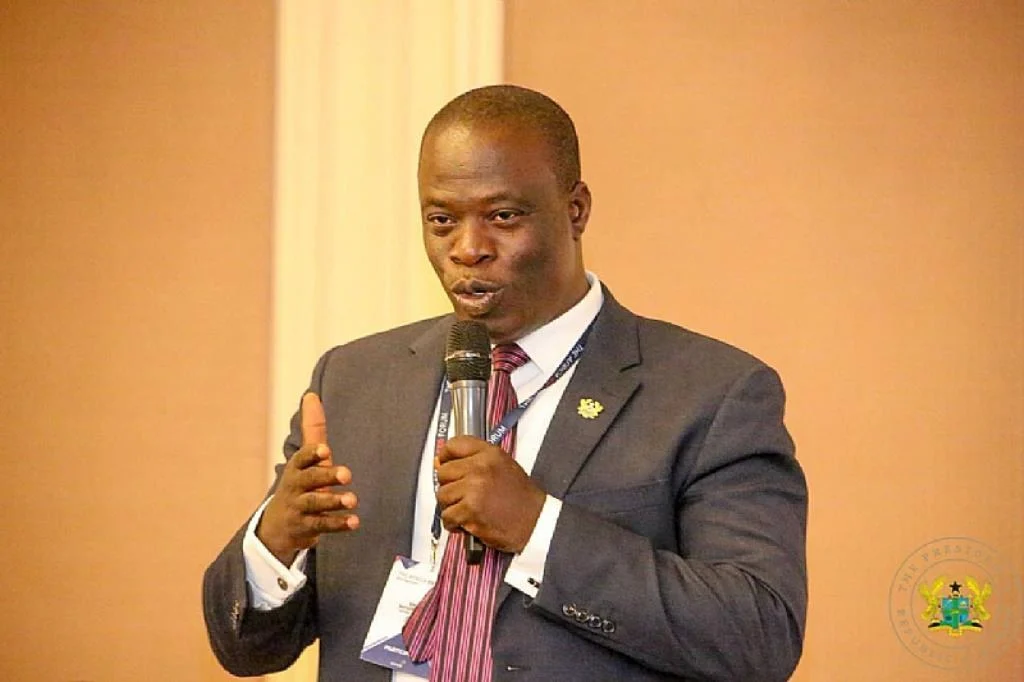
  • Payroll monitoring have saved Ghana over GH₵345m – Employment Minister

    Payroll monitoring have saved Ghana over GH₵345m – Employment Minister

    The Fair Wages and Salaries Commission (FWSC) achieved substantial savings of GH₵345 million through its extensive oversight and management efforts in 2023.


    This was disclosed by the Minister for Employment, Labour Relations, and Pensions, Ignatius Baffour Awuah, during a press briefing on Wednesday, August 28.


    He mentioned that the initiative covered 120 public sector institutions with the aim of reducing the wage bill and enhancing transparency in public sector employment.

    According to him, these efforts have successfully decreased the wage bill, resulting in substantial savings for the government.


    “Last year, the Fair Wages and Salaries Commission conducted a nationwide payroll monitoring exercise across 120 public sector institutions, including 97 MMDAs, 6 universities, and 17 other entities. Analysis of the 2023 payroll data from the Controller and Accountant General’s Department showed a reduction in the wage bill by over GH₵345 million. The payroll monitoring is still ongoing,” he said.


    Mr. Awuah also noted that, over the past seven and a half years, the Ministry of Employment, Labour Relations, and Pensions, with the support of key stakeholders, has successfully resolved all industrial disputes that threatened the country’s peace and security.


    “Overall, the payroll monitoring exercise has contributed to a more efficient, transparent, and accountable public sector payroll management system,” he added.


    The Minister announced that a review of crucial sector legislation, including the Labour Act, 2003 (Act 651), is underway to ensure it meets contemporary workplace needs.


    The proposed new Labour Bill features several reforms, such as banning certain practices by private employment agencies, extending maternity leave, and enhancing protections against workplace violence and harassment.


    Mr. Awuah emphasized the government’s commitment to ensuring fair income levels for workers and pensioners.


    He highlighted the highest adjustment of the Base Pay since the implementation of the Single Spine Pay Policy in 2010 and a 25 percent increase in monthly pensions for SSNIT pensioners as key achievements.


    “The Ministry will continue its work to improve the welfare of workers and employers while maintaining a peaceful labor environment,” he said.


    Additionally, he outlined the Ministry’s accomplishments, including strengthening the Labour Department’s operational capacity, creating jobs, and improving pension management.

  • Job seekers in Ghana are more than entrepreneurs – Basil Anthony

    Job seekers in Ghana are more than entrepreneurs – Basil Anthony

    CEO of Modern Floors Ghana, Basil David Anthony, has voiced apprehension regarding the nation’s educational system, arguing that it’s generating more individuals seeking jobs than those creating them.

    In an exclusive interview on the Happy Morning Show with Sefah Danquah, Mr Anthony stressed the imperative of fostering a shift towards empowering people to become creators of opportunities rather than mere seekers.

    “One fundamental issue facing us as a country right now is that we’re creating too many job seekers. We need more job creators, and we need to empower people to take up that challenge,” Anthony asserted.

    “It’s all about your dream and focus. Not everyone can come out from school and commit to the usual 9-5. Some of us need to be job creators,” he added.

    He highlighted the limitations of the conventional 9-to-5 employment model, underscoring the necessity of instilling entrepreneurial mindsets early on.

    Anthony’s comments come in the context of Ghana’s soaring unemployment rates, particularly among its youth.

    With a population exceeding 30 million, he questioned the capacity of both the government and private sectors to absorb the annual influx of job seekers into the market.

    “Schooling and everything is good, but after where is the current employment and unemployment rate at? Because there are only two sectors who can employ you, which is the government or public and the private. How many people can the government employ in a country over 30 million population?” he posited.

    The CEO’s advocacy for a transition towards entrepreneurship and job creation resonates with government initiatives aimed at fostering self-employment and small business growth to tackle the unemployment crisis.

    For years, experts have urged a reevaluation of Ghana’s educational curriculum to integrate entrepreneurial skills and mindsets, equipping students with the tools needed to identify and capitalize on business opportunities post-graduation.

  • Woman fails to get job for not wearing makeup

    Woman fails to get job for not wearing makeup

    Job hunting is often a daunting task for many, and the disappointment of being turned down after what seemed like a promising opportunity can sting even more.

    Such was the experience of one woman who was rejected for a job, not for her qualifications or skills, but allegedly because she didn’t wear makeup to the interview.

    Melissa Weaver, a TikTok user, shared her story in a viral video where she expressed her shock and confusion.

    “I interviewed for a job earlier this week,” she explained to her viewers. “The interview went so well. Every question she had, I had a great answer for. I used to work in recruitment. I know how to interview.”

    Despite a successful interview where she felt she was a perfect fit for the position of vice president, she received an email stating she wouldn’t be moving forward in the process.

    “I get an email from the recruiter saying that I’m not going to be moving on to the next round,” Weaver said. “I was really bummed because I wanted the job, but I was also very confused.”

    Weaver reached out to the recruiter for feedback and was informed that while her background, experience, and alignment with the company’s values were all commendable, the lack of effort in her appearance, specifically not wearing makeup, was a concern for the level of the role she applied for.

    “She said that while my background was exactly what they were looking for, my experience lined up with what they need for the position, and my own personal goals and values aligned with the company’s, she was concerned that for my interview, I hadn’t put enough effort in my appearance given the level of role I was interviewing for.

    “I don’t really wear a lot of makeup. Not to be quirky, I just don’t,” she explained, stating that she had interviewed for a vice president position.

    The incident sparked discussions about societal expectations and biases, with many pointing out the unfairness of such judgments, especially in professional settings.

    While some suggested legal action, Weaver opted not to pursue that route, focusing instead on continuing her job search.

    The story serves as a reminder of the challenges faced by women in the workforce and the importance of addressing biases and discriminatory practices.

  • Big Akwes returns to Ghana after 6-month stay abroad, abandons cleaner job offer

    Big Akwes returns to Ghana after 6-month stay abroad, abandons cleaner job offer

    Ghanaian actor Big Akwes has returned to Ghana following a six-month stint abroad with his wife. His visit to Germany, where his wife resides, led to some tension in their relationship.

    During his time overseas, Big Akwes frequently took to TikTok to share melancholic videos, which his wife found frustrating.

    She felt these videos portrayed her negatively and urged him to stop. Despite her efforts to secure him employment, he declined, citing his status as a celebrity.

    His somber videos stemmed from feelings of loneliness while his wife was at work, combined with observations of Ghanaians enduring difficult working conditions abroad.

    However, Big Akwes clarified that his trip was primarily for leisure and shopping, not for work.

    Now back in Ghana, Big Akwes plans to visit the Agradaa Love Palace in Obo, Kwahu. Agradaa, once known for her “sika gari” practices, was a significant figure in his life, with Big Akwes serving as her right-hand man during that time.

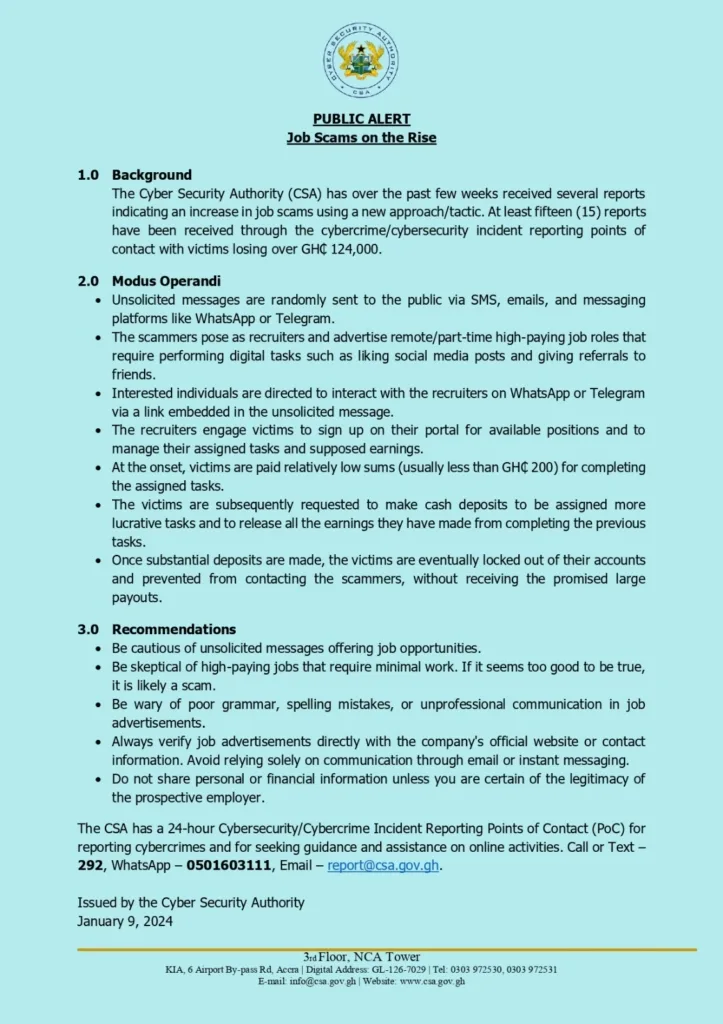
  • Job scams on the rise, be vigilant – CSA tells Ghanaians

    Job scams on the rise, be vigilant – CSA tells Ghanaians

    The Cyber Security Authority (CSA) is issuing a warning about a significant surge in job scams across Ghana, urging citizens to exercise caution.

    The CSA has already recorded at least 15 reports through its cybercrime reporting channels, detailing victims who have collectively lost over GH₵124,000 to these scams.

    The scammers employ tactics centered on masquerading as recruiters, reaching out with unsolicited messages that present enticing job opportunities.

    These fraudulent offers often promise high salaries with minimal work requirements, a characteristic that should raise suspicions for individuals familiar with legitimate job markets.

    In a statement, the CSA emphasized, “If it seems too good to be true, it’s likely a scam,” advising the public to stay vigilant and exercise skepticism when encountering such job propositions.

  • US jobs growth slows as policymakers fight inflation

    Jobs growth in the US has slowed for a second month, in a sign that the labour market in the world’s largest economy may be starting to cool.

    US employers added 263,000 new jobs in September, the fewest since April 2021.

    Despite the lower figure, analysts said the US central bank will need to do more to slow the economy if it wants to rein in rapidly rising prices.

    The dollar strengthened following the report, as investors expect interest rates to continue to rise.

    This strengthening pushed the pound down to $1.11, having been above $1.12 before the jobs figures were released.

    The labour market in the US is being closely watched, as the US central bank raises borrowing costs sharply.

    Officials hope the higher interest rates will cool demand for big-ticket items such as homes and cars, and ease the pressures that are pushing up prices at the fastest pace since the 1980s.

    They have warned that the slowdown in activity is likely to lead to some job loss, but say they hope to avoid a sharp economic downturn.

    Analysts said that Friday’s report from the US Labor Department showed the jobs market remains relatively tight, as a backlog of unfilled positions pushes companies to continue to hire despite fears of wider economic slowdown.

    Restaurants, bars and health care firms led the job gains last month, while the unemployment rate fell from 3.7% in August to 3.5%, returning to a 50-year low.

    The average hourly wage in September was also 5% higher than a year earlier.

    While that lags the inflation rate, analysts said the gains still put upward pressure on prices, especially as the pool of workers with jobs or looking for work has remained stubbornly below pre-pandemic levels.

    “Although this month’s jobs report is weaker than the figures recorded last month, the labour market remains relatively strong,” said Richard Flynn, managing director at Charles Schwab UK.

    “The Fed has been increasingly clear that substantial weakness in the economy may be the expense for a return to lower inflation. As rate hikes feed through to the real economy in the months ahead, the labour market may weaken further, reflecting investors’ recessionary concerns.”

    Consumer spending – the main driver of the US economy – has held up in recent months, despite the spike in prices eroding purchasing power.

    But anecdotal reports of job losses are rising, as firms announce job cuts or hiring freezes, especially those in the housing and tech sector. Peloton this week announced its fourth round of job cuts this year, shedding another 500 positions – or roughly 12% of its workforce.

    Some retailers have also scaled back hiring plans. Walmart, for example, has said it is hiring 40,000 workers for the holiday season, after taking on 150,000 last year.

  • Unemployment crisis: Some curriculum teachings not connected to employers expectations – Lecturer

    A business consultant and entrepreneurship lecturer, Isaac Tweneboah-Kodua, has urged students to be dedicated to learning more in order to be well-packaged and marketable for the job market.

    According to him, the curriculum program of the country only fills the gap for students between their education and their readiness for the corporate sector.

    “The first one has to with the curriculum we teach the younger people at the universities. Some of them are not really connected with what the employers are looking for.

    “So, when the people come out of school especially those who did not do anything directly with what the industry is looking for, it because very difficult for them to stick themselves into the industry,” he told Samuel Eshun on the Happy Morning Show.

    He did, however, proposed that despite the shortcomings of Ghana’s curriculum activities, students might prepare themselves by making an investment in enhancing their knowledge and skills in other academic areas.

    “But that does not warrant that if for example someone did a course that there is no readily available job in the market the person shouldn’t prepare him or herself.

    “I did Geography and Political Science when I was in Legon but at the time I got to know that if I didn’t find myself something to improve myself, I would be unemployed after school.

    “So right away I did Marketing at along my main courses as did my roommate. From that time till now I have never known unemployment. Not that I’m superhuman but the fact is I got to understand my talent alone doesn’t warrant me to automatically get a job after school.

    “If I did my main courses alone, my best bet would have been to teach in the classroom. At the same time my colleagues at Winneba and UCC were doing the same course with education. If we both were looking for the teaching jobs, they would be favorited ahead of me,” he added.

  • HSBC to press on with 35,000 job cuts

    HSBC, the UK’s largest bank, is to resume its plans to cut 35,000 jobs.

    New chief executive Noel Quinn gave the news to his 235,000 staff around the globe in a memo seen by the BBC and confirmed as authentic by the bank.

    The lender had originally announced the plan in February, but put it on hold amid the coronavirus pandemic.

    HSBC said it would try to find internal jobs for those affected but that redundancies were likely.

    In April, the bank had said it would hold fire on the cuts, explaining that it did not want to leave staff unable to find work elsewhere during the coronavirus outbreak.

    The move is part of a restructuring programme which aims to achieve $4.5bn (£3.6bn) of cost cuts by 2022.

    Some cuts are likely to come from merging support roles in the commercial bank and investment bank.

    The bank will also review less-profitable areas of business.

    ‘Why now?’ At its peak, the bank employed more than 300,000 people, but since the global financial crisis around 2008, HSBC has sold businesses and left some countries, including Brazil in 2016.

    Various chief executives have aimed to make HSBC a simpler business, especially after the bank agreed to pay $1.9bn to regulators in 2012 over poor money laundering controls.

    Trade union Unite said the news would cause apprehension with many lockdown measures still in place.

    “The question that must be asked today is why now HSBC?” Dominic Hook, Unite national officer said.

    “At present vast numbers of HSBC staff are making massive sacrifices working from home or taking risks travelling into offices and bank branches to help customers.

    ” “Unite will continue to oppose any compulsory job losses within HSBC and work vigorously to ensure staff are heard and their jobs protected,” he said.

    The bank also faces political challenges.

    It is reliant on China’s attitude towards its massive home market of Hong Kong, and on the US to be able to bank in dollars, the currency of choice for many commodity markets.

    Earlier this month, US Secretary of State Mike Pompeo criticised HSBC for supporting China’s move to impose new security legislation in Hong Kong.

    Mr Pompeo also said the US stood with its allies against China’s “coercive bully tactics”.

    The Trump administration has repeatedly attacked Beijing for what it says is an attempt to end Hong Kong’s autonomy.

    HSBC, which is UK-based but was formed in Hong Kong in 1865, declined to comment on Mr Pompeo’s remarks.

    Last month, China’s parliament approved a resolution that would impose legislation on Hong Kong that criminalises criticism of the city’s government.

    Disclaimer : “Opinions expressed in this article are the sole responsibility of the author(s) and do not in any way reflect those of backend.theindependentghana.com. Our outfit will hereby not be liable for any inaccuracies contained in this article.”

    Source: bbc.com

  • Coronavirus: How exposed is your job?

    Millions of workers are doing their day jobs from makeshift set-ups in their living rooms and kitchens, while those in England who can’t work from home are now encouraged to go back in if they can do so safely.

    But how exposed to coronavirus might you be in your job? And how does that compare to others?

    Data from the UK’s Office for National Statistics, based on a US survey, puts into context the risk of exposure to disease, as well as the amount of close human contact workers had before social distancing and other safety measures were introduced.

    While most jobs require people to work relatively closely to others – somewhere in the range between arm’s length and a shared office environment – there are very few that typically involve exposure to disease more than once a year.

    It’s important to note that the data on both exposure to disease at work and how close people are to others is based on interviews that took place with US workers before the pandemic broke out and social distancing recommendations were introduced.

    Some jobs may find it easier to adjust than others and there may be slightly different working practices and conditions in the US for certain occupations. The results can be expected to be broadly the same in most developed countries.

    Almost all the jobs that have a high exposure to both disease and other people are healthcare professions, while those who scored low on both measures include artists, lawyers and those in more typical office jobs like marketing, HR and financial advisers.

    Cleaners, prison officers and undertakers are among those who have relatively high exposure to disease without so much close interaction with other people.

    But the people who might be most at risk to a new infectious disease like Covid-19, are those who have lots of close contact with people, but aren’t used to being exposed to disease.

    Bar staff, hairdressers and actors fall into this category, as well as taxi drivers and bricklayers.

    Other figures released by the ONS this week showed that deaths in the healthcare sector in the UK are no higher on average than those in the wider community, although social care workers were dying at higher rates. Given that these healthcare occupations are so exposed to both disease and other people, why have there not been more deaths?

    This could be because workers in these jobs are more likely to be using personal protective equipment (PPE) like masks and gloves, says Ben Humberstone, deputy director for health analysis at the ONS. They also follow regular hygiene measures like washing hands.

    One of the jobs which had many more coronavirus deaths than the average was taxi drivers. That’s a job which scores highly in terms of closeness to other people, particularly among those jobs which are still actually possible to do at the moment. Bar staff, hairdressers and fitness instructors all score higher, but with bars, gyms and hair salons shut, most of these people will be isolating.

    As taxi drivers are less exposed to disease in normal times, there may not be an existing culture of regular hand-washing and wearing PPE. Some firms are trialling partition screens and distributing gloves and masks to protect their drivers and customers.

    Methodology

    The data in the look-up comes from this release by the ONS.

    The figures on proximity to others and exposure to disease come from a survey carried out by the Occupational Information Network (O*NET) in which they asked respondents in the US to place themselves on a 1-5 scale for the following two questions.

    1. How physically close to other people are you when you perform your current job?

    2. How often does your current job require you to be exposed to diseases or infection?

    For exposure to disease, a score of one means they are never exposed, while a score of five means they are exposed daily. It’s referring to any disease, not coronavirus specifically.

    For the physical closeness question, one means the respondent works more than 100ft away from the nearest other person, while five means they need to touch or be near to touching other people at work. The survey was carried out before social distancing measures were introduced and workers in certain jobs will of course find it easier to adjust than others.

    The responses for people in the same jobs were averaged together and extrapolated to form a score of 100. We’ve looked at these scores out of of 100 and given each job a ranking.

    If any two jobs had the same score we’ve given them a tied ranking.

    Source:

  • Wednesday: Advertised jobs in newspaper today

    Prospective job seekers can find below the advertised jobs in the April 1, 2020 edition of Daily Graphic as published in the paper today.

    Source: theghanareport.com

  • Thursday: Advertised jobs in newspapers today

    Prospective job seekers can find below the advertised jobs in the March 5, 2020 edition of Daily Graphic newspaper as published in the paper today.


    Source: theghanareport

  • Job advertisements in today’s newspaper

    Prospective job seekers can find below the advertised jobs in the January 21, 2020 edition of Daily Graphic and Ghanaian Times as published today in the paper.

    Source: theghanareport.com