Tag: Joe Biden

  • Democracy is on the ballot – Biden

    With less than a week until the US midterms, President Joe Biden has warned voters that “democracy is on the ballot”.

    Biden was speaking at a fundraising event for Charlie Crist, the Florida Democratic candidate for governor, who is running against Ron DeSantis, the state’s incumbent Republican governor.

    “You’ve got 350-so-election deniers on the ballot, on the Republican ticket … democracy is on the ballot this year,” Biden said.

    He was referring to Republican candidates who back Donald Trump’s false assertion that he won the 2020 presidential election.

    Biden also took aim at DeSantis.

    “Charlie is running against Donald Trump incarnate,” he said.

    DeSantis is widely believed to be considering a presidential run in 2024, along with former President Trump.

    Crist said DeSantis “is tearing us apart”.

    He accused his opponent of “attacking anyone who doesn’t look like him, doesn’t act like him, doesn’t think like him and they are women, people of colour, LGTBQ community, teachers, doctors, scientists.

    “He punishes businesses like Disney World because they disagree with him on a bill. It’s unconscionable.”

    “Governor DeSantis only cares about the White House. He doesn’t give a damn about your house,” he added.

    Source: BBC.com 


  • Paul Pelosi attack: Violent extremism warning ahead of US election

    The violent attack on Speaker of the House Nancy Pelosi’s husband comes with just over a week to go before the US midterm elections – a moment when political tensions are coming to a boil.

    As if to emphasise this point, just a few hours after news of the assault on Paul Pelosi on Friday, the US government distributed a bulletin to law enforcement across the nation. It warned of a “heightened threat” of domestic violent extremism against candidates and election workers driven by individuals with “ideological grievances”.

    Also on Friday, the US Department of Justice announced that a man from Pennsylvania had pleaded guilty to making multiple phoned death threats against an unnamed congressman – reported to be Democrat Eric Swalwell of California. The threats included telling a staff member in the congressman’s Washington office that he was going to come to the US Capitol with a firearm.

    These wailing klaxons of a political system in peril come as Republicans and Democrats frame the upcoming midterm voting, which will determine which party controls Congress next year, as a pivotal moment in American history.

    Republicans warn this is the last chance to put a check on Democrat Joe Biden’s presidency. Democrats say American democracy itself is at stake because of the numerous Republican candidates who have refused to accept the results of the 2020 presidential election.

    And the rhetoric comes at the culmination of what has been a steady drumbeat of violence – and violent threats – that has been building all year.

    Death threats

    In Arizona, there have been multiple reports of masked individuals with firearms staking out ballot drop boxes, ostensibly to monitor the sites for election fraud. They’ve posted photographs of individuals casting their ballots on right-wing social media sites and encouraged others to join their efforts.

    In June, a man was arrested near the home of Supreme Court Justice Brett Kavanaugh. He had travelled to the Washington suburb from California and called police after he arrived to tell them he had a firearm and intended to kill the conservative justice.

    The following month, the Republican candidate for governor, Lee Zeldin, was attacked while on stage during a campaign rally. Congresswoman Pramila Jayapal, a liberal leader in the Democratic Party, was threatened by a man with a handgun outside her Seattle home. He was subsequently charged with felony stalking.

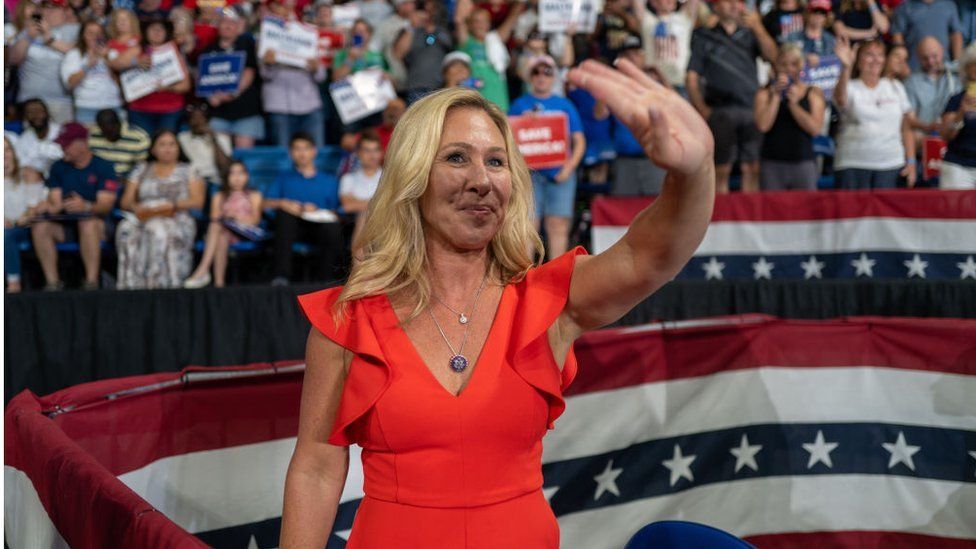
    Marjorie Taylor Greene waves to supporters at a Donald Trump rally.
    IMAGE SOURCE,GETTY IMAGES Image caption, Marjorie Taylor Greene waves to supporters at a Donald Trump rally.

    Republican congresswoman Marjorie Taylor Greene has had police respond to her home six times based on anonymous hoax calls. The practice, called “swatting”, is used to try to provoke a confrontation between the target and law enforcement. She has also been the target of numerous death threats.

    Partisan violence – and the threat of it – is nothing new in American politics, of course. The bloodiest recent attack occurred five years ago, when a man with multiple weapons opened fire on Republican politicians playing baseball at a city park. Five were injured, including one critically – second-ranking Republican in the House of Representatives, Steve Scalise of Louisiana. That, however, was an isolated incident.

    Keeping politicians safe

    Data provided by the US Capitol Police suggests a violent wave is building. The number of cases involving threats against members of Congress has increased every year since 2017. In the first three months of 2022, the department has documented more than 1,800 incidents.

    In response, Capitol Police announced in July that it would cover up to $10,000 for security upgrades in the homes of congressional legislators.

    There are 435 members of Congress, however. They regularly travel to and from their homes around Washington and from the nation’s capital to their homes across the nation. A motivated individual fixated on violence will be able to find a way to strike against a targeted politician – or their family.

    With Mrs Pelosi thousands of miles away in Washington, there was no police security provided for Mr Pelosi at their San Francisco home. He was not the intended target, but he became the victim.

    Before the attack, the suspect is said to have asked, “Where is Nancy?” – the phrase harkening back to the 6 January assault on the US Capitol, when a man roamed the halls of the Capitol, calling out: “Where are you, Nancy? We’re looking for you.”

    Politicians on both sides of the nation’s partisan divide have expressed their sympathy for Mr Pelosi and called for a cooling of the rhetoric. It is a task that is easier said than done, however.

    With a population encased in political bubbles of social media and news outlets that reinforce their existing political beliefs and fears, individuals will continue to be tempted by extremism and violence. And when they go looking for the politicians they read about and see on television – ones they are told are enemies of the nation and threats to democracy – they will be able to find them.

    Source: BBC.com

  • Appeals court puts Biden’s student debt relief plan on pause

    Joe Biden’s student debt relief plan has hit a legal roadblock.

    According to CNN, a federal appeals court temporarily blocked the program on Friday, as it reviews a challenge brought by six GOP-led states. More than a month after Biden announced the plan, Nebraska, Missouri, Arkansas, Iowa, Kansas, and South Carolina filed a lawsuit that claimed Biden could not cancel the debt without congressional approval, which he never received. The states also argued that the debt relief would threaten their tax revenues as well as hurt state-related entities that own or invest in privately held loans.

    A lower court judge dismissed the case Thursday, stating the plaintiffs failed to establish “ongoing injury” caused by the program. The states immediately appealed the ruling, and the 8th U.S. Circuit Court of Appeals granted a stay as the case is being reviewed.


    The Biden administration has until Monday to respond. The plaintiffs have been asked to issue their reply no later than Tuesday.

    POTUS said the debt relief plan aims “to give everybody a little more breathing room.”

    Source: Complex.com

  • Burna Boy launches cannabis brand in USA

    Nigerian singer, Damini Ebunoluwa Ogulu popularly known as Burna Boy, has launched a cannabis brand in Miami, in the United States of America.

    According to reports, the Grammy award-winning musician unveiled the brand, named ‘BrkFst’, in partnership with ‘Jokes Up Ice Kream’, a weed dispensary and shipping company in the states.

    Fans in attendance at the launch got a first look at the merchandise and were also treated to Burna Boy’s music.

    This event comes at a time Burna Boy’s country, Nigeria, is still debating the legalization of cannabis for business and medicinal purposes.

    It can be recalled that sometime in 2021, Burna Boy spoke against the unwillingness of the Nigerian government to legalize the drug, adding that “everyone smokes.”

    “It’s just kind of hypocritical out there. They try to make it seem like if you smoke weed you’ll just go mad in Nigeria. Everybody smokes it. It’s just a topic no one wants to talk about. No one wants to talk about it; everybody is cool. Nobody wants to make it a thing to advocate for legalization of weed,” he earlier stated in an interview with Home Grown Radio in Los Angeles.

    US president’s take on Cannabis

    Joe Biden, the US president, on October 6, pardoned all federal offenders convicted of “simple possession” of marijuana.

    “As President, I will decriminalize cannabis use and automatically expunge prior convictions,” he promised.

    Check out the post below:

    Source:ghanaweb.com

  • Biden Administration launches Student Loan Forgiveness Applications

    The Biden administration on Friday launched a beta version of its student loan forgiveness application process, allowing borrowers to sign up online before the official website is unveiled later this month.

    The application, which is available here, is the first step in Biden’s program to cancel student debt for tens of millions of Americans.

    “This testing period will allow the Department to monitor site performance through real-world use, test the site ahead of the official application launch, refine processes, and uncover any possible bugs prior to official launch,” an Education Department spokesperson said.

    The Education Department urges borrowers to apply by Nov. 15, and said that those who sign up by October could have the majority of their debt wiped out as soon as November.

    Back in August, Biden announced plans to forgive $10,000 in student loan debt for millions of borrowers who make $125,000 a year or less. Borrowers who received a Pell grant will qualify to get an additional $10,000 forgiven.


    “In keeping with my campaign promise, my administration is announcing a plan to give working and middle class families breathing room as they prepare to resume federal student loan payments in January 2023,” Biden tweeted when announcing his administration’s plan.

    Source: Complex.com

  • Biden strongly blasts Russia’s missiles strikes

    Russia’s missile attacks on Ukraine this morning have been “seriously criticised” by US President Joe Biden.

    In a statement, Mr Biden said: “These attacks killed and injured civilians and destroyed targets with no military purpose.

    “They once again demonstrate the utter brutality of Mr Putin’s illegal war on the Ukrainian people.”

    The US leader went on to offer his condolences to the families and loved ones of those who were “senselessly killed”.

    “These attacks only further reinforce our commitment to stand with the people of Ukraine for as long as it takes,” he added.

    “Alongside our allies and partners, we will continue to impose costs on Russia for its aggression, hold Putin and Russia accountable for its atrocities and war crimes, and provide the support necessary for Ukrainian forces to defend their country and their freedom.

    “We again call on Russia to end this unprovoked aggression immediately and remove its troops from Ukraine.”


  • No new intelligence behind Biden nuclear war remarks says, White House

    The US does not have any new intelligence that sparked Joe Biden’s remarks about nuclear “Armageddon”, the White House has said.

    President Biden had said the world is closer to nuclear war than at any time since the Cuban missile crisis.

    In statements this afternoon, the White House said the US has seen no reason to change its own nuclear posture.

    Its spokesperson said Russia’s talk of using nuclear weapons was irresponsible, but added that it has no indications that Moscow is preparing to imminently use them.

    President Biden’s comments show how seriously he takes the threats, the spokesperson added.


  • Biden to issue pardon for all Federal offenses of simple Marijuana possession

    President Biden announced pardons for thousands of people convicted of simple marijuana possession under federal law, the New York Times reports.

    Biden’s administration confirmed that approximately 6,500 people convicted of simple possession of marijuana from 1992 to 2021 would be pardoned. Thousands of others who received the same conviction in the District of Columbia will also receive pardons, with officials adding that Biden will encourage governors across the country to allow pardons for those convicted on state charges. In addition, his administration plans to review whether marijuana should still be considered a Class 1 drug, similar to harder substances like LSD and heroin.

    “As I’ve said before, no one should be in jail just for using or possessing marijuana. Today, I’m taking steps to end our failed approach,” Biden’s official Twitter account wrote. “We classify marijuana at the same level as heroin—and more serious than fentanyl. It makes no sense.”

    Concluding the POTUS Twitter thread, Biden added, “Sending people to jail for possessing marijuana has upended too many lives – for conduct that is legal in many states. That’s before you address the clear racial disparities around prosecution and conviction. Today, we begin to right these wrongs.”

    Despite legalization in various states, either medically or re-creationally, marijuana is still illegal under federal law. Biden stressed that “important limitations on trafficking, marketing, and under-age sales should stay in place.” His announcements stopped short of decriminalization, something he said his administration would pursue in February 2021.

    Source: Complex.com

  • Biden blasts Russia’s “shameless” annexation efforts

    A “so-called referendum” conducted by Russia in Ukrainian territory has been denounced by Joe Biden as a “shameless and transparent endeavor by Russia to acquire parts of neighboring Ukraine.”

    The US president made the comments during a White House summit with Pacific Island nations.

    Mr Biden said the results of Russia’s “referendums” “were manufactured in Moscow”.

    He added “the United States will never, never, never recognise Russia’s claims on Ukraine sovereign territory.

    The US and its allies have promised to adopt even more sanctions than they’ve already levied against Russia and to offer millions of dollars in extra support for Ukraine.

  • Akufo-Addo absent as Ruto, Weah, others meet Joe Biden in New York

    President of the United States, Joe Biden, on Wednesday (September 21) held a reception for a select group of Heads of States and government representative at the American Museum of Natural History in New York.

    The leaders present were in New York to attend the 77th United Nations General Assembly with the US president hosting the reception on the sidelines of the UNGA.

    President Nana Addo Dankwa Akufo-Addo who is also attending the annual gathering of world leaders happened to be in town but per GhanaWeb checks was not at the reception.

    A rundown of the President’s engagements at the UNGA as shared by deputy director of communications at the presidency, Jefferson Sackey, also did not capture any such engagement by Akufo-Addo.

    Some of his peers who were present included William Samoei Ruto, the new Kenyan president, Felix Tshisekedi of the Democratic Republic of Congo, DRC; Hakainde Hichilema of Zambia and Ali Bongo Ondhimba of Gabon.

    Also present was George Weah of Liberia as well as the Chairperson of the African Union Commission, AUC, Moussa Faki Mahamat.

    All attending presidents and their spouses took photos with the Bidens – Joe and Jill – with the American flag and presidential flag against a black background.

    “Kenya will continue expanding its strategic partnership with the United States of America to advance peace and prosperity in Africa.

    “With Rachel at a reception hosted by the @POTUS during the 77th Session of the United Nations General Assembly, New York,” Ruto captioned his photo with Joe Biden.

    Other world leaders who attended include: Racep Tayyip Erdogan of Turkey, Crown Princess Mary of Denmark, President Klaus Iohannis of Romania, Prime Minister of St. Lucia, Philip Pierre; Foreign Minister of Sri Lanka, Ali Sabry and Prime Minister Andrew Holness of Jamaica.

    Akufo-Addo among African guests of Trump in 2017

    The President of the Republic, Nana Addo Dankwa Akufo-Addo, together with eight other African Heads of State, on Wednesday, 20th September, 2017, at the side-lines of the 72nd Session of the United Nations General Assembly, held talks with the President of the United States of America, Donald Trump, on US-African relations.

    The 8 Heads of State present at the meeting were President Muhammadu Buhari of Nigeria, President Alasanne Ouattara of Côte d’Ivoire, President Jacob Zuma of South Africa, President Macky Sall of Senegal, President Alpha Conde of Guinea, who is also Chairperson of the African Union, President Yoweri Museveni of Uganda, and President Hage Geingob of Namibia.

  • Elton John cries as Biden surprises him with medal at White House gig

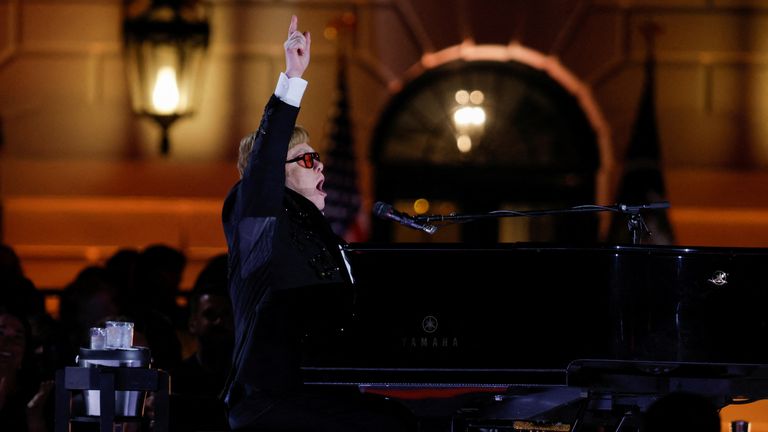
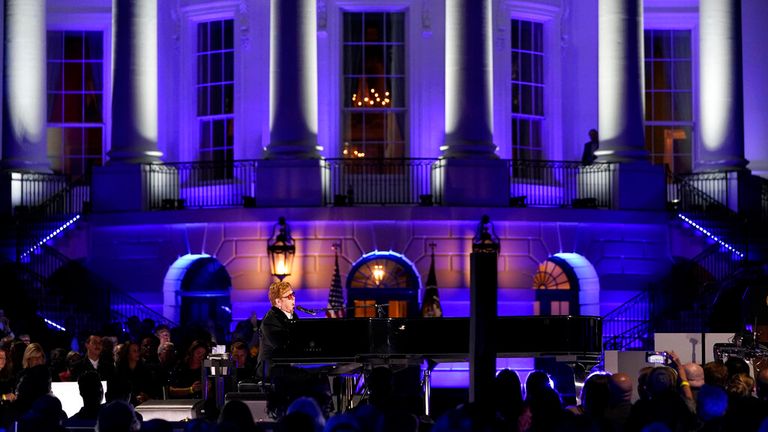
    Sir Elton John has played for Joe Biden and about 2,000 fans on the White House lawn as part of his farewell tour, with the singer in tears as the president awarded him a medal.

    Introducing the star, Mr Biden said: “Like so many Americans, our family loves his music. It’s clear Elton John’s music has changed our lives.”

    The president said in his 2017 book that he sang Crocodile Rock to his son Beau when he was a child, and again when he was dying of cancer.

    Sir Elton performed the song at Friday’s gig, as well as tracks such as Tiny Dancer, Rocketman and Your Song.

    Nurses, teachers, emergency services workers and LGBTQ activists were among the audience at the show, intended to honour what the White House called “everyday heroes”.

    The singer, 75, said the performance was the “icing on the cake” of his decades-long career.

    Elton had previously declined to play for former president Donald Trump’s inauguration but appeared in his element at Friday’s gig.

    And there was a surprise too – with President Biden awarding him the National Humanities Medal.

    “I’m flabbergasted,” said a tearful Sir Elton. “I will treasure this.”

    “I don’t know how to take a compliment very well,” he added.

    “But it’s wonderful to be here amongst so many people who have helped my AIDS foundation and my heroes, the ones that work day to day on the front line.”

    Pic: AP
    Image:Pic: AP

    In between songs, Elton gave shout-outs to the likes of ex-president George W Bush for his administration’s plan to tackle AIDS – and former first lady Laura Bush was in the audience.

    The singer’s foundation has raised more than £400m to combat the virus around the world since being set up in 1992.

    Elton is in the middle of a farewell tour that includes a show in Washington on Saturday and gigs across America until mid-November.

    It heads to Australia and New Zealand at the end of the year before heading to Europe in March – where dates include nine days at London’s O2 Arena.

    Source: Sky news

  • These African leaders were invited to Joe Biden’s reception in New York

    President of the United States, Joe Biden, on Wednesday (September 21) held a reception for a select group of Heads of States and government representatives at the American Museum of Natural History in New York.

    The leaders present were in New York to attend the 77th United Nations General Assembly with the US president hosting the reception on the sidelines of the UNGA.

    Per GhanaWeb checks, African leaders present included William Samoei Ruto, the new Kenyan president, Felix Tshisekedi of the Democratic Republic of Congo, DRC and Ali Bongo Ondimba of Gabon.

    Also present was George Weah of Liberia as well as the Chairperson of the African Union Commission, AUC, Moussa Faki Mahamat.

    All attending presidents and their spouses took photos with the Bidens – Joe and Jill – with the American flag and presidential flag against a black background.

    “Kenya will continue expanding its strategic partnership with the United States of America to advance peace and prosperity in Africa.

    “With Rachel at a reception hosted by the @POTUS during the 77th Session of the United Nations General Assembly, New York,” Ruto captioned his photo with Joe Biden.

    Other world leaders who attended include: Racep Tayyip Erdogan of Turkey, Crown Princess Mary of Denmark, President Klaus Iohannis of Romania, Prime Minister of St. Lucia, Philip Pierre; Foreign Minister of Sri Lanka, Ali Sabry and Prime Minister Andrew Holness of Jamaica.

  • Russia wants Ukraine to cease to exist – Biden

    Biden says Russia’s war is about extinguishing Ukraine’s right to “exist as state, as a people”.

    “Just before he invaded, Putin asserted, and I quote, ‘Ukraine was created by Russia’ and never had quote ‘real statehood’.

    “And now we see attacks on schools, railway stations, hospitals.. even more horrifying evidence of Russia’s war crimes.”

    The US president also references the mass grave recently uncovered in Izyum, which he said “showed signs of torture”.

    He says Russia’s war is about extinguishing Ukraine’s right to exist as a state – “plain and simple”, before telling those at the UN General Assembly:

    Quote Message: Whoever you are, wherever you live, whatever you believe – that should make your blood run cold. That’s why 141 nations in the General Assembly came together to unequivocally condemn Russia’s war against Ukraine.

    Whoever you are, wherever you live, whatever you believe – that should make your blood run cold. That’s why 141 nations in the General Assembly came together to unequivocally condemn Russia’s war against Ukraine.He adds that the US has personally marshalled “massive levels of security assistance, hamartian aid and direct economic support” to Ukraine.

  • Negotiations over Northern Ireland: Joe Biden to explain to Truss the need for UK and EU’s negotiations

    The contentious Northern Ireland protocol will be covered at a postponed meeting between the US president and the prime minister on Wednesday in New York.

    The Northern Ireland Protocol must be resolved by negotiation, Joe Biden will say to Liz Truss when they meet later today, according to the White House.

    In a meeting on Tuesday, Ms. Truss declined to discuss the protocol with French President Emmanuel Macron, and No. 10 did not indicate whether she will bring it up with European Commission President Ursula von der Leyen.

    But US national security adviser Jake Sullivan made it clear President Biden will discuss it “in some detail” with Ms Truss.

    Mr Sullivan told reporters the president “will encourage the UK and the European Union to work out an effective outcome that ensures there is no threat to the fundamental principles of the Good Friday Agreement”.

    “And he will speak in some detail to her about that,” he added.

    The adviser said Mr Biden will “communicate his strong view that the Good Friday Agreement – which is the touchstone of peace and stability in Northern Ireland – must be protected.

    “And we must collectively take steps – the US, the UK, the parties in Northern Ireland, the Republic of Ireland – to ensure that it is protected,” he added.

    Unilateral action

    The UK and EU remain in dispute over the trading arrangements between Great Britain and Northern Ireland, with the UK insisting physical checks on farm produce and other goods are removed.

    The UK has insisted it will act unilaterally if a solution cannot be found and has drawn up legislation to enable the UK to tear up part of the protocol – the Northern Ireland Protocol Bill.

    The EU and other critics say it will breach international law by effectively ditching key parts of the Brexit deal signed by Boris Johnson and the EU in 2019.

    The bill was tabled by Ms Truss this summer and is expected to reach the Lords in mid-October, and threatens to further escalate tensions between the EU and potentially the US as well.

    Mr Biden, who has Irish heritage, has previously raised concerns about Brexit’s threat to the peace process.

    Lord Darroch, who served as the UK ambassador to the US under Ms Truss’ three predecessors, told Sky News it is “stone cold certain” that the lack of progress in striking a free trade deal with the US is related to that.

    He said: “The Democrat administration has made this clear in briefings, there is going to be no trade deal unless we can sort out the protocol in a way that the EU and particularly the Irish government is happy with, and no unilateral rewriting of it.”

    Speaking ahead of Wednesday’s meeting, he said there are “clearly tensions under the surface” – pointing to both the protocol bill and President Biden’s recent comments about “trickle-down economics”.

  • Covid-19 pandemic is over in the US – Joe Biden

    President Joe Biden has declared the pandemic over in the US, even as the number of Americans who have died from Covid continues to rise.

    Mr Biden said that while “we still have a problem”, the situation is rapidly improving.

    Statistics show that over 400 Americans on average are dying from the virus each day.

    The head of the World Health Organization (WHO) said last week that the end of the pandemic is “in sight”.

    In an interview with 60 Minutes on CBS, Mr Biden said that the US is still doing “a lot of work” to control the virus.

    The interview – aired over the weekend – was partly filmed on the floor of the Detroit Auto Show, where the president gestured towards the crowds.

    “If you notice, no one’s wearing masks,” he said. “Everybody seems to be in pretty good shape…I think it’s changing.”

    In August, US officials extended the ongoing Covid-19 public health emergency, which has been in place since January 2020, through 13 October.

    To date, more than one million Americans have died from the pandemic.

    Data from Johns Hopkins University shows that the seven-day average of deaths currently stands at over 400, with more than 3,000 dead in the last week.

    In January 2021, by comparison, more than 23,000 people were reported dead from the virus over a single week-long span. About 65% of the total US population is considered fully vaccinated.

    Some federal vaccine mandates remain in place in the US – including on healthcare workers, military personnel and any non-US citizen entering the country by airplane.

    Public health officials have expressed cautious optimism in recent weeks that the world is edging towards a pandemic recovery but continue to urge people to remain careful.

    On Monday, Dr Anthony Fauci, head of the National Institute of Allergy and Infectious Diseases, acknowledged the situation has improved.

    But in comments made at Washington DC think-tank, he added that the current daily death rate is still “unacceptably high”.

    “We are not where we need to be if we’re going to be able to ‘live with the virus,’” he said.

    He also cautioned that new Covid-19 variants could still emerge, especially in the coming winter months.

    The US recently authorised new vaccines that match the version of the Omicron variant currently dominant in the country, with federal health officials asking Americans to keep their jabs up-to-date.

    Last week, WHO Director-General Tedros Adhanom Ghebreyesus said that the world has “never been in a better position to end the pandemic”.

    “We are not there yet,” he said. “But the end is in sight.”

    Covid-19 also continues to have a significant impact on the US economy, with the National Bureau of Economic Research reporting last week that Covid-related disease has slashed the US workforce by approximately 500,000 people.

    Mr Biden said he believes that the pandemic has had a “profound” impact on the psyche of Americans.

    “That has changed everything…people’s attitudes about themselves, their families, about the state of the nation, about the state of their communities,” he said.

    “It’s been a very difficult time. Very difficult.”

    More than 6.5 million people have died since the beginning of the pandemic around the world. The US has had the highest death toll, followed by India and Brazil.

    Source: BBC

  • Mark Frerichs: US hostage exchanged for Taliban-affiliated Afghan leader

    The Taliban have released a US engineer they had held hostage since 2020 in exchange for an Afghan tribal leader held in US custody since 2005.

    Mark Frerichs was handed over at Kabul airport on Monday, the Taliban said.

    In return, they received Bashir Noorzai, a Taliban ally serving a life sentence for drug trafficking.

    US President Joe Biden said that the swap required “difficult decisions” that he did not take lightly.

    Mr Frerichs, 60, was abducted by the Taliban the year before the group swept back to power in Afghanistan and its Western-backed government collapsed.

    He had been living and working in Kabul as a civil engineer for 10 years. Mr Frerich’s sister, Charlene Cakora, said the family had never given up hope of getting him back.

    “I am so happy to hear that my brother is safe and on his way home to us. Our family has prayed for this each day of the more than 31 months he has been a hostage,” she said in a statement.

    “There were some folks arguing against the deal that brought Mark home, but President Biden did what was right. He saved the life of an innocent American veteran.”

    The detention of the former navy officer has been a major impediment to improving relations between the US and the Taliban, whose government is still to be recognised by any country in the world.

    President Biden said in January: “The Taliban must immediately release Mark before it can expect any consideration of its aspirations for legitimacy. This is not negotiable.”

    At least one other American remains in Taliban hands. Filmmaker Ivor Shearer and his Afghan producer, Faizullah Faizbakhsh, were detained in Kabul in August.

    Eric Lebson, a former national security official who worked as a volunteer to help the Frerichs family, said he hoped Mr Biden’s actions to secure Mr Frerichs’ release “are an indicator of his commitment to do the same on an urgent basis for other Americans held hostage or wrongfully detained abroad”.

    “They are being held because they are Americans and they need the US government to bring them home,” Mr Lebson said.

    Bashir Noorzai told reporters in Kabul his release would bring peace with the US

    Bashir Noorzai was given a hero’s welcome on his return to the Afghan capital, and was greeted by Taliban fighters carrying garlands of flowers.

    “My release together with that of an American will make peace between the countries,” he told a news conference.

    Noorzai was a close ally and friend of Taliban founder Mullah Omar and helped finance the first Taliban government in the 1990s.

    He did not hold an official position but “provided strong support including weapons”, Taliban spokesman Zabihullah Mujahid told the AFP news agency.

    Noorzai had served 17 years in US custody for heroin smuggling. Prosecutors said he ran a vast opium-growing operation in Kandahar province, the Taliban’s traditional heartlands in the south of the country.

    At the time of his arrest in 2005, he was considered one of the biggest drug dealers in the world, controlling more than half of Afghanistan’s drug exports, which account for most of the world’s harvest.

    In 2008, he was convicted by a court in New York of conspiring to smuggle more than $50m of heroin into the United States.

  • World leaders bused to funeral of Queen Elizabeth II

    As announced earlier, all heads of state and royals arrived at the Westminster Abbey via a bus with the exception of the US president, Joe Biden, to the funeral of Queen Elizabeth II.

    President Joe Biden was driven in his office’s official vehicle, ‘The Beast’.

    Some of the images that have popped up so far include Kenyan President, William Ruto and President of Tanzania, President Samia Suluhu.

    It is reported that 500 heads of state and foreign dignitaries are in London for the ceremony.

    These leaders are there to commiserate with the British people and pay their last respect to the former head of the Commonwealth.

    President Akufo-Addo and his wife, Rebecca Akufo-Addo, have been sighted.

  • Joe Biden says COVID-19 pandemic is officially ‘Over’

    United States President Joe Biden told Scott Pelley in his 60 Minutes interview on Sunday that the Covid-19 pandemic is “over.”

    Biden and Pelley were walking through Huntington Place, the site of this year’s Detroit Auto Show, when the president was asked if the pandemic is over. “The pandemic is over,” Biden responded. “We still have a problem with COVID. We’re still doing a lotta work on it …but the pandemic is over. If you notice, no one’s wearing masks. Everybody seems to be in pretty good shape. And so I think it’s changing. And I think this is a perfect example of it.”

    Two administration officials told Politico that saying the pandemic is over wasn’t part of Biden’s planned remarks heading into his 60 Minutes interview.

    His declaration comes less than a week after Tedros Adhanom Ghebreyesus, director-general of the World Health Organization, struck an optimistic tone about the state of the Covid pandemic, but wouldn’t go as far as to say it is over. “Last week, the number of weekly reported deaths from Covid-19 was the lowest since March 2020,” Ghebreyesus said, per CNN. “We have never been in a better position to end the pandemic. We’re not there yet, but the end is in sight.”

    According to data collected by Johns Hopkins, there were 2.2 million cases and over 13,600 deaths in the United States due to Covid this past month.

    Source: Complex.com


  • Biden vows to defend Taiwan should China attack

    United States President, Joe Biden, has reaffirmed his pledge to defend Taiwan in the event of an attack by China.

    When asked whether US troops would defend the island during an CBS interview, Mr Biden said: “Yes, if in fact, there was an unprecedented attack.”

    His remarks, however, prompted the White House to clarify that the official US policy – which doesn’t commit to military action on Taiwan – had not changed.

    Mr Biden’s comments, his clearest yet in pledging US military intervention, seemingly run counter to Washington’s stance of “strategic ambiguity” – it does not commit to defending Taiwan, but also does not rule out the option.

    In Sunday’s interview Mr Biden also reiterated that the US was not encouraging Taiwan independence.

    “There’s a One China policy and Taiwan makes their own judgements on their independence. We are not moving, not encouraging their being independent – that’s their decision,” he said.

    Taiwan responded to Mr Biden’s remarks on Monday by welcoming the “US government’s rock-solid security commitment to Taiwan”. Taipei said it would continue to deepen its “close security partnership” with Washington.

    However, Beijing said it “deplores and firmly opposes” Mr Biden’s pledge of action.

    The foreign ministry said it had lodged “stern representations” with Washington over the remarks, broadcast in a CBS 60 Minutes interview on Sunday.

    Taiwan is a self-ruled island off the coast of eastern China that Beijing claims as part of its territory.

    Washington has always walked a diplomatic tightrope over the issue.

    On the one hand it adheres to the One China policy, a cornerstone of its relationship with Beijing. Under this policy, the US acknowledges that there is only one Chinese government, and has formal ties with Beijing rather than Taiwan.

    But it also maintains close relations with Taiwan and sells arms to it under the Taiwan Relations Act, which states that the US must provide the island with the means to defend itself.

    Only earlier this month, the US agreed to sell $1.1bn (£955m) in weaponry and missile defence to Taiwan, provoking anger from China.

    This is the third time since October last year that President Biden has gone further than the official stance.

    In May, speaking in Japan on his first tour of Asia as president, he said “Yes” when asked if the US would defend Taiwan.

    The White House had quickly issued a follow up saying there was no departure from long-standing US policy.

    This time too the White House issued a statement, downplaying the president’s comments: “The President has said this before, including in Tokyo earlier this year. He also made clear then that our Taiwan policy hasn’t changed. That remains true.”

    Beijing has previously condemned such comments from Mr Biden promising US military action.

    “Taiwan is an inalienable part of China’s territory… The Taiwan question is purely China’s internal affair that brooks no foreign interference,” a foreign ministry spokesman had said in May in response to Mr Biden’s remarks in Japan.

    Tensions between US and China – especially over Taiwan – have ramped up after US House Speaker Nancy Pelosi made a controversial visit to the island in August – a trip Mr Biden had said was “not a good idea”.

    Beijing responded with a five-day military blockade around Taiwan. The US claims China shot missiles over the island, but Beijing did not confirm this. Taiwan said the missiles China fired flew high into the atmosphere and posed no threat.

    Elsewhere in the pre-recorded interview, Mr Biden also warned Russia not to use chemical or tactical nuclear weapons in the war in Ukraine.

  • Biden: A tentative agreement avert first US rail strike in 30 years

    In order to prevent the first nationwide rail strike in 30 years, US freight rail corporations and the unions that represent their employees have negotiated a “tentative agreement.”

    The agreement was reached after 20 hours of nocturnal discussions on working conditions and months of back-and-forth bargaining.

    The result was hailed as “an important win for our economy and the American people” by President Joe Biden.

    Millions of Americans would have been affected by the strike, which would have cost the economy an estimated $2 billion (£1.7 billion) day.

    It would also have disrupted passenger services, as many of these trains run on tracks that are operated and maintained by freight carriers.

    The agreement, which was announced early on Thursday, ensures that a strike that had been due to begin after midnight on Friday will no longer take place.

    The deal includes a 24% wage increase and $5,000 bonuses, as well as changes to existing policies on time off which had been a crucial sticking point for workers.

    “This is a win for tens of thousands of workers and for the dignity of their work,” Mr Biden said at a news conference. “They earned and deserve these benefits, and this is a great deal for both sides.”

    “We reached an agreement that will keep our critical rail system working and avoid disruptions of our economy,” he added.

    The resolution of the conflict brought widespread relief as many firms continue to grapple with supply chain woes and had been braced for further disruption.

    “We’re really excited about the progress,” Ford chief executive Jim Farley told the BBC after the deal was announced. “Any delay, like a real strike, even for a day or two will have a tremendous impact on an industrial company like Ford. And even if it only lasts for, you know, hours or a day, it could have impacts for weeks to come.”

    Heated contract negotiations have been taking place for three years between railroad management and the dozen unions that represent more than 100,000 workers.

    Ten unions had agreed to the most recent contract offer, but until Thursday two of the largest unions in the country – representing the engineers and conductors who make up two-person train crews – held out.

    They complained that staffing shortages and workplace attendance policies have created punishing schedules for staff.

    Workers say they are effectively on call throughout the year, with no paid time off in some cases even if they are unwell or have other personal emergencies.

    More than one million Americans worked on the railroads in the 1950s, but the industry now employs fewer than 150,000 people, according to data from the Bureau of Labour Statistics.

    Cost-cutting has led to the culling of some 45,000 jobs over the last six years, putting pressure on those who have remained in their jobs.

    Analysts had warned a strike would result in supply chain chaos and cost the economy more than $2bn a day. In anticipation of service interruption, the Amtrak passenger rail service canceled all of its long-distance services around the country for Thursday.

    President Biden personally called rail unions and companies to try to broker a compromise earlier in the week. Labour Secretary Marty Walsh, a former union leader himself, secured the deal after the marathon talks.

    The two holdout unions, BLET and Smart, credited the duo and other Democrats for “allowing for an agreement to be reached across the bargaining table, rather than through legislation”.

    “The solidarity shown by our members, essential workers to this economy, who keep America’s freight trains moving, made the difference,” it added.

    The agreement will now go before union members for a ratification vote.

    The parties have also agreed that, if the vote fails, there will be a “cooling off period” before any strike action is taken.

  • World leaders remember ‘kind-hearted’ Queen Elizabeth II

    Tributes have been pouring from world leaders and dignitaries as they mourn Queen Elizabeth II, who died at the age of 96.

    The late Queen’s deep sense of duty and resilience was shone bright.

    France’s Emmanuel Macron who led the tributes remembered “a kind-hearted queen” who was also “a friend of France”.

    US President Joe Biden who first met Her Majesty 40 years ago and described her as “more than a monarch – she defined an era”.

    Remembering his visit to the UK in 2021 as president, Mr Biden said “she charmed us with her wit, moved us with her kindness, and generously shared with us her wisdom”.

    “Queen Elizabeth II was a stateswoman of unmatched dignity constancy who deepened the bedrock of the Alliance between the United Kingdom and the United States. She helped make our relationship special,” Mr Biden added.

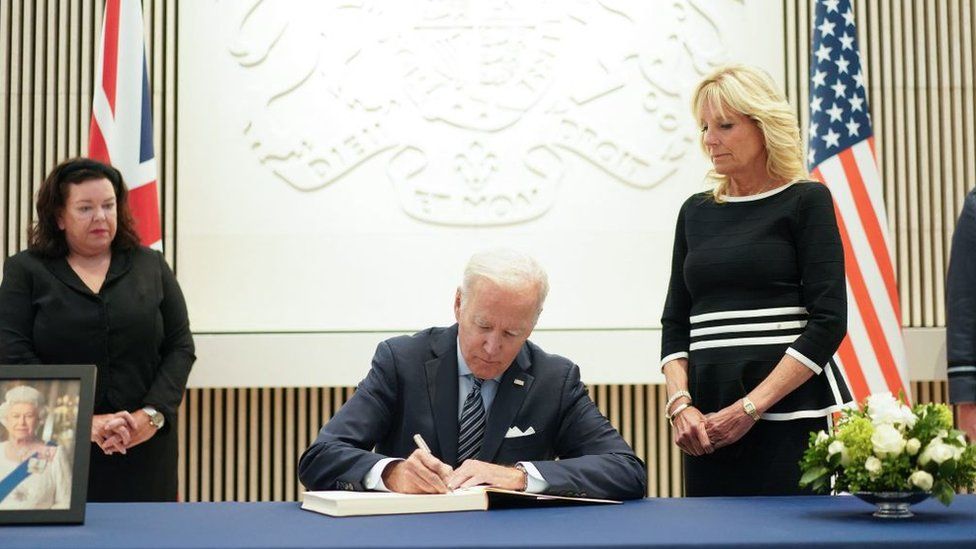
    US President Biden signs a book of condolences at the British embassy in Washington DC
    IMAGE SOURCE,GETTY IMAGES Image caption, US President Biden, watched by his wife Dr Jill Biden and UK Ambassador Karen Pierce, signs the condolence book at the British Embassy in Washington DC

    Chinese President Xi Jinping offered “sincere sympathies to the British government and people” following the Queen’s death, adding: “Her passing is a great loss to the British people.”

    Canada – where Queen Elizabeth was head of state – has seen 12 prime ministers during her reign.

    An emotional Justin Trudeau – who has known the Queen for decades, first meeting her as a child when his father was prime minister – said she had “an obvious deep and abiding love for Canadians”.

    “In a complicated world, her steady grace and resolve brought comfort to us all,” the prime minister said, adding that he would miss their “chats” where she was “thoughtful, wise, curious, helpful, funny and so much more”.

    “She was one of my favourite people in the world, and I will miss her so,” he said, holding back tears.

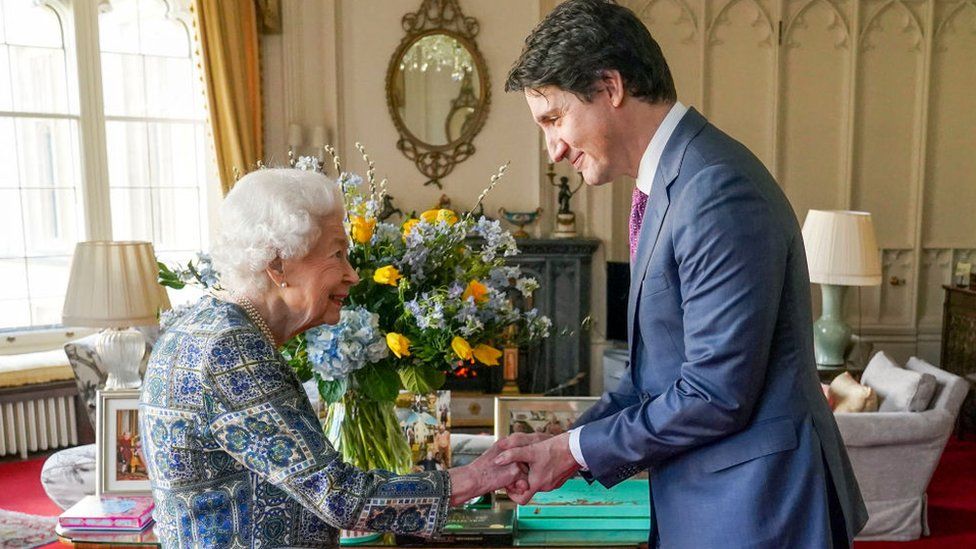
    Queen Elizabeth II receives Canadian Prime Minister Justin Trudeau during an audience at Windsor Castle, on March 7, 2022 in Windsor, England
    IMAGE SOURCE,GETTY IMAGES Image caption, Her Majesty met Canada’s Justin Trudeau several times, including earlier this year at Windsor

    ‘An extraordinary personality’

    Flags have been lowered to half-mast around the world – including at the European Commission in Brussels, Belgium.

    EU Commission President Ursula von der Leyen said the Queen’s “empathy and ability to connect with every passing generation, while remaining rooted in the tradition that truly mattered to her, was an example of true leadership”.

    King Willem-Alexander of The Netherlands – who is Queen Elizabeth’s fifth cousin – said he and Queen Maxima remembered the “steadfast and wise” monarch with “deep respect and great affection”.

    Sweden’s King Carl XVI Gustaf, also a distant relative to Her Majesty, said: “She has always been dear to my family and a precious link in our shared family history.”

    And Belgium’s King Philippe and Queen Mathilde said she was “an extraordinary personality… who, throughout her reign, showed dignity, courage and devotion”.

    German Chancellor Olaf Scholz paid tribute to the Queen’s “wonderful humour” and said in a statement that “her commitment to German-British reconciliation after the horrors of World War Two will remain unforgotten”.

    Indian Prime Minister Narendra Modi recalled his “memorable meetings” with the monarch during two UK visits.

    “I will never forget her warmth and kindness,” he tweeted. “During one of the meetings, she showed me the handkerchief Mahatma Gandhi gifted her on her wedding. I will always cherish that gesture.”

    Saudi Arabia’s King Salman and Crown Prince Mohammed bin Salman sent their condolences, with the king describing her as “a role model for leadership that will be immortalised in history”.

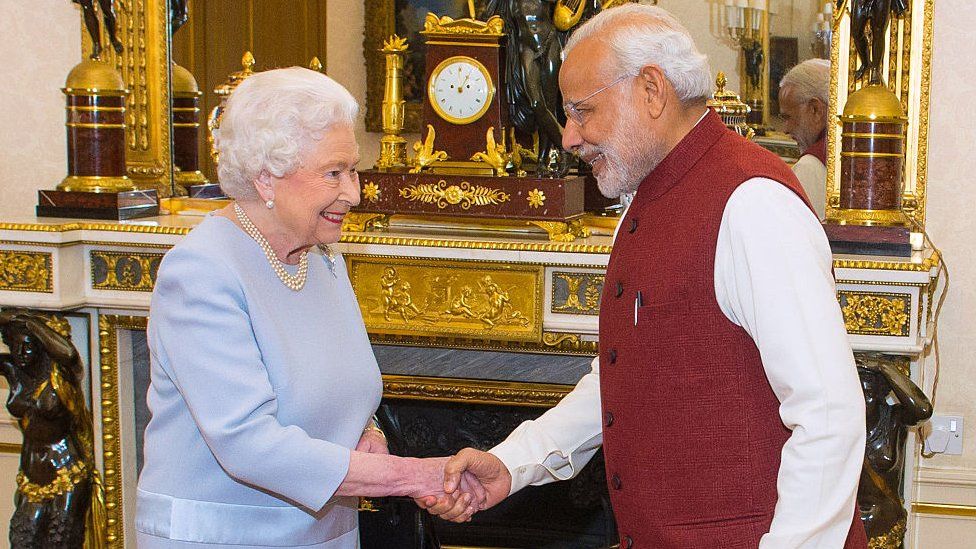
    Queen Elizabeth and India's Narendra Modi at Buckingham Palace in 2015
    IMAGE SOURCE,GETTY IMAGES Image caption, Queen Elizabeth II and India’s Narendra Modi at Buckingham Palace in 2015

    ‘A reassuring presence’

    As monarch for seven decades, Queen Elizabeth lived through times of extraordinary change, and this was reflected in several tributes.

    Mr Macron observed that she “embodied the British nation’s continuity and unity for over 70 years” and former US President Barack Obama observed that she lived “through periods of prosperity and stagnation – from the Moon landing to the fall of the Berlin Wall”.

    Japanese Prime Minister Fumio Kishida expressed his “deep sorrow”. “The death of the queen, who led Britain through turbulent times in the world, is a great loss not only for the British people but also the international community,” he told reporters.

    Irish President Michael D Higgins honoured the Queen’s “extraordinary sense of duty”, which he said would “hold a unique place in British history”.

    “Her reign of 70 years encompassed periods of enormous change, during which she represented a remarkable source of reassurance to the British people,” he said in a lengthy statement.

    Ireland’s Taoiseach, Micheál Martin, spoke of her reign as one of “historic duration” and described the Queen’s passing as “the end of an era”.

    “Her dedication to duty and public service were self-evident and her wisdom and experience truly unique,” Mr Martin said in a statement. He also recalled her “many gracious gestures and warm remarks” during a state visit to Ireland in 2011.

    António Guterres, the UN’s secretary-general, said Queen Elizabeth was “a reassuring presence throughout decades of sweeping change, including the decolonisation of Africa and Asia and the evolution of the Commonwealth”.

    In a statement, he paid tribute to “her unwavering, lifelong dedication to serving her people. The world will long remember her devotion and leadership”.

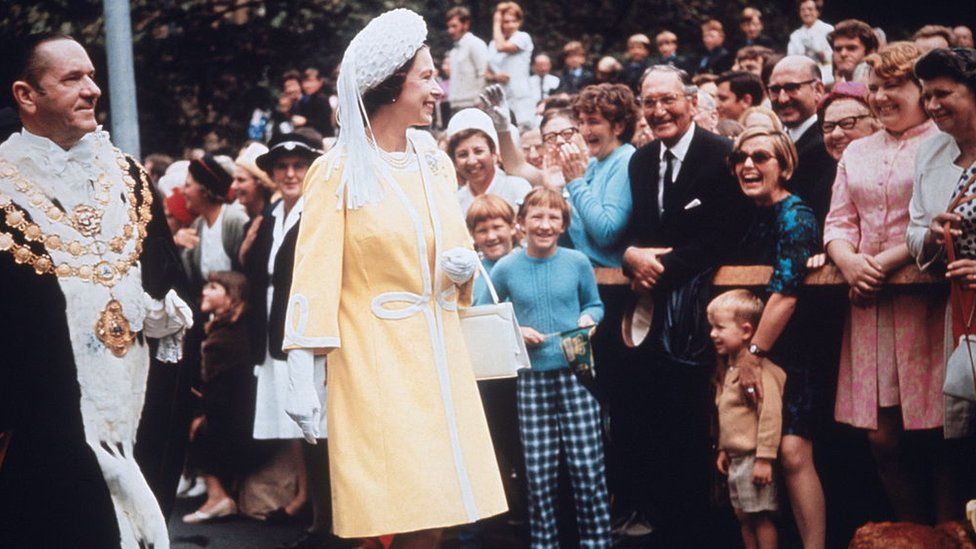
    Queen Elizabeth II visits the Town Hall in Sydney with Emmet McDermott (1911 - 2002), Lord Mayor of Sydney, during her tour of Australia, May 1970. She is there in connection with the bicentenary of Captain Cook's 1770 expedition to Australia
    IMAGE SOURCE,GETTY IMAGES Image caption, Queen Elizabeth visited Australia 16 times – here she greets excited crowds in Sydney in 1970

    Queen Elizabeth visited Australia – another Commonwealth nation where she was head of state – 16 times, the only reigning monarch to head down under.

    Prime Minister Anthony Albanese noted that many had never known a world without her.

    “Though the noise and tumult of the years, she embodied and exhibited a timeless decency and an enduring calm,” he said in a statement.

    “She celebrated our good times, she stood with us in the bad. Happy and glorious, but steadfast too.”

    New Zealand’s Prime Minister, Jacinda Ardern, said she was woken to the news of the monarch’s death by a police officer shining a torch into her bedroom at 04:50 to wake her up.

    “She was extraordinary… The last days of the Queen’s life captures who she was in so many ways, working to the very end on behalf of the people she loved,” Ms Ardern said.

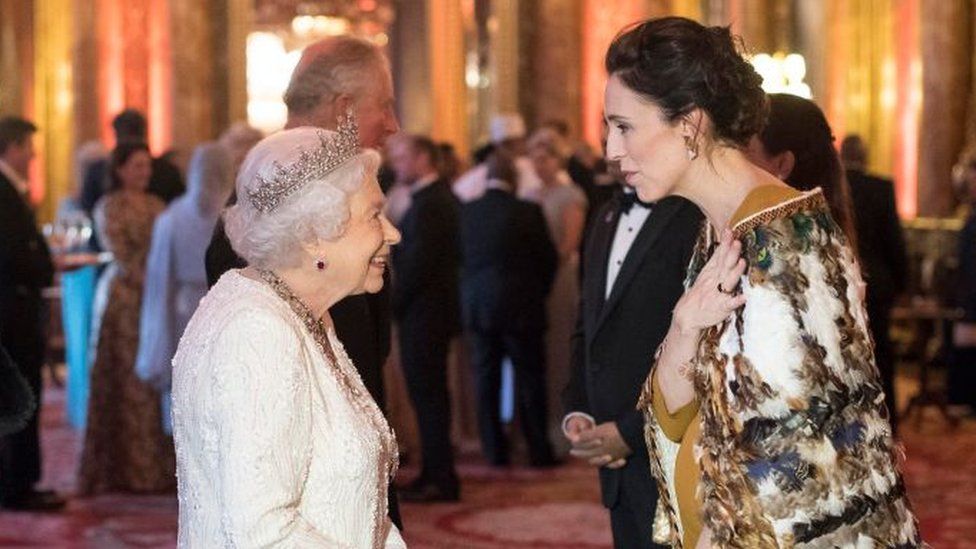
    Queen Elizabeth II greets Jacinda Ardern, Prime Minister of New Zealand in the Blue Drawing Room at The Queen's Dinner during the Commonwealth Heads of Government Meeting (CHOGM) at Buckingham Palace on 19 April 2018 in London, England
    IMAGE SOURCE,GETTY IMAGES Image caption, Queen Elizabeth with New Zealand’s Prime Minister, Jacinda Ardern, in 2018

    ‘She lived history, she made history’

    Queen Elizabeth II met 13 US presidents – beginning with Dwight D Eisenhower- during her reign.

    Barack Obama said the Queen had “captivated the world” with a “reign defined by grace, elegance and a tireless work ethic”.

    “Time and again, we were struck by her warmth, the way she put people at ease, and how she brought her considerable humour and charm to moments of great pomp and circumstance,” Mr Obama, who met the Queen on several occasions, said in a statement.

    Donald Trump said he would “never forget Her Majesty’s generous friendship, great wisdom, and wonderful sense of humour”.

    And another former president, George W Bush, reflected fondly on the time he spent having tea with Her Majesty and her corgis, describing her “great intellect, charm and wit”.

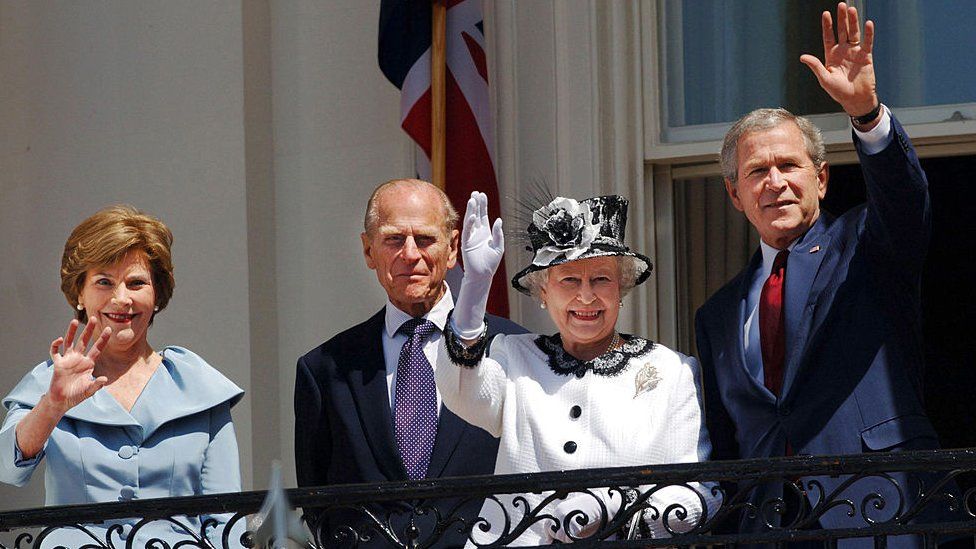
    Queen Elizabeth II and the President of the United States of America George W. Bush are accompanied by their spouses, Prince Philip, Duke of Edinburgh and Laura Bush, on the balcony of the White House, Washington DC, on May 7, 2007
    IMAGE SOURCE,GETTY IMAGES Image caption, Queen Elizabeth with Laura Bush, Prince Philip and George W Bush at the White House in 2007

    Israel’s President, Isaac Herzog, also acknowledged the enormous change the Queen saw throughout her reign, but said that throughout this, she “remained an icon of stable, responsible leadership and a beacon of morality, humanity and patriotism”.

    While the Queen did not visit Israel, Princes Charles, Edward, William and the late Prince Philip – whose mother is buried in Jerusalem – did.

    “Queen Elizabeth was a historic figure: she lived history, she made history, and with her passing, she leaves a magnificent, inspirational legacy,” President Herzog wrote.

    King Abdullah II of Jordan said his country “mourns the passing of an iconic leader”. He said the Queen, who visited Jordan in 1984, was “a beacon of wisdom and principled leadership… a partner for Jordan and a dear family friend”.

    Ukraine’s President Volodymyr Zelensky tweeted that it was with “deep sadness” that he learned of “this irreparable loss”.

    And Russian leader Vladimir Putin who met the Queen several times and once reportedly kept her waiting for 14 minutes, sent his “deepest condolences” to King Charles III.

    “The most important events in the recent history of the United Kingdom are inextricably linked with the name of Her Majesty,” Mr Putin wrote in a statement. “

    For many decades, Elizabeth II rightfully enjoyed the love and respect of her subjects, as well as authority on the world stage.”

    Russia currently has heavy economic sanctions imposed on it by Western nations, including the UK, because of its invasion of Ukraine.

    The Queen With Prince Philip With King Hussein And Queen Noor Of Jordan Visiting Petra
    IMAGE SOURCE,GETTY IMAGES Image caption, Prince Philip, followed by the Queen, and Jordan’s King Hussein and Queen Noor visiting the Petra archaeological site in 1984Presentational white space

    African leaders also shared tributes for Queen Elizabeth – who knew many of them well and, as the head of the Commonwealth, was sympathetic to their cause.

    Kenyan President-elect William Ruto praised her “historic legacy” and said Kenyans would “miss the cordial ties she enjoyed” with the country.

    Kenya, a former British colony that became independent in 1963, was a very special place for the monarch. For a start, it was where she became Queen. The young princess, then just 25 years old, was on holiday there when her father, King George VI, died in his sleep in 1952.

    President Ali Bongo Ondimba of Gabon, which is one of the newest nations to join the Commonwealth, said: “The Queen was a great friend of Africa and Africa showed her affection in return.”

    And Ghana’s President Nana Akufo-Addo tweeted that his country had fond memories of the two visits the Queen made, remarking on “her friendliness, elegance, style and sheer joy she brought to the performance of her duties”.

    Her first trip to Ghana, also a former British colony, was controversial and there were concerns for the monarch’s safety. Five days earlier, bombs had gone off in the capital, Accra, but the Queen was not deterred, in part because she had already cancelled a previous visit when she became pregnant with Prince Andrew.

    The Queen alongside President of Kenya Daniel arap Moi (1924-2020) in the motorcade after her arrival in Nairobi, Kenya, 10th November 1983. Prince Philip and Queen Elizabeth II are on a four-day State Visit to Kenya
    IMAGE SOURCE,GETTY IMAGES Image caption, Kenya was always a special place for Queen Elizabeth – shown here alongside President Daniel arap Moi during a state visit in 1983
  • Trump ideology threatens US democracy – Joe Biden

    United States President Joe Biden has stated that those in support of Donald Trump’s “Make America Great Again” (Maga) agenda are a threat to the country’s democracy.

    Speaking in a primetime speech in Pennsylvania, he said “Maga forces are determined to take this country backwards.”

    The Democratic president delivered his speech on Thursday night from Independence Hall in Philadelphia, where the US Declaration of Independence was signed. He picked up his 2020 campaign theme of restoring the “soul of America”.

    According to President Biden, his comment is not to condemn all 74 million Americans who voted for Mr Trump two years ago.

    “Not every Republican, not even a majority of Republicans, are Maga Republicans. But there’s no question that the Republican party today is dominated, driven and intimidated by Donald Trump and the Maga Republicans, and that is a threat to this country,” he said.

    Mr Biden said Trump supporters thought of the mob who stormed the US Capitol last year as patriots rather than insurrectionists.

    “For a long time,” he continued, “we told ourselves that American democracy is guaranteed. But it’s not. We have to defend it. Protect it. Stand up for it. Each and every one of us.”

    In response, Mr Trump posted a defence of his Maga slogan and said his rival had “threatened America”.

    Throughout Mr Biden’s speech someone was heard heckling and sounding a bullhorn, according to a BBC reporter at the scene.

    Mr Biden addressed the disruption twice, saying the second time: “They’re entitled to be outrageous. This is a democracy.”

    The president, who came into office pledging to unite the country, has recently sharpened his rhetoric against supporters of Mr Trump.

    Last week Mr Biden equated what he called “extreme” Republicans with “semi-fascism”.

    The duelling speeches come two months before mid-term elections, which will decide the power balance in Washington.

    Top Republican Kevin McCarthy gave his own address, saying Mr Biden had “severely wounded America’s soul”.

    Republican calls for Biden apology

    Mr McCarthy, who is Republican minority leader in the US House of Representatives, spoke shortly beforehand from Mr Biden’s hometown of Scranton, Pennsylvania.

    The California congressman said the president “has chosen to divide, demean, and disparage his fellow Americans”.

    “Why? Simply because they disagree with his policies. That is not leadership.”

    He called on Mr Biden to “apologise for slandering tens of millions of Americans as fascists”.

    The top Republican said the Biden presidency had saddled America with soaring inflation, open borders, Covid school shutdowns that damaged children’s learning, the “botched” withdrawal from Afghanistan, and the deadliest national crime wave in two decades.

    “In the past two years,” he said, “Joe Biden has launched an assault on the soul of America, on its people, on its laws, on its most sacred values. He has launched an assault on our democracy. His policies have severely wounded America’s soul, diminished America’s spirit and betrayed America’s trust.”

    Mr Trump added his own criticism of Mr Biden’s speech in a post on his Truth Social platform.

    “If he doesn’t want to Make America Great Again, which through words, action, and thought, he doesn’t, then he certainly should not be representing the United States of America,” he wrote.

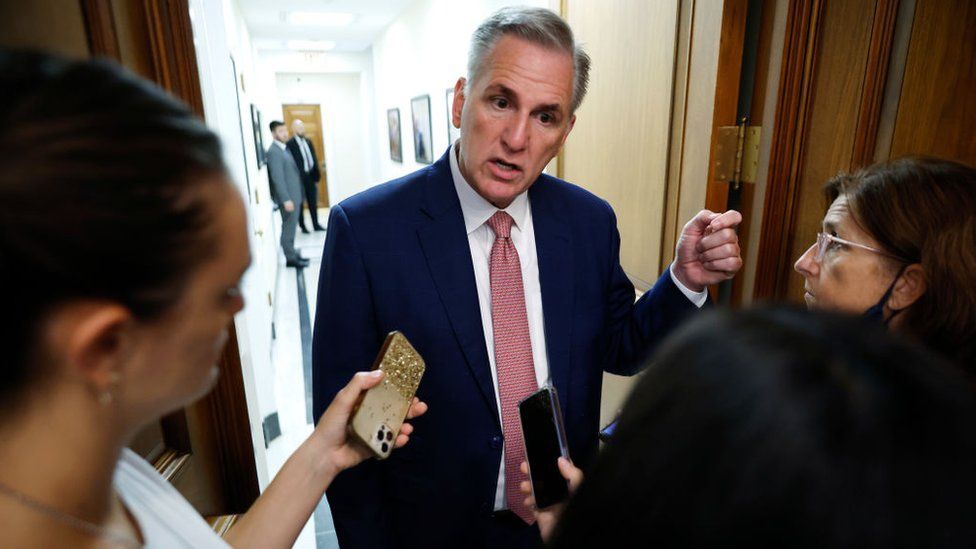
    Republican Kevin McCarthy speaking to reporters last month
    IMAGE SOURCE,GETTY IMAGES Image caption, Republican Kevin McCarthy speaking to reporters last month

  • Biden signs climate, tax and health bill into law

    A $700 billion (£579 billion) bill approved by US President Joe Biden, proposes to combat climate change and healthcare expenses while raising taxes primarily on the wealthy.

    The act includes measures to make good on decades of congressional promises to curb the price of prescription drugs.

    The final version is more modest in scope than the $3.5tn package first envisaged by Democrats.

    A flagship of Mr Biden’s agenda, the bill could provide a boost ahead of the mid-term elections.

    Voters casting their ballots in November will decide whether Mr Biden’s Democrats retain control of Congress for two more years.

    The president hailed the bill as he signed it on Tuesday as the “final piece” of his domestic agenda.


    The package invests $375bn to fight climate change – the most significant federal investment in history in the issue.

    An analysis by scientists with the Climate Action Tracker says the bill will reduce future global warming by “not a lot, but not insignificantly either”.

    It is projected to lower US emissions by up to 44% by 2030, compared with the current US trajectory, which would lower emissions by up to 35%, according to an analysis by the Rhodium Group, a consultancy.


    The bill does not require companies to reduce their emissions, but includes tax incentives for firms to invest in renewable energy and rebates for people who buy electric cars or invest in energy-efficient home improvements.

    In a major breakthrough, the package also allows the government to negotiate lower prices for some prescription medicines provided under its Medicare health insurance programme for those aged over 65.

    That is expected to save hundreds of billions of dollars over the next decade, according to estimates from the nonpartisan Congressional Budget Office.

    On Tuesday, Mr Biden said the measure was a “historic moment”, adding: “Every single Republican in Congress voted against this bill.”

    But Republican Senate leader Mitch McConnell said the legislation “means higher taxes, higher energy bills, and aggressive IRS [tax] audits”.

    Key economic claims about the legislation have been under scrutiny.

    Despite being called the Inflation Re duction Act(IRA), the package will have zero measurable impact on inflation, according to an analysis by the Penn Wharton Budget Model, a group of economists and data scientists at University of Pennsylvania.

    The bill sets a minimum 15% tax for corporations, and Democrats have pledged it will entail no tax hikes for those with incomes below $400,000 a year.

  • US Senate passes sweeping climate, tax and healthcare package

    The bill seeks to lower the cost of some medicines, increase corporate taxes and reduce carbon emissions.

    The passing of the bill – a flagship part of President Joe Biden’s agenda – is a boost ahead of mid-term elections.

    But it is a significantly scaled-back version of the $3.5tn package that was first proposed by his administration.

    The bill, a product of 18 months of intense wrangling, passed by a margin of 51 to 50 on Sunday with Vice-President Kamala Harris casting the deciding vote. It was previously blocked by two Democratic senators who shared Republican concerns about its cost.

    It will now be sent to the Democratic-controlled House of Representatives, where it is expected to pass in a vote on Friday before the president can sign it into law.

    The Inflation Reduction Act includes legislation that would allow the government to negotiate lower prices for prescription medicines provided under its Medicare health insurance programme for those aged over 65.

    That is expected to save hundreds of billions of dollars over the next decade, according to estimates from the non-partisan Congressional Budget Office.

    The package also includes a minimum 15% tax on most corporations that make more than $1bn a year in profits. That measure, an issue of contention during negotiations in Congress, is opposed by business groups who argue it will limit investment.

    The bill also includes $369bn for climate action – the largest investment in the issue in US history.

    Some households could receive up to $7,500 in tax credits to buy an electric car, or $4,000 for a used car. Billions will also be spent in an effort to speed up the production of clean technology such as solar panels and wind turbines.

    There will also be $60bn given to communities that have suffered the most from fossil fuel pollution.

    The authors of the bill say it will cut the country’s carbon emissions by 40% by 2030.

    The action on climate comes as the US experiences a wave of extreme weather, including a recent heatwave as well as deadly flooding in Kentucky that left dozens dead. President Biden visited flood-damaged areas of the state on Monday.

    Many factors contribute to flooding, but a warming atmosphere caused by climate change makes extreme rainfall more likely.

    The world has already warmed by about 1.1C since the industrial era began and temperatures will keep rising unless governments around the world make steep cuts to emissions.

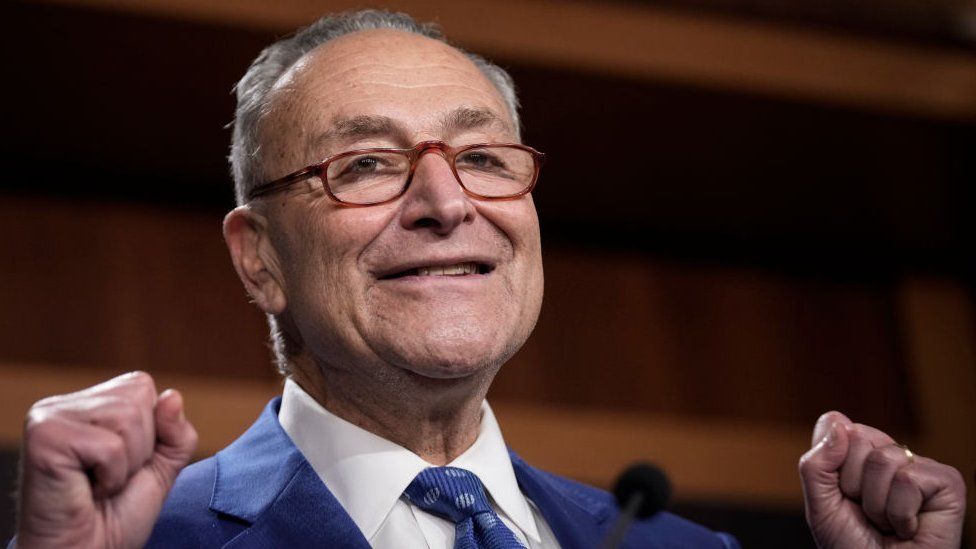
    Democratic Senate majority leader Chuck SchumerImage source, Getty Images
    Image caption, Democratic Senate majority leader Chuck Schumer said lawmakers were “making history”

    Democratic Senate majority leader Chuck Schumer said: “After more than a year of hard work, the Senate is making history. To Americans who’ve lost faith that Congress can do big things, this bill is for you.”

    Senator Brian Schatz, a Democrat from Hawaii, reportedly cried tears of joy as he left the chamber. “Now I can look my kid in the eye and say we’re really doing something about the climate,” he said, according to the New York Times.

    Some Republicans have said they will try to stall or block the progress of the bill.

    Florida’s Republican Senator Marco Rubio argued it was out of touch as it did not help to lower prices for working people or keep criminals in jail – “the things working people in this country care about”.

    On Saturday, Congress debated a revised version of the bill, after compromises on the more ambitious original plan were agreed with two key Democratic holdouts, Senators Joe Manchin of West Virginia and Kyrsten Sinema of Arizona.

    Mr Manchin had feared the original bill would have exacerbated inflation.

    President Biden – who has called the bill “historic” – has pledged to return the US to the international stage on climate action. In April last year, he pledged to slash greenhouse gas emissions by at least 50% by 2030.

    Last month, he announced $2.2bn to help build infrastructure that can withstand extreme weather and natural disasters.

    2px presentational grey line

    The US is back in the climate battle


    Analysis box by Justin Rowlatt, climate editor

    This isn’t the all-singing, all-dancing climate mega-bill Joe Biden promised when he became president – but if it passes it will be the most ambitious action the US has taken to try to stop the planet overheating.

    And the indirect impact could be even more consequential.

    President Biden’s climate envoy, John Kerry, has been tireless in his efforts to persuade other countries to raise their ambitions on climate change.

    But the US faced a credibility gap.

    “You can’t preach temperance from a bar stool,” is how one Democratic senator put it.

    What he means is you can’t ask India, China or Brazil to cut emissions unless you are doing so yourself.

    That’s still a very big ask, and things are particularly strained with China right now. Beijing said it is halting co-operation over climate change following senior Democrat Nancy Pelosi’s recent trip to Taiwan.

    But with the US leading by example, the hope is that international efforts to tackle global warming will be revitalised.


    Source: BBC

  • US invests $280bn in high tech to compete with China

    US President Joe Biden has signed a law committing $280bn (£232bn) to high tech manufacturing and scientific research amid fears the country is losing its technological edge to China.

    Business groups have long pushed for more government support, citing the need to reduce reliance on China.

    Top Senate Democrat Chuck Schumer said the bill was a “game changer” that would ensure American leadership and prosperity in the next century.

    “Authoritarians were cheering for us to lose and hoping we sit on our hands,” he said. “By enacting the CHIPS and Science Act we are making clear we believe another great American century lies on the horizon.”

    The US currently produces roughly 10% of the global supply of semiconductors, which are key to everything from cars to mobile phones, down from nearly 40% in 1990.

    The country is not alone in its investments in the industry.

    The European Union this spring said it would commit more than €40bn to boost production of computer chips, while China has also been boosting its investments in science and technology.

    The Chinese Embassy in Washington had opposed the semiconductor bill, calling it reminiscent of a “Cold War mentality.”

    In addition to the chip investments, the bill directs about $200bn to agencies such as the National Science Foundation, aiming to boost investments in fields like robotics and wireless communications.

    Mr Biden called it a “once in a generation” investment and said it was already yielding growth in the US, pointing to plans from Micron to spend $40bn on memory chip manufacturing, a project expected to create 40,000 jobs.

    It is the latest accomplishment for the White House, which also recently clinched a deal to advance a sweeping plan to combat climate change.

    Unlike that plan, which was opposed by Republicans, this bill was supported by both parties, despite marking a large expansion of the role of the US government into a domain often left to the private sector.

    Source: BBC

  • Killing of al Qaeda’s Zawahiri is ‘justice for 9/11 victims’ – Joe Biden

    Justice has been delivered to victims of the September 11 attacks following the killing of Ayman Al Zawahiri, the known leader of al-Qaeda terrorist group.

    The US government through President Joe Biden announced this week that al Zawahiri had been killed by two Hellfire missiles in a targeted operation in Afghanistan.

    Biden, who was kept abreast of the strike against Zawahiri as he isolated with a rebound case of Covid-19, spoke outdoors Monday, August 1, from the Blue Room Balcony at the White House.

    Zawahiri, Biden said, “was deeply involved in the planning of 9/11, one of the most responsible for the attacks that murdered 2,977 people on American soil. For decades, he was the mastermind of attacks against Americans.”

    “Now, justice has been delivered and this terrorist leader is no more. People around the world no longer need to fear the vicious and determined killer,” he continued.

    “The United States continues to demonstrate our resolve and our capacity to defend the American people against those who seek to do us harm. We make it clear again tonight, that no matter how long it takes, no matter where you hide, if you are a threat to our people, the United States will find you and take you out.”

    The President said the precision strike targeting was the result of the “extraordinary persistence and skill” of the nation’s intelligence community.

    “Our intelligence community located Zawahiri earlier this year — he moved to downtown Kabul to reunite with members of his immediate family,” Biden said.

    The strike comes one year after Biden ordered the withdrawal of US troops from Afghanistan, prompting Taliban forces to rapidly seize control of the nation.

    Biden said on Monday that when he withdrew US troops from the country, he “made the decision that after 20 years of war, the United States no longer needed thousands of boots on the ground in Afghanistan to protect America from terrorists who seek to do us harm, and I made a promise to the American people, that we continue to conduct effective counterterrorism operations in Afghanistan and beyond. We’ve done just that.”

    Biden pledged that Zawahiri “will never again allow Afghanistan to become a terrorist safe haven, because he is gone and we’re going to make sure that nothing else happens.”

    The President concluded by expressing gratitude to US intelligence and counterterrorism communities, saying that he hopes Zawahiri’s death will bring some measure of closure to the friends and families of 9/11 victims.

    “To those who continue to seek to harm the United States, hear me now: We will always remain vigilant and we will act — and we will always do what is necessary to ensure the safety and security of Americans at home and around the globe,” he concluded.

    Source: CNN

  • Joe Biden tests positive for COVID again

    US President Joe Biden has tested positive for Covid-19 again, in what has been described as a “rebound” infection by his doctor.

    The 79-year-old first contracted the virus on 21 July, when he was revealed to be experiencing mild symptoms.

    On Saturday Mr Biden said he was not experiencing symptoms but would isolate “for the safety of everyone around me”.

    The president had tested negative for the virus four times between Tuesday and Friday last week.

    In a letter describing the situation, Mr Biden’s physician Dr Kevin O’Connor said there was no need to resume treatment but the president would remain under “close observation”.

    Mr Biden has been taking Paxlovid, an antiviral medicine which Dr O’Connor said had led to a “small percentage” of Covid patients experiencing a “rebound” test.

    Source: BBC 

  • World was safer during Cold War – security adviser

    The West risks entering a nuclear war because it is not talking enough to Russia and China, the UK’s national security adviser has said.

    Sir Stephen Lovegrove said rival powers understood each other better during the Cold War, and that a lack of dialogue today made miscalculations more likely.

    “In the obligatory Churchill quotation, we want jaw-jaw, not war-war,” he said.

    He added that we were in a “new age of proliferation” in which dangerous weapons were more widely available.

    It came ahead of a phone call between US President Joe Biden and Chinese President Xi Jinping, the first call between the two leaders since March.

    They are expected to discuss ongoing tensions over Taiwan and Trump-era tariffs on Chinese imports.

    Sir Stephen was delivering a speech at the Center for Strategic and International Studies in Washington DC, focusing on the implications of Russia’s invasion of Ukraine and what he called a “much broader contest unfolding over the successor to the post-Cold War international order”.

    He said that, throughout the decades of the Cold War, the Western powers benefitted from negotiations that “improved our understanding of Soviet doctrine and capabilities – and vice versa”.

    “This gave us both a higher level of confidence that we would not miscalculate our way into nuclear war,” he said.

    “Today, we do not have the same foundations as others who may threaten us in the future – particularly China.

    “Trust and transparency built through dialogue should also mean that we can be more active in calling out non-compliance and misbehaviors where we see them.”

    Sir Stephen continued that the risk of an “uncontrolled conflict” was being heightened by Russia’s repeated violations of its treaty commitments as well as the pace of China’s expansion of its nuclear arsenal and its apparent “disdain” for arms control agreements.

    He also spoke of the danger associated with the rapid advance of technology and the number of states now developing arms such as land-attack cruise missiles.

    He said there was “no immediate prospect of all of the major powers coming together to establish new agreements”, so the Nato powers could focus on “work of strategic risk reduction”.

    “We should take early action to renew and strengthen confidence-building measures to… reduce, or even eliminate the causes of mistrust, fear, tensions and hostilities,” he said.

    “[Such measures] help one side interpret correctly the actions of the other in a pre-crisis situation through an exchange of reliable and uninterrupted information on each other’s intentions.

    “Confidence and trust grow when states are open about their military capacities and plans.”

    The threat of nuclear war hung over the Cold War. At times in the early 1960s and early 1980s there were risks it might flare hot.

    But overall, structures were put in place – like arms control negotiations and hotlines – for the two sides to talk.

    But many of those same guard-rails are not around now, as tensions grow between the West, Russia and China.

    New technologies like cyber-attacks could quickly escalate a conflict in unpredictable ways, while new types of delivery systems may tempt countries to use nuclear weapons in different ways.

    And hanging over all of this is the concern that more countries are seeking to develop their own weapons.

    Altogether, that leads to the fear that this emerging and unstable world could be more dangerous than that of the past.

    Source: bbc.com

  • Joe Biden tests positive for COVID-19

    US President Joe Biden has tested positive for Covid-19 and is experiencing “very mild symptoms”, the White House says.

    The 79-year-old, who is fully-vaccinated and has twice received booster jabs, will isolate at the White House and continue to carry out all his duties, a statement said.

    More soon….

    Source: BBC

  • Saudi Arabia: Biden meets crown prince amid criticism

    US President Joe Biden has been greeted by the Saudi crown prince on his arrival in the kingdom he said he would ostracise over its human rights record.

    Mr Biden gave Mohammed bin Salman a fist bump. The White House has said the president is trying to avoid handshakes to protect him from Covid-19.

    He has faced criticism over the trip in the wake of the murder of dissident Jamal Khashoggi by Saudi agents.

    The president has defended his visit, saying he did not want to rupture ties.

    He flew to the kingdom directly from Israel – something previously barred.

    Saudi Arabia, which does not officially recognise Israel and for decades led a regional boycott of the Jewish state, earlier announced it would allow “all carriers” to use its airspace, seen as a conciliatory gesture to Mr Biden and Israel.

    The president is aiming to broaden Israel’s integration in the region, especially in the field of security and defence, as part of efforts to counter the threat from Iran.

    Saudi Arabia and Iran are regional rivals, while Israel considers Iran its most dangerous foe. Iran does not recognise Israel’s right to exist and has repeatedly called for its elimination.

    Mutual concerns about Iran have led to unofficial security and intelligence ties between Saudi Arabia and Israel.

    Saudi Arabia has long been an important regional ally to the US, serving as a major oil supplier and buying billions of dollars of US weaponry.

    However, ties have been tested in recent years, with a US pivot towards Asia, withdrawal of forces and air defence capabilities from the Middle East and Mr Biden’s declared prioritisation of human rights as a plank of his foreign policy.

    The US-Saudi relationship faced its most serious challenge with the 2018 murder of Jamal Khashoggi, a US-based journalist who wrote for the Washington Post.

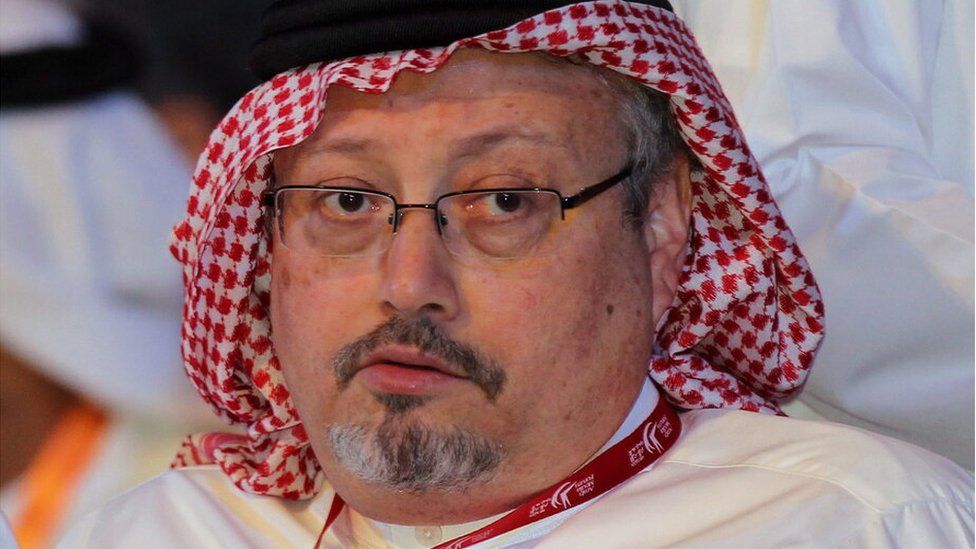
    Jamal Khashoggi
    IMAGE SOURCE,EPA Image caption, Jamal Khashoggi was murdered by Saudi agents in 2018

    Crown Prince Mohammed was accused by US intelligence agencies of approving the murder. The prince denied the allegations, and Saudi prosecutors blamed “rogue” Saudi agents.

    When he was campaigning for the presidency in 2019, Mr Biden vowed to make Saudi Arabia “the pariah that they are” for killing Khashoggi.

    Mr Biden subsequently faced a storm of criticism over his decision to visit the kingdom. It comes at a time of near record oil prices in the US, with the president expected to push Saudi officials to commit to increasing production.

    The White House has downplayed Mr Biden’s meeting with Prince Mohammed, saying he will also be meeting other Arab leaders when he attends a conference in Jeddah on Saturday.

    Meanwhile, it has been revealed to the BBC that a Saudi American businessman in his 70s – whose case has not been disclosed before – has been detained without charge by the Saudi authorities since November.

    The information came from a member of his family, who requested anonymity. Relatives of those held there often do not make the cases public as they fear the consequences of doing so.

    The man went missing on his arrival in Saudi Arabia last November. The member of his family believes his detention may be due to social media posts critical of the Saudi authorities.

    A source at the US State Department told the BBC that the department had no higher priority than protecting US citizens abroad, but that for privacy reasons it would make no further comment.

    Source: BBC


  • Saudi Arabia: Biden set to meet Crown Prince amid criticism

    US President Joe Biden will meet Palestinian leaders in the occupied West Bank on Friday before he flies to a controversial summit in Saudi Arabia.

    His meeting with Palestinian President Mahmoud Abbas is likely to be strained, analysts say, after ties hit a low under the Trump administration.

    Later, Mr Biden will travel to Saudi Arabia to meet its de-facto ruler, Crown Prince Mohammed bin Salman.

    Mr Biden will meet both the prince and his father, King Salman.

    Two years ago, Mr Biden had pledged to make Saudi Arabia a “pariah” over the 2018 murder in Turkey of Saudi dissident journalist Jamal Khashoggi by Saudi agents.

    The prince denies involvement, but US intelligence concluded he approved it.

    Topics of discussion for the leaders will include energy supply, human rights, and security cooperation.

    Mr Biden’s meeting with President Abbas in Bethlehem earlier on Friday will be the highest-level meeting between the US and the Palestinians since the Palestinians froze ties in a dispute over the closure of the Washington office of the Palestine Liberation Organisation (PLO) – the main representative body of the Palestinians – by the Trump administration in 2018.

    The Palestinians want the US to do more to re-start peace talks with Israel, and to reopen the US consulate in Jerusalem, which served as a de facto embassy to the Palestinians before it was shut under President Trump in 2019.

    Saudi Arabia is the world’s biggest oil producer, and the attempted reset of relations follows a spike in oil prices driven by Russia’s war in Ukraine.

    The US is expected to push Saudi officials to commit to increasing production.

    Late on Thursday, Saudi Arabia announced it would open its airspace to commercial Israeli flights – a decision welcomed by the US.

    The move will see the kingdom’s airspace open to all carriers that meet its requirements for overflights, and paves the way for more flights to and from Israel.

    US National Security Adviser Jake Sullivan said it “paves the way for a more integrated, stable, and secure Middle East region”.

    Mr Biden will become the first US president to fly directly to Saudi Arabia from Israel, which is seen as a small but significant sign of Riyadh’s growing acceptance of Israel after decades of boycott in solidarity with the Palestinians.

    Joe Biden and Yair Lapid
    IMAGE SOURCE,GETTY IMAGES Image caption, Mr Biden will fly from Israel, where he has been meeting with Prime Minister Yair Lapid

    On Friday evening, Mr Biden will arrive in the Saudi city of Jeddah, where he will meet Prince Mohammed for the first time since taking office.

    Up to now, the president has insisted on speaking with King Salman, who US officials say is Mr Biden’s direct counterpart.

    White House officials have refused to say whether Mr Biden will raise the murder of Mr Khashoggi, who was a Washington Post columnist and lived in the US.

    They also declined to say if the pair would shake hands.

    Source: BBC

  • Supreme Court limits Biden’s power to cut emissions

    The US Environmental Protection Agency (EPA) has lost some of its power to reduce greenhouse gas emissions.

    The landmark ruling by the US Supreme Court represents a major setback to President Joe Biden’s climate plans.

    He called it a “devastating decision” but said it would not undermine his effort to tackle the climate crisis.

    The case against the EPA was brought by West Virginia on behalf of 18 other mostly Republican-led states and some of the nation’s largest coal companies.

    They argued that the agency did not have the authority to limit emissions across whole states.

    These 19 states were worried their power sectors would be forced to move away from using coal, at a severe economic cost.

    In a 6-3 ruling, the court sided with the conservative states and fossil-fuel companies, agreeing that the EPA did not have the authority to impose such sweeping measures.

    Attorney General Eric Schmitt for Missouri – one of the 19 states – called it a “big victory… that pushes back on the Biden EPA’s job-killing regulations”.

    The court hasn’t completely prevented the EPA from making these regulations in the future – but says that Congress would have to clearly say it authorises this power. And Congress has previously rejected the EPA’s proposed carbon limiting programmes.

    Environmental groups will be deeply concerned by the outcome as historically the 19 states that brought the case have made little progress on reducing their emissions – which is necessary to limit climate change.

    The states made up 44% of the US emissions in 2018, and since 2000 have only achieved a 7% reduction in their emissions on average.

    “Today’s Supreme Court ruling undermines EPA’s authority to protect people from climate pollution at a time when all evidence shows we must take action with great urgency,” said Vickie Patton, general counsel for Environmental Defense Fund (EDF).

    President Biden looking thoughtful with hands clasped
    IMAGE SOURCE,EPA-EFE/REX/SHUTTERSTOCK

    It means President Biden is now relying on a change of policy from these states or a change from Congress – otherwise the US is unlikely to achieve its climate targets.

    This is a significant loss for the president who entered office on a pledge to ramp up US efforts on the environment and climate.

    On his first day in office he re-entered the country into the Paris Agreement, the first legally-binding universal agreement on climate change targets.

    And he committed the country to reducing its greenhouse gas emissions by 52% by 2030 against 2005 levels.

    “While this decision risks damaging our nation’s ability to keep our air clean and combat climate change, I will not relent in using my lawful authorities to protect public health and tackle the climate crisis,” he said.

    The outcome of this case will be noted by governments around the world, as it will affect global efforts to tackle climate change. The US accounts for nearly 14% of the world’s greenhouse gas emissions.

    A United Nations spokesman called it “a setback in our fight against climate change” but added that no single nation could derail the global effort.

    In the US, this ruling could also affect the EPA’s broader existing and future regulatory responsibilities – including consumer protections, workplace safety and public health.

    The ruling gives “enormous power” to the courts to target other regulations they don’t like, Hajin Kim, assistant professor of law at University of Chicago, tells the BBC.

    This is because judges can say Congress did not explicitly authorise the agency to do that particular thing, she adds.

    Source: BBC

  • Ukraine needs strong signal from EU, Macron says ahead of possible visit

    President Emmanuel Macron voiced a tougher line on Russia on Wednesday and said Europe needed to send a strong signal to Ukraine as he sought to assuage concerns in Kyiv and among some European allies over his previous stance towards Moscow.

    Macron arrived in Romania on Tuesday for a three-day trip to Ukraine’s eastern neighbors including Moldova, before possibly heading to Kyiv on Thursday on a visit with German Chancellor Olaf Scholz, Italian Prime Minister Mario Draghi and Romanian President Klaus Iohannis, two diplomatic sources said.

    The symbolic visit would come a day before the European Commission makes a recommendation on Ukraine’s status as an EU candidate, something the biggest European nations have been lukewarm about and are set to discuss at a leaders’ summit on June 23-24.

    “We are at a point when we (Europeans) need to send clear political signals, us Europeans, towards Ukraine and its people when it is resisting heroically,” Macron said, without giving details.

    The French leader has been criticized by Ukraine and eastern European allies for what they perceive as his ambiguous backing for Ukraine in the war against Russia.

    French officials have in recent days sought to strengthen the public messaging, while Macron appeared to take a tougher line on Tuesday evening when he was with his troops. read more

    “We will do everything to stop Russia’s war forces, to help the Ukrainians and their army and continue to negotiate,” he told French and NATO troops at a military base in Romania.

    Speaking alongside Iohannis, Macron downplayed those comments, but insisted that Ukraine, which he hoped would win the war, would eventually have to negotiate with Russia.

    CONSTANTA, Romania, June 15 (Reuters) – President Emmanuel Macron voiced a tougher line on Russia on Wednesday and said Europe needed to send a strong signal to Ukraine as he sought to assuage concerns in Kyiv and among some European allies over his previous stance towards Moscow.

    Macron arrived in Romania on Tuesday for a three-day trip to Ukraine’s eastern neighbors including Moldova, before possibly heading to Kyiv on Thursday on a visit with German Chancellor Olaf Scholz, Italian Prime Minister Mario Draghi and Romanian President Klaus Iohannis, two diplomatic sources said.

    Advertisement · Scroll to continue

    The symbolic visit would come a day before the European Commission makes a recommendation on Ukraine’s status as an EU candidate, something the biggest European nations have been lukewarm about and are set to discuss at a leaders’ summit on June 23-24.

    Register now for FREE unlimited access to Reuters.com

    “We are at a point when we (Europeans) need to send clear political signals, us Europeans, towards Ukraine and its people when it is resisting heroically,” Macron said, without giving details.

    Advertisement · Scroll to continue

    The French leader has been criticised by Ukraine and eastern European allies for what they perceive as his ambiguous backing for Ukraine in the war against Russia.

    French officials have in recent days sought to strengthen the public messaging, while Macron appeared to take a tougher line on Tuesday evening when he was with his troops. read more

    “We will do everything to stop Russia’s war forces, to help the Ukrainians and their army and continue to negotiate,” he told French and NATO troops at a military base in Romania.

    Macron has in recent weeks repeatedly said it was vital not to “humiliate” Russia so a diplomatic solution could be found when fighting ended and he has continued to keep communication channels open with the Kremlin open, riling more hawkish allies. read more

    Speaking alongside Iohannis, Macron downplayed those comments, but insisted that Ukraine, which he hoped would win the war, would eventually have to negotiate with Russia.

    “We share a continent. Geography is stubborn and at the end of it, Russia is there. It was there yesterday, it’s there today and will be there tomorrow,” he told reporters.

    France leads a NATO battle group in Romania of about 800 troops, including 500 French troops alongside others from the Netherlands and Belgium. Paris has also deployed a surface-to air missile system.

    Macron heads to Moldova later on Wednesday to support a country many fear could be drawn into the conflict in neighboring Ukraine.

    Source: www.reuters.com

  • North Korea fires missiles hours after Biden leaves Asia

    North Korea fired three ballistic missiles early on Wednesday morning, South Korea’s military has said.

    Authorities in Seoul said the missiles were fired in the space of less than an hour from the Sunan area in Pyongyang.

    It comes just a day after US President Joe Biden left the region, following a trip that saw him vowing to bolster measures to deter North Korea.

    North Korea has been test-firing a flurry of ballistic missiles since the beginning of this year.

    Japan confirmed at least two launches happened on Wednesday but acknowledged there may have been more.

    Japan’s Defence Minister Nobuo Kishi said the first missile flew about 300km (186 miles) with a maximum altitude of around 550km, while the second, reaching as high as 50km, travelled around 750km.

    Mr Kishi criticised the launches, saying they were “not acceptable” adding that it would “threaten the peace, stability and safety of Japan and the international community”.

    In a meeting convened after the missile launch, South Korea’s National Security Council called the test a “grave provocation”, the presidential office said.

    The launches came hours after Mr Biden departed for the US on Tuesday evening, after a five-day trip that saw him visit South Korea and Japan.

    US and South Korean officials had earlier warned that North Korea appeared ready for another weapons test, possibly during the Biden visit.

    During his visit to Seoul over the weekend, Mr Biden and his South Korean counterpart Yoon Suk-yeol agreed to hold bigger military drills and deploy more US strategic assets if necessary to deter North Korea’s intensifying weapons tests.

    Mr Biden had said the United States was “prepared for anything North Korea does”.

    line
    Analysis box by Jean Mackenzie, Seoul correspondent

    The timing of these launches is not an accident – just hours after President Biden completed his trip to Asia, and days after he agreed with South Korea’s president to bolster their defences against North Korea.

    For weeks intelligence suggested North Korea was planning to test something major while the president was here. Slightly less provocatively, it has waited until he had left, but only just. Air Force One hadn’t touched down on US tarmac before the missiles were fired.

    At their weekend summit, President Biden and President Yoon said they were ready to take on the threat of North Korea together. This was their first test. They have responded quickly, condemning the launches, while joint-firing missiles of their own.

    This marks another escalation by North Korea, which, over the past six months has become increasingly aggressive. But the concern is over what comes next. Evidence is mounting that North Korea is preparing to test a nuclear weapon. This would be its first nuclear test in five years and a major step-up.

    Missiles amidst Covid ’emergency’

    The latest launches come as North Korea struggles to contain a suspected outbreak of Covid amongst its largely unvaccinated population of 25 million.

    More than a million people have now been sickened by what Pyongyang is calling a “fever”, and more than 68 people have died since late April, the authorities say.

    On 12 May, North Korea test-fired ballistic missiles the same day that Mr Kim declared an “emergency” over the Covid outbreak.

    South Korea has said it offered humanitarian aid, but Pyongyang is yet to respond.

    Source: BBC News

  • North Korea fires missiles hours after Biden leaves Asia

    North Korea has fired three ballistic missiles early Wednesday morning, South Korea’s military has said.

    Authorities in Seoul said the missiles were fired in the space of less than an hour from the Sunan area in Pyongyang.

    It comes just a day after US President Joe Biden left the region, following a trip that saw him vowing to bolster measures to deter North Korea.

    North Korea has been test-firing a flurry of ballistic missiles since the beginning of this year.

    Japan confirmed at least two launches happened on Wednesday but acknowledged there may have been more.

    Japan’s Defence Minister Nobuo Kishi said first missile flew about 300km (186 miles) with a maximum altitude of around 550 km, while the second, reaching as high as 50 km, travelled around 750 km.

    Mr Kishi criticised the launches, saying they were “not acceptable” adding that it would “threaten the peace, stability and safety of Japan and the international community”.

    In a meeting convened after the missile launch, South Korea’s National Security Council called the test a “grave provocation”, the presidential office said.

    The launches came hours after US President Joe Biden departed for the US on Tuesday evening, after a five-day trip that saw him visiting South Korea and Japan.

    U.S. and South Korean officials had earlier warned that North Korea appeared ready for another weapons test, possibly during Biden’s visit.

    During his visit to Seoul over the weekend, Mr Biden and his South Korean counterpart Yoon Suk-yeol agreed to hold bigger military drills and deploy more U.S. strategic assets if necessary to deter North Korea’s intensifying weapons tests.

    Mr Biden had said the United States was “prepared for anything North Korea does.”

    Source: BBC

  • Quad Summit: World faces ‘dark hour’ with Ukraine war, says Biden

    The world is “navigating a dark hour in our shared history” with Russia’s invasion of Ukraine, US President Joe Biden told key Asian allies.

    The war has now become a “global issue” underscoring the importance of defending international order, he said.

    Japanese PM Fumio Kishida also echoed his comments, saying that a similar invasion should not happen in Asia.

    Mr Biden is meeting the leaders of Japan, Australia and India in Tokyo in his first visit to Asia as president.

    The four countries known collectively as the Quad are discussing security and economic concerns including China’s growing influence in the region – and differences over the Russian invasion.

    Mr Biden’s comments come a day after he warned China that it was “flirting with danger” over Taiwan, and vowed to protect Taiwan militarily if China attacked, appearing to contradict a long-standing US policy on the issue.

    In his opening remarks at Tuesday’s summit, Mr Biden said their meeting was about “democracies versus autocracies, and we have to make sure that we deliver”.

    The Ukraine war, he said, “is going to affect all parts of the world” as Russia’s blockade of Ukraine grain exports worsens a global food crisis.

    Mr Biden promised the US would work with allies to lead the global response, reiterating their commitment to defend international order and sovereignty “regardless of where they were violated in the world” and remaining a “strong and enduring partner” in the Indo-Pacific region.

    While Quad leaders will be looking to present a united front, there are differences.

    India is the only Quad member so far that has refused to directly criticise Russia for the invasion. In his opening remarks at Tuesday’s summit, Indian PM Narendra Modi did not mention the issue.

    Australia’s new PM Anthony Albanese meanwhile emphasised his country’s commitment to regional security and climate change.

    What is the Quad – and why is China a concern?

    Formally referred to as the Quadrilateral Security Dialogue, the Quad began as a loose grouping of countries following the 2004 Indian Ocean tsunami that banded together to provide humanitarian and disaster assistance. The group fell dormant before it was resuscitated in 2017.

    Australian Prime Minister Anthony Albanese, US President Joe Biden, Japanese Prime Minister Fumio Kishida, and Indian Prime Minister Narendra Modi wave to the media prior to the Quad meeting at the Kishida's office in Tokyo on May 24, 2022.IMAGE SOURCE, GETTY IMAGES
    Image caption, Australia’s Anthony Albanese, US’ Joe Biden, Japan’s Fumio Kishida and India’s Narendra Modi met on Tuesday

    Since then however, the top leaders have gathered for the fourth time – they have already met once in Washington last September and twice virtually – in less than two years.

    Analysts say the steady decline in each Quad nation’s bilateral ties with China in the past few years appears to have given the grouping more impetus.

    There has been mounting discomfort with China’s growing assertiveness in the region, with ongoing maritime disputes between China and several countries, and a land boundary conflict with India.

    Beijing’s heavy investment in strengthening its navy and its recent security pact with the Solomon Islands has stoked fears in Australia, while Japan has become increasingly wary of what it calls routine “incursions” from the Chinese navy in its waters.

    In a move to preserve US interests in the region, Mr Biden unveiled the Indo-Pacific Economic Framework for Prosperity (IPEF) on Monday – a new US-led trade pact aiming to promote regional growth that includes 13 countries, mostly in Asia.

    US Commerce Secretary Gina Raimondo called it an “important turning point in restoring US economic leadership in the region” that would provide countries “an alternative to China’s approach”.

    Officials said it would set standards in the areas of trade, supply chains, clean energy and infrastructure, and tax and anti-corruption.

    Source: BBC

  • Covid in North Korea: No response to US vaccine offer

    President Joe Biden says North Korea has not responded to a US offer of Covid vaccines, as the country battles its first acknowledged outbreak.

    Nearly 2.5 million people have been sickened by “fever” in North Korea and it is under a nationwide lockdown, according to the country’s state media.

    It is thought to be particularly vulnerable because it has little testing or vaccine supply.

    Mr Biden announced the offer at a press conference in South Korea.

    “We’ve offered vaccines, not only to North Korea but to China as well, and we’re prepared to do that immediately,” Mr Biden said in a joint appearance with South Korean President Yoon Suk-yeol.

    “We’ve got no response,” he added.

    The isolated regime of North Korea has previously turned down offers of vaccines from Covax, the global vaccine-sharing scheme, and from South Korea, as well as reportedly declining other offers.

    Instead, it claimed to have successfully kept Covid out of the country by sealing its borders, although experts believe the virus has been present there for some time.

    State media has recommended remedies such as herbal tea, gargling salt-water and taking painkillers such as ibuprofen, while the country’s leader, Kim Jong-un, has accused officials of bungling the distribution of national medicine reserves.

    China is also struggling to control a wave of infections from the highly transmissible Omicron variant, with tens of millions of people under some form of lockdown.

    At the news conference in the South Korean capital, Seoul, President Biden said he was willing to meet Mr Kim under the right circumstances.

    “It would depend on whether he was sincere and whether he was serious,” Mr Biden said.

    His predecessor, Donald Trump, held a historic summit with Mr Kim in Singapore in 2018 and became the first US president to set foot in North Korea the following year.

    But two years ago, Mr Kim questioned whether there was any need to continue “holding hands” with the US.

    The US and South Korean presidents also agreed to deploy American weapons if necessary to deter North Korea and to increase military drills – which had been scaled down in recent years in an effort to reduce tensions.

    Source: BBC

  • Ukraine war: US fully backs Sweden and Finland Nato bids, Biden says

    Sweden and Finland have the “full, total and complete backing” of the US in their decision to apply for Nato membership, President Joe Biden says.

    Both countries submitted their applications to be part of the Western defence alliance this week, marking a major shift in European geopolitics.

    To join the alliance, the two nations need the support of all 30 Nato member states.

    But the move by the Nordic nations has been opposed by Turkey.

    Speaking alongside Swedish Prime Minister Magdalena Andersson and Finnish President Sauli Niinisto at the White House on Thursday, Mr Biden called Sweden and Finland’s applications “a watershed moment in European security”.

    “New members joining Nato is not a threat to any nation,” he said. The president added that having two new members in the “high north” would “enhance the security of our allies and deepen our security co-operation across the board”.

    Russia has repeatedly said it sees Nato as a threat and has warned of “consequences” if the block proceeds with its expansion plans.

    Turkey has accused both Sweden and Finland of hosting suspected militants from the Kurdistan Workers’ Party (PKK), a group it views as a terrorist organisation.

    However, both Nato Secretary-General Jens Stoltenberg and British Defence Minister Ben Wallace have expressed confidence that these concerns will eventually be addressed.

    Mr Biden’s comments came as the US Senate voted to approve a new $40bn (£32bn) bill to provide military and humanitarian aid to Ukraine. It is the biggest emergency aid package so far for Ukraine.

    The bill – which was passed by the House of Representatives with broad bipartisan support on 10 May – was expected to be passed earlier this week, but was blocked by Kentucky Republican Rand Paul over a dispute about spending oversight.

    But the Republican’s Senate leader Mitch McConnell dismissed these concerns and told reporters that Congress had a “moral responsibility” to support “a sovereign democracy’s self-defence”.

    “Anyone concerned about the cost of supporting a Ukrainian victory should consider the much larger cost should Ukraine lose,” Mr McConnell said.

    Last week, Defence Secretary Lloyd Austin and Secretary of State Antony Blinken urged Congress to approve the package and warned that the US military only had enough funds to send weapons to Kyiv until 19 May.

    Ukraine’s President Volodymyr Zelensky praised the aid package as “a significant US contribution to the restoration of peace and security in Ukraine, Europe and the world”.

    The package brings the total US aid delivered to Ukraine to more than $50bn, including $6bn for security assistance such as training, equipment, weapons and support.

    Another $8.7bn will be allocated to replenish stocks of US equipment already sent to Ukraine.

    Source: BBC

  • Somalia: President Biden reverses Trump’s withdrawal of US troops

    US officials say President Biden has approved the redeployment of US troops in Somalia, reversing a decision by his predecessor Donald Trump.

    The deployment was requested by the Pentagon to support the fight against militant group al-Shabab.

    President Trump withdrew about 700 US troops from Somalia in 2020.

    The move to re-establish a military presence in the East African country comes as long-overdue elections delivered a new president.

    Hassan Sheikh Mohamud, a former peace activist, promised to work closely with international partners as he took office on Monday.

    Somalia has suffered from decades of chronic insecurity, and the Islamist militants who once controlled the country still hold large swathes of it and continue to collect taxes in places.

    Many in the country expressed deep concern when former president Donald Trump ordered the withdrawal of US troops, who had long been relied on as well as more than 19,000 peacekeepers from African Union nations.

    This time around, fewer than 500 US troops will be deployed, which has been described as “a repositioning of forces already in theatre who have travelled in and out of Somalia on an episodic basis” by US National Security spokeswoman Adrienne Watson.

    Her statement appeared critical of the Trump administration, calling its decision to withdraw troops “precipitous”.

    Al-Shabab militants regularly carry out attacks in the capital Mogadishu, which they stepped up in the run-up to May’s election in the hopes of derailing it.

    Somalia faces other formidable challenges including a drought that has left millions in urgent need of aid.

    Source: BBC

  • LGBTQ+ debate: Be careful! Leave us out of this – Joe Biden cautioned

    Charles Owusu has commended Adwoa Safo for comments made on the legalization of Lesbian, Gay, Bisexual, Transgender and Queer Intersex Rights (LGBTQI).

    The Minister-designate for Gender, Children and Social Protection, Sarah Adwoa Sarfo during her vetting in Parliament said:

    “Mr Chair, the issue of LGBT is an issue that when mentioned, it creates some controversy but what I want to say is that our laws are clear on such practice. It makes it criminal. Section 104 of the Criminal Code prohibits one from having unnatural carnal knowledge with another person. So, on the issue of its criminality, it is non-negotiable. On the issue of our cultural acceptance and norms, these practices are also frowned upon. So, for me, these are two distinct clarities on the matter and that is what I strongly stand for”.

    Prior to this US President Joe Biden has threatened to sanction countries that are yet to legalise LGBTQI.

    A memo from Joe Biden read: “When foreign governments move to restrict the rights of LGBTQI+ persons or fail to enforce legal protections in place, thereby contributing to a climate of intolerance, agencies engaged abroad shall consider appropriate responses, including using the full range of diplomatic and assistance tools and, as appropriate, financial sanctions, visa restrictions, and other actions.”

    “All human beings should be treated with respect and dignity and should be able to live without fear no matter who they are or whom they love.”

    “The United States belongs at the forefront of this struggle speaking out and standing strong for our most dearly held values.”

    Charles Owusu speaking to this, sent a strong warning to Joe Biden.

    Listen to him in the video below:

    Source: Peace FM

  • FBI warns of plans for nationwide armed protests ahead of Biden’s inauguration

    The FBI has warned of armed protests being planned for Washington and all 50 U.S. state capitals in the run-up to President-elect Joe Biden’s Jan. 20 inauguration, a federal law enforcement source said on Monday.

    Threatened with more violence from outgoing President Donald Trump’s supporters following last Wednesday’s storming of the U.S. Capitol, the FBI issued warnings for next weekend that run at least until Inauguration Day, the source said.

    In other steps to safeguard the U.S. capital, the National Guard was authorised to send up to 15,000 troops to Washington, and tourists were barred from visiting the Washington Monument until Jan. 24.

    The chief of the National Guard Bureau, General Daniel Hokanson, told reporters he expected about 10,000 troops in Washington by Saturday to help provide security, logistics and communications.

    He said the number could rise to 15,000 if requested by local authorities.

    At least one lawmaker asked the Pentagon to do more.

    Senator Chris Murphy, who said he was sending a letter to the acting secretary of defense on Monday, said it was unclear if the National Guard would be sufficient to protect the nation’s capital and that active-duty troops may be needed also.

    “I’m not afraid of taking the oath outside,” Biden told reporters in Newark, Delaware, referring to the traditional setting for the swearing-in ceremony on the Capitol grounds. But he said it was critically important that people “who engaged in sedition and threatened people’s lives, defaced public property, caused great damage” be held accountable.

    Biden’s inaugural committee said on Monday the theme of the Jan. 20 ceremony would be “America United.” Trump, who has sought unsuccessfully to overturn the Nov. 3 election results with false claims of widespread fraud, said last week he would not attend the ceremony, a decision the president-elect supported.

    Washington monument closed to tours

    The Park Service said it would suspend tours of the Washington Monument, an obelisk honouring the country’s first president, due to safety concerns from threats to disrupt the inauguration.

    Washington Mayor Muriel Bowser called for the U.S. Interior Department to cancel public-gathering permits through Jan. 24. “This inaugural planning period has to be very different than all the others,” she told reporters on Monday.

    In a letter to acting Homeland Security Secretary Chad Wolf made public on Sunday, Bowser called for a fresh approach to security after what she called last week’s “unprecedented terrorist attack.”

    Bowser asked Wolf to extend the National Special Security Event period from Monday through Jan. 24. The Secret Service heads security operations for events, including presidential inaugurations, considered to be nationally significant.

    Wolf said in a statement he had instructed the Secret Service to begin National Special Security Event operations for the inauguration effective Wednesday, instead of Jan. 19 as previously scheduled. The acting secretary told his staff he was stepping down on Monday.

    The assault on the Capitol, challenging the certification of Biden’s election victory, sent lawmakers into hiding and left five people dead, including a Capitol Police officer. Dozens of people have been charged in the violence and hundreds more cases are expected.

    The assault occurred shortly after Trump urged supporters to march on the Capitol during a rally where he repeated false claims his resounding defeat in November’s election was illegitimate.

    Democrats in Congress began a push on Monday to force Trump from office, introducing an article of impeachment that accuses him of inciting insurrection.

    The presidential inaugural committee and Bowser have told Americans not to travel to the inauguration, and said Washington’s National Mall would be covered with 191,500 flags of different sizes, to represent the missing crowds.

    A presidential inauguration traditionally draws hundreds of thousands of visitors to Washington, but the ceremonies have been scaled back dramatically because of the COVID-19 pandemic.

    In state capitols, governors are on high alert ahead of the inauguration.

    In Wisconsin, a swing state where Trump alleged election fraud, Governor Tony Evers authorised the Wisconsin National Guard to support the state’s Capitol Police.

    In Michigan, another swing state where Biden’s victory was contested by Trump, the state’s Capitol Commission, which oversees the legislature, issued an order to ban the open carrying of weapons inside the Capitol building in Lansing.

    Source: france24.com

  • State Department is preventing Biden from accessing messages from foreign leaders

    A stack of messages from foreign leaders to President-elect Joe Biden are sitting at the State Department but the Trump administration is preventing him from accessing them, according to State Department officials familiar with the messages.

    Traditionally, the State Department supports all communications for the President-elect, which is why many countries began sending messages to State over the weekend.

    But with Biden prohibited from accessing State Department resources by the Trump administration, because President Donald Trump refuses to accept Biden’s victory, dozens of incoming messages have not been received.

    Biden’s team is in touch with foreign governments without State Department involvement, and he has held numerous calls with leaders, including Germany’s Angela Merkel and Canada’s Justin Trudeau. But they are operating without the logistical and translation support that the State Department operations center provides.

    “They would prefer to be using the State Department resources,” said a source familiar with the situation, who noted that the Biden team is having to deal with the unexpected challenge of facilitating these calls.

    Not only is Biden being blocked by the State Department from receiving messages and assistance facilitating and from preparing for calls, on Tuesday Secretary of State Mike Pompeo refused to acknowledge Biden’s victory, saying that “there will be a smooth transition to a second Trump administration,” igniting a furore and roiling diplomats.

    Biden is also being blocked from getting the same intelligence briefings as the President, known as the President’s Daily Brief, and should the Trump administration continue to block a typical transition close to Inauguration Day on January 20, there are concerns Biden’s administration will be playing catch-up the day he takes office.

    Foreign leaders have begun to figure out that State cannot get them in touch with the President-elect and their teams have reached out to former Obama-era diplomats for their assistance on how to send congratulatory messages to Biden’s team, sources told CNN. Some foreign governments feel they are navigating an unfamiliar maze, foreign diplomats have told CNN.

    CNN has asked the State Department and the Biden transition team for comment.

    In the past, the State Department has facilitated a smoother process.
    “It was helpful to have State ops place the calls and to provide translation services, and we were grateful for the cooperation from the Bush administration for making that happen,” said Denis McDonough, who served in the Obama administration and worked with Obama during the transition.

    Calls aren’t highly sensitive

    The calls taking place right now are not highly sensitive, and even during a well-oiled transition period they are not normally conducted on secure lines, multiple sources explained.

    “These calls in the past have been handled on open lines. They are congratulatory calls,” McDonough said, adding that both sides are providing readouts, which is consistent with protocol.

    Barack Obama often made these calls to foreign leaders on his cell phone when he was President-elect, explained a State Department official who worked on setting up those calls at the time. But they all went through the operations center, which meant there is a government record of the calls he made.

    Career officials at the State Department are ready to help the Biden team when the time comes.

    “The agencies implemented the law faithfully prior to the election. The materials are ready, the offices are ready, everything is ready; they are waiting for the green light,” said David Marchick, the director of the Center for Presidential Transition at the Partnership for Public Service.

    Operating without State Department support right now, the Biden team — made up of many experienced former government officials — has sent out readouts of all of the calls, which help with record keeping. They are making an effort to formalize the process and will use State Department resources when they are available, said a source familiar with the unfolding situation.

    This is a stark contrast with the transition between the Obama and Trump administrations. At the time, President-elect Trump opted not to use State Department resources. Instead, he made his calls out of Trump Tower and resisted using the government support and coordination system, which meant that translators and staff sat waiting without any work while Trump made calls on his own, a State Department official told CNN at the time.

    At any other point since Biden left the White House, he would have been able to call into the State Department operations center to place a call to a foreign leader, State Department officials told CNN. Former presidents and vice presidents are allowed to use the resource whenever they wish. But now, as he is President-elect, Biden is being prevented from using that facility by the Trump administration.

    Source: CNN

  • Bush congratulates Biden, says election was ‘fundamentally fair’ and ‘its outcome is clear’

    Former President George W. Bush congratulated President-elect Joe Biden in a phone call Sunday and said that, while President Donald Trump has the right to pursue legal challenges and recounts, the 2020 race was “fundamentally fair” and “its outcome is clear.”

    The gesture by Bush, the only living former Republican president, was a break from his party’s outgoing president, Trump, who has so far refused to concede the race.

    In the statement, Bush said he had called Biden and Vice President-elect Kamala Harris on Sunday.

    “Though we have political differences, I know Joe Biden to be a good man, who has won his opportunity to lead and unify our country,” Bush said. “The President-elect reiterated that while he ran as a Democrat, he will govern for all Americans. I offered him the same thing I offered Presidents Trump and Obama: my prayers for his success, and my pledge to help in any way I can.”

    Bush also offered congratulations in the statement to Trump “on a hard-fought campaign,” nodding to his “extraordinary political achievement” of winning the votes of more than 70 million Americans, the second-most in history behind Biden. “They have spoken, and their voices will continue to be heard through elected Republicans at every level of government,” Bush said.

    Bush in 2000 was elected by a much smaller margin than Biden, with his race against Democratic then-Vice President Al Gore coming down to 537 votes in Florida and a Supreme Court decision in December. He said Trump “has the right to request recounts and pursue legal challenges,” but said Biden’s win was clear.

    “The American people can have confidence that this election was fundamentally fair, its integrity will be upheld, and its outcome is clear,” Bush said.

    Bush has largely stayed out of politics since leaving office in January 2009. He was only an occasional presence on the campaign trail in 2016, when his brother, former Florida Gov. Jeb Bush, ran against Trump and others in the Republican presidential primary.

    CNN and other news outlets projected Saturday that Biden has won the presidential race. According to CNN’s projections, Biden has won 279 electoral votes to Trump’s 214, with Alaska, Arizona, Georgia and North Carolina still uncalled.

    Biden delivered a triumphant victory speech in Wilmington, Delaware, on Saturday night, pledging to heal the nation’s partisan divides and saying to Trump supporters: “Let’s give each other a chance.”

    As of Sunday afternoon, Trump has refused to concede, tweeting a host of unproven claims about voter fraud without offering any evidence and wrongly insisting that he had won the election. His attorneys have filed lawsuits in several states, so far without any success.

    “The challenges that face our country will demand the best of President-elect Biden and Vice President-elect Harris — and the best of us all,” Bush said. “We must come together for the sake of our families and neighbours, and for our nation and its future. There is no problem that will not yield to the gathered will of a free people. Laura and I pray for our leaders and their families. We ask for God’s continued blessings on our country. And we urge all Americans to join us in wishing our next President and Vice President well as they prepare to take up their important duties.”

    Source: CNN

  • Netanyahu congratulates Biden, ‘a great friend of Israel’

    Israeli Prime Minister and close Donald Trump ally Benjamin Netanyahu congratulated Joe Biden on his election victory early Sunday, calling the United States president-elect “a great friend of Israel”.

    “I look forward to working with both of you to further strengthen the special alliance between the US and Israel,” Netanyahu wrote on Twitter, referring to Biden and vice president-elect Kamala Harris.

    Netanyahu, whose Twitter account features a picture of himself seated next to Trump, said he and Biden had “a long and warm personal relationship for nearly 40 years, and I know you as a great friend of Israel.”

    The Israeli premier had described Trump as his country’s strongest-ever ally in the White House, and the Republican advanced policies that delighted Netanyahu’s right-wing base.

    In a subsequent tweet, Netanyahu thanked Trump “for the friendship you have shown the state of Israel and me personally, for recognising Jerusalem and the Golan, for standing up to Iran, for the historic peace accords and for bringing the American-Israeli alliance to unprecedented heights”.

    Trump unilaterally pulled out of the 2015 Iran nuclear deal — an agreement between Tehran and world powers loathed by Netanyahu — and recognised Jerusalem as Israel’s “undivided” capital.

    He also endorsed Israeli sovereignty over the Golan Heights — which was seized from Syria — and avoided criticising Jewish settlements in the occupied West Bank.

    He also brokered normalisation deals between Israel and three Arab countries — the United Arab Emirates, Bahrain and Sudan.

    Netanyahu, along with his defence and foreign ministers, had been criticised Saturday evening by opposition leader Yair Lapid for not congratulating Biden on his victory in a timely manner.

    “The fact that Netanyahu, (Benny) Gantz and (Gabi) Ashkenazi have yet to congratulate the US president-elect is shameful cowardice that harms Israel’s interest,” Lapid said.

    “If the president of France, the chancellor of Germany and prime minister of Britain can do so, you can too,” he wrote on Twitter.

    Defence Minister Gantz and foreign minister Ashkenazi congratulated the president-elect and Harris hours later, following Biden’s victory speech on Saturday night.

    According to a poll before the US election by the Israel Democracy Institute think-tank, 63 percent of Israelis wanted Trump to win a second term.

    Source: france24.com

  • Making history, VP-elect Harris tells women she won’t be last

    Kamala Harris on Saturday shattered barriers to become the first woman vice president and, in a symbolism-heavy victory speech, told girls she would not be the last.

    Introducing President-elect Joe Biden in an optimism-fueled outdoor rally, Harris — also the first Black woman and Indian-American as vice president — sported a white suit in recognition of the suffragist movement that fought to give US women the vote a century ago.

    “While I may be the first woman in this office, I won’t be the last,” she said to cheers and honks from the crowd gathered in socially distanced cars.

    “Because every little girl watching tonight sees that this is a country of possibilities.”

    Harris vowed to fight to “root out systematic racism” but, like Biden, made a broad appeal to unity, saying that Americans “have elected a president who represents the best in us.”

    The California senator’s speech was in itself a sign of the prominent role that she has been given by Biden, with newly elected presidents historically keeping the spotlight on themselves rather than sharing the podium with their number twos.

    A beaming Harris raised her hands in celebration as she entered to the energetic beats of Mary J. Blige’s song “Work That,” an ode to Black women’s self-confidence.

    She opened immediately by hailing John Lewis, the civil rights icon turned congressman who died in July — and whose state of Georgia startled pundits with its sharp swing in Tuesday’s election toward their Democratic Party.

    Harris also paid tribute to her mother, Shyamala Gopalan Harris, who emigrated from India when she was 19 and died in 2009.

    “Maybe she didn’t quite imagine this moment,” Harris said.

    “But she believed so deeply in an America where a moment like this is possible.

    “So I’m thinking about her and about the generations of women — Black Women, Asian, White, Latina, and Native American women throughout our nation’s history who have paved the way for this moment tonight.”

    Source: france24.com

  • Kamala Harris didn’t insult her way to the top Manasseh advises

    Reactions to the 2020 US Presidential Election results have been rife in Ghana and for journalist Manasseh Azuri Awuni, the story of Kamala Harris becoming the first female vice president of the US emphasises the need for gender partnership.

    In a post on his Facebook page, sighted by GhanaWeb, Manasseh expressed that there is a need for men and women to see themselves as partners and not competitors.

    “Kamala Harris didn’t insult her way to the top. She partnered a man to the top. We’re partners, not competitors,” he shared in his short post.

    Kamala Devi Harris, born October 20, 1964, is an American politician and attorney who is the vice president-elect of the United States. A member of the Democratic Party, she is set to assume office on January 20, 2021 alongside president-elect Joe Biden, having defeated incumbent President Donald Trump and Vice President Mike Pence in the 2020 presidential election.

    Harris has served as the junior United States senator from California since 2017. She will be the first Indian American, the first African American, and the first female vice president in U.S. history, and thus, the highest-ranking female elected official in United States history. Harris is a multiracial American.

    The nomination of Kamala Harris and now her election as the first female vice president of the United States has generated a new level of conversation about gender activism and equality.

    Many see her feat as a great inspiration for women across the world.

    Source: www.ghanaweb.com

  • Race for the White House narrows as votes are counted in key battlegrounds

    Vote counters worked all night in the crucial states that will decide the cliffhanger election with margins narrowing in Arizona, Georgia and Pennsylvania as former Vice President Joe Biden edged toward the 270 electoral votes needed to win and President Donald Trump pinned his hopes on a more uphill route back to the White House.

    Two days after Election Day, the slow churn of results is expected to offer more clarity Thursday on who will lead America for the next four years and when that final result will become known. Biden currently leads with 253 electoral votes to Trump’s 213. The race is coming down to tight vote counts in Arizona, Georgia, Nevada and Pennsylvania.

    If the former vice president wins Pennsylvania, the race will be over. Thousands of mostly mail-in votes remain uncounted so far, with Biden trailing by just over 160,000 votes. The Keystone State’s Lt. Gov. John Fetterman, a Democrat, told CNN that the result could come as early as Thursday and that he believed outstanding ballots in areas that favor Democrats would deliver a clear win for Biden.

    The Democratic nominee has also been making a run in Georgia, which has 16 electoral votes, where the President’s lead dwindled to about 18,500 votes overnight as results came in from Fulton County around Atlanta with 96% of the state vote count reported.

    The story was reversed in Arizona, where several tranches of votes from Maricopa County, which includes Phoenix, narrowed Biden’s lead to just under 69,000 votes with Trump’s team insisting the President will eventually prevail and keep his hopes of a path to 270 alive.

    There is also a close contest in Nevada, which released very little information on Wednesday with an estimated 200,000 ballots outstanding. The state is expected to report another batch of results around midday Thursday. Democrats had the state down as a likely win but it is closer than expected.

    The final result will come down again to mail-in votes, which could favor Biden since thousands are outstanding in Clark County, around Las Vegas which is usually Democratic territory. If Biden holds leads in Arizona and Nevada, he will get to 270 and will be able to claim the presidency.

    Trump’s team, seeking to keep his slim path to victory alive, has launched a flurry of sometimes contradictory legal challenges and political offensives, demanding vote counts continue in states where he is behind and wanting them shut down in those where he leads.

    Trump did not appear in public on Wednesday after accusing Democrats of trying to steal the election even though continuing vote counts are working through legally cast ballots.

    Biden did come before the cameras, and while stopping short of claiming victory, he sought to present an image of momentum and confidence and made a thematic pivot from the partisanship of the campaign trail to the calls for unity expected of an incoming president. He dismissed Trump’s attempts to undermine the results, stating that “the people rule. Power can’t be taken or asserted.”

    “There will not be blue states and red states when we win. Just the United States of America,” Biden said Wednesday afternoon as he promised to bring the country together. “We are not enemies. What brings us together as Americans is so much stronger than anything that can tear us apart.”

    CNN projects Biden will win at least three of Maine’s four electoral votes, plus Wisconsin, Michigan, Hawaii, Rhode Island, Minnesota, Virginia, California, Oregon, Washington state, Illinois, New Hampshire, New Mexico, Colorado, Connecticut, New Jersey, New York, Vermont, Delaware, Washington, DC, Maryland, Massachusetts and one of Nebraska’s five electoral votes. Nebraska and Maine award two electoral votes to their statewide winners and divide their other electoral votes by congressional districts.

    CNN projects Trump will win Montana, Texas, Iowa, Idaho, Ohio, Mississippi, Wyoming, Missouri, Kansas, Utah, Louisiana, Alabama, South Carolina, North Dakota, South Dakota, Arkansas, Indiana, Oklahoma, Kentucky, West Virginia and Tennessee and four of Nebraska’s five electoral votes.

    Trump mounts aggressive legal strategy to contest results

    As one piece of his legal strategy, the Trump campaign plans to ask the Supreme Court to intervene in a case challenging a Supreme Court decision that allowed Pennsylvania ballots to be counted after Election Day. The justices had refused to expedite the appeal before the election and are considering whether to take up the case.

    Trump and his campaign team also sought to raise doubts about how Biden made a late surge to victory in the vital state of Wisconsin, where the Democrat rose on the strength of mail-in and early votes that were counted after most of the ballots cast in person on Election Day.

    The Trump campaign said Wednesday that it will demand a recount in Wisconsin while mounting legal challenges in Michigan and Georgia.

    “The President is well within the threshold to request a recount (in Wisconsin) and we will immediately do so,” Trump campaign manager Bill Stepien said in a statement.

    Stepien noted that results show “a razor thin race as we always knew that it would be” and claimed that there were irregularities in several Wisconsin counties, but did not specify what the campaign believes those irregularities are.

    The campaign’s state-by-state approach revealed the glaring inconsistencies in its strategy: it appears to be trying to stop vote counts in states where Trump is trailing, like Pennsylvania and Michigan, while demanding that all the votes are counted in states where it believes the President has a chance of catching up to Biden, like Arizona and Nevada.

    Candidates can ask for a recount in Wisconsin if they are within 1% of the winner’s vote total — but the recount cannot be formally requested until completion of the canvass, which could be as late as November 17. It seems highly unlikely that a margin the size of Biden’s lead in Wisconsin, about 20,000 votes, could get reversed on a recount. But because the margin is less than 1%, the Trump campaign is well within its rights to request a recount.

    With CNN’s Kevin Liptak reporting that even Trump himself appears to skeptical of the thin basis for some of the challenges that his campaign is filing, the campaign said it plans to file a lawsuit in Georgia claiming that a Republican poll observer in that state witnessed 53 late absentee ballots “illegally added to a stack of on-time absentee ballots in Chatham County.”

    Trump offered a less-than-enthusiastic endorsement of his team’s legal strategy in phone calls with some of his allies on Wednesday, sounding resigned to the plan falling short and questioning why his team hadn’t successfully challenged voting rules before the election, even as he remained willing to see it through, CNN reported.

    The Trump campaign also said it is filing a lawsuit in Michigan asking the state to halt its count because it has “not been provided with meaningful access to numerous counting locations to observe the opening of ballots and the counting process, as guaranteed by Michigan law.”

    Ryan Jarvi, a spokesperson for Michigan Attorney General Dana Nessel, responded to the threat of the lawsuit by saying in a statement that “Michigan’s elections have been conducted transparently, with access provided for both political parties and the public.”

    Trump campaign officials said Wednesday afternoon that they believe the President can hold his lead in Pennsylvania, but they are also suing the commonwealth, claiming that Democratic election officials are “hiding the ballot counting and processing” from Republican poll observers.

    Trump Deputy Campaign Manager Justin Clark said the aim of the lawsuit is “to temporarily halt counting until there is meaningful transparency and Republicans can ensure all counting is done aboveboard and by the law.”

    The President is making baseless claims that the election, which had looked more favorable to him late on Tuesday before hauls of early votes started being tabulated, is being stolen from him and demanding that vote counting in some areas should stop. An appearance in the White House East Room in the early hours of Wednesday in which he falsely claimed victory represented his most brazen threat yet to the democratic principles that underpin the US political system.

    “As far as I’m concerned, we already have won it,” Trump said, painting a picture at odds with the true state of the race. Earlier, Biden had warned each side needed to wait for the votes to be counted, saying, “We’re going to have to be patient until we the hard work of tallying the votes is finished.”

    And while the President has long threatened legal challenges to the election, the voting itself largely went peacefully, without violence at polling places or intimidation of people casting their ballots as had been widely feared, especially given Trump’s attempts to discredit voting procedures ahead of time.

    But the election did not turn into the wholesale repudiation of the President and his wrecking ball presidency that Democrats had hoped for. Trump demonstrated a remarkable bond with his base of mainly White voters in rural areas and a new connection with groups of Latino voters in some states.

    A blue wave many Democrats were looking for to end Mitch McConnell’s GOP Senate majority has so far not been realized, though some key races are still undecided. And despite aiming to expand their House majority, Democrats lost several seats and some threatened Republicans clung to theirs.

    Source: edition.cnn.com

  • Trump campaign files lawsuit in Georgia

    US President Donald Trump’s campaign and Republicans in Georgia have filed a lawsuit in the state, marking Trump’s third legal challenge around vote counting.

    The lawsuit asks a judge to order Democratic-leaning Chatham County in Georgia to “secure” and store ballots that were received after 7 pm on Election Day.

    The lawsuit alleges that a county worker added mail-in ballots that were not “properly processed” with other ballots, raising concerns that some ballots received after 7 pm could be intermixed.

    In Georgia, all ballots must be received by 7 pm on Election Day to be counted.

    Georgia has not yet been called for either Trump or his rival Joe Biden.

    Source: GNA

  • Trump, Biden speak as results show tight race

    Donald Trump accused Democrats of an attempt to commit fraud as he trailed challenger Joe Biden in early results.

    The US president provided no evidence to back his allégations.

    Speaking from the White House, Trump vowed to seek a court order to halt vote counting.

    “This is a major fraud on our election. We want the law to be used in a proper manner. So we’ll be going to the US Supreme court. We want all voting (he means counting) to stop. We want them to find any ballots at 4 o clock in the morning and add them to the list,” Trump said.

    As of 09:00GMT, Trump had garnered 213 electoral votes against Biden’s 238. 270 votes are needed for one to be declared the winner.

    Joe Biden was the first to speak. He told supporters from Delaware that he was confident of a Victory.

    “We’re feeling really good about Wisconsin and Michigan. And by the way, it’s going to take time to count the votes. We’re going to win Pennsylvania,” said the 77-year-old.

    Trump won the state of Florida, a big prize with 29 electoral votes, denying Biden an early win. Arizona was called for Biden by AP, the first state to flip from Red to Blue in this election, a massive boost for the Democrats.

    Police are deployed in several cities as fears of a possible explosion of clashes grew after the tense vote.

    Source: africanews.com

  • Livestreaming: Who wins the race to the White House?

    In what has been projected to be the highest turnout in a century, Americans choose their president today.

    Polls project a tight race to the White House between incumbent Republican President Donald Trump and Democratic candidate, Joe Biden.

    U.S. media report that some 100 million Americans have cast a ballot using early voting, which far outstrips the over 47 million voters that did so in 2016.

    Get full coverage of the U.S. elections in the live stream below.

    Source: www.ghanaweb.com