Tag: journalist

  • No journalist harmed on duty will be left uncompensated – Srem-Sai

    No journalist harmed on duty will be left uncompensated – Srem-Sai

    The government has pledged to protect media practitioners against attacks, intimidation, and other forms of abuse in the line of duty.

    During the third Ghana Journalists Association (GJA) Dinner Night at the Ghana International Press Centre on Monday, December 23, the Deputy Attorney General and Minister of Justice, Justice Srem-Sai, stated that journalists who sustain injuries while performing their professional duties will be compensated and supported.

    He noted that the assurance forms part of the government’s efforts to safeguard press freedom.

    “The first undertaking is that we will not hurt any journalist. The second is that we will not allow anyone to hurt any journalist. The third is that we will punish any person who hurts a journalist. And the final one is that we will compensate any journalist who has been hurt,” Dr. Srem-Sai stated.

    Assaults on journalists in the country remain a troubling issue, often making headlines, with recent incidents drawing widespread concern. President of the Ghana Journalists Association (GJA), Albert Kwabena Dwumfuor, condemned attacks on journalists during the Ablekuma North rerun election in July.

    At the Odorkor Methodist 1 polling station in the Ablekuma North constituency, some individuals engaged in a scuffle with police personnel. Additionally, a JoyNews journalist was slapped by an unknown individual, while a journalist with GH One Television, Banahene Agyekum, was also slapped by a police officer.

    The Ghana Police Service interdicted the officer caught on camera slapping Agyekum during the rerun election. In line with internal disciplinary procedures, he was referred to the Police Professional Standards Bureau (PPSB) for investigation and withdrawn from ongoing election duty at Ablekuma North.

    Ghana has currently set a record as the first African country to make a financial contribution to the International Fund for Public Interest Media (IFPIM), President John Dramani Mahama announced.

    The Fund, established in 2022 by a coalition of governments, philanthropic organisations, and media development experts, aims to address the crisis in media sustainability, particularly in countries where independent journalism is most at risk. Its objectives include increasing resources for trustworthy journalism, supporting long-term solutions to media financing, and promoting democracy, peace, and security through informed public discourse.

    Speaking at the High-level International Conference on Information Integrity and Independent Media on Tuesday, October 29, in Paris, France, President Mahama announced that, as a demonstration of his government’s commitment to promoting and ensuring independent media freedom, Ghana will be the first country to contribute financially to the Fund.

    “In addition, I’m proud to declare that Ghana will become the first African country to make a financial contribution to the International Fund for Public Interest Media. This gesture reflects our conviction that independent journalism and reliable information are indispensable public goods,” he said. He called on other global leaders to move from words to action in their shared commitment to fight for the public media interest and ensure the genuineness of information shared worldwide.
    “The time has come for all of us to translate our shared ideals into tangible action, to demonstrate genuine commitment to supporting public interest media and safeguarding the integrity of information,” he added.

    The President also announced that Ghana is set to become a full member of the Partnership for Information and Democracy, noting that the necessary processes for membership have been initiated. The Partnership for Information and Democracy is a non-binding intergovernmental agreement launched in 2019 during the United Nations General Assembly. It builds on the International Declaration on Information and Democracy and aims to protect and promote reliable, pluralistic, and independent information as a cornerstone of democracy.
    “This decision has been officially communicated through the appropriate diplomatic channels, affirming Ghana’s unwavering commitment to the principles of transparency, accountability, and open governance. Our landmark decision sends a clear message to the international community that Ghana remains steadfast in advancing the frontiers of freedom, upholding the rule of law, and serving as a model nation in promoting democracy and good governance,” President Mahama noted.

    President Mahama expressed satisfaction that the conference achieved tangible outcomes, including: “The endorsement of the Paris Declaration on Multilateral Action for Information Integrity and Independent Media, reaffirming our collective commitment to free, independent, and pluralistic information ecosystems; renewed political and financial commitments to replenish the International Fund for Public Interest Media, targeting €130 million between 2026 and 2028 to support independent journalism worldwide; the establishment of a Consultative Committee to enhance coordination among states, civil society, and the Forum for Information and Democracy; and, above all, a shared understanding that the defence of truth must now be a sustained and collective endeavour, transcending national and institutional boundaries.”

    Over the last three years since IFPIM’s establishment, several countries, including France, Germany, the United Kingdom, Canada, Australia, Sweden, and the United States, have contributed financially, with varying levels of support from the US, often through philanthropic foundations.

    Major philanthropic organisations have also played a crucial role, including the MacArthur Foundation, Luminate, the Gates Foundation, Craig Newmark Philanthropies, and the Open Society Foundations.

    By the end of 2024, the Fund had accrued over $50 million USD in total funding, supporting 122 media organisations across 31 countries, with an average grant size of approximately $275,000 USD. Consequently, 63% of grantees reported increased total revenue, while 88% expanded their audience reach.

    President Mahama’s latest commitment to media freedom through a financial contribution to IFPIM comes at a time when assaults on journalists remain frequent in Ghana, affecting the country’s global ranking on press freedom. He pledged continued support for media safety, freedom, and a compensation package for journalists who have been assaulted while on duty.

    During the GJA’s courtesy call on Friday, September 5, Mr. Albert Dwumfuor reminded the president to uphold his promise to ensure the safety and sustainability of the media in Ghana. He appealed to the president to take concrete steps to end assaults on media professionals.

    “Unwarranted attacks on journalists must end. We call on you to ensure that perpetrators of violence against media personnel are held accountable,” he stressed.

    During a media engagement on August 16, 2024, then-presidential candidate Mahama pledged to journalists that once in office, his government would protect media freedom and ensure their safety.

    “The best thing you can give the media is to give them the freedom to do their work. Unfortunately, that hasn’t happened under this government. Media people have been hounded, some have run into exile, some have been threatened, their lives have been threatened, and indeed some have paid the ultimate price like Ahmed Suale did,” he said. He continued with a personal pledge: “You can trust that as a person who is a member of the Ghana Journalists Association (GJA) myself, I am not the kind of person who would hound the media, and so one gift I can give to you is the freedom to do your work without anybody intimidating and harassing you.”

    Mr. Dwumfuor urged President Mahama to exercise his executive powers by enacting stronger laws to empower security agencies to protect journalists. He noted that attacks on journalists are often premeditated, making them aggravated offences that require tougher punishment.

    “Your Excellency, we encourage you to invoke your executive powers to enact a law to empower security agencies to protect journalists. Since most of these attacks are premeditated, they must be treated as aggravated offences. If we continue to treat them as misdemeanours, it will not serve as a deterrent,” he said.

    President John Dramani Mahama, at the same event, revealed that he has received a report from the Ghana Police Service containing records of all victims of electoral violence. He stated that after a thorough review of the report, victims would be duly compensated. Additionally, he assured that the compensation package would also cover journalists who have suffered repeated attacks during elections.
    “…And so once that is done, I’m sure that if there were journalists involved, they would also be considered for compensation,” he added.

  • Police grants bail to suspected illegal miner accused of assaulting journalist

    Police grants bail to suspected illegal miner accused of assaulting journalist

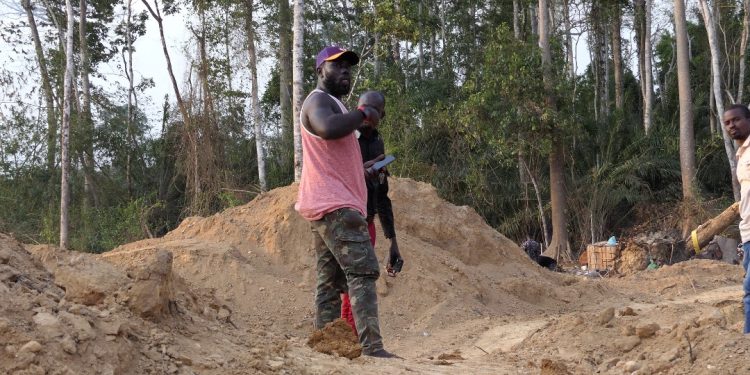
    A suspected illegal miner, Daniel Baidoo, also known locally as Yaw Tenkorang, has been granted bail with surety by the Asankragwa District Police after his arrest in connection with the recent attack on Citi FM’s Western Regional Correspondent, Akwasi Agyei Annim.

    The assault, reportedly carried out by illegal miners linked to the Dabena mining company, took place in the Adomanya Forest, located within the Wassa Amenfi West District of the Western Region.
    Baidoo, who is believed to be connected to the family that sold the disputed Adomanya land to the miners, is alleged to have led the group of galamsey operators responsible for the violent assault on Annim and two other journalists on Friday, February 21, 2025. The journalists were accompanied by police officers while filming when the attack occurred.

    Chief Inspector Anthony Amponsah, the Station Investigator at the Asankragwa District Police Command, explained to Citi News that Baidoo’s release was necessary due to legal restrictions on detention without formal charges.

    “Daniel could not be held for more than 48 hours without charge,” Chief Inspector Amponsah stated.

    He added that the police are making arrangements to present the suspect before the court and are actively working to apprehend other individuals involved in the assault.

  • TV3 Journalist threatened on live TV while covering recollation of election results at Tesano Police Depot

    TV3 Journalist threatened on live TV while covering recollation of election results at Tesano Police Depot

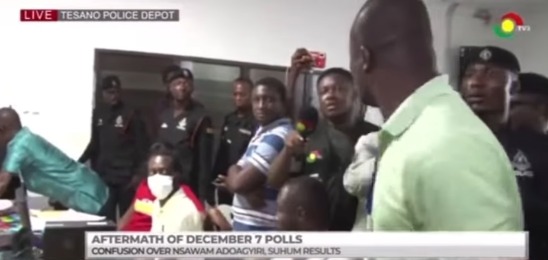
    A journalist with Accra-based TV3, Godwin Asediba, received a threat on his life while covering the recollation of results from four constituencies in the Eastern Region at the Tesano Police Depot in Accra on Thursday.

    While seeking the views of the opposing sides, the New Patriotic Party (NPP) and the National Democratic Congress (NDC), he faced resistance from the former, who accused him of being unfair and calling results, a claim he shot down, saying “we haven’t called any results.”

    He then engaged the NDC, following consistent resistance. Later in the video, gone viral, an unknown individual threatened to physically harm the journalist. It took the intervention of the police to whisk the journalist away to prevent him from suffering any harm.

    Recouting his poignant experience, which he described as “extremely tense,” the journalist in a post on Instagram wrote, “This, coupled with the harassment and attacks I endured earlier during the elections, has been an eye-opener. I strongly believe the GJA still has a lot of work to do to protect journalists.”

    According to him, the maltreatment of journalists in the country continues to fester, as “people feel free to do anything they want to a journalist without fear of consequences because they know they will go scot-free in the end.”

    “This is completely unacceptable!” he added.

    The recipient of the “Best in Community Reporting in West Africa” award at the 2024 Centre for Journalism Innovation and Development (CJID) Excellence in Journalism Awards held in Abuja, Nigeria, further shared other harrowing post-election violent experiences when some thugs thronged the Gas House in Dzorwulu while reporting.

    The situation escalated after a military deployment, leading to chaos and panic in the area—where gunshots were fired.

    Mr Asediba revealed that he was almost chocked to death and immediately bolted after he was released.

    “I’ve never run this fast in my life as a journalist. I was grabbed by the neck but was later saved when some of the thugs recognized me after they realized I was live,” the journalist wrote.

    He also shared how “a colleague journalist, a cameraman, was slapped in the face and ended up urinating on himself out of fear.”

    Prior to the 2024 polls, several stakeholders, including the Ghana Journalist Association (GJA), cautioned the public and political parties against harming any journalist during their line of work.

    The caution fell on deaf ears as journalists were attacked at Awutu Senya East and other areas during this year’s polls, according to Albert Kwabena Dwumfour, the president of the GJA.

    Presently, the Police are working to curb any post-election violent incident from occurring after the arrest of 123 individuals.

  • Ghanaians are not stupid, we will punish you if you insult us – Bernard Avle to politicians

    Ghanaians are not stupid, we will punish you if you insult us – Bernard Avle to politicians

    Ghanaian Broadcast Journalist Bernard Avle emphasized on his morning show that politicians must start taking Ghanaians seriously.

    He expressed frustration with politicians making empty promises amidst the current economic challenges faced by Ghanaians.

    Avle asserted that Ghanaians are now prepared to defend their livelihoods, emphasizing,

    “Ghanaians are not stupid, we will punish you if you insult us.”

    Watch video below:

  • Trust must be earned, it’s not a right – Bernard Avle on politicians making grandiose promises

    Trust must be earned, it’s not a right – Bernard Avle on politicians making grandiose promises

    Ghanaian Broadcast Journalist Bernard Avle emphasized on his morning show the urgent need for politicians to heed Ghanaians’ concerns seriously.

    He criticized the prevalence of empty promises amid the country’s economic struggles and warned that Ghanaians are no longer willing to tolerate disrespect.

    Avle emphasized that people are prepared to hold politicians accountable for their actions.

    “We will not take things for granted this time around. Empty promises won’t make the cut. Trust must be earned, it’s not a right,” Bernard Avle stated.

    As the 2024 elections race heat up politicians have mounted various platforms making numerous promises.

    The December polls are nearing with major political parties like the New Patriotic Party (NPP) trying to maintain the seat and major opposition National Democratic Congress (NDC) trying to overthrow the government.

    The third force Cheddar of the New Force Movement and Alan’s Movement for change garnering for the top spot.

    Watch video below:

  • Flashback: NAPO briskly brushes off journalist who tried to interview him

    Flashback: NAPO briskly brushes off journalist who tried to interview him

    In a flashback video, Dr. Mathew Opoku Prempeh was caught on video briskly brushing off a journalist attempting to interview him.

    The former Minister of Education has been a subject of scrutiny with past videos of his interactions popping up.
    This incident has fueled speculation about his demeanor, with some labeling him as ‘arrogant,’ a characterization strongly refuted by his team.

    As the 2024 general elections approach, controversies surrounding key figures like NAPO are intensifying.

    The National Council of the governing New Patriotic Party (NPP) unanimously approved the nomination of Dr Mathew Opoku Prempeh, as the running mate to Dr Mahamudu Bawumia for the 2024 presidential election.


    The General Secretary of the party, Justin Kodua Frimpong, made the announcement after the party’s National Council had finished its emergency meeting at Alisa hotel in Accra on Thursday afternoon, [July 4, 2024.)

    Watch the video below:

  • Journalists today are missing the mark – Bernard Avle

    Journalists today are missing the mark – Bernard Avle

    A prominent figure in the media, Bernard Avle, has called on fellow journalists to maintain their integrity amidst the growing trend of achieving celebrity status in the field.

    During the Citi Breakfast Show on Thursday, April 11, 2024, Bernard Avle discussed the evolving nature of journalism, highlighting his apprehensions regarding the emphasis on fame and social media metrics over core journalistic values.

    He offered insights into the development of Ghanaian television, specifically focusing on the late 1990s era.

    “Those days, those our actors were good, these days things have changed even the journalists have changed, we’ve become celebrities,” Avle remarked during the show. “Things are not the same anymore. Those days, those who were in the journalism profession, they were professionals, they were even working at other places and they were doing part-time. Of course, you can’t do part-time anymore, and media people were role models. We need purity; we need to accept that things have changed.

    We need to have some puritans in the media, people who will have to stick to what they have to do and do it “.

    Avle underscored the significance of preserving journalistic integrity despite the temptation of fame and the allure of social media metrics.

    “A young journalist now, the thing they are now being told about what the profession needs, influencers, and all those things. Do your story, be accurate, and be fair, you can have 20, 000 followers on Facebook but that is not the work, your real work is to make sure when you do the story, you should make sure it is well written, your grammar is correct, you attribute it rightly. These are the basics but people are missing it.”

    “Some guy came to me that he wants to come and work here, he has so many people following him, his grammar is even wrong and people are following him all over and he wants to be a media guy, how can you be a media guy when you can’t write English or whatever language you want to use to do the media “

    The experienced journalist raised alarm about the diminishing presence of in-depth journalism and critical analysis, attributing it to the prevalence of rapid, superficial content.

    “We can’t even read thorough stories because most stories are like four paragraphs and they’re moving to the next, it is even changing the way we think because people are not able to think deeply. You can’t sit quietly and meditate for two hours because everything is quick, we creating a generation of people who are dumb we need to go back to some fundamentals”

    Avle emphasized the core principles of journalism, urging his colleagues to withstand the allure of fame and stay true to their professional values.

    “The basis of journalism is verification of information to put out because now I am using this to advise myself as well because it’s changing, followership, stardom when people see you they want autographs and you think you are a big guy, you are not any big guy , you are a simple journalist, never forget who you are. Don’t let people define you because of your big car”

    Bernard Avle has made noteworthy contributions to Ghanaian journalism, earning a reputation as a respected and influential media personality. He is renowned for his insightful analysis, compelling presentation style, and dedication to addressing issues in Ghana. His articulate voice and valuable insights have garnered him a sizable following and solidified his position as a prominent figure in Ghanaian media.

  • No prosecutable docket received -Godfred Dame on Ahmed Suale’s murder

    No prosecutable docket received -Godfred Dame on Ahmed Suale’s murder

    The Attorney-General and Minister for Justice, Godfred Yeboah Dame, has clarified that his office has not received any prosecutable docket related to the murder of investigative journalist, Ahmed Suale.

    Although investigations are ongoing, the Minister for justice revealed that four initial suspects were detained and later released on police enquiry bail due to a lack of eyewitness identification.

    Ahmed Suale lost his life on January 16, 2019, in Madina, targeted by two unidentified assailants on a motorcycle with a concealed license plate as he returned from a family meeting.

    During a recent parliamentary session, Minister Dame highlighted the murder of Ahmed Suale as one of several pending cases.

    “A number of cases are pending in court and I will begin with the murder of Ahmed Suale. It is worthy to know that it is a matter being investigated by the criminal investigations department of the Ghana Police Service. No docket or document fit for prosecution has been built and presented to my office since the murder.

    He informed the assembly that the criminal investigations department of the Ghana Police Service is actively handling the matter, but, as of now, no document suitable for prosecution has been submitted to his office.

    Mr Dame mentioned a previous visit from the former inspector of police, James Oppong-Boanuh, expressing concern over the unresolved case and others, leading to an inquiry and a subsequent report request.

    “On being appointed Attorney General, the former inspector of police [James] Oppong-Boanuh paid a courtesy call on me on March 29, 2021, for being concerned about the failure to resolve this case and other cases.

    “I inquired about the state of investigations into the matter and demanded a report on the case and the director general of CID obliged.”

  • Journalist assaulted by 2 policemen for filming district assembly inauguration

    Journalist assaulted by 2 policemen for filming district assembly inauguration

    Safety of journalists executing their duties has been called into question following reports of physical aggression, verbal abuse, and obstruction faced by Ralph Apetorgbor, the Consulting Editor of Telegraph Ghana, while covering the district assembly inauguration ceremony at the Ga Central Municipal Assembly.

    The incident, which occurred on Monday, February 12, 2024, has sparked outrage in the area and brought attention to the challenges faced by journalists, particularly during an election year.

    According to Apetorgbor’s account of the incident, he was covering the election of the presiding member at the assembly’s forecourt when he was approached by two police officers. 

    They accused him of filming the proceedings without authorization and demanded to see the photos on his camera. Despite his refusal to comply, one officer attempted to seize his camera.

    Eyewitnesses corroborated Apetorgbor’s account, stating that the journalist refused to allow access to his camera, leading to a confrontation with the police officers.

    Apetorgbor further described how he was physically pushed outside the premises by Assistant Superintendent of Police (ASP) Richard Kungu and Chief Inspector Aikins, who subjected him to verbal abuse. He highlighted the unprofessional conduct of the Sowutuom police officers, which hindered his ability to report on the proceedings.

    Following the conclusion of the ceremony, Apetorgbor alleged that he was again confronted by ASP Kungu, who, along with Inspector Aikins, verbally assaulted and threatened him. The officers reportedly boasted about their impunity and threatened further violence against journalists.

    Apetorgbor has since lodged complaints with the Inspector General of Police (IGP), Dr. George Akufo Dampare, and the Private Newspaper Publishers Association of Ghana (PRINPAG). He plans to officially file a complaint against the officers for threatening him, obstructing his professional duties, and verbally assaulting him.

    As of now, the Sowutuom police command has not commented on the matter.

  • NMC has failed journalists by not protecting them from attacks – Retired Journalist

    NMC has failed journalists by not protecting them from attacks – Retired Journalist

    A retired journalist from Graphic Communications Group, Lloyd Evans, has voiced his support for the Ghana Journalist Association’s (GJA) decision to blacklist two Members of Parliament (MPs) for allegedly attacking journalists.

    He sees this as a crucial step towards safeguarding press freedom and upholding the integrity of journalism in the country.

    The incidents leading to the media blacklist included the reported attack on Citi FM’s Northern regional correspondent, Mohammed Aminu Alabira, allegedly by MP for Yendi, Farouk Aliu Mahama, during coverage of the National Patriotic Party’s (NPP) parliamentary primaries, and the alleged assault on Cape FM’s David Kobbina by supporters of the MP for Awutu Senya East, Mavis Hawa Koomson.

    In contrast, Yaw Boadu-Ayeboafoh, the chairman of the National Media Commission (NMC), expressed skepticism about the GJA’s approach, suggesting that it might not yield the desired outcomes.

    Speaking on the 12 O’Clock Report on Tuesday, February 13, Evans expressed disappointment in Boadu-Ayeboafoh’s failure to bridge the gap between the GJA and the NMC, given his background in the industry.

    “I think, as a very senior journalist and then a chairman of the Media Commission, he [Boadu-Ayeboafoh] should have been able to bridge the gap. Ever since journalists started having these attacks, I haven’t seen how the Media Commission has gone to condemn some of these things and then taken certain actions,” Evans stated.

    Mr. Evans echoed the sentiment, emphasizing the importance of condemning attacks on journalists and taking decisive action to address such incidents. He stressed that journalists should not be subjected to physical assault or intimidation, highlighting the Ghana Journalist Association’s decision to blacklist the MPs as a commendable step towards protecting journalists’ rights.

    “So for the GJA also to take such a step for me, I think it’s a step in the right direction. I don’t think journalists are punching bags that any Tom, Dick, and Harry at all can get up, and then with the least issue and then start punching them, I don’t think that is right.”

    Reflecting on Boadu-Ayeboafoh’s reservations, Evans suggested that a constructive dialogue between the National Media Commission (NMC) and the Ghana Journalist Association (GJA) could be beneficial in addressing concerns and finding common ground.

    He urged Boadu-Ayeboafoh to initiate a roundtable discussion to thoroughly examine the implications of the GJA’s decision and explore potential alternatives.

    “If Mr. Ayeboafoh is not happy with what has happened, the best thing for him to do, as I said earlier, should call the GJA to a round table discussion and then discuss the pros and cons of their action.”

  • Journalist attacks in Ghana: Survey reports 40% as victims while on duty

    Journalist attacks in Ghana: Survey reports 40% as victims while on duty

    A 2023 survey conducted by the School of Communications at the University of Ghana, has reported that approximately 40% of journalists have experienced attacks while performing their duties.

    The survey further reveals that 70% of practitioners are aware of colleagues who have also been subjected to such attacks.

    Dr. Abena Animwaa Yeboah-Banin, a Senior Lecturer at the School of Communications, discussed these findings with JoyNews on February 13. She highlighted that these incidents have instilled fear among journalists about the execution of their responsibilities.

    “At least 38 percent of those who have been sampled experienced. An even bigger number—nearly 70 percent of those sampled—said they were aware of colleagues who have experienced attacks in their line of work.

    “Altogether, therefore, quite a good number expressed feelings of insecurity; they generally felt unsafe doing the work of journalists in the country,” she said.

    Dr Yeboah-Banin said this was a cause for concern as the rate of attacks on journalists kept doubling with no measures to curb the situation.

    “Report after report has suggested that the rate of attacks on journalists for doing their work, is increasing but the actions that you would see to make a statement to perpetrators that this will not be countenanced—such an action does not seem to be as swift or even existent in quite a number of instances,” she bemoaned.


    In the wake of recent attacks on journalists by politicians and their followers, there have been notable developments. Mohammed Aminu Alabira, a correspondent for Citi FM in the Northern region, was reportedly assaulted while covering the NPP’s parliamentary primaries, allegedly by Farouk Aliu Mahama, the Member of Parliament for Yendi Constituency.

    Additionally, individuals suspected to be supporters of Mavis Hawa Koomson, the MP for the Awutu Senya East Constituency, are accused of attacking a journalist in the Central region.

    Consequently, the Ghana Journalists Association (GJA) has called for a media blackout on these lawmakers. Information Minister Kojo Oppong Nkrumah has endorsed these calls and urged the GJA to intensify pressure on both the Ghana Police Service and the Judiciary to effectively address incidents of violence against journalists in the country.

  • We won’t stop blacklisting politicians who fuel attacks against journalists – GJA

    We won’t stop blacklisting politicians who fuel attacks against journalists – GJA

    The Ghana Journalists Association (GJA) has reaffirmed its commitment to safeguarding the rights and freedoms of journalists nationwide, pledging to combat any form of aggression towards them.

    Albert Dwumfuor, the President of the Association, asserted on Eyewitness News on Citi FM that the GJA will persist in instructing its members to blacklist any individual who threatens journalists in the country.

    This resolution comes following a directive jointly issued by the GJA, the Ghana Independent Broadcasters Association (GIBA), the Private Newspaper Publishers Association of Ghana (PRINPAG), and the Media Foundation for West Africa (MFWA).

    The directive urges media organizations across the country to blacklist Farouk Mahama, the Member of Parliament for Yendi, for his reported assault on Mohammed Aminu M. Alabira, a Northern Regional Reporter for Citi News.

    According to reports, Mr. Mahama and his team attacked Alabira while he was covering the disruption of the New Patriotic Party’s (NPP) parliamentary primary in the Yendi constituency on January 27, 2024.

    Mr. Dwumfuor added in the interview, “In fact, this is the way to go. We want to send a signal, a caution that we are not going to relax on our call for our members to blacklist politicians, individuals, or groups who rise against journalists or who impede press freedom and media independence… We will not entertain such acts.”

  • Expedite thorough investigation into Ahmed Suale’s death – UPDN tells  government

    Expedite thorough investigation into Ahmed Suale’s death – UPDN tells government

    Journalists across the country express frustration over the lack of progress in the justice process for the late investigative journalist Ahmed Hussein-Suale Divela, five years after his tragic death.

    Ahmed Hussein-Suale Divela, an investigative journalist with Tiger Eye P.I., was brutally murdered on the night of January 16, 2019, sending shockwaves through the Ghanaian journalistic community and beyond.

    The United Press for Development Network (UPDN) released a statement on January 16, expressing anger at the perceived lack of advancement by the security forces in bringing the perpetrators to justice.

    “UPDN expresses deep disappointment and dismay at the lack of progress in bringing the perpetrators of this heinous crime to justice. We are particularly concerned about the apparent lack of urgency and commitment demonstrated by key authorities in resolving this case.”

    UPDN specifically called on Inspector General of Police (IGP) Dr. George Akuffo Dampare, Information Minister Kojo Oppong Nkrumah, Attorney General Godfred Yeboah Dame, and President Nana Addo Dankwa Akufo-Addo to prioritize the investigation into Ahmed Suale’s murder.

    The network described the absence of accountability for his murder as ‘disheartening,’ asserting that it poses a threat to press freedom.

    “We call upon the Director-General of the Criminal Investigation Department, DCOP Faustina Agyeiwaa Kodua Andoh, Inspector General of Police (IGP) Dr. George Akuffo Dampare, Information Minister Kojo Oppong Nkrumah, Attorney General Godfred Yeboah Dame and President Nana Addo Dankwa Akufo-Addo to prioritize the investigation into Ahmed Suale’s murder. It is disheartening to witness the lapse in accountability for such a grave violation of human rights and an attack on the cornerstone of democracy and freedom of the press,” UPDN stated.

    UPDN issued a strong warning against any form of assault on journalists before, during, and after the upcoming December polls.

    Read the statement by UPDN below

    PRESS RELEASE

    Five (5) Years On: Remembering the Tragic Murder of Investigative Journalist Ahmed Hussein-Suale Divela

    ACCRA, GHANA TUESDAY JANUARY 16, 2024; Today marks the solemn occasion of the fifth anniversary of the brutal murder of Mr. Ahmed Hussein-Suale Divela, a dedicated member of Tiger Eye P.I. and a fearless investigative journalist. Ahmed Suale lost his life in a callous act of violence on the night of Wednesday, January 16, 2019, sending shockwaves throughout the journalistic community in Ghana and around the world.

    Ahmed was shot twice in the chest and once in the neck by faceless assailants riding motorcycles, in what was a blatant attack on press freedom and the pursuit of truth. His untimely death occurred just months after the airing of the ground breaking investigative documentary “Number 12: When Greed and Corruption Become the Norm,” led by the celebrated undercover investigative journalist Mr. Anas Aremeyaw Anas.

    United Press for Development Network (UPDN) stands in solidarity with the family, friends, and colleagues of Ahmed Hussein-Suale Divela on this solemn occasion. We remember Ahmed not only for the fearless journalist he was but also for the impact his work has had on fostering transparency, accountability, and ethical journalism.

    The tragic events of that fateful night serve as a stark reminder of the challenges journalists face in their pursuit of truth. The attack on Ahmed Suale echoes the broader threats against press freedom and the dangers faced by investigative journalists who strive to expose corruption and wrongdoing.

    UPDN expresses deep disappointment and dismay at the lack of progress in bringing the perpetrators of this heinous crime to justice. We are particularly concerned about the apparent lack of urgency and commitment demonstrated by key authorities in resolving this case.

    We call upon the Director-General of the Criminal Investigation Department, DCOP Faustina Agyeiwaa Kodua Andoh, Inspector General of Police (IGP) Dr. George Akuffo Dampare, Information Minister Kojo Oppong Nkrumah, Attorney General Godfred Yeboah Dame and President Nana Addo Dankwa Akufo-Addo to prioritize the investigation into Ahmed Suale’s murder. It is disheartening to witness the lapse in accountability for such a grave violation of human rights and an attack on the cornerstone of democracy and freedom of the press.

    Ghana, often hailed as the shining star of democratic values and free speech credentials in Africa, has seen a decline in its world press freedom ranking. This tragic incident and the subsequent lack of progress in ensuring justice serve as a stain on Ghana’s reputation as a beacon of democratic principles. Our current world press freedom ranking is a stark reminder of the urgency needed to address these challenges and restore faith in the nation’s commitment to press freedom.

    As the 2024 Parliamentary and Presidential elections approach, UPDN issues a stern warning against any form of press assault and media brutality in Ghana. We firmly believe that when you touch one journalist, you touch all journalists. Our commitment to defending the rights and safety of journalists is unwavering, and we will not countenance any act that undermines the essential role of the media in a thriving democracy.

    UPDN calls for immediate and transparent action to bring the perpetrators of Ahmed Suale’s murder to justice, reinforcing the values of democracy, free speech, and press freedom that Ghana has long championed on the African continent.
    We remember Ahmed Hussein-Suale Divela with utmost respect and solidarity.

    Rest in Peace Soldier

    Rest in Perfect Peace Ahmed Hussein-Suale

    God bless our homeland Ghana and make our nation great and strong.

    -End-

    Signed

    Kofi Asante Mensah
    (President)
    Tel: 024-469-0262
    Office: 0302-965-325

    National Communication Bureau

    Kelvin Malor
    (National Organizer)
    024-599-5541

    Betty Boafo
    (Secretary)
    024-487-0055

    David Albert Quainoo
    (South Korea Coordinator)
    +821021174780

    Eric Nana Prekoh
    (Media Relations Coordinator)
    024-646-0428

    William Hayford Mintah
    (Central Region Coordinator)
    024-476-6538

  • “There are severe consequences for journalist”

    “There are severe consequences for journalist”

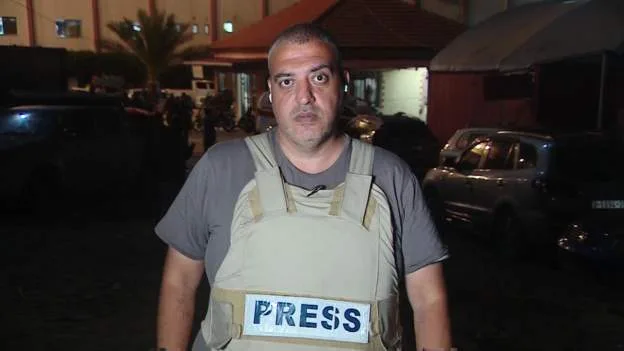
    The BBC’s Rushdi Abualouf, who has been reporting from Gaza for a long time, talked about the challenges for journalists reporting from the region.

    He said on the BBC News Channel that the journalist will face big consequences. People think that the person filming is a hero, but they forget that he is just a normal person with a family to take care of.

    He’s always worried about his family, just think about someone losing five of their family members. He thinks he should keep writing the story, but it’s hard for him to keep reporting because he feels so sad and upset.

    Rushdi said that many journalists have been killed during the fighting since October 7th.

  • Son of Al Jazeera journalist killed in Gaza

    Son of Al Jazeera journalist killed in Gaza

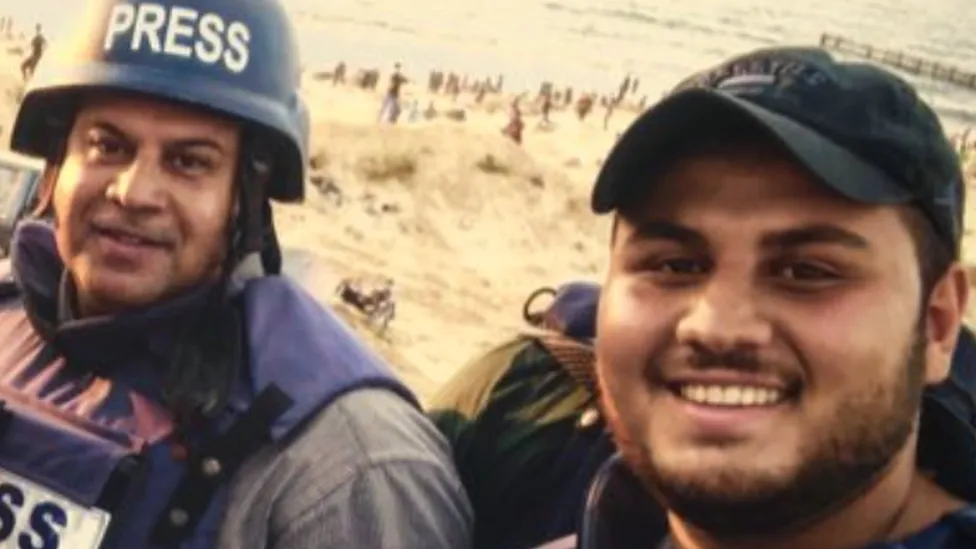
    The oldest son of the person in charge of Al Jazeera‘s office in Gaza was killed in a bomb attack by Israel in the south of Gaza.

    Hamza al-Dahdouh, a journalist and cameraman for Al Jazeera, was on a road with other reporters when a drone attacked them between Khan Younis and Rafah.

    Freelance journalist Mustafa Thuraya was also murdered.

    In October, four more of bureau chief Wael al-Dahdouh’s family members were also killed.

    His wife Amna, his grandchild Adam, his 15-year-old son Mahmoud and seven-year-old daughter Sham were all killed in an attack by Israel.

    According to Hisham Zaqout, a reporter for Al Jazeera, Hamza and a group of journalists were on their way to the Moraj area northeast of Rafah. The area had been declared a “humanitarian zone” by the Israeli army, but had recently been bombed.

    Many people from Gaza ran away to this place to get away from the bombing in other parts of the area. Hamza planned to tell about what was happening and what happened after the bombings in the area, according to Al Jazeera.

    Live video from Al Jazeera showed what happened after the car they were in got hit.

    His father, Wael al-Dahdouh, was crying and holding his hand while standing next to his body in a morgue in Khan Younis. He was laid to rest in the southern city of Rafah.

    Hamza was more than just a part of me. He meant everything to me. He was my everything. These tears are from feeling sad and missing someone or something. “These are the tears of people,” his father said during the funeral.

    “I want the world to pay attention to what’s happening in Gaza. ”

    Wael al-Dahdouh got hurt and his cameraman Samer Abu Daqqa was killed in a different attack while they were filming last month.

    Mral-Dahdouh, who has eight kids, kept talking about the fighting in Gaza.

    Hamza al-Dahdouh had a lot of people who liked his Instagram posts- one million. He wrote about his dad in his last post before he died. “You are strong and calm. ” Don’t give up hope in God’s kindness. “He said you will definitely get a reward,” he told me.

    Over 75 reporters have died since the fighting in Gaza began.

    More than 22,000 people have died in Gaza, according to the health ministry run by Hamas.

  • Renowned journalist from Mozambique killed close to capital

    Renowned journalist from Mozambique killed close to capital

    Well-known Mozambican reporter João Chamusse was discovered dead near his house in the outskirts of the city Maputo. It is believed to be a murder.

    The local news says that he was attacked and killed by people no one knows. His neighbors heard him shouting for help on Thursday morning.

    Other journalists say Chamusse had a cut on his head and a machete and gardening hoe were found close to his body.

    Chamusse, who owns and helps run Ponto por Ponto, an online newspaper, gave his opinion on TV about the government.

    The paper says its editorial director was killed with a knife.

    The Media Institute of Southern Africa in Mozambique said they were very upset about the killing.

    The group said Chamusse helped fight for freedom of the press and expression in the country.

    The Committee to Protect Journalists is very upset about the journalist’s killing and wants the authorities in Mozambique to thoroughly investigate what happened.

    Mozambican officials have not said anything about the murder yet.

  • Another American journalist detained in Russia

    Another American journalist detained in Russia

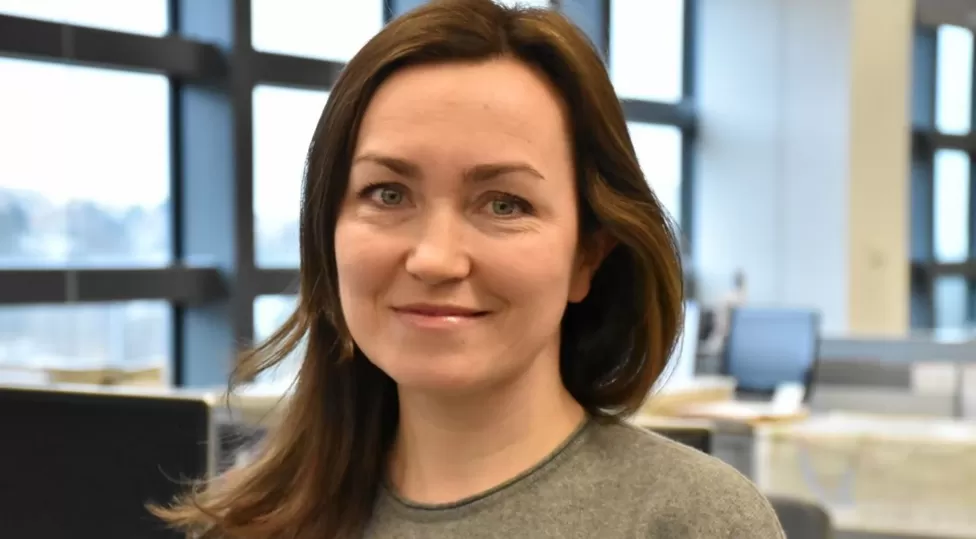
    Alsu Kurmasheva, an American journalist, was arrested after visiting her family in the Russian city of Kazan. Now, she is being accused of a crime, according to her coworkers.

    She worked as an editor for Radio Free Europe/Radio Liberty in Prague, which is funded by the United States. On 2 June, she was held for a short time by authorities.

    She was arrested again on Wednesday and accused of not registering as a foreign agent. If convicted, she may be sentenced to up to five years in jail.

    Ms Kurmasheva is the second American journalist who has been detained in Russia this year.

    Evan Gershkovich, a reporter for Wall Street Journal in Moscow, who is 31 years old, was arrested in March for spying. This month, a court in Moscow said no to his request and told him that he needs to stay in jail.

    His boss and the United States government are saying that the accusations are not true and that he is being kept so he can be exchanged for Russians who are held in the custody of the United States or its friends.

    Alsu Kurmasheva has citizenship in both the US and Russia. She works for RFE/RL’s Tatar-Bashkir service. Tatar and Bashkir are two similar languages spoken by native people in two parts of Russia.

    According to RFE/RL, Ms. Kurmasheva, who lives in Czech Republic, went to Kazan at the end of May because of a family emergency. She was stopped and held by authorities while waiting for her flight back home and they took away her passports from Russia and America.

    She was accused of not registering as a foreign agent and of gathering information for foreign governments, as reported by a local state news website called Tatar Inform.

    Dmitry Kolezev, a well-known journalist from Russia, explained that the law Ms Kurmasheva was accused of breaking was written in a way that makes it possible to restrict gathering simple information about military members, like their names and which unit they belong to. “They captured another person,” he added.

    Ms Kurmasheva’s work often dealt with problems that people from different ethnic backgrounds in central Russia experience.

    According to independent Russian media organizations and press freedom watchdogs, Russian authorities often use strict laws to bother journalists and prevent them from reporting freely on important matters.

    Many reporters and people who oppose the Kremlin have been called “foreign agents”. This includes Dmitry Muratov, who won the Nobel Peace Prize.

    Last year in September, Ivan Safronov, a journalist for Kommersant and Vedomosti, was given a 22-year prison sentence for the crime of treason.

    In March, a student named Dmitry Ivanov was given a prison sentence of eight and a half years for sharing false information about the Russian army on the messaging app called Telegram.

  • Journalist for Somali TV killed in suicide attack

    Journalist for Somali TV killed in suicide attack

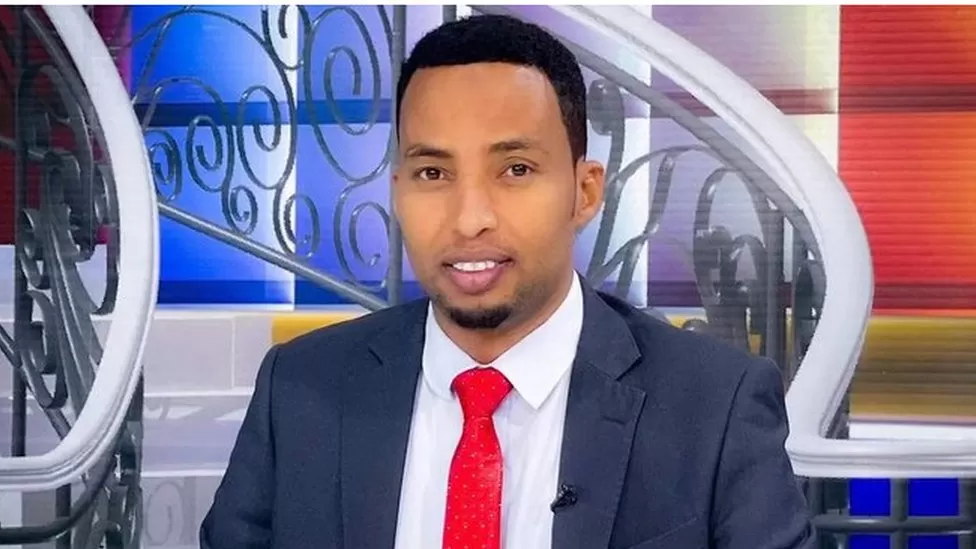
    The Somali public is expressing reverence and admiration for a prominent TV journalist from Somalia who was killed in a restaurant bombing in the city of Mogadishu.

    Abdifatah Moalim Nur, also called Qeys, was thought of as someone very special and motivating by his coworkers.

    According to a local media watchdog, he is the first journalist to be killed in Somalia this year.

    The terrorist group called al-Shabab said they were responsible for the bombing at Blue Sky restaurant.

    The police said that four more people got hurt outside the restaurant that is close to the place where the president lives.

    The Information Minister, Daud Aweis, spoke out against the attack, calling it cowardly.

    The National Union of Somali Journalists (NUSOJ) expressed deep sadness and shock over the senseless and brutal murder of Nur, the director of Somali Cable Television which is privately owned.

    The union said that his amazing career and strong dedication have made a lasting impact on Somali journalism. It has inspired many young journalists to work hard and do their best.

    Nur, who strongly supports the freedom of the press, had been threatened before, according to the Somali Journalists Syndicate (SJS).

    Last October, journalist Mohamed Isse Hassan died along with over 100 others in two car bombings in Mogadishu.

    A reporter named Ahmed Mohamed Shukur was killed by a landmine close to the capital city. He worked for Somali National Television, which is owned by the government.

    Al-Shabab is doing harmful attacks in Somalia because the military is trying to force them out.

    Somalia’s President Hassan Sheikh Mohamud became president in May last year, and he promised to fight against the group with full force.

  • Journalist from Radio Ada arrested for spreading false news about McDan passes away

    Journalist from Radio Ada arrested for spreading false news about McDan passes away

    In a heart-wrenching development, Noah Narh Dameh, who held the position of Deputy Station Coordinator at Radio Ada, has passed away at the age of 49.

    This somber news was confirmed by a report from fourthestate.gh.com.

    Mr. Dameh, who had been entangled in a legal dispute over allegations of disseminating false information concerning businessman Daniel McKorley, commonly known as McDan, breathed his last in the confines of his home.

    The precise cause of Mr. Dameh’s passing remains undisclosed, but individuals close to his family disclosed that his health had been in a precarious state since his release from police custody in December 2022.

    Noah Narh Dameh leaves behind three children and two grandchildren.

    His significance extended beyond his role in the media, as he was a committed community advocate who utilized his position at Radio Ada to champion the cause of the coastal region, renowned for its commercial salt production.

    Throughout his career, Mr. Dameh labored tirelessly to engage the community on issues pertaining to their civic rights and responsibilities.

    He accomplished this by delivering news stories and valuable insights not only to the Dangme people but also to a wider audience.

    In addition to his work within the radio studio, Mr. Dameh actively participated in various community initiatives.

    He spearheaded numerous endeavors aimed at effecting positive change within the community.

    However, Mr. Dameh’s health deteriorated significantly as a result of the events surrounding his relentless reporting on the contentious lease of the Songhor Lagoon to a single investor.

    In his quest for justice, he shed light on grave human rights violations, including arbitrary arrests, detentions, prosecutions, and brutalities endured by some Ada residents in connection with the lease.

    The turning point came when Mr. Dameh posted a photograph on his Facebook page, depicting an Ada resident handcuffed to a hospital bed while in police custody.

    In his post, he alleged that the young man was being mistreated at the behest of Mr. McKorley, the Chief Executive Officer of Electrochem Ghana Limited, the company that had been granted a salt mining lease in Ada.

    In response to these allegations, Electrochem Ghana Limited initiated a defamation lawsuit against Mr. Dameh.

    This legal battle thrust Mr. Dameh into the national spotlight, where he continued to champion the cause of the marginalized and oppressed.

    In December 2022, he was discharged by the Tema Magistrate Court, which cited a lack of jurisdiction over the case.

    However, an unexpected twist occurred when he was re-arrested by the police and remanded for seven days.

    Subsequently, he was granted police inquiry bail of GH₵ 60,000.00 and appeared in court with his lawyer.

    On July 3, 2023, an unfortunate incident unfolded when his lawyer failed to appear in court.

    The presiding judge accused Mr. Dameh of impersonation, even expressing difficulty in recognizing him due to his deteriorating health.

    Eventually, the police investigator on the case identified him as the accused.

    Regrettably, Mr. Dameh’s health continued to deteriorate, and he was unable to recover.

  • Journalists prohibited from entering Libya’s flood-ravaged city

    Journalists prohibited from entering Libya’s flood-ravaged city

    A minister from the eastern Libyan government has issued an order for all journalists to vacate the devastated city of Derna. The minister, Hisham Chkiouat, has accused the media of obstructing the efforts of rescue teams following the recent floods.

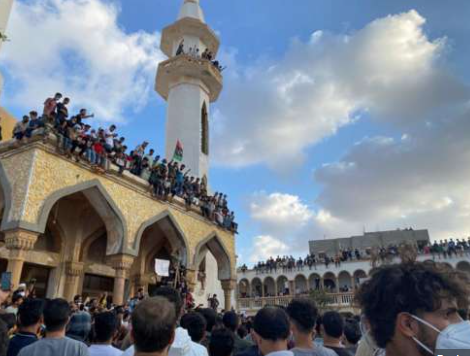
    In response to the disaster, which occurred when two dams collapsed during heavy rainfall, demonstrators on Monday set fire to the residence of the former mayor. Many residents believe that this catastrophe could have been prevented, as officials have admitted that a contract to repair the dams was left unfinished.

    Estimates of the death toll vary significantly, but the World Health Organization has confirmed that more than 3,900 people have lost their lives, with thousands more reported as missing.

  • Journalist briefly detained by Egypt following Zambian smuggling report

    Journalist briefly detained by Egypt following Zambian smuggling report

    The Egyptian authorities arrested then released a journalist who published articles accusing officials of involvement in smuggling cash, weapons and gold to Zambia.

    The allegations by Karim Asaad followed the seizure by Zambian officials of a chartered aircraft at Lusaka airport.

    It was said to be carrying more than $5m (£3.9m) in cash as well as pistols, ammunition and over 100kg of suspected gold.

    Documents – purportedly from a Zambian investigation – had allegedly named several Egyptian army and police officers as suspects.

    Egypt’s national press union says Mr Asaad was the 24th journalist to be detained in the country.

    Mr Asaad works for the news site Matsda2sh. Colleagues of Mr Asaad have accused security forces of assaulting his wife and child during his arrest on Saturday.

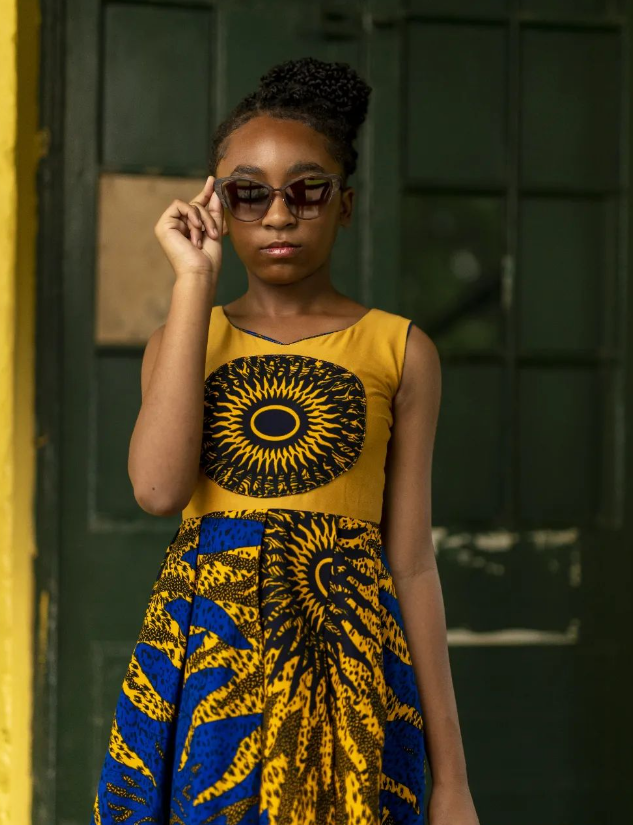
  • Meet the 11-year-old Entertainment journalist in Ghana

    Meet the 11-year-old Entertainment journalist in Ghana

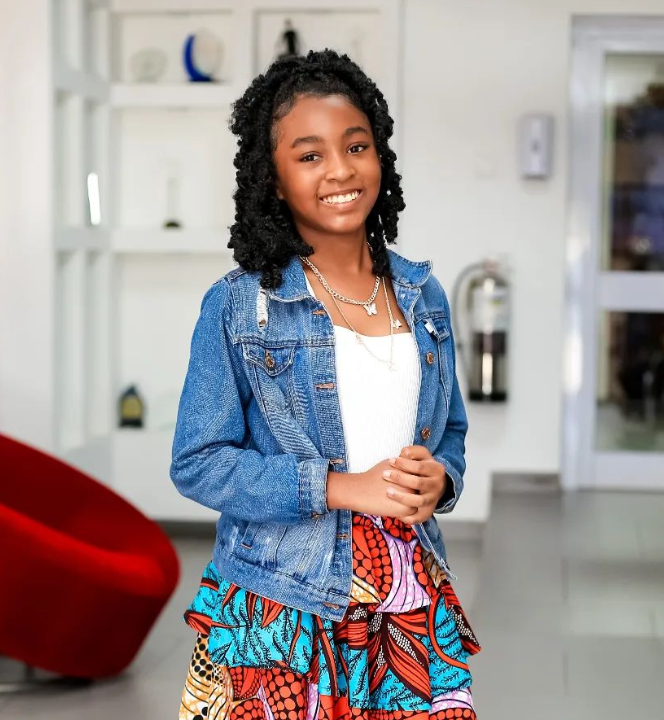
    At the age of 11, Samara Osae-Asare claims a commanding presence as the high-spirited anchor of TV3’s Kidz Arena.

    In this capacity, she gracefully takes the lead, holding enlightening conversations with international celebrities.

    Amid the realms of journalism and entertainment, Samara distinguishes herself. She has an ambition to contribute to the awareness of the West African state, Ghana, and Africa in general.

    In her engagements with celebrities, she often imparts a few words in the local Twi language to them.

    With a keen focus on the array of languages, the culinary delights appreciated by the locals, and the captivating tourist destinations, the Ghanaian-American girl leaves no aspect of Ghana unnoticed.


    She has extended invitations to prominent figures including singer Usher, Black Panther actress Letitia Michelle Wright, American singer Erykah Badu, sensational vocalist Lauryn Hill, and renowned rappers Ice Cube and Snoop Dogg, among others, urging them to explore the wonders of Ghana.

    Currently, Samara Osae-Asare is being encouraged by many, particulary Ghanaians to keep up the good work. Ghanaian rapper, Sarkodie, is of the view that her works are nothing short of beautiful.

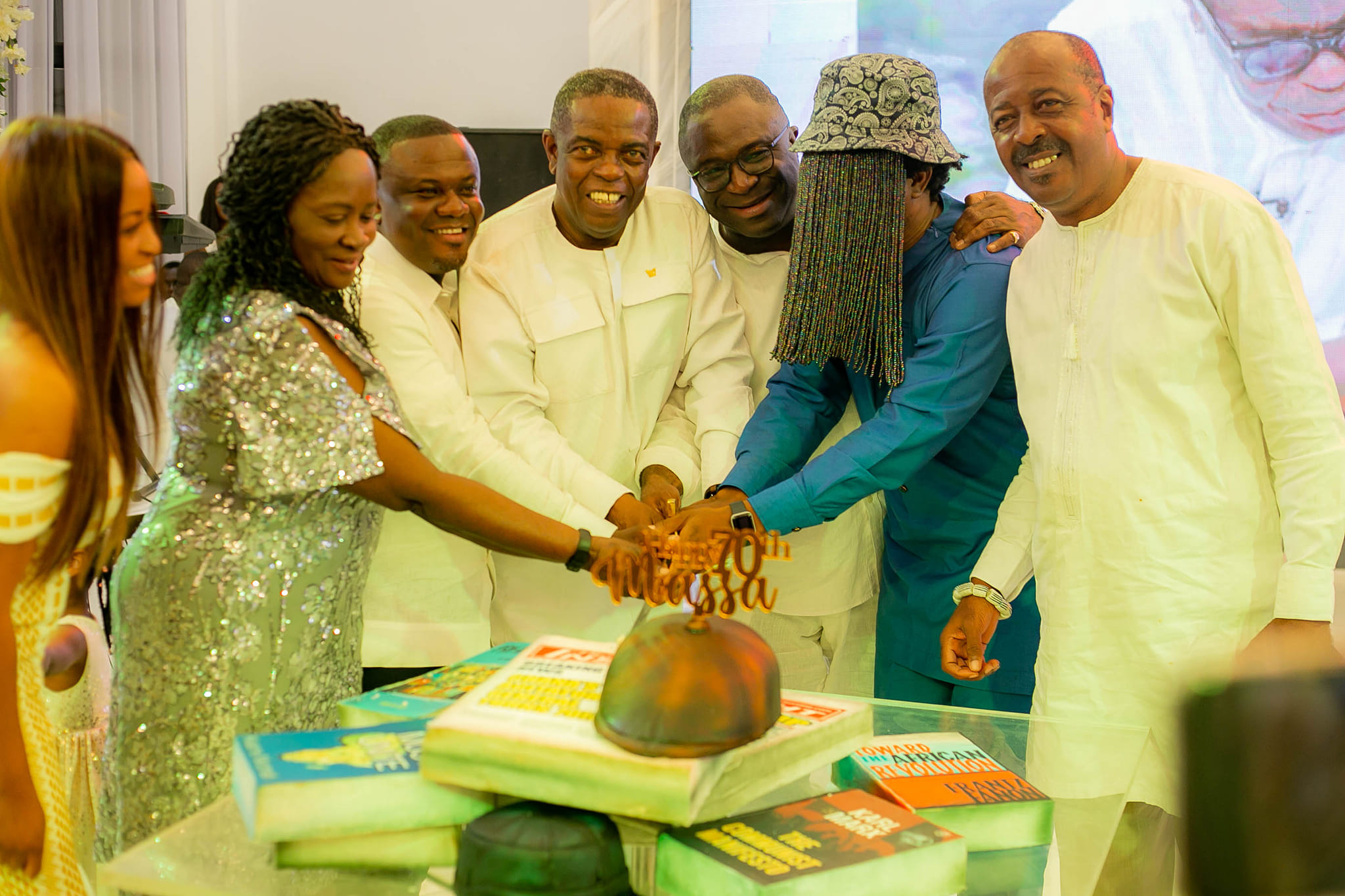
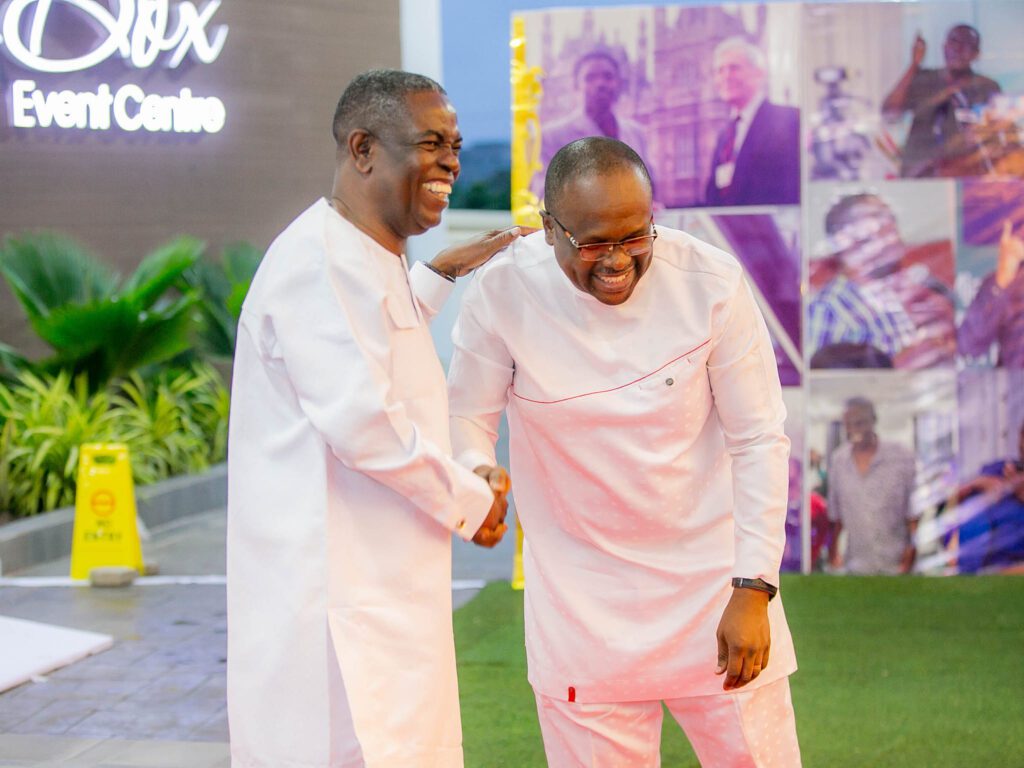
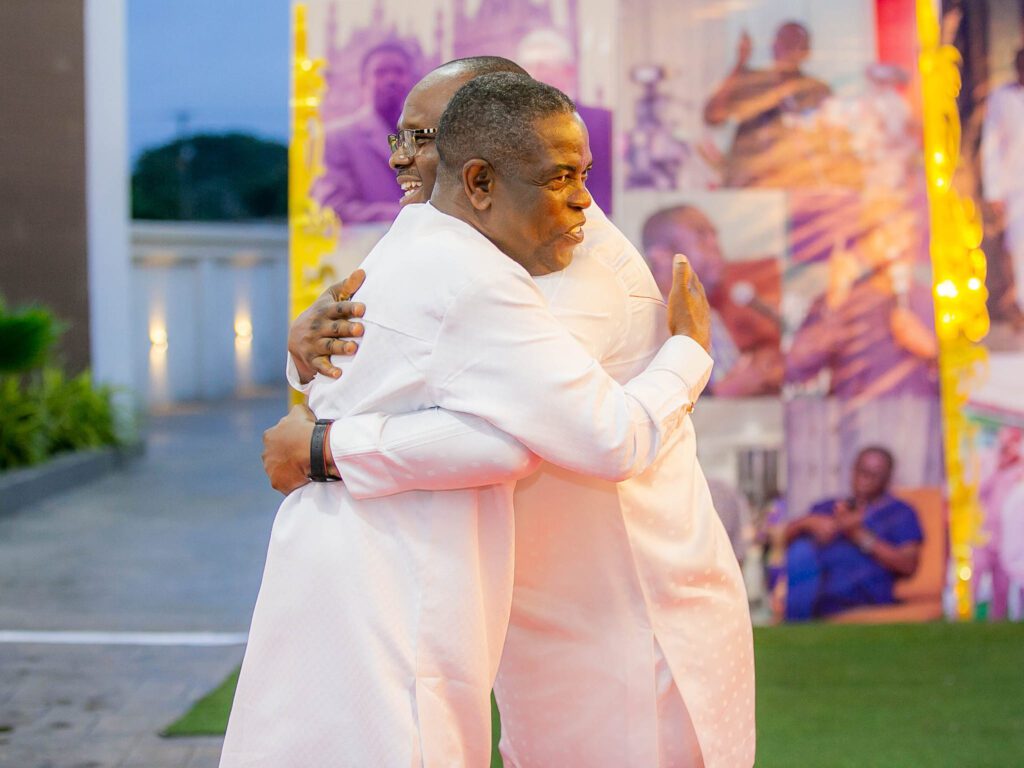
  • Photos: Kwesi Pratt Jnr celebrates 70th birthday in a plush event

    Photos: Kwesi Pratt Jnr celebrates 70th birthday in a plush event

    Managing Editor of the Insight Newspaper, Kwesi Pratt Jnr, on August 9, 2023 celeberated his 70th birthday in a plush ceremony.

    It was a bash, held in Accra at the Sky Bar where family and friends organized themselves to honor the veteran journalist.

    Photos and videos displayed on social media shows the presence of affluent politicians from the governing New Patriotic Party (NPP) and the main opposition National Democratic Congress (NDC).

    Others were also recognized to be members of his own Convention People’s Party (CPP) and other minor parties were also present.

    Also in attendance were, Chief of staff for the NPP, Akosua Frema Opare, represented the government, and the national chairman of the NDC, Asiedu-Nketiah, represented the party.

    Prof. Jane Naana Opoku-Agyemang, a vice presidential candidate for the NDC, as well as Tsatsu Tsikata, investigative journalist Anas Aremeyaw Anas, and TV anchor Kweku Sintim Misa were there.

    Nyaho Nyaho Tamaklo, the father of the NPP, Kobina Ivor Greenstreet, a former CPP flagbearer, and Osei-Kwame Despite, CEO of Despite Media, are also among those detained.

  • Zimbabwean florist, demonstrates how she uses paper flowers to bring nature to life

    Zimbabwean florist, demonstrates how she uses paper flowers to bring nature to life

    Precious Tariro Guwira, a former journalist, has always had a natural talent for handicrafts, but despite being the go-to person in her social circles for creative space décor, she never for a second considered crafting as a professional option.

    That was before to her starting to assist at her neighborhood church in Mutare, eastern Zimbabwe. She excels in making paper flowers.

    “From crafting church decorations, I also started beautifying homes, workplaces, hotels, weddings, birthday parties, and engagements. On popular holidays such as Valentine’s Day and Mother’s Day, I become particularly busy as more people appreciate the idea of long-lasting paper flowers that can serve as a keepsake,” she said, looking back at her journey to becoming a full-time artisan.

    “The dream was so straightforward that I left my journalism job to pursue paper flower-making,” she said.

    But the reality wasn’t quite as straightforward as she’d presumed.

    “I had to familiarise myself with various types of paper required for creating realistic botanical flowers. I was amazed to discover the diverse range of papers available. Some papers required kneading to increase flexibility, while others needed heating before curling. I also had to paint or dampen some papers to achieve the desired colours before drying them,” she said, explaining that gaining the experience required took longer than expected.

    “With my experience, I can now quickly determine which paper suits a specific project to achieve a long-lasting effect,” she said.

    The paper florist now uses a mix of recycled and imported florist paper that can be dyed and curled, or even ironed, straightened, creased, or stretched.

    “I create water-resistant flowers using imported foam paper, and I use organza silk to make giant flowers. I also recycle paper that can be easily manipulated, especially for curling petals. However, I do not use the paper typically used for writing or drawing. The paper I use is unique and is specifically used to make long-lasting and unique paper flowers.”

    Guwira is inspired to create by natural flowers, and she carefully studies each one. She counts the petals, counts the center stamen, counts the seal, counts the stem, and counts the leaves as they grow.

    “For example, I deconstruct a rose, petal by petal, until I reach the centre.” Then I traced the petals onto paper to create templates for our paper flowers. I have a collection of templates for classic roses, David Austin’s garden roses, hydrangeas, sunflowers, gladiolus, lilies, peonies, and many more. The list keeps growing since there are over 1,000 varieties of flowers and plants out there. Once we trace the template onto the paper, we use it to cut the paper and let the magic happen as we create the paper flowers, petal by petal.

    The most distinctive and lovely aspect of paper flowers is that no two are alike, and there is no right or wrong way to arrange the petals as long as they are in an organized fashion. It’s a soothing procedure. Mother Nature herself doesn’t always produce the same thing, after all,” she said.

    Guwira has recently given her project the name “Helia Paper Flowers” in reference to the sun, its aura, and the radiance connected with the beauty of the rising sun in the morning.

    She is still regularly faced with the challenge of convincing people to embrace and accept paper flowers while compensating her fairly for her efforts. The average cost of her creations is US$60.

    “Paper flowers are a new thing, and more people are used to fresh flowers. So, to capture the target market, I have tried to devise ways and strategies to push the paper flower agenda smoothly. Most people think we use the ordinary paper we use to write and draw on. So one can say the charge for a bouquet is too much for paper. As well as the storage of the giant flowers since I am currently working from my mother’s living room,” she said.

    The paper florist hires part-time staff to assist with cutting and assembling when she receives large orders, but the inconsistency of those orders means she cannot afford her workspace due to the high costs.

    “I’m still working from my mom’s living room at the moment because, after carefully doing the math of paying taxes and then adding rent, which ranges from $450 to $600, I saw it best to continue at home at the moment.

    The biggest challenge is the storage of our giant flowers. At the moment we hang them on walls, and some we close in the petals and nicely store them away in boxes, and then when we want to use them, we open the petals and shape them again.”

    Guwira caters to a broad spectrum of clients, such as event organisers, designers, balloon artists, corporate entities, individuals, and religious institutions. She markets her products through social media platforms and a WhatsApp catalogue and offers delivery services for all orders.

    “I love her creations; they outlast the event and augment the memories. The flowers are like a physical manifestation of our inner beings; the creations speak to you,” said Charlotte Tudhe Mutambara, a regular client who places orders for functions.

    “Tariro is incredibly creative and has a talent for making paper flowers that look just like the real thing. Last year, while I was still working in the USA, I ordered two Mother’s Day bouquets from her. Her paper flowers are stunning, timeless, and make for the perfect everlasting gift for those special people in our lives,” said Fadzai Lynette Masiya, another client.

    Guwira believes that people should consider paper flowers due to their numerous advantages, particularly their eco-friendliness.

    “Paper flowers offer versatility to achieve the same look as real flowers but with a lasting impression. They are available in and out of season, they are allergy-free, they don’t need water or sunlight to bloom, and they can be repurposed. Above all, they are eco-friendly as they are not replaced every day,” she concluded.

  • Nigerian with Ghanaian refugee passport recounts challenges with entry into Zimbabwe

    Nigerian with Ghanaian refugee passport recounts challenges with entry into Zimbabwe

    A Nigerian investigative journalist and filmmaker recently recounted his distressing encounter with Zimbabwean authorities when he attempted to enter the country using a Ghanaian refugee passport. His ordeal sparked an online diplomatic discussion on Twitter after he was denied entry.

    David Hundeyin took to Twitter on Wednesday, July 19, 2023, at 7:32 PM to express his frustration, sharing how he was detained for a staggering 7 hours upon his arrival at Harare Airport, despite presenting a refugee passport from Ghana.

    In a series of tweets, the journalist described being confined to a malodorous locked room for nearly 7 hours and only being permitted to use the washroom after 10 hours of detention.

    Hundeyin further clarified that although he traveled with a Ghanaian refugee passport, the authorities insisted he could not enter the country without a visa, leading to the unfortunate situation. The incident sparked conversations on Twitter about the challenges faced by journalists and travelers in similar situations.

    “They said that despite using the travel document of a country with a visa-free relationship, my nationality is still Nigerian, and thus, I need a visa,” he tweeted.

    David Hundeyin provided a comprehensive account of the events leading to his detention and the reasons behind it. This came after Zimbabwe’s Permanent Secretary in the Information, Publicity, and Broadcasting Service, Nick Manwana, shared some details about the incident in a tweet.

    According to David’s explanation, he had no prior knowledge of the visa requirement for traveling to Zimbabwe, as he possessed a refugee passport from Ghana. The refugee passport should have granted him visa-free entry into the country.

    He further expressed that in the past two years, he had utilized the same Ghanaian refugee passport to visit numerous countries worldwide without encountering any issues. It was only in Zimbabwe that he faced refusal of entry with this particular passport.

    The incident sparked discussions online, raising awareness about visa policies and the challenges faced by travelers, particularly those with refugee passports, when trying to enter certain countries.

    “I wasn’t aware that it is standard operating procedure in Zimbabwe for the country’s minister of information to tweet the asylum status of a foreigner, but since you’ve resorted to telling half truths, perhaps you should mention to your audience that I came into Zimbabwe with this valid Ghanaian refugee passport, which I have used to travel extensively over the world for 2 years.

    “I’m sure you saw the valid UK Visa inside it. I’m also sure that you saw the numerous entry and exit stamps inside it belonging to multiple jurisdictions inside and outside Africa. Only in Zimbabwe have I EVER had an issue travelling with this document.

    “You might also want to share with your audience that I put a call through to the Zimbabwean embassy in Accra before I travelled, to confirm that I did not need a visa, and that J was expressly advised that as long as the airline was happy to recognise the travel document, I would have no problem coming into Zimbabwe visa-free,” he tweeted.

    Being the journalist he is, a number of people, after seeing the series of tweets by David Hundeyin, prompted authorities in Zimbabwe, from which Nick Mangwana, the Permanent Secretary in the Information, Publicity and Broadcasting Service responded to one of them.

    In the tweet, Nick wrote that although the journalist had documents showing he was from Ghana as a refugee, he was Nigerian and as such, he needed a visa to enter their country.

    “David came with Ghanaian Refuge papers claiming he was a Nigerian who was a refugee from his home country. His country of Asylum is Ghana after claiming to be running away from persecution in Nigeria.

    “People in this category certainly need Visas to enter Zimbabwe. He wasn’t coming in to work as a journalist. He said he was just coming to visit but without getting a Visa in Ghana first. Other parts of his story were also unsatisfactory to the immigration authorities. He was considered not a candidate for entry into Zimbabwe,” he said in the first of his reactions to a Twitter user’s message.

    The Zimbabwean authority further explained in other replies that David Hundeyin was also not fully honest with officials.

    While refraining from confirming whether or not they detained the journalist for hours, Nick Mangwana said, in response to a question in that respect, that “That’s his side of the story.”

    The journalist tweeted again that he eventually got released and safely returned home, although it is unclear whether that is in Ghana or in Nigeria.

  • Journalists attacked by thugs during live programme in Drobo

    Journalists attacked by thugs during live programme in Drobo

    A group of individuals described as thugs reportedly invaded the premises of Jaman Radio, a local radio station located in Drobo within the Jaman South Municipality of the Bono Region.

    The incident occurred on Tuesday, July 11, 2023, and resulted in an assault on several journalists working at the station.

    According to Kwabena Asante, the Morning Show Host of the station, the Municipal Chief Executive, Andrews Bediako, entered the studio unannounced to clarify some road issues being discussed on the air.

    Kwabena Asante revealed that during the programme, one of the guys who had accompanied the MCE was disrupting the programme so he ordered him to be removed from the studio.

    “We were having our live programme today when the MCE together with some guys entered the studio to clarify some issues so I obliged but in the course of the programme one of the guys was disrupting the programme so I ordered him out”.
    He added that one of the guys, Adinkra Kusi in the ensuing melee engaged in a physical fight with Alhaji Gausu, a journalist at the station, and also injured Godfred Asah, the technician on duty.

    “One of the guys was disruptive in the studio so I ordered him out of the studio but he engaged in a fight with one of our colleagues, Alhaji Gausa, which attracted bystanders. The technician of our station was also injured in the ensuing melee”

    Response of the MCE

    In a sharp response, Honourable Andrews Bediako refuted the claims that he stormed the radio station to attack them but was rather there to set the records straight on some road contracts awarded in the municipality.

    “I did not go there to attack anybody but rather I was there to set the records straight in relation to some road contracts because they were making wild allegations and ignorantly spewing lies against me”.

    He accused his political opponents of pursuing a grand agenda against him because of his decision to contest in the upcoming party primaries.

    “Consistently, my political opponents have been spewing lies about me because of my decision to contest in the primaries”.

  • Kenyan president supports minister’s criticism of the media

    Kenyan president supports minister’s criticism of the media

    The threat against a media outlet over its coverage of a scam involving cooking oil has been supported by Kenyan President William Ruto’s trade minister.

    Moses Kuria had warned government departments not to advertise with the Nation Media Group (NMG) after the report which alleged that certain private firms were allowed by his ministry to import cooking oil tax-free.

    The report noted that the specific exemption under Kenyan law could only be made for emergency relief goods – with the entire deal potentially leading to the loss of more than $100m (£78m).

    On Twitter, Mr Kuria also called journalists working at NMG “whores”.

    His comments caused outrage in the media sector, even earning him a rebuke from the industry regulator.

    Mr Kuria vowed never to apologise for his remarks, accusing the media of being biased.

    By Wednesday, a high court had issued an order barring Mr Kuria from uttering any demeaning or insulting words against journalists, pending a case filed by a human rights activist that the minister’s outburst made him unsuitable to serve as a public officer.

    But President Ruto said that people should be allowed to call out the media: “We must also defend the rights of those who hold the media to account when the media goes rogue.

    “We must defend the rights of people like Moses Kuria to speak their mind the same way we are defending the media to say all the things they want including the wrong ones.”

  • Expose those who commit actual crimes, don’t set people up – IEA to Anas

    Expose those who commit actual crimes, don’t set people up – IEA to Anas

    Director of research at the Institute of Economic Affairs (IEA), Dr. John Kwakye, has cautioned investigative journalist, Anas Aremeyaw Anas against setting up people to commit crimes in a way to expose them.

    Dr Kwakye says setting people up to commit a crime is unacceptable and should be condemned.

    His comments come after Anas said that he would be releasing a documentary on corruption in Ghana before the 2024 general elections.

    Anas said this exposé will shake the foundation of the country.

    He said these while answering questions in an interview on whether Anas was a ‘terrorist’ as was recently said by a High Court judge.

    Anas defended his methods and talked about corruption in Africa.

    He said “The work that I am doing now might be the last before we get into the [2024] elections. But already the signs are very clear and I can tell you that the foundation would be shaken once again.”

    “There are a couple of international ones that are about to be released. But this one, talking to you as a Ghanaian, I mean the foundation of Ghana would be shaken,” he is reported to have said.

    Commenting on this in a tweet, Dr Kwakye said “If Anas isn’t interested in cashing in on the elections, he should wait to publish his documentary after not before.

    “Anas shouldn’t think that he can hold the whole country to ransom. No one is without blemish in this world. He himself isn’t an angel. Anas should work to catch people who commit actual crimes. He shouldn’t set people up to commit crimes. That’s unacceptable and should be condemned.

  • NDC communicator ordered to apologise over attack on journalist

    NDC communicator ordered to apologise over attack on journalist

    The Northern Region’s National Democratic Congress (NDC) has asked its former communications officer, Hardi Pagzaa, who allegedly assaulted a Dagbon FM journalist earlier this week, to apologize.

    This was made known by the NDC’s Northern Regional Secretary, Mohammed Abdul-Salam in an interview on Eyewitness News.

    Mr. Abdul-Salam said that the reported attack on the journalist, Sadiq Gariba came to the leadership of the party in the region as a surprise and therefore triggered a decision where he was admonished to render an apology to both the journalist and the radio station.

    Mr. Abdul-Salam told the host of Eyewitness News, Umaru Sanda Amadu that, Hardi Pagzaa was scolded and made to understand that the party will not countenance any attempts by any member or leader to dent its image publicly.

    “If we have proven evidence of anybody putting the party’s name in a bad light and bringing the party to the public domain for ridicule, we will not hesitate to apply the full rules and regulations of the party because giving us bad light tarnishes the party’s image, and we will not allow that.”

    Mr. Abdul-Salam further clarified that Hardi Pagzaa isn’t a current executive of the party in the region.

    “The conduct is not of our communications officer. This person is not any executive, he contested an internal election and lost, and he is not even a member of our communications team.”

    The attack on the Tamale-based Dagbon FM and the journalist was captured in a video which has gone viral on social media.

    The attack occurred on World Press Freedom Day on Wednesday, May 3, and has since attracted widespread condemnation from different quarters including the Ghana Journalists Association.

    The Ministry of Information also called for investigation and prosecution following the attack on the journalist.

  • Marrying two women is a bad idea – ‘former polygamist’

    Marrying two women is a bad idea – ‘former polygamist’

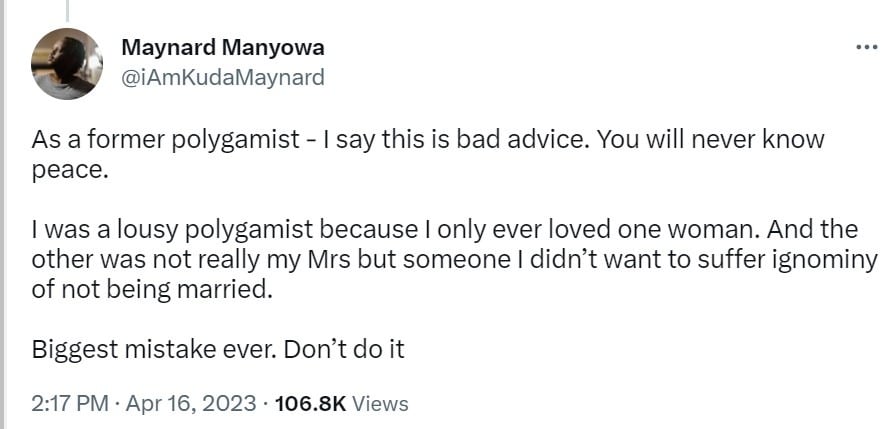
    A journalist identified as Maynard Manyowa, has taken to Twitter to share his biggest mistake and regret in life after marrying two wives.

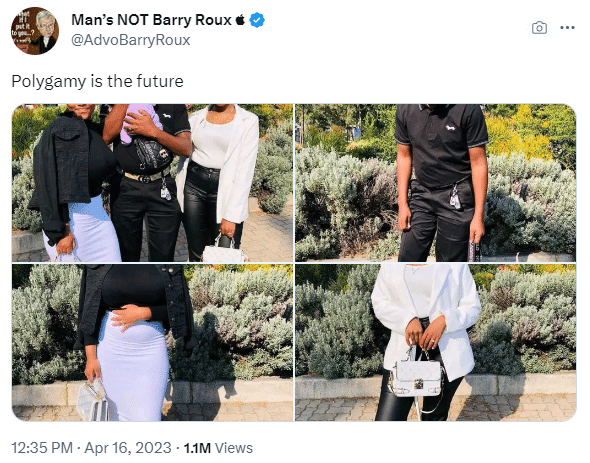
    The man, who described himself as a ‘former polygamist’, made this revelation while reacting to a Twitter post that declared that polygamy is the future of marriage.

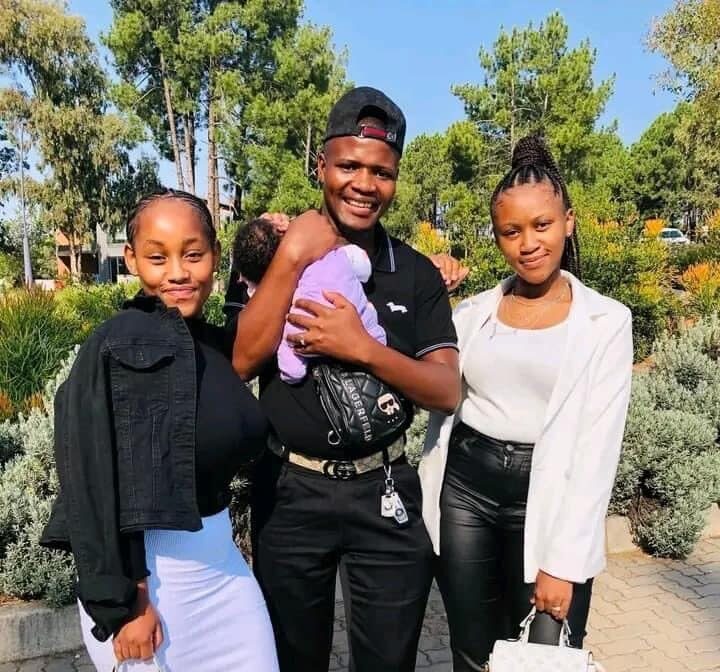
    The polygamist who’s proud of his marriage choice flaunted his beautiful damsels in a series of snaps he shared on the internet which has set tongues wagging.

    Reacting to the photos, the tweep explained that he is not in support of polygamy because of his personal experience with his two wives, and urged men to desist from polygamy otherwise they won’t have a peaceful life.

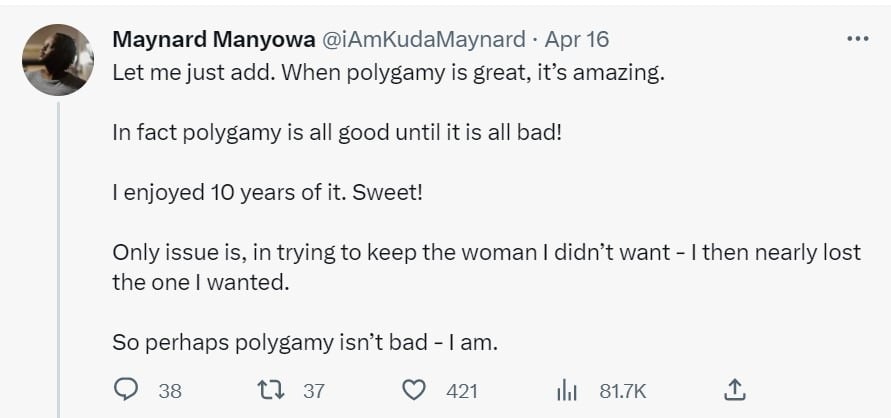
    According to Maynard, he loves his first wife and only married his second wife to save her from the shame of being single.

    However, over time, he almost lost his first wife whom he loved deeply because he wanted to keep his second wife.

  • Prof Gadzekpo bemoans meagre salaries of media practitioners in Ghana

    Prof Gadzekpo bemoans meagre salaries of media practitioners in Ghana

    Professor Audrey Gadzekpo of the Department of Communication Studies, University of Ghana, has bemoaned meagre salaries earned by media practitioners in Ghana.

    Making a strong case for journalists to be well-remunerated to ensure the effective and professional delivery of their mandate, she said the current state of remuneration for journalists was precarious and “shockingly low,” which impacted negatively on the quality of stories they produced, she said.

    “Salaries are woefully low, shockingly low…considering that media work is formal work, and you don’t expect formal work to be so precarious.”

    This forms part of the key findings of the “The State of the Ghanaian Media Report 2023” launched by the Department of Communication Studies, University of Ghana, in Accra, on Wednesday.

    Prof Gadzekpo, a former Dean of the School of Information and Communication Studies, and Chairperson of CDD-Ghana, who presented the Report, charged media owners and managers to improve the working conditions of their staff to enable them to work effectively.

    The Report, among other things, was to determine the financial viability of media organisations in Ghana, and the safety and working conditions of media practitioners.

    It found that the poor recruitment process, which lacked transparency, was a major reason for the poor remuneration of media practitioners in the country.

    “It tends to be who you know, rather than the former advertisement that will go out to say, we have this job available, and therefore, it invites people to apply, and it becomes more meritocratic,” she said.

    “Whereas many earned an average of GH¢500 to 1000 a month, the majority also worked without contracts.”

    One concern was the poor working conditions, generally.

    “The research found that how you came in determines the conditions of service, who brought you in, determines your conditions of service,” Prof Gadzekpo said.

    Most media organisations were under severe financial stress, she said, adding; “At best they are breaking even.”

    On the safety of journalists, she mentioned a growing sense of insecurity among journalists in the country and said even though the violations were a little bit gendered, male journalists were more at risk of physical attacks.

    Even though such attacks were mostly perpetrated by state actors, political appointees, the police, and national security, a significant minority (almost 46 percent) of the attacks were by non-state actors, including political fanatics, foot soldiers, and church congregants.

    Prof Gadzekpo, therefore, recommended the establishment of regulatory frameworks to safeguard the well-being and security of journalists.

    That, she indicated, would prevent political capture of the media and ensure accountability.

    She also called on institutions responsible for frequency authorisation to de-politicize them to make them more transparent.

    “There’s also the important issue of how to address media conglomeration and concentration. The more your media is concentrated, the less diversity there is. So that’s an important recommendation that has been put out in the report,” she added.

    George Sarpong, the Executive Director of, the National Media Commission commended the Department for a good job and said the report would enable policymakers, media owners, managers, and journalists to undertake measures to improve the media profession.

  • Former Indian politician killed on live TV along with his brother

    Former Indian politician killed on live TV along with his brother

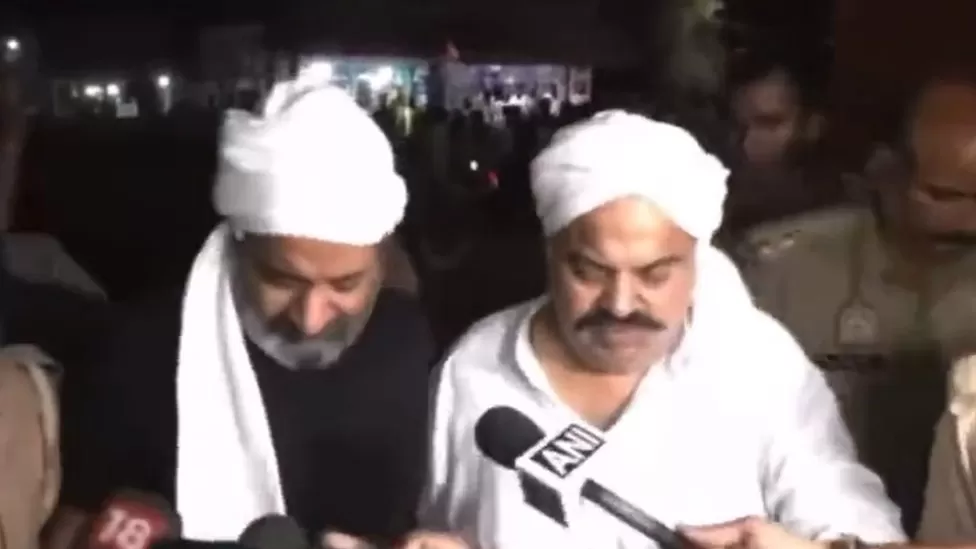
    Live on television, a former Indian politician who had been convicted of kidnapping was shot to death alongside his brother.

    In Prayagraj, better known as Allahabad, Atiq Ahmed, who was being escorted by police, was speaking to reporters when a gun was drawn dangerously close to his head.

    Three individuals who had been pretending to be journalists soon surrendered and were brought into custody after the bullets were fired on Saturday night.

    Ahmed’s teenage son was shot dead by police days earlier.

    Dozens of cases, including kidnapping, murder and extortion, were registered against Atiq Ahmed over the past two decades. A local court sentenced him and two others to life in jail in March this year in a kidnapping case.

    Ahmed had previously claimed there was a threat to his own life from the police.

    Video showed Ahmed and his brother, Ashraf, both in handcuffs, speaking to journalists on the way to a medical check-up at a hospital seconds before they were both shot.

    • Why do Indians vote for ‘criminal’ politicians?

    In the footage, shared widely on social media and TV channels, Ahmed is asked whether he attended his son’s funeral.

    His last words to camera are: “They did not take us, so we did not go.”

    The three suspected assailants had arrived at the site on motorcycles, the police said. A policeman and a journalist were also injured at the scene.

    Following Saturday night’s incident, Chief Minister Yogi Adityanath ordered a judicial probe into the killings and banned large gatherings in the districts of Uttar Pradesh state to ensure peace.

    Experts have raised questions on how a man could be killed in front of the media and the police. BBC Hindi correspondent Anant Zanane reported from Prayagraj that the city was in a lockdown-like situation.

    Who was Atiq Ahmed?

    He had a long stint both in politics and with the criminal world. He was first accused in a murder case in 1979. In the next 10 years, he emerged as a person who had strong influence in the western part of Allahabad city.

    He won his first election as an independent candidate and became a state lawmaker in 1989. He went on to win the seat for two consecutive terms and his fourth win came as a lawmaker from the regional Samajwadi party (SP).

    In 2004, he won a seat in the federal election as an SP candidate and became an MP. Meanwhile, cases continued to be filed against him in Allahabad and other parts of the state.

    Ahmed contested a few more elections in the next decade but lost all of them. In 2019, India’s top court ordered that he should be moved to a jail in Gujarat state after it emerged that he planned attacks on a businessman from a prison in Uttar Pradesh where he was being held awaiting trial in another case.

    He was brought back to Prayagraj in March from Gujarat to appear in a local court as it announced his sentencing in a kidnapping case.

    Ahmed was also brought to the city to be questioned in other cases. His brother Ashraf, who was in a jail in Bareilly district, was also brought to the city to be questioned.

    • Why India’s ‘fake encounters’ are shockingly common

    They were both being questioned in the February murder of Umesh Pal, a key witness in the 2005 murder of Raju Pal, a lawmaker belonging to the regional Bahujan Samaj Party (BSP).

    Raju Pal had defeated Ashraf in the 2004 assembly elections in Atiq Ahmed’s political stronghold.

    Umesh Pal was killed in February this year when several people fired at him.

    Atiq Ahmed’s teenage son Asad and few others were named as the main suspects in the Umesh Pal murder case. Asad and another man were killed by police earlier this week in what was described as a shootout.

    ‘Crime has reached its peak in UP’

    Last month India’s Supreme Court declined to hear Ahmed’s petition in which he alleged there was a threat to his life from the police.

    Uttar Pradesh is governed by the Hindu-nationalist BJP, and opposition parties criticised the killings as a security lapse.

    “Crime has reached its peak in UP and the morale of the criminals is high,” Akhilesh Yadav, chief the opposition Samajwadi Party, tweeted in Hindi.

    “When someone can be killed in firing openly amidst the security cordon of the police, then what about the safety of the general public. Due to this, an atmosphere of fear is being created among the public, it seems that some people are deliberately creating such an atmosphere,” he added.

    More than 180 people facing various charges have been killed by police in the state in the past six years.

    Rights activists accuse the police of carrying out extra-judicial killings, which the state’s government denies.

    The police usually calls them “encounters” – many say these are really staged confrontations which almost invariably end with dead criminals and unscathed police.

  • How bogus copyright claims are putting journalists behind bars

    How bogus copyright claims are putting journalists behind bars

    A recent research claims that the abuse of US copyright law has forced journalists to remove articles that were critical of big oil lobbyists temporarily.

    At least five such articles have been subject to fake copyright claims, including one by the respected South African newspaper Mail & Guardian, according to the Organized Crime and Corruption Reporting Project (OCCRP).

    The claims – which falsely assert ownership of the stories – have been made by mystery individuals under the US Digital Millennium Copyright Act (DMCA), a law meant to protect copyright holders.

    Just last month, three separate false copyright claims were made against Diario Rombe, an investigative news outlet that focusses on Equatorial Guinea.

    The articles under attack are about the president of Equatorial Guinea’s son, Gabriel Mbaga Obiang Lima, and his close associate, Cameroonian businessman and lawyer NJ Ayuk.

    The OCCRP claimed in a report published on Wednesday that the DMCA process was often abused by “unknown parties” who create backdated fake articles to target critical news reports.

    Under the US law, any online author saying that their content has been stolen can seek to have what they claim is the infringing material “taken down” by triggering a formal legal process through web servers who host the material.

    The process differs depending on the server provider, but it can mean content is removed from the web for weeks while the genuine author proves their credentials.

    The OCCRP is yet to discover who is behind the attacks, however all the stories were critical of NJ Ayuk.

    NJ Ayuk, also known as Njock Ayuk Eyong, is the CEO of African law firm Centurion Law Group and the founder of the African Energy Chamber (AEC). He is also an outspoken advocate of the oil industry in Africa.

    Mr Ayuk has a close relationship with the other subject of two of the stories, Gabriel Mbaga Obiang Lima. Mr Obiang Lima was Equatorial Guinea’s Minister of Mines and Hydrocarbons until a recent cabinet reshuffle.

    Man in a suit with glasses and a beard being photographed
    Image caption,Gabriel Mgeba Obiang Lima is the son of Equatorial Guinea’s president

    Mr Ayuk has issued press releases from Centurion Law Group and the AEC which publicly attack journalists criticising his oil lobbying activities and questioning his close relationship with Mr Obiang Lima.

    The first known false copyright claim to target reports on Mr Ayuk was made in 2019, following the publication of an article in South Africa’s Mail & Guardian (M&G) titled Fraudster named in SA’s oil deal.

    The story examined Mr Ayuk’s involvement in an oil deal between South Africa and South Sudan worth hundreds of millions of dollars. It revealed that Mr Ayuk was convicted of fraud in the US in 2007 after pleading guilty to illegally using the stationery and signature stamp of a congressman to obtain visas for fellow Cameroonians.

    After the story was published, the M&G’s web server Linode was contacted by an “Ian Simpson”, claiming he was the original author of the piece. Linode took down the news outlet’s entire website for a morning in response to the complaint.

    M&G investigated and found that the US address given did not exist and that there were no other traces online of this alleged author. M&G concluded that “Simpson” and his article were fakes but Linode forced the newspaper to take down its article about Mr Ayuk before it would restore the rest of the M&G website.

    Writing about the takedown, the M&G called this a “censorship attack”.

    Last November during the UN’s climate summit COP27, UK-based Climate Home News published an article about Mr Ayuk launching a partnership with two UN agencies called UN gives platform to convicted fraudster lobbying for African gas.

    The article highlighted the role of the African Energy Chamber in the UN’s flagship Team Energy Africa private investments initiative and referenced Mr Ayuk’s US fraud conviction.

    The UN cancelled the initiative following the publication.

    Two weeks later, Climate Home News’ server AWS received copyright claims on both articles from “Thomas L Pierce” and “Marcus A Webre”. The OCCRP was unable to trace the complainants, and emails to their provided addresses went unanswered.

    AWS told Climate Home that it might have to take action against Climate Home News unless it could confirm that the matter had been successfully addressed.

    Climate Home editor Megan Darby removed the articles while addressing the false claims with AWS. It took several weeks before Climate Home was able to reinstate the articles.

    Ms Darby told the OCCRP: “These bogus allegations look like a devious tactic to suppress independent journalism.”

    Earlier this year, unknown parties filed three complaints against independent investigative outlet Diario Rombe over articles authored by them. Two were with its server Cloudflare and one with Google. They targeted two 2021 articles published in collaboration with OCCRP which were critical of Mr Ayuk and his relationship with Mr Obiang Lima.

    All three complaints appear to have originated from South Africa. The OCCRP said that it could not establish whether the purported claimants “Lavino Siqueira” and “Mark E Bailey” were real people, and again, emails to their addresses went unanswered.

    Google removed the second article from its search results. It reinstated the piece only after Diario Rombe filed a so-called “counter-notice”.

    Diario Rombe editor Delfin Mocache Massoko said: “These copyright complaints for a small outlet without funds like Diario Rombe do huge damage to our work. I believe that the author has a single mission, to eliminate all negative information about Mr Ayuk and Lima from the internet.”

    When contacted by the BBC, Mr Ayuk strongly denied corruption allegations and said he, the AEC and Centurion Law Group denied the allegations made by the OCCRP including in relation to fake copyright claims.

    Gabriel Mgeba Obiang Lima did not respond to requests for comment at time of publication.

    The OCCRP contacted AWS, Google and Cloudflare for comment on the bogus copyright complaints, but they did not respond.

    Source: BBC

  • Investigative journalists must never use money to lure subjects – Francisca Enchill

    Investigative journalists must never use money to lure subjects – Francisca Enchill

    Francisca Enchill, a multi-award-winning Ghanaian investigative journalist with Corruption Watch, has given her open opinion about entrapment.

    The reigning GJA best investigative and female journalist of the year averred that trapping people with money in an attempt to expose an officer of corruption is totally wrong.

    In an interaction with some student journalists at the Ringway campus of the Ghana Institute of Journalism (GIJ) in Accra on Tuesday, Mrs Enchill said the best way to embark on an investigative report is by natural participation.

    “Professionally, investigative journalists are not supposed to use the entrapment method. Ideally, you need to use the natural participation method,” she noted.

    The author of the ‘Pay or Die’ investigative report explained that corrupt individuals will surely show their true colours even when they are not trapped.

    She stressed that the target may be facing some challenges at home, including an urgent situation for money which may compel the person to accept the bribe.

    “If I’m supposed to investigate an individual or an organisation, I don’t have to trap you with money; I need to let you show it willingly if indeed you are corrupt.

    “If you identify any person or an organisation which you want to investigate, you need to move to them in a natural way by participating, and if they are corrupt as you detected, they will show it to you, but it is totally wrong to trap them because they may be going through certain challenges at that time, including an urgent need for money, which they cannot reject at that time,” she explained.

    In response to another question on whether undercover journalists are free to break certain ethics in their line of work, Mrs Enchill responded affirmatively indicating that it’s for the benefit of the general public.

    “Investigative journalists are legally allowed to break certain rules because it is illegal to secretly videotape someone and publish or to invade their privacy, but our line of work permits us,” she asserted.

  • Rwandan government critic died in road crash – police

    Rwandan government critic died in road crash – police

    Well-known journalist and government critic died in a car accident in Kigali, the country’s capital according to police

    The Chronicles news site editor John Williams Ntwali passed away on Tuesday night when the motorbike taxi he had boarded was struck by a car in the Kimihurura neighborhood. The police informed his brother Emmanuel Masabo.

    In order to confirm the identity of the body in a mortuary, Mr. Masabo claimed that he was contacted by the police on Thursday afternoon.

    “When I arrived, they took me to the mortuary. I saw that it was him and I confirmed to them,” Mr Masabo told the BBC.

    He added: “They did not provide with me more details… maybe they will later. I also had no energy to ask for more [at that moment].”

    The Chronicles news site has also confirmed the death of the 43-year old journalist in a tweet. He had been the publication’s editor since 2021.

    Mr Ntwali was critical of the government and the ruling party in his reports that focused on injustice and social issues facing Rwandans through his YouTube channel, Pax TV-Ireme news.

    Government sympathisers criticised him of being “an extremist” and repeatedly attacked him on social media.

    Journalists and friends have expressed shock over his death.

    He is survived by a wife and a daughter.

  • Media personality Oheneni Adazoa celebrates Christmas with ghetto boys

    Ghanaian media personality and news anchor for TeraOne Media, Oheneni Ama Korankye, popularly known as Adazoa has joined some ghetto brethren in Techiman in the Bono East Region to celebrate the Christmas.

    It is an annual celebration known as “Christmas with Ghetto Boys” organized by Adazoa for the youth in the Techiman Municipality who are primarily restricted to the ghettos.

    The occasion this year took place on Tuesday, December 27, 2022, and the popular journalist gave the ghetto brothers nicely parked hot meals.

    Adazoa spent time with them and gave them a message from God to enable them to reintegrate into society. She counseled them on the need to get back to the society as all hope was not lost.

    When asked what inspired her to start this charitable endeavor, she replied that she wanted to brighten the Christmas season for the less fortunate members of society.

    She continues by pointing out that this is a time of the year when we should be loving and kind to one another.

    Adazoa emphasized that those who live in isolated or segregated places are similar to everyone else, except that they have chosen to limit their freedom as a result of past social issues.

    She urged corporate organizations and individuals to offer love to those who were living in ghettos since, in her opinion, doing so would help reshape them and bring them back into society.

    She noted that interacting with them will encourage them to share their personal struggles and life stories.

    She took the opportunity to express her gratitude to everyone who helped her make this year’s program a success.

    The ghetto brothers thanked Adazoa and her crew for the thoughtful act.

    Below are pictures from Adazoa’s visit to the ghetto:

  • ‘Galamsey Economy’ exposé is part of a vendetta; It’s not about Adu Boahen – Adom-Otchere claims

    Broadcaster Paul Adom-Otchere has questioned the timing of the release of the ‘Galamsey Economy’ exposé by investigative journalist Anas Aremeyaw Anas, which was recorded in 2018.

    In an editorial on his Good Evening Ghana show, Paul Adom-Otchere said that the explanations given by renowned journalist Abdul Malik Kweku Baako Jnr on why the documentary was delayed point to an ongoing fight.

    He hinted that the documentary was not released to fight corruption but to score points against someone he described as a presidential candidate who got hold of the documentary in 2018.

    “It (issues surrounding the documentary) comes out as a major vendetta between two people. It may not even have been about Charles. Now, we are hearing that the fundamental opponent to Tiger Eye, whom we know (a presidential candidate) … in the process of investigating Tiger Eye, probably found the material (the documentary). It is believed that he found this material and shared it with other people… so this material has been in the system since 2019.

    “…so, it looks like the person that Kweku Baako said stole it; he took it and shared it with other people. And as Kweku Baako alleges, somebody (either the person who stole the documentary or another person) was boasting about having the documentary.

    “So, when the Tiger Eye people, whom Kwaku Baako described as owners and authors, found out that they had a copy of the material, they decided to fire it (publish it). So that is the vendetta. At that stage, I’m not sure it is about fighting corruption to support Ghana. It is a personal vendetta,” he said.

    The Editor-in-Chief of the New Crusading Guide newspaper, Abdul Malik Kweku Baako Jnr, explained why his protégé, Anas Aremeyaw Anas, used a video shot in 2018 to expose and cause the dismissal of Minister of State, Charles Adu Boahen.

    The journalist premiered an investigative documentary dubbed ‘Galamsey Economy,’ in which the minister was engaged in acts considered to be of a corrupt nature, whereas he (the minister) also impugned corruption on others, especially Vice President Dr. Mahamudu Bawumia.

    One of the main defenses the sacked minister has advanced is that he was recorded four years ago in the United Arab Emirates but that the journalist is now using the said footage in his so-called investigation.

    Kweku Baako’s explanation was contained in a purported response to a Facebook user by the name of “Kwadwo Yeboah-Gyan.”

    Baako wrote: “Somebody “stole and sold” it to somebody; thinking the evidence had been deleted forever! The “buyer” went out boasting about his possession for years, for whatever reason nobody could tell! Apparently, the real “owners/authors” subsequently discovered an extra copy! Today’s story begins from there. PAY ATTENTION!”

    “Same guy who fabricated a video of Candidate Akufo-Addo receiving a donation from a lady supporter of the NPP in his Nima residence in 2016 when Akufo-Addo was not President but tried to make it look as if he was the President!” he added.

  • Anas’ videos were stolen and sold to ‘noisy’ buyer in 2018 – Kweku Baako reveals

    Abdul Malik Kweku Baako has revealed that undercover footage belonging to investigative journalist Anas Aremeyaw Anas was stolen and sold by an unnamed ally in 2018.

    He explained in a Facebook comment that the very incident was partly the reason why Anas used 2018 footage to expose corruption on the part of Charles Adu Boahen, Minister of State at the Finance Ministry, in his latest exposé titled ‘Galamsey Economy.’

    Baako said the theft coupled with the death of the lead investigator in 2019, that is Ahmed Hussein Suale, impacted the specific investigation, adding further that it was only after backup files had been accessed that the Tiger Eye PI team decided to go ahead with the latest expose.

    Baako wrote about the videos in response to a Facebook comment: “Somebody “stole and sold” it to somebody; thinking the evidence had been deleted forever! The “buyer” went out boasting about his possession for years for whatever reason nobody could tell! Apparently, the real “owners/authors” subsequently discovered an extra copy! Today’s story begins from there. PAY ATTENTION!”

    Today’s story from the above quote refers to a publication in the New Crusading GUIDE’s November 14 edition in which Anas – a co-publisher of the paper along with Baako – wrote about the minister’s deeds and misdeeds.

    The documentary was subsequently screened twice at the Accra International Conference Center, AICC.

    In further explanations on the Facebook wall of a pro-Bawumia activist relative to the alleged footage thief, Kweku Baako explained that it happened to be the same guy (unnamed) who doctored a video of Akufo-Addo allegedly taking bribes in 2016.

    “Same guy who fabricated a video of Candidate Akufo-Addo receiving a donation from a lady supporter of the NPP in his Nima residence in 2016 when Akufo-Addo was not President but tried to make it look as if he was the President!” he explained.

    Baako is also on record to have stated that the Vice President had not been in any way implicated by the documentary just as president Akufo-Addo was not implicated in the Number 12 documentary in which he was mentioned by former Ghana Football Association, GFA, president, Kwesi Nyantakyi; as someone who could be influenced with money.

    Background

    Charles Adu Boahen, Minister of State at the Finance Ministry was implicated in the ‘Galamsey Economy’ investigative documentary released by investigative journalist Anas Aremeyaw Anas on November 14.

    The now dismissed minister was captured on tape making comments to the effect that access by investors to Vice President Mahamudu Bawumia could be facilitated at a cost of US$200,000.

    Bawumia has dispelled the allegations and insisted that his integrity remains his most cherished asset in life.

    “My most cherished asset in life is my integrity and I will not allow anyone to use my name to engage in corrupt activities,” Bawumia said in a post calling for the minister’s dismissal.

    President Nana Addo Dankwa Akufo-Addo has since terminated Adu Boahen’s appointment and referred the contents of the investigation to the Office of the Special Prosecutor.

  • Uproar as Journalist, Kemi Olunloyo calls out Davido and Chioma Rowland for allegedly faking Ifeanyi’s death

    A popular Nigerian journalist and a self- acclaimed investigator, Kemi Olunloyo have called out a popular Nigerian singer, Davido, and his baby mama/fiances, Chioma Rowland for allegedly faking the death of their son and using it for clout chasing.

    Recall that Ifeanyi Adeleke reportedly passed away on the 31st of October 2022 after he drowned inside the swimming pool which is located inside the mansion of his father in Banana Island, Lagos state, Nigeria.

    Meanwhile, while some people have been mourning this loss, many Nigerian as well have kept on spreading rumors that Ifeanyi Adeleke is alive and did not die like it was rumored.

    However, Kemi Olunloyo said that she was called by a lawyer saying that Ifeanyi Adeleke is alive as it has turned into a clout trend. However, she made it known that Chioma Rowland and Davido should be arrested for faking their child’ s death and lying to the police if this turns out to be true.

    Furthermore, Kemi Olunloyo said that she has been seeing people faking death but hasn’ t seen anyone do so with a child. Finally, she laid out some questions saying that Davido should get a spokesperson who should come out and address all these.

    She wrote, ” BREAKING: A prominent Lagos

    The lawyer called me this afternoon to tell me Davido’ s son #ifeanyiisalive. This Clout hashtag has been TRENDING for a week. If it turns out this is true, Davido and Chioma should be PROMPTLY ARRESTED for faking their child’ s DEATH and lying to Police” .

  • Minister: Killing of Pakistani journalist in Kenya was ‘targeted’ attack, minister says

    A Pakistani journalist killed by police in Kenya last month was the victim of a “targeted killing,” according to a senior member of Pakistan’s government, who did not provide any evidence to back up his claim.

    On October 23, television journalist Arshad Sharif, a vocal critic of the Pakistani military, was killed in a police shooting near Nairobi, Kenya.

    Interior Minister Rana Sanaullah told reporters an initial assessment by a two-member fact finding team that traveled to Kenya on behalf of the Pakistani government was “that Arshad Sharif was killed in a case of targeted killing.” More evidence was needed “to confirm all this,” he said.

    Sanaullah’s comments appear to contradict earlier accounts from Kenyan authorities that Sharif was shot dead by police responding to reports of a stolen vehicle in a case of mistaken identity.

    The Pakistani interior minister also accused Kenyan police of “not cooperating” with the fact-finding team, saying “important data” about the case had not been handed over by Kenyan authorities. A formal request to obtain the information had been lodged, he added.

    Kenyan police told CNN they were unaware Pakistani officials had made any allegations about non-cooperation. “We haven’t received any such complaints, which if any, will have to be made formally,” police spokesperson Isohi Shioso said.

    Shioso said the case is being handled by police watchdog the Independent Policing Oversight Authority. CNN has reached out to the watchdog for comment.

    Sharif fled Pakistan in August after sedition charges were leveled against him for allegedly criticizing state institutions and “abetting mutiny” within the military.

    Those allegations followed Sharif’s interview with opposition politician Shahbaz Gill, a close ally of Imran Khan, the ousted former Prime Minister who was shot last week in murky circumstances during a protest rally in Pakistan’s Punjab province.

    Following the interview, Pakistani police also charged Gill with sedition, claiming he had made “anti-state comments.”

    Sharif’s television news channel ARY initially claimed it was “being hounded by the present regime,” but later cut its ties with the journalist after it was taken off air for about a month by Pakistani media regulators.

    Earlier, a close friend of Sharif told CNN the journalist had to “flee Pakistan in August to save his life.” He had initially gone to Dubai but was forced to flee again due to “harassment by Pakistani officials,” the associate said.

    The associate said Sharif then went to Kenya and had only been in the East African country for a few weeks before his death.

  • Anas ordered by Supreme Court to show face without mask in court in Nyantakyi case

    The Supreme Court of Ghana has delivered a damaging blow to Anas Aremeyaw Anas after ordering the journalist to appear in open court without his usual face mask to face Kwesi Nyantakyi.

    The highest ruling body in Ghana ruled on Tuesday morning that the reluctant journalist must appear in court without any face mask covering to testify in the case with the former Ghana FA President.

    Anas, who has been extremely reluctant to appear in court let alone without his mask, will now be publicly seen in court in his real flesh as he testifies in court.

    This comes after the Supreme Court quashed an earlier ruling by a lower court giving permission to Anas to testify in camera.

    The journalist, whose investigation led to Nyantakyi resigning several football posts, claimed his life would be in danger if he testifies in court.

    The order of the High Court 2, Criminal Division granted permission to Anas Aremeyaw Anas to testify on camera in the case against Kwesi Nyantakyi.

    But on appeal by lawyers of Nyantakyi, the Supreme Court ruled in favour of the former football chief and asked Anas to appear in flesh to be cross-examined in open court by Nyantakyi.

    By this decision of the Supreme Court Anas Amereyaw Anas must give evidence in open court.

    Nyantakyi is fighting his case against the controversial journalist in a bid to clear his name.

    The former Ghana FA capo is serving a global ban following the documentary.

    Nyantakyi, who was rising to the very top of global football administration, had to step aside from his roles with Caf including as 1st vice-president, the most senior figure at the confederation after its former president, Ahmad.

    Nyantakyi and other football officials from around the continent were secretly filmed by undercover reporters receiving cash gifts as part of a documentary by controversial Ghanaian investigative journalist Anas Aremeyaw Anas.

  • Philippines’ prison chief responsible for the murder of a journalist says police

    Police in the Philippines have accused the country’s prison service chief of ordering the assassination of a prominent radio journalist.

    Percival Mabasa, 63, was shot dead as he drove to his radio studio in a Manila suburb last month.

    According to officials, he had previously made allegations of corruption against Bureau of Corrections Director General Gerald Bantag.

    Mabasa was also a vocal opponent of former President Rodrigo Duterte.

    Mr Bantag, who is currently suspended from duty, will “probably be the highest official of [the] land ever charged with a case of this gravity”, said Justice Secretary Crispin Remulla, according to an AFP report.

    Police have also filed a murder complaint against his deputy security officer Ricardo Zulueta. The alleged gunman, Joel Escorial, surrendered to authorities earlier in October after his face was captured from security footage.

    Mr Bantag and Mr Zulueta have also been accused of ordering the killing of another prison inmate, who allegedly passed on the kill order to the gunman.

    Mr Bantag allegedly ordered Mabasa’s murder following “the continued expose by the latter against the former on his show”, Eugene Javier of the National Bureau of Investigation told reporters.

    Earlier last month, Mr Bantag, who had been hired by former president Rodrigo Duterte, had reportedly told broadcaster DZRH that he had nothing to do with the killing.

    It will be up to prosecutors at the justice department to decide if there is enough evidence to file charges in court.

    Mabasa, who went by the name Percy Lapid on his radio show, was killed on 3 October – the second journalist to be killed since current President Ferdinand Marcos Jr took office.

    “That the incident took place in Manila indicates how brazen the perpetrators were, and how authorities have failed to protect journalists as well as ordinary citizens from harm,” the National Union of Journalists of the Philippines had earlier said.

    At least 187 journalists have been killed in the past three decades in the Philippines, according to international watchdog Reporters without Borders (RSF).

    RSF ranks the Philippines 147 out of 180 countries on its Press Freedom Index, down nine places from 2021.

  • Philippine prison head charged in connection with the murder of journalist Mabasa

     A radio personality, Percival Mabasa , a who had criticized officials for corruption, was assassinated in October in Manila.

    Philippine authorities have filed murder charges against the country’s prisons chief and others in connection with the assassination of a prominent radio journalist, which attracted international condemnation.

    The charges were filed on Monday against suspended Bureau of Corrections chief Gerald Bantag, prisons security official Ricardo Zulueta, and other key suspects in the October 3 fatal shooting of Percival Mabasa.

    The 63-year-old was killed by two assailants on a motorcycle at the gate of a residential compound in the Las Pinas area of suburban Manila. Mabasa had fiercely criticised Bantag and other officials for alleged corruption and other anomalies.

    A joint statement read at a news conference by top justice, interior and police officials said three gang leaders locked up in the country’s largest prison under Bantag’s control were tapped to look for a gunman to kill Mabasa for a 550,000-peso ($9,400) contract.

    Philippines' Secretary of Interior Benjamin Abalos Jr., (R) gestures with Philippines' Justice Secretary Jesus Remulla (L) during a press conference announcing suspects in the killing of radio journalist Percival Mabasa, at the Department of Justice in Manila on November 7, 2022
    Philippines Secretary of Interior Benjamin Abalos Jr, right, with Philippines’ Justice Secretary Jesus Remulla, left, during a press conference [Ted Aljibe/AFP]

    After the killing, however, the gunman, who was identified by police as Joel Escorial, surrendered in fear after government officials raised a reward for his capture. He then publicly identified an inmate, Jun Villamor, who he said was assigned by detained gang leaders to call him and arrange Mabasa’s killing.

    The gang leaders later killed Villamor inside the prison by suffocating him with a plastic bag allegedly on orders of Bantag and Zulueta, officials said.

    Eugene Javier, a National Bureau of Investigation agent reading the statement said “Bantag had a clear motive to effect the murders … For Percy Lapid, it was the continued exposé by the latter of the issues against the former on his show, Lapid Fire.”

    Bantag has denied any involvement in the killings. He and Zulueta have also been charged for the killing of Villamor. No warrants have been issued yet for their arrests, officials said.

    Mabasa, who used the broadcast name Percy Lapid, is among the latest media workers killed in a Southeast Asian country regarded as among the most dangerous for journalists in the world.

    ‘Good development’

    Jonathan De Santos, chairman of the National Union of Journalists of the Philippines, welcomed the “good development” in the case, but warned there was a long way to go.

    “As we have seen it takes a decade or more to secure a conviction,” De Santos told AFP news agency.

    Aside from Bantag, Mabasa had also strongly criticised former President Rodrigo Duterte, who oversaw a deadly crackdown on illegal drugs. Duterte ended his turbulent six-year term in June.

    Duterte appointed Bantag as Bureau of Corrections chief in 2019 despite pending criminal cases. Bantag had faced charges for a 2016 clash that killed 10 inmates when he was the warden in another detention centre. A court later cleared him.

    Nearly 200 journalists have been killed in the country since 1986, when dictator Ferdinand Marcos was overthrown, according to the journalists’ union. The group led a protest on Tuesday night and called on the government to do more to stop the killings.

  • Senegal arrests journalist and government critic

    A prominent journalist has been arrested in Senegal over accusations that he distributed information liable to harm the country’s security.

    Pape Alé Niang, who runs the news website Dakar Matin, is well-known for his columns on current affairs, which are often critical of the Senegalese government.

    Mr Niang’s lawyer said his client had been detained at the central police station in Dakar on Sunday over three alleged offences.

    Local media say the arrest came after the journalist published recent articles about rape charges against Senegal’s main opposition leader, Ousmane Sonko.

    Source: BBC
  • Prominent Haitian journalist has escaped an assassination attempt

    Roberson Alphonse, a journalist for the daily newspaper Le Nouvelliste and the radio station Magik9, is recovering in a Port-au-Prince hospital.

    Officials said a well-known Haitian journalist survived an assassination attempt in which he was shot in his car while on his way to work in the capital Port-au-Prince on Tuesday.

    According to Frantz Duval, chief editor of both the daily newspaper Le Nouvelliste and the radio station Magik9, Roberson Alphonse has undergone two operations and is currently hospitalized and expected to recover.

    The incident highlights the deteriorating security situation in a country racked by gang violence.

    Haiti’s Ministry of Culture and Communication said it learned “with horror the news of the assassination attempt” that occurred in the Delmas neighbourhood.

    “His rigour, his effort to be impartial, and his sense of perfection make him a model for the profession,” the ministry said in a statement.

    Haiti
    Motorcycle drivers pass through a burning roadblock as anger mounted over fuel shortages that have intensified as a result of gang violence, in Port-au-Prince, Haiti [File: Ralph Tedy Erol/Reuters]

    Many colleagues echoed the sentiment, including Widlore Mérancourt of the online news site AyiboPost.

    “My friend, Roberson Alphonse could be anything he wants anywhere in the world. He picked Haiti. He also could’ve (made) millions selling his platforms. He opted for integrity and independence. I love him and I wish him well,” he wrote.

    Duval thanked an unidentified person he said rescued Alphonse and applied a tourniquet to stop the bleeding before medical help arrived. He noted the car had more than 10 bullet holes.

    Body of another journalist found

    The attack on Alphonse comes just weeks after Haitian leaders requested the immediate deployment of foreign security forces as the country faces an unprecedented crisis.

    Also on Tuesday, authorities found the body of another journalist who had been missing for several days.

    Garry Tess used to host a political talk show in the southern city of Les Cayes, according to the government’s Office of Citizen Protection, which said it was extremely worried about the security of journalists in Haiti and urged they be protected.

    No one has been arrested in either case, although journalists in Haiti have long been the target of warring gangs who have grown more powerful since the July 2021 assassination of President Jovenel Moise.


    Meanwhile, the president of Haiti’s Senate, Joseph Lambert, demanded a judicial investigation.

    The attacks come more than a month after two other journalists identified as Tayson Latigue and Frantzsen Charles were fatally shot and their bodies set on fire while reporting in a slum controlled by gangs.

    In January, gang members killed two other journalists who were reporting in Laboule, a community south of Port-au-Prince.

    The Miami-based Inter-American Press Association says this year has been one of the most violent for the press since record-keeping began in 1987.

    Journalists also are still seeking justice in the March 2018 disappearance of freelance photographer Vladjimir Legagneur, who was last seen in Port-au-Prince’s Grand Ravine, one of its poorest and most dangerous areas.

    Foreign troops

    The government’s decision to seek international security assistance has triggered anger and protests, with Haitians shouting against “foreign occupation” and demanding the resignation of Prime Minister Ariel Henry, who had asked international partners for “the immediate deployment of a specialised armed force, in sufficient quantity” to stop the “criminal actions” of armed gangs across the country.

    One of Haiti’s most powerful gangs surrounded the main fuel terminal more than a month ago, demanding Henry’s resignation as they prevented the distribution of petroleum.

    Gas stations have shut down, banks and grocery stores are operating on limited hours and potable water is becoming scarce as the country battles a cholera breakout that has killed at least 40 people, with more than 1,750 suspected cases so far.

    UNICEF warned on Monday that the actual number of cholera cases is likely much higher, given under-reporting. The agency noted that it has only been able to find a third of the 318,000 litres (70,000 gallons) of fuel needed to serve more than half of 16 cholera treatment centres in Port-au-Prince.

    On Tuesday, the European Union said it was extremely concerned about the deterioration of Haiti’s situation, adding that it has reached unsustainable levels.

    “The EU regrets that as a humanitarian catastrophe unfolds and protests have been co-opted by gangs, escalating into violence, looting and territorial gains for armed gangs, political actors have so far failed to find a political solution to the crisis,” it said.

    “The EU, therefore, urges all political actors to …engage in constructive negotiations to overcome the current political crisis and its security and humanitarian consequences


  • Journalists advised to avoid misinformation

    Country Lead at Dubawa, a fact-checking organisation, has advised journalists to build their skills to avoid misinformation in their reportage and guard against fake news.

    Ms Caroline Anipah urged them to use their core skills and competencies to verify information before publishing.

    Ms Anipa gave the advice during a two-day fact-checking training for journalists in Tamale, supported by the United States (US) Embassy, to enhance their capacity in verifying the authenticity of news stories before publication.

    She said: “When using articles and online sources, be sure to check the website and determine who is providing the information and the motive behind it.”

    Mr Nathan Gadugah, Editor, Ghana at Dubawa, urged the participants to use the tools and resources at their disposal to verify fake news.

    He reminded them to ensure fairness, balance and accuracy in their reportage while keeping their audience informed.

    It was the duty of journalists to endeavour to sort out facts from opinions on subjects from experts, not forgetting to use multiple experts in gathering their news, he noted.

    Dr Abena Animwaa Yeboah-Banin, the Head of Communication Studies, University of Ghana, urged journalists to be guided by the ethics of the profession.

    She said they should be honest and courageous in gathering information and avoid conflict of interest.

    Source: GNA

  • Are people buying cocoa lands for galamsey ‘ghost’ – Kweku Baako to National Security

    Veteran journalist Kweku Baako Jnr has bemoaned the failure of the state’s security apparatus to trace people who purchase lands meant for cultivating cocoa and use them for illegal mining, popularly known as ‘galamsey’.

    According to him, the sale of cocoa lands to ‘galamseyers’ is a crime because, even though the lands belong to the cocoa farmers, the minerals beneath them belong to the state.

    Kweku Baako, who made these remarks in a Peace FM interview monitored by GhanaWeb, said that the failure of the security to find the people who are buying cocoa lands and turning them into ‘galamsey’ sites is very worrying.

    “People are selling lands meant for cocoa lands to galamseyers, other farmers are being driven out by these activities. Both the buyer and the seller I have a problem with but the buyer is where my emphasis is. So if the sellers can be encouraged to tell us who the buyers are, why not.

    “Are the people buying galamsey lands ghost? No, they are not. With a little intelligence gathering, even collaborating with the sellers, these galamseyers can be caught.

    “The point is that even though the land belongs to the farmers the minerals under them belong to the state. So, there is clearly some element of criminality if the farmers are selling the lands to people who are going to dig for the minerals beneath them,” he said.

    The veteran journalist added that even if the cocoa farmers are not willing to cooperate, the security apparatus must be able to gather the needed intelligence to arrest these illegal miners.

    Kwesi Baako made these remarks while reacting to reports that indicated that illegal mining is gradually reducing Ghana’s cocoa production levels.

  • Immigration boss slaps Johnnie Hughes and TV3 with GH¢20m defamation lawsuit

    The Comptroller General of the Ghana Immigration Service, Kwame Asuah Takyi has sued the managers of TV3, Media General over some alleged incidents of defamation.

    The suit which makes GH¢20 million demand in damages also named the host of the morning show on the television network, Johnnie Hughes as a co-respondent.

    According to details of the suit published by Dailyguidenetwork.com, the host on the Johnnies Bite, a segment on the show, made statements that were defamatory to the person of the Immigration Service boss.

    “Comptroller General, you were interdicted in 2013. That is what your officers are saying for the same visa fraud and permit malpractices. As of your 2019/2020 since your directive came, you are bringing all those pets to you. The people are begging to ask questions again. What are you up to? Are you doing something again?

    “They say they don’t understand why you have tried to centralise everything when you have made guilty in the past and went on interdiction. Until 2017, you were interdicted five (5) years.

    “The corruption must stop, Takyi must go” the suit repeated some statements said to have been made by the journalist between August 24 and September 23, 2022, on the programme.

    According to the plaintiff, the journalist by his statements described him as a corrupt official who treats his officers unfairly and poorly and as well uses his office to settle personal issues with other officers.

    Kwame Asuah Takyi also averred that the publication by the journalist has caused right thinking persons to believe he has a questionable character and is unfit to fulfil his mandate as Comptroller General. The plaintiff added that the defendant caused right thinking persons to see him as using his office to enrich himself.

    The allegations by the journalist, according to Mr Kwame Asuah Takyi, are false and calculated to dent his image and lower his reputation in the eyes and minds of right thinking members of the public.

    The plaintiff deems the statement by the journalist to be defamatory and has asked as part of his demands that the defendants are ordered by a court to retract and delete the publication from its various media platforms, websites, archives or records.

    He is also demanding an unqualified apology through the same medium where the statements and publications were made against him.

    In addition, the Immigration Service boss is asking for a reward of GHC20 million in damages as well as an order restraining the defendants or assignees from further publication or causing to be published the said words or any other words.

    Watch the latest episode of The Lowdown below:

    The Lowdown: Role of the diaspora in the development of Africa

    CEO of the Aaron Manvel Foundation Millie Lorene Tucker and Gary Hope, the CEO of FLCC – Bring Back Hope Foundation underscore the need for the African diaspora to help develop the continent in this episode of The Lowdown on GhanaWeb TV. According to the women trying to make and create a change in Ghana, our forefathers were sold away and made to develop strange lands. Thus, coming back home and developing their home country is the best thing to do especially when resources are available.

  • ‘Deportation from US’ publication: Presidential staffer threatens legal action

    Charles Nii Teiko Tagoe has threatened legal action against Editor of The Herald Newspaper, Larry Dogbey, over a story he inists is defamatory.

    In the said story, Larry Dogbey alleged that Teiko Tagoe had been arrested in the United States and deported to Ghana despite using a diplomatic passport.

    The Herald story read in part: “Mr Tagoe, had posted a picture of himself on Facebook on September 14, 2022, with his leg on a chair moments before boarding the plane at Kotoka International Airport’s Terminal 3.

    “His 5:33 am post and picture was with the caption “If you know, you know. Good morning #Minister4Happiness, Nana Yaw Kesse. Gone in 60 seconds…”

    “But shortly upon arriving in the US, he was picked up and shoved into another aircraft and sent back to Ghana like a common criminal, despite his diplomatic passport. It is not clear, if he was handcuffed or chained to his seat.”

    It added that their sources said Tagoe was directed to deal with the US embassy for clearance before he attempts reentry into the US.

    In his first response to The Herald, the head of new media at the presidency stated that he did not use a diplomatic passport and hadn’t been deported as the report stated.

    “My attention has been drawn to a Herald Publication alleging my deportation from the United States despite using a diplomatic passport.

    “I wish to state that I do not use a diplomatic passport and there is absolutely no truth in the story. I have referred the Herald Newspaper and its Editor Larry Dogbey to my Solicitors for the necessary legal action,” he posted on Facebbok.

    The journalist in responding to the threat, added supposed travel details suggesting that the presidential staffer spent less than a day in the United States before returning to Ghana via a direct flight.

    “Charles Nii Teiko Tagoe ..I didn’t know it was this easy to get you talking. You left Ghana on Tuesday 13th September 2022 onboard KLM through Schipol Amsterdam to New York.

    “You returned the next day Wednesday 14th September 2022 by a direct flight from New York to Accra onboard Delta Airlines. You wanted to come back onboard same KLM through Schipol on Wednesday, 21 September 2022.

    “Who buys a ticket for nearly UD$10,000 to see New York City through the windows of an airport? Waiting for your lawyers. Regards to your wife….” Larry Dogbey replied via Facebook.

    The presidential staffer offered another clarification on his Facebook wall: “So I arrived at John F Kennedy International Airport on Delta Airlines flight DL 047 from Amsterdam and I was arrested and deported at Dallas, Texas International Airport, onboard a United Airlines according to Larry Dogbey and The Herald Newspaper? We shall meet very soon wai.”

  • Journalist detained for recording Court hearing discharged

    Sacut Amenga-Etegu, a freelance journalist who was arrested for allegedly recording proceedings in court has been discharged.

    This was after he was arraigned before the criminal division 5 of the Accra High Court.

    The National Security Minister denied earlier reports the journalist was picked up and detained by its officials.

    He was detained following the court order on Thursday February 24,2022.

    Background:

    The Court presided over by Her Ladyship, Lydia Osei Marfo, before detaining him said that the freelancer “could be a security threat to the Court [Criminal Court 5] and the Court Complex at large, if not the whole country.”

    Per the Court records, Justice Marfo said she heard noise outside her courtroom as she was calling a case for trial.

    According to Her Ladyship, what she heard “on the corridors of this Court were not ordinary noise” prompting her to cause her Court Warrant Officer (CWO) to investigate.

    Detective Inspector Dometi Wisdom, from the National Security, upon being summoned by the Court, narrated to the Court how Sacut was spotted attempting to take a video of the National Security operatives and the accused persons while they were leaving the Courtroom.

    Source: Starrfm.com.gh