Tag: JP Morgan

  • JP Morgan cuts over 1,000 jobs

    JP Morgan cuts over 1,000 jobs

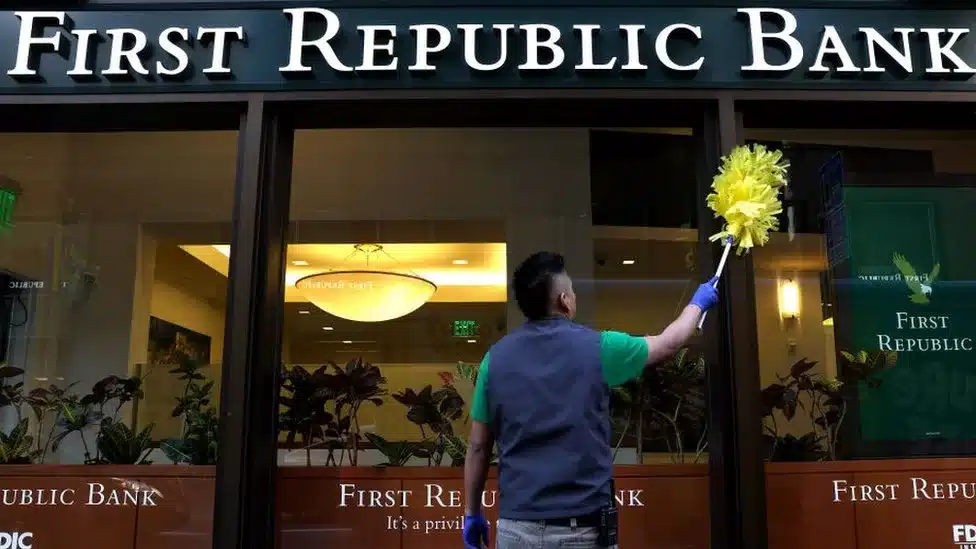
    JP Morgan Chase, the prominent Wall Street institution, is implementing job cuts at recently acquired First Republic Bank, which faced financial difficulties. Approximately 1,000 positions, equivalent to 15% of First Republic’s workforce, will be eliminated, according to sources familiar with the matter.

    This week, First Citizens, the buyer of another struggling financial institution’s US unit, also announced job reductions.

    Earlier this year, concerns arose about a potential broader crisis when problems emerged within US regional banks.

    JP Morgan confirmed the job cuts but did not disclose the exact number of positions affected. Affected employees will receive 60 days of pay and benefits, along with a comprehensive severance package including a lump sum payment and other perks.

    JP Morgan further expressed its commitment to assisting affected employees in finding new roles either within the company or externally.

    “Since our acquisition of First Republic on May 1, we’ve been transparent with their employees and kept our promise to update them on their employment status within 30 days,” a JP Morgan spokesperson said in a statement.

    “We recognise that they have been under stress and uncertainty since March and hope that today will bring clarity and closure,” the spokesperson added.

    First Republic, which was known for its big home loan business and stable of wealthy clients, was the 14th largest lender in the US at the end of last year. It was worth more than $20bn (£16.2bn) at the beginning of April.

    However, it came under pressure after the collapse of several lenders in the US, including the technology-focused Silicon Valley Bank (SVB), sparked fears about the state of the banking system.

    Later in April, First Republic said it had lost around $100bn in deposits as customers moved to withdraw their funds.

    Earlier this month, JPMorgan said it would pay $10.6bn to take over First Republic in a deal brokered by regulators.

    In the wider market, there were also concerns about the value of bonds held by banks as rising interest rates made those bonds less valuable.

    The failure of First Republic is the second-largest in US history. Earlier this month, the bank’s 84 offices in eight states reopened as branches of JP Morgan Chase Bank after regulators seized control and sold it to the Wall Street institution.

    Meanwhile, SVB’s US operations were taken over by First Citizens, as its business in the UK was bought by by London-headquartered banking giant HSBC.

    First Citizens is also planning to cut around 500 roles held by former SVB workers, the BBC understands.

    In an email seen by the BBC this week, First Citizens’ chief executive Frank Holding highlighted the problems faced by SVB earlier this year and said the cuts will affect: “select SVB corporate functions and do not include any personnel in client-facing positions.”


  • JP Morgan to take over major US bank

    JP Morgan to take over major US bank

    First Republic‘s collapse on Monday was verified by the Federal Deposit Insurance Corporation (FDIC) in a statement.

    Investment banking giant JP Morgan will now take on “all of the deposits and substantially all of the assets of First Republic Bank”.

    First Republic becomes the third major US bank to collapse in recent months.

    The San Francisco-based lender’s shares fell by more than 75% last week after it admitted that customers had withdrawn $100bn (£79.6bn) of deposits in March.

    It follows on from the collapse of Silicon Valley Bank (SVB) in March, which prompted fears of a wider banking crisis.

    That was swiftly followed by the demise of another US lender, Signature Bank.

    A deposit flight from lenders has forced the Federal Reserve, the US central bank, to step in with emergency measures to stabilise financial markets.

    In March, a group of America’s biggest banks stepped forward to pump $30bn into First Republic in a bid to stabilise the business, but the efforts proved futile.

    Founded in 1985, First Republic is a mid-sized US lender, similar to SVB.

    For years, it has catered to wealthy clients – whose money was at risk before the takeover was announced after a weekend of negotiations.

    In the US, FDIC insures customer deposits up to $250,000.

    When Silicon Valley Bank and Signature collapsed, the FDIC said it would guarantee all deposits to prevent a rush of people trying to get their money out, which is known as a run on a bank.

    As part of the First Republic agreement, it will share losses on loans with the JP Morgan. The FDIC has estimated that its insurance fund would take a hit of about $13bn in the deal.

    First Republic’s 84 offices across eight states will also reopen as branches of JPMorgan Chase.

    In Europe, banking giant Credit Suisse was bought by rival UBS in March, in a deal orchestrated by Swiss authorities.

    As central banks around the world raised interest rates aggressively to dampen the rate of price rises, otherwise known as inflation, some lenders have come under pressure.

    Increased interest rates have hurt the values of the large portfolios of bonds bought by banks when rates were lower.

  • Ex-Barclays CEO accused of receiving photos of Young Women from Jeffrey Epstein

    Ex-Barclays CEO accused of receiving photos of Young Women from Jeffrey Epstein

    Unredacted court filings have shed more light on the relationship between Jeffrey Epstein and former Barclays executive Jes Staley.

    According to the Guardian, the newly unsealed documents allege Staley exchanged more than 1,200 emails with the convicted pedophile between 2008 and 2012. Some of those conversations included cryptic references to Disney characters, such as Snow White and Beauty and the Beast. The correspondence was outlined in a lawsuit filed by the United States Virgin Islands against Staley’s former employer JPMorgan Chase.

    According to the complaint, the men would communicate about “women who they referred to by the names of Disney princesses that Epstein [allegedly] procured for Staley.” The suit also alleges Epstein had “emailed Staley photos of young women in seductive poses.”

    “In July 2010, Staley sent an email to Epstein, saying: ‘Maybe they’re tracking u? That was fun. Say hi to Snow White.’” the suit read. “Epstein responded: ‘[W]hat character would you like next?’ When Staley said ‘Beauty and the Beast,’ Epstein replied: ‘well one side is available.’”

    About seven months earlier, Staley allegedly messaged Epstein to tell him he was “deeply” appreciative of their friendship, which he described as “profound.” In December 2009, he reportedly told Epstein it was great to give him “a long, heartfelt hug.” The late financier allegedly responded to the message by sending two pictures of young women.

    Staley is also accused of visiting Epstein’s private island in the USVI, where most of his sex crimes allegedly took place. The USVI government sued JPMorgan Chase in late 2022, claiming it had “direct and actual knowledge” of Epstein’s crime and allowed him to use the bank to facilitate sex-trafficking activities.

    Staley has denied the allegations.

    “We wish to make it expressly clear that our client had no involvement in any of the alleged crimes committed by Mr. Epstein, and code words were never used by Mr. Staley in any communications with Mr. Epstein, ever,” his lawyer Kathleen Harris previously said.

    Source: Complex.com

  • Ghana’s debt restructuring to further weaken cedi – JP Morgan warns

    JP Morgan, a leading global investment bank and provider of financial services, has issued a warning that Ghana’s proposed debt restructuring initiative may worsen the position of the local currency.

    The US-based company claims that the trend may be significant even if Ghana’s central bank temporarily tightens or loosens its foreign exchange (FX) purchasing strategy in order to support the cedi.

    In a recent Emerging Market Quick Take article on the Ghana Cedi’s performance, JP Morgan ascribed the loss to the Bank of Ghana’s decision to buy dollars from mining and oil businesses, which unintentionally decreased the amount of foreign exchange available in the inter-bank market.

    The global investment bank further attributed the loss of confidence in the domestic economy, which it believes has drained FX reserves and resulted in volatility.

    “The cedi has now weakened by around 60% against the US dollar this year, as uncertainties about the need for, and extent of, debt restructuring increased. The drain of FX reserves year-to-date means the Bank of Ghana (BoG) now has limited firepower to smooth FX volatility.”

    It continued, “However, we believe the main trigger for the move to 14.875 (mid) in spot over recent days can be traced to BoG’s decision to purchase dollars from mining and oil companies, inadvertently reducing FX availability within the inter-bank market.”

    JP Morgan added that, “Although the current account deficit (CAD) is only moderately wider, the loss of confidence domestically has resulted in a significant drain from the financial account, even though portfolio outflows have been relatively limited.”

    “Based on our risk-reward scorecard, Ghana now looks attractive, but we expect concerns about the scope of debt restructuring to continue dominating, potentially leading to even more GHS weakness, even if an increase in FX forward auction sizes or reversal of the FX purchase policy results in short-term respite for the cedi”, it explained.

    Further touching on the Bank of Ghana’s decision to purchase dollars from mining firms, JP Morgan said the move has rather resulted in a squeeze and increased pressure in the FX market.

    At the present, the BoG has not increased the size of the fortnightly FX forward auctions and continues to issue at $25 million although demand has reached $100 million per auction.

    “To reduce volatility, we believe the BoG may need to use proceeds from mining sector FX purchases to increase interventions, or alternatively, reverse the FX purchase policy. Since the policy was implemented, the central bank reports that it had purchased around $84 million as at end-September [2022] and expects to have purchased $500 million by year-end,” JP Morgan advised.

  • Debt restructuring not suitable to check falling cedi caused by BoG – JP Morgan

    Global leader in financial services and US firm, JP Morgan is against a restructuring of Ghana’s debt.

    According to the US firm, such an initiative would further weaken the Ghana cedi, even when an increase in Foreign Exchange Forward Auction sizes or reversal of the foreign exchange (FX) purchase policy results in short-term respite for the cedi.

    JP Morgan further noted that the Bank of Ghana is responsible for the decrease in value of the local currency.

    It argued that the cedi has fallen because of the B central bank’s decision to purchase dollars from mining and oil companies, inadvertently reducing forex availability within the inter-bank market is one of the reasons behind the falling value of the cedi.

    It also said the loss of confidence domestically has resulted in a significant drain from the financial account, even though portfolio outflows have been relatively limited.

    “The cedi has now weakened by around 60% against the US dollar this year, as uncertainties about the need for, and extent of, debt restructuring increased. The drain of FX reserves year-to-date means the Bank of Ghana (BoG) now has limited firepower to smooth FX volatility. However, we believe the main trigger for the move to 14.875 (mid) in spot over recent days can be traced to BoG’s decision to purchase dollars from mining and oil companies, inadvertently reducing FX availability within the inter-bank market.”

    “Although the current account deficit (CAD) is only moderately wider, the loss of confidence domestically has resulted in a significant drain from the financial account, even though portfolio outflows have been relatively limited. Based on our risk-reward scorecard, Ghana now looks attractive, but we expect concerns about the scope of debt restructuring to continue dominating, potentially leading to even more GHS weakness, even if an increase in FX forward auction sizes or reversal of the FX purchase policy results in short-term respite for the cedi”, it added.

    Furthermore, it pointed out that the Bank of Ghana’s purchase of dollars from mining companies has resulted in a squeeze in the FX market, adding, while the new FX purchase policy is only a few months old, it has shifted FX away from the secondary market, thus resulting in increased FX pressure.

    In the meantime, the Central Bank has not increased the size of its fortnightly FX forward auctions, where it continues to sell $25 million, despite receiving demand amounting to $100 million per auction.

    “To reduce volatility, we believe the BoG may need to use proceeds from mining sector FX purchases to increase interventions, or alternatively, reverse the FX purchase policy. Since the policy was implemented, the central bank reports that it had purchased around $84 million as at end-September [2022] and expects to have purchased $500 million by year-end”.

    Change in FX policy to provide some relief in near-term

    Continuing, the US banking giant said the recent volatility of the cedi is mostly policy driven, but medium-term pressure to persist

    However, it stressed that a change in FX purchase policy could provide some near-term relief.

    It also said the FX reserves have been drained at a breath-taking pace, noting, “Gross international reserves have declined to $6.6 billion as at end-September, from $9.7 billion at the start of the year. However, net reserves have declined at a faster pace, reaching $2.7 billion in September [2022], from $6.1 billion in January’.

    At that pace, JP Morgan said gross reserves will have declined to $5.6 billion by the end of this year ($1.6 billion for net reserves), although disbursement of the $1.1 billionCocobod syndicated loan should provide a boost to FX reserves.