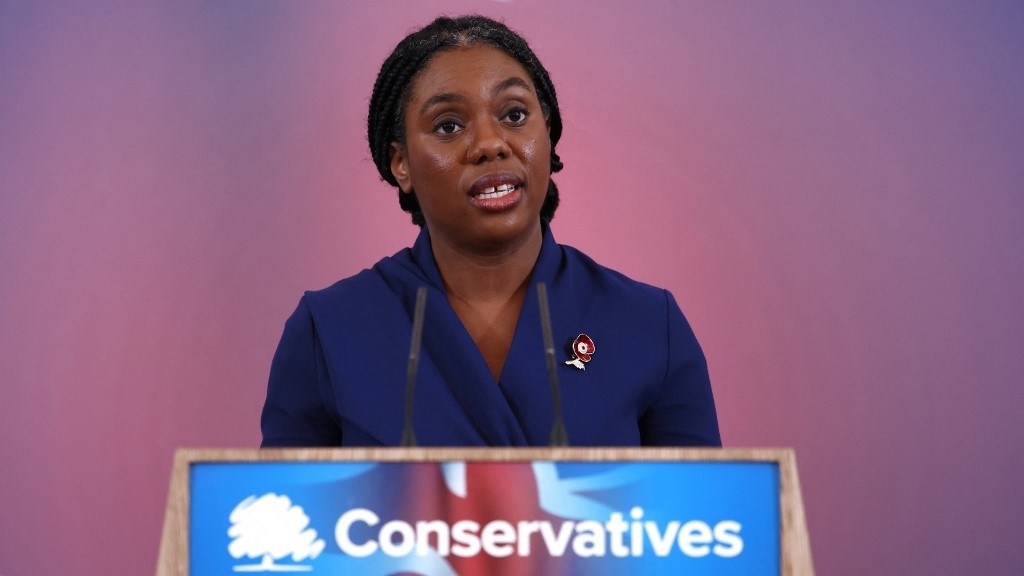
British Conservative Party leader Kemi Badenoch has described reparation demands as exploitative, arguing that calls for financial redress from the United Kingdom are attempts to manipulate guilt over colonial history.
While acknowledging the British Empire’s flaws, she emphasized the importance of recognizing its positive contributions as well. Badenoch suggested that the British Empire’s role in abolishing the Atlantic slave trade should be more widely discussed.
In a GB News debate in October, then Conservative leadership candidates Robert Jenrick and Kemi Badenoch shared their views on the demand for reparation by some African countries.
Kemi Badenoch dismissed calls for reparations as misguided and said people in former colonies may not view Britain as negatively as some left-leaning critics suggest but urged the UK to consider how it could assist other nations in meaningful ways moving forward.
“There are many things the British Empire got wrong. But there are many amazing things the British Empire also did and we need to be honest about that and stop pretending that it was all bad. The British Empire ended slavery, the Atlantic Slave Trade. We need to talk about that more.
“I grew up in a Commonwealth country. Many people in these countries don’t normally carry the barrage that a lot of the left-leaning comments want to put on our country. We need to look at how we can help other countries best as they can. We did a lot to help those countries, we can do more again. I would like to see that but the answer is no reparation.
“We don’t need to be embarrassed by our colonial past. Every country in this world, at one point or the other either colonised or attempted to colonise another group of people. This is the past, we need to talk about the future. There are many countries now who want to use guilt to try to exploit the UK. They ask for reparation. I saw it as Trade Minister. I was at the WTO, I wouldn’t want to name the Minister from another country but he was telling me that we needed to give up some of the things we were doing because of colonialism and because they needed time to develop. These arguments are a scam. Don’t fall for it. We need to make sure that we put this country first,” she said.
The 44-year-old is now the first black woman to lead a major political party in the UK after fellow right-winger Robert Jenrick, 42, by 12,418 votes following a marathon contest to replace Rishi Sunak, who led the party to the biggest defeat in its history in July’s general election.
African and Caribbean countries have called for paying reparations or making other amends for slavery during the trans-Atlantic slave trade.
Per reports, from the 15th to the 19th century, at least 12.5 million Africans were kidnapped and forcibly transported by European ships and merchants and sold into slavery. Those who survived the brutal voyage ended up toiling on plantations under inhumane conditions in the Americas, mostly in Brazil and the Caribbean, while European settlers and others profited from their labour.
Ghana then Gold Coast was colonised by the British in the late 19th century. Ghana gained independence from Britain in 1957, becoming the first sub-Saharan nation to break free from colonial rule.
Ghanaian President Nana Akufo-Addo has indicated that financial reparations are long overdue to Africans and the diaspora as compensation for the enslavement of people of African descent.
“No amount of money can restore the damage caused by the transatlantic slave trade. But surely, this is a matter that the world must confront and can no longer ignore.”The entire period of slavery meant that our progress, economically, culturally, and psychologically, was stifled. There are legions of stories of families who were torn apart. You cannot quantify the effects of such tragedies, but they need to be recognised,” President Akufo-Addo said at the launch of a four-day reparations conference in Accra in November last year.
Delegates at the reparations summit agreed to establish a Global Reparation Fund to push for overdue compensation for millions of Africans enslaved centuries ago during the trans-Atlantic slave trade.
The United Nations has indicated that countries could consider making financial payments among other forms of compensation, but cautioned that legal claims are complicated by the time passed and the difficulty in identifying perpetrators and victims.
Activists such as the Director of the U.S.-based Reparation Education Project, Nkechi Taifa, have said reparations should go beyond direct financial payments to also include developmental aid for countries, the return of colonized resources and the systemic correction of oppressive policies and laws.