Tag: Kenya

  • Kenya records first coronavirus death

    Kenya has registered its first death from the coronavirus (Covid-19), the health ministry announced on Thursday.

    In a statement, Health Minister Mutahi Kagwe said that the victim was a 66-year-old Kenyan man and had a long-term health condition.

    “We have received the sad news of the death of first patient who had tested positive for coronavirus,” said Mr Kagwe.

    He had arrived into the country from South Africa through Eswatini on March 13.

    The patient died at the Aga Khan Hospital intensive care unit in the capital Nairobi on Thursday afternoon.

    Kenya has confirmed three more cases of coronavirus, raising the national tally to 31.

    Source: theeastafrican.co.ke

  • Germany not paying for masks ‘stolen in Kenya’

    The German authorities have said they do not have to pay for the six million face masks the government ordered but that went missing from an airport in Kenya.

    The shipment was due in Germany on March 20 but never arrived after disappearing at the end of last week, Germany’s Der Spiegel magazine reported.

    The German embassy in Kenya tweeted on Thursday that they had agreed to pay upon delivery so they would not be paying.

    The statement embedded in the tweet added that the supplier had not given them a reason why they had not delivered.

    Source: bbc.com

  • Worship in churches and mosques suspended in Kenya

    Religious leaders in Kenya have suspended worship in some churches and mosques after the country confirmed seven coronavirus cases.

    The Presbyterian Church of East Africa, All Saints’ Cathedral of Anglican Church, Christ is the Answer Ministries, Kenya Assemblies of God and the Nairobi Chapel have suspended congregational worship.

    All the five churches said they would live stream Sunday services on social media platforms.

    The Presbyterian Church and Anglican Church urged congregants to cancel upcoming weddings or opt for short ceremonies with less people in attendance.

    Church-related meetings have also been stopped in line with President Uhuru Kenyatta’s directive that banned all public gatherings as a precaution to prevent the spread of coronavirus.

    The Jamia Mosque in the capital, Nairobi, announced that it was stopping all congregational prayers.

    Source: bbc.com

  • Kenyas coronavirus cases rise to 7

    Kenya has confirmed three more cases of coronavirus, bringing the total to seven.

    Health Minister Mutahi Kagwe said all the cases the patients had arrived from abroad.

    The latest cases involve a couple who had travelled from Spain’s capital, Madrid, through Dubai, arriving on 5 March.

    The other involved a Burundian national, who arrived from Dubai on 17 March and was isolated after being found to have a high temperature at Kenya’s main airport in the capital, Nairobi.

    Mr Kagwe said the authorities were tracing all the people who came into contact with the three latest cases.

    Last week, Kenya blocked entry to all travellers coming from countries with reported cases, but Kenyan citizens, diplomats and foreigners with valid residence permits are allowed in.


    Source: BBC 

  • Coronavirus: Nairobians stock up on supplies

    The announcement of Kenya’s first confirmed case of Covid-19 caused by coronavirus has caused anxiety in the country.

    The authorities said the patient – a Kenyan citizen who arrived in the country on 5 March from the US – was receiving treatment and that those she had been in contact with have been traced.

    Despite also reassuring the public that measures to deal with an outbreak had been put in place, some people have chosen to stock up on supplies.

    A tweeter has shared this video of a packed supermarket in the capital Nairobi.

    Source: bbc.com

  • Kenya confirms its first coronavirus case

    Kenya has confirmed that a woman has tested positive for Covid-19.

    Health Minister Mutahi Kagwe said she had arrived from the US on 5 March and tested positive for the virus on Thursday.

    She had travelled from the US, transiting in London without leaving the airport.

    The minister said the patient was now stable and eating, adding that her fever had gone down.

    She would be kept in isolation until she tested negative, he said.

    Kenya’s Citizen TV tweeted a video of the minister’s statement:

    Source: www.bbc.com

  • Kenya bans government employees from travelling

    Kenya’s government spokesperson Cyrus Oguna announced a ban on Thursday of all non-essential travel by public servants and advised citizens not to travel to avoid contracting coronavirus.

    Mr Oguna also said the government was still implementing a self-isolation requirement for Kenyans and other travellers arriving from affected countries.

    He said the new directives were issued after President Uhuru Kenyatta had met the committee established to co-ordinate preparations for the possible spread of coronavirus.

    Here is the government spokesperson’s statement:

    Kenya confirmed its first coronavirus case on Friday. The patient is a woman who had travelled home from the US last week.

    Source:www.bbc.com

  • Kenya suspends all public gatherings over coronavirus

    The Kenyan government has suspended all public gatherings following the confirmation of the country’s first case of coronavirus.

    The minister of health, Mutahi Kagwe, said church services will continue but churches must provide hand-sanitisers.

    Mr Kagwe said schools will remain open but there will be no inter-school activities.

    He added there should be “no cause for alarm” but urged for “serious citizen responsibility”.

    The health minister said rapid-response units will be dispatched to respond to any suspected cases in the country.

    He urged member of the public to observe personal hygiene, and transport operators to regularly clean their vehicles.

    Kenya’s NTV tweeted a video of part of the minister’s statement:

    Source: www.bbc.com

  • Quarantined foreigners declared virus-free in Kenya

    Health authorities in eastern in Kenya have given the all-clear to 12 foreigners who had been quarantined for 15 days as a precaution against coronavirus.

    All 12 arrived in Machakos county, east of the Kenyan capital Nairobi, from China last month and were required to self-isolate on arrival.

    Kenya has no confirmed cases of coronavirus.

    Machakos Governor Alfred Mutua confirmed the news in a tweet:

    Source: bbc.com

  • Kenya: Teenage pregnancies on the rise as report calls for stern action

    Kenya is facing a serious teenage pregnancy crisis according to a report released by a government agency Monday.

    One in five girls aged between 15 and 19 are pregnant according to the National Council on Population and Development (NCPD) report titled Teenage Pregnancy Situation in Kenya and that was released in a Nairobi hotel.

    Narok County leads the list of shame with 40 percent of girls (two in every five) pregnant followed by Homa Bay (33 per cent), West Pokot (29 per cent), Tana River and Nyamira (28 per cent).

    The Narok figures are double the national average of one in every five girls being expectant.

    Antenatal clinic

    At six per cent, Murang’a County has the lowest rates followed by Nyeri (seven percent), Embu (eight percent), Elgeyo Marakwet (nine percent) and Nyandarua (10 percent).

    The worrying situation is an indication of trends having remained largely unchanged despite efforts by the government, child rights activists and non-governmental organisations to reduce the incidence of minors becoming pregnant.

    In 2018, the National Aids Control Council reported that 430,825 teens aged between 10-19 attended at least one antenatal clinic session in a public health facility.

    In 2019, the figure dropped considerably to 379,573 but serious concerns remain over the relatively high numbers of minors engaging in unprotected sex with young and old men.

    A total of 20,828 teenagers aged between 10 and 14 years were recorded as having visited health facilities for antenatal care.

    Among the expectant teenagers aged between 10 and 14 years, Nairobi led with 2,432, followed by Nakuru with 1,748, Kajiado (1,523), Kericho (1,006), Homa Bay (957) and Garissa (901).

    Fistula

    On the other hand, only 14 teenagers from Isiolo County were pregnant, as compared to Lamu (22), (Embu (25), Kilifi (53), and Elgeyo Marakwet (59).

    The scenario rapidly shifted as the report looked at older girls, with Nairobi recording 24,106 pregnant girls aged between 15 and 19 years. Nakuru was next with 17,019 followed by Meru (15,353), Narok (14,052), Bungoma (13,920), Kiambu (13,128) and Trans Nzoia (11,687).

    Counties with the lowest number for pregnant teens aged between 15 and 19 were Lamu (1,285), Embu (2,126), Wajir (2,684), Isiolo (2,851) and Nyeri (2,508). Presenting the figures, assistant director of population Lucy Kimondo said many of the girls ended up severely depressed with some committing suicide.

    “There is also a very high rate of fistula among these girls. Imagine a 10-year-old girl trying to push a baby during birth,” she said.

    Sexual violence

    Ms Kimondo identified sexual violence as major driver for the crisis, saying a girl younger than 18 cannot consent to sex.

    The Sexual Offences Act prohibits adults from engaging in sex with minors, with jail terms ranging from life to 15 years for those found guilty of the offence. The vice has however remained rampant in the country, with a low conviction rate in courts for most suspects charged with sexually violating minors.

    According to the report, some of the causes of teenage pregnancy in the country include poverty, peer influence, drug abuse, lack of youth-friendly services in health facilities, early marriage, rape and defilement.

    The NCPD blamed poor parenting and an education system that has ignored the need to make teenagers aware of their sexuality. Among the reasons listed in the report are “inadequate parental and curriculum guidance”.

    Suicide

    The document that paints a worrying picture of a country that prides itself as having made strides in education, economic growth, technology and democratic governance still grappling with the prospect of its young citizens becoming parents before completing their education.

    The NCPD lists some of the consequences of teenage pregnancy as depression, suicide, abortion, interrupted schooling, poor maternal health, morbidity and death, birth-related complications like fistula, and early marriages.

    “An estimated 26 per cent of teenagers in poor households are likely to fall pregnant compared to 10 per cent of their peers in wealthier households,” the document says.

    A 2016 report by the Faith to Action Network in Kilifi County identified “cultural practices such as dances and funeral attendance where the girls have no parental presence as making them susceptible to early sexual debut”.

    “Poverty drives young girls to work as sex entertainers to earn a living … including food, clothing and electronics, leading to pregnancies,” the Kilifi study said.

    Source: allafrica.com

  • Four Kenyan senators stranded in Germany spending all their travel allowances

    According to the People Daily, four Kenyan senators are reportedly stranded in Berlin, Germany for lack of fare.

    Reports say that the four had traveled to the European nation for an annual trade conference which was slated to kick off on Monday but was canceled due to the Coronavirus.

    The four, who have been identified as Charles Kibiru (Kirinyaga), Loitiptip Anuar (Lamu), Christopher Langat (Bomet) and Mwangi Kithomi (Nyandarua), had spent all their per diems before leaving Nairobi.

    Four Kenyan Senators Stranded In Germany

    And to make matters worse for the Senators, the hotel they had already booked in the city turned down their request for a refund.

    However, Senate speaker Ken Lusaka rubbished the claims saying the four are held up in Germany due to the limited flights to Nairobi.

  • Family exhumes man’s body ‘to pack in his cigarettes’

    A Kenyan family has exhumed the body of a relative to honour his wish to be buried with a pack of cigarettes and his favourite sweets, private television station NTV has reported.

    The family of Kenga Kalama, who died aged 63, also went against his wishes by burying him in a coffin.

    This caused his spirit to “complain of being unable to roam freely because of the coffin”, according to a relative interviewed by NTV.

    So, two months after Kalama’s burial, they have reburied him in accordance with his wishes.

    As his body was lowered into the ground, his eldest child held his ear and asked for forgiveness on behalf of the family.

    Source: bbc.com

  • Kenya university’s rape memo sparks anger

    A top Kenyan university has apologised after blaming “reckless” female students for becoming victims of rape.

    The security memo, which was sent to all students on Tuesday, was “insensitive”, the University of Nairobi’s vice-chancellor admitted.

    A petition started in response to the memo questioned how women could be blamed for their own rape.

    Popular media personality, Adelle Onyango, posted on Instagram: “This is what victim shaming looks like.”

    The 31-year-old, who is a rape survivor, told her 374,000 followers that she was outraged that the university had had no condemnation for the rapists.

    “This is what normalisation of rape looks like. And we will not stand for it.”

    The memo, signed by the head of security, said the rising number of cases of robbery and rape of university students in the capital, Nairobi, occurred at certain spots close to campuses.

    “In all the three rape incidences reported last year, a clear case of recklessness on the part of our female students can be drawn,” it said.

    It gave an example of a drunk student who was gang-raped on her way back in the early hours of the morning.

    It also included tips about how to keep safe in social gatherings, suggesting students always go out with trusted friends, memorise important numbers in case they lost a phone and never leave their drinks unattended.

    Adelle Onyango

    Adelle Onyango said that if men just stopped raping, rape would stop

    Ms Onyango, who is raising funds to launch Safe 24/7 to offer free therapy and support to survivors of rape, said such advice given to women was part of the problem.

    “Right now, where we go, what time we will go there, who we will go with, how we will get there, what we will wear etc is governed by how safe we will be and that is NOT normal neither is it OK!

    “If men just stopped raping us, rape will stop.”

    The Change.org petition, so far signed by nearly 1,500 people, said: “Misogyny has been time and again endorsed by the powers in play in Kenya, and that has got to stop.”

    Stephen Kaima, the university’s vice-chancellor, said students were advised to call the security department whenever they faced “security challenges during day and night”.

    According to a Kenya National Bureau of Statistics study from 2014, 14% of Kenyan women have experienced sexual violence.

    Source: BBC
  • Kenya rules out evacuating citizens from epicenter of coronavirus

    Kenya’s government said that its citizens stranded in Wuhan city; the epicenter of the coronavirus outbreak are safer staying where they are.

    The announcement came amid demands for evacuation by the families of about 100 Kenyans stuck in the city, a majority of them students on Chinese scholarships.

    Speaking Thursday, government spokesperson Cyrus Oguna said none of the students had contracted the disease, but if they flew back home, they could put others at risk.

    “We are a very wise government that looks at things in broad totality, not based on what others are doing but based on what we think is right for our children,” Oguna said. “These Kenyans are coming from different locations of Wuhan and they will be assembled in one central location. Through that movement, the potential of one of them getting infected cannot be ruled out. If one of them gets infected, the possibility of the other 100 getting infected cannot be ruled out.”

    In an effort to keep the virus at bay, a majority of African governments have chosen not to evacuate their citizens.

    Trade between China and Africa has raised fears of a coronavirus outbreak across the continent because of the volume of air traffic between some African countries and China.

    Most African countries have increased surveillance in their various ports of entry to ensure that the virus does not sneak in. Some African airlines, including Kenya Airways, have canceled scheduled flights to China as a safety measure.

    Kenya’s Director General of Health, Dr. Patrick Amoth, said everything is being done to ensure that Kenyans stuck in China — including a team of acrobats — are comfortable.

    “However, the situation in China is getting better in terms of the numbers, and we will continue to provide that psycho-social support,” Amoth said.

    “We have also gone ahead to give further support in terms of financials. Yesterday the ministry of foreign affairs released Kenya shillings 1 million, to be distributed to the 100 students plus acrobats in China for their upkeep. Further, the People’s Republic of China donated 5,000 US dollars’ worth of provisions, which the Kenyan embassy in Beijing is processing for onward transition to the students.”

    Over 2,000 people infected with the virus have died, while more than 75,000 infections have been confirmed. Cases have been confirmed in at least 26 other countries, but none in sub-Saharan Africa.

  • Kenyan students in Wuhan, China to get upkeep – Govt

    The Kenyan government will disburse Ksh1.3 million ($13,000) for the upkeep of Kenyan students in Wuhan, the Chinese city that is the epicentre of the Covid-19 virus epidemic.

    In addition, Ksh500,000 ($5,000) worth of provisions from the Chinese government is also being processed.

    The move follows anxious appeals from Kenyans living in the country after a coronavirus lockdown left students confined to their residences and unable to procure groceries.

    State spokesman Cyrus Oguna says 100 Kenyans are currently living in the Chinese city, with 91 of these being students while nine are artistes.

    “We are aware there are two expectant Kenyans…they’ve been receiving medical services. They have necessary support and are in good health,” Col Rtd Oguna said in a briefing on Thursday.

    All transport, including trains, flights and public means have been halted by Chinese authorities to prevent spread of the viral disease.

    Source: allafrica.com

  • Kenyans defend hawkers arrested with plastic bags

    Kenyans online are outraged after three hawkers were arrested for using banned plastic bags.

    The country’s environment agency said the three would be fined up to $40,000 (£32,000) or face a prison sentence of up to four years.

    The National Environment Management Authority (Nema) shared a photo of the three vendors clutching plums, passion fruit and sugarcane packed in plastic bags.

    Kenyans online have defended the hawkers:

    Giitwa Gichuki tweeted, “Though I do not sympathise with anyone using the banned bags, this is too low for you guys. Extremely low, bearing in mind that the unscrupulous dealers responsible for production and supplying the polythene bags in bulk are walking scot-free.”

    Onyango Ongoya questioned, “Where do you think those guys are gonna get 2-4mn and imprisoning them for 1-4 years will kill their families? You must be very proud of upholding the law by making an example with the small fish.”

    Samantha wrote, “This is low even for Nema. Nema can’t do basic stuff like draft local trash separation and recycling policies for the public or even come up with plastic recycling plants but they can harass poor people lol. I struggle to see the use of Nema.”

    Source: bbc.com


  • Why has Kenya been facing serious shortages of human blood?

    Kenya is facing a shortage of blood supplies in its hospitals, with relatives and friends of patients increasingly having to put out calls for people to donate.

    The Kenya Red Cross has been posting some of these social media appeals on Twitter.

    Already this month, they have posted appeals for more than 10 people who need blood in different hospitals around the country.

    So how much blood does Kenya need and why are there shortages?

    How much blood does Kenya collect?

    Based on World Health Organization guidelines for the proportion of donors relative to total population, Kenya should be collecting as much as one million units of blood a year.

    Kenya’s population is 47 million, so even if just 1% donated blood, the country would have at least 470,000 units.

    But in 2018/2019, only 164,000 units of blood were collected, much less than these guidelines, as Kenyans are reluctant to donate.

    The figures have not changed much over the years.

    In addition, in 2018, 77% of people who donated blood were first-time donors.

    Repeat blood donors are better as they ensure a regular supply of blood and reduce the cost and effort involved in trying to find first-time donors.

    Why have shortages emerged?

    The vast majority of funding for this blood collection programme – some 80% – came from outside donors, according to a recent government report.

    This ensured there was money for essential supplies, personnel and other blood safety-related costs.

    The main donor was the US government through the President’s Emergency Plan for Aids Relief – known as Pepfar for short. It’s a programme to help save the lives of those suffering from HIV/Aids around the world.

    Kenya was a major beneficiary of this, but funding was cut back last September, as a result of which supplies and equipment for the blood supply programme stopped.

    Ruweida Obo, a member of the national assembly, says the problem has been over-reliance on donors. “When the funds were cut the government didn’t have an alternative plan in place,” she says.


    A government report in December warned of the impending risk, saying that “the national blood transfusion service stands a risk of extremely diminished collection” and called for “urgent funding from exchequer”.

    But the funding was not provided on time.

    US funding has dropped in 2020

    Pepfar programme

    Source: US official data

    Dr Fridah Govedi, the head of the national blood transfusion service, admits that the government was caught off guard by the decision to end funding, saying they had expected it to run up to March 2020.

    “There was a gap in ensuring sustainability… I think that was an oversight,” she told the BBC.

    She acknowledged that at one point after donor funding ended in September, they were down to 1,000 units of blood a day. “We require a minimum of at least 1,500 units daily, and ideally 3,000 units per day to be fully stable,” she says.

    But she insists that currently the country is collecting between 2,500 and 3,000 units per day, and is now able to fund blood collection through reallocating resources at the Health Ministry.

    Doctors have, however, told the BBC they are still experiencing shortages.

    How can the situation be improved?

    Dr Thuranira Kaugiria, a public health advocate, believes more autonomy should be given to the national blood transfusion service, rather than it being controlled by the government.

    But he says the country is suffering because not enough people give blood.

    “If only 1% of Kenyans donated blood we would have enough. But even with the funding, we don’t usually have enough blood. We need to instil a blood donating culture,” he told the BBC.

    Image captionKenyans can sometimes be reluctant to donate blood

    Dr Govedi says Kenyans do not appreciate the importance of donating blood.

    “Some people believe that if you donate blood you will die, or if you give blood it is a bad omen. Some also fear being tested – that they could be called back for results – that’s the fear of the unknown.”

    The government has been holding public blood donation events. It is also targeting adult donors to avoid blood shortages during school holidays as it relies heavily on donations by secondary school pupils.

    Source: BBC

  • Kenya investigates fraudulent arms deal

    Detectives in Kenya are questioning staff from the Deputy President William Ruto’s office as part of an investigation into a fraudulent military arms deal worth nearly $400m (£300m).

    In a court in the capital Nairobi a former sports minister, Rashid Echesa, has denied committing fraud.

    He is accused of trying to obtain the money from some Polish businessmen after promising them they would get a tender to supply military equipment to the Kenyan military.

    Police say Mr Echesa had already received more than $100,000.

    Mr Ruto has also denied any involvement in the scandal.

    Source: bbc.com

  • Record rains push up tomato prices in East Africa

    Tomato prices have hit a record high in Kenya, Tanzania and Uganda, making the staple food a luxury for many.

    Harvests have been smaller and poorer in quality because of prolonged heavy rains that led to flash floods, landslides, and the destruction of agricultural land.

    In Kenya, one tomato used cost about $0.05 (£0.04) but some shops have increased their prices seven-fold.

    Last year, swathes of East Africa experienced one of the wettest rainy seasons on record – with total rainfall four times higher than average, according to the Kenya Meteorological Department.

    With above average rainfall predicted across Kenya in the next few months, it is expected that prices of ready-made food will go up.

    Source: bbc.com

  • Kenya’s deputy president admits ‘scammers’ visited his office

    Kenya’s Deputy President William Ruto has admitted that “scammers” visited his office, known as Harambee House Annex.

    “Other than 23 [minutes] in Annex,” Mr Ruto tweeted, “which government offices involved in the ‘tender’ did the scammers visit?”

    He added that the focus on his office was “sponsored nonsense in the media”, and insisted that his office did not procure arms for the government.

    But Kenyan media say this latest tweet appears to be an admission that former Sports Minister Rashid Echesa, who is facing charges of being involved in an illegal arms deal, used Mr Ruto’s office to conduct his business.

    In a previous tweet, Mr Ruto has referred to Mr Echesa and others as “fraudsters”, in relation to reports about these same allegations that Mr Echesa used Harambee House Annex for meetings.

    Mr Ruto, whose office was raided by investigators over the weekend, said he never met the former minister and the business people he visited with, and was not involved in the alleged deal reportedly worth 40bn Kenyan shillings ($397m; £304m).

    Mr Echesa has also denied the allegations.

    The former sports minister was fired by President Uhuru Kenyatta in March 2019 for undisclosed reasons.

    He told the Daily Nation newspaper at the time that he wasn’t told why he was being fired, but he believed his unwavering support for Mr Ruto was to blame.

    Source: bbc.com

  • Kenya to deport Chinese nationals over alleged video attack

    Kenya’s Interior Minister has ordered the deportation of four Chinese nationals who were taken to court after video footage circulated purportedly showing one of them caning a worker.

    Fred Matiang’i signed the deportation order just hours after the court had allowed police to detain the four individuals for 15 more days. No court charges have yet been made.

    The four were arrested on 9 February after detectives raided Chez Wou Restaurant in the capital Nairobi’s Kileleshwa suburb.

    After questioning it was discovered that only one of them had a work permit.

    They were presented in court on Thursday where the prosecution’s request for more time to investigate was granted.

    The office of public prosecutions tweeted photos from the court

    This is not the first time that the interior minister has ordered of the deportation of Chinese nationals.

    Last year, a Chinese man was deported for abusing President Uhuru Kenyatta in a video filmed by an employee at his motorcycle shop.

    Source: bbc.com

  • Kenyan lawmaker found dead in India

    A Kenyan lawmaker was found dead in his hotel room in India, officials have confirmed.

    Mr Rono Kosigi the Liaison Officer at the Kenyan High Commission in India confirmed on Wednesday that Kahawa Wendani member of county assembly (MCA) Cyrus Omondi was found dead in Mumbai.

    News of his death threw Kiambu County Assembly into mourning.

    Mr Omondi was in India for a workshop alongside his colleagues in the Education committee.

    Mr Omondi was a first-time ward representative at the Kiambu County Assembly in central Kenya. He was elected on President Uhuru Kenyatta’s Jubilee Party ticket.

    Mr Omondi rose from humble beginnings, working as a mechanic in Kahawa before his rise in politics. He clinched the Kahawa Wendani seat in 2017 after failing in his first attempt in 2013.

    Source: Theeastafrican.co.ke

  • Rampaging soldier kills 20 in Thailand before being shot dead

    A soldier who killed 20 people in a gun rampage in the Thai city of Nakhon Ratchasima has been shot dead by the security forces, Thai police say.

    Jakraphanth Thomma on Saturday killed his commanding officer before stealing weapons from a military camp.

    The suspect continued his attack on the streets and in a shopping centre in Nakhon Ratchasima, also known as Korat.

    The gunman, who posted material to social media, was shot dead after being cornered all night in the building.

    His motives for his actions remain unclear.

    “We don’t know why he did this. It appears he went mad,” Defence Ministry spokesman Kongcheep Tantrawanit told Reuters news agency.

    Public Health Minister Anutin Charnvirakul posted on his Facebook page on Sunday morning, congratulating the security forces for their actions in the north-eastern Thai town.

    “Thank you police and army for ending the situation. Shooter shot dead!!!”

    Officials said that the death toll stood at 20, with 42 wounded, revising an earlier total of 21 dead.

    “The official number of the dead right now is 20 and 42 wounded. Of them, 21 are still in hospital and 21 have gone home,” said Narinrat Phitchayakhamin, head of the Provincial Office of Public Health in the town.

    However, it is still possible that the number of fatalities could rise.

    What happened at the shopping centre?

    Shortly after 03:00 local time (20:00 GMT Saturday) gunfire was heard as the security forces raided the building, trying to dislodge the gunman.

    Several people were led out of the centre, but there were concerns that more people were being held hostage.

    At 09:30 (02:30 GMT) on Sunday, police confirmed that the gunman had been shot dead, but so far there are no more details about how the operation concluded.

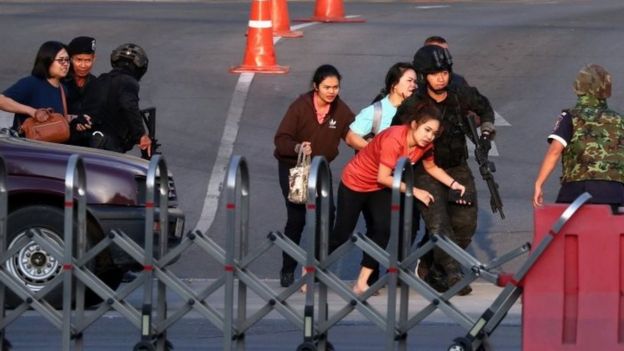
    Thai security forces evacuate people from the Terminal 21 shopping centre in Nakhon Ratchasima. Photo: 9 February 2020

    REUTERS

    Image captionThai security forces on Sunday evacuated more people from the Terminal 21 shopping centre

    Earlier reports said the gunman, aged 32, had tried to escape via the back of the building.

    The suspect’s mother was also brought to the shopping centre to try to persuade him to give himself up.

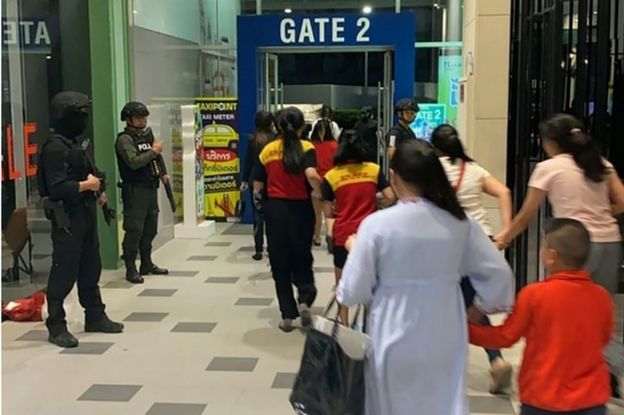
    Security forces evacuate people from the shopping complex

    AFP/THAI ROYAL POLICE

    Image captionSecurity forces evacuate people from the shopping complex

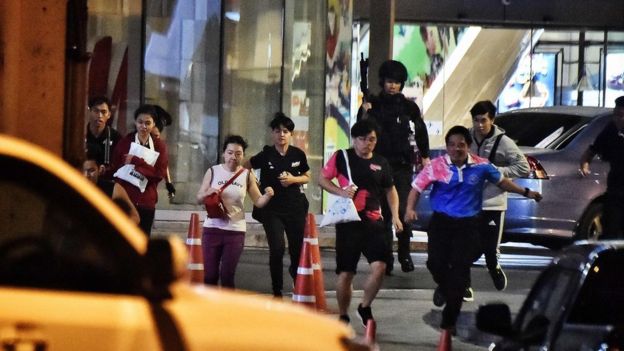
    People fleeing the shopping centre

    People described hiding under tables in the shopping centre before they managed to flee

    One of the people freed told the BBC how she and others hid in a bathroom on the fourth floor, before fleeing to the second and hiding under a restaurant table for three hours, hearing at least four gunshots before she saw some soldiers and could get to safety.

    Charlie Crowson, a teacher of English who lives in Nakhon Ratchasima, told the BBC there were “bodies on the streets” of the normally peaceful town.

    He said that one of his girlfriend’s former students was among those killed in the attack that lasted for many hours.

    How did the attack unfold?

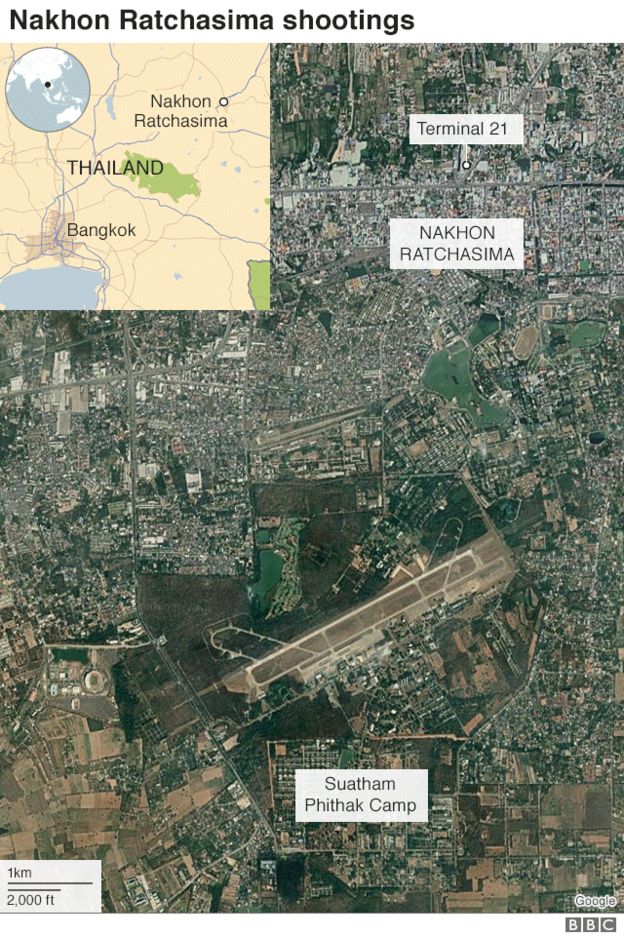
    It began at about 15:30 local time on Saturday (08:30 GMT) at the Suatham Phithak military camp, where the commanding officer, named by the Bangkok Post as Col Anantharot Krasae, was killed.

    The Post said a 63-year-old woman, Col Anantharot’s mother-in-law, and another soldier were also killed there.

    Map

    AFPPresentational white space

    The suspect seized arms and ammunition from the camp before taking a Humvee-type vehicle.

    He then opened fire at a number of sites before arriving at Terminal 21 at about 18:00 local time (11:00 GMT).

    Local media footage appeared to show the suspect getting out of his vehicle and firing shots as people fled.

    CCTV footage showed him inside the shopping centre with a raised rifle.

    Thai police put a wanted poster on their Facebook pageThai police put a wanted poster on their Facebook page

    What did the suspect post on social media?

    He posted on his social media accounts during the attack, with one post on Facebook asking whether he should surrender.

    He had earlier posted an image of a pistol with three sets of bullets, along with the words “it is time to get excited” and “nobody can avoid death”.

    Facebook has now taken the page down.

    It said: “Our hearts go out to the victims, their families and the community affected by this tragedy in Thailand. There is no place on Facebook for people who commit this kind of atrocity, nor do we allow people to praise or support this attack.”

    Source: myjoyonline.com
  • Mental health in Kenya: I was accused of bewitching my husband

    Esther Kiama was working as a teacher in Nyeri, central Kenya, when she received the call.

    Her husband, David, was unwell.

    “And it is not a minor illness,” the caller emphasised, and then explained: “It’s a mental illness.”

    At that point, in 2005, Mrs Kiama had not seen her husband much over the previous year as he had moved to another town to set up a business.

    On the times she visited she had not noticed his health problems.

    But once the call came, Mrs Kiama left immediately to find him.

    “We had to go get him home so that he could get medication,” she told the BBC.

    Mrs Kiama said that her husband “would talk to himself, throwing his arms about, appearing to be talking to people while there was really no-one he was talking to”.

    She was describing what later would be diagnosed as bipolar disorder.

    “It got worse when he came home. I would leave him in the house and one day I found that he had burnt the ceiling, saying there were strange people he was looking for up there.”

    It was as if her husband had transformed into someone she did not know, and she did not understand what was happening.

    ‘You have bewitched our son’

    She decided that she would take him to hospital but her relatives would not let her.

    They accused Mrs Kiama of casting a spell on her husband.

    “His dad came to take him and said: ‘I have been told that my son is sick, I have come because you have bewitched him.’”

    The forceful removal of her husband of 15 years was a traumatic experience for her and their four children.


    “I was shocked at first, but I’m a believer, even though it really shocked me, I believed this would end,” she said.

    Meanwhile she could see that her husband’s health was deteriorating.

    But because of their belief that he was under a spell, Mrs Kiama’s in-laws did not look for medical help.

    Mental health problems in Kenya are sometime associated with witchcraft or curses, rather than something can be treated or managed.

    Kenya’s ministry of health says that many people do not seek help for these kinds of conditions and would rather conceal their illness.

    The World Health Organization estimates that one in four people will be affected by a mental health problem or neurological disorder at some point in their lives.

    There are no up-to-date figures for the situation in Kenya – an indication, perhaps, of how much work needs to still be done on the issue in the country.

    Chased with a machete

    For three years, Mr Kiama was a burden to his parents, especially to his elderly mother who at some point fell ill, seeing the sad state of her son.

    Occasionally, neighbours would contact Mrs Kiama about her husband.

    “Sometimes I’d be called to be told that he was in town roaming about and I’d go hire a taxi and take him back,” Mrs Kiama says. She would at times go and cook for him.

    But she was still blamed for her husband’s behaviour and this filtered through to him.

    “He once chased after me with a panga [machete] saying: ‘You bewitched me.’ But I asked him: ‘If you kill me, who will cook for you?’ He then threw away his panga,” she said.

    Mrs Kiama was grateful that except for that incident, her husband was not violent.

    What is bipolar disorder?

    • There are different types of bipolar
    • Those with type 1 experience periods of manic highs and depressive lows
    • Those with type 2 experience severe depression and mild manic episodes – known as hypomania – that last for a shorter period of time
    • Those with cyclothymia experience fewer severe mood swings, but they can last longer
    • During a manic episode, those with bipolar disorder can feel euphoric and have lots of energy, ambitious plans and ideas. But they can become aggressive, and experience symptoms of psychosis
    • The exact cause of bipolar disorder is unknown. Some experts believe it can be developed as a result of severe emotional distress as a child, as well as genetic and chemical factors

    Sources: NHS, Royal College of Psychiatrists and Mind

    Mrs Kiama said it was difficult watching someone she loved suffering so much from an illness that she hardly understood. She also struggled with the reaction she got from friends.

    Many turned their backs on her.

    Kenyan psychotherapist Maggie Gitu, who specialises in marriage, family and sex issues, said it was not right to label mentally ill people as “insane” or “crazy”, as often happens.

    The labels obscure understanding the condition.

    Abandoned by friends

    She told the BBC that medical check-ups were necessary to determine what kind of mental disorder a person could be suffering from.

    She said that mental health problems could be triggered by stress, feelings of loneliness, fear, panic or a feeling of not being appreciated.

    Despite her husband’s condition, Mrs Kiama was not going to abandon him, against all the advice from her friends.

    “I told them it was because of the vow. We had had a church wedding. He came to pick me from home, as a young bride.

    “To say the truth, we loved each other very much… we had four children”.
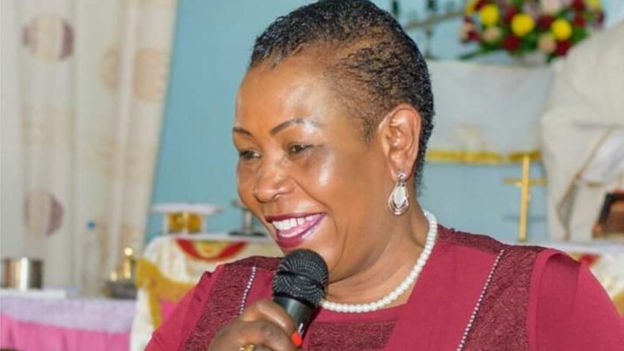
    Esther Wanjiru Kiama
    Esther Kiama said her children have now been taught not to be afraid of their dad’s illness

    In the end, Mrs Kiama decided that she was going to reclaim her husband from her in-laws.

    “After three years, I told my children [that] we are going to steal dad,” she said.

    Together with her children and a psychiatrist, they devised a way to get her husband out of his parents’ home.

    By then, she said: “His finger and toe nails had grown long and dirty that it would take days to clean them. His beard and hair had overgrown so much that it gave him a horrible appearance.

    “He was like Nebuchadnezzar of the Bible, totally unkempt.”

    Back with the children

    Mr Kiama’s bipolar disorder was then diagnosed and he was admitted to hospital for about two months.

    Since leaving hospital, he has been recovering at home, although he is still on long-term medication.

    The family is now back together.

    “The doctor has counselled my children, how to live with their dad and they should love him the way he is… and it has worked,” Mrs Kiama said.

    Source: myjoyonline.com

  • Kenya: Where toilets have become a constitutional right

    In our series of letters from African journalists, media and communication trainer Joseph Warungu looks at a recent court ruling that could end some uncomfortable road trips.

    We in Kenya have discovered that we have a constitutional right to relieve ourselves in public, at the expense of the government.

    Here’s how.

    Travelling to and from distant places by road in Kenya, is not something many people look forward to.

    Road signs in Kenya
    But where are the signs for the toilet?

    The biggest challenge is to arrive alive at your destination. Over 3,400 people died on Kenyan roads last year, an increase of 13% from 2018.

    The main causes are speeding, drunk driving and fatigue.

    If you avoid death or serious injury, you still may not escape the discomfort of the terrible roads.

    Although there’s been a lot of improvement of Kenya’s infrastructure in recent years, some of the roads are in poor shape and become unusable during rainy season.

    As a former British colony, we drive on the left in Kenya, but people are often forced to drive on whatever’s left of the roads due to the numerous potholes which scar many roads, including the central business district of the capital Nairobi.

    However, there’s another reason that makes long-distance road travel a nightmare – toilets.

    When you’re squashed in a packed bus, and the call of nature comes, you’re in deep trouble.

    That’s because when the authorities built these highways, they did not include public toilets along the way.

    So, in these instances, drivers stop in the middle of nowhere, and as soon as the door is opened, people dash in different directions, in search of the nearest bush to relieve themselves.

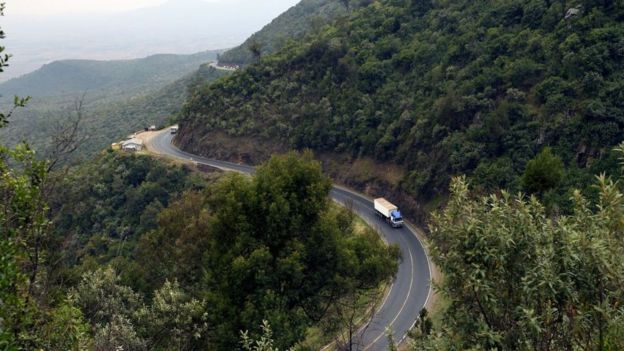
    A truck drives on August 21, 2019 on a section of a road leading down the eastern escarpment of the historic Rift Valley, snaking down the cliffside leading from Limuru town
    It is not always safe for passengers to relieve themselves by the roadside


    It makes for a disturbing picture of men, women and children forced into a communal squat position.

    All shame is lost as the multitude that was in a bus focuses on one grave priority – emptying bladders and bowels.

    ‘Unfortunate meal’

    Some students I mentor from a college in the coastal region of Mombasa told me how they recently went on a trip to central Kenya, a distance of about 700km (435 miles).

    Before leaving Mombasa, they had a meal, which unfortunately upset their stomachs.

    “With no toilets along the way, our bus driver was forced to make several stops near bushes and forests for us to attend to the upheavals in our tummies,” explained one of the students. “It was the most uncomfortable 10-hour journey I’d ever had”.

    Road builder
    Lots of new roads have been built in Kenya, now toilets will have to be added too

    But now help has come through the actions of one man who went to court to compel the government to bring an end to this kind of suffering.

    Adrian Kamotho Njenga sued four public entities arguing they had breached the constitution by failing to provide free toilet facilities along public highways.

    The four bodies – the Council of Governors, which brings together the governors of all 47 counties, the Kenya National Highways Authority, the Kenya Rural Roads Authority and the Kenya Urban Roads Authority – all rejected the accusation and turned to a blame game.

    Some said Mr Njenga had not shown details of how exactly they had violated the constitution regarding public toilets. Others argued that they do not have a constitutional mandate to provide sanitation services.

    But like an impatient man pressed by the call of nature, Mr Njenga continued to push for a solution from the court.

    He argued that as a result of the failures of the public entities, road users on public highways had no way of disposing of human waste flowing from human biological functions, and end up relieving themselves in bushes and on the roadside, which is inhuman and degrading.

    No toilets = torture

    He even quoted from the Bible’s fifth book, Deuteronomy, in which Moses commands the Israelites who were travelling to the promised land, to designate a place outside their camp where they could go to relieve themselves.

    And just in case the court was not persuaded to rely on the Bible as an authority in determining a constitutional matter, Mr Njenga explained the lack of toilets was subjecting commuters to suffer “immense biological, metabolical and physiological torture, when faced with a call of nature while travelling on Kenyan roads”.

    Now these are words I don’t think about when answering the call of nature, myself.

    But they sound quite serious, and in the end the judge agreed with Mr Njenga, and instructed the authorities concerned to create and implement a policy for the provision of toilets and other sanitation facilities along the Kenyan road network.

    So, we’re all looking forward to the day when as commuters, we’ll stop hopping about in the bushes to avoid stepping on human mess in the search for a clear spot, to bring relief to our bodies.

    For now, in the absence of the “constitutional” toilets, the beautiful wildlife that can be seen near the roads from Nairobi to Kisumu in the west, or to Mombasa at the coast, will continue to witness some ugly scenes as humans invade their space to dispose of their waste.

    Source: myjoyonline.com

  • Two Rwandan ministers resign from cabinet

    The Ministers of State affiliated to the Justice and the Education docket have stepped down.

    Evode Uwizeyimana, the Minister of State in charge of Constitutional & Legal Affairs and Isaac Munyakazi the Minister of State in charge of Primary and Secondary Education submitted their resignation letters to the Prime Minister on Thursday, February 6, 2020.

    The news was confirmed by Prime Minister Edouard Ngirente’s office through a tweet posted shortly before midnight.

    According to the Prime Minister, the letters were to be presented to President Paul Kagame.

    Uwizeyinama’s resignation comes only four days after he was seen shoving to the ground a female private security guard who demanded he undergoes security procedures required prior to entry of public buildings in Kigali.

    The incident was posted on the social media platform Twitter. The former Minister responded begging pardon.

    Some reports have attributed Munyakazi’s reason for stepping down to a case involving last year’s national exams where a school was promoted to the top 10 best performers without merit.

    It is alleged that Munyakazi was involved in that process and investigations are ongoing to get to the bottom of the matter and hold to account all those involved.

    The Rwanda Investigation Bureau confirmed Tuesday that it was investigating the incident involving Uwizeyimana.

    Both Uwizeyima and Munyakazi joined the cabinet in 2016.

    Source: allafrica.com

  • Much-loved 50-year-old elephant dies in Kenya

    Tim – a famous and much loved tusker elephant that roamed Kenya’s southern Amboseli National Park – has died form natural causes at the age of 50, Kenya Wildlife Service (KWS) has said.

    He was “unassuming, unpretentious and laid back,” KWS Director Paul Udoto said in a statement.

    But Tim did have some scrapes through his long life.

    “Some years back he was struck on the head with a large rock and pierced through the ear with a spear which was embedded in his shoulder,” Mr Udoto said.

    The elephant was later treated of his injuries.

    Tim’s carcass is on its way to the National Museums of Kenya in the capital, Nairobi, for a taxidermist to prepare it for preservation for education and exhibition purposes, the statement said.

    Source: bbc.com

  • Stampede kills 13 Kenyan schoolchildren

    Police in Kenya say at least 13 children have been killed in a stampede at a primary school in the western town of Kakamega. Nearly 40 others were hurt.

    Some reports said the students started rushing down a narrow staircase after a teacher waved a cane at them. The staircase is said to have collapsed.

    Parents have gathered at the local hospital, waiting for news about their children.

    A Kenyan television station has tweeted a photo of the school:

    Source: bbc.com

  • Nairobi leads Africa in spoken and written English

    Nairobi has the most English proficient speakers on the continent, according to a new study.

    Nairobians’ knowledge of spoken and written English, according to the English Proficiency Index 2019, is 61.94 per cent, the highest for any African city.

    The EPI index, which ranked 100 countries and regions, reported that only two African cities — Nairobi and Lagos — which scored 58.47 are in the high proficiency band. About 13 African countries participated in the survey.

    Globally, Kenya’s English language skills ranked 18th, the second highest on the continent, after South Africa that ranked sixth in the world.

    Nigeria and Ethiopia ranked 29th and 63rd respectively while Libya ranked the lowest.

    The 2019 index saw eight new entrants in the survey, namely, Kenya, Sudan, Côte d’Ivoire, Bahrain, Kyrgyzstan, Maldives, Nepal and Paraguay.

    Africa’s average proficiency score dropped, primarily due to score changes in South Africa and Ethiopia and to the inclusion of Sudan and Cameroon, which both fall in the “very low” proficiency band, the report said.

    Another key finding of the report was that the English proficiency gender gap is closing. In 2018, women’s average English level was higher than men’s worldwide and in a majority of countries. But in 2019, women outscored men by less than one point in Africa, Asia and Europe

    The scores are achieved through analysing results from 2.3 million adults who took an online English test in 2018 via EF Standard English Test.

    Authors of the EPI report also found a correlation between high English proficiency and various indicators of economic competitiveness, including higher income and increased labour productivity.

    While there’s no evidence that English proficiency directly drives economic success, the authors of the report say that the complex relationship between language skills and economic growth is that greater wealth facilitates more English training, and English skills help economies stay competitive hence highlighting the role that English plays in broader schemes for economic growth.

    “We consistently find a correlation between ease of doing business and a country’s English proficiency,” said Kate Bell, a co-author of the survey.

    The study further found a correlation between English proficiency and a country’s service exports as well as the value added per worker in services.

    As the complexity and sophistication of economic exchange increases, so does the demand for linguistic competencies, the survey explained.

    The report notes that in the last 30 years, many emerging economies closed the gap with richer countries, thanks to manufacturing.

    But as opportunities, especially in the manufacturing sector dry up, people will need to focus more on education, for both children and adults, to enable them tap into international trading opportunities and develop service-sector industries.

    Source: allafrica.com

  • African LGBT+ refugees plead U.N. for safe shelter after Kenya camp attacks

    Dozens of African LGBT+ refugees in northwestern Kenya’s sprawling Kakuma refugee camp pleaded on Thursday with the United Nations to relocate them to a safer place, saying they had suffered violent attacks.

    More than 40 LGBT+ refugees from countries including Uganda, Burundi and the Democratic Republic of Congo said they were targeted in two homophobic attacks by other refugees in the last three weeks.

    Fifteen people were injured in the Dec. 21 and Jan. 7 incidences and some taken to hospital with wounds to the head and internal bleeding, they said.

    The Thomson Reuters Foundation was given photographs of people with bleeding wounds on their head and scars on their limbs, but could not immediately verify the pictures.

    Read:No gene causes LGBTQI, they are medical conditions needing treatment Group

    The U.N. refugee agency (UNHCR) said there had been some incidents of vandalism in the camp, but there was no evidence that LGBT+ refugees were specifically targeted.

    “They came in large numbers – much more than us. They beat us with sticks and rods, kicked and punched us and told us to leave. They destroyed our shelters,” said Andrew, a 23-year-old gay man from Uganda who did not want to give his real name.

    “We cannot go back to the shelters inside the camp. The other refugees know who we are and will kill us. We ask the U.N. to give us shelter and protection somewhere else – but they are ignoring us.”

    The refugees have been staying outside the UNHCR reception centre in Kakuma since the first attack on Dec. 21, he said by phone from the camp in Kenya’s remote Turkana county.

    Read:RE: UN sacked Professor Adei for objecting to LGBTQ Foh-Amoaning

    The UNHCR’s regional spokesperson Dana Hughes said they were closely monitoring the situation, adding that decisions to relocate refugees were made on an individual basis and required authorization from the Kenyan authorities.

    “Incidents of shelter vandalism were reported to law enforcement authorities in December, however these attacks were found to be attributed to common petty criminality and were not targeted at any particular individuals,” said Hughes.

    The allegation that LGBT+ refugees were attacked on Jan. 7 had not been substantiated, she said.

    “Security reports from law enforcement indicated that there was no attack/assault at the venue.”

    It is not the first time LGBT+ refugees have faced physical violence in Kakuma, a vast camp that is home to more than 180,000 refugees.

    Read:Russia LGBT activists detained during St Petersburg rally

    In December 2018, the UNHCR relocated about 200 LGBT+ refugees from the camp to Nairobi as an emergency measure after a spate of violent attacks against them.

    But Kenya requires most refugees to stay in designated camps and 75 of them were returned to Kakuma in June.

    African countries have some of the most prohibitive laws against homosexuality in the world, with punishments ranging from imprisonment to death.

    Although gay sex is punishable with up to 14 years in jail in Kenya, the law is rarely enforced. The east African nation is seen as more tolerant than neighbouring Uganda and Tanzania, though discrimination against the LGBT+ community is prevalent.

    Gay rights groups say the camps are not safe for LGBT+ refugees and are calling on Kenya to allow them to live in urban areas.

    Read:US cautions gays on Tanzania travel

    “These persons were relocated out of this camp due to such violence last year, only to be forced to return to this dangerous and volatile situation,” said a statement from Refugee Coalition of East Africa.

    “Claims that these attacks do not specifically target LGBTQI refugees are unfounded and patently untrue.”

    Source: news.trust.org

  • Swarms of locusts threaten food security in Kenya – Govt

    Large swarms of desert locusts are spreading through Kenya, after wreaking havoc in Somalia and Ethiopia, posing a significant threat to food security, the agriculture minister said Friday.

    The locusts — part of the grasshopper family — have led to what the Food and Agriculture Organisation (FAO) has termed the “worst situation in 25 years” in the Horn of Africa.

    Swarms formed in eastern Ethiopia and northern Somalia and have moved through the region, possibly still threatening South Sudan and Uganda.

    Kenyan Agriculture Minister Mwangi Kiunjuri told a press conference that the swarms had crossed the border from Somalia on December 28, and had now spread to northern Mandera and Marsabit, eastern Wajir and Garissa, as well as central Isiolo and Samburu.

    Read:Changing tides as men lead war against female circumcision in Kenya

    “We recognise that the pest invasion and potential to spread rapidly to other counties pose (an) unprecedented threat to food security and livelihoods in the country,” said Kiunjuri.

    Desperate measures have seen police deployed to shoot in the air and spray teargas at the critters, while residents clap their hands, whistle and bang bottles and cans together to try chase away the thick clouds of locusts, according to images obtained by AFP.

    However Kiunjuri said the government had obtained pesticides and two aircraft to spray affected areas, and hopes to soon have a third.

    The FAO estimated that there was low risk of breeding in Kenya, however said a “potentially threatening situation” was developing on both sides of the Red Sea, with growing populations on the coasts of Egypt, Sudan, Eritrea, Saudi Arabia and Yemen.

    Read:Somalis fight locust invasion by eating them

    The United Nations agricultural organisation in December said some 70,000 hectares (173,000 acres) of land had been infested in Ethiopia and Somalia.

    “Insecurity and a lack of national capacity have so far not allowed control operations in Somalia,” the FAO said in a statement this week.

    Desert locusts — whose destructive infestations cause major crop damage and hunger — are a species of grasshopper that live largely solitary lives until a combination of conditions promote breeding and lead them to form massive swarms.

    According to the FAO, swarms can travel up to 130km (80 miles) per day — a kilometre-wide (half-mile-wide) swarm can contain up to 80 million locusts.

    Source: France24

  • Aids deaths reduce in Kenya by 60%

    Aids-related deaths in Kenya have dropped by about 55 per cent from 60,000 in the last nine years to 28,000 last year according to the World Aids Report 2019 released on Wednesday.

    Additionally, new infections reduced by 51 percent over the same period from 100,000 in 2013 to 49,000 currently.

    The country’s HIV and Aids prevalence was at 4.9 percent with 1.8 percent (52,767) being new infections.

    The report released at Garissa Road Primary School in Thika town by Health Cabinet Secretary Sicily Kariuki, also showed the Antiretroviral Therapy (ART) coverage had improved with 1.2 million people on treatment.

    Read:UN reports Libyan guards shot at migrants fleeing air raids

    Statistics from Africa showed that 25 million people live with the virus, with 24.5 million on treatment globally.

    The CS said the results affirmed the government’s efforts in countering the epidemic despite the structural, economic and cultural barriers in accessing health care and shrinking donor support.

    Budget

    “To address this, the Health Ministry’s budget has been increased by more than 50 percent over the last two years. Beginning 2020, the Ministry has set aside funds to plug donor cuts in anti-retroviral therapy and essential services. This is in addition to increased counterpart financing,” said Kariuki.

    Read:HIV/AIDS prevalence rate in Ghana pegged at 1.69 per cent

    She announced that in partnership with governors, they plan to employ 40,000 health providers to bring the number of community health volunteers to 100, 000.

    They will help in the Level one’s in psycho-social support and will become the first point of contact in treatment.

    UNAIDS Executive Director Winfred Byanyima, said women between 15-24 years are the most vulnerable, with statistics showing that more than 6,000 women within that age are being infected with HIV every week, the status being high in Africa.

    She said efforts must be made to safeguard the interests and rights of girls and women such as rape, violence and gender inequality,

    Read:Dr Duncan honoured for discovery of potential cure of HIV/AIDS

    She added that millions of women can’t access healthy sex precautions like condoms or contraceptives unlike their male counterparts.

    “A girl’s first experience with sex is violent, forceful, that’s the reality. Chances of infections that time are high. Poverty amongst women also contributes to the high prevalence,” she said.

    Acting Kiambu Governor James Nyoro said the HIV incidence in Kiambu was among the highest in the country at 4.5 per cent, with youths aged between 15 and 24 bearing the bigger percentage.

    He said the community health volunteers will help in sensitizing residents and easing access to sex education.

    Source: allafrica.com

  • 24 killed in a landslide in Kenya

    At least 24 people have been reported dead due to a landslide in eastern Kenya. The residents in West pokot were swept way by the landslide following heavy rains Friday evening in the region.

    West Pokot County Commissioner Apollo Okello said 12 bodies, including seven children, have been recovered so far and that search efforts are continuing, reports The Daily Nation.

    Read:Heavy rains in Japan cause deadly landslides and floods

    Rescue operations have been halted because most bridges have been swept and it is still raining heavily according to West Pokot County Commissioner Apollo Okello. Adding that, many people could be trapped in in Pokot South and Pokot Central says The standard

    “Seven people of the same family were buried alive in Nyarkulian area, Pokot South and 24 were buried alive in Muino area, Pokot Central sub county,” said Okello.

    Read:Family of four buried alive by landslides in Kenya

    Source: africanews.com

  • Death row convict in Kenya tastes freedom after 19 years behind bars

    A death row convict jailed in 2001 got a reprieve after the Makadara Law Court reviewed his sentence and handed him 19 years’ sentence.

    Chief Magistrate Heston Nyaga sentenced Joseph Kinyanjui Wainaina to 19 years’ imprisonment backdated to October 2000 when he started his incarceration after he was charged.

    Read:Moroccan king pardons journalist jailed for having an abortion

    Convicted

    Wainaina and others robbed shopkeeper Harrison Mwangi Kimotho in Kariandundu village, Nairobi on October 26, 2000 while armed with a pistol.

    His accomplices were never arrested.

    Wainaina was sentenced to hang on June 18, 2001 after he was convicted following successful prosecution. Wainaina has been at the Kamiti Maximum Security Prison for the period he has been behind bars.

    He appealed in High Court the same year and lost. Wainaina lodged his second appeal at the Court of Appeal in April 2004, which he also lost.

    Read:Pupil Teacher jailed 15 years for Incest

    The convict opted to apply for re-sentencing after the Supreme Court annulled the mandatory death sentence for convicts of capital offences.

    Mandatory sentence

    Nyaga said he has considered the fact that although Wainaina and his accomplice were armed with a dangerous weapon, no death was caused during the robbery and if it is retribution of the convict, it has been done during the 19 years he has been in prison.

    “Previously, the issue of the sentence for this offence did not require any debate since the assumption and the reasoning of the courts was that the “mandatory sentence” provided for was death,” Nyaga said.

    Read:You can be jailed for 2 years for denying your husbands sex Police warn wives

    “After promulgation of the new constitution, the meting out of death sentence to convicts has been looked at from different a perspective.”

    Nyaga said he there are documents to show that the convict has gained some practical and educational knowledge that may assist him if he gets back to the society.

    The magistrate also considered a social inquiry report of Wainaina. Members of public where he came from told probation officials that they are ready to receive him back home and don’t see him as a threat.

    Source: allafrica.com

  • Chemistry exam leaves Kenyan students and teachers ill

    A number of Kenyan students sitting a chemistry practical exam have taken ill after being exposed to a poisonous chemical, the local Daily Nation newspaper reports.

    One exam invigilator, a pregnant teacher, is also reported to have developed complications following the exposure. She was admitted to a hospital, the newspaper said.

    The incidents have been reported in schools in Kisumu and Trans Nzoia counties in the country’s western region.

    Read:Anger in Kenya over poisonous food discovery

    The Kenyan National Examinations Council (Knec) reportedly directed headteachers to buy and use xylene as an alternative for cyclohexane, which they were supposed to use, but which was unavailable.

    Breathing xylene vapors in small amounts can cause headache, dizziness, drowsiness, and nausea, according to the Agency for Toxic Substances and Disease Registry. In some cases exposure to xylene can even lead to death.

    During the practical exam, candidates were expected to heat the chemical and observe the sample without wearing protective gear.

    It is not clear if officials at the education ministry were aware of the adverse health effects of the compound.

    Read:Family of four buried alive by landslides in Kenya

    “We had to rush some of the students to hospital after the exam because they were complaining of chest pains, headaches and stomach discomfort. We gave milk to the rest,” a teacher is quoted as saying by the Daily Nation.

    Meanwhile, teachers have accused the examinations council of negligence.

    “Knec should not just be concerned about the integrity of the examination and overlook the health of the teachers who are manning the examination. Our lives matter,” a union official said according to the newspaper.

    Knec has not yet commented.

    Source: bbc.com

  • Family of four buried alive by landslides in Kenya

    A family of four has been buried alive in western Kenya due to landslides triggered by ongoing heavy rains, local media reported.

    Two children and their parents were buried by the debris inside their house in the village of Kapkonder in Elgeyo Marakwet county, witnesses told the Star newspaper on Friday.

    The Kenya Red Cross, along with police and disaster management staff in the county – located in the former Rift Valley province – were at the scene working to unearth the bodies, the Star added.

    Read:Thirteen killed in Kenya bus crash

    Heavy rain has wreaked havoc in several parts of the country, with Kenya’s Meteorogical department putting residents on high alert.

    “The rainfall is expected to intensify to more than 40mm in 24 hours from Thursday to Sunday over the coast, southeastern, northeastern, western and central regions including Nairobi,” the meteorological department said.

    “Floods may suddenly appear even in places where it has not rained heavily, and they can be deeper and faster than they look, especially in semi-arid and urban areas,” it added.

    Read:Kenya school collapse: 7 dead, scores wounded in Nairobi

    On Thursday, four people were killed in Meru county – in the former Eastern province – after they were swept away by flash floods, the Star reported.

    One person was rescued and five others were reported missing in Kitui county after the vehicle they were travelling in was swept away by flash floods on Wednesday night, Kenya Red Cross said on Twitter.

    Source: aljazeera.com

  • Hundreds of Kenya schools to be shut down after deadly collapse

    Hundreds of informal schools in Kenya will be shut down after a school building collapsed in Nairobi last month, killing eight children.

    Officials blamed poor construction and overcrowding. Now, the education ministry has ordered 300 informal schools to be closed, affecting approximately 10,000 children.

    Read|:Kenya school collapse: 7 dead, scores wounded in Nairobi

    They are supposed to be transferred to nearby public schools which are already overcrowded.

    Al Jazeera’s Catherine Soi reports from Nairobi.

  • For rural Kenyans, treating snakebites is an uphill struggle

    Simotwo village in Baringo, a western county in Kenya, is a peaceful place. Cattle, sheep and goats graze leisurely. The grassy area straddles hillocks, boasts a generous outcrop of granite rocks and is rich in indigenous tree cover.

    But beneath the veneer of calm village life, a deadly menace haunts the residents and their livestock.

    The semi-arid environment of Simotwo and most parts of Baringo County are favourable habitats for a number of snake species.

    This is a fact Kelly Simba, 34, knows too well.

    In April, he was walking along a narrow path to his uncle’s home, carrying a stick in his right hand which he occasionally used to turn a stone or move a branch.

    It was hot and water was scarce, so he stopped to get water for his cattle. As he poured it into a trough, he felt a sharp sting on his left foot.

    Wincing in pain, he jumped up and managed to catch a glimpse of the puff adder, a long and heavy snake that relies on its camouflage, as it disappeared.

    If not treated appropriately, a puff adder bite can be fatal.

    “There was an old cloth on the fence nearby, so I took it and tore a strip to tie my foot. I then called a bodaboda (motorcycle taxi) to take me to hospital in Kabartonjo,” said Simba.

    Read:Kenya school collapse: 7 dead, scores wounded in Nairobi

    Kabartonjo sub-district hospital is rated level four by Kenya’s Ministry of Health, meaning it is better equipped than the pharmacies in and near Simotwo.

    It took him three hours to get to the hospital; he was treated and discharged after three days.

    In the village of Simotwo, everyone knows someone who’s been bitten by a snake.

    Despite the local government’s efforts, barriers to solving the snakebite problem include poor road networks, the lack of public health education and absence of anti-venom in rural health facilities.

    Daisy Chepnyango, 18, from the neighbouring Karas village was also bitten by a puff adder.

    Her mother carried her the 15 kilometres (9.3 miles) to Kimalel Hospital for treatment.

    In the case of Simba’s nine-year-old nephew, Brian Kipsang, he had just finished a school day and was carrying water from a nearby stream when he felt a stinging pain at his ankle.

    Like Simba, he was also rushed to hospital on a motorbike, arriving two hours later.

    Simba, Chepnyango and Kipsang were the lucky ones, managing to make it from a rural area to a hospital. Many others are less fortunate, and succumb in the countryside.

    Read:Kenyan judge rules Rastafarianism is a religion

    Poor infrastructure

    There is no exact data on the number of snakebites across Kenya.

    Dr Winnie Bore, chief officer for health in Baringo County, said: “Conservative figures of victims of snakebites in Baringo County is between 200 to 300 per month. A third of these succumb to the bite.”

    She cited efforts to distribute anti-venom to all health facilities in affected areas, train clinicians in dealing with snakebites, and educate residents on how to avoid snakebites.

    Hesborn Nyambati, a snake expert at the National Museums of Kenya, said if someone is bitten, the first step is to minimise motion – and therefore, warned against running.

    But poor infrastructure areas like Simotwo means the only way to travel quickly is by motorbike, on a bumpy road.

    Bore admitted that the roads needed improving, saying: “There is a correlation between health outcomes and road networks, especially in cases like snakebites or even maternal and childcare.”

    In health facilities where there is no electricity, Bore claimed to be working towards installing solar power so that anti-venom that needs refrigeration can be stored. In county areas where the snakebite rate is particularly high, she said officials were planning to stock medicine that does not need to be refrigerated.

    Read:Kenyan MP demands law to control farting on planes

    Simba and other villagers Al Jazeera interviewed said a local facility does not stock anti-venom.

    “The health centre closes at five in the evening, so in case a patient is brought in there at night, there will be no one to attend to him,” he said. “In any case, they do not treat snake-bites and do not have an admission ward.”

    Kenya is in the initial stages of setting up a facility that extracts poison from snakes to produce anti-venom, but it will take time before this is available for use in hospitals.

    Currently, the government imports anti-venom from South Africa.

    According to snake expert Nyambati, this is sometimes problematic because anti-venom produced from poison extracted from one environment may not be effective on a snakebite in a different environment.

    These challenges have prompted some residents to try alternative treatment.

    Musyoka Mutisya, a traditional healer, has travelled around Baringo County treating victims, most of whom were bitted by a puff adder.

    “I use a black stone which I place on the area of the bite. The black stone attaches to the area and sucks out the poison. My grandfather taught me how to do it. I have now treated hundreds of victims,” he claimed.

    While there is no scientific research to support the idea that traditional methods work, Nyambati believes that “healers” assure patients psychologically and therefore, address the panic.

    Read:Kenya orders suspension of top betting company SportPesa

    “However, the [general] level of awareness is very low. Not many people know what to do and therefore, many succumb to the bites,” Nyambati said.

    Despite promises from local officials, Simotwo residents said they had not yet received training in how to deal with the snakes.

    For Karen Chepchieng, a resident of Karas village, some practical help would be useful.

    She claims she regularly finds snakes in her home and has managed to kill most of them.

    “I am not afraid of finding it,” she said. “What I am afraid of, is not finding it. Then it could end up biting me or my children.”

    Source: aljazeera.com

  • Last day for Kenya’s old banknotes

    It’s the last day of legal tender for Kenya’s old 1,000 shilling banknote and other smaller denominations.

    New banknotes were introduced in June, with customers given four months to exchange them for the new currency.

    The governor of the Central Bank Patrick Njoroge said the operation was intended to tackle corruption and illicit financial flows.

    The design of the new currency, which features an image of a statue of Kenya’s first President, Jomo Kenyatta – the current president’s father, has sparked anger among some Kenyans.

    Read:Anger in Kenya after MPs fight in church

    A human rights activist challenged the use of the former president’s image arguing it contravened the constitution which outlaws the use of portraits of individuals in any currency.

    The High Court ruled last week that President Jomo Kenyatta’s statue was not a portrait.

    The court also declined to extend the expiry date of old Sh1,000 notes.

    The old 1,000 shilling notes is being withdrawn to crack down on embezzlement and tackle counterfeits

    In recent days, shopkeepers have reported a number of large transactions being made in cash – including that of a luxury Mercedes car.

    Read:Kenyan MP demands law to control farting on planes

    One bar is offering to swap the banknotes for its clientele and is holding an “Old Notes Send Off Party”.

    Source: bbc.com

  • Seven pupils die in Kenya classroom collapse

    Seven pupils have died after a classroom collapsed in Kenya’s capital, Nairobi.

    Police commander George Seda and the area’s MP, John Kiarie, confirmed the death toll after the structure at Precious Talent School – made of wood and corrugated iron sheet – collapsed on Monday morning.

    The school’s manager, Moses Wainaina Ndirangu, told Kenya’s Citizen TV that the structure had been weakened by the construction of a nearby sewer.

    He said around 800 pupils attended the school, but only 20 could be accounted for in an emergency roll call after the incident.

    Most pupils had ran into the neighbourhood of Dagoretti, in the west of the city, after the collapse, he said.

    A senior official in the education ministry, Belio Kipsang, has arrived at the scene.

    Source: bbc.com