Kevin McCarthy, a former leader of the US House, has announced that he will be leaving Congress at the end of December.
Mr McCarthy, who is 58 years old, announced on Wednesday in an article in the Wall Street Journal.
He said he will leave the House at the end of the year to help America in new ways.
Mr McCarthy, who is a Republican, was removed from his position as Speaker in October because some members of his party rebelled against him.
In January, it was very chaotic when he became Speaker. It took 15 rounds of voting before he got enough support for the job.
In his article, Mr. McCarthy said that even though he’s not in Congress anymore, he will keep trying to get really smart and talented people to run for office.
“The Republican Party is getting bigger all the time, and I want to use my experience to help the new leaders,” he wrote.
The California lawmaker has decided to retire after working in the House for 16 years. During that time, he moved up the ranks of the Republican leadership, serving as Majority Whip, Majority Leader, and then Speaker. His retirement marks the end of his career in the House.
In his last year as President, there were disagreements within his own party because some members didn’t agree with him making a deal with Senate Democrats to fund government agencies and prevent a shutdown.
Mr McCarthy was removed from the Speaker role by a rarely used procedural tool called a motion to vacate, which was filed by Florida Republican Matt Gaetz.
Mr Gaetz said that Mr. McCarthy made a secret agreement with Democrats to keep giving money to Ukraine for their defense against Russia. Some Republicans think the US can’t afford to keep doing this.
Mr McCarthy said it wasn’t true. However, he was removed from his position by a small margin, with 216 people voting for his removal and 210 people voting against it.
He said in the Wall Street Journal that he still feels positive about things.
“Why wouldn’t I be. My dad is a firefighter. ” I have been in the same job for 17 years. I was once not allowed to intern there. He said it only happens in America.
His leaving means California Governor Gavin Newsom will have to schedule a special election to choose someone new.
Tag: Kevin McCarthy
-
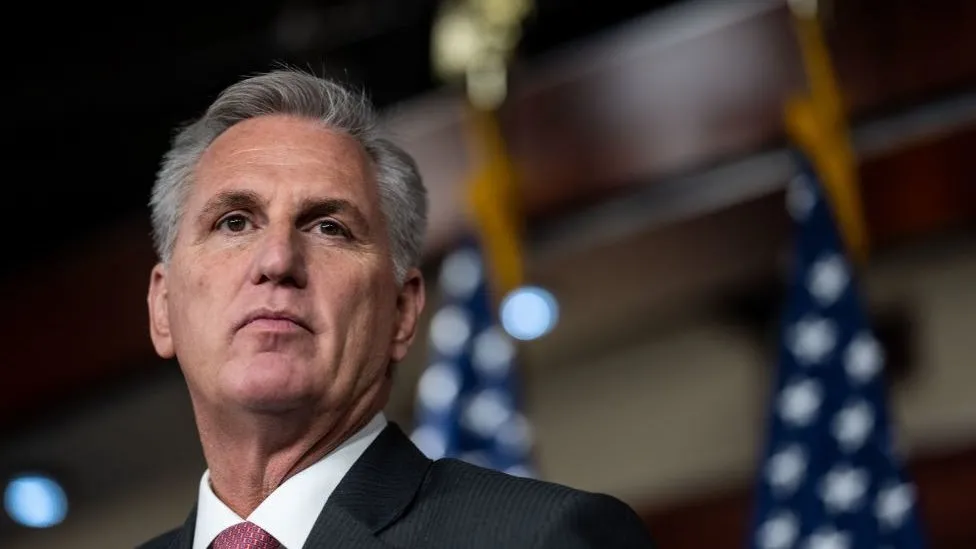
Kevin McCarthy declares his retirement from Congress
-
US government shutdown: Kevin McCarthy rushing to close a deal
The most important Republican in the United States House of Representatives has stated that he is hopeful that a deal can be made at the last moment to prevent a government shutdown.
House Speaker Kevin McCarthy said that by the end of the day, we will finish this task.
The Congress has until midnight on Saturday to pass a new budget for funding the government agencies.
Many people will be forced to take time off work without pay, and certain important organizations will no longer be able to function if an agreement is not reached.
“I wake up every day feeling positive,” Mr. McCarthy, who is 58 years old, said when asked about the chances of a deal being made. I think you should invest your money in me. We will finish this.
The chances of a shutdown seemed to go up on Thursday as the Senate and the House had different ideas about how to pay for things.
The Senate plans to have a vote to decide on a temporary funding bill. This bill has support from both Democrats and Republicans in the Senate. The bill would prevent the government from stopping its operations until 17 November, allowing Congress to have more time to come to an agreement on a budget for a longer period of time.
However, in order for the bill to become a law, it must be approved by the House. Unfortunately, at least nine members of Mr McCarthy’s small Republican majority are not willing to support any temporary measure.
The group keeps saying they will take Mr. McCarthy out as House Speaker if he uses Democratic votes to get around their disagreement and pass a funding bill without their support.
What occurs during a US government shutdown.
President Joe Biden said on Wednesday that he believes the Speaker is deciding between being the Speaker and looking out for the United States’ interests.
Democratic Senate Majority Leader Chuck Schumer said that this puzzle is not difficult and can be solved. “Says McCarthy should stop allowing extreme Maga supporters to influence his choices. ”
The House is planning to vote on short-term spending bills on Friday, but these bills are not expected to be approved by the Senate.
MrMcCarthy has not agreed to bring the Senate’s bill for temporary funds to the House for a vote, but he said that a government shutdown could be avoided if Democrats addressed the issue of border security in that bill more effectively.
“We want to find a way to improve the current Senate bill by adding some border provisions,” he said to reporters on Thursday.
This morning, I spoke with a few Democratic senators who agree with our goals and ideas. They want to take action regarding the border.
Lately,McCarthy has noticed that the moderate and right wings of his caucus have been growing apart in their beliefs.
The right-wing side has only a few members, but they have a lot of influence in a chamber controlled by Republicans with a small majority.
They strongly disagree with the usual way of doing things in Washington, and they want the party to make spending cuts and focus on conservative issues.
That means Mr. McCarthy might need help from the other party to save him and agree on a temporary spending plan.
If he works with Democrats, it is very likely that they will start a process to remove him as Speaker. -
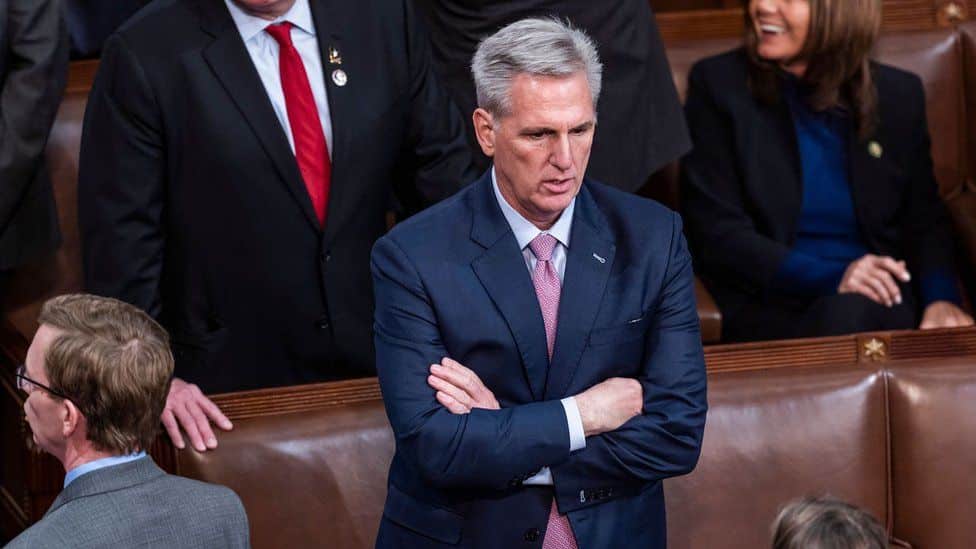
What did Kevin McCarthy forgo, and at what cost?
Kevin McCarthy has been chosen as Speaker of the House of Representatives after 15 votes, a midnight vote, and a close encounter in the revered halls of Congress.
Through a combination of cajoling, arm-twisting and finger-jabbing, the California congressman succeeded in convincing enough of the 20 holdout Republicans to support him – or at least not explicitly oppose his bid for the Speaker’s gavel.
Getting those recalcitrant Republicans on board, however, was not an easy job. Mr McCarthy has had to make promises, and key concessions, that limit his own power and increase the influence of conservatives in the House of Representatives.
Concession: A one-member election trigger
One of the key demands of the Republican holdouts was the ability for just one legislator to trigger a vote on whether to remove the Speaker from office. This “motion to vacate” could spawn another round of voting in the House, just like what we’ve seen this past week, serving as a proverbial sword dangling over his head for every minute he has the gavel.
Cost: The motion to vacate is a rule that has a long history in the Congress, but the number of people necessary to trigger it was raised to five in recent years to prevent a lone member of Congress from threatening the Speaker’s power. While the holdouts have promised not to abuse the privilege if it is restored, Mr McCarthy’s hold on power will be much more unstable with it in place.
Concession: No easy path to push through legislation
Students of US civics – and fans of the old children’s TV series Schoolhouse Rock! – may recall learning about how bills work their way through the House of Representatives. They’re introduced by a legislator, assigned to a committee for review and revision, brought to the floor of Congress and further amended, then given an up-or-down vote.
That is not how things work very often these days, as massive spending bills are negotiated behind closed doors and passed on short notice and with little debate. Mr McCarthy promised to make bill-passing more like the good old days, with members of Congress outside of the top leadership having more say over how bills are proposed, amended and passed.
Cost: The reason regular order has mostly ended is that legislating, particularly with modern partisan divisions, is hard. Crafting new bills is an arduous task and the process can easily be torpedoed by a handful of politicians with an agenda. While returning to the traditional rules of the game is a noble cause, it is going to be a hard promise for Mr McCarthy to keep.
Concession: Conservatives could be making the rules
As its name might suggest, the House Rules Committee essentially sets the rules of the game on the floor of the House. The committee determines when a bill will be voted on, how long it is debated for and how it can be altered by amendment on the floor – or whether it can be changed at all. Mr McCarthy has guaranteed to give the hard-core conservatives at least one seat on this powerful group.
Cost: A seat at the table gets you in the game. With more representation on the Rules Committee, conservatives will be able to shape the kind of legislation the House produces before it fully takes shape – and nip undesired proposals in the bud.Media caption,
Watch: The unusual moments from a chaotic week in Congress
Concession: Taking plum roles away from supporters
Several of the holdouts have had their eyes on the gavels in influential House committees. Andy Harris of Maryland, for instance, has expressed an interest in chairing the health subcommittee of the House Appropriations committee, which controls billions of dollars in government spending. Mr Harris switched his support to Mr McCarthy on Friday afternoon. Mr McCarthy has made no public promises, but legislators will be watching closely to see if any Republicans get rewarded for their intransigence.
Cost: Giving a committee chair to a holdout means taking it away from a loyal McCarthy supporter who should have been next in line based on seniority. Mr McCarthy may end up making some enemies within his own camp if he promises too much to his former opponents.
Concession: Spending restraints
A common complaint among hard-core conservatives has been that federal spending has surged to unsustainable levels. During the Speaker fight, they have asked Mr McCarthy to commit to tangible fiscal restraints, such as cutting spending to 2022 levels, requiring that any increase in the amount of debt the government issues be tied to corresponding budget cuts, and allowing individual lines of spending to be removed from larger legislation through votes on the House floor.
Cost: With majority control of the House, Republicans will be able to pass any budget levels they agree on. Mr McCarthy is committing himself to siding with budget hawks in these intra-party debates – which has already angered some conservatives who fear massive cuts to defence spending. Republicans in the House will eventually have to negotiate with Democrats in the Senate to pass spending legislation, however. Mr McCarthy’s commitments here could give him less room to work out the kind of compromises necessary to avoid a government shutdown later in the year.
Concession: Prioritise their issues
The issue of congressional term limits and border security have been frequent topics of conversation among the Republican holdouts. Mr McCarthy has reportedly promised to hold votes on both early in the year.
Cost: The House was certainly going to take up the immigration issue quickly no matter what the holdouts wanted, as tightening border security and immigration policy have been the centrepiece of the Republican agenda since the start of Donald Trump’s presidential campaign in 2015. As for term limits, such a reform would probably require a constitutional amendment to enact. The Supreme Court has already ruled that state attempts to restrict the terms of members of Congress is unconstitutional.
Source: BBC
-
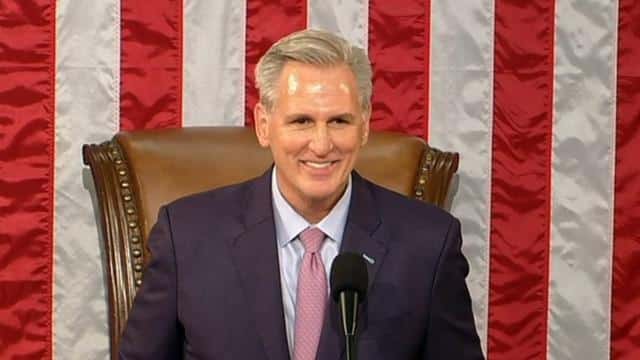
Kevin McCarthy elected US House Speaker after 15 rounds of voting
Kevin McCarthy has been elected Speaker of the US House of Representatives after heated exchanges which almost saw fellow Republicans come to blows.
It took 15 rounds of voting for Mr McCarthy to win the job, despite his party having a majority in the chamber.
It came after a dramatic pressure campaign played out live on the House floor as party rebel Matt Gaetz was urged to vote for Mr McCarthy.
The Florida Congressman was among six holdouts who relented late on Friday.
Earlier, amid heated scenes in the chamber, Mr Gaetz had almost come to blows with Rep Mike Rogers – a supporter of Mr McCarthy. The Alabama congressman had to be physically restrained by colleagues as he bellowed and jabbed his finger at Mr Gaetz. Media caption,
Watch: The dramatic moment in Congress annotated
The Speaker sets the House agenda and oversees legislative business. The post is second in line to the presidency after the US vice-president.
Speaking after his confirmation, Mr McCarthy wrote on Twitter: “I hope one thing is clear after this week: I will never give up. And I will never give up for you, the American people.”
Mr McCarthy told reporters that former President Trump had helped him get the final votes: “I don’t think anybody should doubt his influence”.
“He was with me from the beginning… he would call me and he would call others,” he said.
US President Joe Biden congratulated Mr McCarthy for his win and said he looked forward to co-operating with the Republican Party.
“The American people expect their leaders to govern in a way that puts their needs above all else, and that is what we need to do now,” he said.
Republicans have already pledged to launch investigations into Mr Biden’s family business dealings and administration.
In a remarkable turnaround in the 12th round of voting, Mr McCarthy was able to persuade 14 Republican holdouts to cast their vote for him. A 15th rebel followed suit for the 13th ballot.
After the 13th ballot was adjourned, Mr McCarthy insisted to reporters that he would “have the votes” to take the speakership on the next round.
But the California congressman was still three votes short of the 217 he needed to take the prized gavel, and in chaotic and dramatic scenes, he again failed to win on the 14th ballot.
The dissidents included members of the House Freedom Caucus, who argue that Mr McCarthy is not conservative enough to lead them as they work to try to oppose Democratic President Joe Biden’s agenda.
Mr McCarthy has offered various concessions to the rebels, including a seat on the influential rules committee, which sets the terms for debate on legislation in the chamber.
He also agreed to lower the threshold for triggering a vote on whether to unseat the Speaker, to only one House member, leading to the possibility that the Republican coalition could easily fracture again even after Mr McCarthy’s victory.
As the last politician on the roll – Montana’s Ryan Zinke – voted, the House floor erupted in applause as it became clear Mr McCarthy had finally emerged victorious.
Mr McCarthy hugged other representatives and signed autographs, but across the room the Democrats’ side was completely silent. No democrat applauded.
Senior Democratic Party lawmakers accused Mr McCarthy of ceding power to an extreme wing of his party and likened the stand-off to the riot exactly two years ago on Capitol Hill by Trump supporters who disrupted Mr Biden’s certification as president.
“Two years ago insurrectionists failed to take over the Capitol,” Congressman Eric Swalwell wrote on Twitter. “Tonight Kevin McCarthy let them take over the Republican Party.”
And Virginia Congressman Don Beyer referred to the angry scenes among Republicans that followed the 14th count.
“Unsettling that this process ends in threats of violence in the House Chamber, on this of all days,” he said. “Maybe it didn’t determine the outcome, but that is no way to conduct the people’s business. A dark and sobering moment will probably be remembered long after this session ends.”
The minority Democrats had continued to vote in unison for their leader, New York’s Hakeem Jeffries, the first black person ever to lead a party in Congress.
Friday was the first day that Mr McCarthy’s vote count actually surpassed that of Mr Jeffries.
Mr McCarthy opened his acceptance speech joking; “that was easy, eh?”. He outlined a range of Republican policy objectives that included lowering prices, securing the US-Mexico border and combatting what he described as a “woke indoctrination”.
He said one of his primary goals was to stop “wasteful Washington spending”.
The lawmakers began leaving the Congress around 02:00 local time (07:00 GMT) on Saturday morning – 14 hours after the gavel first rang at noon.
Not since 1860 in the build-up to the American Civil War has the lower chamber of Congress voted this many times to pick a speaker. Back then it took 44 rounds of ballots.
Source: BBC
-
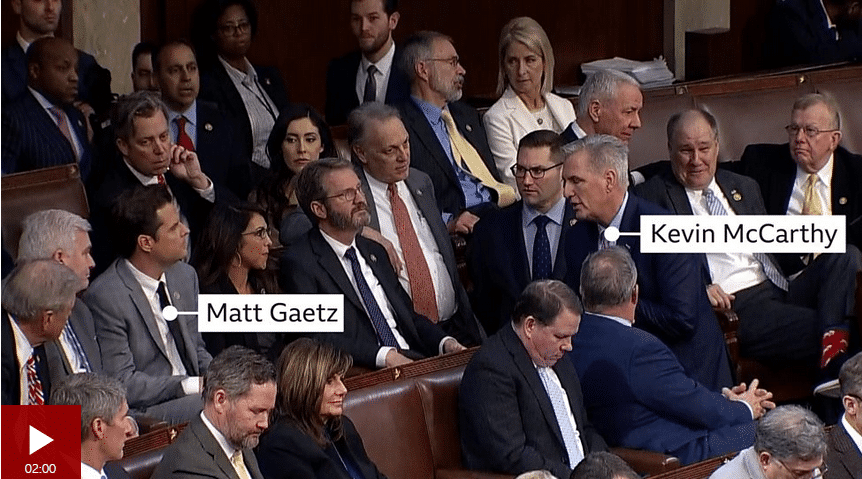
Heated exchange between McCarthy and Gaetz
This was the dramatic moment when tensions flared on the floor of the House of Representatives after 14 rounds of voting for a new Speaker.
We’ve annotated the video so you can follow who’s who as Kevin McCarthy challenges his fiercest critic Matt Gaetz.
Source : Ghanaweb -
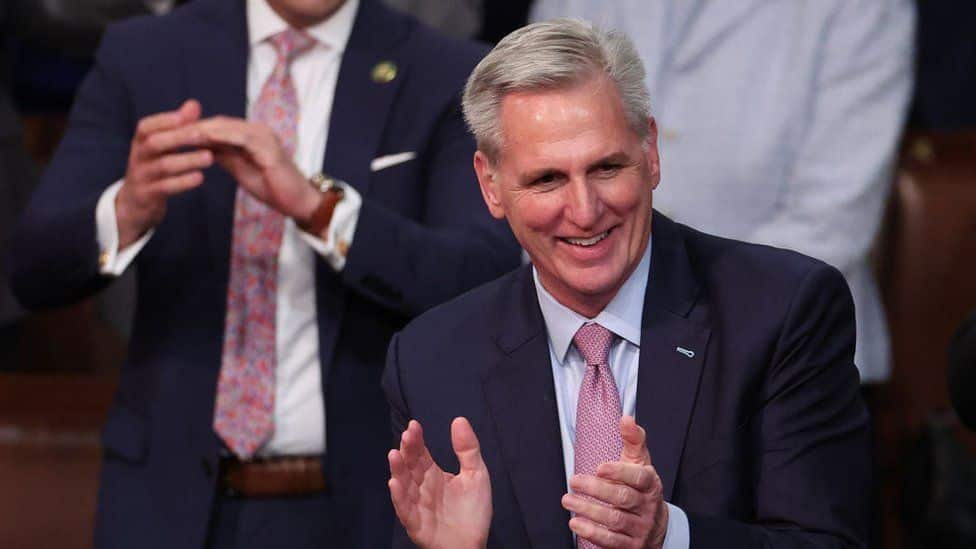
US has a new Speaker, Kevin McCarthy
Kevin McCarthy was selected as the new Speaker of the US House of Representatives following tense debates that nearly led to physical altercations between Republican Party members.
Despite holding a majority in the house, Mr. McCarthy’s party had to endure 15 voting rounds before its victory was certified.
On the House floor before the vote, a spectacular lobbying effort was launched to persuade party defector Matt Gaetz to support Mr. McCarthy.
Late on Friday, six holdouts—among them the Florida congressman—decided to give up.
Rep. Mike Rogers, a McCarthy supporter, and Mr. Gaetz previously got into tense arguments in the chamber and came dangerously close to fighting.
Mr. Gaetz was forcibly detained by his colleagues after the Alabama lawmaker shouted and pointed a finger at him.
The Speaker sets the agenda for the House and is in charge of all legislative business. The post is second in line for the presidency after the US vice president.
Speaking after his confirmation, Mr McCarthy wrote on Twitter: “I hope one thing is clear after this week: I will never give up. And I will never give up for you, the American people.”
US President Joe Biden congratulated Mr McCarthy for his win and said he looked forward to co-operating with the Republican Party.
“The American people expect their leaders to govern in a way that puts their needs above all else, and that is what we need to do now,” he said.
Republicans have already pledged to launch investigations into Mr Biden’s family business dealings and administration.
After the 13th ballot was adjourned, Mr McCarthy insisted to reporters that he would “have the votes” to take the speakership on the next round.
In a remarkable turnaround in the 12th round of voting, Mr McCarthy was able to persuade 14 Republican holdouts to cast their vote for him. A 15th rebel followed suit for the 13th ballot.
But the California congressman was still three votes short of the 217 he needed to take the prized gavel, and in chaotic and dramatic scenes, he again failed to win on the 14th ballot.
The dissidents included members of the House Freedom Caucus, who argue that Mr McCarthy is not conservative enough to lead them as they work to stymie Democratic President Joe Biden’s agenda.
Mr McCarthy has offered various concessions to the rebels, including a seat on the influential rules committee, which sets the terms for debate on legislation in the chamber.
He also agreed to lower the threshold for triggering a vote on whether to unseat the Speaker, to only one House member, leading to the possibility that the Republican coalition could easily fracture again even after Mr McCarthy’s victory.
Senior Democratic Party lawmakers accused Mr McCarthy of ceding power to an extreme wing of his party and likened the stand-off to the riot exactly two years ago on Capitol Hill by Trump supporters who disrupted Mr Biden’s certification as president.
“Two years ago insurrectionists failed to take over the Capitol,” Congressman Eric Swalwell wrote on Twitter. “Tonight Kevin McCarthy let them take over the Republican Party.”
And Virginia Congressman Don Beyer referred to the angry scenes among Republicans that followed the 14th count.
“Unsettling that this process ends in threats of violence in the House Chamber, on this of all days,” he said. “Maybe it didn’t determine the outcome, but that is no way to conduct the people’s business. A dark and sobering moment will probably be remembered long after this session ends.”
The minority Democrats had continued to vote in unison for their leader, New York’s Hakeem Jeffries, the first black person ever to lead a party in Congress.
Friday was the first day that Mr McCarthy’s vote count actually surpassed that of Mr Jeffries.
Not since 1860 in the build-up to the American Civil War has the lower chamber of Congress voted this many times to pick a speaker. Back then it took 44 rounds of ballots.
In November’s midterm elections, Republicans won the House by a weaker-than-expected margin of 222 to 212. Democrats retained control of the Senate.
-
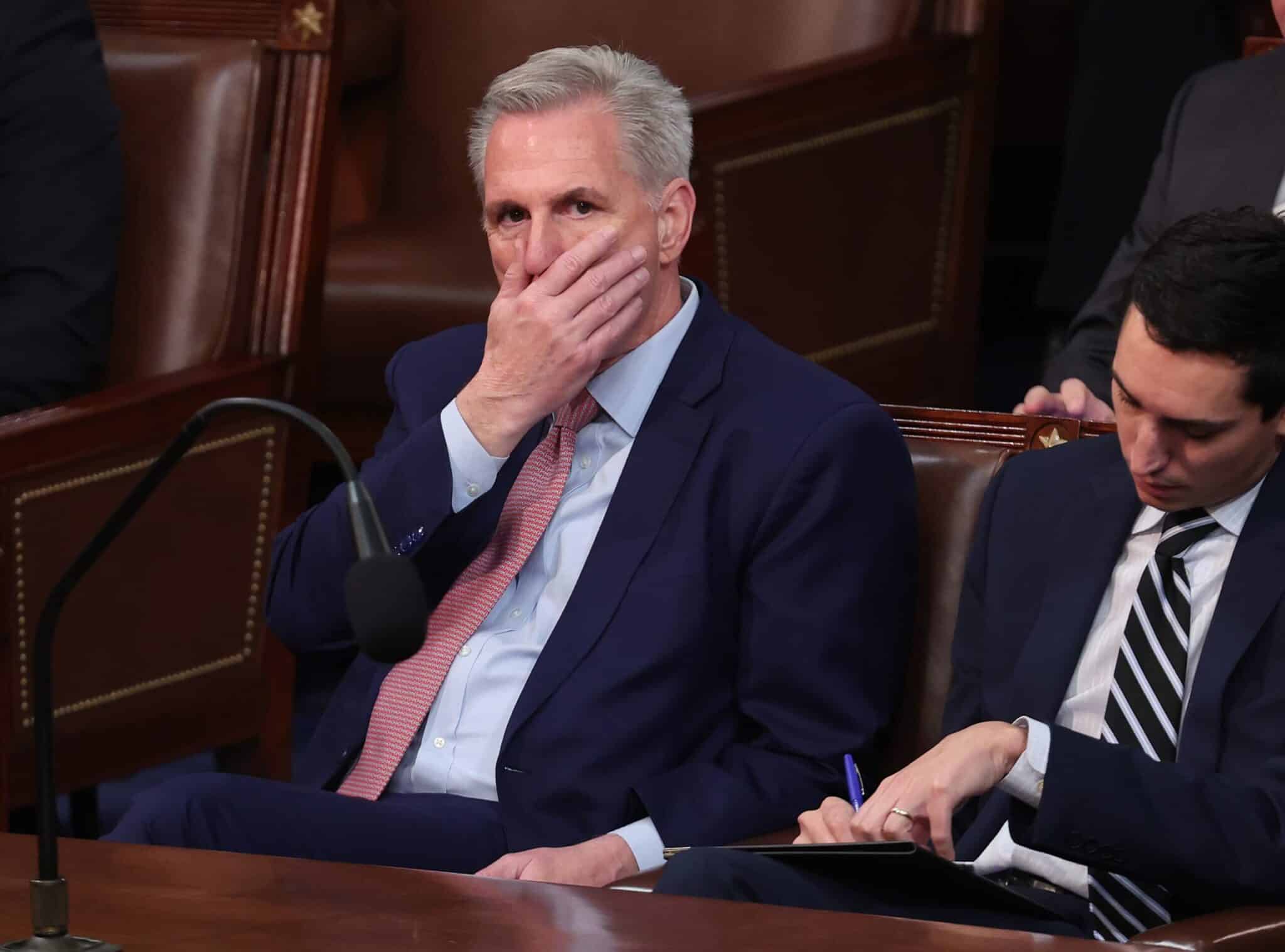
US House in disarray after Kevin McCarthy fails to secure speaker votes
Republican leader Kevin McCarthy repeatedly failed in his bid to be elected Speaker of the US House of Representatives on a day of political drama not witnessed in Congress in a century.
On Tuesday evening, the House adjourned without electing a speaker, the first time this had happened since the first round of elections in 1923.
The beginning of a new Congress was meant to be the Republican Party’s victory lap after winning control of the lower chamber in the elections held in November. Instead, he encountered an internal uprising and made history for all the wrong reasons.
The California congressman has lost three consecutive votes for Speaker so far, and it’s unclear what his path to victory could be when the House returns on Wednesday to try all over again. They will keep voting until someone wins a majority.
And even if Mr McCarthy finds a way, analysts warn, the turmoil on the floor of the House foreshadows a tumultuous two years of moderate and right-wing Republicans at war with each other.
‘Negotiations made him look weak’
Republicans narrowly won control of the House in November, so Mr McCarthy only had a few votes to spare in his bid to become Speaker. That allowed a group of hardline conservatives to band together to oppose his nomination.
The rift was a long time coming, according to Republican observers.
“Kevin McCarthy has not made friends with certain segments of the caucus for a while; he’s made a lot of enemies,” said one Republican lobbyist, who requested anonymity to speak frankly about Tuesday’s vote. “There’s people who don’t like him for political reasons, for personal reasons.”
Mr McCarthy entered into negotiations with his detractors – who see him as too mainstream and power hungry – offering concessions to try to win their vote. At one point, he reportedly agreed to change the House rules to make it easier to oust a sitting Speaker, handing his opponents an enormous check on his power.
“The fact he was negotiating with the Republicans at all made him look very, very weak to the point of being desperate,” the Republican lobbyist said.
His opponents feel emboldened
The futility of that approach became clear on Tuesday.
In three consecutive votes, Mr McCarthy failed to reach the required 218 vote threshold. Though Republicans hold 222 seats, a bloc of 19 hard-right Republicans had solidified in opposition to him. They oppose Mr McCarthy on ideological and personal grounds, but also see an opportunity to exploit Republicans’ narrow majority to force further concessions from him.
They would “never back down,” Representative Rob Good, a Virginia Republican, told reporters on Tuesday.
In one of the day’s most dramatic moments, they even nominated Representative Jim Jordan to challenge him, just moments after Mr Jordan himself nominated Mr McCarthy for Speaker.
Even after Mr Jordan – who is a leading figure in the hard-right Freedom Caucus – urged Republicans to “rally around” Mr McCarthy in the third round of voting, 20 Republicans voted for Mr Jordan, again denying victory to Mr McCarthy.
Meanwhile, Democrats remained unified behind their party’s new leader, Representative Hakeem Jeffries of New York.
A few could not help publicly teasing their Republican counterparts about their party’s difficult afternoon. One congressman, Ruben Gallego of Arizona, tweeted that Democrats were “breaking the popcorn out,” and as evidence included a photo of the snack.
What are McCarthy’s options now?
Political observers in Washington have begun spinning out various theories about how this all could end. Their predictions to the BBC ranged from the feasible (Mr McCarthy holds out and wins, but walks away seriously weakened) to the entirely possible (he bows out and backs his second in command, Representative Steve Scalise of Louisiana). One suggestion verged on fantasy (five Republicans decide to vote for Mr Jeffries, a Democrat, and deliver him control of the House).
As it stands, Mr McCarthy is “essentially hostage to one side of his party,” said Ruth Bloch Rubin, a political scientist at the University of Chicago who studies partisanship.
Mr McCarthy has pledged not to make any more concessions, but may not have a choice. He could try to win over obstinate lawmakers with plum committee assignments or new leadership roles.
“He’s got to give the people who are against him something to hang their hat on,” said Aaron Cutler, a lobbyist who once worked for former congressman Eric Cantor, another politician who was ousted by conservative opposition. The other Republican lobbyist, however, believed there was “no path to victory, at all, period.”
Members will reconvene for a fourth time on Wednesday, though it’s unclear if the stalemate will break.
“We haven’t heard anything new from McCarthy,” one of the conservative holdouts, Representative Lauren Boebert of Colorado, told reporters. “So I guess we’ll just keep doing this.”
Source: BBC.com -
WATCH: Top Republican McCarthy says his party will take control of House
Representative Kevin McCarthy, who was backed by former US President Donald Trump for speaker, has given a statement to say that Republicans will take control of the House of Representatives.
His party, he said, would “get America back on track”.
“Let me tell you, you’re out late, but when you wake up tomorrow, we will be in the majority and Nancy Pelosi will be in the minority.”
The vote for speaker is an internal process and only House members cast a vote. The current speaker of the House is Democrat Nancy Pelosi.
As we’ve been reporting, Republicans are looking likely to take control of the House but final results are not yet in.
Source: BBC