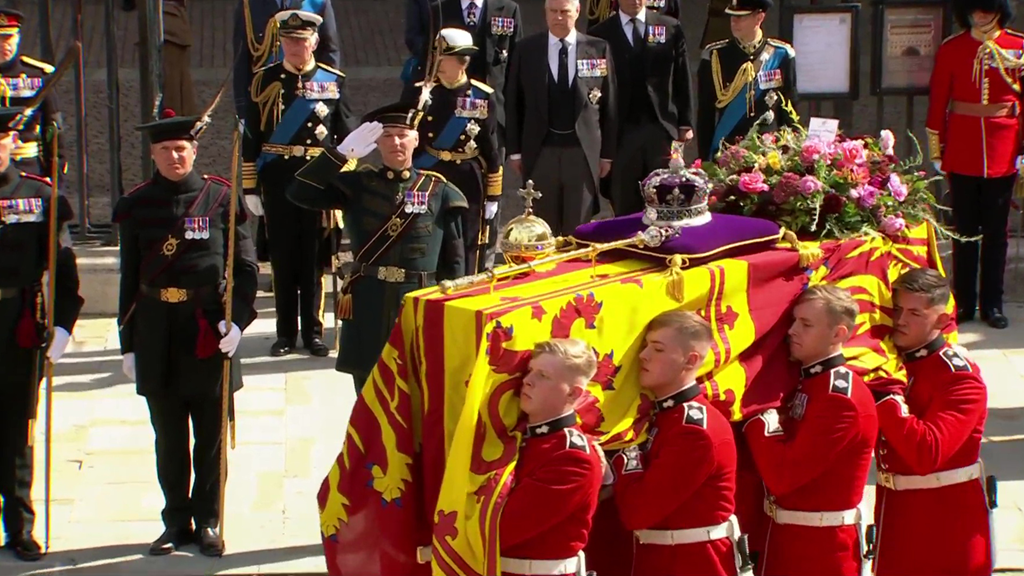
The Queen’s coffin has been carried into St George’s Chapel for the committal service.
This will be led by the Dean of Windsor, David Conner.
It starts with the coffin procession entering the chapel and proceeding down the nave to lay the Queen’s coffin in the quire.
Most of the congregation were not at Westminster Abbey earlier in the day, and this second service has been designed with royal staff in mind.
Many are past or present employees of the Queen’s estates.
Notable politicians are expected to be in attendance alongside the Royal Family and members of their households.
The simple service now taking place at St George’s Chapel was all agreed with the Queen before her death. It will be led by David Conner, Dean of Windsor.
The Blessing will be pronounced by Justin Welby, Archbishop of Canterbury.
Here, St George’s Chapel, is where the day’s events will come to a close.
This evening, the Queen will be laid to rest alongside her late husband, the Duke of Edinburgh.
She’ll be buried in the royal vault of King George VI’s Memorial Chapel – part of St George’s Chapel.
That will be in a service for the Royal Family which will be small-scale and highly private in nature.
Among others, he spoke to political leaders and some royal leaders with close ties with the British monarchy.
According to a list shared by Cameron Walker, a Royal Reporter with GB News, King Charles spoke to the ‘King of Ashanti,’ as well as Presidents of Ghana, the United Arab Emirates and Egypt and Prime Minister of Bangladesh.
President Akufo-Addo and First Lady Rebecca Akufo-Addo have been spotted in London along with other world leaders attending the funeral of Queen Elizabeth II.
A formal invitation to the Asantehene was also formally invited via the Foreign and Commonwealth Office, FCO. A later report indicates that the Asantehene also communicated his inability to attend the funeral.
The world’s longest serving leader, Her Majesty Queen Elizabeth II, was pronounced dead on Thursday, September 8, 2022, via a statement from the royal family.
Born on April 21, 1926, the Queen, christened Elizabeth Alexandra Mary, immediately acceded the British throne on February 6, 1952, when her father, King George VI died.
She became queen at the age of 25 and remained on the throne for seven decades before her death.
Elizabeth II was Queen of the United Kingdom and Head of State for 14 other jurisdictions.
Queen Elizabeth’s eldest son Charles, 73, has been named succesor and by that becomes king of the United Kingdom and the head of state of 14 other realms including Australia, Canada and New Zealand. His wife Camilla becomes Queen Consort.
Reporter Jennifer Scott reports that Birmingham’s stunning and commandingSt. Peter’s Cathedral welcomed guests seeking shelter from the rain to watch the ceremony on a large screen.
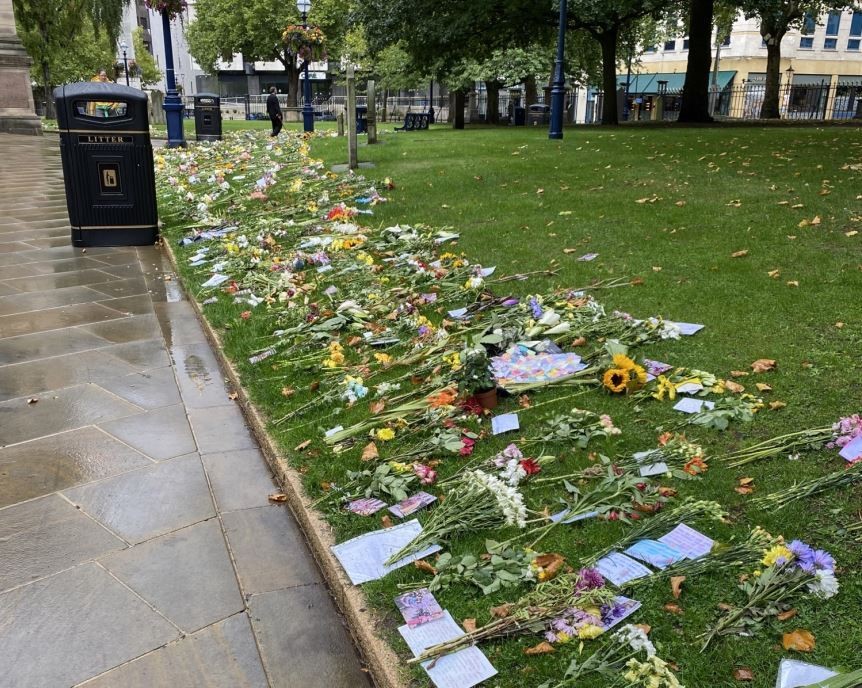
The graveyard was strewn with flowers – and a few jars of marmalade – in memory of the Queen.
Inside, though, the religious element of the day – something which influenced Her Majesty’s life so strongly – was keenly felt.
The congregation joined in the Lord’s Prayer, dutifully said “amen” to every offering, and quietly sang hymns to themselves as the sacred music filmed the room.
And, as the service drew to a close, people stood unprompted to sing God Save the King, a few tears falling in memory of his predecessor.
But many seemed to find comfort from sharing it in the holy venue and, perhaps fittingly, the sun came out just as the Queen’s coffin was carried from Westminster Abbey and as people began to leave Birmingham Cathedral, too.
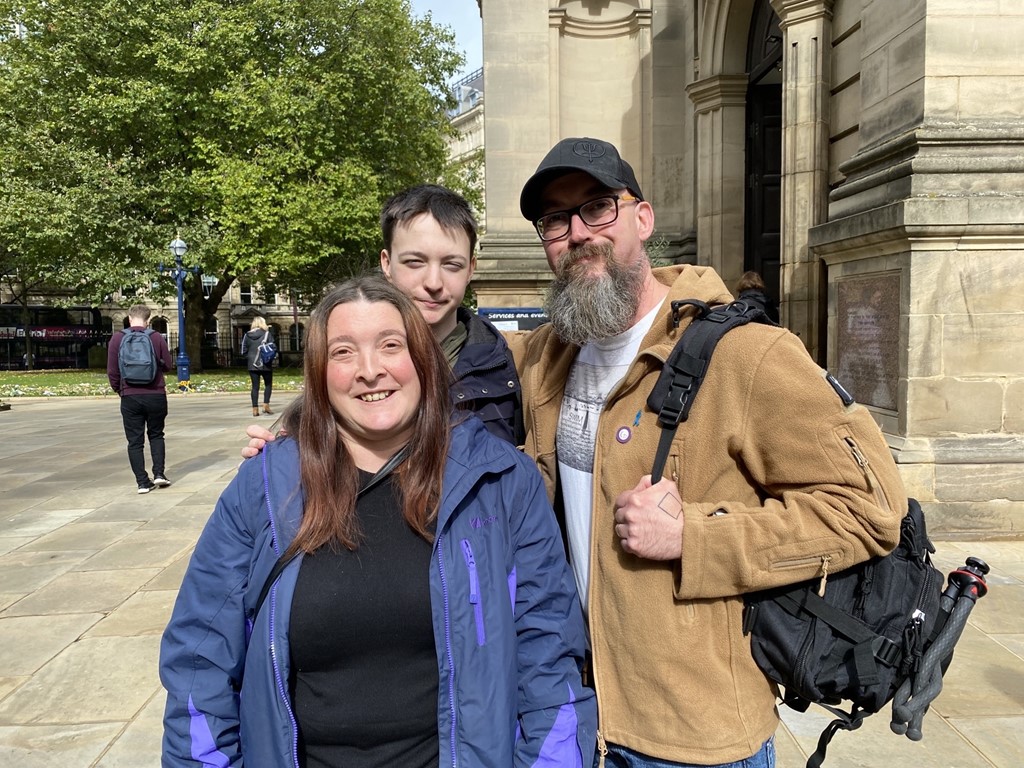
Matt and Corinne Wakefield came with their son Samuel to watch the funeral in the cathedral because they wanted to witness history.
“It was emotional,” said Matt, who saw the Queen once when she visited nearby Dudley.
“But there was a real sense of national pride, too.
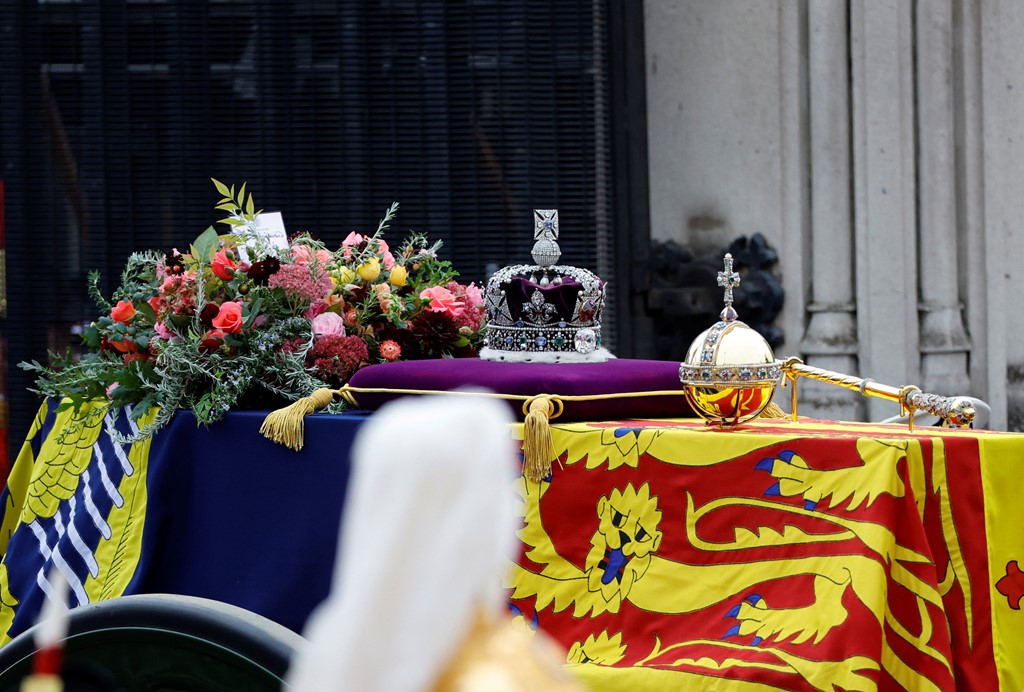
A card in the flowers ontop of the Queen’s coffin read simply: “In loving and devoted memory. Charles R.”
The note was placed on top of a wreath of flowers.
Cut from the gardens of Buckingham Palace, Clarence House, and Highgrove House, the flowers and foliage have been chosen for their symbolism.
They include rosemary, for remembrance, and myrtle cut from a plant that was grown from a sprig of myrtle in the Queen’s wedding bouquet, an ancient symbol of a happy marriage.
As far as the eye can see, there are people on Windsor’s The Long Walk, says journalist Becky Cotterill.
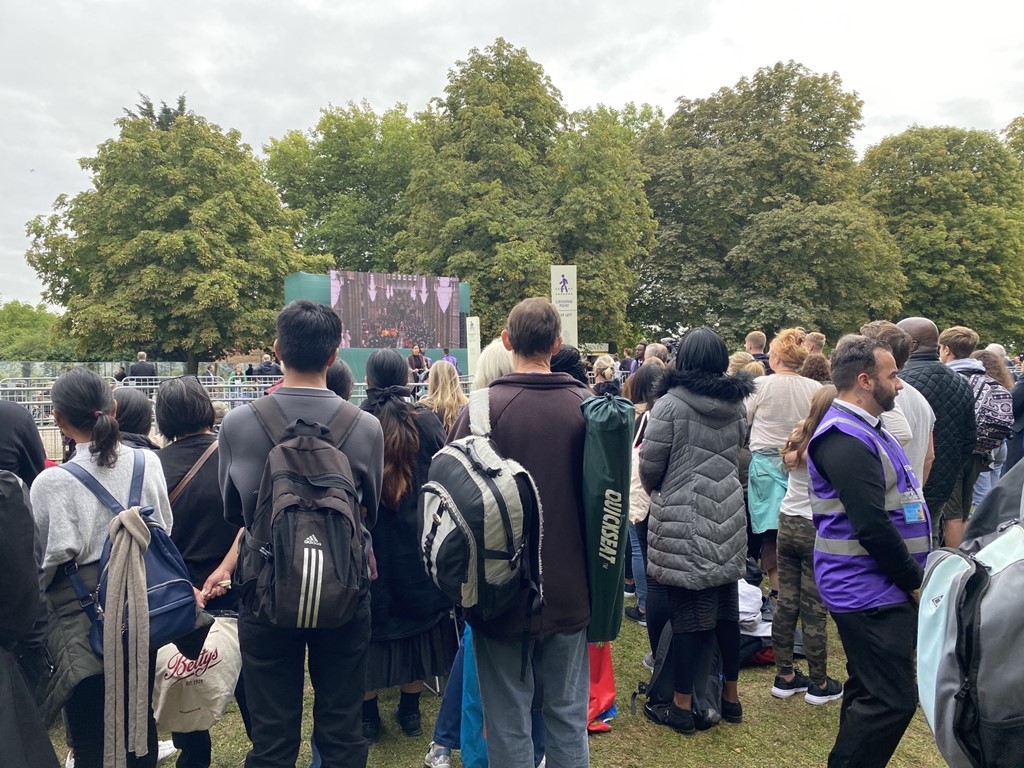
Screens have also been established so mourners can watch the state funeral take place.
Just after 3 pm this afternoon, The State Hearse will travel up The Long Walk to St George’s Chapel for the committal service.
There will be a procession led by a dismounted attachment of the Household Cavalry, with pipers and drums and a band from the Coldstream Guards. Members of the Queen’s personal staff will follow.
During the funeral, members of the Royal Family sat in front of the Queen’s coffin.
Vice Admiral Sir Tim Laurence, the Duke of York, the Earl of Wessex, and the Countess of Wessex were seated in the front row with King Charles III, the Queen Consort, and Princess Royal.
King Charles ordered specific flowers for the Queen’s funeral wreath, which also features a personal note from the new king.
The flowers and greenery were selected for their symbolic meaning and were taken from the gardens of the Queen-loved homes Buckingham Palace, Clarence House, and Highgrove House.
They include rosemary, for remembrance, and myrtle cut from a plant that was grown from a sprig of myrtle in the Queen’s wedding bouquet.
Myrtle is often seen as a symbol of a happy marriage and evokes images of the Queen’s 70-year marriage to Prince Philip.
Also included are English oak to symbolize the strength of love, pelargoniums, garden roses, autumnal hydrangea, sedum, dahlias, and scabious.
These are in shades of gold, pink and deep burgundy, with touches of white, to reflect the Royal Standard.
Also at the King’s request, the wreath has been made in a sustainable way, in a nest of English moss and oak branches.
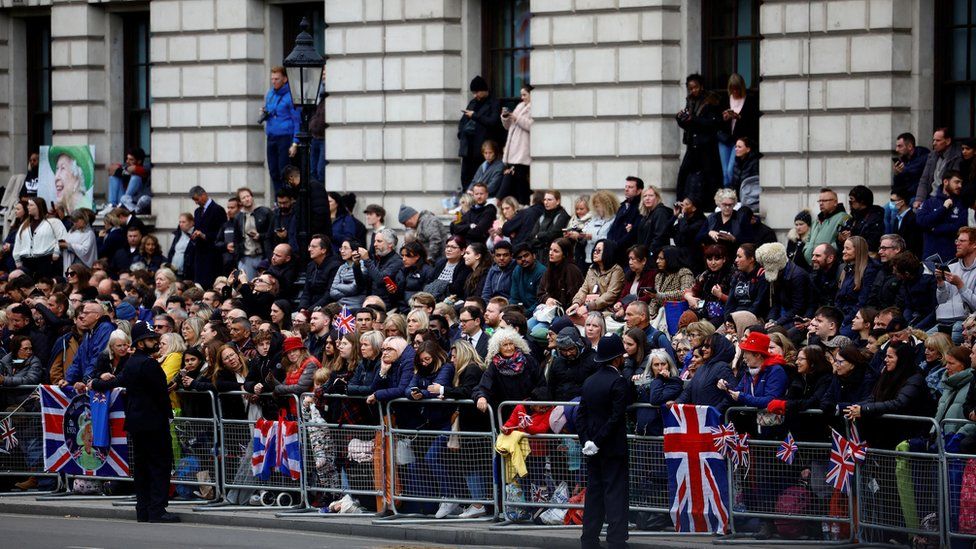
Hundreds of thousands of people gathered to catch a glimpse of the Queen’s funeral procession, while guests from around the world took their places in the abbey.
A bell in Westminster Abbey tolled 96 times, counting out the years of Queen Elizabeth II’s long life.
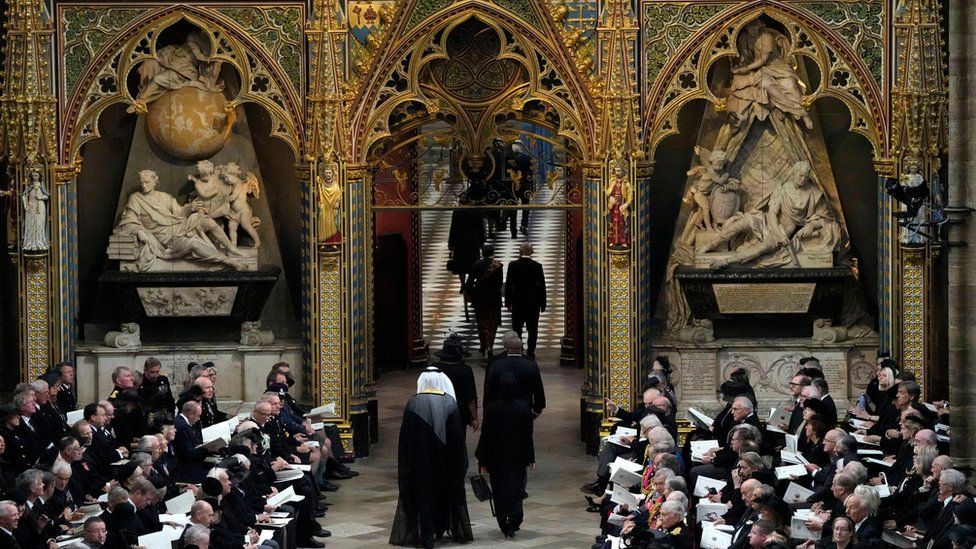
Inside the abbey, it’s bristling with uniforms, famous faces and clusters of dignitaries being ushered into pews below the statues and memorials.
Today’s politicians looked up at stone monuments to yesterday’s leaders. About 500 leaders and dignitaries from the UK and around the world joined the congregation at Westminster Abbey.
An organ played over a sea of black clothes and hats, seats filling up under the high gothic arches.
US President Joe Biden and his wife Jill arrived at the abbey. They flew in on Saturday.
The doors of Westminster Abbey have opened ahead of the state funeral of Britain’s longest-reigning monarch, Queen Elizabeth II.
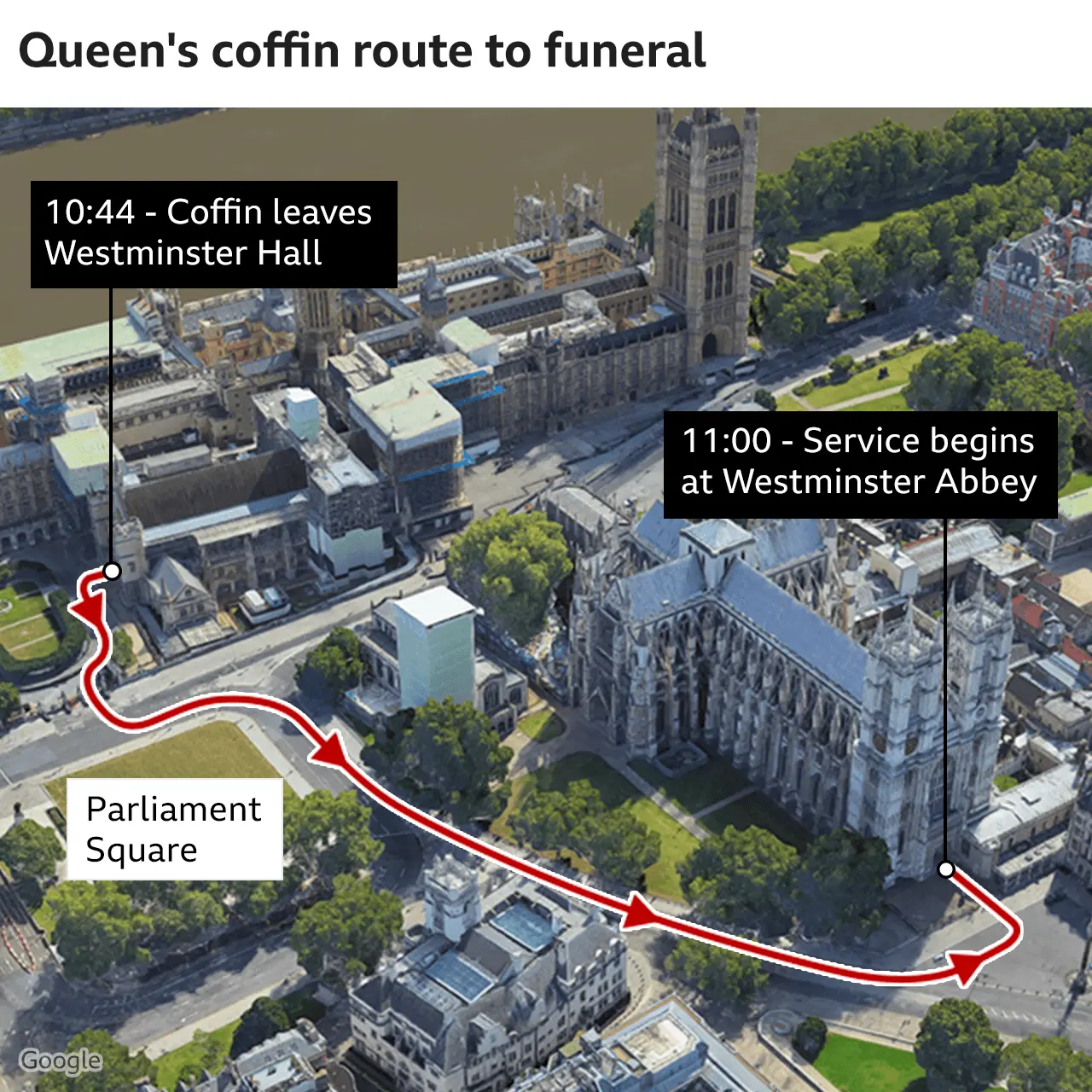
King Charles III will lead a sombre procession behind his mother’s coffin on the short journey from Westminster Hall to the abbey later.
The abbey’s bell has started to toll once a minute ahead of the service which will begin at 11:00 BST.
It marks the end of 10 days of events across the UK since the Queen’s death.
As London prepares for as many as one million visitors for the historic occasion, roads and bridges are closed to traffic and an unprecedented security operation is under way.
All public viewing areas for the procession are already full, London’s City Hall said.
Before the service begins, the Queen’s coffin will be conveyed – in the first of three processions throughout the day – through Parliament Square, a distance of about 820ft (250m).
The Prince of Wales and the Duke of Sussex will once more walk side-by-side behind their father, the King, who will walk alongside his siblings, the Queen’s four children.
Two of the Queen’s great-grandchildren, Prince George, nine, and Princess Charlotte, seven, will also walk behind the Queen’s coffin.
The State Gun Carriage will carry the coffin, drawn by 142 sailors. A guard of honour will stand in the square made up of all three military services, accompanied by a Royal Marines band.
The final people to attend the Queen’s lying-in-state paid their respects at Westminster Hall just after 06:30 – after four-and-a-half days and a queue which stretched as far as Southwark Park in south-east London.
Some 2,000 mourners will bid farewell to the Queen at the state funeral, including 500 dignitaries – with presidents, prime ministers and foreign royalty among the guests.
US President Joe Biden, as well as French President Emmanuel Macron, Canadian Prime Minister Justin Trudeau and Ukraine’s first lady Olena Zelenska will be at the abbey.
There will also be members of many European royal families, including Belgium, the Netherlands, Spain and Denmark, as well as the Emperor and Empress of Japan.
Labour leader Sir Keir Starmer, the UK’s chief medical adviser Prof Chris Whitty, Business Secretary Jacob Rees-Mogg and Northern Ireland’s former first minister Arlene Foster are among those to have arrived at the abbey.
About 200 people who were recognised in the Queen’s birthday honours also received invitations.
Knife crime campaigner Natalie Queiroz told BBC Breakfast she was “totally speechless” when she was asked to attend.
“I think it reflects Her Majesty because she wanted to constantly be in touch with her people and even on her final moments she’s made sure that her people are here represented.”
Barbara Crellin, a volunteer emergency responder, said she “just cried and cried” when she was invited and described herself as “so humbled and privileged to be here”.
IMAGE SOURCE,PA MEDIA Image caption, Guests arrive at Westminster Abbey
Foreign dignitaries are also arriving at the Royal Hospital Chelsea, from where they will be transported on busses to Westminster Abbey.
Some 4,000 service personnel will be involved throughout the day and people have already begun to line the streets of the capital in preparation for a glimpse of the Queen’s final journey.
Millions of people will be watching the funeral across the country and most workplaces are closed for a bank holiday.
IMAGE SOURCE,REUTERS Image caption, All viewing areas for the procession are full
The event is also expected to be watched by millions around the world, with the Queen the head of state for 14 realms throughout the Commonwealth.
For those not invited big screens have been put up in cities across the country, while some cinemas, pubs and other venues are also showing the once-in-a-generation event.
This is the first state funeral to be held since Sir Winston Churchill’s in 1965.
The service will be conducted by the Dean of Westminster David Hoyle, with the Archbishop of Canterbury Justin Welby giving the sermon.
The Order of Service shows a service filled with traditional church music and readings from the Bible.
Towards the end the Last Post will be played before there will be a two-minute national silence.
Following the service, the coffin will be drawn in a walking procession from the Abbey to Wellington Arch, at London’s Hyde Park Corner, to the sombre toll of Big Ben.
Gun salutes will also fire every minute from Hyde Park during the procession and people can watch in person from designated viewing areas along the route.
Once at Wellington Arch, at about 13:00, the coffin will be transferred to the new State Hearse for its final journey to Windsor Castle. There, the Queen’s coffin will enter St George’s Chapel for a committal service.
Attended by a smaller congregation of about 800 guests, the committal service will be conducted by Dean of Windsor David Conner, with a blessing from the Archbishop of Canterbury.
At a private family service later, the Queen will be buried alongside her late husband, the Duke of Edinburgh, at the King George VI memorial chapel, located inside St George’s Chapel.
The statement Prince Andrew made in honour of the Queen was accompanied by a black and white photo of his mother cradling him as a baby in March 1960. Prince Andrew is no longer a working royal.
“Mummy, your love for a son, your compassion, your care, and your confidence I will keep forever,” the Duke of York said in a tribute to the Queen.
In memory of his brother Charles, he concluded it with the phrase “God Save The King.”
The Duke of York said he would miss the late monarch’s “insights, advice, and humour”, saying he “found your knowledge and wisdom infinite”.
The statement read: “Dear Mummy, Mother, Your Majesty, three in one. Your Majesty, it has been an honour and privilege to serve you.
“Mother – of the nation, your devotion and personal service to our nation is unique and singular; your people show their love and respect in so many different ways and I know you are looking on honouring their respect.
“Mummy, your love for a son, your compassion, your care, your confidence I will treasure forever. I have found your knowledge and wisdom infinite, with no boundary or containment.
Prince Andrew at vigil
“I will miss your insights, advice, and humour. As our book of experiences closes, another opens, and I will forever hold you close to my heart with my deepest love and gratitude, and I will tread gladly into the next with you as my guide.
“God save The King.”
Prince Andrew stepped down from public life over his friendship with paedophile billionaire Jeffrey Epstein in 2019.
He has been stripped of his honorary military roles, including Colonel of the Grenadier Guards, and has given up his HRH style.
At one point during the commemorations for the Queen’s death, he was heckled by a man in the crowd.
The Duke of York has settled a civil sexual assault case against a woman he claimednever to have met. The exact amount of the settlement has not been disclosed, but some reports at the time put it at £12m.
Virginia Giuffre sued him for allegedly sexually assaulting her when she was 17 after she was trafficked by Epstein.
For a two-day visit to celebrate Queen Elizabeth II, President Joe Biden flew into London late on Saturday. According to the president, the long-reigning monarch “shaped an era.”
Biden, who visited the late sovereign last year and said later that she reminded him of his mother, is joining leaders from a considerable number of other countries to pay their respects to the late sovereign.
For Biden, it is an opportunity to think back on a monarch whose life was a timeline of the most important historical events of the last 100 years and who personified a dedication to public service.
When Biden first encountered the Queen in 1982, his own Irish American mother admonished him not to show her any respect.
He didn’t bow down then, or when he met the Queen as President last year while attending a Group of 7 summits in England. But his respect for a woman whose constancy on the world stage over the last century was unparalleled has been plain.
“She was a great lady. We’re so delighted we got to meet her,” Biden said on the day that she died.
The Queen’s surprise decision last year to travel to the Cornish coast to meet world leaders at the G7 summit was a signal of her desire to remain engaged in global affairs.
Later that week, when she hosted Biden and first lady Jill Biden for tea at Windsor Castle, she inquired about two authoritarian leaders, Presidents Xi Jinping of China and Vladimir Putin of Russia, the President told reporters afterward.
“She had such curiosity. She wanted to know all about American politics, and what was happening. So, she put us at ease,” Jill Biden said recently in an interview with NBC.
At Sunday evening’s reception, Biden will see Charles for the first time since he became King. The two men have met previously and spoke last week by phone.
As Prince of Wales, Charles was a passionate campaigner for certain issues Biden has also championed, including combating climate change. It remains to be seen how involved the new King will be on those issues going forward.
Relatively close in age — Charles is 73, Biden is 79 — the two men have a shared experience of being in the public eye for decades before assuming their current roles as heads of state.
On his call with the King, Biden “conveyed the great admiration of the American people for the Queen, whose dignity and constancy deepened the enduring friendship and special relationship between the United States and the United Kingdom,” the White House said. “President Biden conveyed his wish to continue a close relationship with the King.”
Security in the British capital is at its highest level in memory as Biden and dozens of other world leaders convene to remember the late Queen, who met 13 sitting US Presidents during her reign.
White House aides have declined to provide specific security details for the President’s visit but say they are working well with their British counterparts to ensure the demands of presidential security are met.
Plans for the Queen’s funeral have been in place for years, allowing US advisers greater insight into precisely what will happen over the coming days as they make security arrangements.
The White House said it received an invitation only for the President and first lady, making for a slimmed-down American footprint.
Biden traveled with his national security adviser, communications director, and other personal aides aboard Air Force One to London.
When reports emerged last week that world leaders would be required to ride on a bus to the funeral, US officials were skeptical and shot down the suggestion Biden that would travel to Westminster Abbey in a coach.
In 2018, when other world leaders traveled together in a bus to a World War I memorial in Paris, then-US President Donald Trump traveled separately in his own vehicle. The White House explained at the time that the separate trip was “due to security protocols.”
The Queen’s death came at a moment of economic and political turmoil for the United Kingdom. A new prime minister, Liz Truss, entered office after months of uncertainty following the decision of her predecessor, Boris Johnson, to step down.
Truss invited several visiting world leaders to meet individually at 10 Downing Street this weekend. In the role for only a little more than a week, it will be Truss’ first time meeting face to face with many of her foreign counterparts.
While her office initially said Biden would be among the leaders visiting Downing Street, it was later announced that Truss and the President would meet for formal bilateral talks on Wednesday on the sidelines of the United Nations General Assembly in New York.
A host of issues are currently testing the US-UK “special relationship,” which has been heralded repeatedly in the UK.
It was only two days after Truss traveled to Balmoral Castle in Scotland to formally accept the Queen’s appointment as prime minister that the long-reigning monarch passed away. Since then, the country has been in a formal period of mourning.
Truss inherited a deep economic crisis, fueled by high inflation and soaring energy costs, that has led to fears the UK could soon enter a prolonged recession. The challenges have been aggravated by Russia’s invasion of Ukraine, which has caused volatility in the oil and gas markets.
While few in the Biden administration shed tears at Johnson’s resignation– Biden once described him as the “physical and emotional clone” of Trump — the US and the UK were deeply aligned in their approach to Russia under his leadership.
White House officials expect that cooperation will continue under Truss, even as she comes under pressure to ease economic pressures at home.
Less certain, however, is whether Truss’s hard-line approach to Brexit will sour relations with Biden. The President has taken a personal interest in the particular issue of the Northern Ireland Protocol, a post-Brexit arrangement that requires extra checks on goods moving between Northern Ireland and the rest of the UK.
The rules were designed to keep the border between Northern Ireland and the Republic of Ireland open and avoid a return to sectarian violence. But Truss has moved to rewrite those rules, causing deep anxiety in both Brussels and Washington.
Biden, who makes frequent references to his Irish ancestry, has made his views clear on the issue, even though it does not directly involve the United States. Congressional Democrats have similarly expressed concern over any steps that could reignite the Northern Ireland conflict.
In their first phone call as counterparts earlier this month, Biden raised the matter with Truss, according to the White House.
A US readout of their conversation said they discussed a “shared commitment to protecting the gains of the Belfast/Good Friday Agreement and the importance of reaching a negotiated agreement with the European Union on the Northern Ireland Protocol.”
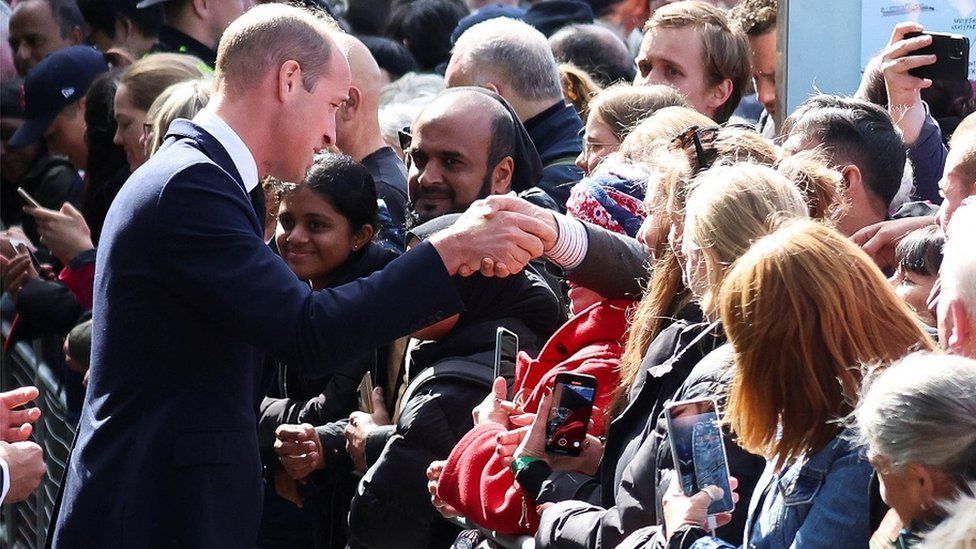
Those waiting in line to view the Queen lying in the state were surprised to see King Charles and Prince William.
The Prince of Wales told one young girl, “You’re over halfway,” as they praised people who had waited through the night.
William also mentioned how important it was to his family that there was a long line.
I hope you didn’t get too frozen, the King said to one in reference to the chilly overnight temps.
There were cheers of God Save the King, God Save the Prince of Wales, and hip hooray as the pair walked up and down the queue.
The queue time is now around 16.5 hours, with the line stretching five miles along the River Thames to Southwark Park.
One woman in the queue told the Prince of Wales she had been queuing for 13 hours already. He replied: “Thirteen hours? You’re looking very good on 13 hours.”
The Prince of Wales said he was sorry people had had to wait for so long
Those waiting in Lambeth, south London, told the pair the wait was “worth it” but William said he was sorry they had had to wait for so long.
The prince commented to one person waiting that their trainers were a good choice of footwear for the queue.
Several people cried after meeting Prince William, and one woman told him: “You’ll be a brilliant king one day.”
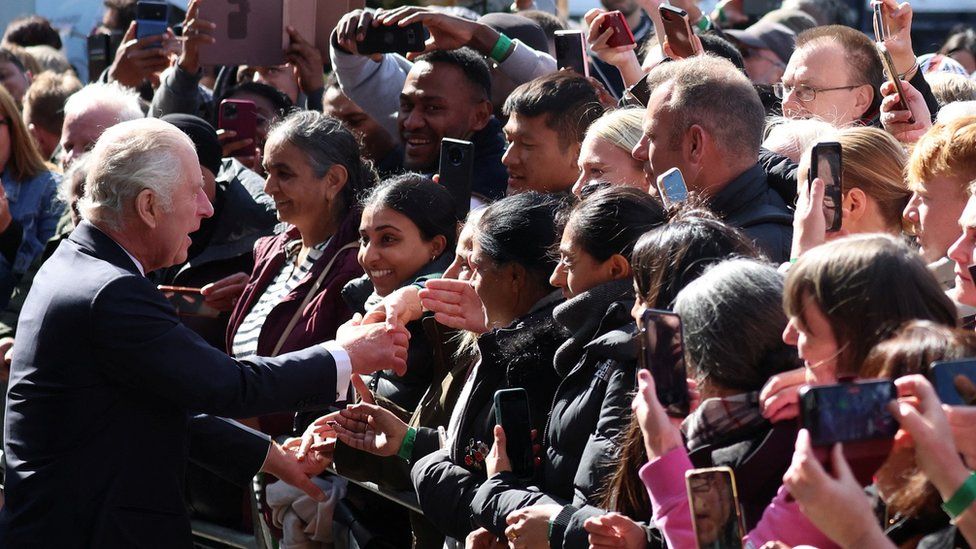
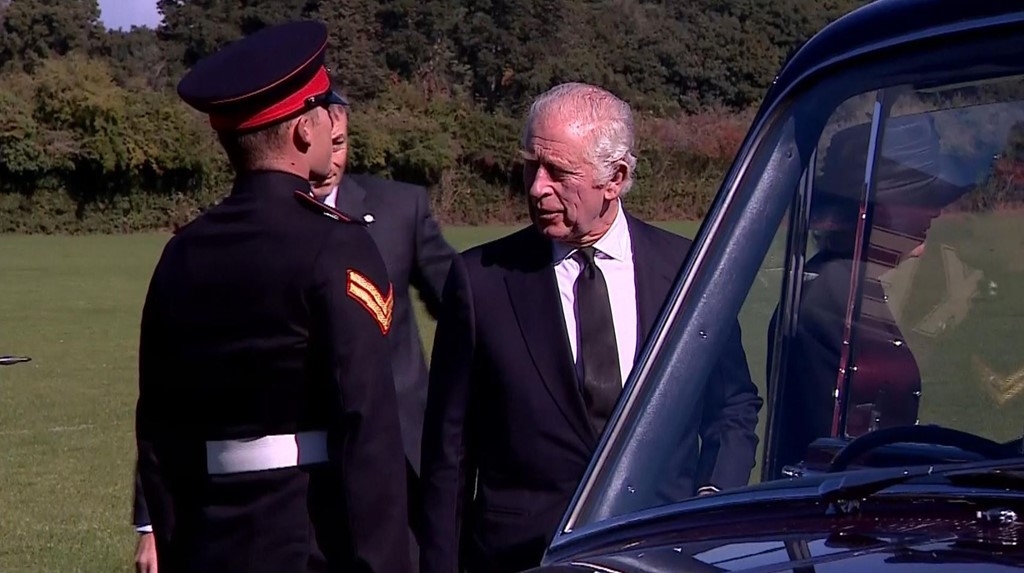
King Charles left around 20 minutes after arriving and was driven back to Buckingham Palace, but his son stayed longer to speak to more people.
King Charles shook people’s hands during the surprise visit
The beginning of King Charles’s reign has seen the Royal Family take part in several walkabouts and meetings with the public.
The Queen’s youngest son could be heard asking mourners where they had come from and whether they were making their way to Green Park to lay flowers.
The pair had come from a lunch held inside the palace by the King and Queen Consort for governors-general from Commonwealth countries.
Representatives from Antigua and Barbuda, Australia, the Bahamas, Belize, Canada, Grenada, New Zealand, Papua New Guinea, Saint Lucia, Saint Vincent and the Grenadines, the Solomon Islands, and Tuvalu were among those present, along with the Prince and Princess of Wales.
On Saturday evening, the Prince of Wales, his brother the Duke of Sussex and their cousins will stand guard around the Queen’s coffin, a day after their parents held their own vigil at the Palace of Westminster.
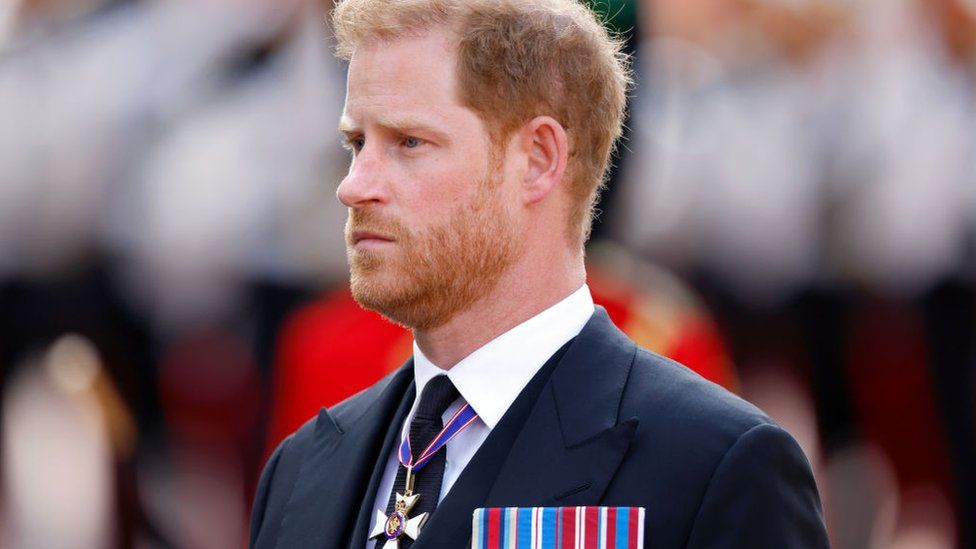
Prince Harry has been given permission by the King to wear a military uniform.
Saturday is the third full day the Queen’s coffin will lie in state in Westminster Hall, where she will remain until the morning of the funeral, on Monday.
The Prince of Wales and the Duke of Sussex will be among the grandchildren of the Queen who will keep watch over her coffin this evening as she lies in state in Westminster Hall.
Prince Harry will don a military uniform for the first time in 2020 at King Charles’ request.
Since the Queen’s passing, Prince Harry has appeared in public wearing regular clothes.
The King and the Queen’s children manned the guard duty for around ten minutes on Friday night.
As they left the hall, members of the public applauded them.
The grandchildren’s vigil is expected to last around 15 minutes.
The King’s two sons will be joined by Peter Phillips, Zara Tindall, Princesses Beatrice and Eugenie, Lady Louise Windsor, and James, Viscount Severn.
He served two tours in Afghanistan as part of the Army. He now lives in California with his wife Meghan and their two children.
Prince Harry wore a morning suit to walk behind the Queen’s coffin, while his brother wore a military uniform
Prince Andrew was also allowed to wear his military uniform as he stood guard on Friday. The 62-year-old stepped down as a working royal in 2019, after a Newsnight interview about his relationship with the late sex offender Jeffrey Epstein.
The prince was later stripped of his military titles.
Before the vigil, the Queen’s youngest child, Prince Edward, thanked the public for their support.
“We have been overwhelmed by the tide of emotion that has engulfed us and the sheer number of people who have gone out of their way to express their own love, admiration and respect to such a very special and unique person who was always there for us,” he said.
“And now, we are there for her, united in grief.”
The Queen will lie in state at Westminster Hall until her funeral on Monday. The queue to see the coffin stretches as far as Southwark Park. Officials have said if the park reaches capacity, entry will be paused.
At the park, there is a queue for wristbands and to join the queue properly. Further along, an LED display warns people of how long they should expect to wait. Many are anticipating a long stay, wearing parkas, hats, and big jumpers.
At 14:00 BST on Saturday, the government website said the waiting time was now up to 16.5 hours.
Foreign dignitaries are traveling to London ahead of Monday’s funeral, which will be one of the biggest diplomatic events of recent years, with some 500 heads of state and other dignitaries expected to attend.
Australian Prime Minister Anthony Albanese laid flowers in Green Park, central London, before meeting King Charles at Buckingham Palace on Saturday. Mr Albanese said it was a “great honour” to represent Australia and commemorate “a life well-lived”.
Meanwhile, King Charles is back in London, having completed a tour of the UK’s four nations.
On Saturday the King met the heads of the armed forces at Buckingham Palace and visited the Metropolitan Police’s headquarters, New Scotland Yard.
He then went to Lambeth Bridge, alongside Prince William, to shake hands and greet those queuing for the lying-in-state. He is meeting world leaders this afternoon.
A senior Metropolitan Police officer described the Queen’s funeral as “the largest single policing event [the force] has ever undertaken”.
Deputy Assistant Commissioner Stuart Cundy said the “hugely complex” operation surpasses the London 2012 Olympics – which saw up to 10,000 police officers on duty each day.
Events, moments of reflection, and public screenings of the funeral are also taking place across the UK this weekend, outside London.
In Blackpool, the tower illuminations – which were changed to red, white, and blue for the period of mourning – will be switched off at 20:00 on Sunday, when a national one-minute silence will take place.
King Charles III of Great Britain has extended an official invitation to the Asantehene to attend the state burial of Queen Elizabeth II.
Otumfuo Osei Tutu II was invited to the lying-in-state of the late queen as well as the king’s reception, state funeral service, and the foreign secretary’s reception, according to the invitation that was delivered by the Protocol Directorate of the Foreign, Commonwealth and Development Office of the British government on behalf of the king.
It further stated that the Asantehene could bring his spouse or a companion to the state funeral, which is set for Monday, September 19, 2022.
Otumfuo will be the second invitee to the queen’s funeral from Ghana, the first being President Nana Addo Dankwa Akufo-Addo who was reportedly invited as the president of Ghana, a Commonwealth nation.
Invitations have also been sent to all leaders from the Commonwealth nations.
So far, as the BBC reports, the Prime Minister of Australia, Anthony Albanese; New Zealand Prime Minister, Jacinda Ardern; and Canadian Prime Minister, Justin Trudeau, have all confirmed their participation in the funeral.
The Prime Minister of Bangladesh, Sheikh Hasina, and the Sri Lankan president, Ranil Wickremesinghe, have also reportedly accepted invitations.
Other world leaders who have confirmed they will be attending the state funeral include King Felipe and Queen Letizia of Spain, royal families of Norway, Sweden, and Demark, Belgium’s King Philippe and Queen Mathilde, President of the United States of America, Joe Biden and the First Lady Jill Biden.
View Otumfuo’s invitation below:
📌His Majesty Otumfuo Osei Tutu II, Asantehene, has received the invitation of His Majesty King Charles III to attend the events marking the State Funeral of Her Majesty Queen Elizabeth II.#Opemsuoradio#opemsuo1047pic.twitter.com/gxlFenGnzU
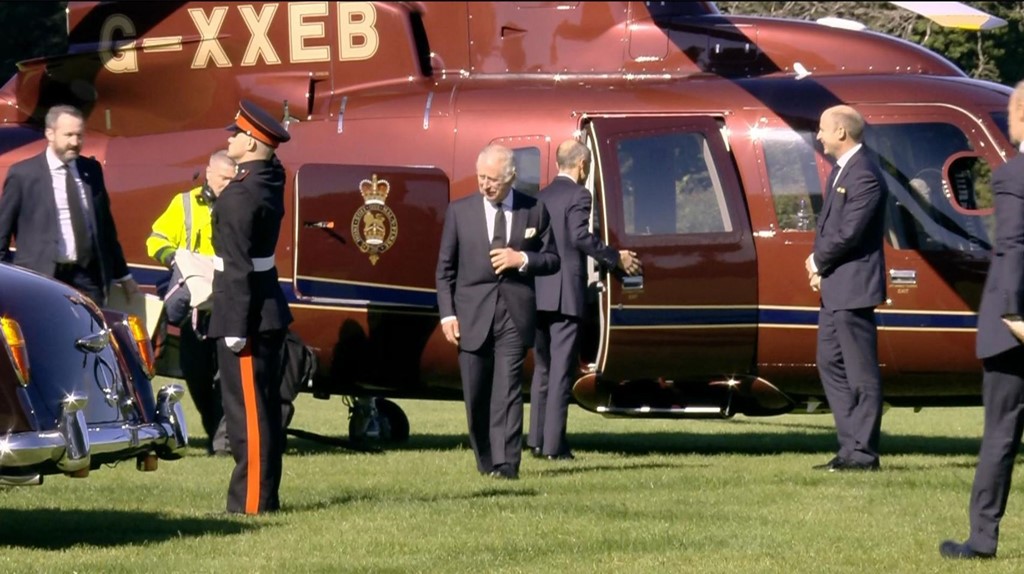
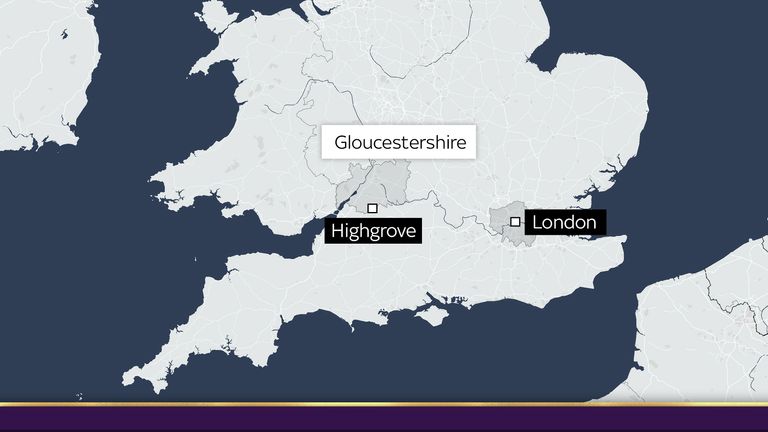
For a solitary day of reflection, King Charles has retired to his Highgrove palace in Gloucestershire.
A day was reserved for the incoming monarch to spend away from official duties at his family home as part of the London Bridge preparations for what would happen following the Queen’s passing.
Although it is thought he will be working in preparation for his new position and collecting his red boxes of state paperwork, he is not anticipated to attend any public events.
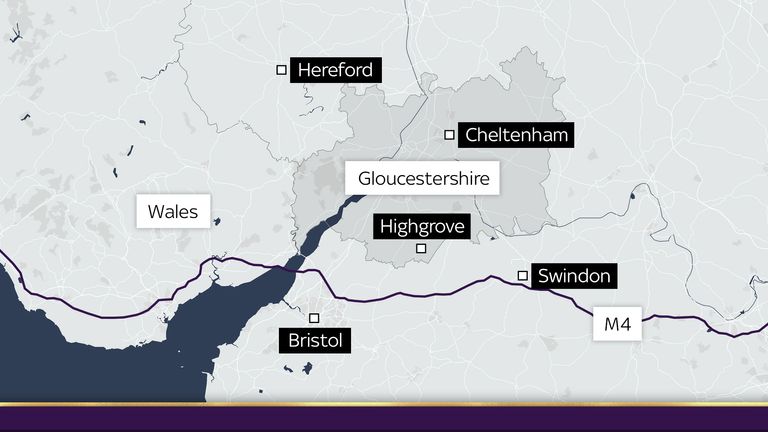
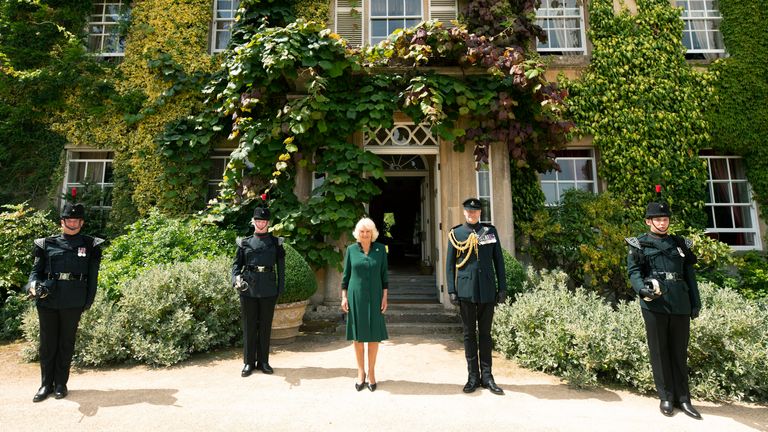
The King will spend his first day out of the public spotlight since the death of his mother at his beloved Highgrove House near Tetbury, Gloucestershire, a Georgian neo-classical house that serves as the private home for the monarch the Queen Consort.
A passionate gardener and environmentalist, King Charles has spent over 40 years transforming the gardens around the house.
over 40 years of transforming the gardens around the house.
The home has been owned by various families until it was purchased by the Duchy of Cornwall from former prime minister Harold Macmillan’s son, Maurice Macmillan, in 1980.
Image:The Prince of Wales in the gardens of his home in Highgrove
He and his then-wife Princess Diana renovated the property with neo-classical additions in 1987 and the interior was stripped out and redecorated.
The Duchess of Cornwall with her dog Beth at Highgrove
The King’s passion project has been the estate’s gardens, which were overgrown and untended when he first moved in but have since been completely overhauled.
The green-fingered monarch introduced a wild garden, formal garden, walled kitchen, and a stumpery.
His environmental beliefs are echoed on the estate, which includes solar panels, biomass boilers, and air source heat pumps, while waste from the house is filtered through a natural reed bed sewage system.
The Prince of Wales flanked by his sons Princes William and Harry at Highgrove
Fruit and vegetables from the kitchen garden are used for meals at Charles and Camilla’s table, while flowers in the garden are used to decorate the house.
The King has also planted rare trees and plants for future generations and heritage seeds have been planted to ensure they flourish.
The monarch has said: “One of my greatest joys is to see the pleasure that the garden can bring to many of the visitors and that everybody seems to find some part of it that is special to them.”
Guests and the public have been able to tour the gardens since 1994 and thousands visit each year.
It remains to be seen where the King will live during his reign.
Traditionally the monarch would live at Buckingham Palace, though a friend previously told the Mail on Sunday: “Despite what everybody thinks about him not wanting to live there, he will certainly have accommodation there – but it will be a much more modest flat-above-the-shop situation akin to that of the Prime Minister at Downing Street.”
The house technically belongs to the Duchy of Cornwall, so has passed to Prince William who is the new Duke of Cornwall.
It means the King could pay his son an estimated £700,000 a year in rent to stay at Highgrove, according to the Daily Mail.
The new king is due to be proclaimed by an Accession Council at 10:00 Saturday. What exactly does that mean?
Charles is already king – under the terms of the Act of Settlement 1701, he automatically became so on the death of his mother. So the purpose of the Accession Council is basically a ceremonial one – it officially announces the name of the new monarch.
Normally, this happens within 24 hours of the death of the sovereign. But on this occasion a little more time will have passed between the death of Queen Elizabeth II and the ceremony at St James’s Palace in London.
In another break with tradition, King Charles III has decided that for the first time the Accession Council will be televised.
Who attends, and what can we expect?
The council is attended by members of the Privy Council (a group of senior politicians that formally advise the monarch), the Lord Mayor of the City of London, and senior judges and officials.
The Accession Council is divided into two parts, and Charles will only be present for the second.
In the first part, the Lord President – the MP Penny Mordaunt, appointed by Liz Truss on 6 September – will announce the monarch’s death.
She will then ask the clerk of the council, currently retired civil servant Richard Tilbrook, to read out the Accession Proclamation, which confirms the name of the new monarch.
The proclamation is then signed by the members of the Royal Family, the prime minister, the Archbishop of Canterbury, the Lord Chancellor and the Earl Marshall – the Duke of Norfolk, who is responsible for organising state ceremonies.
After the signing, Ms Mordaunt will call for silence then read out the outstanding items of business, which include disseminating the proclamation and directing that artillery guns will be fired at Hyde Park in central London and the Tower of London.
The proclamation will then be read out from a balcony above the Friary Court at St James’s Palace by the Garter King of Arms, England’s senior herald. He is joined by the Earl Marshall and other officials wearing traditional heraldic garments.
The proclamation will also be read in Belfast, Cardiff and Edinburgh, and other locations around the country.
IMAGE SOURCE, PA MEDIA
Image caption,
The accession of Queen Elizabeth II and the proclamation of her accession in 1952
What is Charles’ role?
Part two of the Accession Council is the first meeting of the Privy Council held by the new monarch, and Charles is expected to begin with a personal declaration.
According to Robert Hazell, professor of government and the constitution at University College London, this usually has three elements. The king will commemorate the Queen, affirm his fidelity to the constitution and express “hope for the support of the nation in his heavy responsibilities”.
Under the terms of the Act of Union, new monarchs are also required to make an oath to maintain and preserve the Church of Scotland. Usually, this takes place at part two of the Accession Council and the new monarch signs two copies of the oath.
Charles can say if he objects to any of the oaths he is asked to make, although the last time a new monarch did so was in 1910 when King George V rejected the anti-Catholic wording of the declaration oath. The government of the time evidently agreed with him as they changed the wording in the Accession Declaration Act 1910.
After the Accession Council concludes its business, it may be some time before Charles’s coronation takes place. Some 16 months passed between the death of Queen Elizabeth’s father, King George VI, in February 1952 and her coronation in June 1953.
King Charles III on Friday delivered his first televised address to the nation as sovereign following the death of his mother Queen Elizabeth II.
Here is a transcript of his prerecorded speech:
I speak to you today with feelings of profound sorrow. Throughout her life, Her Majesty The Queen — my beloved Mother — was an inspiration and example to me and to all my family, and we owe her the most heartfelt debt any family can owe to their mother; for her love, affection, guidance, understanding and example.
Queen Elizabeth was a life well lived; a promise with destiny kept and she is mourned most deeply in her passing. That promise of lifelong service I renew to you all today.
Alongside the personal grief that all my family are feeling, we also share with so many of you in the United Kingdom, in all the countries where The Queen was Head of State, in the Commonwealth, and across the world, a deep sense of gratitude for the more than 70 years in which my Mother, as Queen, served the people of so many nations.
In 1947, on her 21st birthday, she pledged in a broadcast from Cape Town to the Commonwealth to devote her life, whether it be short or long, to the service of her people.
That was more than a promise: it was a profound personal commitment that defined her whole life. She made sacrifices for duty.
Her dedication and devotion as Sovereign never waivered, through times of change and progress, through times of joy and celebration, and through times of sadness and loss.
In her life of service we saw that abiding love of tradition, together with that fearless embrace of progress, which makes us great as Nations. The affection, admiration, and respect she inspired became the hallmark of her reign.
And, as every member of my family can testify, she combined these qualities with warmth, humour and an unerring ability always to see the best in people.
I pay tribute to my Mother’s memory and I honour her life of service. I know that her death brings great sadness to so many of you and I share that sense of loss, beyond measure, with you all.
When The Queen came to the throne, Britain and the world were still coping with the privations and aftermath of the Second World War, and still living by the conventions of earlier times.
In the course of the last 70 years we have seen our society become one of many cultures and many faiths.
The institutions of the State have changed in turn. But, through all changes and challenges, our nation and the wider family of Realms — of whose talents, traditions, and achievements I am so inexpressibly proud — have prospered and flourished. Our values have remained, and must remain, constant.
The role and the duties of Monarchy also remain, as does the Sovereign’s particular relationship and responsibility towards the Church of England — the Church in which my own faith is so deeply rooted.
In that faith, and the values it inspires, I have been brought up to cherish a sense of duty to others, and to hold in the greatest respect the precious traditions, freedoms, and responsibilities of our unique history and our system of parliamentary government.
As The Queen herself did with such unswerving devotion, I too now solemnly pledge myself, throughout the remaining time God grants me, to uphold the Constitutional principles at the heart of our nation.
And wherever you may live in the United Kingdom, or in the Realms and territories across the world, and whatever may be your background or beliefs, I shall endeavour to serve you with loyalty, respect and love, as I have throughout my life.
My life will of course change as I take up my new responsibilities.
It will no longer be possible for me to give so much of my time and energy to the charities and issues for which I care so deeply. But I know this important work will go on in the trusted hands of others.
This is also a time of change for my family. I count on the loving help of my darling wife, Camilla.
In recognition of her own loyal public service since our marriage 17 years ago, she becomes my Queen Consort.
I know she will bring to the demands of her new role the steadfast devotion to duty on which I have come to rely so much.
As my Heir, William now assumes the Scottish titles which have meant so much to me.
He succeeds me as Duke of Cornwall and takes on the responsibilities for the Duchy of Cornwall which I have undertaken for more than five decades.
Today, I am proud to create him Prince of Wales, Tywysog Cymru, the country whose title I have been so greatly privileged to bear during so much of my life and duty.
With Catherine beside him, our new Prince and Princess of Wales will, I know, continue to inspire and lead our national conversations, helping to bring the marginal to the centre ground where vital help can be given.
King Charles IIIÂ made his first address as monarch to the people of England following the demise of Queen Elizabeth II, his mother, who died aged 96 on September 8, 2022.
He paid tribute to his mother Queen Elizabeth II, saying her commitment to service and the people never wavered and “defined her whole life.”
“That was more than a promise. It was a profound personal commitment which defined her whole life,” he said.
He said the Queen made sacrifices and her dedication remained strong “through times of change and progress, but times of joy and celebration, and through times of sadness and loss.”
The King said during her life of service, her love of tradition, but also her embrace of progress, made her great.
“The affection, admiration and respect she inspired became the hallmark of her reign,” he said. “And as every member of my family can testify, she combined these qualities with warmth, humor, and an unerring ability always to see the best in people.”
Prior to this, he greeted crowds outside Buckingham Palace on his return to London with Camilla, the new Queen Consort.
Some of the citizens he encountered shouted “God save the King”.
Charles will be officially proclaimed King at the Accession Council at 10:00 on Saturday in a ceremony televised for the first time.
The Accession Council on Saturday will be attended by his son the Duke of Cornwall and Cambridge on Saturday.
It is also attended by invited Privy Councillors and current serving government ministers – but that could also include former ministers, prime ministers, and senior clergy.
After the meeting, the Principal Proclamation, announcing Charles as sovereign, will be read at 11:00 from the balcony overlooking Friary Court at St James’s Palace, central London.
The 73-year-old, who was by his mother’s side at her beloved Scottish Highlands home as her health deteriorated, will return to the capital to hold his first audience with Prime Minister Liz Truss as king before he addresses the nation on television at 6 pm.
King Charles III, the Queen’s son and a successor has left Balmoral en route to Aberdeen airport where he will fly to London.
Dressed in a black suit and tie, the grieving king, left the estate seated in the back of a car, with his wife Camilla, the Queen Consort, in the front passenger seat, as they were driven in convoy to the airport where he was pictured boarding the flight.
The couple spent the night at Balmoral following the death of the 96-year-old monarch, who he described as a “cherished sovereign and a much-loved mother”.
The King will return to the capital to hold his first audience with Prime Minister Liz Truss before he addresses the nation on television at 6 pm.
The 73-year-old was by his mother’s side at her beloved Scottish Highlands home for much of Thursday after catching the royal helicopter from Dumfries House in Ayrshire.
Following news that the Queen’s health was deteriorating, other senior royals also rushed to be by her side, including the next in line to the throne, Prince William.
His brother Prince Harry, was the first to leave the Royal Family’s Scottish residence this morning and boarded a British Airways flight from Aberdeen to London after he traveled to Scotland alone.
Prince William did not join his father, as it is a royal protocol that the monarch and heir to the throne do not travel together.
He, Princess Royal, the Earl and Countess of Wessex, and Prince Andrew remain in Scotland.
King Charles III acceded to the throne immediately following the death of Elizabeth II on Thursday, and described losing his mother as “a moment of the greatest sadness for me and all members of my family”.
During this period of mourning, he said he and his family would be “comforted and sustained by our knowledge of the respect and deep affection in which the Queen was so widely held”.
The new monarch – born Charles Philip Arthur George – became heir to the throne at the age of three, a title he would hold for 70 years.
He has been preparing to be King for his entire life, and has chosen to use his Christian name for his title as monarch, just like his late beloved mother, Queen Elizabeth II.
Following the passing of his mother, Queen Elizabeth II, King Charles III is expected to address the nation for the first time in his capacity as monarch later.
At Balmoral in Scotland, the longest-reigning monarch of Britain passed away quietly on Thursday. She was surrounded by her family.
Gun salutes will be fired and church bells will be tolled on Friday as the UK pays tribute to her reign.
Members of the public have traveled to leave flowers, messages of thanks, and condolence for the Queen and Royal Family, with many visibly tearful or overcome with emotion.
Union jacks are being flown at half-mast and Parliament will gather later to pay tribute to her momentous reign.
The bells of St Paul’s Cathedral, Westminster Abbey and Windsor Castle are expected to toll at noon in tribute to her life and service.
A gun salute in London’s Hyde Park has been arranged for the following hour, with 96 rounds to mark each year of her life to fire around 13:00 BST.
There will be a remembrance service at St Paul’s at 18:00 BST, attended by Prime Minister Liz Truss and other senior ministers.
Those wishing to attend must visit in person the City of London tourism office on Carter Lane in London to collect a wristband from 11:00.
A police officer appears to cry as he stands guard in front of Buckingham PalacePeople gathered to pay tributes to the Queen in London
The King and his wife, Camilla, now Queen Consort, will later on Friday return to London, where the monarch is expected to address the nation after holding an audience with the new Prime Minister Liz Truss.
All of the Queen’s children and grandchildren, the Duke of Cambridge and Duke of Sussex, traveled to Balmoral, near Aberdeen, on Thursday after the Queen’s doctors became concerned about her health.
Prince Harry left Balmoral on Friday morning to travel to Aberdeen airport, where he was seen placing an arm around a member of staff.
Prince Harry places his arm around a member of staff before boarding a plane at Aberdeen International Airport
On Friday, the palace released some details of plans for the coming days, with King Charles declaring a period of Royal mourning is observed for seven days after the funeral of his mother.
There will be no physical book of condolences for members of the public to sign, but the palace has opened an online book of condolences for those who wish to leave messages.
The government has said it expects large crowds to gather in central London and other Royal Residences as a mark of respect, warning there could be some travel disruption, traffic delays, and significant crowding,
A man wipes away tears next to floral tributes laid by an entrance to Balmoral Castle
Tributes to the Queen will also be paid by MPs and peers in the Houses of Commons and Lords from midday, with normal politics to be put on hold for a period of mourning which is due to last until late into Friday evening.
The Cabinet met on Friday morning, with the only item on the agenda to pay tribute to the Queen.
There will also be a rare Saturday sitting of the House of Commons, where senior MPs will gather to take an oath of allegiance to the new King from 14:00, with condolences continuing again until the evening.
In his opening remarks, King Charles paid tribute to his late mother, Queen Elizabeth, describing her passing as “a moment of greatest sadness for me and all members of my familyâ€.
King Charles III expressed awareness and acknowledgment of the messages of commiserations from around the world.
He said that his family will find comfort in the “respect and deep affection in which The Queen†was widely held.
After Queen Elizabeth II passed away on Thursday, September 9, as such, King Charles III was proclaimed King of England.
The throne passed immediately and without ceremony to the heir, Charles, the former Prince of Wales following confirmation of the demise of his mother, Queen Elizabeth II on Thursday, September 8, 2022.
According to BBC, there are several protocols and traditional steps that he must go through to be crowned King.
There will be a new title for Charles’ wife, whose full title will be Queen Consort – consort is the term used for the spouse of the monarch.