Days after its rivals in the region staged a historic summit, and as joint military drills between the US and South Korea begin nearby, North Korean official media revealed pictures of its leader Kim Jong Un inspecting a missile launch on Monday.
Kim was reportedly present to see the launch of strategic cruise missiles from a patrol ship that is a part of the North Korean Navy’s East Sea Fleet, according to the Korean Central News Agency (KCNA).
Kim was on board the patrol ship as it was examined for armaments and combat readiness. According to KCNA, Kim “highly praised the ship for maintaining high mobility and mighty striking power and constant preparedness for combat to cope with sudden situation.”
The missile test, it was stated, showed off the ship’s capabilities and trained the sailors for “carrying out the attack mission in actual war.”
Kim can be seen in photos published by KCNA, standing on the ship’s deck next to uniformed sailors while wearing a white and black outfit. Other images capture the actual test, in which a missile is seen launching from a ship in a cloud of smoke.
While the article did not mention the test’s date, KCNA published the images on Monday, the first day of the US and South Korea’s ten-day, extensive joint military exercises.
In response to the rising risks in the Indo-Pacific region and North Korea’s quick expansion of its own nuclear testing programme, the two nations have recently boosted their military and economic cooperation.
According to South Korean authorities, suspected North Korean hackers allegedly targeted a company involved in the exercises on Sunday, just before the joint manoeuvres started. However, the security system stopped them, and no military-related data was taken. The US military and South Korean officials are currently investigating the hacking attempt.
Seoul also reacted to the North Korean missile exercise on Monday, labelling state media claims as “exaggerated and in many cases different from the facts.” The Joint Chiefs of Staff of the nation stated that Seoul and Washington were both keeping an eye on Pyongyang’s activities and that the South Korean military was prepared to “respond to any provocation by North Korea.”
After making a commitment to forge a stronger alliance during the first-ever stand-alone trilateral summit on Friday at Camp David in the US, the leaders of South Korea, Japan, and the US conducted a missile test shortly after.
Following their meeting, the three presidents unveiled a new yearly trilateral summit, a three-way hotline, and an agreement to hold yearly military drills and exchange intelligence.
The summit was a show of force against China’s military and economic aggressiveness and North Korea’s provocative behaviour, even though it did not result in a three-way collective defence agreement.
The three presidents reaffirmed their call for North Korea to denuclearize in their joint statement, asking it to “abandon its nuclear and ballistic missile programmes,” and denouncing its “unprecedented number of ballistic missile launches.”
Kim Jong Un, the leader of North Korea, has reportedly fired the country’s top general amid a reorganisation of the military hierarchy and wants his army to “gird for a war,” according to official media on Thursday.
According to the government-run Korean Central News Agency (KCNA), Vice Marshal Ri Yong Gil has been nominated as General Pak Su Il’s replacement.
Without getting into specifics, KCNA said that other “leading commanding officers” were let go, moved, or appointed during a Central Military Commission meeting on Wednesday.
North Korea frequently changes the military’s top brass. Some former military commanders eventually surface in new roles, while others vanish from public view.
Analysts noted that the new top general Ri’s career, who recently took over the No. 2 position in the North Korean military hierarchy on December 31, reflected this.
“Ri Yong Gil has been a stalwart member of North Korea’s military elite for many years, but his career had its ups and downs before he reached the top. After a reorganisation of personnel seven years ago, he was even said to have been put to death, according to Leif-Eric Easley, a professor of international studies at Ewha Womans University in Seoul.
Cheong Seong-chang, a senior analyst at the Sejong Institute private think tank outside of Seoul, stated that Kim’s military rearrangement may have been motivated by a variety of factors and was not necessarily punitive.
“It is inappropriate to regard CEOs’ dismissals as punishment,” Cheong stated. “Kim Jong Un has regularly promoted, demoted, and terminated executives according on their capacity to accomplish duties.
Easley suggested that the North Korean leader may be only trying to prevent anyone below him from gaining excessive authority.
“Kim Jong Un frequently rotates leadership posts below him to prevent the emergence in North Korea of anyone like [founder of the Wagner Group] Yevgeny Prigozhin, who challenged Russian President Vladimir Putin’s authority after gaining personal control of financial assets and loyalty among armed forces,” Easley said.
The reorganisation of the military hierarchy was only briefly mentioned in the KCNA report, which otherwise concentrated on what it called the “important issue of making the army more thoroughly gird for a war given the grave political and military situation prevailing in the Korean Peninsula.”
The report omitted mentioning South Korea or its main ally, the United States. The statement that the group “analysed the military moves of the chief culprits of deteriorated situation” on the peninsula appeared to make indirect reference to them.
According to the KCNA report, “making full war preparations” was the meeting’s main agenda item.
The Democratic People’s Republic of Korea (DPRK) army is required to have more positive, proactive, and overwhelming will as well as thorough and perfect military readiness for a war, according to the statement. “The current situation, in which the hostile forces are getting ever more undisguised in their reckless military confrontation with the DPRK,” it said.
This summer, North Korea has stepped up its military rhetoric, threatening to fire down US spy planes and retaliate against South Korea for allowing a US ballistic missile submarine with nuclear capability to dock there for the first time in 40 years.
Pyongyang has also demonstrated its improvements in ballistic missile technology, launching last month what it claimed to be an intercontinental ballistic missile (ICBM) called the Hwasong-18 with a flight time that shows it might reach the US mainland.
This weapon was one of many displayed at what North Korea referred to as its “Victory Day” parade last month, which was held to commemorate the armistice that put a stop to hostilities in the Korean War 70 years ago. Since no formal peace treaty has ever been signed, the two Koreas technically are still at war.
Kim signed the directives for war exercises using the nation’s most recent weaponry during the summit on Wednesday in Pyongyang.
Kim visited munitions and weapons companies late last week and delivered “important directions” regarding “capacity-building for the serial production of new ammunition,” according to a KCNA report.
South Korea declared this month that it would organise a national civil defence exercise on August 23 in the midst of the tension on the peninsula.
The majority of the 51 million people in the nation are anticipated to practise retreating to secure areas beneath the earth or bunkers during the 20-minute drill, which Seoul claims is in reaction to “provocations” from Pyongyang.
Delegations from China and Russia, North Korea‘s main allies in the Korean War, gathered in Pyongyang this week to commemorate North Korea’s “Victory Day” in that conflict, which ravaged the Korean Peninsula seven decades ago, as they also united over Russia’s destructive invasion of Ukraine, another very modern conflict.
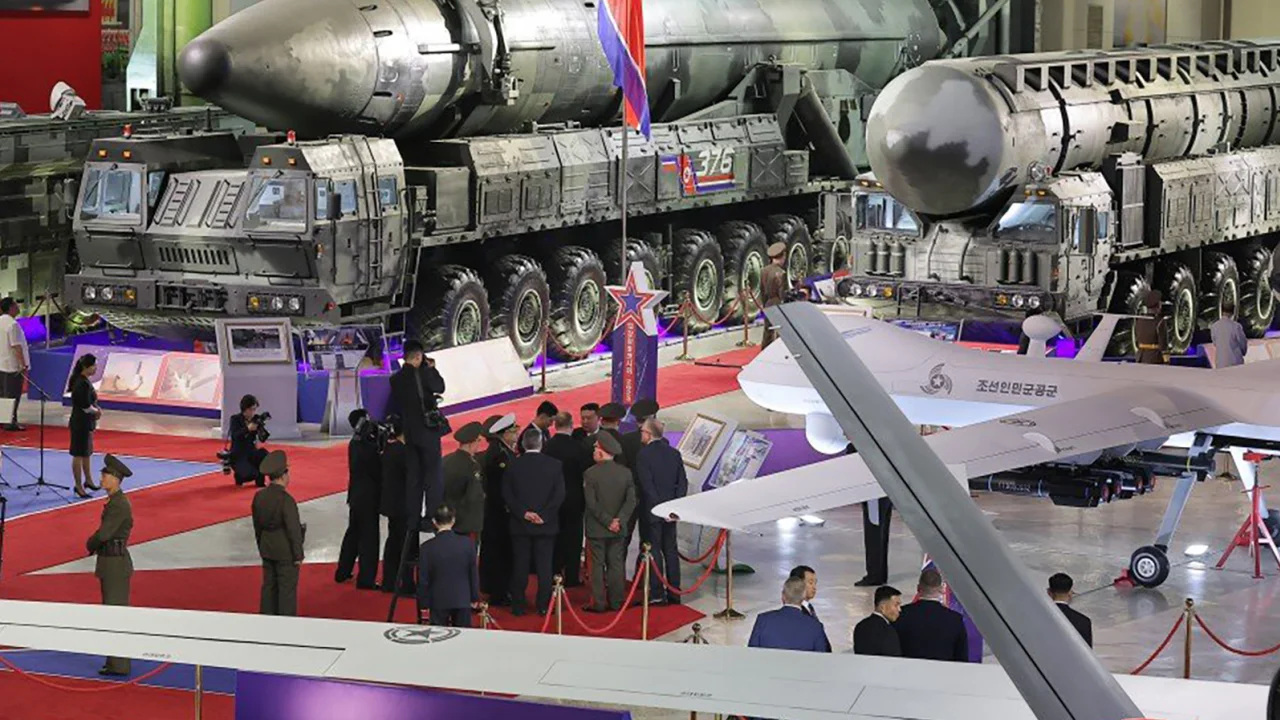
On Wednesday, North Korean leader Kim Jong Un gave Russian Defence Minister Sergei Shoigu a tour of a defence exhibition in Pyongyang. Images from North Korean media show them passing a variety of weapons, from Pyongyang’s nuclear-capable ballistic missiles to its newest drones. Shoigu was a key architect of Moscow’s assault on Ukraine.
According to a report from the state-run Korean Central News Agency (KCNA), North Korean Defence Minister Kang Sun Nam expressed Pyongyang’s full support “for the just struggle of the Russian army and people to defend the sovereignty and security of the country” at a state reception for Shoigu and the Russian delegation in a reference to the conflict in Ukraine.
Shoigu then made his own comments, claiming that the Korean People’s Army (KPA) has “become the strongest army in the world” and promising to continue working together to maintain this status.
Senior North Korean official Kim Song Nam expressed gratitude to Chinese forces for participating in the Korean War on Wednesday at a reception for the delegation led by Politburo member Li Hongzhong, saying North Korea “would not forget forever the heroic feats and merits of the bravery soldiers who recorded a brilliant page in history.”
The attendance of the Chinese and Russian delegations at the armistice anniversary, according to Ankit Panda, Stanton Senior Fellow in the Nuclear Policy Programme at the Carnegie Endowment for International Peace, “underscores the importance Pyongyang attaches to its relationships with both countries.”
Shoigu’s presence stands out in particular because it demonstrates how close Pyongyang and Moscow have grown since Russia’s invasion of Ukraine last year, according to Panda.
The Korean War, which lasted from 1950 to 1953 and was one of the first global hostilities of the Cold War era, came to a conclusion on Thursday, marking its 70th anniversary.
In the autumn of 1950, China dispatched a quarter of a million soldiers onto the Korean Peninsula to help its ally North Korea and drive out the combined forces of South Korea, the United States, and other nations fighting under the United Nations Command.
In the Korean War, also known in Beijing as the War to Resist US Aggression and Aid Korea, more than 180,000 Chinese soldiers lost their lives.
The Soviet Union, which preceded Russia, also helped North Korea during the conflict by supplying heavy weapons like tanks and providing military assistance by sending Soviet aircraft to engage US fighters.
Despite Pyongyang’s claims of victory, the conflict it started in 1950 ended in a standoff, leaving the demilitarised zone that exists today along the 38th parallel largely where it did before the conflict.
Although a genuine peace agreement has never been signed, the Korean War armistice that was signed on July 27, 1953, put an end to hostilities.
After the war, the US, which served as the focal point of the UN Command that supported South Korea, had a sizable number of soldiers stationed at several army and air sites in the South. The largest US military base abroad is Camp Humphreys, located in Pyeongtaek, south of Seoul.
In the meantime, Moscow has consistently supported North Korea throughout the years, particularly given their shared hostility to the West. The same is true of the Chinese Communist Party, particularly under the leadership of Xi Jinping, the country’s current president.
Panda emphasised how Pyongyang’s interests have been upheld before the UN Security Council by both Moscow and Beijing, permanent members of the organisation, as Western nations led by the US have attempted to impose additional sanctions on North Korea.
With regard to Ukraine, a former Soviet state that Russia invaded in February 2022 after declaring it to be historically Russian territory, the three authoritarian nuclear powers are now putting up a united front.
That invasion quickly came to a halt as the Ukrainians mounted a valiant defence of their country and Western powers hurried to transfer arms and ammunition to Kiev as Moscow depleted its own supplies and turned to friends like Iran and North Korea for reinforcements.
Last year, US officials claimed that North Korea was supplying Russia with millions of rockets and artillery shells for use in the conflict in Ukraine.
And as the war in Ukraine enters its 18th month, China, although not giving Russia any arms, has remained solidly in Moscow’s camp, with Xi expanding his connection with Putin and mirroring the Kremlin’s rhetoric on the war.
Following the Wagner mercenary group’s brief mutiny in Russia last month, a spokeswoman for the Chinese Foreign Ministry declared support for the Putin administration.
An online statement read, “China supports Russia in maintaining national stability and achieving development and prosperity as its friendly neighbour and comprehensive strategic partner of coordination for the new era.”
The People’s Liberation Army’s English website states that the militaries of China and Russia have been active in the waters off the Korean Peninsula. Their most recent joint exercise, Northern/Interaction-2023, brought together naval and air forces from both nations in drills aiming to “strengthen both sides’ capabilities of jointly safeguarding regional peace and stability and responding to various security challenges.”
The US Navy’s nuclear-capable ballistic missile submarine made its first port call in South Korea in forty years during those manoeuvres in the waters between the Korean Peninsula and Japan, which also coincided with military demonstrations by South Korea and the US.
A military parade in the city’s centre was scheduled to take place on Thursday as part of Pyongyang’s commemorations of the armistice. North Korea frequently exhibits its newest weapons at significant points in its history.
The Hwasong-18 ICBM, a solid-fueled, nuclear-capable missile that North Korea claims could target any location in the United States, is one such weapon that could be on show. Two times this year, most recently earlier this month, it has tested the missile.
The defence minister of Russia has arrived in North Korea to’strengthen’ military ties with the ‘friendly’ regime of Kim Jong-Un.
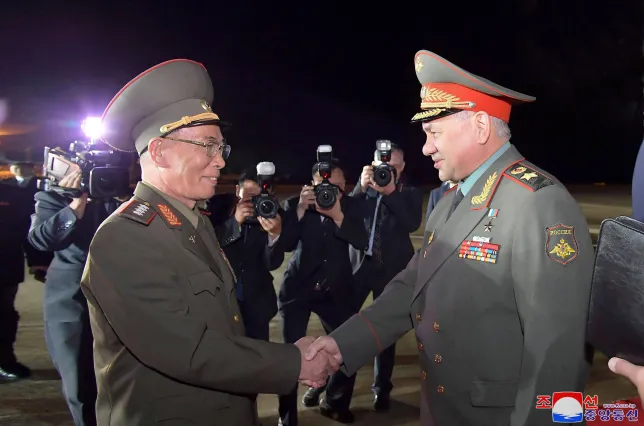
The group arrived in Pyongyang on Tuesday night under the leadership of Sergei Shoigu, according to the official Korean Central News Agency (KCNA).
Shoigu is seen in images provided by official media being welcomed at the airport by Kang Sun Nam, the North Korean counterpart.
‘I am certain that today’s talks will assist strengthen cooperation between our defence departments,’ he said during a meeting with ministers.
The Kremlin said the visit will help to enhance relations and mark “an important stage” in the development of their bilateral cooperation when it first announced it yesterday morning.
The Russian ministry posted on Telegram that this visit “will contribute to bolstering Russian-North Korean military ties and will be a crucial step in the development of cooperation between the two countries.”
A member of the Chinese Communist Party’s Politburo named Li Hongzhong was in charge of a group from his country.
The two delegations will be present at the 70th commemoration of “Victory Day” on Thursday in Pyongyang, which, according to official media, would be marked in a “grand manner that will go down in history.”
A military parade in the capital is set to top off North Korea’s extensive anniversaries celebrations, which have been planned in great detail.
Some observers believe that it may increase its weapons testing in the lead-up to the occasion.
Beginning in 2020, North Korea closed its border to all commerce and diplomatic interactions, including those with its two key trading and political partners, China and Russia.
Kim Jong-un, who appeared to be enjoying himself, grinned as he observed North Korea launch yet another ballistic missile.
According to state media, the nation launched its most recent and potent intercontinental ballistic missile (ICBM) Wednesday, which traversed 1,000 km and flew for 74 minutes.
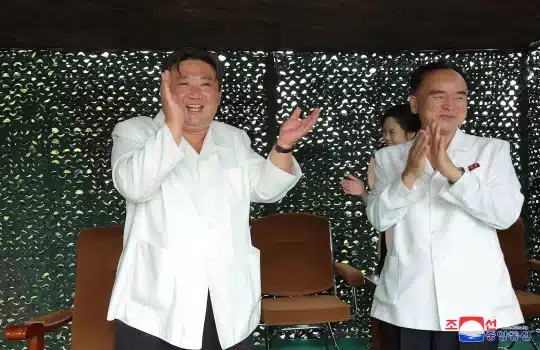
Kim may be seen cheering the missile from the command post in pictures of the launch that were published by North Korea’s official Korean Central News Agency (KCNA).
KCNA reported that the easy-going tyrant, wearing a white suit jacket, ‘personally guided the test-fire of a new-type ICBM Hwasongpho-18 on the spot’.
He was joined by his wife Ri Sol Ju, General Kim Jong Sik and other top officials.
According to state media, Kim was ‘greatly satisfied’ with the results of the test run, with photographs showing him standing up to applaud.
Kim Jong-un has made it a habit to oversee missile launches (Picture: AFP)North Korea’s leader stoop up to applaud after the launch (Picture: AFP)
Yesterday’s solid-fuel ICBM was its first test in three months, South Korea’s military said, with the missile landing in waters between North Korea and Japan.
‘The test-fire had no negative effect on the security of the neighbouring countries,’ KCNA reported.
The launch was organised by the Missile General Bureau, a government agency that South Korean experts say was revealed in February to make it clear that the nation is a nuclear weapons state.
The Hwasongpho-18 was one of many ICBMs, strategic cruise missiles and short-range missiles North Korea has fired in recent years.
Kim has long shown his face at missile launches as North Korea’s propaganda wing moves into first gear as the US and South Korea beef up their alliance.
He has been photographed hunching over in black suits as he watches the ballistic missiles blast off with a pair of binoculars.
In March last year, Kim threw on a ‘Top Gun-style’ leather flight jacket and black aviator sunglasses as he emerged out of a warehouse to oversee a missile test.
Footage released by state media even had the moment he walked across the site in slow motion with the hunkering missile behind him.
As the missile shoots up into the sky, the Workers’ Party of Korea general secretary whipped off his sunglasses before shouting ‘hooray’.
Though the dictator isn’t always so buttoned or zipped up.
In October, Kim strayed from his usual all-black attire and donned a white tunic and a safari-style hat for an unplanned missile test.
It came during a month marked by increasingly aggressive and proactive missile tests, with an intermediate-range ballistic missile flying over northern Japan on October 4 triggering alarms and prompting panicked residents to seek shelter.
Only two days later, the nation rehearsed the launching of ‘nuclear warheads’ before firing two cruise missiles deployed at units operating ‘tactical nukes’ on October 12.
The following month – which saw North Korea fire at least 46 ballistic missiles – Kim revealed his daughter to the world for the first time.
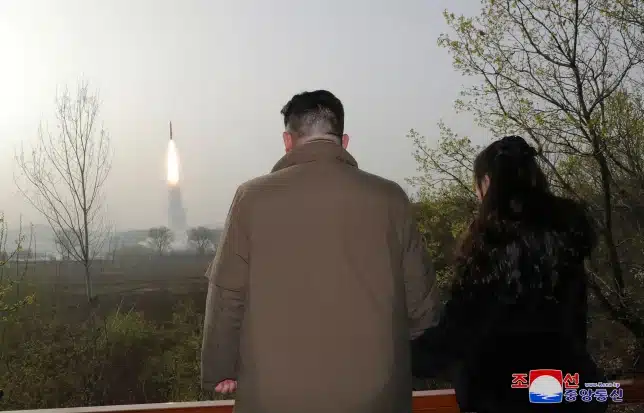
He was pictured walking hand-in-hand with his ‘beloved daughter’, state media said, wearing casual coats as a massive Hwasong-17 looms behind them.
North Korea claims that the latest intercontinental ballistic missile (ICBM) it tested on Thursday was solid-fueled, a development that analysts say could enable it to launch long-range nuclear strikes more quickly and easily as it expands its missile program.
Just after 7 a.m. on Thursday, the new missile, known as the Hwasong-18, was launched, prompting a temporary evacuation order on the northern Japanese island of Hokkaido before it fell into the waters east of the Korean Peninsula.
State-run Korean Central News Agency (KCNA) said on Friday that the missile launch, which was witnessed by the North Korean leader Kim Jong Un and his daughter, “would serve as a powerful strategic attack means of greater military efficiency.”
KCNA quoted Kim as saying the Hwasong-18 would “radically promote” his county’s ability to launch a nuclear counterstrike to suppress invasions and protect the nation.
Analysts noted that North Korea already has that ability, though the new missile may enhance it.
“I think it demonstrates technological progress, but I would not describe this as a game changer,” said Ankit Panda, a nuclear policy expert at the Carnegie Endowment for International Peace.
South Korea’s Defense Ministry said Friday Pyongyang still needs “more time and effort to successfully complete its solid-fuel intercontinental ballistic missile technology.”
Thursday’s missile test was North Korea’s 12th of the year, according to CNN’s count, and it came after United States and South Korean forces had earlier this month concluded their biggest military drills in years, including a large amphibious landing exercise.
It also came just days after a key meeting of North Korea’s Central Military Commission on Monday, when Kim stressed the need to quickly expand Pyongyang’s nuclear deterrence in response to “the ever-worsening security on the Korean Peninsula,” according to KCNA.
The testing of a solid-fueled ICBM is important because they’re more stable thanthe liquid-fueled ones that North Korea has previously tested on long-range missile launches.
A solid-fueled ICBM would be fueled during manufacturing and can be moved more easily to avoid detection before a launch that can be initiated in a matter of minutes, according to Joseph Dempsey, a research associate at the International Institute for Strategic Studies.
A liquid-fueled ICBM would need to undergo a fueling process at its launch site that could take hours, giving time for an adversary to detect and neutralize it, Dempsey wrote in an analysis earlier this year.
Explained: How much damage can North Korea’s weapons do?
Thursday’s launch came as no surprise to analysts who noted that North Korea had publicized a test of a solid-fueled rocket engine in December.
Kim has wanted to bring his forces up to the standards of other nations with ICBMs after starting out with easier-to-master liquid-fuel technology – and the apparent success of the solid-fueled ICBM launch suggests his missile program is advancing.
“At an earlier stage of North Korea’s missile program, liquid-fuel ICBMs represented the quickest and easiest path to achieving the country’s historic goal of being able to threaten the continental United States,” the IISS’ Dempsey wrote.
“The addition of solid-fuel ICBMs to the missile force would make it a more credible strategic deterrent by providing a more capable, less vulnerable pre-emptive and retaliatory capability,” Dempsey wrote.
The new Hwasong-18 has three stages, according to KCNA, just like the United States’ main ICBM, the Minuteman III, which is powered by three solid-fueled rocket motors.
Jeffrey Lewis, an analyst at the James Martin Center for Nonproliferation Studies, said on Twitter that it was “no surprise” a solid-fueled ICBM wasted tested by North Korea, saying “it’s just easier to use solid-fuel missiles.
“North Korea was always going to follow the same technical path as the US, Soviet Union, France, China, Israel and India,” he added. “Given that North Korea has been testing large diameter solid rocket motors for … several years, it’s been clear (to me at least) that since 2020 a test like this could have come at any time.”
Even with Thursday’s test, some doubt remains as to whether a North Korean ICBM could actually deliver a nuclear warhead at a long distance, for instance to the mainland United States.
Thursday’s test, like earlier North Korean ICBM tests, was fired at highly lofted trajectory, with the missile falling into waters between the Korean Peninsula and Japan. To cover the longer distance to the mainland US, an ICBM launched from North Korea would have to be launched at a much flatter trajectory.
ICBMs are fired into space, where they speed along outside Earth’s atmosphere before their payloads – nuclear warheads – undergo a fiery reentry process, much like a space shuttle or space capsule, before plunging down on their targets.
If the process of reentering the atmosphere isn’t executed with pinpoint accuracy and with materials that can withstand the immense heat generated, the warhead would burn up before reaching its target. Reentering the atmosphere at a shallow angle that would be needed on a long-range strike can make the process more difficult.
Panda, the Carnegie expert, said North Korea acknowledges that its lofted ICBM launches do not test reentry technology. But he said Pyongyang likely has the ability to master it.
“Based on their competency with materials and engineering that we’ve seen in other areas, developing a robust enough reentry vehicle is not a substantial technical challenge,” he said.
For Thursday’s test, KCNA said the highly lofted angle was used to prevent debris from posing a danger to other countries.
On Thursday, the launch sparked momentary panic on the Japanese northern island of Hokkaido after the government’s emergency alert system warned residents to take cover. The warning was soon lifted.
Soon after, fear turned into anger and confusion amid reports that the evacuation order had been sent in error, with local officials saying there was no possibility of the missile hitting the island, and Tokyo later confirming it had fallen outside Japanese territory, in waters off the east coast of the Korean Peninsula.
North Korea claims to have successfully tested a brand-new solid-fuel intercontinental ballistic missile (ICBM).
The disclosure portends a potential success in the covert regime’s pursuit of a more potent, harder-to-detect weapon that can strike the US mainland.
The information was released by its official Korean Central News Agency a day after a long-range missile launch from close to Pyongyang created concern in Japan.
Leader Kim Jong-un, who personally guided the test, warned the Hwasong-18 – the most powerful missile in his nuclear arsenal – would ‘strike extreme uneasiness and horror’ into the country’s enemies.
He said the weapon would cause them to ‘experience a clearer security crisis, and constantly strike extreme uneasiness and horror into them by taking fatal and offensive counter-actions until they abandon their senseless thinking and reckless acts’.
Kim also hit out once again at the recent military drills carried out by the US and South Korea.
KCNA released photos of him watching the launch, accompanied by his wife, sister and daughter, and the missile covered in camouflage nets on a mobile launcher.
‘The development of the new-type ICBM Hwasongpho-18 will extensively reform the strategic deterrence components of the DPRK, radically promote the effectiveness of its nuclear counterattack posture and bring about a change in the practicality of its offensive military strategy,’ KCNA said, using the initials of its official name.
‘Pho’ means ‘artillery’ in Korean.
Analysts said it is the North’s first use of solid propellants in an intermediate-range or intercontinental ballistic missile.
Developing a solid-fuel ICBM has long been seen as a key goal for North Korea, as it could help the North deploy missiles faster during a war.
Most of the country’s largest ballistic missiles use liquid fuel, which requires them to be loaded with propellant at their launch site – a time-consuming and dangerous process.
Ankit Panda, a senior fellow at the US-based Carnegie Endowment for International Peace, said: ‘For any country that operates large-scale, missile based nuclear forces, solid-propellant missiles are incredibly desirable capability because they don’t need to be fuelled immediately prior to use.
‘These capabilities are much more responsive in a time of crisis.’
North Korea first displayed what could be a new solid-fuel ICBM during a military parade in February after testing a high-thrust solid-fuel engine in December.
In order to “strike fear into the enemies,” according to North Korea, it fired an intercontinental ballistic missile (ICBM).
The test launch occurs as South Korea, Japan, and the US resolve to collaborate closely on regional security and conduct military drills in the area.
According to the official Korean Central News Agency (KCNA) of North Korea, leader Kim Jong Un oversaw the test-firing of the Hwasong-17 missile and emphasized the need to “strike fear into the adversaries” because to what it described the US-South Korea exercises’ “open hostility” toward the North.
Launched at a high angle to avoid the territory of North Korea’s neighbours, the missile reached a maximum altitude of 6,045 kilometres (3,756 miles) and travelled 1,000 kilometres (621 miles).
North Korea launches another missile into its eastern waters in ‘warning to US’
A photo released by the official North Korean Central News Agency shows Kim and his daughter.North Korea said the missile was fired ‘to strike fear into the enemies.
It landed in waters off the country’s eastern coast, KCNA said.
The South Korean and Japanese militaries assessed the flight, indicating the the US mainland is within the missile’s range.
It remains unclear whether North Korea has developed nuclear bombs small enough to fit on its long-range rockets or the technology to ensure its warheads survive atmospheric re-entry when fired at a normal trajectory.
North Korea’s official Rodong Sinmun newspaper published photos of Mr Kim watching from afar as the missile blasted off from a launch vehicle parked on an airport runway.
The missile launched at the Sunan international airport in Pyongyang, North Korea.Rumours suggest Kim is lining his daughter up to take over in the future.
Mr Kim was accompanied by a girl who appeared to be his daughter, believed to be named Kim Ju Ae and about 10-years-old.
She has accompanied him to several military events since she was publicly revealed for the first time during another ICBM launch in November.
Analysts say the intent of her public appearances at military events is to tie the dynastic rule of Mr Kim’s family to the nuclear arsenal Mr Kim sees as the strongest guarantee of his survival.
Already, four missile displays have been made this week.A missile is displayed during a parade to mark the 75th founding anniversary of North Korea’s army.
Rodong Sinmun also published photos implied to have been taken by a camera on the missile as it soared into space. They showed a rounded view of the Earth, with clouds scattered over what appeared to be the Korean Peninsula and Asian coastline.
The photos were apparently intended as proof the missile would be capable of accurately striking its target, said Cheong Seong-Chang, a senior analyst at South Korea’s private Sejong Institute.
KCNA said the ICBM launch sends a ‘stronger warning’ to North Korea’s rivals who are escalating tensions with their ‘frantic, provocative and aggressive large-scale war drills’.
Mr Kim said it is crucial for North Korea’s nuclear missile forces to maintain readiness to counterattack rivals with ‘overwhelming offensive measures anytime’ and make them realise their persistent and expanded military actions will ‘bring an irreversible, grave threat to them’, according to KCNA.
U.S. Air Force B-52H Stratofortress aircraft, top, flies in formation with South Korea’s Air Force F-15K fighters over the western sea of Korean peninsula during a joint air drill (Picture: AP)North Korean leader Kim Jong Un attending a banquet with his daughter is presumed to be Ju Ae.
The missile was launched on Thursday morning, hours before South Korean President Yoon Suk Yeol met with Japanese Prime Minster Fumio Kishida.
Both united at a summit partly aimed at rebuilding security ties between the US allies in the face of North Korean nuclear threats.
With four missile displays in about a week, North Korea has ratcheted up its tit-for-tat response to ongoing US-South Korean military drills that are the biggest of their kind in years.
The Biden administration wants better South Korea-Japan ties, which declined over historical issues in recent years, as it pushes to strengthen its alliance network in Asia to counter the North Korean nuclear threat and China’s rising influence.
Aside from their combined exercises that began on Monday and run through March 23, the US and South Korea are also participating in anti-submarine warfare drills, along with Japan, Canada and India, that began on Wednesday.
Lee Hyojung, spokesperson of South Korea’s Unification Ministry, which handles inter-Korean affairs, said it is deeply regrettable that the North continues to use the US-South Korean military drills as an excuse to stage provocative military demonstrations.
‘It’s clear that North Korea’s reckless nuclear and missile development is the cause of escalating tensions on the Korean Peninsula,’ she said, urging Pyongyang to return to dialogue.