Tag: Kyiv

  • Russia has cancelled a grain export agreement with Ukraine

     TASS has indicated that Russia has suspended its participation in a grain export deal following overnight attacks on ships in Crimea.

    The UN-mediated agreement, signed in July, allowed shipments of Ukrainian grain to be exported from blockaded ports.

    “Taking into account… the terrorist act by the Kyiv regime with the participation of British experts against the ships of the Black Sea Fleet and civilian vessels involved in ensuring the security of the “grain corridor”, the Russian side suspends participation in the implementation of agreements on the export of agricultural products from Ukrainian ports,” the ministry said in a statement.

    It earlier said the drone attacks were mostly repelled, although a ship received minor damage.

    Social media videos purport to show fires and black smoke in the Bay of Sevastopol.

    A UN spokesperson has said they are in touch with Russian authorities and that all sides should refrain from doing anything to imperil the deal.

    In the last few minutes, Russia’s agriculture minister Dmitry Patrushev said only 3% of the food exported under the UN-brokered deal had gone to the poorest countries – and that Moscow intends to supply 500,000 tonnes of grain to these nations over the next few months.

    On Wednesday, UN aid chief Martin Griffiths said he was “relatively optimistic” the deal would be extended beyond mid-November. 


  • Russia blasts the United States for remarks about grain deals

    Russia has slammed the United States for making false claims about Moscow’s decision to withdraw from a grain export deal mediated by the United Nations.

    Russia’s defence ministry said Ukraine used 16 drones to attack its Black Sea Fleet near Sevastopol on the Russian-annexed Crimean peninsula early Saturday, and that British navy “specialists” assisted in coordinating the “terrorist” attack.

    Anatoly Antonov, the Russian ambassador to the US, said on Telegram: “Washington’s reaction to the terrorist attack on the port of Sevastopol is truly outrageous.

    “We have not seen any signs of condemnation of the reckless actions by the Kyiv regime.”

    Mr Antonov added: “All the indications that the British military specialists were involved in organising the massive strike with the use of drones, are disregarded.”

    The UK has dismissed Russia’s claims as false, while US President Joe Biden denounced Russia’s decision on the grain deal as “purely outrageous” and said it would increase starvation.


  • Russi-Ukraine war: Kyiv will face longer power outages after air strikes

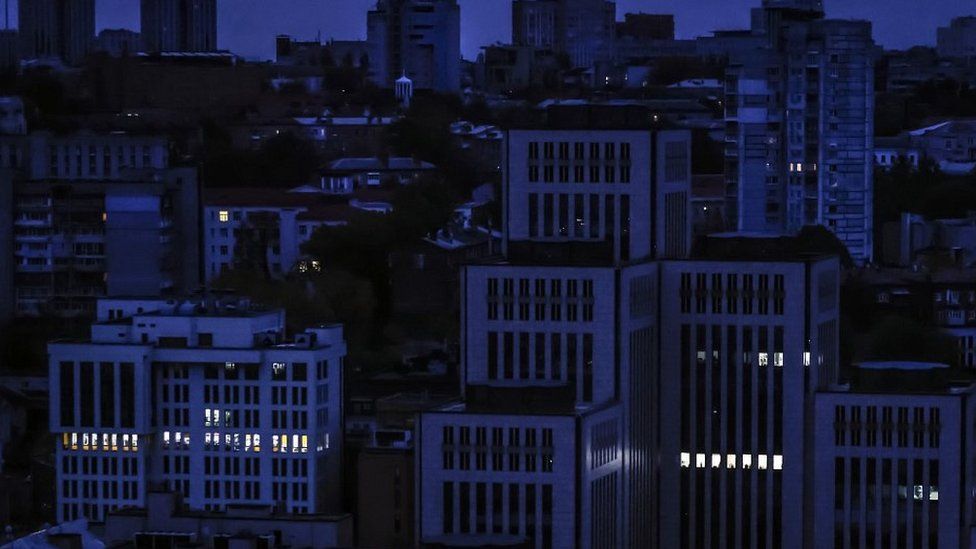
    Because of Russian attacks on energy infrastructure, Ukrainian authorities have warned residents in Kyiv to expect longer power outages lasting more than four hours.

    Rolling blackouts are affecting not only Kyiv but also Ukraine’s central regions, including Dnipro.

    According to President Volodymyr Zelensky, approximately four million people have been affected, but “the shelling will not break us.”

    This month Russia launched dozens of missiles and Iranian-made drones.

    Ukraine’s energy infrastructure is being pounded by the air attacks – Mr Zelensky says about a third of the country’s electric power stations have been destroyed.

    The Kyiv region has lost 30% of its power capacity, the private energy company DTEK says, meaning “unprecedented” power cuts will be necessary.

    “Unfortunately the scale of restrictions is significant, much larger than it was before,” said DTEK director Dmytro Sakharuk.

    The power cuts have meant curbs on the use of street lights and electric-powered public transport, besides the discomfort in people’s homes.

    Darkness in Dnipro as street lighting switched off, 27 Oct 22
    IMAGE SOURCE,EPA Image caption, The scene in Dnipro as street lighting is switched off

    The EU and other international allies of Kyiv have condemned the deliberate targeting of civilian infrastructure – attacks that Ukraine sees as war crimes.

    Ukraine’s second city Kharkiv, heavily damaged by Russian shelling, also faces long power cuts, along with the central cities of Zhytomyr, Poltava and Chernihiv.

    Russia stepped up its missile attacks on Ukraine’s power stations and other civilian infrastructure in retaliation for the 9 October bombing of the Kerch Bridge – a key link to Russian-annexed Crimea.

    President Vladimir Putin called that blast a Ukrainian “act of terrorism”. The bridge is a symbol of his campaign to incorporate large swathes of Ukraine into Russia.

    A power station employee called Pavlo, quoted by AFP news agency, said “we are confronted by such damage for the first time”. The unnamed plant had twice been targeted by missiles and then by an Iranian-made “kamikaze” drone.

    He said repairs had been underway for more than two weeks, but “there are difficulties in that the equipment that has been damaged is unique – it’s hard to find the same parts”.

    In other developments:

    • Russia said it had mobilized 300,000 reservists – the target number set by defence minister Sergei Shoigu. He said 41,000 of those called up had already been deployed to the battlefield in Ukraine
    • Russia also said it had completed an operation to move thousands of civilians out of occupied Kherson, ahead of an expected battle with Ukrainian forces for the strategic southern city
    • President Zelensky accused Russia of dismantling medical facilities in Kherson – removing “equipment, ambulances, just everything” – and pressurising doctors to move to Russia
    • Chechen leader and Putin ally Ramzan Kadyrov admitted that a Chechen unit had suffered “big losses” – 23 fighters killed and 58 wounded in a Ukrainian artillery attack
    • UN Secretary-General Antonio Guterres has urged all parties to renew the grain export deal, which is due to expire next month. Russia has suggested it might not renew the deal. The agreement allowed Ukraine to resume exports in the Black Sea which had been blocked when Russia invaded.


  • Iranians demonstrate in Kyiv against the delivery of drones to Russia

    Iranians, who live in Ukraine, have been pictured protesting against Iran’s government and deliveries of Iranian drones to Russia, in Kyiv.

    Protesters held signs featuring pictures of Iran’s leader and Russia’s president, alongside the Ukrainian flag.


    Iranian-made drones have been used by Russian forces to attack Ukraine.

    However, Iran has denied Ukrainian and Western accusations that it is supplying drones to Russia.

    Source:Skynews.com


  • Mayor: Electricity in Kyiv will be restored in up to three weeks

     Kyiv Mayor Vitali Klitschko says electricity will not be fully restored in the Ukrainian capital for at least three weeks.

    This month, Russia resumed strikes on Kyiv, targeting critical infrastructure and forcing Ukraine to implement rolling blackouts.

    According to Mr Klitschko, the city’s electricity deficit currently ranges between 20% and 50%.

    It is, therefore, still operating in an emergency capacity.

    Ukraine’s main power supplier, Ukrenergo, said it hopes to eliminate the shortages within two to three weeks – if there are no further strikes.

    Mr Klitschko said: “The city is doing everything possible to save electricity consumption. In particular, trolleybuses have been replaced by buses on many routes of communal public transport.

    “At the same time, the capital is not going to stop the metro. Once again, I call on the citizens of Kyiv and businesses to reduce electricity consumption!

    “The risk of a major blackout, when a lack of electricity can lead to even greater consequences and an even greater shutdown, there is.”


  • Ukraine war: In two days, Russia deploys dozens of drones – Zelensky

    President Volodymyr Zelensky says, Russia has launched over 30 drone attacks on Ukraine in just two days.

    He went on to say that Moscow had carried out 4,500 missile strikes and over 8,000 air raids in total.

    Mr Zelensky, speaking from Kyiv and standing next to what appeared to be a downed Iranian Shahed drone, pledged to “clip the wings” of Moscow’s air power.

    Western officials believe Iran has supplied a large number of drones to Russia, but Moscow and Tehran deny it.

    It comes as US Secretary of State Antony Blinken called Russia’s aggressive use of drones “appalling”.

    The top US diplomat accused Russian commanders of using the devices to “kill Ukrainian civilians and destroy the infrastructure they rely on for electricity, for water, for heat” during a visit to the Canadian capital Ottawa.

    “Canada and the United States will keep working with our allies and partners to expose, to deter, and to counter Iran’s provision of these weapons,” Mr Blinken said.

    In recent weeks, Russian attacks have targeted Ukraine’s civilian infrastructure, damaging the country’s electricity and water supply just as temperatures begin to drop.

    Western countries say Iran is supplying its domestically developed drones to Moscow and that Iranian military experts are on the ground in Russian-occupied Crimea to provide technical support to pilots.

    Kyiv has identified the drones used in some attacks on its infrastructure as Iranian Shahed-136 drones. They are known as “kamikaze” drones because they are destroyed in the attack – named after the Japanese fighter pilots who flew suicide missions in World War Two.

    Ukraine says around 400 drones have already been used by Russia, from a total order of roughly 2,000 weapons.

    But Tehran has repeatedly denied that it has struck any arms deal with the Kremlin, and Moscow also denies using Iranian drones.

    On Wednesday, Iran’s Foreign Minister Hossein Amir-Abdollahian called the accusations “baseless” and urged Ukraine to “present any evidence supporting the accusations”.

    “If… it becomes clear to us that Russia has used Iranian drones in the war against Ukraine, we will definitely not be indifferent about this issue,” he added.

    Tehran’s regional adversary, Israel, has also attacked Iran over the alleged exports. During a meeting with US President Joe Biden at the White House on Thursday, President Isaac Herzog slammed the regime’s activities.

    “The fact that Iran, following its activities in killing its own citizens, in working towards nuclear weapons endlessly, endangering the entire world and the region — and now killing innocent civilians in Ukraine, clearly that gives you a picture of what Iran is all about,” Mr Herzog said.

    Prior to the visit, he had pledged to share “proof” with Mr Biden that Iran was supplying the weapons.

    Meanwhile, US officials have said they will supply Ukraine with an additional $275m (£237m) of military aid, according to the Associated Press.

    The assistance is expected to be used to restock ammunition for Ukrainian artillery systems, including the HIMARS launchers that Kyiv’s forces have used to great effect.

    On the ground, fighting has slowed in recent days, with a much anticipated Ukrainian advance on the southern city of Kherson stalled due to poor weather.


  • Big cat cubs rescued in Ukraine arrive in Poland

    After surviving drone attacks and bombing in their first few months of life, four lion cubs and a black leopard cub from war-torn Ukraine have found refuge in a Polish zoo, according to the International Fund for Animal Welfare (IFAW).

    The cubs were transferred to animal rescue organisations in Kyiv and Odesa after a crackdown on the exotic pet trade in Ukraine, and are now in Poznan zoo in western Poland awaiting onward travel.

    IFAW said it had partnered with a sanctuary in the United States and one in Europe to care for the cubs, who were bred in captivity and cannot be released into the wild.


  • IAEA experts to arrive in Ukraine amid allegations of a ‘dirty bomb’

    We have been reporting on Russian claims that Kyiv is preparing to use “dirty bombs,” which are explosives laced with radioactive material.

    The claims were made by Russia’s defence minister, Sergei Shoigu, and were later repeated by Russia’s UN ambassador, Vassily Nebenzia.

    But the West has rejected the claims as false and said they are part of a disinformation campaign.

    Now, Ukraine’s foreign minister Dmytro Kuleba has said that experts from the International Atomic Energy Agency (IAEA) are expected to arrive in Ukraine “shortly” amid the claims.

    He said the experts will “prove Ukraine has neither any dirty bombs nor plans to develop them”.


  • EU to give Ukraine 1.5 billion euros next year

    The European Union will send Kyiv 1.5 billion euros each month in 2023 to assist Ukraine in its struggle against Russia’s invading soldiers, according to the bloc’s leader.

    European Commission President Ursula von der Leyen said that the EU had given Ukraine 19 billion euros this year. “It is very important for Ukraine to have a predictable and stable flow of income,” she said, adding that Kyiv estimated its monthly needs at 3-4 billion euros “for the basics.”

    The EU chief told a news conference the EU would finance 1.5 billion euros per month of that, with the rest expected to come from the United States and international institutions.

    “That will give a total of 18 billion for the next year – an amount Ukraine can count on and where there is a stable and reliable, predictable flow of income.”


  • Ukraine conserves energy following damage to power plants

    Ukrainians are experiencing their first large-scale statewide power outages as officials reduce supply.

    The action is intended to enable energy providers to repair power plants damaged by Russian air attacks.

    The president’s office told Ukrainians late on Wednesday to minimise electricity use from 7 am to 11 pm and prepare for temporary blackouts if this was not done.

    No schedule was announced for the outages, but cities such as the capital, Kyiv, and Kharkiv announced curbs on the use of electric-powered public transport such as trolleybuses.

    They also reduced the frequency of trains on the metro.

    President Volodymyr Zelenskyy has said Russian air strikes damaged 30 percent of Ukraine’s power stations in just over a week.


  • Israel and Ukraine discuss air defence systems following drone strikes

    Ukraine’s foreign minister says he has spoken with Israeli Prime Minister Binyamin Netanyahu about the harm inflicted by “Russian missiles and Iranian-made drones.”

    Ukrainian and Israeli officials met to discuss Kyiv’s request for Israeli air defence support, just days after Russia purportedly used Iranian “kamikaze” drones in a new wave of air strikes on war-torn Ukraine.

    Ukrainian foreign minister Dmytro Kuleba said on Thursday he had spoken on the phone to Israeli Prime Minister Yair Lapid and “discussed in detail” the provision of air and missile defense systems and technology.

    “I informed him [about the] unspeakable suffering, loss of life, and destruction caused by Russian missiles and Iranian-made drones,” he tweeted.

    Lapid’s office said in a statement on Thursday that the Israeli prime minister had expressed “deep concern” over the military ties between Russia and arch-foe Iran.

    Ukraine this week accused Russia of using four Iranian-made drones to bomb Kyiv and said its air defences have shot down 223 Iranian drones since mid-September.

    The Kremlin said it had no knowledge of its army using Iranian drones in Ukraine and Tehran said the claims that it is providing Russia with weapons are “baseless”.

    European Union countries, however, said they had found evidence supporting Kyiv’s claim and on Thursday adopted sanctions on Iran over its provision of drones to Russia.

    The phone call between Kuleba and Lapid came two days after Ukraine stepped up appeals for Israeli help with air defence systems to intercept Iranian drones and ballistic missiles.

    In the request, Ukraine also demanded that Israel train its forces in operating the systems, Axios reported.

    Israel has walked a delicate diplomatic line since the start of the Russian invasion in late February, seeking to preserve ties with Moscow.

    While condemning Russia’s move, it has limited its assistance to humanitarian relief, citing a desire to ensure the well-being of Russia’s Jews and to continue cooperation with Moscow over war-ravaged neighbour Syria.

    On Wednesday, Israeli defence minister Benny Gantz reiterated Tel Aviv’s position that it would not sell weapon systems to Ukraine.

    According to a statement by his office, however, Gantz had asked Ukraine “to share information about their needs for air defence alerts”.

    Israel would be able to “assist in the development of a life-saving civilian early-warning system”, the statement said. Ukraine’s ambassador had asked for systems that would shoot down the drones instead.

    Russia warned on Monday that an Israeli move to bolster Kyiv’s forces would severely damage relations between Moscow and Tel Aviv.


  • EU foreign ministers to agree on training 15,000 Ukrainian soldiers

    When EU foreign ministers gather in Luxembourg next month, they are expected to agree on a mission to train 15,000 Ukrainian soldiers as well as an additional 500 million euros ($48.7 million) in funding for military transfers to Kyiv.

    Two senior EU officials said the military training would start in mid-November and take place on EU territory at one hub in Poland and another in Germany.

    Previously, several EU countries have already been instructing Ukrainian troops on how to use specific weapons, which will continue.

    The ministers are also expected to add a further 500 million euros to a fund that reimburses EU member states for arms delivered to Ukraine, bringing the total amount earmarked for arms for Kyiv to more than 3 billion euros.


  • Ukrainian military: 37 Russian drones have been destroyed since Sunday

    Ukraine’s military says to have destroyed 37 Russian drones since Sunday evening, accounting for around 85 percent of aircraft participating in the strikes.

    Russian drone strikes killed at least three civilians in central Kyiv early Monday.

    The airstrikes came exactly one week after Russia unleashed its heaviest aerial bombardment on Kyiv and other Ukrainian cities since the start of the war.


  • Kyiv advised to conserve electricity after Russian missile attack

    Residents of Kyiv have been asked to reduce their evening electricity use after a Russian missile strike knocked out a power plant near the capital.

    Power was restored earlier in Ukraine, according to officials, after Russian missiles struck the electricity infrastructure.

    But Ukraine’s state energy operator Ukrenergo has still called for the reduction between 17:00 and 23:00 (15:00 – 21:00 GMT), warning of possible power cuts.

    The request was not confined to Kyiv.

    The deputy head of Ukraine’s presidential administration, Kyrylo Tymoshenko, said the populations of Zhytomyr, Cherkasy, and Chernihiv should also save electricity.

    “If this advice is ignored, we will have difficulties and it will be necessary to take out the candles,” he warned on Telegram.

    Ukrenergo has urged residents to save electricity in the evening by not using energy-guzzling appliances, switching off unnecessary lighting, and doing their washing at night.

    However, the BBC’s Paul Adams reports that Kyiv streets are already darker than usual at night, but “life very much goes on”.

    The energy warning comes as more heavy fighting is reported north of Russian-held Kherson.


    Kirill Stremousov, a Russian-appointed leader in the southern region, said Ukrainian shelling was coming from the Dudchany area, on the west bank of the Dnieper river (called Dnipro by Ukrainians).

    Advancing Ukrainian forces have repeatedly bombarded bridges over the river, aiming to cut off Russian troops in Kherson city.

    Russian-installed officials in the city have urged Moscow to help transfer Kherson families to Russian cities as Ukrainian shelling intensifies.

    President Vladimir Putin has declared Kherson and three other Ukrainian regions to be part of Russia – a move condemned internationally, after hastily-organized so-called referendums in the regions.

    Meanwhile, Ukrainian prosecutors have accused Russian soldiers of shooting and killing the chief conductor of the Kherson Music and Drama Theatre, Yuri Kerpatenko, in his home. It is widely reported in Ukrainian media, but there are few details. He is said to have refused to cooperate with the occupation authorities.

    Russian oil depot fire

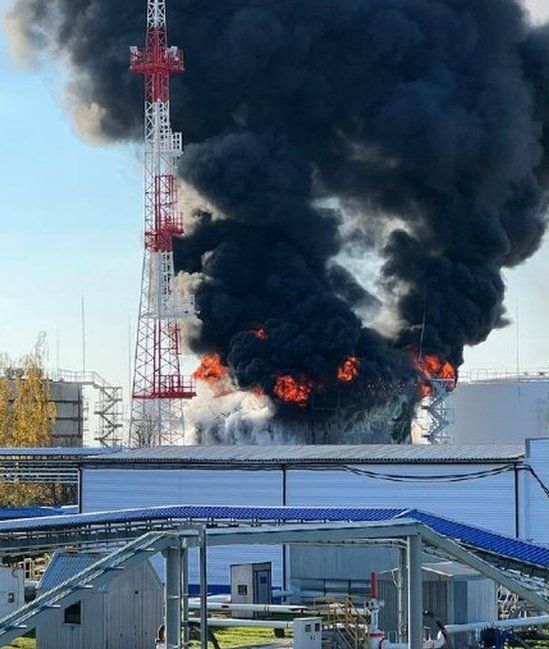
    For two days running the governor of Belgorod, a Russian city 40km (25 miles) north of Ukraine, has reported Ukrainian cross-border shelling. One shell caused a major fire at an oil depot near the city on Saturday, Vyacheslav Gladkov said, adding later that firefighters had extinguished it.

    Ukrainian shelling set fire to an electricity substation in Belgorod on Friday, he reported on Telegram. In that case, too the fire was contained. Kyiv has not commented on the Russian claims, but there have been explosions in the Belgorod region previously, which Russia blamed on Ukrainian shelling.

    Oil depot fire near Belgorod - pic from Governor Gladkov (Telegram)
    IMAGE SOURCE,VVGLADKOV/TELEGRAM Image caption, Oil depot fire near Belgorod – pic from Governor Gladkov (Telegram)

    On Friday President Putin said he saw no need for further massive missile strikes against Ukraine “for now”, on the scale of last Monday’s, which hit Kyiv and other cities, killing at least 20 civilians. Mr Putin said those strikes were retaliation for the attack that damaged Russia’s huge Kerch bridge – a key strategic link to annexed Crimea.

    Another focus of fighting in the south is Zaporizhzhia – Ukrainian officials in the city say it was hit by more Russian missiles and Iranian-made Shahed “kamikaze” drones overnight. There was damage to energy facilities and industrial infrastructure there.

    The Zaporizhzhia nuclear power plant – Europe’s largest – lies just south of the city, under Russian control, and repeated shelling in the area has raised fears of a nuclear disaster.

    The US has announced $725m (£649m) of further military aid for Ukraine, including ammunition for Himars rocket systems, artillery rounds, anti-tank weapons and Humvee armoured vehicles. The US has provided more than $17bn of military aid since Russia’s 24 February invasion – by far the largest contribution among Ukraine’s Western allies.

    On Ukraine’s northern border, Belarus says a new Russian military contingent has arrived – part of what it describes as a regional border protection force. Belarus has hosted Russian forces involved in the war in Ukraine, including those who launched an abortive assault on Kyiv. But so far it has not sent its own troops across the border.


  • Ukraine war: Putin says there will be no more huge strikes for the time being

    Russian President Vladimir Putin has stated that there is no need for any big strikes on Ukraine, just days after the country was bombarded with the worst bombing since the war began.

    He stated that the majority of the planned targets of the strikes had been hit, but that it was not his intention to destroy Ukraine.

    He predicted that Moscow‘s goal of mobilising 300,000 men would be met in two weeks.

    It comes as Russian forces are mostly in retreat and Ukraine advances, almost eight months since the invasion.

    Speaking to journalists after a summit with regional leaders in Kazakhstan’s capital Astana, the Russian leader said that the recent strikes had destroyed 22 out of the 29 targets in Ukraine set by the military and that “they are getting” the remaining seven.

    “There’s no need for massive strikes. We now have other tasks,” he said.

    From Monday onwards, Russia unleashed a wave of strikes on cities across Ukraine, in what Mr Putin said was retaliation for a blast that damaged a key bridge between Russia and annexed Crimea.

    Dozens of people were killed and injured in the strikes, which also damaged infrastructure. Central areas of Kyiv were targeted for the first time since the invasion.

    But Mr Putin said it was not Russia’s intention to destroy Ukraine, but he did not regret the invasion.

    “What is happening today is not pleasant, to put things mildly,” he said. “But all the same, [if Russia hadn’t attacked] we would have been in the same situation, only the conditions would have been worse for us. So we’re doing everything correctly and at the right time.”

    President Putin said 220,000 men had been mobilised, of whom 16,000 were already in combat. He saw no need for additional mobilisation, he added.

    However, the call-up has caused widespread discontent in Russia, with tens of thousands of men fleeing to neighbouring countries. The BBC has also found evidence of the poor level of training such conscripts or recruits receives before being sent to the front.

    Meanwhile, the BBC Russian service says it has identified more than 7,500 Russian service personnel who have died in the Ukraine war. The actual level of casualties is believed to be much higher, and there are reports that some recently mobilised troops have been killed.

    Addressing relations with other former Soviet countries, Mr Putin insisted that the war had not affected their “character and depth”.

    He said it was natural for some countries to be concerned but he was keeping them informed in detail.

    But analysts say Russia’s influence in the region is declining, with leaders like Kazakhstan’s Kassym-Jomart Tokayev trying to distance themselves from Mr Putin over the war.


  • Belarus on high alert for terrorism

    Belarusian President Alexander Lukashenko said his country is on high alert for terrorism due to tensions on its borders.

    Mr. Lukashenko linked the decision to his declaration on Monday that he had ordered Belarusian troops to deploy along Belarus’s southern border with Ukraine alongside Russian forces.

    “In connection with the escalation of tension, a regime of heightened terrorist danger has been introduced,” Mr Lukashenko said in a Russian TV interview.

    “Therefore we began a procedure with the Union group of forces, the basis of which, as I already said, is the Belarusian army, which will be supplemented by units from the Russian Federation. Everything is going according to plan.”

    Belarus is allied with Moscow but wedged between Russia, Ukraine, and three NATO countries.

    Belarus allowed Russia to use its territory as one of the launchpads for its 24 February invasion.

    Its latest troop movements have raised concern in Kyiv and the West that Mr Lukashenko may be about to commit his army to support Russia’s faltering war effort.

    Political analysts say that is an unappealing option for him but that he may not be in a position to refuse if Russian President Vladimir Putin demands it.

    Belarus depends on Russia politically and economically, and Mr Putin’s support helped Mr Lukashenko survive mass pro-democracy protests in 2020.

    Mr Lukashenko crushed the demonstrations and all leading opposition figures have been jailed or forced to flee abroad.


  • Russia-Ukraine war: List of key events, day 233

    As the Russia-Ukraine war enters its 233rd day, we take a look at the main developments.

    • Civilians in the southern Kherson region have started to flee to Russia amid Ukrainian advances, and evacuees were expected to begin arriving there on Friday. A Russian-installed official suggested residents should leave for safety, a sign of Moscow’s weakening hold on territory it claims to have annexed.
    • A Russian region adjoining Ukraine said it was preparing to receive refugees from the Russian-held part of Kherson.
    • Ukraine’s armed forces have retaken more than 600 settlements in the past month, including 75 in the strategic Kherson region, the government said.
    • The governor of a Russian border region accused Ukraine of shelling an apartment block, but a Kyiv official said a stray Russian missile was to blame – one of a series of apparent attacks on Russian towns.
    • Russian missiles hit the Ukrainian port of Mykolaiv. A five-storey residential building was hit, the two upper floors completely destroyed, the mayor said.
    • Three drones attacked the small town of Makariv, west of the capital Kyiv, with officials saying critical infrastructure facilities were hit by Iran-made drones.
    • NATO said it will closely monitor an expected Russian nuclear exercise but will not be cowed into dropping support for Ukraine.
    • Zelenskyy accused the International Committee of the Red Cross of inaction in upholding the rights of Ukrainian prisoners of war and urged it to undertake a mission to Olenivka – a notorious camp in eastern Ukraine.
    •  Kremlin spokesman Dmitry Peskov was quoted as saying in Izvestia newspaper that the goals of Russia’s “special military operation” could be achieved through negotiations.
    • The leaders of Commonwealth of Independent States (CIS) countries, including Russian President Vladimir Putin, are meeting for the CIS summit in Astana.

    • Putin is scheduled to take part in the first Russia-Central Asia summit later on Friday.


    Economy

    • Russia has submitted concerns to the United Nations about an agreement on Black Sea grain exports and is prepared to reject renewing a deal next month unless its demands are addressed, Russia’s UN ambassador in Geneva told Reuters.
    • Putin courted Turkish President Recep Tayyip Erdogan with a plan to pump more Russian gas via Turkey, turning it into a new supply “hub”, bidding to preserve Russia’s energy leverage over Europe.
    Source: Aljazeera


  • Russia-Ukraine war: Turkish president promises to advocate for peace as Astana summit gets under way

    Erdogan has stated that despite the challenges on the ground, Turkey will continue to advocate for peace between Russia and Ukraine.

    “Our goal is to continue the momentum that has been achieved and bring an end to the bloodshed as soon as possible,” the Turkish leader said in his address to the summit of the Conference on Interaction and Confidence-Building Measures in Asia. The summit is being held in Kazakhstan’s capital, Astana.

    Erdogan was referring to agreements that Turkey helped broker which allowed Ukrainians to resume grain exports and led to a prisoner swap between Ukraine and Russia.

    “We are all closely experiencing the effects of the crisis in Ukraine on a regional and global scale,” he said. “I always say that a just peace can be established with diplomacy, that there are no winners in war and no losers in equitable peace.”

    Turkey has retained close ties with both Moscow and Kyiv during the war and has repeatedly offered to organise peace talks between the two sides.


  • IAEA director en route to Ukraine’s capital

    Rafael Grossi, the head of the International Atomic Energy Agency (IAEA), is currently travelling to Kyiv after discussions with Russian authorities on establishing a protection zone around the Ukrainian nuclear power plant that is currently under Russian occupation.

    In a statement on Twitter, Mr Grossi said he had agreed with President Volodymyr Zelenskyy that he would come back to Kyiv and work around the nuclear power plant continued.

    Earlier today, a Russian-installed official said the safety zone around the Zaporizhzhia nuclear plant was not possible until the frontline was at least 100 km (62 miles) away.

    “As of today, I think that it is extremely unsafe,” Yevgeny Balitsky told state television.

    He also warned that it would not be possible to quickly relaunch the plant, amid fears shelling could further compromise its safety.

    “It’s not a toy, you can’t just turn it on and off like a switch. There are runaway processes, there’s cooling, and so forth,” Mr Balitsky added.

    The IAEA has been pushing for a demilitarised security zone around the plant, Europe’s Largest, which remains close to the frontline between Russian and Ukrainian forces.

    Both Moscow and Kyiv have accused each other of shelling the plant and the facilities around it, risking a nuclear accident.


  • ‘It’s a miracle we weren’t harmed’

    Two residents of Kyiv have opened up about Monday’s strikes, which happened just 200m (650ft) from their apartment.

    Ksenia and Bogdan described a “huge noise” as a blast went off in the city’s Shevchenko Park – somewhere they often walk their dog.

    Speaking to BBC Radio 4’s Today programme, they say they took refuge in a windowless corridor. Bogdan says they feared it would be too dangerous to walk “even five minutes” to an underground shelter.

    “Kyiv downtown is no longer a safe place as some people thought”, adds Ksenia.

    It’s been a rollercoaster year for the couple, who’ve got married since first speaking to Radio 4 in February.

    Living through a war “motivates you to go faster and make more brave decisions,” Ksenia reflects.

    Source: BBC
  • Minister says Ukraine is facing ‘new wave of aggression’

    Emine Dzhaparova, the first deputy minister of foreign affairs of Ukraine says, Russia is waging a “new wave of aggression” against Ukraine.

    Ms. Dzhaparova, who is presently in Kyiv, told Sky News that the city’s residents heard explosions early in the morning, which gave her morning a “horrible way.”

    “I jumped out of my window and started filming,” she said.

    “The first three missiles that came to the city centre, and I’ve been staying in the city centre, I could feel. And then I managed to run downstairs just to hide myself and my dog.”

    Asked if the last couple of days in the country had felt like an escalation in the war, Ms Dzhaparova said it was a “new wave of aggression“.

    “The core nature of aggression has not been changed. It’s the same,” she added.


  • Russian military expert describes Ukraine a ‘psychiatrically sick society’

    Following the attacks in Kyiv this morning, a Russian military expert labeled Ukraine a “psychiatrically sick society.”

    Footage shared by the BBC’s Francis Scarr shows Alexander Artamonov telling Russian state television that the “strikes need to continue systematically” following the attack.

    There are fears Ukraine could see more strikes after Vladimir Putin warned of a “harsh” response if attacks against Russia continued.

    Earlier today, he told a Security Council: “The responses will be of the same scale as the threats to Russia.

    “In the event of further attempts to carry out terrorist acts on our territory, Russia’s response will be harsh.”


  • 42 people hospitalized in Kyiv says Klitschko

    Vitali Klitschko, the mayor of Kyiv, has revised his statement on the status of affairs in the Ukrainian capital.

    He says “Russian barbarians” have launched a “major terrorist attack” on Kyiv, where at least five people have died on Monday.

    Mr Klitschko added: “In Kyiv, in the morning and throughout the day, several areas were hit. In particular, in the city centre.

    “The rabid aggressor also hit several objects of the capital’s critical infrastructure.”

    He said that, so far, it is understood five people have died and 51 injured.

    Of these, 42 were hospitalised.

    “The threat of new strikes continues,” Mr Klitschko added.

    You can listen to full media briefing of the two presidents, in Swahili and English, here:

    The deal was said to be part of a longer-term plan to expand infrastructure links between the two big economies of East Africa.


  • Missile attack in Ukraine: Death toll in Ukraine rises to 11

    There has been an update on the death toll in Ukraine in the last few moments, after a wave of coordinated Russian strikes this morning.

    At least 11 people have died – with another 64 injured.

    It is understood at least five of these were killed in Kyiv, where a series of blasts struck a playground, a road, and a building.

    The latest death toll update was provided by the Ukrainian State Emergency Service. It is thought it will continue rising.


  • Workers in Zaporizhzhia recount fears over abduction and torture by Russia

    Workers from the Zaporizhzhia nuclear power plant have recounted their fears of being abducted and tortured by Russian forces occupying the facility and the city of Enerhodar.

    Ukrainian officials say the Russians have sought to intimidate the staff into keeping the plant running, through beatings and other abuse, and to punish those who express support for Kyiv.

    Enerhodar’s exiled mayor Dmytro Orlov estimated that more than 1,000 people, including plant workers, were abducted from Enohodar, and an estimated 100-200 remain abducted.

    Mr Orlov alleged they were tortured at various locations in Enerhodar, including at the city’s police station and in basements elsewhere.

    “Terrible things happen there,” he said.

    “People who managed to come out say there was torture with electric currents, beatings, rape, shootings… some people didn’t survive.”

    Last Friday, the plant’s director, Ihor Murashov, was seized and blindfolded by Russian forces on his way home from work.

    He was freed on Monday after being forced to make false statements on camera, according to Petro Kotin, head of Energoatom, Ukraine’s state nuclear company.

    Mr Kotin said: “I would say it was mental torture.

    Petro Kotin

    “He had to say that all the shelling on the Zaporizhzhia nuclear power plant was made by Ukrainian forces and that he is a Ukrainian spy… in contact with Ukrainian special forces.”

    Mr Orlov, who spoke to Mr Murashov after his release, said the plant official told him he had spent two days “in solitary confinement in the basement, with handcuffs and a bag on his head. His condition can hardly be called normal”.

    Shelling and damage near the site have raised international alarm over the plant’s safety, as both Russia and Ukraine blame each other for the shelling.

  • Ukraine war: Concerns raised about France’s supply of arms to Kyiv

    Why is France’s contribution to the war effort in Ukraine so minimal if it aspires to lead Europe into a new era of military independence?

    Some of the nation’s leading strategic thinkers are pressing President Emmanuel Macron to decide quickly whether to send more armaments to Kyiv, and they are asking him this hard question.

    Recent analysis conducted on the ground in Poland and Ukraine shows that the French share of foreign arms deliveries is less than 2%, way behind the US on 49%, but also behind Poland (22%) and Germany (9%).

    “I was concerned about the reliability of the statistics which showed France low on the list of contributing countries,” says François Heisbourg, who is perhaps France’s most influential defence analyst.

    “So I went out to the main distribution hub in Poland to see how much in tonnage was actually being delivered, rather than just promised.

    “Unfortunately the figures bore out my fears. France is way down the list – in the ninth position.”

    The official reaction to this in Paris is: “Yes, but…”

    Yes, the aid statistics are unflattering, but there are other factors at work.

    First, defense officials say the true measure of military help is quality, not quantity. Some countries are delivering masses of outdated equipment. France has given 18 Caesar self-propelled artillery units, which are now celebrated along the Ukrainian front line.

    France, they add, is like other Western countries in having run down military stocks as part of the post-Cold War peace dividend

    1px transparent line

    Ukraine’s Caesars are fully one-quarter of France’s entire mobile artillery. It cannot offer much more without making itself vulnerable in regions where it is already committed, like the Sahel and the Indo-Pacific.

    “It might look like we are behind other countries, but France has every intention of playing its part,” says Gen Jérome Pellistrandi, editor of the National Defence Review.

    These arguments are not without merit, says Mr Heisbourg. The problem is that by not being more present in the theatre, France risks writing itself out of the plot.

    “When I was in Kyiv, everyone was very polite. I had no sense that the Ukrainians disapproved of us,” he says. “In a way, it was worse. I had the distinct feeling we were becoming irrelevant.”

    For Mr Heisbourg the equation is simple. Ukraine will talk to countries that it knows are likely to deliver the weapons it needs. France at the moment is not one of them.

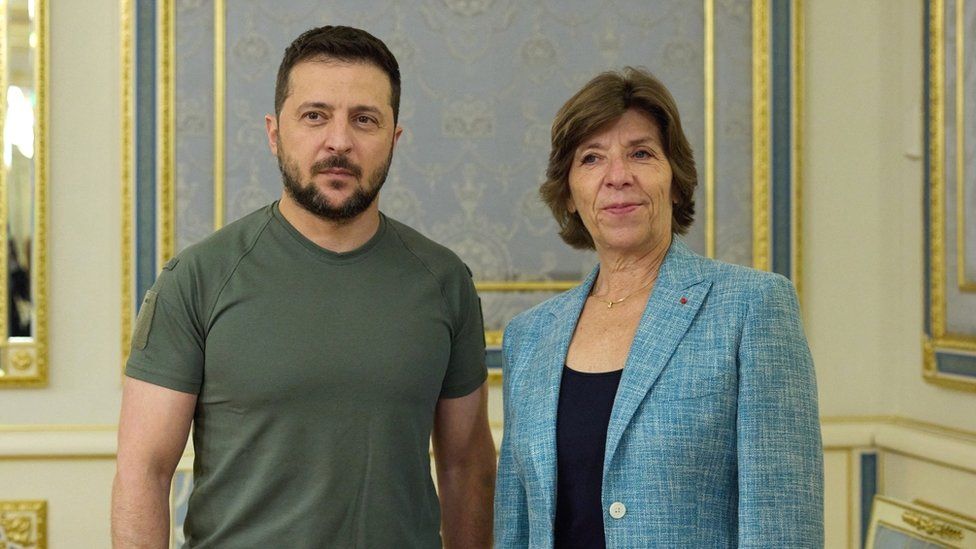
    French Foreign Minister Catherine Colonna and Ukraine's President Volodymyr Zelensky attend a meeting in Kyiv, Ukraine
    IMAGE SOURCE,REUTERS Image caption, French Foreign Minister Catherine Colonna discussed the supply of defence equipment with President Zelensky in Kyiv

    But there is another danger for France. Its relative absence in Ukraine undermines its bid for leadership in the cause of European defence.

    Already many countries of eastern Europe are wary of President Macron, who they believe was far too indulgent towards Russia’s Vladimir Putin in the first months of the war. A narrative has taken root according to which France still feels ambivalent about an outright Ukrainian triumph.

    For Pierre Haroche, who lectures on international security at the Queen Mary University of London, this narrative is unfair – and is not the reason for France’s low levels of arms deliveries to Ukraine.

    However, he is firm of the view that France should beef up its contribution as early as possible, in order to reassure eastern European countries like Poland that “we are all on the same page”.

    “France’s goal of strategic autonomy for Europe is focused primarily on building up our defence industries via joint procurement. But if you want joint procurement, you have to demonstrate to other countries that you have the same vision about our common security,” he says.

    “In order to make our objective of European co-operation viable, we need to show eastern European countries that co-operating with France and buying the idea of strategic autonomy is not a strategic risk.”

    Dr Haroche is calling for France to send 50 Leclerc main battle tanks. Mr Heisbourg would prefer air defense systems, which he says Ukraine is more in need of.

    “It is like a fire extinguisher,” says Dr Haroche. “If there is a fire in a neighbour’s house it is better to offer your extinguisher straightaway, and not wait till the fire reaches your own home.

    “It’s not just generosity. It’s also for your own protection.”

  • Final day of flawed voting in Ukraine under Russian control during the war

    Tuesday marks the penultimate day of a vote for regions of Ukraine controlled by Russia, which the government in Kyiv and its Western allies call a fraud.

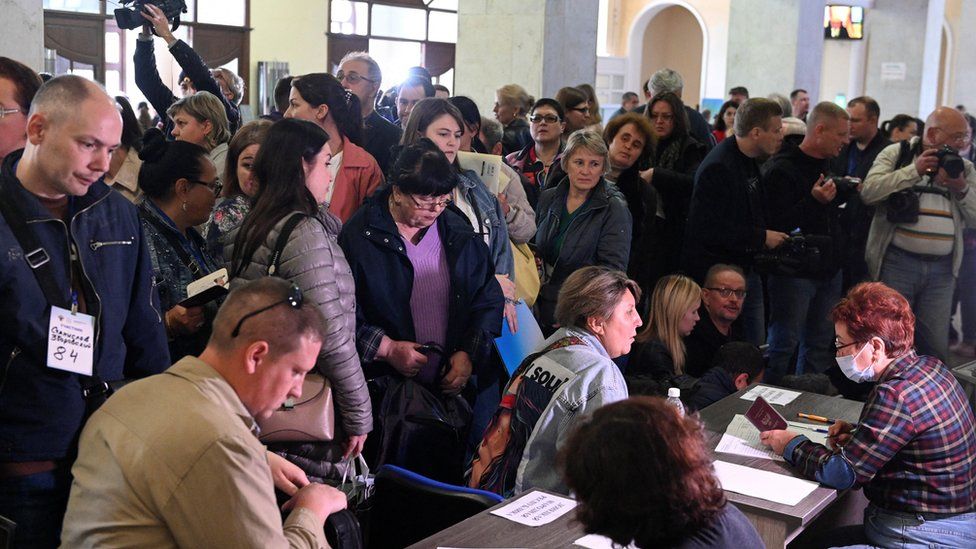
    Nearly four million people from the eastern regions of Donetsk and Luhansk, and the southern regions of Kherson and Zaporizhzhia, are being asked to attend polling stations and vote in so-called referendums on joining Russia.

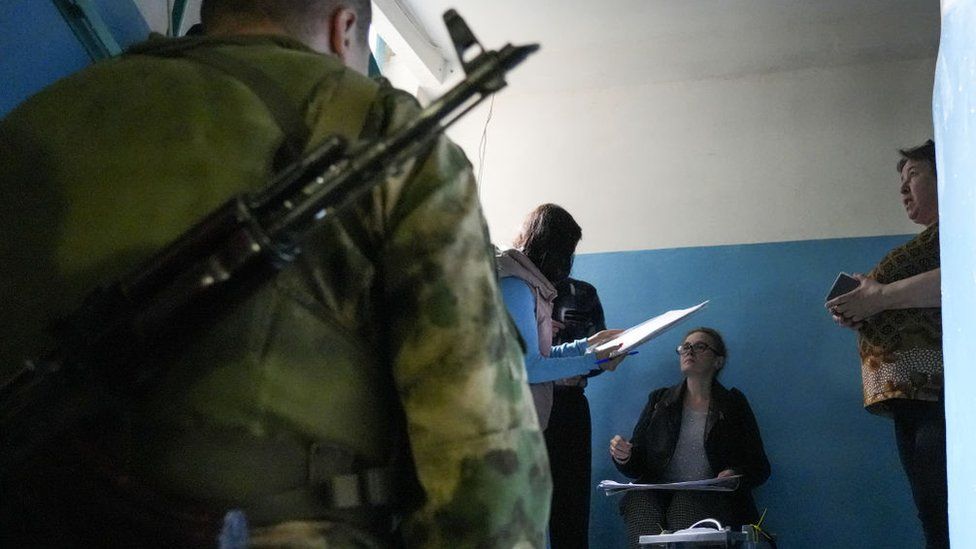
    This follows four days of early voting during which allegations of intimidation multiplied as election officials went house to house accompanied by armed guards.

    The votes, called with just a few days’ notice, serve a deadly serious purpose as they will be used by the Kremlin to legitimise its invasion aims.

    If Russia absorbs these regions, making up about 15% of Ukraine’s territory, it could take the war to a new and more dangerous level, with Moscow portraying any attempt by Ukraine to regain them as an attack on its sovereign territory.

    There is now speculation that Russian President Vladimir Putin may announce the four regions’ annexation in a speech to a joint session of Russia’s parliament on Friday.

    In March 2014 he announced that Ukraine’s Crimea Peninsula had been annexed just a few days after a likewise unrecognised referendum was held.

    ‘At gunpoint’

    Were the guns there to protect you as you voted, or to cow you into voting? That was a question passing through people’s minds in recent days as election officials escorted by soldiers come to knock on their doors.

    Serhiy Haidai, the governor-in-exile of the Luhansk region, accused the separatist authorities there of taking down the names of people who voted against joining Russia or who refused to vote at all.

    “Representatives of the occupation forces are going from apartment to apartment with ballot boxes,” he said, quoted by Reuters news agency. “This is a secret ballot, right?”

    Talking separately to the Associated Press news agency, he suggested the Russians were using the process as a pretext to search homes for men they could mobilise as soldiers as well as checking for “anything suspicious and pro-Ukrainian”.

    One woman described for BBC News how her parents had voted in the city of Melitopol in the Zaporizhzhia region.

    Two local “collaborators” had arrived with two Russian soldiers at their flat to give them a ballot paper to sign, she said.

    Voting in Donetsk, 23 September
    IMAGE SOURCE, GETTY IMAGES Image caption, Soldiers are escorting electoral workers going door to door in Donetsk

    “My dad put ‘no’ [to joining Russia],” the woman said. “My mum stood nearby and asked what would happen for putting ‘no’. They said, ‘Nothing’. Mum is now worried that the Russians will persecute them.”

    Another woman in the embattled town of Enerhodar, where the Zaporizhzhia nuclear power station is located, told the BBC: “You have to answer verbally and the soldier marks the answer on the sheet and keeps it.”

    Ukrainian journalist Maxim Eristavi tweeted to say that his family had been “forced to vote at gunpoint” in southern Ukraine.

    “They come to your house,” he wrote. “You have to openly tick the box for being annexed by Russia (or for staying with Ukraine if you feel suicidal). All while armed gunmen watch you.”

    Petro Kobernik, who left Kherson just before the voting began, told AP in an interview by phone: “The situation is changing rapidly, and people fear that they will be hurt either by the Russian military, or Ukrainian guerrillas and the advancing Ukrainian troops.”

    The vote on paper

    The questions on the ballot papers (there is no digital voting) differ according to region.

    This is because pro-Russian separatists have been running parts of Donetsk and Luhansk since 2014 when they held unrecognized independence referendums.

    Voters, there are being asked whether they “support their republic’s accession to Russia as a federal subject”.

    In the parts of Kherson and Zaporizhzhia occupied by Russian forces since the invasion in February, people are being asked if they “favour the region’s secession from Ukraine, creation of an independent country and subsequent accession to Russia as a federal subject”.

    The ballot papers there are printed in both Ukrainian and Russian whereas in the eastern regions they are printed in Russian only.

    Voting was spread over five days to allow for ballots to be “organized in communities and in a door-to-door manner for security reasons”, Russian state news agency Tass reports.

    Refugees now scattered across Russia can vote in as many as 200 polling stations there.

    The vote is being heavily guarded by Russian or Russian-backed security forces and with reason.

    Not only have Ukrainian forces been pushing the Russians and their separatist allies back in both the east and south, but attacks on figures associated with the Russian occupation have mounted.

    Voters in Rostov-on-Don, 24 September
    IMAGE SOURCE, REUTERS Image caption, People voted at a polling station in the Russian city of Rostov-on-Don

    Former Ukrainian MP Oleksiy Zhuravko, who championed the Russian invasion, was killed along with another person in a missile attack on a hotel in Kherson on Sunday.

    Reports say that Russian journalists who were also staying at the hotel escaped uninjured.

    In the city of Berdyansk in the Zaporizhzhia region, the deputy head of the city administration and his wife who headed the city election commission were killed in an attack a week before the referendum.

    Members of a guerrilla group called the Yellow Band have spread leaflets threatening anyone who votes and urging others to send photos and videos of anyone who does in order to track them down later, AP reports.

    The guerrillas have also sent around phone numbers of election commission chiefs in the Kherson region, asking activists to “make their life unbearable”, the agency reports.

    Ukraine has threatened anyone organizing or supporting the so-called referendums with eventual criminal prosecution, saying they face up to 15 years in prison if convicted.

    International outcry

    Even Serbia, which has close ties with Moscow and is one of the few European countries not to join sanctions on Russia, has announced it will not recognise the results of the voting.

    Foreign Minister Nikola Selakovic said that to do so would be “completely contrary” to his country’s policy of “preserving territorial integrity and sovereignty and… commitment to the principle of inviolability of borders”.

    But in the face of international opposition, Russia’s Foreign Minister, Sergei Lavrov, insisted that the votes were “the expression of the will” of the people who lived in the regions.

    He confirmed that if the four regions joined Russia they would have the same protection as any other part of its territory, including protection with nuclear weapons.

    The White House says the US will never recognise “Ukrainian territory as anything other than part of Ukraine”.

    In its view, the referendums are a “sham – a false pretext to try to annex parts of Ukraine by force in flagrant violation of international law”.

    The UK has responded with new sanctions targeting top Russian officials involved in enforcing the votes among others.

  • Ukraine war: Two people allegedly killed in a hotel attack in Kherson by Kyiv forces

    Kremlin authorities say Ukrainian soldiers killed two persons, including a former member of parliament, in a missile attack on a hotel located in Kherson.

    Oleksiy Zhuravko, a pro-Russian former politician from Ukraine, was alleged to have perished in the strike by a regional official.

    Kirill Stremousov said in a statement that Ukrainian armed forces fired a missile on the Play Hotel by Ribas at 05:30 (03:30 BST) on Sunday.

    Kyiv has not responded to the claims.

    The Russian-installed administration said in a post on Telegram that this “was a planned terrorist act”, adding that the building of the hotel was not used for military purposes.

    The statement said that two people were killed in the attack according to “preliminary information”.

    The authorities said journalists from Russian media were in the hotel when the missile struck, news agency AFP reports. These claims could not be independently verified.

    A representative of the law enforcement agencies in the region was quoted by the TASS news agency as saying that the attack “was clearly carried out with the help of Nato representatives, according to their intelligence and on their tip”.

    Rescue workers were said to be combing the rubble in search of victims at the hotel, located in the center of the southern Ukrainian city.

    The strike comes as Kherson – one of the first places to come under Moscow’s control after the invasion – is taking part in a so-called referendum, asking people if they want to join Russia. As well to Kherson, people in Luhansk, Donetsk, and Zaporizhzhia have also been casting their ballots since Friday and voting is due to finish on Tuesday.

    The West and Kyiv have condemned the votes as “shams” and pledged not to recognize their results. There have also been reports of armed Russian soldiers going door-to-door to collect votes.

    The votes come after Ukrainian forces launched a large-scale counter-offensive in the south. Last month, Ukraine’s military said it had broken through Russia’s first line of defence.

  • Ukraine’s ‘referendums’: Soldiers canvass homes for votes in sham votes

    Armed soldiers have reportedly gone door-to-door in Ukraine’s seized regions to solicit votes for sham “referendums” on joining Russia.

    “You have to answer verbally and the soldier marks the answer on the sheet and keeps it,” one woman in Enerhodar told the BBC.

    In southern Kherson, Russian guardsmen stood with a ballot box in the middle of the city to collect people’s votes.

    The door-to-door voting is for “security”, Russian state media says.

    “In-person voting will take place exclusively on 27 September,” Tass reported. “On the other days, voting will be organized in communities and in a door-to-door manner.”

    One woman in Melitopol told the BBC that two local “collaborators” arrived with two Russian soldiers at her parents’ flat, to give them a ballot to sign.

    “My dad put ‘no’ [to joining Russia],” the woman said. “My mum stood nearby and asked what would happen for putting ‘no’. They said, ‘Nothing’.

    “Mum is now worried that the Russians will persecute them.”

    The woman also said there was one ballot for the entire apartment block building, rather than per person.

    Although the evidence is anecdotal, the presence of armed men conducting the vote contradicts Moscow’s insistence that this is a free or fair process.

    Experts say the self-styled referendums, taking place across five days, will allow Russia to claim – illegally – four occupied or partially-occupied regions of Ukraine as their own.

    In other words, a false vote on annexation, seven months into Russia’s invasion.

    The self-styled “annexation” could lead to Russia claiming that its territory is under attack from Western weapons supplied to Ukraine, which could escalate the war further.

    British Foreign Secretary, James Cleverly, said the UK had evidence that Russian officials had already set targets for “invented voter turnouts and approval rates for these sham referenda”.

    Mr Cleverly said Russia planned to formalize the annexation of the four regions – Luhansk, Donetsk, Kherson, and Zaporizhzhia – by the end of the month.

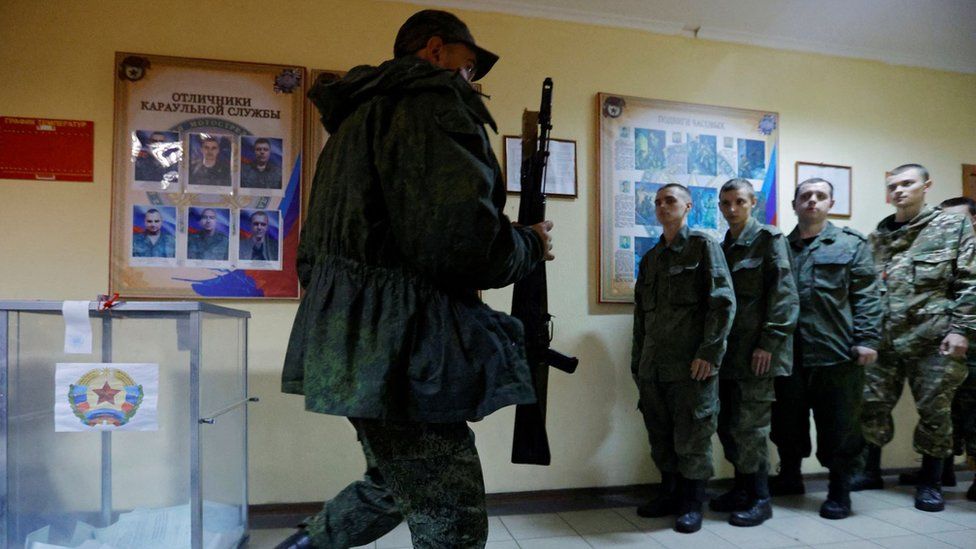
    Armed soldier walks past ballot box as people line up to vote
    IMAGE SOURCE, REUTERS Image caption, Ballot boxes being guarded by armed soldiers in Luhansk

    A source in Kherson told the BBC there was no public effort to encourage voting, apart from an announcement on the Russian news agency that people can vote at a port building, which had been disused for 10 years.

    Another woman in Kherson said she saw “armed militants” outside the building where the vote seemed to be taking place. She pretended to forget her passport, so she didn’t have to vote.

    The woman said all her friends and family were against the referendum. “We don’t know how our life will be after this referendum,” she said. “It is very difficult to understand what they want to do.”

    Kyiv says the referendums will change nothing, and its forces will continue to push to liberate all of the territories.

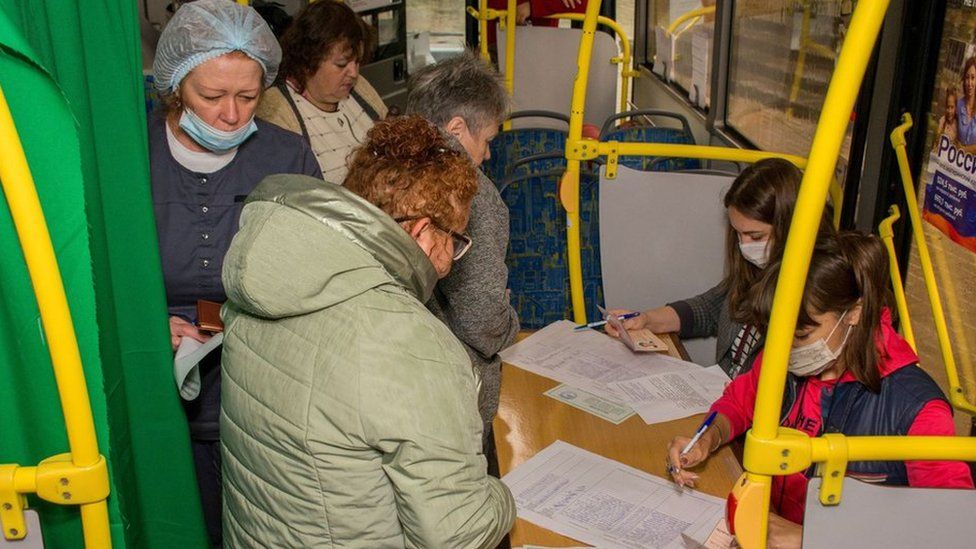
    Women line up to cast vote in referendums on bus.
    IMAGE SOURCE,REX/SHUTTERSTOCK Image caption, These women in Luhansk voted in a converted bus

    Meanwhile, Russian President Vladimir Putin’s recent mobilisation of at least 300,000 extra troops has caused many Russian men of fighting age to flee.

    One young Russian man who left St Petersburg for Kazakhstan to avoid the draft told BBC World Service that most of his friends were also on the move.

    “Right now, I feel like it’s a total collapse. I know only maybe one or two folks that don’t think about exile right now,” he said.

    He said some, like him, are travelling across the border, whereas others have gone to small Russian villages to hide.

    “The big problem of Russia is that we didn’t think about the war in Ukraine in February as we think about it right now,” he said.

  • Putin to increase size of Russian armed forces by 137,000 starting in 2023

    Moscow has not said how many fatalities its army has recorded since it began the war in Ukraine. However, Western officials and Kyiv believe the number is in the thousands.

    Vladimir Putin has ordered Russia’s military to expand with another 137,000 personnel starting from next year.

    The announcement by the Russian president came a day after Moscow’s invasion of Ukraine reached  its six-month mark.

    Moscow has not revealed any losses in the conflict since the first weeks, but Western officials and the Kyiv government believe the number is in the thousands.

    The Russian president signed a decree on Thursday, but it didn’t explain how the military will beef up its ranks and whether this would be through more conscriptions, more volunteer soldiers or a combination of both.

    According to Professor Michael Clarke, unless a “war” is declared by Russia in Ukraine then conscription is not permitted.

    Prof Clarke, former director-general of the Royal United Services Institute, said: “Then there is a fair amount of mutiny at the front lines. But that will not stop the offensive in itself.

    “Russia is now offering big amounts (three to four times the average monthly salary) for young men to take the military contract and serve for as little as six months, with virtually no training.


    Mr Putin’s decree aims to increase the number of military personnel to 1,150,628, which will come into effect on 1 January.

    In November 2017, Mr Putin fixed the size of the number of combat personnel in Russia’s army to 1.01 million from a total armed forces headcount, including non-combatants, of 1.9 million.

    Dozens killed on Independence Day

    Wednesday marked 31 years since it gained independence from the Soviet Union, a date that fell on the same day as the six-month point of Russia’s invasion.

    Ukraine had been bracing for heavy attacks during the day, and a rocket attack in the town of Chaplyne killed 25 people at a train station.

    In the occupied city of Melitopol, in the southeast, the mayor said resistance forces have “blown up” a building which was being used by Russian-back officials in the village of Pryazovsko, which is just outside the city.

    Ivan Fedorov posted a video on his Telegram channel said to show damage to the building, which was apparently being used for issuing Russian passports and to prepare for “voting” in a “pseudo-referendum”.

    The vote is being planned as a way to incorporate the region into Russia.

    Mr Fedorov also claimed on Thursday that Russia had cut off electricity in nearly all the captured areas of the Zaporizhzhia region and said people were now without power, as well as water and gas.

    Source: Sky news

  • Parade of destroyed Russian tanks in Kyiv in pictures

    These images show destroyed Russian military vehicles located on a street in Kyiv as the country marks its independence from Soviet rule today.

    Authorities in the capital have banned large-scale gatherings until Thursday, fearing the national holiday might bring particularly heavy Russian missile attacks.

    Meanwhile, Ukrainian President Volodymyr Zelenskyy has urged the public to be vigilant.


    Pics: AP

  • McDonald’s plans to reopen in Kyiv and western Ukraine

    McDonald’s has announced plans to reopen outlets in Ukraine, which closed after Russia’s invasion in March.

    The fast food chain said it hoped the move would help restore a “small but important sense of normalcy”.

    There will be a phased reopening over the next several months in Kyiv and western Ukraine in areas deemed safe, the burger giant said.

    McDonald’s had more than 100 restaurants in Ukraine before the conflict started.

    The company has continued to pay wages to more than 10,000 staff since then.

    “We’ve spoken extensively to our employees who have expressed a strong desire to return to work and see our restaurants in Ukraine reopen, where it is safe and responsible to do so,” senior vice president Paul Pomroy said in a message posted on the firm’s website.

    “In recent months, the belief that this would support a small but important sense of normalcy has grown stronger. And Ukrainian officials have advised that businesses resuming operations will support the local economy and the Ukrainian people.”

    Analysts expect the war to trigger a 35% or more economic decline in Ukraine this year, disrupting exports, devastating key infrastructure, and forcing shut thousands of businesses.

    In June, Ukrainian President Volodymyr Zelensky spoke at a meeting of western business leaders hosted by Yale University and urged firms to invest in the country.

    He has also celebrated the reopening of dozens of embassies in Kyiv, including the UK’s in April.

    McDonald’s said it was working with suppliers and contractors to ensure the restaurants were ready for reopening.

    KFC, Nike and Zara are among the other western brands whose stores are reported to be open in the country.

    McDonald’s also suspended operations in Russia in March, and in May sold most of its Russian restaurants to a local licensee.

    Source: BBC