Tag: leader

  • Nigerian senate rejects motion to free separatist leader

    Nigerian senate rejects motion to free separatist leader

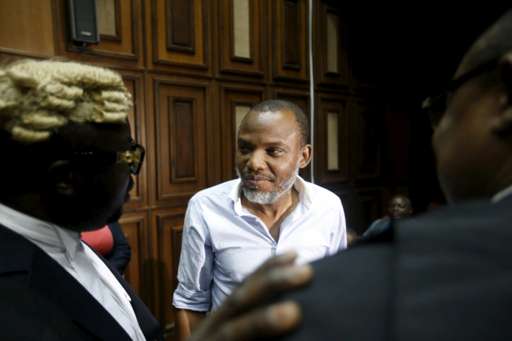
    Head of the secessionist Indigenous People of Biafra (Ipob), Nnamdi Kanu, had a resolution for his release rejected by the Nigerian senate by senators from the south-east area.

    The motion’s sponsor, Senator Osita Izunaso of Imo West, said that releasing Mr. Kanu would put an end to the local gunmen’s sit-at-home instructions.

    “When people are forced to stay at home and businesses remain closed, productivity declines and income is reduced, affecting livelihoods and economic growth,” he said.

    Nevertheless, the Senate turned down the appeals from the south-east lawmaker and instead urged the federal government to arrest those responsible for enforcing the sit-at-home orders.

    Since August 2021, unknown gunmen have been enforcing the weekly sit-at-home directives every Monday, despite Ipob’s disassociation from their actions.

    Mr. Kanu has been in detention since June 2021, even after the court dismissed all terror charges against him in October 2022.

  • Blame parliament for government’s reckless borrowing – Haruna Iddrissu

    The Minority leader in parliament, has asked Parliament to shoulder some of the blame and accountability for the failure to hold the executive branch of government accountable for carrying out its duties.

    According to him, Parliament must accept the blame for the government’s excessive borrowing.

    He said it was the responsibility of Parliament to check the excessive borrowing by the government, asking: “How did we get here?”

    “Parliament’s role as the defender of the people’s interests is lost,” he said.

    He made the admission on Tuesday, December 20, 2022, during a roundtable with the core leadership of Parliament on harnessing the dividends of democracy over the last 30 years, organised by the Ministry of Parliamentary Affairs.

    Democratic dividends refer to the benefits that a democratic system can provide for society.

    Among these benefits are the provision of public goods and an institutionalised arrangement for carrying the people along in the discharge of the duties of the state.

    The discussion was on the theme: ‘Parliament and the harnessing of democratic dividends: Assignment.’

    It brought together experts, including the Chairman of the National Media Commission (NMC), Yaw Boadu-Ayeboafoh, and Dr Maame Adwoa Gyeke-Jandoh, former Head of the Political Science Department at the University of Ghana, Legon.

    The Minority Leader admitted that Parliament was always found wanting when it came to exercising its oversight due to intense partisanship.

    He said the House struggled to determine what was best for the national interest against the interests of political parties.

    Mr. Iddrisu said the consequences of excessive borrowing were being felt by “all of us.”

    He argued that Article 181 of the Constitution gave Parliament the sole right to approve the terms and conditions of all loans.

    “So if the Minister of Finance’s borrowing has exceeded 100 percent of GDP, how did we get here?” He asked.

    He intimated that Parliament had become a “clearing house,” approving Executive members nominated to serve, without scrutinizing them and telling them in the face “that their conduct is not good enough.”

    “The Parliament of Ghana is contributing, through acts of commission or omission, to eroding public faith and confidence in our democracy,” he stressed.

  • Let us not paint good and bad leaders with the same brush

    Leadership is an interesting human endeavour. It is a common principle that infallibility belongs to God and Angels. However, it seems to me that many people expect their leaders to be flawless.

    A good leader does not have to stray from principles of honesty and commitment to build a future of hope for the people. This does not take away the fact that no matter how good a leader may be, there should be some space to accommodate some minimal level of infallibility.

    Some leaders obviously stray from the principles that define a leader. Unfortunately, I have realised that even if a leader gets it 90% correct, the 10% mistakes will be multiplied by ten(10) to cancel out the positive side of the leader and that will push the assessment score into negative.

    This will wrongly push a good leader into the class of bad leaders. We should demand very high performance from our leaders but definitely, such unfair assessment will make it difficult for any human being to pass the leadership mark and that can be demotivating.

    There are many good people with a very high sense of responsibility and the desire to serve as leaders to dedicate themselves to selfless service to people. Such rough leadership terrain discourages many good people from taking leadership positions though they may have the drive and the level of responsibility required for leadership.

    I have encountered such an unfair assessment of some of my favourite leaders like Nelson Mandela. We should criticize our leaders but we should give credit to their positive side and encourage them with our appreciation for their sacrifice to lay a good foundation for the current and future generations. Surely, there would be good and bad leaders. We should differentiate them and not paint bad and good leaders with the same brush. Futurist Kowus.

    Disclaimer : “Opinions expressed in this article are the sole responsibility of the author(s) and do not in any way reflect those of backend.theindependentghana.com. Our outfit will hereby not be liable for any inaccuracies contained in this article.”

    Columnist: Daniel Owusu-Koranteng (Futurist Kowus)

  • Election race heats up as Tundu Lissu returns to Tanzania

    Opposition leader who survived an attack in 2017 returns home three months before the country heads to the polls.

    Prominent opposition leader and presidential hopeful Tundu Lissu has returned to Tanzania to a rousing welcome, three years after narrowly surviving an assassination attempt.

    Chanting “president, president”, hundreds of cheering supporters gathered on Monday at an airport in Dar-es-Salaam to greet the 52-year-old, who had been living in self-imposed exile in Belgium.

    Lissu fled the country after being shot 16 times by unknown gunmen outside his home in the administrative capital, Dodoma, in September 2017.

    A fiery critic of Tanzanian President John Magufuli, Lissu had had a series of run-ins with the police in the months before the gun attack. He was arrested several times, accused of insulting the president – whom he had called a “dictator” over alleged assaults on the opposition and the media and disturbing public order.

    Following the assassination attempt, Magufuli expressed shock at the news and ordered an investigation. Three years on, the gunmen remain at large.

    “The government should ensure his safety given his shooting in 2017,” Oryem Nyeko, a researcher with Human Rights Watch, told Al Jazeera following Lissu’s return to Tanzania.

    Lissu, a member of the main opposition Chadema party, has declared his interest in running for president in Tanzania’s highly anticipated election in October.

    If picked by Chadema, he will run against Magufuli, of the Chama Cha Mapinduzi (CCM) party.

    The president was plucked from the relative obscurity of the Ministry of Works to lead the CCM ticket in the last election thanks to his scrupulous reputation and a work ethic that earned him the nickname “The Bulldozer”. He won the hotly contested vote in 2015 on promises to root out corruption and improve infrastructure.

    His time in office, however, has drawn criticism from the opposition and rights groups who accuse him of narrowing freedoms and repressing political dissent, including by stifling independent journalism and severely restricting the activities of NGOs. The government denies the allegations.

    “The space for government critics and political opposition in Tanzania has been shrinking dramatically since 2015, and we seem to be seeing a continuation of that as we get closer to the elections,” Nyeko said, noting “an increase in restrictions towards the opposition”.

    Last month, opposition leader Zitto Kabwe was freed on bail after he and several members of his Wazalendo Alliance for Transparency and Change (ACT Wazalendo) were arrested for holding an illegal assembly.

    Earlier in June, Chadema leader Freeman Mbowe was allegedly beaten and hospitalised in what his party said was a “politically motivated” attack. Tanzanian police cast doubt on the allegations.

    Meanwhile, authorities on June 23 revoked the licence of Tanzania Daima, an opposition-leaning daily, accusing it of spreading false information among others.

    Three months before the vote, Nyeko called on the government to “make sure that the environment for critics, the media, the opposition and NGOs is open”.

    He said: “That means the government should refrain from arresting critics, suspending or closing media houses, or implanting the myriad of restrictive laws that it has in the past used to clamp down on people that have differing opinions.”

    For his part, Magufuli has promised a transparent vote.

    “I want to assure everyone that the elections will be free and fair, for all political parties,” Magufuli told legislators as he dissolved Parliament in June.

    But Kabwe criticised what he said was a lack of a level playing field and repeated calls for the formation of an independent electoral commission.

    “[The] CCM government under President Magufuli has narrowed the civic space for the last five years,” he told Al Jazeera.

    “It is sad that Tanzanians are not free to air their views. Freedom of association and other fundamental freedoms are curtailed, and people are very angry.”

    The opposition has repeatedly questioned the government’s handling of the pandemic, accusing it of failing to inform the public on its true extent. Authorities have not updated the country’s official number of COVID-19 infections in three months, while Magufuli has declared the disease defeated.

    Besides voting for president, Tanzanians on October 28 will also head to the polls to elect members of parliament and local Councillors. The election commission has said campaigning will run from August 26 to October 27.

    “I believe that if the opposition work together and form a strong coalition, CCM can be defeated,” Kabwe said.

    “I hope we will be able to have a single presidential candidate and divide constituencies in a manner that the opposition will not divide their votes. The election is winnable,” he added.

    Source: aljazeera.com