Four Ghanaian students studying in the United States have been arrested for allegedly submitting fake high school transcripts to gain entry into Lehigh University in Pennsylvania, according to court documents from Northampton County.
The students, identified as Otis Opoku, Evans Oppong, Cyrilstan Nomobon Sowah-Nai, and Henry Dabuo, are facing charges of forgery and theft of services.
They are currently being held at Northampton County Jail, with bail set at $100,000 each, as they await their preliminary hearings scheduled for September 24. The group was arraigned on September 9.
Lehigh University Police Department (LUPD) began the investigation after a complaint was filed by Detective Lieutenant David Kokinda on September 6, implicating three of the students.
The fourth student, Evans Oppong, is still under investigation, and his case is pending processing.
Prosecutors allege that the students altered their high school transcripts, inflating their grades to secure admission and substantial financial aid from the university.
Opoku, enrolled since 2022, reportedly received $212,933 in aid, while Sowah-Nai and Dabuo, who both started in 2023, were awarded $127,213 and $129,244, respectively.
The inquiry was initiated after Dan Warner, Lehigh University’s Vice Provost of Admissions and Financial Aid, raised concerns about discrepancies in a transcript submitted by Jude Dabuo, Henry’s older brother, who had recently been accepted to the university.
The document exhibited unusual errors and inconsistencies, leading the Admissions Office to revoke Jude’s acceptance and scrutinize his brother’s application, uncovering further issues with the other three students’ records.
Friends of the accused have since created a GoFundMe page to support their legal expenses, including attorney fees and bail.
Initially aiming to raise $40,000, the campaign was paused after collecting $9,075 and was later updated with a new goal of $30,925.
The page also highlights that both Opoku and Oppong had previously earned spots on Lehigh’s Dean’s List, a distinction requiring a GPA of 3.6 or higher.
Four Ghanaian students from Lehigh University in Pennsylvania, US, were dismissed by the school authorities and arrested by the Northampton County Corrections Department on charges of theft of services, acquisition of service forgery, and uttering forged writings.
A new research outlines a method through which scientists can capture carbon pollution that warms the earth, convert it to sodium bicarbonate, and store it in the oceans.
According to the authors of the study, which was published on Wednesday in the journal Science Advances, the method could be up to three times more effective than current carbon capture technologies.
Tackling the climate crisis means drastically reducing the burning of fossil fuels, which releases planet-heating pollution. But because humans have already pumped so much of this pollution into the atmosphere and are unlikely to sufficiently reduce emissions in the near term, scientists say we also need to remove it from the air.
Nature does this – forests and oceans, for example, are valuable carbon sinks – but not quickly enough to keep pace with the amounts humans are producing. So we have turned to technology.
One method is to capture carbon pollution directly at the source, for example from steel or cement plants.
But another way, which this study focuses on, is “direct air capture.” This involves sucking carbon pollution directly out of the atmosphere and then storing it, often by injecting it into the ground.
The problem with direct air capture is that while carbon dioxide may be a very potent planet-heating gas, its concentrations are very small – it makes up about 0.04% of air. This means removing it directly from the air is challenging and expensive.
It’s a “significant hurdle,” Arup SenGupta, a professor at Lehigh University and a study author, told CNN.
Even the biggest facilities can only remove relatively small amounts and it costs several hundred dollars to remove each ton of carbon.
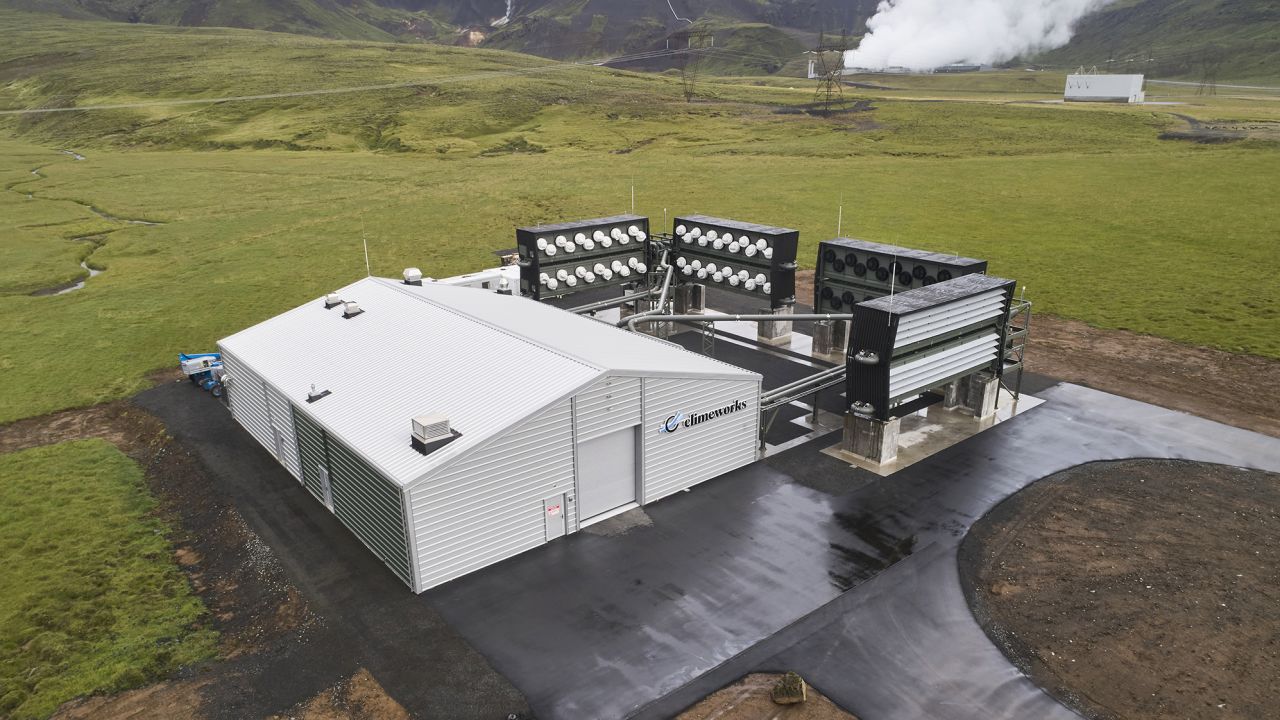
Climeworks’ direct air removal project in Iceland is the largest facility, according to the company, and can capture up to 4,000 tons of carbon dioxide a year. That’s equivalent to the carbon pollution produced by fewer than 800 cars over a year.
The new technique laid out in the study can help tackle those problems, said SenGupta.
The team have used copper to modify the absorbent material used in direct air capture. The result is an absorbent “which can remove CO2 from the atmosphere at ultra-dilute concentration at a capacity which is two to three times greater than existing absorbents,” SenGupta said.
This material can be produced easily and cheaply and would help drive down the costs of direct air capture, he added.
Once the carbon dioxide is captured, it can then be turned into sodium bicarbonate – baking soda – using seawater and released into the ocean at a small concentration.
The oceans “are infinite things,” SenGupta said. “If you put all the CO2 from the atmosphere, emitted every day – or every year – into the ocean, the increase in concentration would be very, very minor,” he said.
SenGupta’s idea is that direct air capture plants can be located offshore, giving them access to abundant amounts of seawater for the process.
Stuart Haszeldine, professor of carbon capture and storage at the University of Edinburgh, who wasnot involved in the study, told CNN that the chemistry was “novel and elegant.”
The process is a modification of one we already know, he said, “which is easier to understand, scale-up and develop than something totally new.”
But there may be regulatory hurdles to surmount. “Disposing of large tonnages of sodium bicarbonate in the ocean could be legally defined as ‘dumping,’ which is banned by international treaties,” Haszeldine said.
Others remain concerned about negative impacts on the oceans, which are already under pressure from climate change, pollution and other human activity.
Peter Styring, professor of chemical engineering and chemistry at the University of Sheffield, told CNN: “Unless you’ve got a full eco-toxic study, then you don’t know what it’s going to do, even at small concentrations.”
Direct air capture also remains expensive and inefficient, Styring said. “This is a big scale problem. Why would you capture from the atmosphere when you’ve got so much coming out of power stations and industrial plants? It just makes sense to go for the high concentrations first,” he said.
Some scientists have expressed concerns that a focus on technology to remove carbon pollution could distract from policies to reduce fossil fuel burning, or could give polluters license to carry on polluting.
But given the scale of the climate crisis, there is a big push from governments and international bodies to scale up this technology.
More research will be needed to understand how the method works at scale, Haszeldine said. But it’s promising, he added, saying “the world needs lots of this type of discovery.”
SenGupta said the technology is ready to be taken out of the lab and trialed. “This is the time to go forward and do something in maybe two or three different places around the world. Let other people get involved, find faults, improve on it, and then proceed accordingly,” he said.