Tag: Leila Djansi

  • “I faced disrespect for looking ordinary” – Leila Djansi

    “I faced disrespect for looking ordinary” – Leila Djansi

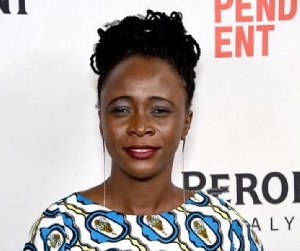
    Celebrated Ghanaian filmmaker, Leila Djansi, has shared an unpleasant experience she had with people who did not initially recognize her.

    According to her, in 2012, she chose to keep her appearance simple while attending the Africa International Film Festival (AFRIFF), which was opened by her film.

    Leila said she wore no makeup and adorned herself in comfortable clothes, with looks  just like “an ordinary girl passing by.”

    “At the hotel sign in table the staff were laughing and chatting. I greeted. No one looked at me. I stepped back and waited until they were done. Ten minutes later one of them finally looked up. ‘Ehe, what?’” she recalled.

    It wasn’t until she gave her name that the staff realized who she was. “She leapt up. ‘Our guest of honor. Madam.’ I just shook my head. She tried to be nice the rest of the festival but that door was already closed.”

    Meanwhile, the renowned filmmaker sparked a debate among industry players, questioning whether they will continue making excuses for the state of Ghana’s film industry or take action to improve it.

    “Good and bad can coexist in anything. But at what point do we stop excusing the bad and start fixing it?” she asked in a Facebook post, calling for a shift from complacency to progress.

    Djansi criticized the industry’s reluctance to embrace constructive criticism, urging filmmakers to compare their work with productions from other African countries such as Nigeria, Zambia, Kenya, and South Africa.

    “Take two of your most recent critically acclaimed films from the previous three years and compare them to two from Nigeria, Zambia, Kenya, and South Africa. Look at them side by side and ask yourself if we are actually gaining any momentum,” she challenged.

    She lamented that since Azali’s Oscar submission in 2018, Ghana’s subsequent entries have not been up to standard.

    “In 2018, we got Azali for the Oscars, and since then, every single submission has been a joke. A literal joke. Some of the films would convince you to burn your Ghana card,” she stated.

    Djansi stressed that the problem is not a lack of talent but an unwillingness to elevate the industry through hard work and innovation.

    Sharing a personal experience, she recalled how a Creative Artists Agency (CAA) agent once critiqued her storytelling approach. Instead of dismissing the feedback, she took it as an opportunity to grow.

    “What he actually said to me was, ‘Go take risks with your storytelling.’ I grew up,” she revealed.

    She urged filmmakers to stop dismissing criticism as hate or jealousy and instead use it as a tool for improvement.

    “Stop enduring mediocrity, please. Instead of these knee-jerk reactions, instead of acting like people just want to hate, forget the who and the how and actually listen. Sit with the criticism. Use it to rise,” Djansi advised.

    With her bold remarks, Djansi hopes to ignite a mindset shift in the Ghanaian film industry, pushing creatives to move beyond excuses and take the necessary steps to compete on the global stage.

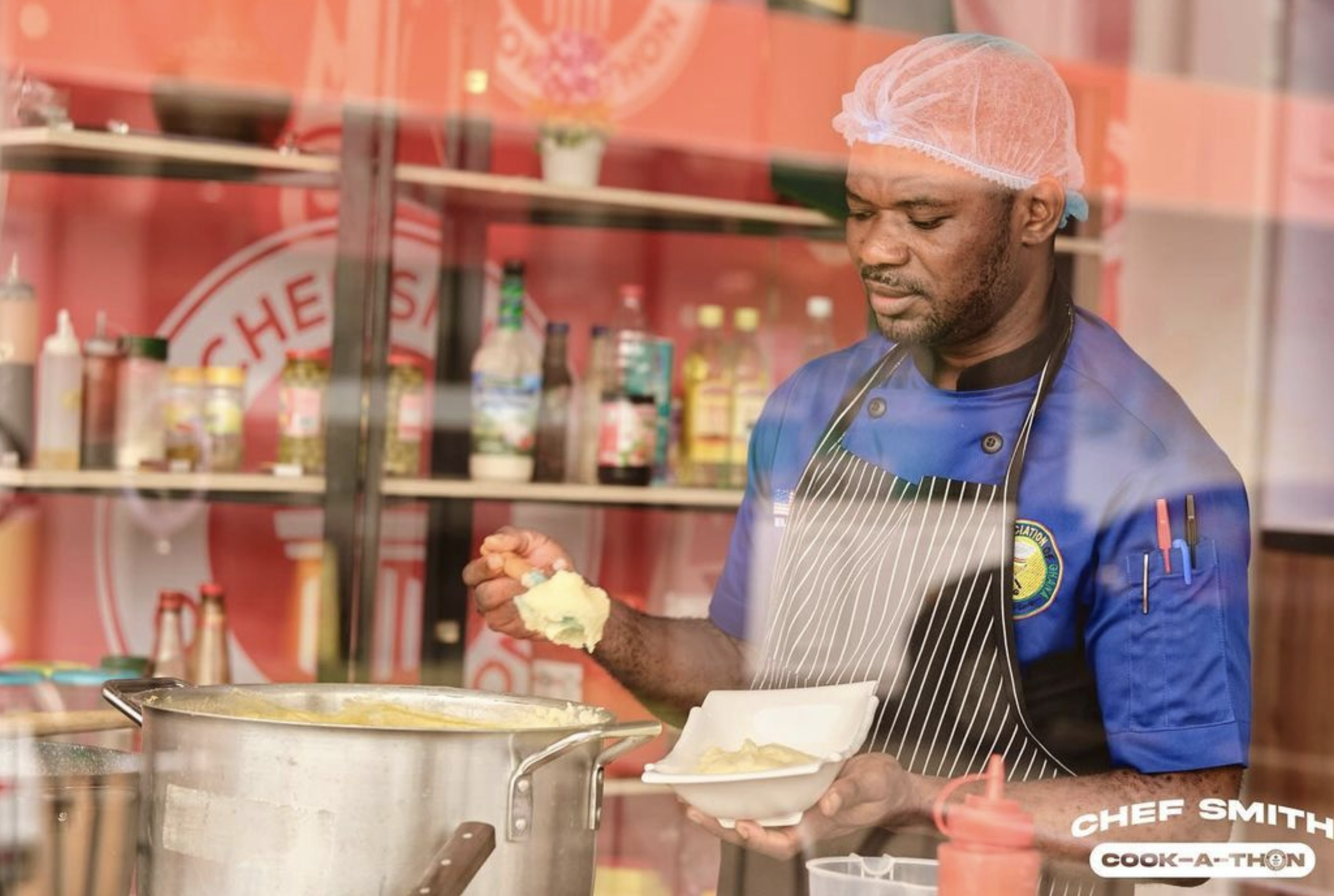
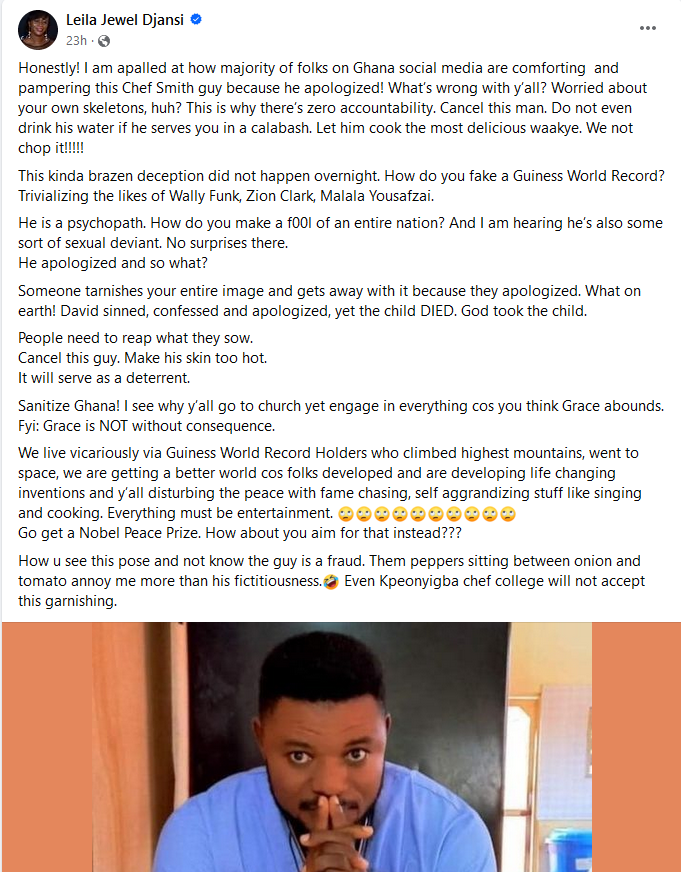
    Responding to a different matter last year, Leila Djansi passionately called for Chef Smith’s cancellation following his admission of fabricating a Guinness World Record. Taking to Facebook, Djansi expressed dismay at the public’s forgiving response to Chef Smith’s apology, arguing that it undermines accountability.

    Describing him as a ‘psychopath’, Djansi criticized the way Chef Smith’s actions have diminished the achievements of genuine record holders. She voiced her frustration with social media’s leniency towards him and urged for stronger consequences, likening the situation to biblical principles where mere apologies should not absolve someone from facing repercussions.

    Djansi emphasized the importance of holding individuals accountable for deceitful behavior to maintain integrity and prevent future incidents.“I am appalled at how the majority of folks on Ghana social media are comforting and pampering this Chef Smith guy because he apologized! What’s wrong with y’all? Worried about your own skeletons, huh? This is why there’s zero accountability. Cancel this man… How do you fake a Guinness World Record? Trivializing the likes of Wally Funk, Zion Clark, Malala Yousafzai.

    “He is a psychopath. How do you make a fool of an entire nation? And I am hearing he is also some sort of sexual deviant. No surprises there. He apologized, so what?

    “Someone tarnishes your entire image and gets away with it because they apologized. What on earth! David sinned, confessed, and apologized, yet the child DIED. God took the child,” Leila Dzansi stated

  • Filmmakers can’t be both creators and distributors – Leila Djansi

    Filmmakers can’t be both creators and distributors – Leila Djansi

    Award-winning filmmaker Leila Djansi has stressed that filmmakers cannot thrive as both filmmakers and film distributors.

    She encouraged filmmakers to tell employ the services of professional distributors and include the as part of their entire project.

    “In Ghana, filmmakers are forced to play both creator and distributor.That’s unsustainable. Your job is to make the film. Get someone else to sell it. Collaborate. Build distribution networks across West Africa, into the diaspora, and then let streamers become an option, not a lifeline,” she said in a post sighted by MyNewsGh.

    Djansi explained that from the script stage, filmmakers must think about their marketing and distribution strategy, ie, Cinema → TV → SVOD → AVOD/FAST, which ensures the film earns over the years, not just once.”

    The renowned Ghanaian filmmaker sparked debate among industry players, questioning whether they will continue making excuses for the state of Ghana’s film industry or take action to improve it.

    “Good and bad can coexist in anything. But at what point do we stop excusing the bad and start fixing it?” she asked in a Facebook post, calling for a shift from complacency to progress.

    Djansi criticized the industry’s reluctance to embrace constructive criticism, urging filmmakers to compare their work with productions from other African countries such as Nigeria, Zambia, Kenya, and South Africa.

    “Take two of your most recent critically acclaimed films from the previous three years and compare them to two from Nigeria, Zambia, Kenya, and South Africa. Look at them side by side and ask yourself if we are actually gaining any momentum,” she challenged.

    She lamented that since Azali’s Oscar submission in 2018, Ghana’s subsequent entries have not been up to standard.

    “In 2018, we got Azali for the Oscars, and since then, every single submission has been a joke. A literal joke. Some of the films would convince you to burn your Ghana card,” she stated.

    Djansi stressed that the problem is not a lack of talent but an unwillingness to elevate the industry through hard work and innovation.

    Sharing a personal experience, she recalled how a Creative Artists Agency (CAA) agent once critiqued her storytelling approach. Instead of dismissing the feedback, she took it as an opportunity to grow.

    “What he actually said to me was, ‘Go take risks with your storytelling.’ I grew up,” she revealed.

    She urged filmmakers to stop dismissing criticism as hate or jealousy and instead use it as a tool for improvement.

    “Stop enduring mediocrity, please. Instead of these knee-jerk reactions, instead of acting like people just want to hate, forget the who and the how and actually listen. Sit with the criticism. Use it to rise,” Djansi advised.

    With her bold remarks, Djansi hopes to ignite a mindset shift in the Ghanaian film industry, pushing creatives to move beyond excuses and take the necessary steps to compete on the global stage.

    On a seperate matter, Leila asserted that YouTube will soon become a thing of the past due to saturation by filmmakers.

    She further argued that a government-backed film fund would be wasted if movies are only released on YouTube.

    She added that piracy also undermines the platform’s viability for film distribution.

    “Personally, I don’t believe the film fund. I really don’t. I think it is premature because there is no distribution. If you give the film fund how are they gonna [make profit].”

    People think that we are just gonna put it on YouTube. I’m sorry YouTube is gonna collapse very soon. There is so much congestion on YouTube and they are always changing their policies. So if you go in now a I think it is seriously over-saturated. If you over-saturate it, they’re gonna reduce the earning. So how much are you gonna earn if you just put your film on YouTube,” she said.

    Meanwhile, James Gardiner, a leading Ghanaian actor, recently discussed the crucial role social media, particularly YouTube, plays in boosting the Ghanaian film industry.

    In an interview with media figure Doreen Avio, the star of ‘Taste of Sin’ pointed out that many are not fully harnessing the potential of these digital platforms.

    Gardiner emphasized that YouTube remains underutilized, despite its potential for significant impact.

    He noted that individual productions can amass millions of views, potentially translating into considerable earnings.

    “YouTube is a goldmine that’s being overlooked. The fact that just one of our productions can hit around 29 million views indicates that African films are resonating widely,” he said.

    While acknowledging the importance of major streaming services like Netflix, Gardiner stressed the value of concentrating efforts on YouTube.

    He shared insights from his recent experiences in Nigeria, highlighting how Nigerian TV stations swiftly adopt and popularize films from YouTube, further amplifying their reach.

    “Work is thriving in Nigeria, and it’s not just Ghanaian audiences that are engaged. In fact, Nigerian platforms quickly pick up new releases from YouTube, often within 20 to 30 minutes, which boosts viewership numbers,” Gardiner observed.

    Despite the hurdles the Ghanaian film industry faces, Gardiner remains hopeful about its future.

    He believes that with a positive outlook and persistent effort, the industry is poised for continued growth and success.

    Popular Nollywood actress Ruth Kadiri recently shared her insights on why she chose YouTube as the platform to showcase her movies.

    In an interview with BBC Pidgin, she highlighted YouTube’s significance as a major income source for independent filmmakers and content creators, emphasizing its pivotal role in sustaining livelihoods within the industry.

    Kadiri emphasized that YouTube has become indispensable, stating that without it, many individuals, not just filmmakers, would face financial hardships. She underscored the platform’s contribution to feeding people by providing opportunities for filmmakers to monetize their content effectively.

    Reflecting on her journey into YouTube, Kadiri revealed her frustration with the constraints of traditional production processes, which motivated her to seek a space where she could freely express her creativity. She discussed her desire to explore and implement innovative ideas without excessive regulations, noting that YouTube offered the flexibility she craved.

    Despite encountering skepticism and discouragement from others, Kadiri viewed YouTube as a platform for reaching a broader audience and honing her skills. Her decision to venture into YouTube was fueled by a passion for storytelling and a determination to overcome challenges, even if it meant learning from initial setbacks.

    Kadiri’s experience on YouTube has been marked by the production of several films, each contributing to her growth as a filmmaker and entrepreneur. Her journey exemplifies the evolving landscape of film distribution and the opportunities that digital platforms like YouTube offer to aspiring creators.

    The surge and mass production of AI-generated content on YouTube has prompted the video-sharing platform to announce a review and update of its monetisation policy under the YouTube Partner Program (YPP).

    The YouTube Partner Program is how creators earn money from their content.

    In a formal statement shared on July 7 on YouTube’s Support page- a platform where the company shares updates and announcements- it spelt out modifications concerning content and its monetisation policy.

    “We’re updating our guidelines to better identify mass-produced and repetitive content. This update better reflects what inauthentic content looks like today,” parts of the statement read.

    According to the statement, effective July 15, content would now be subjected to strict scrutiny, and those found as repetitive with no intention to educate or entertain would be demonetised.

    “On July 15, 2025, we’re updating our guidelines to better identify mass-produced and repetitive content. This update better reflects what inauthentic content looks like today”, it continued.

    Also, content that has been created with heavy use of AI with little to no human effort would be demonetised.

    “AI-assisted content is acceptable, but only if it includes considerable human input. Content created with little to no human effort may not be eligible for monetisation.”

  • YouTube may become a thing of the past due to saturation by filmmakers – Leila Djansi

    YouTube may become a thing of the past due to saturation by filmmakers – Leila Djansi

    Ghanaian-American filmmaker Leila Djansi has asserted that YouTube will soon become a thing of the past due to saturation by filmmakers.

    She further argued that a government-backed film fund would be wasted if movies are only released on YouTube.

    She added that piracy also undermines the platform’s viability for film distribution.

    “Personally, I don’t believe the film fund. I really don’t. I think it is premature because there is no distribution. If you give the film fund how are they gonna [make profit].”

    People think that we are just gonna put it on YouTube. I’m sorry YouTube is gonna collapse very soon. There is so much congestion on YouTube and they are always changing their policies. So if you go in now a I think it is seriously over-saturated. If you over-saturate it, they’re gonna reduce the earning. So how much are you gonna earn if you just put your film on YouTube,” she said.

    Meanwhile, James Gardiner, a leading Ghanaian actor, recently discussed the crucial role social media, particularly YouTube, plays in boosting the Ghanaian film industry.

    In an interview with media figure Doreen Avio, the star of ‘Taste of Sin’ pointed out that many are not fully harnessing the potential of these digital platforms.

    Gardiner emphasized that YouTube remains underutilized, despite its potential for significant impact.

    He noted that individual productions can amass millions of views, potentially translating into considerable earnings.

    “YouTube is a goldmine that’s being overlooked. The fact that just one of our productions can hit around 29 million views indicates that African films are resonating widely,” he said.

    While acknowledging the importance of major streaming services like Netflix, Gardiner stressed the value of concentrating efforts on YouTube.

    He shared insights from his recent experiences in Nigeria, highlighting how Nigerian TV stations swiftly adopt and popularize films from YouTube, further amplifying their reach.

    “Work is thriving in Nigeria, and it’s not just Ghanaian audiences that are engaged. In fact, Nigerian platforms quickly pick up new releases from YouTube, often within 20 to 30 minutes, which boosts viewership numbers,” Gardiner observed.

    Despite the hurdles the Ghanaian film industry faces, Gardiner remains hopeful about its future.

    He believes that with a positive outlook and persistent effort, the industry is poised for continued growth and success.

    Popular Nollywood actress Ruth Kadiri recently shared her insights on why she chose YouTube as the platform to showcase her movies.

    In an interview with BBC Pidgin, she highlighted YouTube’s significance as a major income source for independent filmmakers and content creators, emphasizing its pivotal role in sustaining livelihoods within the industry.

    Kadiri emphasized that YouTube has become indispensable, stating that without it, many individuals, not just filmmakers, would face financial hardships. She underscored the platform’s contribution to feeding people by providing opportunities for filmmakers to monetize their content effectively.

    Reflecting on her journey into YouTube, Kadiri revealed her frustration with the constraints of traditional production processes, which motivated her to seek a space where she could freely express her creativity. She discussed her desire to explore and implement innovative ideas without excessive regulations, noting that YouTube offered the flexibility she craved.

    Despite encountering skepticism and discouragement from others, Kadiri viewed YouTube as a platform for reaching a broader audience and honing her skills. Her decision to venture into YouTube was fueled by a passion for storytelling and a determination to overcome challenges, even if it meant learning from initial setbacks.

    Kadiri’s experience on YouTube has been marked by the production of several films, each contributing to her growth as a filmmaker and entrepreneur. Her journey exemplifies the evolving landscape of film distribution and the opportunities that digital platforms like YouTube offer to aspiring creators.

    The surge and mass production of AI-generated content on YouTube has prompted the video-sharing platform to announce a review and update of its monetisation policy under the YouTube Partner Program (YPP).

    The YouTube Partner Program is how creators earn money from their content.

    In a formal statement shared on July 7 on YouTube’s Support page- a platform where the company shares updates and announcements- it spelt out modifications concerning content and its monetisation policy.

    “We’re updating our guidelines to better identify mass-produced and repetitive content. This update better reflects what inauthentic content looks like today,” parts of the statement read.

    According to the statement, effective July 15, content would now be subjected to strict scrutiny, and those found as repetitive with no intention to educate or entertain would be demonetised.

    “On July 15, 2025, we’re updating our guidelines to better identify mass-produced and repetitive content. This update better reflects what inauthentic content looks like today”, it continued.

    Also, content that has been created with heavy use of AI with little to no human effort would be demonetised.

    “AI-assisted content is acceptable, but only if it includes considerable human input. Content created with little to no human effort may not be eligible for monetisation.”

  • False doctrine on the grace of God is keeping people in bondage – Leila Djansi

    False doctrine on the grace of God is keeping people in bondage – Leila Djansi

    American-based Ghanaian filmmaker and director Leila Jewel Djansi has asserted that the false doctrine of God’s grace is keeping Christians in bondage instead of setting them free.

    In her Facebook post shared on May 20, Leila stated that modern churches are using the idea of “grace” to control believers instead of empowering them.

    She wishes God could take action on manipulators of his “grace” like he did in the days of old when there was no “grace.”

    “I dunno why God is not performing Old Testament gymnastics and has brought this grace that is being used to keep his children in bondage through spiritual blackmail.”

    “Very soon, we’ll stay home, read our Bibles, and take our tithes straight to hospitals and orphanages where they might actually do God’s work,” she added.

    Leila Djansi further made a mockery of the fact that while pastors enjoy salaries, gifts, and luxuries like houses and cars, ordinary church workers are expected to await their reward in heaven.

    “So, the church expects its workers to receive their reward in heaven while the pastor receives his reward here on earth; Salary, gifts, the pastor’s appreciation with houses and cars. The mother of all scams,” she wrote.

    In March this year, Leila commented on the movie industry and some of the scary encounters while on set.

    She recounted a shocking incident where actor-turned-politician John Dumelo was nearly stabbed with a real knife during a movie shoot.

    In a Facebook post on March 2, 2025, Djansi criticized the Ghanaian film industry, calling it a “mirthless joke” and highlighting instances of unprofessionalism she encountered while working in Ghana. Among the incidents she shared was a near-fatal accident involving Dumelo and Hollywood actress Vanessa Williams.

    “Should I talk about the production designer who passed a real knife to an actor for a stabbing scene? My God. If it wasn’t for divine intervention, Vanessa Williams would have stabbed John Dumelo with a real knife that day. How is this not a joke?” she wrote.

    Read post below:

    https://web.facebook.com/leilajeweldjansi/posts/1202402621352365?ref=embed_post


  • Should we keep making excuses or fix what’s wrong? – Leila Djansi asks movie industry players

    Should we keep making excuses or fix what’s wrong? – Leila Djansi asks movie industry players

    Renowned Ghanaian filmmaker Leila Djansi has sparked a debate among industry players, questioning whether they will continue making excuses for the state of Ghana’s film industry or take action to improve it.

    “Good and bad can coexist in anything. But at what point do we stop excusing the bad and start fixing it?” she asked in a Facebook post, calling for a shift from complacency to progress.

    Djansi criticized the industry’s reluctance to embrace constructive criticism, urging filmmakers to compare their work with productions from other African countries such as Nigeria, Zambia, Kenya, and South Africa.

    “Take two of your most recent critically acclaimed films from the previous three years and compare them to two from Nigeria, Zambia, Kenya, and South Africa. Look at them side by side and ask yourself if we are actually gaining any momentum,” she challenged.

    She lamented that since Azali’s Oscar submission in 2018, Ghana’s subsequent entries have not been up to standard.

    “In 2018, we got Azali for the Oscars, and since then, every single submission has been a joke. A literal joke. Some of the films would convince you to burn your Ghana card,” she stated.

    Djansi stressed that the problem is not a lack of talent but an unwillingness to elevate the industry through hard work and innovation.

    Sharing a personal experience, she recalled how a Creative Artists Agency (CAA) agent once critiqued her storytelling approach. Instead of dismissing the feedback, she took it as an opportunity to grow.

    “What he actually said to me was, ‘Go take risks with your storytelling.’ I grew up,” she revealed.

    She urged filmmakers to stop dismissing criticism as hate or jealousy and instead use it as a tool for improvement.

    “Stop enduring mediocrity, please. Instead of these knee-jerk reactions, instead of acting like people just want to hate, forget the who and the how and actually listen. Sit with the criticism. Use it to rise,” Djansi advised.

    With her bold remarks, Djansi hopes to ignite a mindset shift in the Ghanaian film industry, pushing creatives to move beyond excuses and take the necessary steps to compete on the global stage.

  • “He is a psychopath” – Leila Dzansi on Chef Smith’s fake GWR claims

    “He is a psychopath” – Leila Dzansi on Chef Smith’s fake GWR claims

    Renowned Ghanaian filmmaker Leila Djansi has passionately called for Chef Smith‘s cancellation following his admission of fabricating a Guinness World Record. Taking to Facebook, Djansi expressed dismay at the public’s forgiving response to Chef Smith’s apology, arguing that it undermines accountability.

    Describing him as a ‘psychopath’, Djansi criticized the way Chef Smith’s actions have diminished the achievements of genuine record holders. She voiced her frustration with social media’s leniency towards him and urged for stronger consequences, likening the situation to biblical principles where mere apologies should not absolve someone from facing repercussions.

    Djansi emphasized the importance of holding individuals accountable for deceitful behavior to maintain integrity and prevent future incidents.

    “I am appalled at how the majority of folks on Ghana social media are comforting and pampering this Chef Smith guy because he apologized! What’s wrong with y’all? Worried about your own skeletons, huh? This is why there’s zero accountability. Cancel this man… How do you fake a Guinness World Record? Trivializing the likes of Wally Funk, Zion Clark, Malala Yousafzai.

    “He is a psychopath. How do you make a fool of an entire nation? And I am hearing he is also some sort of sexual deviant. No surprises there. He apologized, so what?

    “Someone tarnishes your entire image and gets away with it because they apologized. What on earth! David sinned, confessed, and apologized, yet the child DIED. God took the child,” Leila Dzansi stated.

  • Veteran actor Vincent McCauley’s passing leaves the Ghanaian entertainment industry in grief

    Veteran actor Vincent McCauley’s passing leaves the Ghanaian entertainment industry in grief

    The Ghanaian entertainment community is grappling with sorrow following the demise of the esteemed actor Vincent McCauley, renowned for his memorable role in the iconic series “Things We Do For Love.”

    Expressing his heartfelt grief on social media, Adjetey Anang, a co-star and close friend of McCauley, shared touching memories of their time on set.

    Anang said that even though they were rivals in movies, their friendship off screen endured throughout the years.

    McCauley was hailed as a cherished member of the “Things We Do For Love” family, and Anang conveyed the profound shock felt by everyone in the wake of this unexpected loss.

    He extended condolences to McCauley’s family, acknowledging the pain of losing yet another member of the beloved series cast.

    Producer Leila Djansi, reacting to McCauley’s passing, disclosed that she was aware of his illness and had plans to visit him soon.

    Djansi, who had reached out to McCauley just days before his demise, expressed devastation upon learning the news.

    She mourned the untimely loss as an unexpected beginning to the New Year.

    Beyond his iconic role in “Things We Do For Love,” Vincent McCauley was actively involved in his latest project, “YOLO,” where he portrayed the character of Mark Anthony’s father.

    The news of McCauley’s passing has prompted an outpouring of condolences and shared memories on social media, reflecting the deep impact he had on both the industry and his fans.

  • Lawyer Hari Gakinya charged with murder of Belgian woman

    A Nakuru-based lawyer Hari Gakinya has been charged with the murder of Belgian woman Dysseleer Mireille Lesoipa.

    Appearing before Justice Daniel Ogembo the lawyer, however, pleaded not guilty to the offense of murder.

    It is alleged that between 11th December 2018 and July 2019 jointly with others not before the court at an unknown place within Kenya killed Lesoipa alias Leila.

    He was charged even though the police are yet to find the deceased body who police believe was killed.

    His bail hearing is set for Monday.

    The prosecution has told the court they will be opposing his release on bail.

    Meanwhile, the other suspect Lucy Waithera Njuguna, a close friend to the deceased who is also facing a similar murder charge in the case was also arraigned in court but she did not take a plea for the second time as her mental assessment report was not ready.

    She will be taken for mental assessment at Mathari Hospital.

    She will appear before the court on Thursday to plead to the charge.

    Source: kbc.co.ke