Tag: lethal injection

  • Execution by firing squad could resume in US over scarcity of lethal injection drugs

    Execution by firing squad could resume in US over scarcity of lethal injection drugs

    Due to the present lack of components for lethal injection, firing squad executions may return to the US.

    The use of their goods in fatal injections has been prohibited by numerous pharmaceutical corporations.

    States that still use the death penalty are now without the medications required to carry out these sentences.

    Currently, several states are considering utilising a firing squad to execute prisoners who have been found guilty of murder.

    This week, Idaho lawmakers approved a bill that authorises the use of fire squads to execute people who are sentenced to death row. This includes Mississippi, Utah, Oklahoma and South Carolina.

    Utah is the only state to have actually used a firing squad in the last 50 years, when Ronnie Lee Gardner was executed at Utah State Prison on June 18, 2010.

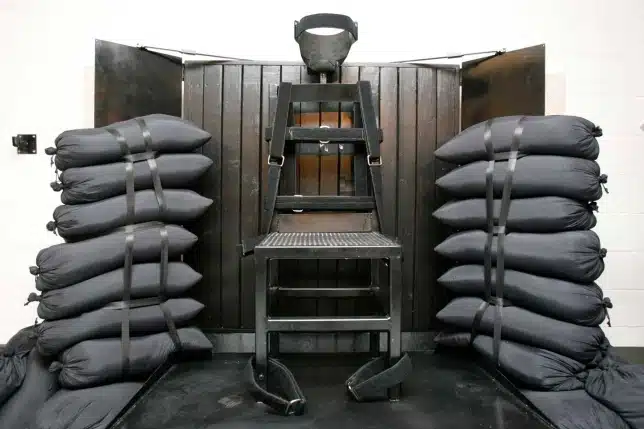
    The man, who killed an attorney during a courthouse escape attempt, sat in a chair surrounded by sandbags while five prison staffers fired from 25 feet away. Gardner was pronounced dead two minutes later.

    Some believe firing squads are actually more humane than the lethal injection, with Supreme Court justice Sonia Sotomayor that is is ‘near instant and may also be comparatively painless’.

    She wrote in a 2017 dissent that lethal drugs can mask intense pain by paralysing inmates while they are still sentient.

    ‘What cruel irony that the method that appears most humane may turn out to be our most cruel experiment yet,’ she said.

    But others are opposed to firing squads for their bloodiness and violence, with anesthesiologist Joseph Antognini arguing that being shot can be ‘severely painful, especially related to shattering of bone and damage to the spinal cord’.

    There has also been lots of controversy around using the lethal injection, leading Arizona to pause the death penalty.

    The state’s first Democratic governor since 2009, Katie Hobbs, ordered a review into death penalty protocols in January.

    This was after Arizona was accused of taking too long to insert the IV into a prisoner’s body.

    The Arizona Republic newspaper requested to witness last year’s three executions but each of these were rejected.

    Ms Hobbs said she believes ‘it’s time to address the fact that this is a system that needs better oversight on numerous fronts’.

    New Democratic attorney general, Kris Mayes, said recent executions had amounted to ‘torture’, saying a ‘thorough review of Arizona’s protocols and processes governing capital punishment is needed’.

  • Missouri judge denies request from 19-year-old to witness her father’s execution

    A man is scheduled to be executed by lethal injection in Missouri on Tuesday without his daughter present due to her age, NBC News reported.

    Kevin Johnson was sentenced to death for the 2005 killing of a Kirkwood, MO police officer. Johnson was 19 at the time he committed the crime, the same age his daughter, Khorry Ramey, is now.

    “I’m heartbroken that I won’t be able to be with my dad in his last moments,” Ramey told NBC News. She said that her father “has worked very hard to rehabilitate himself in prison. I pray that [Gov. Mike] Parson will give my dad clemency.”

    Missouri law prevents individuals under the age of 21 from attending executions. And, on behalf the Ramey, the American Civil Liberties Union filed a lawsuit urging the state to allow Ramey to attend her father’s execution.

    The plaintiffs argue that prohibiting Ramey from attending the execution is unconstitutional and “illustrates the irrationality” of sentencing, someone, to death prior to their 21st birthday but preventing those under 21 from attending executions.

    “I am my dad’s closest living relative and he is mine, other than my baby son,” Ramey told the outlet. “If my dad were dying in the hospital, I would stick by his side and hold his hand, praying until his death.”

    But the judge argued that the plaintiffs did not prove the law was unconstitutional, therefore blocking Ramey from attending the execution of her last living parent.

    “It’s ironic that Kevin was 19 years old when he committed this crime and they still want to move forward with this execution, but they won’t allow his daughter who’s 19 at this time in because she’s too young,” Johnsons’ lawyer, Shawn Nolan, told reporters Friday.

    The Missouri Attorney General’s Office argues that the execution should proceed because “the surviving victims of Johnson’s crimes have waited long enough for justice,” according to NBC News.

    Johnson’s execution is set to occur on Tuesday. But because a special prosecutor is arguing that there was “unconstitutional racial discrimination” in Johnson’s conviction, a hearing is scheduled for Monday that could possibly prevent the execution.

    An attorney for Ramey, an attorney for Johnson, the Missouri Attorney General, and a Missouri special prosecutor did not immediately respond to Insider’s request for comment.

    Source: Insider.com 


  • Missouri: Teenager asks court to let her watch father’s execution by lethal injection

    Kevin Johnson is scheduled to be executed on November 29 for the 2005 murder of a police officer.

    The 37-year-old, who has been in prison since his daughter Khorry Ramey was two years old, has asked that his daughter, who is now 19 years old, attend the execution – and she has stated that she wants to be there.

    A 19-year-old girl has petitioned a federal court in Missouri to allow her to witness her father’s execution by lethal injection.

    Kevin Johnson is scheduled to be executed on November 29 for the 2005 murder of a police officer.

    The 37-year-old, who has been in prison since his daughter Khorry Ramey was two years old, has requested that she attend the execution – and she has stated that she wishes to do so.

    However, Missouri law bars anyone under 21 from witnessing an execution.

    On Monday, the American Civil Liberties Union filed an emergency motion with a federal court in Kansas City, arguing the law serves no safety purpose and violates Ms Ramey’s constitutional rights.

    She called her father in a court declaration “the most important person in my life”.

    “If my father were dying in the hospital, I would sit by his bed holding his hand and praying for him until his death, both as a source of support for him, and as a support for me as a necessary part of my grieving process and for my peace of mind,” she said.

    Court papers said the two have been able to build a bond through visits, phone calls, emails and letters – and last month, she took her newborn son to prison to meet his grandfather.

    Meanwhile, Johnson’s lawyers have filed appeals seeking to halt the execution.

    They don’t challenge his guilt but claim racism played a role in the decision to seek the death penalty, and in the jury’s decision to sentence him to die. Johnson is black and his victim was white.

    His lawyers also argued he has a history of mental illness – and that he was 19 at the time of the crime.

    The Supreme Court in 2005 banned the execution of offenders who were younger than 18 at the time of their crime.

    However, in a court filing last week to the court, the Missouri Attorney General’s Office said there were no grounds for court intervention.

    “The surviving victims of Johnson’s crimes have waited long enough for justice, and every day longer that they must wait is a day they are denied the chance to finally make peace with their loss,” it said.

    William McEntee, a married father-of-three, was among several police officers sent to Johnson’s home on July 5, 2005, to serve a warrant for his arrest for an alleged probation violation.

    Johnson’s 12-year-old brother, who suffered from a congenital heart defect, collapsed and began having a seizure. He later died in hospital.

    When the police officer later returned to the neighbourhood to investigate unrelated reports of fireworks being set off, Johnson shot him several times.


  • Alan Miller: Execution of a triple murderer by lethal injection postponed due to inability to quickly locate a vein

    Due to time constraints and difficulty getting into Alan Miller’s veins, the lethal injection execution was postponed.

    Officials in Alabama have halted the lethal injection execution of a prisoner on death row because they couldn’t find a vein before the midnight deadline.

    Alabama corrections commissioner John Hamm said the decision to call off the scheduled execution of Alan Miller was made after it became clear they could not get the process underway in time.

    The last-minute reprieve came nearly three hours after the US Supreme Court cleared the way for the execution to go ahead.

    “Due to time constraints resulting from the lateness of the court proceedings, the execution was called off once it was determined the condemned inmate’s veins could not be accessed in accordance with our protocol before the expiration of the death warrant,” Mr Hamm said.

    The execution team had begun the process of trying to establish intravenous access, but he did not know for how long.

    The execution was abandoned at around 11.30 pm on Thursday – half an hour before the state’s death warrant was set to expire.

    Miller, a delivery truck driver, was convicted of killing three men in a workplace shooting rampage in 1999 near Birmingham, Alabama.