Japan’s highest court has declared that a rule which forced transgender individuals to undergo sterilization before obtaining legal recognition is against the constitution. This ruling is considered a significant achievement for Japan’s LGBTQ community after many years of fighting for their rights.
Under a law made 20 years ago, transgender people who want to change their official documents must have been diagnosed with a condition called “gender identity disorder. ” They must also be at least 18 years old, not married, and not have any children under the age of 18.
They also need to have private parts that look like the opposite sex and cannot have children. This means that they had to go through surgery and sterilization.
The law has been criticized by rights groups for a while. In the past, attempts to challenge it in court were not successful. However, in this case, a transgender woman wanted to change her legal gender from male to female without having surgery and she is challenging the law.
The person who brought the lawsuit claimed that taking hormones for a long time had already affected her ability to have children, according to NHK.
Before going to the Supreme Court, a lower court and a higher court did not accept her case. On Monday, the court decided she won the case because the rule making sterilization necessary broke the law of the country.
The limit on keeping people safe from physical harm is not needed anymore and is now more severe. So, the court said that the rule is not needed or fair.
The text means that reproductive rights are seen as very important human rights according to the constitution. The decision said that it is unkind that they have to go through a procedure to remove their ability to have babies without wanting to, just so that they can legally be the gender they identify as.
According to NHK, the recent decision made by the Supreme Court of Japan is significant because it is only the 12th time since World War II that the court has declared a law as unconstitutional. This means that the parliament of Japan now needs to reconsider the law.
But, that doesn’t mean the entire law is being altered – just the part that says people need to be sterilized.
The country’s highest court decided not to make a final decision on whether transgender people should have reproductive organs that look like the opposite gender’s. They believe it is allowed by the constitution. According to a ruling on Monday, the part of the case will be sent back to a lower court to think about it. The ruling also said that the rule does not directly force transgender people to have surgery.
Some people in the LGBTQ community were happy and celebrated the ruling, but there were also worries about the need for more surgeries and how society might react.
During a press conference, the lawyer for the person who filed the lawsuit, Kazuyuki Minami, shared a statement from that person. The statement expressed their immense surprise due to the unexpected judgment.
“I am sad that the Grand Chamber of Justice did not approve my gender change and that the case has been delayed,” she said in the statement. However, she also said, “I am happy that this case will lead to a positive result. ”
The lawyer, Minami, said that not many judgments say that current laws are against the constitution, so this ruling is very important. But he also said it’s frustrating that the plaintiff didn’t get the outcome they wanted.
Ken Suzuki, a law professor who focuses on LGBTQ matters at Meijin University in Japan, said that the court’s decision was incomplete. He mentioned that the LGBTQ community is still waiting for the lower court to determine if they will need additional surgeries to have genitals that look like those of the opposite gender.
“However, it brings them optimism,” he said, describing it as a “groundbreaking decision. ” “A lot of people can see that the judges have shown a strong interest in the subject. ”
The LGBT Law Coalition, a group that supports laws for people with sexual orientation and gender identity difficulties, praised the decision. They also expressed their hope that the Supreme Court would make a fair decision on the other requirements for transgender individuals.
The organization is really sorry about the recent unfair treatment of transgender people. This includes many transgender people feeling anxious and scared when they try to use the bathroom they feel comfortable in.
During the summer, the Supreme Court made a decision against a government agency. This agency had stopped a transgender employee from using the women’s bathroom. It was the first time the court addressed the rights of sexual minorities at work.
Many people in Japan have traditional beliefs about LGBTQ issues. Although some polls indicate a change in attitudes, activists argue that discrimination is still common. For example, Japan is the only country in the Group of Seven (G7) that does not have laws to protect same-sex unions.
This spring, the government faced more and more pressure to create a law that supports the LGBTQ community. This was because they were going to host the G7 leaders’ summit in May. However, there were disagreements about the bill, so it was only given to parliament the day before the summit started.
At the end, the approved bill was not as strong as activists wanted. It didn’t include any guarantees for human rights and some people worry that it may indirectly support discrimination.
Tag: LGBTQ community
-
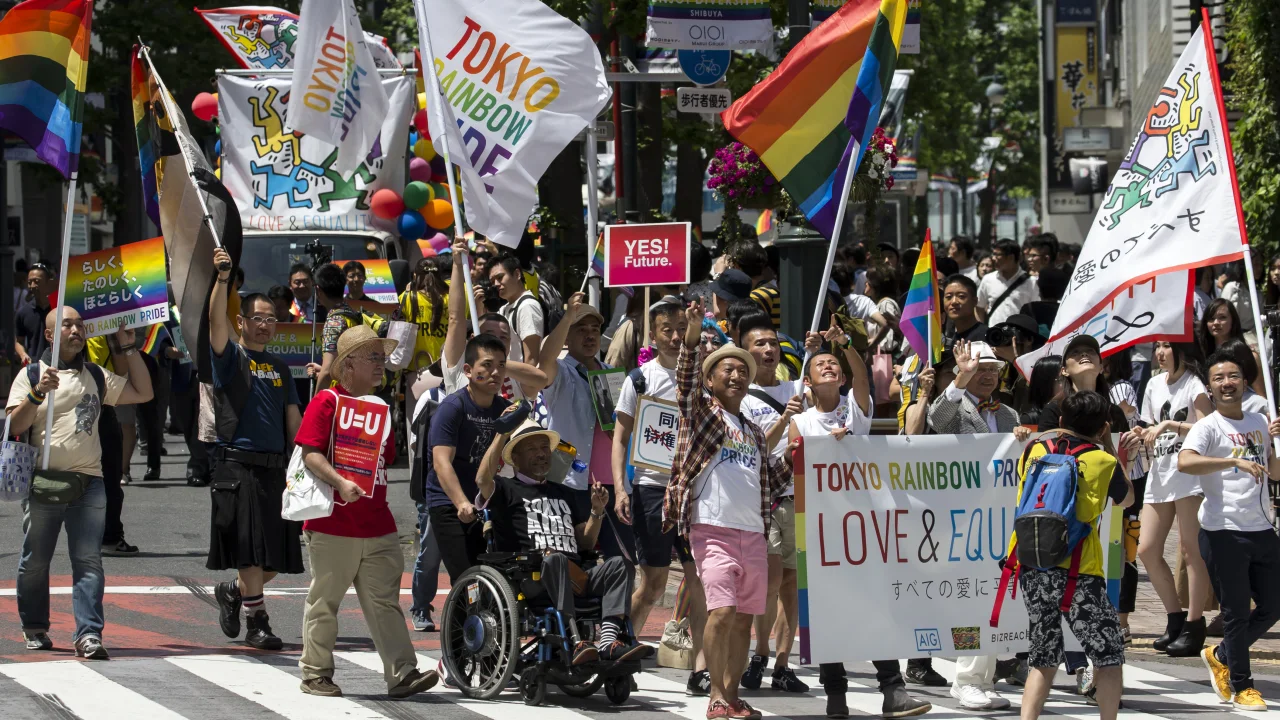
Japan court declares requiring transgender sterilisation ‘unconstitutional’
-

Highest court in India to make decision regarding same-sex marriage
Aditi and Susan didn’t fall in love when they first met at a book club in Mumbai.
“We didn’t like each other at all,” Anand, a filmmaker, said happily as she remembered the meeting. “We always disagreed with each other’s opinions on the books we were reading. ”
After a few weeks, the two women saw each other at a phone store. Dias purposely didn’t pay attention to Anand.
She made a big effort to ignore me. “But luckily, or maybe luckily for both of us, we met each other at the phone counter,” Anand said. We greeted each other and gave each other our phone numbers.
Over ten years later, Anand and Dias have created a life together.
But they cannot get married in their home country.
India, which is the biggest democracy and has the most people, does not accept same-sex marriage. This means that millions of LGBTQ couples are not able to receive legal benefits connected to marriage, such as adoption, insurance, and inheritance.
The current law only recognizes one of them as the legal parent of their son, which affects important decisions like who can make medical choices for him.
But, things might be about to change.
India’s highest court, the Supreme Court, has been hearing arguments from activists since April about a significant case. The proceedings are being broadcasted live to the public, and tens of thousands of people are watching it every day.
People who support the rights of 18 petitioners say that India should start treating LGBTQ people as equal citizens according to its constitution.
They said in a recent court filing that these unions were an idea for people in cities and of high social status, and therefore not wanted in the country.
The court is going to make a decision soon.
If the activists succeed, it could greatly alter what is usually a very traditional and conservative country.
“I want my son to have two parents who are legally and officially recognized,” said Dias, who is one of the 18 people petitioning, just like Anand. “And that’s why we think this petition matters to us. ”Hindu stories from many years ago tell about men who turn into women, and sacred texts talk about characters who are neither male nor female. Same-sex sex was made illegal and only straight couples could get married in India in 1860 by the British rulers.
After that, the LGBTQ community in India, which is probably one of the biggest in the world because of the country’s 1. 4 billion people, has been treated poorly and excluded by society.
Both of these laws from the colonial period were still being used even 70 years after India became independent in 1947. These laws were no longer being used in the country they came from, England and Wales, who made same-sex intercourse legal in 1967 and same-sex marriage legal in 2013.
For almost ten years, Narendra Modi, the leader of India, and his ruling party, the BJP, have wanted to get rid of India’s connection to its past as a colony. They have changed the names of streets and cities and have promoted the idea of India being in control of its own future. However, the laws in Victoria that govern same-sex marriage are a remnant of the past from when the country was a colony. His party has been working hard to keep these laws in place.
In 2017, when Vishwa and Vivek got married, being gay was still against the law and could result in up to 10 years in jail. They had a small Hindu ceremony at Vishwa’s parents’ apartment near New Delhi. They only invited a few of their closest friends and family.
We had to do it fast. Vivek, who works for a non-profit organization, said that it had to be short. “My family was not there. ”
In that year, the talented Indian filmmaker, Karan Johar, wrote about the experience of being homosexual in India.
“I don’t need to loudly announce my sexual orientation as everyone already knows it,” he wrote in his book “An Unsuitable Boy. ” I will not say this because in my country, I could possibly go to jail for it.
However, it seems like people’s opinions and behaviors are starting to shift.
In 2018, the Supreme Court made a decision to end a law that made same-sex intercourse a crime. However, they did not change the law that only allows heterosexual couples to get married.
In the past few years, the movie industry and big cities in India have become more accepting of same-sex relationships. Bollywood, the influential Hindi-film industry, and cities like Mumbai and Bengaluru now celebrate pride month with parades and big events.
Vishwa believes that these wins are great for the community and have motivated people to keep trying to change the law, despite strong opposition from the government. He said that even if the judge ruled against the people making the request, there could still be some positive aspects.
It may not result in a victory. Most of us have accepted it without any problems,” Vishwa said. We believe that if the Supreme Court agrees with us, it will help us in the long run. We are prepared to keep fighting.
No matter what the court says, its decision will impact many people in India for a very long time.
Famous chef and LGBTQ supporter Suvir Saran is one of many who disagree with the government’s position. He believes that the government is showing that India does not accept people for who they are.
In areas with a lot of discrimination in the countryside, the consequences of revealing your true identity can be very serious, according to Saran.
If you don’t have good education or basic things for living, you’re in a bad situation. Saran said that you might feel damaged or hurt even before you understand your sexual identity.
Anish Gawde, who started Pink List India, a group that keeps watch on Indian politicians and their views on LGBTQ issues, mentioned that a lot of people have been expelled from their homes and made to live alone because they do not have any support.
Gawde said that marriage equality is very important to many queer people in India. “They keep loving each other even though people judge them and try to hold them back. ”
Vivek wants a positive decision to make his relationship with his husband recognized and accepted by more people.
“I want to be recognized as Vishwa’s legal partner,” he said. Marriage is an agreement between two people that is recognized by society. It is also an agreement about money. The privileges given to opposite-sex couples are extremely important for people like us to create a life together.
After asking the highest court for help, Dias explained that she now understands they are not doing this only for themselves, but for the many people who cannot afford to fight.
Now, many people are working together to take action. “I’m doing this for people who can’t do it themselves, just as much as I’m doing it for myself,” she explained.
Anand said yes, adding that their home conversation turned into a big movement that brought together India’s LGBTQ community.
She asked if we can be equal. -

Report men who force you to have anal sex, use sex toys – Communications Minister charges women
Member of Parliament for Ablekuma West, Ursula Owusu-Ekuful, has called on Ghanaian women who are coerced by their partners into engaging in oral and anal sex, and using sex toys to make a complaint to the police.
During the parliamentary discussion on the Promotion of Proper Sexual Human Rights and Ghanaian Family Values bill on Wednesday, she emphasized that such acts, regardless of the genders involved, are illegal under the anti-LGBTQ bill and will be treated as criminal offenses.
Expressing concern over reports of wives facing divorce threats from their husbands for refusing to participate in these sexual activities, the lawmaker emphasized the importance of women knowing their rights and seeking legal assistance when faced with such coercive situations.
“For the avoidance of doubt and the information of all Ghanaians, oral sex, anal regardless of whether it is between woman and man, man and man or woman and woman is illegal under our law and so if there is anybody who is practising oral sex or anal sex please note that what you are doing is against the existing law of this country.
Addressing her colleagues on July 5, she insisted underscored the significance of the proposed bill in addressing such issues.
“And so I will urge any woman or young girl being subjected to any of such practice under the guise of heterosexual sex to know that what they are being asked to do is against and law and must seek help from the police. Anal sex is unnatural carnal knowledge, use of sex toys is unnatural carnal knowledge.”
Per Section 104 of the Criminal Code of Ghana “unnatural carnal knowledge is sexual intercourse with a person in an unnatural manner or with an animal.”
The second reading of the bill hit a snug as two lawsuits have been filed against it —one at the High Court and the other at the Supreme Court.
As a result, Parliament has decided to take a cautious approach and slow down the decision-making process regarding the bill.
But today, the second reading of the Promotion of Proper Human Sexual Rights and Ghanaian Family Values Bill, popularly known as the anti-LGBTQ bill went through, and the consideration stage will follow before a third reading to signal passage.
The proposed anti-LGBTQ bill presented to Parliament in 2021 as a private bill by some MPs has been a subject of intense debate in Ghana, sparking discussions both domestically and internationally.
The bill seeks to criminalise activities related to homosexuality and increase penalties for those involved.
-

Ghana’s president modifies country’s stance on harsh anti-LGBTQ bill as Kamala Harris visits
In light of Kamala Harris’ visit, Ghana’s president modifies the nation’s position on a harsh anti-LGBTQ law.
President Nana Akufo-Addo of Ghana stated that after his administration’s intervention, “substantial elements” of a harsh anti-LGBTQ bill that the country’s parliament was considering “have been modified.”
The announcement was made by Akufo-Addo and US Vice-President Kamala Harris on Monday during a press conference held in conjunction with Harris’ visit to the country of West Africa.
He emphasised that the proposed legislation, disguised as a “family values” bill, was actually a private member’s bill that sought to enact some of the harshest anti-LGBTQ laws on the African continent. In August 2021, the bill made its initial appearance in the legislature.
“The bill is going through the parliament. The attorney general has found it necessary to speak to the committee (the constitutional and legal committee of parliament) about it regarding the constitutionality … of several of its provisions. The parliament is dealing with it. At the end of the process, I will come in,” the Ghanaian leader said.
After parliamentary deliberations, a final bill will be sent to the president for assent.
“My understanding … is that substantial elements of the bill have already been modified as a result of the intervention of the attorney general,” Akufo-Addo said.
Ad Feedback
In suggesting that the bill may end up being watered down in the amendment process, Akufo-Addo added that he was convinced the parliament will consider the sensitivity of the bill to human rights issues as well as the feelings of the Ghanaian population “and come out with a responsible response.”
Anti-gay bill still “rigid and tough”
However, one of the parliamentarians who introduced the bill, Samuel Nartey George, insists that the proposed law remains “rigid and tough.”
“The bill has not been substantially changed. The bill remains as tough and as rigid as it was,” George told local media in a televised interview.
He added: “When the bill is laid before the House (of parliament), you will realize that the focus of the bill which has to do with voiding (gay) marriages, preventing them from adopting or fostering children, the clampdown on platforms and media houses that are going to do promotion and advocacy or push those materials still remain enforced.”
George also implied that restrictions against “expressions, be it lesbian, gay, bisexual, transgender are all still there. “So when he (Akufo-Addo) says the bill has been watered down, he doesn’t know what he is talking about.”
The proposed aw would see LGBTQ Ghanaians face jail time, or be forced into so-called “conversion therapy” – a widely discredited practice debunked by much of the international medical and psychiatric communities.
Under the bill, advocates of the LGBTQ community would face up to a decade in prison; public displays of same-sex affection or cross-dressing could lead to a fine or jail time, and certain types of medical support would be made illegal.
The new law would also make the distribution of material deemed pro-LGBTQ by news organizations or websites illegal. It calls on Ghanaians to report those they suspect of being from the LGBTQ community.
Harris, the US vice-president, said at the press conference she felt very strongly about supporting the freedom and equality of the LGBTQ community.
“This is an issue that we consider to be a human rights issue, and that will not change,” she said.
Ghana not pressured
Ghana’s information minister, Kojo Oppong Nkrumah, also told CNN on Tuesday that the outcome of the parliamentary debate on the bill may differ from its original provisions.
“The bill is now in an enactment process. What will come out in enactment when 275 members get on the floor and start dealing with it clause by clause and voting clause by clause, may end up being different from what was proposed. You propose a bill and parliament … can tweak it and make it harsher or less harsh … it is in the hands of parliament now,” Nkrumah said.
The minister also insisted however that the Ghanaian government was not under pressure to relax existing legislation on homosexuality.
“We are not pressured in any way to focus on things that are not essentially within our main priorities. Our priority number one is getting the Ghanaian economy on track and that’s what we’re focused on.”
“This conversation is not part of our mainstream conversation here in Ghana,” he added.
Old sodomy laws dating back to 1960 remain on the statute books in Ghana but they are rarely enforced.
Activist Danny Bediako, who runs the NGO Rightify Ghana, told CNN that living in Ghana would become tougher for the LGBTQ community if the bill passes in parliament.
“It’s going to make it difficult for the (LGBTQ) community to exist. They are just trying to erase the community through this bill, so it will definitely lead to an increase in attacks,” said Bediako, who added that his organization had documented 27 cases of violent attacks targeted toward the LGBTQ community in the country this year.
“There have been different types of cases, but the most dominant one is the activities of violent groups and they are widespread. So if this bill is passed, these activities are going to continue and it’s only going to also get worse.”
-

Identifying as LGBTQ to be illegal in Uganda
The present ban on same-sex relationships, according to legislators, does not go far enough, thus a bill that would make identifying as LGBTQ a crime was taken up by Uganda’s parliament on Thursday.
Same-sex relationships are punished by up to a life sentence in jail in this socially conservative and religious country in east Africa.
More than 30 African nations forbid same-sex relationships, but if Uganda’s bill is approved, it would appear to be the first to make it a crime to identify as lesbian, gay, bisexual, transgender, or queer (LGBTQ).
The proposed Ugandan law was introduced as a private lawmaker’s bill and aims to allow the country to fight “threats to the traditional, heterosexual family”, according to a copy seen by Reuters.
It punishes with up to 10 years in prison any person who “holds out as a lesbian, gay, transgender, a queer or any other sexual or gender identity that is contrary to the binary categories of male and female”.
It also criminalizes the “promotion” of homosexuality and “abetting” and “conspiring” to engage in same-sex relations.
Ugandan President: Being gay not a right
The law is similar in some ways to a law passed in 2013 that stiffened some penalties and criminalized lesbianism. It drew widespread international condemnation before it was struck down by a domestic court on procedural grounds.
After the new bill was read in parliament, Speaker Anita Among sent it to a committee for scrutiny and public hearings before it is brought back to the House for debate and a vote.
Among urged members of parliament to reject intimidation, referencing reported threats by some Western countries to impose travel bans against those involved in passing the law.
“This business of intimidating that ‘you will not go to America’, what is America?” she said.
An investigation by a parliamentary committee ordered in January into reports of alleged promotion of homosexuality in schools has already sparked a wave of discrimination and violence against members of the LGBTQ community, activists say.
-

Pope Francis: Homosexuality a sin but not a crime
Pope Francis has called homosexuality laws “unjust,” saying God loves his children exactly as they are, and has urged Catholic bishops who support the laws to welcome LGBTQ people into the church.
“Being homosexual isn’t a crime,” Francis said during an interview with the Associated Press on Tuesday.
He acknowledged Catholic bishops in some parts of the world support laws criminalising homosexuality or discriminate against the LGBTQ community – and referred to the issue in terms of “sin”.
But he attributed such attitudes to cultural backgrounds and said bishops in particular need to undergo a process of change to recognise the dignity of everyone.
“These bishops have to have a process of conversion,” he said, adding that they should apply “tenderness, please, as God has for each one of us”
Some 67 countries or jurisdictions worldwide criminalise consensual same-sex sexual activity, 11 of which can or do impose the death penalty, according to The Human Dignity Trust, which works to end such laws.
Experts say even where the laws are not enforced, they contribute to harassment, stigmatisation and violence against LGBTQ people.
In the US, more than a dozen states still have anti-sodomy laws on the books despite a 2003 Supreme Court ruling declaring them unconstitutional.
Gay rights advocates say the antiquated laws are used to harass homosexuals, and point to new legislation, such as the so-called “don’t say gay” law in Florida, which forbids instruction on sexual orientation and gender identity from nurseries through to school year four, as evidence of continued efforts to marginalise LGBTQ people.
The United Nations (UN) has repeatedly called for an end to laws criminalising homosexuality outright, saying they violate rights to privacy and freedom from discrimination and are a breach of countries’ obligations under international law to protect the human rights of all people, regardless of their sexual orientation or gender identity.
Being homosexual is not a crime. It’s not a crime. Yes, but it’s a sin. Fine, but first let’s distinguish between a sin and a crime. It’s also a sin to lack charity with one another.
Declaring such laws “unjust”, Francis said the Catholic Church can and should work to put an end to them.
“It must do this. It must do this,” he said.
Francis quoted the Catechism of the Catholic Church in saying gays must be welcomed and respected and should not be marginalised or discriminated against.
“We are all children of God and God loves us as we are and for the strength that each of us fights for our dignity,” Francis said, speaking from the Vatican hotel where he lives.
Such laws are common in Africa and the Middle East and date from British colonial times or are inspired by Islamic law.
Some Catholic bishops have strongly upheld them as consistent with Vatican teaching that considers homosexual activity “intrinsically disordered”, while others have called for them to be overturned as a violation of basic human dignity.
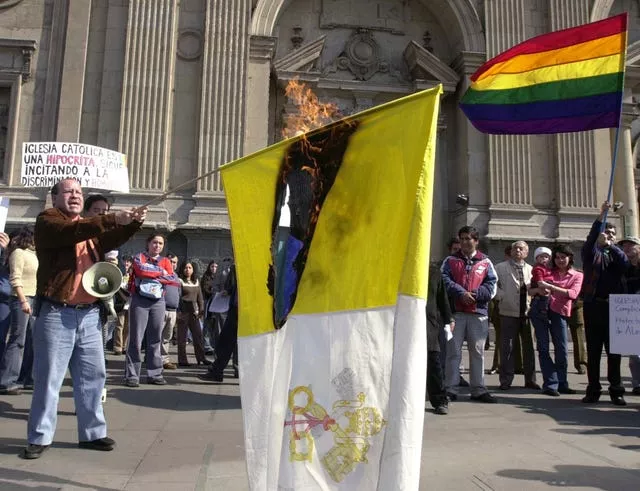
Rolando Jimenez, leader of a Chilean gay rights organisation, holds a flaming Vatican flag during a protest by gay activists against the Roman Catholic Church’s rejection of same-sex marriages, in front of a cathedral in Santiago, Chile, in 2003 (Santiago Llanquin/AP) In 2019, Francis had been expected to issue a statement opposing criminalisation of homosexuality during a meeting with human rights groups that conducted research into the effects of such laws and so-called “conversion therapies”.
In the end, the pope did not meet with the groups, which instead met with the Vatican number two, who reaffirmed “the dignity of every human person and against every form of violence”.
On Tuesday, Francis said there needs to be a distinction between a crime and a sin with regard to homosexuality.
“Being homosexual is not a crime,” he said.
“It’s not a crime. Yes, but it’s a sin. Fine, but first let’s distinguish between a sin and a crime.”
“It’s also a sin to lack charity with one another,” he added.
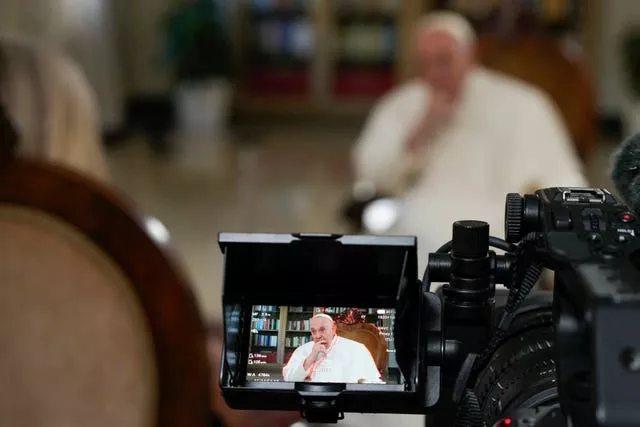
Pope Francis ponders a question during the interview (Andrew Medichini/AP) Catholic teaching holds that while gay people must be treated with respect, homosexual acts are “intrinsically disordered”.
Francis has not changed that teaching but he has made reaching out to the LGBTQ community a hallmark of his papacy.
Starting with his famous 2013 declaration, “Who am I to judge?” when asked about a purportedly gay priest, Francis has gone on to minister repeatedly and publicly to the gay and trans community.
As archbishop of Buenos Aires, he favoured granting legal protections to same-sex couples as an alternative to endorsing gay marriage, which Catholic doctrine forbids.
Despite such outreach, Francis was criticised by the Catholic LGBTQ community for a 2021 decree from the Vatican’s doctrine office that the church cannot bless same-sex unions “because God cannot bless sin”.
The Vatican in 2008 declined to sign onto a UN declaration that called for the decriminalisation of homosexuality, complaining the text went beyond the original scope and also included language about “sexual orientation” and “gender identity” it found problematic.
In a statement at the time, the Vatican urged countries to avoid “unjust discrimination” against gay people and end penalties against them.