The head of Libya’s judicial police, Osama Najim, has been arrested on war crimes charges following a warrant issued by the International Criminal Court (ICC), according to media reports.
Najim, who manages the Mitiga detention center in Tripoli, was reportedly taken into custody on Sunday in Turin, Italy.
Former detainees from several Libyan detention centers have accused authorities of severe abuses, including routine torture and rape. In 2022, the United Nations reported finding evidence of “serious rights violations.”
Italian newspaper la Repubblica said Najim was arrested at a hotel after Interpol provided a tip. An Italian migrant rescue group, Mediterranea Saving Humans, explained that the arrest followed a “difficult” ICC investigation that relied on years of victim complaints and testimonies.
The ICC has not yet commented on the case.
Mediterranea Saving Humans also criticized a controversial agreement between Italy and Libya. Under this deal, Italy provides training and funding to Libya’s coastguard to intercept migrant boats, aiming to reduce the flow of migrants traveling through Libya to Italy.
At the time of his arrest, Najim was reportedly with other Libyan citizens and planned to visit a stadium, according to attorney general Lucia Musti, as reported by la Repubblica.
Najim’s case has been forwarded to the Italian justice ministry and the appeals court in Rome for further action.
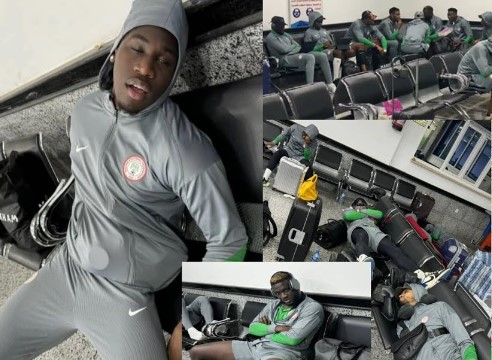
Confederation of African Football (CAF) has responded to the treatment of Nigerian players at Al-Abaq airport in Libya as they arrived for their qualifier match for the 2025 Africa Cup of Nations.
In a statement issued on Monday, October 14, 2024, CAF announced that it has launched an investigation into the matter.
The organization emphasized its commitment to upholding standards and regulations within African football, assuring that appropriate penalties will be imposed on any individuals or entities found to have breached their rules.
“The Confederation Africaine de Football (CAF) has been in contact with the Libyan and Nigerian authorities after it had been informed that the Nigerian National Football Team (‘Super Eagles’) and their technical team were stranded in disturbing conditions for several hours at an airport that they were allegedly instructed to land by the Libyan authorities.
“The matter has been referred to the CAF Disciplinary Board for investigation, and appropriate action will be taken against those who violated the CAF Statutes and Regulations.”
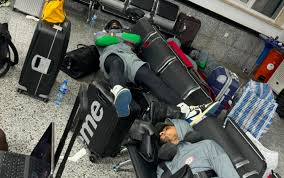
The Super Eagles of Nigeria faced significant delays at Al-Abaq Airport, where they were kept waiting for over 13 hours after their arrival.
Reports indicate that their chartered flight, initially bound for Benghazi, was unexpectedly rerouted to another location while still in the air.
The treatment of the Super Eagles and their officials has sparked controversy, especially in light of Libya’s previous complaints about their treatment during their visit to Nigeria for the first leg of the match.
In response to the situation, the Nigeria Football Federation (NFF) has reached out to CAF, expressing their intention to boycott the upcoming game. The team has since returned to Nigeria from Libya.
The Nigerian national football team, known as the Super Eagles, faced an unexpected setback at Al Abraq airport in Libya.
They were en route to Benghazi for an important Africa Cup of Nations qualifier against Libya on Tuesday, October 15, 2024.
However, their flight was redirected to Al Abraq just an hour before landing, a city more than two hours away from their intended destination. This sudden change left the team in a challenging situation, far from where they needed to be.
The Nigerian Football Federation (NFF) had carefully organised their travel plans, arranging a chartered flight to land directly in Benghazi. This location was chosen for its proximity to Benina, ensuring a short journey to their accommodations.
However, the unexpected diversion disrupted these plans, leaving the team without immediate transportation upon arrival.
Journalist Adepoju Tobi Samuel reported that although the Nigerian Football Federation (NFF) had arranged transportation in Benghazi, the Libyan Football Association failed to provide any alternative solutions at Al Abraq airport.
The situation escalated as the Super Eagles found themselves stranded for over 12 hours within the airport, with no buses or transport options available.
Samuel noted the frustration of the NFF, which attempted to arrange alternative transport but faced resistance due to the airport gates being closed.
Team captain and defender Troost-Ekong took to social media to share their experience, describing the airport as desolate and the team as isolated, without even phone connectivity.
He expressed his disappointment over the Libyan government’s abrupt cancellation of their approved landing in Benghazi, implying that such actions were psychological tactics ahead of their important match.
The IOM said they don’t know how they died or where they were from, but they think they died while being taken through the desert to the Mediterranean.
The United Nations organization said it was very surprised by the discovery.
Libya is looking into it, the IOM said.
The tomb was discovered in the southwest part of Libya.
A person from IOM said that every time a migrant goes missing or dies, it makes their family very sad and they want to know what happened to them. It is a very sad and tragic situation.
Not doing enough has led to more people dying and migrants suffering in terrible situations.
The group said the sad event showed that we need to work together to stop people from being smuggled and to find legal ways for them to come to our country.
Libya is one of the main places where people leave from to try to cross the Mediterranean Sea and get to Europe.
A lot of people died when the boat they were on had problems in the sea. Now, a lot of their bodies have been found in a big hole in the ground. This happened after about 60 people, who were trying to get to Europe from Libya, died.
The IOM recently announced that 2023 was the worst year for migrants in the past ten years, with more than 8,565 people dying while trying to migrate to different places around the world.
The United Nations agency helps people in Libya who are in need. They said the number of people they helped increased by 20% from the previous year.
Imad Trabelsi, who is in charge of the inside of the country, said that a deal was made for the regular forces to be in charge of keeping the peace in Tripoli after talking for a long time.
He said only police for emergencies, city officers, and investigators would be there.
Many groups with weapons have caused a lot of trouble in Libya since Muammar Gaddafi was removed from power in 2011.
A lot of fighting and violence happened, and the ruler was killed. This caused a lack of safety and order in the country, and it has been very chaotic ever since.
Right now, Libya is split between two governments. The western government, led by Prime Minister Abdul Hamid Dbeibah in Tripoli, is recognized by other countries. In the east, there is another government led by military leader Khalifa Haftar.
During a meeting with reporters, Mr. Trabelsi said the militia should stay in their headquarters. The Libyan government will only use them for special missions in rare situations.
He said that after they left the capital, other cities would also be free. He mentioned that there would be no more stops or armed groups on the roads.
The agreement means that at least five armed groups will leave Tripoli by 9 April, the end of Ramadan. This includes one group that is located in an area where 10 people were killed recently.
The militias named in the article the General Security Force, the Special Deterrence Force, Brigade 444, Brigade 111, and the Stability Support Authority have a lot of weapons and control different parts of the city.
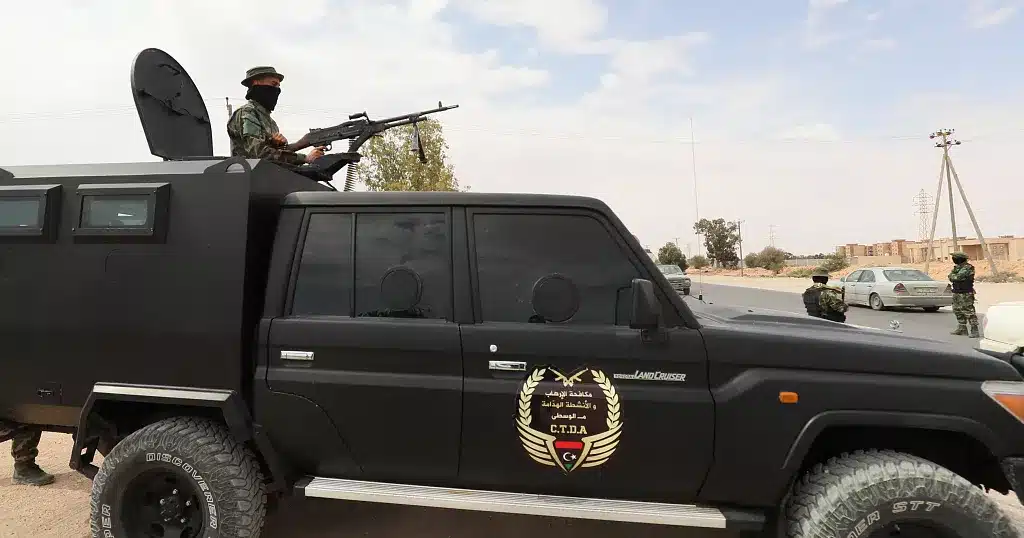
The groups were easily seen in Tripoli. They wore masks and set up checkpoints on the roads using armored vehicles with weapons on them.
But they often fought each other, and in one case in August, 55 people were killed and nearly 150 were injured.
They do not have to follow orders from the Libyan government, but they get money from the government. They were given more freedom to operate on their own by the government in 2021.
Ghana’s Embassy in Tripoli, in collaboration with the International Organization for Migration (IOM), has orchestrated the repatriation of 165 Ghanaian nationals from Libya to their home country.
The initiative, unveiled by the Information Ministry in a press release on Thursday, February 8, signifies a concerted endeavor to assist Ghanaian citizens in distress abroad. The group is scheduled to arrive at Kotoka International Airport at 1500 hours GMT.
This endeavor follows previous successful repatriation endeavors, including the return of 169 Ghanaians from Tripoli to Accra last October and the voluntary repatriation of 134 individuals from Misrata to Ghana on October 10, 2023, as part of the Voluntary Humanitarian Return (VHR) program.
Since the inception of the VHR program in 2023, a total of 629 Ghanaians have been beneficiaries, underscoring the commitment to aiding nationals facing challenges abroad.
The repatriation efforts prioritize several categories of individuals, including those detained, individuals requiring medical assistance, families with children, stranded individuals, and destitute individuals seeking assistance to return to Ghana. This emphasis underscores the humanitarian nature of the initiative, aiming to provide support to those most vulnerable and in need of assistance.
Such collaborative efforts between the Ghanaian government, represented by its embassy, and international organizations like the IOM highlight the importance of collective action in addressing challenges faced by citizens abroad. The coordinated approach ensures a swift and efficient response to crises while upholding the principles of humanitarianism and solidarity.
As the repatriation process unfolds, the Ghanaian authorities continue to demonstrate their unwavering commitment to safeguarding the welfare of citizens both at home and abroad, providing essential assistance to those in distress and facilitating their safe return to Ghana.
The Ghanaian Embassy in Tripoli, in partnership with the International Organization for Migration (IOM), has facilitated the repatriation of 165 Ghanaian nationals from Libya to Ghana.
According to a press statement from the Information Ministry, the group is scheduled to arrive at Kotoka International Airport (KIA) at 1500 hours GMT on Thursday, February 8.
This recent repatriation effort follows previous initiatives coordinated by the Embassy and IOM. Last October, the fourth batch of 169 Ghanaian nationals was successfully repatriated from Tripoli to Accra under the Voluntary Humanitarian Return (VHR) program for 2023.
Additionally, on October 10, 2023, a third batch of 134 Ghanaian nationals was voluntarily repatriated from Misrata to Ghana under the same program. In total, 629 Ghanaians have benefited from the VHR program in 2023.
Priority for repatriation was given to individuals in detention centers, those in need of medical assistance, families with children, stranded individuals, and destitute individuals requiring assistance to return to Ghana.
Mutaz Ibrahim from Libya has been selected as the centre referee for the Africa Cup of Nations (AFCON) Group B match between Mozambique and Ghana.
Assisting Mutaz Ibrahim will be Djibril Camara from Senegal (Assistant I), Abbes Akram Zerhouni from Algeria (Assistant II), and Samuel Uwinkunda from Rwanda (Fourth Official).
The officiating team comprises these individuals for the upcoming game.
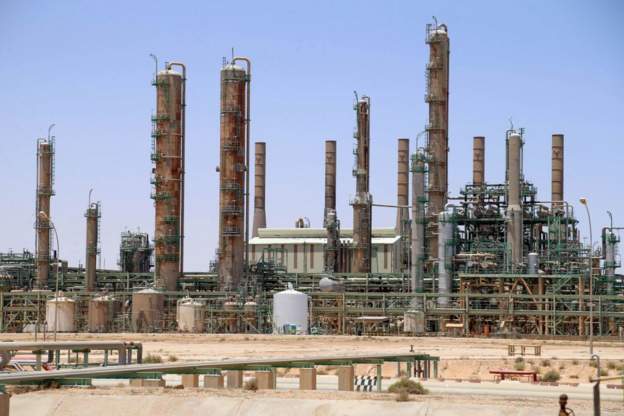
Libya’s government energy company has announced that it cannot fulfill its contracts because protests have stopped oil production at the Al-Sharara oilfield.
Force majeure is a law that lets people off the hook for their responsibilities in a contract if something really bad happens that they couldn’t control, like a war or a big natural disaster.
The field stopped making oil a few days ago because of protests in the area, according to the National Oil Corporation. It used to make up to 300,000 barrels a day.
The shutdown has stopped the flow of crude oil from the field to Zawiya terminal, the oil company reported.
The NOC did not give details about what the protesters want, but they said they are talking to try to start making things again.
Libya has had trouble producing oil because of protests since the revolt against its former leader Muammar Gaddafi in 2011.
The Swiss government gave a very old statue made of Libyan marble to the Libyan embassy in Bern, Switzerland.
The sculpture of a young woman’s head is 19cm (seven inches) tall and was made between the first century BC and the first century AD, according to Switzerland’s Federal Office of Cultural Affairs.
Please simplify this passage: “Can you please endeavor to ameliorate your behavior in the classroom and exhibit greater respect towards your peers and teachers. ” “Can you please try to improve how you act in class and show more respect to your classmates and teachers. ” “It probably came from the ancient city of Cyrene in Libya and shows that the Greeks once spread out into North Africa. ”
In 2013, a sculpture was found in a storage place in Geneva by customs officers. In 2016, the Swiss government took it because it was not allowed to be there.
The office said there is a good reason to think the sculpture was taken illegally, but they don’t know how it got to Switzerland.
Libya and Switzerland both agreed to a treaty in 1970 with Unesco to stop the illegal selling of cultural items.
The office repeated what the UN and other groups have said before about people stealing and ruining Libya’s old things.
They are part of the 4,000 people who have been officially declared dead until now. Additionally, over 8,500 people are still not found.
The deaths of these 101 doctors, nurses, and paramedics affects not just their families and loved ones, but also the whole community. The health sector in eastern Libya and beyond will face a significant impact. This was stated by Dr Ahmed Zouiten, WHO Representative in Libya, as a tribute to the health workers.
The disaster occurred when two dams, which were not well taken care of during years of conflict, broke because of heavy rainfall from Storm Daniel.
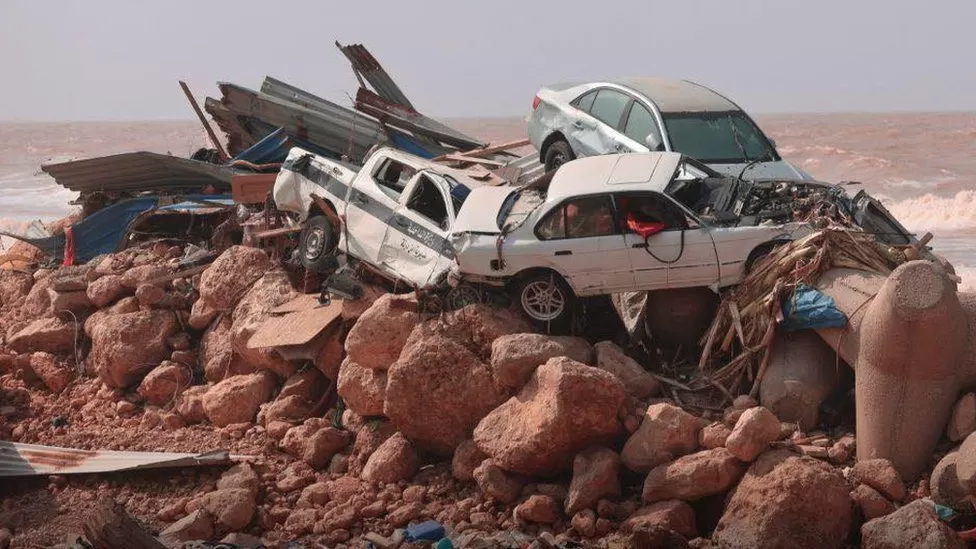
Whole neighborhoods vanished underwater when the water reached eastern Libya, especially the city of Derna, which was heavily affected.
In the eastern Libyan city of Derna, hundreds of residents have taken to the streets in protest against local authorities, following devastating floods that claimed thousands of lives in the city.
The protesters directed their criticism towards Aguila Saleh, the leader of eastern Libya’s parliament, and local officials, holding them responsible for the floods, which have resulted in nearly 4,000 casualties according to revised UN estimates.
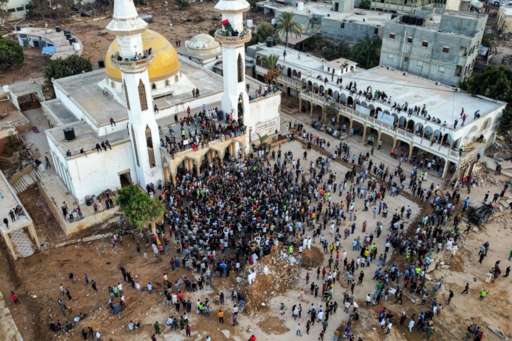
During the demonstration outside the city’s primary mosque on Monday, the protesters issued a joint statement, demanding swift investigations into the disaster and legal actions against the responsible leaders.
They also called for compensation, inquiries into the city’s financial situation, and the reconstruction of Derna.
It’s worth noting that eastern Libya operates under a parallel government distinct from the UN-recognized government in Libya’s capital, Tripoli.
Various experts and humanitarian organizations have suggested that the floods could have been prevented had local authorities evacuated residents or adequately communicated warnings about Storm Daniel.
Neglecting the city’s dams was also cited as a key factor in their rupture and the subsequent flooding.
The protesters escalated their discontent by setting fire to the residence of Derna’s mayor, Abdulmenam al-Ghaithi. As a response, Prime Minister Osama Hammad of eastern Libya suspended Mr. Ghaithi, along with other municipal officials from Derna.
Approximately 10% of the known fatalities resulting from the recent floods in Libya were migrants, according to the International Organization for Migration (IOM), a United Nations agency, as reported by BBC News.
Libya is a significant destination for migrants, with data from the IOM revealing that over 706,000 migrants resided in the North African nation as of February 2023.
Some migrants establish long-term lives and employment in Libya, while others use it as a transit point on their journey to Europe.
The IOM is aware of around 400 registered migrant fatalities in the floods, although this figure is expected to change as additional bodies are recovered.
The overall confirmed death toll, as reported by the IOM and the World Health Organization, stands at 3,900.
However, different sources have provided varying statistics, with the mayor of the Libyan city of Derna estimating that more than 20,000 people perished.
Derna suffered the most extensive damage from the floods, primarily caused by two dams bursting due to heavy rainfall, resulting in significant parts of the city being submerged.
Approximately 10,000 migrants were living in the port city before the disaster, and the IOM anticipates a high death toll among migrants, especially those settled in low-lying areas, according to Federico Soda, the IOM’s Director of Emergencies.
Five people from Greece who were helping others in need and three people from Libya who were part of a family, were killed in a car accident in the eastern part of Libya.
The helpers were part of a group that was going on a bus to the city of Derna, which had been badly affected by a flood. However, their bus crashed into a car that had the family inside.
According to a Libyan official, two people in the car and eight people on the bus were seriously hurt.
An investigation has started.
Othman Abdeljalil, who is in charge of healthcare in the eastern part of the country, said in a press conference that a group of people was traveling from Benghazi, a city in the east, when the accident occurred.
He said that four people died, but Greek officials said that five members of their aid team were killed.
The Greek army and foreign ministry are bringing back five people, including three officials and two translators, to Athens on Monday. This was announced by the Greek chiefs of staff, according to AFP news agency.
The Greek Prime Minister, Kyriakos Mitsotakis, described the accident as a very sad and unfortunate event.
“He said that everyone in the entire country is feeling very sad. ”
Libya is divided into two rival governments. One is supported by the United Nations and is located in the capital, Tripoli. The other is supported by Egypt and is based in Benghazi.
The Greek authorities say that a bus with medical workers crashed into a car going the other way.
They said it wasn’t clear what happened and they’re trying to figure it out with Libya’s help. They’re also bringing their people back.
A person who knows about diplomacy told a news site in Greece that 16 of the team members were rescue workers from Greece and three were translators.
They were going to meet up with teams from France and Italy that were already on the ground.
A lot of people died when two dams near Derna broke because of a big storm last week. The United Nations says that about 11,300 people have died.
More than 10,000 people are still officially considered missing, according to information from the UN’s Office for the Co-Ordination of Humanitarian Affairs.
Over a week now, the teams said most of the victims’ bodies are in the sea, and some are in hard-to-reach places that require special tools to access.
The person from Tunisia said in a meeting with representatives from other countries that the bodies are decaying a lot and it may become impossible to get them back at some point. “We require help to make our intervention more effective,” he said.
Representatives from the UAE, Egypt, and Algeria said they found dead bodies in the Mediterranean Sea in places that can only be reached by special boats.
The person from Algeria said that his team saw about 50 dead bodies from a high cliff, about 7 miles away from the Derna port. However, only divers and boats can reach that area.
The person from Egypt said that if we have the correct boats, we can bring back 100 bodies each day.
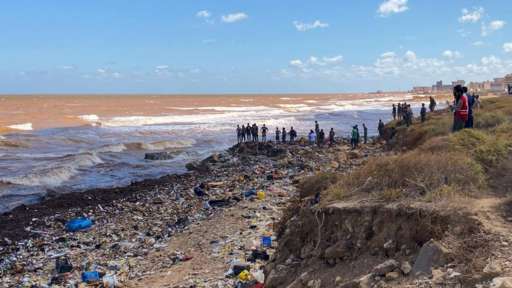
A very bad flood happened last Sunday and it washed away whole neighborhoods into the Mediterranean Sea.
We don’t know how many people have been affected by the floods in Derna. A report from the UN, released on Saturday, says that the number of people who have died has gone up to at least 11,300. There are also 10,100 people who are still missing.
However, the officials in Libya disagreed with this number. The health ministry of Libya’s eastern government said they have recorded 3,252 deaths in Derna. They believe the United Nations’ count is not correct. The health ministry records information about the dead bodies that are found and put in graves.
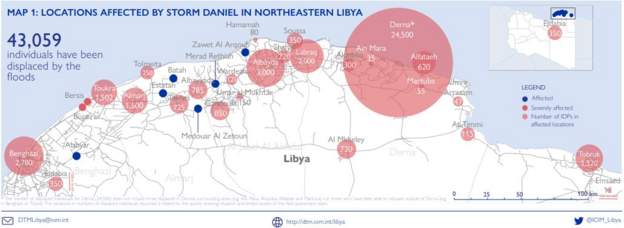
Over 40,000 people in northeastern Libya were forced out of their homes due to heavy rain brought by Storm Daniel, according to the United Nations.
According to experts, the storm’s impact was made much worse by a deadly combination of factors including old and falling apart infrastructure, not enough warnings, and the effects of climate change getting worse.
Derna, the center of the disaster, was divided into two parts when flood waters came and destroyed whole neighborhoods, creating a path to the sea. It had about 100,000 people before the sad event.
The waterfront is now being used as the main place to deliver and transport dead bodies for burial. This is because it is not safe to have decomposing bodies in multiple locations due to the health risks.
On Saturday, a group of people from CNN saw at least four bodies being carried and placed into a truck.
Two people from Derna who were helping said that on Saturday, 22 dead bodies were brought for burial. They said that on Friday, up to 90 dead bodies were brought.
The bodies of the people who died are not easily recognizable after seven days of flooding as they all appear similar. This was explained by a volunteer to CNN.
Asma Awad, one more person who offered to help, told Jomana that she lost many family members, including her husband’s whole family. Derna was a very pretty city, Awad said, and she nicknamed it “the mermaid. ”
Awad asked if Derna will recover and start again, then started crying.
In the aftermath of devastating flooding in eastern Libya, relief teams are engaged in a challenging effort to assist survivors and recover the deceased, marking five days of intensive work.
The catastrophe unfolded when two dams ruptured in the aftermath of Storm Daniel, resulting in the complete submersion of entire neighborhoods within the city of Derna.
Tragically, thousands of lives were lost in this disaster. Estimates regarding the death toll vary, ranging from approximately 6,000 to 11,000 casualties.
However, the city’s mayor has expressed concerns that the final count could potentially reach as high as 20,000, given the thousands who remain unaccounted for.
Survivors have recounted harrowing experiences, including terrifying escapes and witnessing individuals being swept away right before their eyes during the torrential flooding.
The United Nations’ World Meteorological Organization has pointed out that many of these tragic deaths could have been averted if timely warnings had been issued.
The impact of this catastrophe has left about 30,000 people without homes, according to the UN’s International Organization for Migration.
Furthermore, there is a grave concern about the risk of disease stemming from contaminated water sources in the affected areas.
💔New video footage reveals the devastating Libya floods, with streets transforming into fast-moving rivers in Derna as nearby dams gave way due to heavy rainfall. Over 11,000 deaths have been confirmed, with another 10,000 still missing.pic.twitter.com/AmQfyaAHD3
The World Health Organization (WHO) and various aid agencies have issued a plea to Libyan authorities, urging them to cease the practice of burying flood victims in mass graves.
According to a UN report, over 1,000 individuals have already been interred in mass graves.
The joint statement stressed the importance of laying victims to rest in clearly marked and documented graves. It highlighted that hurried burials can result in prolonged emotional distress for bereaved family members.
The catastrophic flooding has resulted in the complete destruction of neighborhoods in Derna, with thousands losing their lives and many more still unaccounted for.
Rescue and relief teams are engaged in a challenging effort to aid survivors and locate casualties five days after a catastrophic flood struck eastern Libya.
This disaster unfolded when two dams gave way in the aftermath of Storm Daniel, resulting in the complete inundation of entire neighborhoods within the city of Derna.
The death toll figures vary, with estimates ranging from approximately 6,000 to 11,000 casualties. Furthermore, thousands of individuals remain unaccounted for, leading the city’s mayor to express concerns that the final toll could potentially reach as high as 20,000 victims.
Survivors recount harrowing stories, including entire families perishing together and dramatic escapes. Some witnessed people being swept away before their very eyes during the deluge.
The United Nations’ World Meteorological Organization points out that a significant portion of these tragic deaths could have been prevented had timely warnings been issued.
In the wake of this disaster, around 30,000 people have been left without shelter, according to the International Organization for Migration. The UN’s humanitarian agency has also sounded an alarm about the potential health risks stemming from contaminated water sources in the affected areas.
The Russian Emergencies Ministry's IL-76 has left to Libya with humanitarian aid for flood victims.
Government of National Unity in Libya, which is recognized by other countries, announced this on Wednesday. The government’s headquarters are located in the capital city of Tripoli.
Two different governments in Libya, led by PM Al-Dabaiba and PM Osama Hamad, are working to help the people affected by floods in eastern Libya.
The statement said that schools will be used as places to stay for people affected by the flood and learning will be put on hold for now.
If you have recently started following us, the top news today is that many countries are working together to assist Libya after severe flooding. Sadly, the number of people believed to have died is increasing.
The teams from Egypt, Turkey, and Qatar have come for rescuing.
The mayor of the destroyed city of Derna thinks that around 20,000 people might have passed away.
He said the number was calculated by counting the districts that were completely destroyed by the bursting of two dams on Sunday, which caused a massive flow of water.
A lot of people are still buried in the rubble of buildings that have fallen down or in the water.
Over 5,300 people lost their lives when two dams broke, causing extremely destructive floods in the eastern city of Derna.
The mayor of Derna, Abdulmenam al-Ghaithi, said that the number of people affected could be as high as 20,000, because a large part of the city was destroyed.
Another person from thegovernment in Tobruksaid that many bodies are always being thrown into the sea.
MrGhaithi said that around 18,000 to 20,000 people could die in the city. This estimation is based on the number of buildings destroyed by the flood in different areas of the city.
We need teams who are experts in finding and bringing back dead bodies.
Over 10,000 people are currently lost and many more have been forced to leave their homes.
Hichem Abu Chkiouat, a government official in charge of aviation in eastern Libya, said to Reuters that the number of people who died could go up by a lot because the sea keeps bringing more dead bodies.
Guma El-Gamaty, a Libyan academic and head of the Taghyeer Party, explained that there is concern that the number of casualties from the incident could be even higher. This is because there are many people who have not been found or reached out to their families. Their phones are not working, so it’s unclear if they are trapped under the debris, if they have died, or if they are in the ocean.
Officials have requested additional assistance from other countries.
A person who works for the UN said that both the governments in the east and west asked for help from other countries and were talking with each other.
Tauhid Pasha, from the International Organisation for Migration, said that both governments asked the international community for help and services.
“The Western government called the Government of National Unity is helping us and speaking on behalf of the whole country. They are also working together with the government in the east,” he said.
“The current challenge is for the international community to respond appropriately to the needs and requests of governments,” he said.
MrPasha stated that we need to increase support for the city very quickly and we need money to do so. The city originally had about 90,000 people before the flood.
After the overthrow of the long-time leader Col Muammar Gaddafi in 2011, the Libyan state started to break apart.
It broke into two rival groups that are both in charge of different parts of Libya, one in the west called Tripoli and one in the east called Tobruk.
The country is still stuck in a fight between many groups of armed people.
Abdul Hamid Dbeibah is the leader of the government in Tripoli that is supported by the United Nations.
Osama Hamad is the leader of the rival House of Representatives in the eastern region.
But, lots of people believe that the true person in charge is Gen Khalifa Haftar, who is the leader of the Libyan National Army.
Gen Haftar met with a group of soldiers from Egypt to give help and assistance after a terrible event.
The UN High Commissioner on Human Rights, Volker Turk, emphasized that after the floods, it was important for all political groups to join forces and collaborate.
“He said that now is a time when we should all work together towards the same goal. ”
Everyone who is affected should be helped, regardless of any specific group or organization they belong to. It is important to make sure that we take extra care to protect groups of people who are in vulnerable situations and are at even greater risk after a disaster.
Abdulkader Assad, who is the political editor of the Libya Observer, mentioned that having one government that is accepted worldwide in the western part of Libya being challenged by another government in the eastern part has made it difficult for rescue operations to take place.
“We are aware that Libya has been divided by two governments for at least ten years. However, we have not really experienced the consequences of this split because both governments were focused on gaining power and controlling different parts of the country,” he explained.
But now that a few cities are going through this natural disaster, we can observe that the absence of a united centralized government is actually impacting people’s lives.
Libyan teams looking for people who are alive in Derna are getting help from others on the field.
People who look for and save people who are lost or in danger are coming from Egypt and Tunisia. Over 160 people from Turkey and firefighters from Italy and Spain are coming together.
Tommaso Della Longa, a representative for the president of the International Federation of Red Cross and Red Crescent Societies, stated that there was not much time left to find people who were still alive.
“He said that we are aware that this window will unfortunately close soon, but there is still hope. ”
The Libyan Red Crescent teams who were present at the scene described the disaster as a combination of a bombardment and an earthquake. Happening at the same time means that two or more things are occurring together or in sync.
“What they are telling us is actually stories about whole parts of the city that no longer exist, villages that are completely wrecked, and thousands of families who currently need everything,” Mr. Della Longa included.
Usama Al Husadi, who is 52 years old, has been looking for his wife and five children since the terrible flood occurred.
I walked to find them. He told Reuters news agency that he went to all hospitals and schools but had no success. He was crying with his head in his hands.
“We have lost at least 50 relatives from my father’s family – some are missing and some have died,” he said.
The emigration ministry of Egypt said that the bodies of over 80 Egyptian migrants who died in the flood were brought back to Egypt. They were buried in their hometowns.
Over 5,000 people have died because of very bad flooding in eastern Libya. This happened because there was a lot of rain from Storm Daniel and it made the coastal area of the country fill up with water.
The government and the hospitals have said this. About 10,000 people are thought to be lost, according to the International Federation of RedCross and Red Crescent Societies.
There were serious floods in the city of Derna in the northeast. The floods were so bad that whole neighborhoods were washed away and went into the sea. This information was shared by a spokesperson from the Libyan National Army. Over 30,000 individuals have been forced to leave their homes due to flooding in Derna, as reported by the United Nations’ International Organization for Migration in Libya on Wednesday.
Many people died in a very bad flood in Libya and their bodies were buried together in large graves.
Over 5,000 people have been reported dead in the tragedy that happened in Derna on Sunday. There are concerns that 10,000 people are missing and cannot be found.
The flood happened because of a strong storm that broke the dams close by. This let out a lot of water that destroyed at least a quarter of the city by the Mediterranean Sea.
The floods caused both buildings and the people who lived in them to be washed away.
On Monday, the director of a hospital in the city shared that they have counted 1,700 dead bodies at their hospital. Additionally, 500 more bodies have been buried in a different area of the city. Around 10,000 people are thought to be missing, and it is believed that many have been taken out to sea.
Mohammed Qamaty, a person who helps out for free in Derna, said people who save others were still looking for the people who got hurt or died.
He asked all the young people in Libya with a degree or medical experience to come and assist them.
‘We don’t have enough nurses, so we need assistance. ‘
Videos after the event show lots of water flowing through the tall buildings that are still standing and cars that have been turned over. Later, there are dead bodies on the side of the road covered with blankets, ready to be buried.
People who live there said that the only sign that something bad was happening was the loud noise that happened when the dams were breaking. There was no system in place to alert them about the danger or a plan to get them to safety.
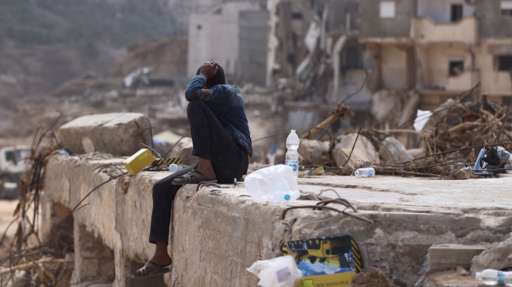
According to reports, many bodies were placed on the floor in hospital hallways. People are still searching for their missing family members as more dead bodies were brought in. One person from Derna named Mustafa Salem said that he has already lost 30 members of his family.
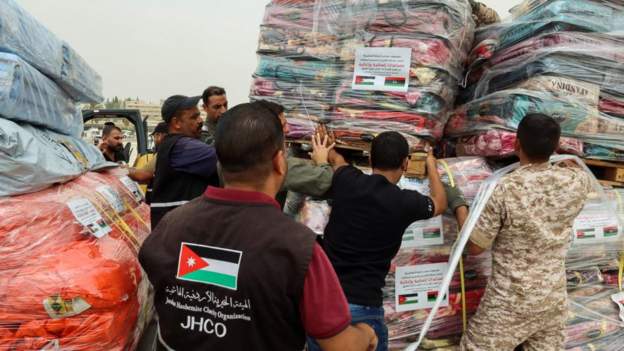
Today, trucks with bulldozers and aid supplies were going to the city.
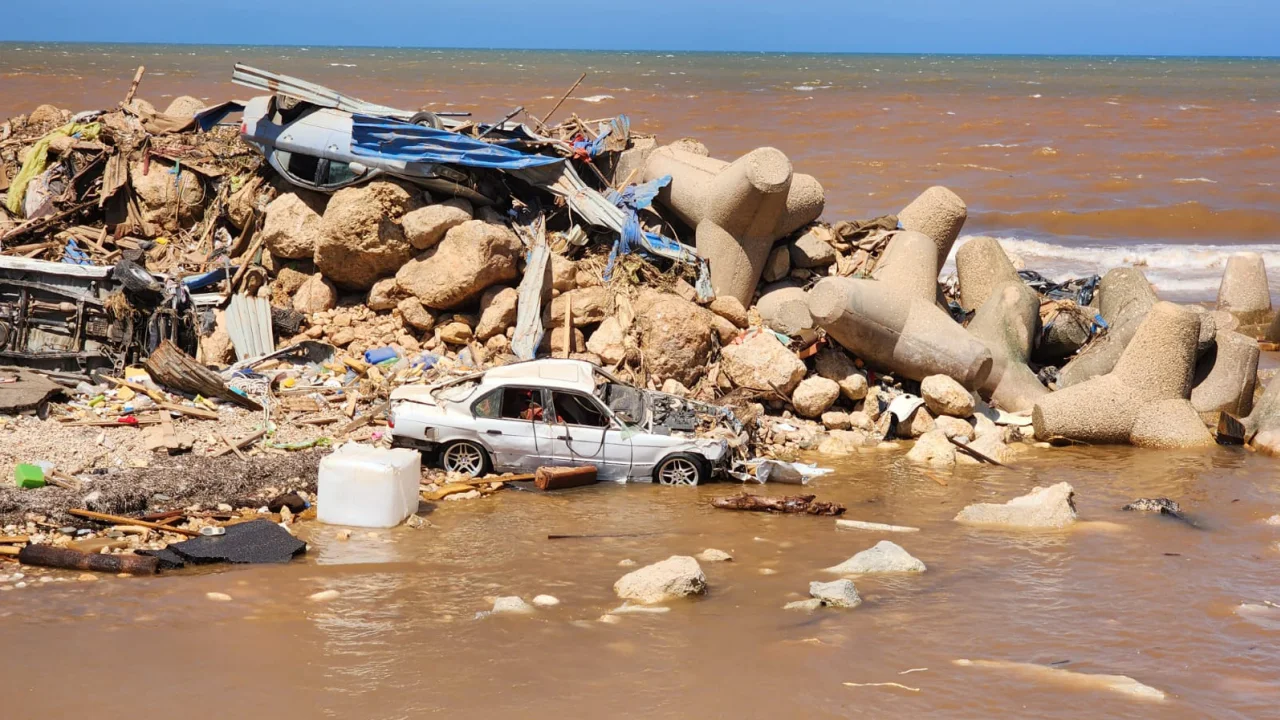
The flood caused a lot of damage, turning over and damaging cars and leaving the streets of Derna filled with rubble, mud, and debris.
Pictures taken from space of the city before and after the disaster reveal that a previously small river running through the middle of the city has become much wider. All the buildings that used to be next to the river are now gone.
There is a lot of damage in different parts of the city where flood waters came out, and buildings are missing.
The cities of Soussa, Al-Marj, and Misrata were also impacted by the storm on Sunday.
The rescue missions become difficult because Libya is divided politically. The officially recognized government called Government of National Unity (GNU) is located in Tripoli, which is in the western part of the country. Derna is located in the east, where there is a separate administration and Commander Khalifa Haftar’s Libyan National Army has power and control.
On Tuesday, Libya’s Prime Minister Abdulhamid al-Dbeibah, who leads the government in Tripoli, said that the floods were a huge and unusual disaster. The leader of Libya’s Presidential Council, Mohammed al-Menfi, is asking for all the people in the country to work together and be unified.
Derna is a town located around 250km to the east of Benghazi, alongside the coast. It is surrounded by the nearby hills of the fertile Jabal Akhdar region.
The city was once a place where fighters from the Islamic State group established themselves in Libya, following the downfall of Gaddafi.
The United Nations (U. N) The Office for the Coordination of Humanitarian Affairs said that teams were sent to help immediately. Qatar and Turkey governments have quickly sent help to Libya.
Led by Lt Gen Osama Askar, the army chief of staff of Egypt, the group will start an airlift. They will use three aircraft to deliver medical supplies, food, and rescue teams. Another plane will assist in moving people who were hurt or killed during the storm.
The person speaking on behalf of the group shared pictures on Facebook that showed them being greeted by some Libyan military leaders, including Khalifa Haftar, who is in charge of the Libyan National Army in the eastern region.
In another message, the military spokesperson said that the Egyptian President, Abdul Fattah al-Sisi, told the armed forces to provide various kinds of help like medical staff, rescue tools, and temporary camps for people in need.
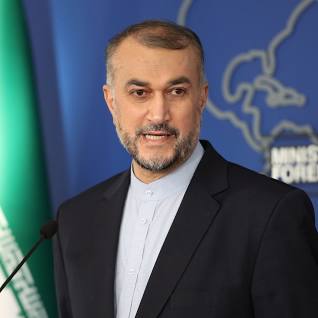
Mr Amir-Abdollahian wrote on the X website on Tuesday that Iran’s Red Crescent Society is ready to help Libya.
The minister from Iran also said he was very sorry about the terrible event, and he sent sympathetic messages to the Libyan leaders, the Libyan people, and the families of the people who were hurt or killed.
Iran and Libya recently decided to improve their relationship and have agreed to reopen their embassies.
The two countries are friends, but Iran closed its office in Libya when people in Libya were fighting against their leader, Muammar Gaddafi, who has passed away.
The new Libyan ambassador to Tehran, Ali Jumaa Hassan Fudail, met with Iran’s President Ebrahim Raisi in Tehran in early July to officially introduce himself.
“We have received news from reliable sources that the number of people who are missing has reached 10,000,” explained Tamer Ramadan, who leads the IFRC team in Libya.
Heavy rain has caused flooding and landslides, ruining lots of houses and roads.
The area that suffered the most damage is the port of Derna. A lot of it is now underwater because two dams and four bridges broke.
Mr Ramadan said that a lot of people have died, and it’s possible that the number of deaths could be in the thousands.
The IFRC may ask for immediate money to help the people affected by floods in Libya.
About 2,000 people have lost their lives and many more are missing following Storm Daniel. The storm caused a large amount of rainfall in Libya‘s northeast, which led to the collapse of two dams. This caused water to flow into areas that were already flooded.
Othman Abduljalil, who is the health minister in Libya’s government supported by the parliament in the east, visited the city of Derna on Monday. He described some areas of Derna as a “ghost town. “
Abduljalil said that the situation in Derna was very bad. Dead bodies are still in many places.
“Some families are still trapped in their houses and there are people buried under destroyed buildings. I think some people may have been carried away by the sea, and tomorrow morning we will find many of them,” he said.
Around 6,000 people are currently unaccounted for in Derna, according to Abduljalil. However, this is just one area that has been impacted by flooding in multiple cities located near the Mediterranean Sea in the country’s northeast.
There are worries that giving help might be made difficult by political disagreements in the country. This country has had a long-lasting fight for control between two different governments – one in the east and the other in the west.
The heavy rain happened because of a strong low-pressure system. It caused a lot of flooding in Greece and then moved into the Mediterranean Sea. It turned into a tropical-like cyclone called a medicane. The weather system is like storms in the Atlantic or Pacific oceans.
According to a message on social media, on Monday, the Red Crescent Society of Libya said that over 300 people have died in Derna.
Ahmed Mismari, who speaks for the Libyan National Army in the eastern part of Libya, said that two dams broke due to flooding.
As a result, three bridges were broken. The water moved quickly and washed away whole neighborhoods, then left them in the ocean,” he said.
The leader of Libya’s Emergency and Ambulance authority, Osama Aly, told CNN that when the dam broke, all the water flowed towards a place close to Derna, which is a hilly region near the coast.
The strong muddy currents washed away houses in valleys and also carried vehicles and debris. The phone lines in the city are not working, which is making it harder to rescue people. Aly said that the workers cannot go into Derna because there is a lot of damage there.
Aly said that the people in charge didn’t expect the disaster to be so big.
Aly said that the weather conditions were not well looked into. They did not study the levels of seawater, amount of rainfall, or wind speeds. They also did not evacuate families who could be affected by the storm and living in valleys.
Libya was not ready for a big disaster like that. It has never seen such a disastrous event before. We acknowledge that there were mistakes, even though this is the first time we have experienced such a major disaster,” Aly said in an interview with Al Hurra channel.
Mismari, who speaks for the LNA, said that many cities have been affected by the floods. These include Al-Bayda, Al-Marj, Tobruk, Takenis, Al-Bayada, and Battah. The floods have also caused damage along the eastern coast all the way to Benghazi.
Libya is a country with six million people. It has been divided into groups that are fighting against each other since 2014, after a rebellion supported by NATO in 2011 to remove Moammar Gadhafi from power.
There is still a disagreement between rival governments in the city of Benghazi and the capital city Tripoli. Abdulhamid Dbeibeh leads the government of National Unity (GNU) that has the support of the United Nations. They are in charge in the capital city. On the other hand, Khalifa Haftar controls the eastern part of the country along with his Libyan National Army (LNA). They support the parliament led by Osama Hamad, which is based in the east.
Derna, a city that is about 300 kilometers (190 miles) away from Benghazi, is currently governed by Haftar and his administration in the eastern region.
According to a report from Libyan News Agency (LANA), Hamad referred to the situation as “terrible and never seen before. “
Videos posted on social media showed cars underwater, buildings that had fallen down, and a lot of water flowing through the streets.
The hospitals in the eastern city of Bayda were emptied because of heavy rain that caused flooding, as shown in videos posted on Facebook by the Medical Center of Bayda.
The United Nations in Libya is keeping a close eye on the emergency situation caused by bad weather in the eastern region of the country, according to a post by the United Nations Support Mission in Libya on X.
Many countries have sent their sympathies and help to Libya as rescue teams rush to find people alive under the collapsed buildings and wreckage.
On Tuesday, Turkey’s Emergency Management Authority (AFAD) reported that Turkish planes carrying aid for people in need have arrived in Libya.
The Turkish President, Recep Tayyip Erdogan, announced that Turkey will be sending 168 teams to help find and rescue people in Benghazi. They will also be providing aid to help with the situation. The news was reported by the state-run news agency, Anadoulu Agency, on Tuesday.
The US Embassy in Libya said on a social media platform called Twitter that they were talking to the United Nations and Libya’s government to figure out how to quickly provide help where it is most needed.
The President of the United Arab Emirates, Zayed Al Nahyan, has ordered help and rescue teams to be sent to the affected area. He also expressed his sympathy to those affected by the tragedy, according to the state news agency.
Egypt’s President, Abdel-Fattah El-Sisi, expressed his sympathy to Libya. El-Sisi said on social media that he hopes the injured people get better soon and wants the crisis in Libya to end quickly with everyone coming together in unity.
The weather system will slowly move to the east and head towards the northern part of Egypt. Rainfall in the next two days might be 50mm, which is a lot compared to the usual 10mm in September.
A senior official who recently visited the eastern port of Derna in Libya has reported a staggering death toll exceeding 1,000 from the floods in that city alone.
According to the minister representing the eastern-based government, the situation is dire, with bodies strewn throughout the area. Derna, a city with approximately 100,000 residents, has been inundated due to the collapse of two dams and four bridges.
These devastating floods, which have also caused widespread destruction in other coastal regions, are the aftermath of Storm Daniel, which struck the area on Sunday.
“The number of bodies recovered in Derna is more [than] 1,000,” Hichem Chkiouat, the aviation minister and part of the eastern government’s emergency response committee, told Reuters by phone.
He said the final death toll was expected to be much higher.
“I am not exaggerating when I say that 25% of the city has disappeared. Many, many buildings have collapsed.”
Hundreds feared dead, thousands missing after devastating floods hit Libya
The flooding has also impacted the eastern cities of Benghazi, Sousse, and Al-Marj. Earlier, Eastern Prime Minister Osama Hamad reported to a Libyan TV channel that an estimated 2,000 people had lost their lives, and thousands were still missing. He described the situation, stating that “Entire neighborhoods in Derna have disappeared, along with their residents, swept away by water.”
In addition to the eastern regions, the western city of Misrata has also been affected by the devastating floods.
Libya has been mired in political turmoil since the overthrow and killing of long-serving ruler Col Muammar Gaddafi in 2011. This has left the country effectively divided, with an interim government recognized internationally operating from the capital, Tripoli, and another government in the east.
According to Libyan journalist Abdulkader Assad, this political divide is hindering rescue efforts, as the various authorities struggle to respond effectively to a natural disaster.
A powerful storm, named Daniel, has resulted in the tragic loss of at least 150 lives due to severe flooding in eastern Libya, as confirmed by an official statement.
Storm Daniel made landfall in the North African nation over the weekend, prompting the declaration of a state of extreme emergency by the authorities. In the preceding week, this storm had already claimed the lives of a dozen people in Europe.
During the ongoing rescue operations, seven Libyan army personnel have gone missing.
In response to the crisis, officials in eastern Libya have imposed a curfew, and the closure of schools and shops has been mandated.
Mohamed Massoud, a spokesman for the Benghazi-based administration in Libya, informed the French news agency AFP that “at least 150 people were killed as a result of flooding and torrential rains left by storm Daniel in Derna, the Jabal al-Akhdar region, and the suburbs of Al-Marj.”
The impact of Storm Daniel has been felt in eastern cities such as Benghazi and Sousse, along with Derna and Al-Marj. Even the western city of Misrata has not been spared from the floods.
Unverified videos of the storm, including one showing a man being swept away by torrents of floodwater and another depicting trapped drivers on the roofs of their cars, have been circulating online.
The storm has also led to the closure of four major oil ports in the affected areas.
Prime Minister Abdulhamid Dbeiba of the internationally recognized government in the capital, Tripoli, announced on Sunday that he had directed all state agencies to respond immediately to the damage and flooding. The United Nations in Libya stated that it was closely monitoring the situation and would provide urgent relief assistance to support local and national response efforts.
Libya has been divided between two rival administrations since 2014, following the death of long-time leader Muammar Gaddafi in 2011.
Storm Daniel had previously struck Greece, Turkey, and Bulgaria last week, resulting in the loss of over a dozen lives. It is expected to reach western Egypt on Monday.
Climate scientists have warned that global warming is causing increased evaporation of water during the summer, leading to more intense storms.
The foreign minister of Libya was suspended from her position after attending a meeting with Israel’s foreign minister in Rome recently.
Israel said that the meeting was an important first move in building relations.
However, Najla al-Mangoush explained that it was an unplanned and informal meeting while talking with the Italian foreign minister.
Ms Mangoush is currently being investigated.
It will give information to the prime minister in three days.
The presidential council, which speaks for Libya’s three provinces, has said that making relations with Israel normal is against the law.
The speaker’s office in parliament has accused Ms. Mangoush of a serious crime called grand treason and asked for an urgent meeting on Monday.
Even though Israel’s relations with certain Arab and Muslim countries are getting better, it still doesn’t have official diplomatic connections with Libya.
Commissioner for Political Affairs for the Economic Community of West African States (ECOWAS), Abdel-Fatau Musah, has expressed his astonishment and concern over the questions raised regarding ECOWAS not seeking permission from the UN Security Council before considering the use of force in Niger in response to the coup.
Speaking in an interview on the sidelines of an ECOWAS military chiefs meeting held in Accra on Thursday, August 17, 2023, he emphatically stated that ECOWAS does not need consult the UN before it takes any decision or embarks on any move that will ensure the peace and stability of the West African bloc.
“Why is it in Africa that people start asking why don’t you go to the Security Council? Did the Russians go to the Security Council before going to Ukraine, and those pumping weapons into Ukraine, are they asking the Security Council? When Libya was attacked, was it a security sector authorisation?” he asked.
Notwithstanding, he said ECOWAS has the full support of the UN, though clarifying that this doesn’t necessarily equate to an endorsement from the Security Council.
“The UN has condemned the coup, they are supporting the actions of the ECOWAS. When the UN supports, it doesn’t mean it is like an approval from the Security Council. The UN Secretariat has supported us and we are constantly working with the special representative for the Secretary General for West Africa which also shows their support to what we are doing,” he said.
As a follow-up to the directive of the ECOWAS Authority of Heads of State and Government at its Extraordinary Summit on the political situation in the Republic of Niger held on 10th August 2023 in Abuja, Nigeria, the ECOWAS Committee of Chiefs of Defence Staff (CCDC) has commenced the activation of the ECOWAS Standby Force for the restoration of constitutional order in the Republic of Niger.
To this end, the ECOWAS Committee of Chiefs of Defence Staff will be having an extraordinary meeting in Accra, Ghana from 17th to 18th August 2023 to finalise plans for the deployment of the Standby Force.
Addressing the gathering on the first day of the meeting, Minister of Defence of Ghana Dominic Nitiwul mentioned that some countries including Mali, Guinea, etc., were not present.
“Four of our member states [Mali, Burkina Faso, Guinea and Niger] are now facing sanctions for resorting to unconstitutional change of government which contradicts the ECOWAS protocol on good governance and democracy,” he explained.
The United Nations Support Mission in Libya (UNSMIL) has voiced its apprehension on Thursday regarding the kidnappings, detentions, and forced disappearances of individuals, including a former minister and public figures.
The mission cautioned against the emergence of a climate characterized by fear and heightened tension.
The UN is “deeply concerned by the continuing abductions, arbitrary arrests and disappearances of citizens and public figures by various security bodies in Libya“, according to a statement released on Thursday.
Former Minister of Finance, Faraj Abderrahmane Boumtari, in 2018 in the national unity government, “was arrested on Wednesday on arrival at Mitiga airport (Tripoli) and taken to an unknown location”, Manul said.
Unconfirmed reports from local media suggest that Faraj Abderrahmane Boumtari, a former minister, was apprehended by agents of the Internal Security Agency (OSI). Meanwhile, members of Boumtari’s tribe, the Zouaya, have issued threats to block oil terminals in the eastern region of the country unless he is released.
Additionally, unverified reports circulating on social media indicate that protesters have already blocked two oil fields in the south, namely al-Charara and al-Fil, which together contribute to a significant portion of Libya’s oil production. However, these reports have not been verified by AFP.
On Thursday, “five members of the High Council of State (HCE) were banned from traveling to the same airport”, Manul announced, citing “information”.
Mitiga airport in Libya is jointly operated by both the authorities and security organizations, granting them the authority to restrict the movement of travelers entering or exiting the airport.
In response to the recent abductions, detentions, and enforced disappearances of individuals, including a former minister, the United Nations Support Mission in Libya (Manul) has urged the Libyan authorities and security entities to release all arbitrarily detained individuals and ensure independent investigations into these incidents.
Manul has expressed concern that these escalating tensions are creating an atmosphere of fear and exacerbating inter-community and inter-tribal divisions. This environment is deemed unfavorable for conducting transparent and inclusive elections or achieving national reconciliation.
Since the downfall of Muammar Gaddafi’s regime in 2011, Libya, which possesses Africa’s richest oil reserves, has been engulfed in chaos. Divisions between the eastern and western parts of the country have further contributed to the unstable situation.
The country is currently grappling with a power struggle between two competing governments: one based in Tripoli (recognized by the UN) under the leadership of Abdelhamid Dbeibah, and another in the east supported by the influential Marshal Khalifa Haftar.
Reports have it that the son of a notorious former Libyan intelligence chief was discovered dead in the southern city of Sabha.
There are conflicting reports on the cause of Amhammed al-Senussi’s death.
His father Abdullah al-Senussi – now in a Libyan jail – was one of the late Colonel Muammar Gaddafi’s most-trusted officials and also his brother-in-law.
He was charged with crimes against humanity by the International Criminal Court (ICC), following the brutal suppression of anti-Gaddafi demonstrations in 2011.
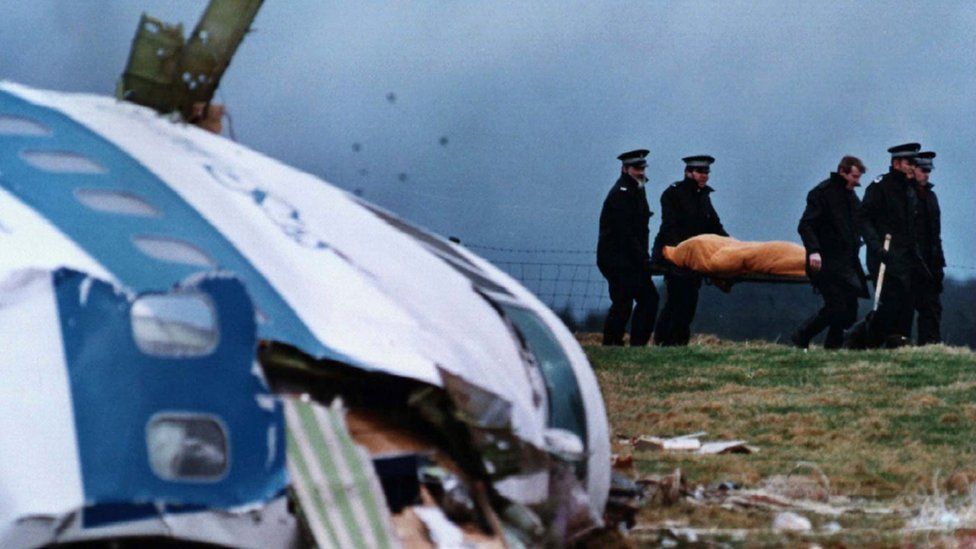
The former head of intelligence is also wanted for questioning by Scottish and US investigators over the 1988 Lockerbie bombing.
270 people died aboard a Pan Am passenger plane when a bomb in the aircraft exploded as it flew over Scotland.
Off the coast of Tunisia, ten individuals who were sailing to Europe perished in the sea after their boat capsized.
According to the coast guard, 72 of the passengers, all of them were from sub-Saharan Africa, were saved close to the coastal city of Sfax.
As the primary departure point for individuals escaping poverty and conflict in Africa and the Middle East, Tunisia has replaced Libya.
The Tunisian National Guard says 14,000 migrants have been rescued in the first three months of this year – five times more than in the same period last year.
Two South African football club officials who were held in a Libyan hotel for nearly three weeks due to a money dispute say they feared for their safety during the experience.
“When you see how Benghazi is – vandalised buildings, the army – you will get scared. We don’t see that often in South Africa,” physio Tebogo Amos Dhlomo told journalists on Tuesday.
After the game, they were held at the hotel due to unpaid bills, according to South African media reports.
Uncertainty surrounds the issue, however a club official is cited on the news24 website as blaming problems with electronic payment systems for forcing cash payments.
According to other accounts, the matter was settled as a result of the South African sports ministry’s intervention.
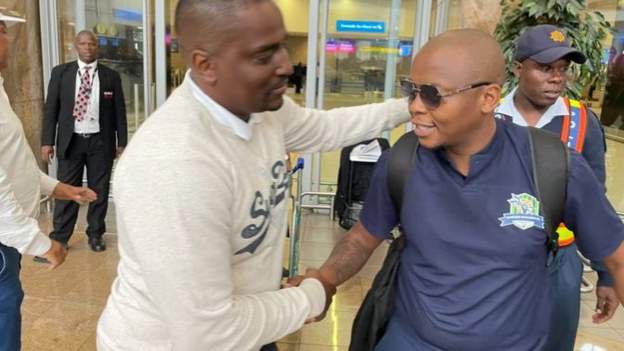
Mr Dhlomo and media manager Rufus Matsena returned home on Sunday but narrated their ordeal on Tuesday at a media briefing attended by government officials.
Marumo Gallants FC, a South African Premier Division team, claims to be attempting to settle a “financial dispute” that has left two of its staff members detained in a Libyan hotel for two weeks due to unpaid expenses.
It comes after Gallants’ game against Al Akhdar in the African Confederation Cup last month in Benghazi.
Rufus Matsena, the team manager, and Dina Dhlomo, the physiotherapist, were denied permission to leave the team’s lodging following the game because the club allegedly failed to pay the hotel bill and other expenses incurred during the stay.
In a statement, the club said they are in “communication with relevant officials to resolve the situation” and that the officials are “safe and waiting for the matter to be settled”.
According to Reuters, the South African government has stepped in to try and settle the matter.
The detention is the culmination of a trip described by the club’s English coach, Dylan Kerr, as a “nightmare”.
The team were delayed in Istanbul for three days while in transit, waiting for onward tickets to Libya to be bought.
They finally arrived in Benghazi on matchday and went straight to the stadium from the airport without their kit. The match had already been pushed back by three hours, but the hosts were not informed and arrived at the Matyrs of February stadium to find no officials and no opponent.
Despite a 4-1 defeat in Libya, Gallants finished top of their group to qualify for the knockout stages of the continent’s second-tier club competition.
But taking part in the tournament, with travel to Algeria and DR Congo as well as Libya, has strained the team’s finances to such an extent that on Sunday they needed financial support from provincial authorities to help cover expenses for their last group match against Saint-Eloi Lupopo in Johannesburg.
The club, who are currently bottom of the Premier Division, say they will not be making any further comment until its two employees in Libya have been released.
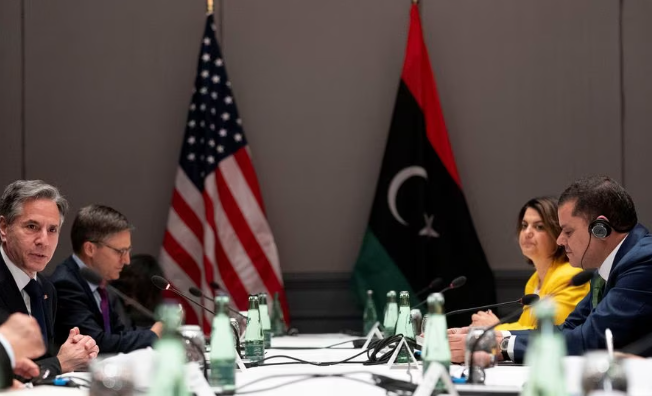
The U.S. Secretary of State, Antony Blinken has said on Wednesday that the US is “actively” working to resume diplomatic relations with Libya, but he would not specify a timeline for when the embassy would reopen.
After Muammar Gaddafi was overthrown in a NATO-backed rebellion in 2011, Libya has had little peace. The country divided in 2014 into opposing eastern and western factions, and the last significant fighting was finally resolved in 2020 with a ceasefire.
Washington shut its embassy in Tripoli in 2014 and moved to its mission to neighboring Tunis following intensifying violence between rival factions. U.S. Special Envoy for Libya, Richard Norland, has operated out of the Tunisian capital, and took occasional trips into Libya.
A September 2012 assault on the U.S. consulate in Benghazi, since closed, killed four Americans including the then U.S. ambassador to Libya, Chris Stevens.
“I can’t give you a timetable other than to say that this is something we’re very actively working on. I want to see us be able to re-establish an ongoing presence in Libya,” Blinken said at a Senate Appropriations subcommittee hearing.
Blinken did not provide any details on the active work he referred to.
Assistant Secretary Barbara Leaf, top diplomat for the Middle East and North Africa, is currently touring the region, traveling to Jordan, Egypt, Libya, Lebanon, and Tunisia March 15-25.
In Libya, the State Department said, Leaf will meet with senior Libyan officials “to underscore U.S. support for UN-facilitated efforts to promote consensus leading to elections in 2023.”
“There’s also an important moment where through the work of the UN envoy, there may be, and I emphasize maybe, a path forward to moving Libya in a better direction including getting election for legitimate government and our diplomats are deeply engaged in that,” Blinken added.
The OPEC member country has been locked in political stalemate since late 2021 when a scheduled election was canceled because of disputes over the rules and the eastern-based parliament, the House of Representatives, withdrew support from the interim government.
Peacemaking efforts have focused on getting the House of Representatives and the High State Council to agree on a constitutional basis for elections and on voting rules.
The United Nations’ special envoy for Libya last month moved to take charge of a stalled political process to enable elections that are seen as the path to resolving years of conflict.
The High Council of State of Libya has approved a constitutional modification on Thursday meant to serve as a foundation for elections, but analysts believe the amendments fall short of resolving the conflicts that have prevented a long-delayed national vote.
A special UN representative for Libya took action earlier this week to seize control of a delayed political process in order to facilitate elections, which are thought to be the key to ending years of bloodshed.
Libya has been locked in a political stalemate since late 2021 when a scheduled election was cancelled because of disputes over the rules and the eastern-based parliament, the House of Representatives, withdrawing support from the UN-brokered interim government.
The interim government was a step to unite Libya’s two competing administrations – the UN-recognised Government of National Accord (GNA) based in Tripoli and the House of Representatives based in the eastern city of Tobruk. But the interim government has since split, complicating the political process in the north African country.
Peace-making efforts since then have focused on getting the House of Representatives and the High Council of State, an advisory body comprising of ex-GNA members based in the capital of Tripoli, to agree on a constitutional basis for elections and voting rules.
Big political changes
Thursday’s vote approved a constitutional amendment that was issued last month by the House of Representatives and was presented as a step towards holding elections.
Foreign powers have long indicated that big political changes need the approval of both the House of Representatives and the High Council of State under a 2015 agreement that was intended to establish a short transitional period that would ultimately resolve the conflict.
On Monday, UN envoy Abdoulaye Bathily cited that 2015 agreement to say he was setting up a steering committee of major Libyan figures to adopt a time-bound road map to elections.
“The political process remains protracted and falls short of the aspirations of Libyans, who seek to elect their leaders and reinvigorate their political institutions,” said Bathily last week.
“In short, Libyans are impatient,” he stressed, noting that they are widely questioning the will and desire of political actors to hold inclusive and transparent elections in 2023, as planned.
In remarks that appeared aimed at both the House of Representatives, which was elected in 2014, and the High Council of State, which emerged from a chamber elected in 2012, he said that “most institutions lost their legitimacy years ago”.
Speaking before it was approved, Bathily also described the amendment as “controversial within the Libyan political class and general citizenry”, noting it did not address contentious issues such as candidate eligibility or create a clear timeline for elections.
Skeptical of political leaders
Many Libyans have grown sceptical that their political leaders are negotiating in good faith, saying their true goal is to delay any election that could cost them positions of power and privilege.
Emadeddin Badi, a senior fellow at the Atlantic Council, said that “the latest ‘sessions’ held to pass a 13th amendment to the constitutional basis was a badly orchestrated attempt by Aguila [Libya’s Parliamentary Speaker] and Mishri [head of Libya’s High Council of State] to retain relevance, remain custodians of the political process and pretend they are making progress towards elections.”
He clarified that in practice the amendment will not affect things in Libya.
“Even the UN has finally grown exasperated with the HoR and HSC [House of Representatives and High Council of State] conspiring to jointly indefinitely delay elections to retain their hold on power,” said Badi.
“This was made clear by Bathily lately, including in his address to the Security Council announcing an initiative that will bypass these illegitimate bodies,” he added.
Tim Eaton of Chatham House, a London-based think-tank, said the amendment seemed aimed at making it harder to sideline the two chambers.
“There is a ‘breakthrough’ every time it looks like the House of Representatives and High State Council are going to lose control of the process,” he said.
The latest amendment appeared to create new labyrinthine processes that would only trigger subsequent processes later on, he added, calling it “process for process’s sake”.
Netflix recently reduced its subscription prices in more than 30 countries across Asia, Europe, Latin America, sub-Saharan Africa, and the Middle East.
The streaming firm made this announcement on Thursday as it attempts to attract more subscribers amid various stiff competition and tight consumer budget.
Netflix had in recent times reduced prices in India and some parts of South-East Asia following a decline in growth. However, Thursday’s decision only affects countries that account for a small fraction of its customer base.
Subscription charges have been lowered in Yemen, Jordan, Libya, Iran, Kenya, Croatia, Slovenia, Bulgaria, Nicaragua, Ecuador, Venezuela, Malaysia, Indonesia, Thailand, and the Philippines, amongst others.
The cuts apply to certain price plans, with subscription charges falling by half in some cases.
The company did not name the UK or the US as countries where it had cut its prices.
According to a statement from Netflix, it said “We’re always exploring ways to improve our members’ experience. We can confirm that we are updating the pricing of our plans in certain countries”
The firm’s shares closed 3.4% lower in New York on Thursday after the Wall Street Journal first reported the story.
Furthermore, the company has clamped down on subscribers sharing their login details and passwords. In some countries, Netflix introduced limits on password sharing, requiring customers to pay extra charges if they want friends and family to share their subscriptions.
Netflix previously expanded password sharing in countries including Canada, New Zealand, Portugal, and Spain; the feature was previously piloted in Latin America. The users will no longer be able to share passwords, they can however transfer profiles.
However, people using an account can now easily transfer a profile to a new account, which they have paid for; keeping their personalized recommendations, viewing history, My List, saved games, and more.
(Image credit: TRE / JBKlutse Foundation)
Also, members of a household can still easily watch Netflix on their personal devices or log into a new TV, like at a hotel or holiday rental. Aside from this, the users’ Standard or Premium plan in many countries (including Canada, New Zealand, Portugal, and Spain) can add an extra member sub-account for up to two people they don’t live with; each with a profile, personalized recommendations, login, and password — for an extra CAD$7.99 a month per person in Canada, NZD$7.99 in New Zealand, Euro 3.99 in Portugal, and Euro 5.99 in Spain.
This news will come as a relief for Netflix users considering the high inflation rates around the world at the present time. Users can now enjoy watching Netflix at a lower price.
As part of its most recent effort to bring peace back to the nation, the African Union is organizing a meeting for national reconciliation in Libya.
At the conclusion of a two-day summit in Addis Abeba, the statement was made by Moussa Faki Mahamat, chair of the AU commission.
He stated that the AU was collaborating with all parties to choose a time and location for the summit.
Recent reports from the UN claimed that the two Libyan governments had reached an agreement on a plan to remove foreign troops and mercenaries from the nation.
Yet, they have been unable to produce a departure schedule. The African Union in 2011 lifted its suspension of Libya’s membership.
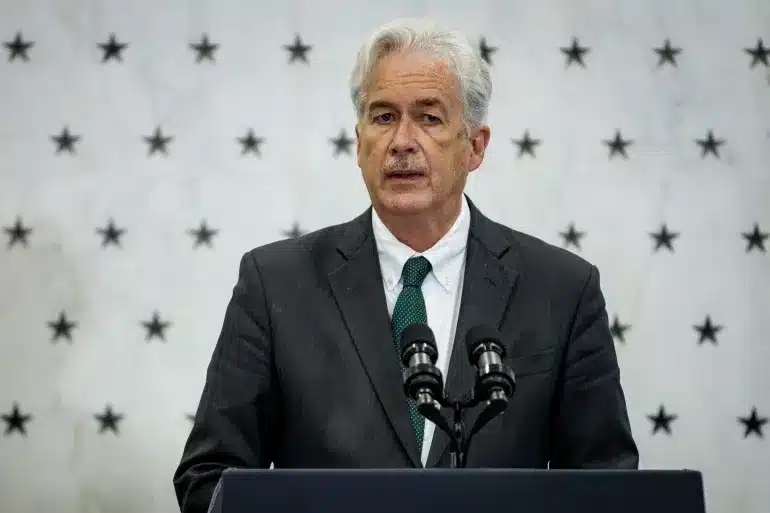
William Burns makes a rare trip to Libya, where he meets Haftar, the military strongman based in the east, andinterim Prime Minister Dbeibah.
William Burns, the director of the Central Intelligence Agency, has made a rare trip to Libya where he met with the interim prime minister a few weeks after the country’s authorities gave the United States a suspect in the 1988 Lockerbie bombing, according to the Tripoli-based government.
The CIA director’s Thursday meeting in Tripoli, which was also covered by Libyan media, was part of his first trip to the country since the 2012 attack on a US mission in Benghazi, which left the ambassador and three other people dead.
The visit and the meeting with Prime Minister Abdulhamid Dbeibah were announced by his Government of National Unity on its Facebook page, where a picture of Burns and Dbeibah together was posted.
“Prime Minister Abdelhamid Dbeibeh hosted the director of the Central Intelligence Agency, William Burns” at the cabinet office in Tripoli, along with Foreign Minister Najla al-Mangoush and Libyan intelligence chief Hussein al-Ayeb, Dbeibah’s government said in the post.
Burns “underlined the need to develop economic and security cooperation between the two countries”, it said.
Libyan media reported that Burns also met Khalifa Haftar, the eastern Libya-based military strongman who has attempted to march on Tripoli and overthrow the Government of National Unity in the past.
The meeting took place at Haftar’s headquarters in Benghazi.
The CIA, which does not regularly announce such visits, declined to comment.
The country has been de facto divided since 2014 between warring factions based in the west and east of the country.
Dbeibah’s government was installed through a United Nations-backed process in 2021 as part of a peace plan, but his administration is no longer recognised by the main political factions in the east.
Burns, CIA chief since March 2021, visited Libya in 2014 as undersecretary of state for the Middle East.
He was the first US official to visit the country when Washington was mending ties with the Gaddafi regime.
Last month, a Libyan man accused of making the bomb that took down a Pan Am flight over Scotland in 1988, appeared in a US court after being extradited by Dbeibah’s government.
Alleged former intelligence officer Abu Agila Mohammad Masud Kheir al-Marimi could face life in prison if convicted of “destruction of an aircraft resulting in death” and two other related charges over the attack, which killed 270 people and was the deadliest-ever terror attack in Britain.
The move sparked a public backlash against the Tripoli-based government, with Dbeibah facing bitter criticism from political rivals, rights groups and relatives of Libyan detainees who fear being handed over themselves. Libya has no extradition treaty with Washington.
A Libyan man has been arrested by Scottish police on suspicion of creating the bomb that destroyed Pan Am Flight 103 over Lockerbie 34 years ago and is in US jail.
The United Statescharged Abu Agila Masud two years ago, stating that he was a crucial figure in the December 21, 1988, attack.
270 persons were killed in the Boeing 747 explosion.
It is the deadliest terrorist incident to occur on British territory.
All 259 passengers and crew on board the jumbo jet bound for New York from London died while another 11 people were killed in Lockerbie when wreckage destroyed their homes.
Last month it was reported that Masud had been kidnapped by a militia group in Libya, leading to speculation that he was going to be handed over to the American authorities to stand trial.
A US Justice Department spokesperson told the Reuters news agency that Masud would make an initial appearance in a federal court in Washington.
He was the only man to be convicted over the attack.
Megrahi was jailed for life but was released on compassionate grounds by the Scottish government in 2009 after being diagnosed with cancer.
He died in Libya in 2012.
Megrahi, who always proclaimed his innocence, launched two appeals against his 27-year sentence. One was unsuccessful and the other was abandoned.
A spokesperson for the Crown Office and Procurator Fiscal Service (COPFS) said: “The families of those killed in the Lockerbie bombing have been told that the suspect Abu Agila Mohammad Mas’ud Kheir Al-Marimi (“Mas’ud” or “Masoud”) is in US custody.
“Scottish prosecutors and police, working with UK government and US colleagues, will continue to pursue this investigation, with the sole aim of bringing those who acted along with Al Megrahi to justice.”
Lockerbie bombing timeline
US and British investigators indicted Megrahi in 1991 but he was not handed over by the Libyans until April 1999.
May 2000 – A special trial under Scots law starts on neutral ground at Camp Zeist in the Netherlands.
31 January 2001 – Former Libyan intelligence officer Megrahi is found guilty of mass murder and jailed for life with a minimum term of 27 years.
IMAGE SOURCE, REUTERS Image caption, The Pan Am flight was bombed just days before Christmas
March 2002 – Megrahi loses an appeal against his conviction.
September 2003 – The Scottish Criminal Cases Review Commission (SCCRC) is asked to investigate Megrahi’s conviction.
June 2007 – The SCCRC recommends that Megrahi is granted a second appeal against his conviction.
18 August 2009 – Megrahi’s move to drop his second appeal is accepted by judges at The High Court in Edinburgh.
20 August 2009 – Megrahi, who has terminal prostate cancer, is released from prison on compassionate grounds.
May 2012 – Megrahi dies at his home in Tripoli, aged 60.
July 2015 – Scottish judges rule that relatives of the Lockerbie bombing victims should not be allowed to pursue an appeal on Megrahi’s behalf. Courts had previously ruled that only next of kin could proceed with a posthumous application.
July 2017 – Megrahi’s family launched a new bid to appeal against his conviction.
March 2020 – The Scottish Criminal Case Review Commission said Megrahi’s conviction can be taken to a fresh appeal.
November 2020 – Five Scottish judges hear the third appeal against Megrahi’s conviction on grounds of a possible miscarriage of justice.
The Libyan Government of National Unity, centred in Tripoli, has encouraged foreign oil companies with contracts with the national oil company to begin operationsthere.
The country’s National Oil Corporation, NOC, stated that it would assist the companies’ return and provide a safe working environment “in cooperation with the civil and military authorities in Libya.”
NOC Chief Farhat Bengdara
Over the past ten years, armed groups and demonstrators have repeatedly invaded oil fields, leading to production halts.
The ongoing struggle between opposing governments in the country’s west and east for control of resources and power has increased tensions.
With the greatest crude oil reserves in Africa, Libya is desperately trying to boost output in order to finance much-needed improvements to the nation’s infrastructure for housing, transportation, and energy.
Your Friends Also Read:Business Edge | Ethiopia Continues Deregulation Drive
The National Unity Government also on said it had lifted the force majeure for oil and gas explorations. During the last major bout of conflict, groups affiliated with eastern commander Khalifa Haftar cut nearly all of Libya’s oil output for eight months.
“This call comes within the corporation’s efforts to lift force majeure after an objective follow-up and evaluation based on a realistic and logical analysis of the security situation, which has begun to improve dramatically,” NOC said.
It added that the improvement of the security situation has led to “the commencement of excavation work in sites where it was difficult to work in the recent past, in which there are now many global service companies.”
Your Friends Also Read:Ghana Owes Bretton Wood Institutions, Others $7.9bn
NOC Chief Farhat Bengdara said in November that oil output had risen to 1.2 million barrels per day (bpd) from 600,000 bpd three months agoand that NOC does not expect any disruption in production.
An influential Libyan official said that the United Nations’ special envoy should meet with the joint electoral committee made up of rival Libyan factions, to start constitutional arrangements for elections.
Aguila Saleh, the influential speaker of Libya’s east-based parliament, was speaking to reporters in Cairo after meeting Arab League Secretary-General, Ahmed Aboul Gheit.
Saleh said the joint committeecould send their recommendations to the High National Election Commission, which would then be responsible for holding elections.
Earlier this month, Abdoulaye Bathily, the new UN special envoy for Libya warned that the first anniversary of Libya’s postponed elections is quickly approaching and that further delaying a vote could lead the troubled north African nation to even greater instability, putting it “at risk of partition.”
“The Libyan executive body’s term is over,” said Saleh, calling for a peaceful transfer of power and a return to previous electoral procedures.
The UN’s new special envoy for Libya warned Tuesday that the first anniversary of the postponed elections was fast approaching and that further postponement of the polls could lead the country to even greater instability, putting it “at risk of partition.
Abdoulaye Bathily told the U.N. Security Council that the October 2020 ceasefire still held despite escalating rhetoric and the build-up of rival governments’ forces in the east and west of the country.
Oil-rich Libya plunged into chaos after a NATO-backed uprising toppled and killed longtime dictator Muammar Gaddafi in 2011.
In the chaos that followed, the country was divided between rival administrations supported by rebel militias and foreign governments.
The current political crisis stems from the failure of elections on December 24, 2021, and the refusal of Prime Minister Abdelhamid Dbeibah – who headed a transitional government in the capital, Tripoli – to resign.
In response, the country’s eastern-based parliament appointed a rival prime minister, Fathi Bachagha, who has been trying for months to install his government in Tripoli.
Bathily, a former Senegalese minister and diplomat who arrived in Libya in mid-October and has traveled to all parts of the country, told the council that he has seen Libyans hope for “peace, stability and legitimate institutions.”
“However, there is a growing recognition that some institutional actors are actively impeding progress toward elections,” he said.
He warned that further prolonging the elections “will make the country even more vulnerable to political, economic, and security instability” and could risk partition. And he urged Security Council members to “join efforts to encourage Libyan leaders to work with determination to hold elections as soon as possible.
Bathily urged the Council to “send an unequivocal message to the obstructionists that their actions will not go without consequences.”
He said the Security Council must make it clear that ending the ceasefire and resorting to violence and intimidation “will not be accepted and that there is no military solution to the Libyan crisis.”
Russia requested this preparatory meeting and its deputy ambassador, Dmitry Polyansky, described the situation in the country as “very tense” and “rather unstable”, with no sign of an end to the rival governments soon.
This “means that there will be no inclusive national elections or unification of Libyan state bodies in the short term,” he said.
Mr. Polyansky warned that “the situation risks getting out of control under the influence of the divergent interests of external stakeholders.
He accused Western nations, especially the United States, of prolonging the Libyan crisis by using the turbulent situation in the country to pursue their own interests, namely unfettered access to Libyan oil.
Polyansky asserts that Western governments have set themselves the goal of “turning Libya into a ‘gas station’ to meet their energy needs.” And he asserted that the U.S. administration “still views the Libyan political process solely through the prism of U.S. economic interest … with the aim of preventing the growth of ‘black gold’ prices.”
U.S. Deputy Ambassador Richard Mills countered by saying, “The United States rejects accusations that somehow access to Libyan oil reserves is the cause of the political impasse in Libya today.”
Referring to Russia, he said the U.S. was dismayed that a Council member that violated the U.N. Charter by invading and occupying its neighbor continues “to divert the attention of this Council with baseless conspiracy theories.”
“This is simply a failed attempt to shield itself from legitimate criticism,” Mills said. “Libyan leaders must take responsibility for achieving lasting peace, good governance, and ultimately prosperity for the Libyan people. And the United States stands ready to support them.”
Egypt’s and Greece’s foreign ministers met Sunday in Cairo following controversial maritime and gas deals that their shared rival Turkey signed with a Libyan leader, officials said.
Cairo and Athens have strengthened ties in recent years, including cooperation in developing energy resources, combating terrorism, and signing new maritime border agreements with Cyprus.
At a joint news conference, Greek Foreign Minister Nikos Dendias said talks with his Egyptian counterpart, Sameh Shukry, focused on the memorandums of understanding between Turkey and Abdul Hamid Dbeibah, the leader of one of two competing governments in divided Libya.
He said such agreements were a threat to regional stability.
The deals, signed last week in the Libyan capital of Tripoli, include the joint exploration of hydrocarbon reserves in Libya’s offshore waters and national territory.
Dendias slammed the deals as illegal, saying they infringed on Greek waters.
The Egyptian foreign minister, meanwhile, said Dbeibah’s government has no authority to conclude such deals, given that its mandate expired following Libya’s failure to hold nationwide elections in December last year.
He called for the U.N. to take a clear position on the legitimacy of Dbeibah’s government, saying the international body should not keep silent.
Turkey’s agreements with Dbeibah’s government came three years after another controversial agreement between Ankara and a former Tripoli government. That 2019 deal granted Turkey access to a contested economic zone in the gas-rich eastern Mediterranean Sea, fueling Turkey’s pre-existing tensions with Greece, Cyprus and Egypt over drilling rights in the region.
Dendias said the two ministers also discussed developments in the Aegean Sea, in reference to tensions with Turkey over the alleged deployment of dozens of U.S.-made armored vehicles by Greece to the Aegean islands of Samos and Lesbos.
There were no immediate comments from Turkey or Dbeibah’s government.
Libyanauthorities have discovered 42 unknown bodies in a mass grave in the northern coastal city of Sirte.
The General Authority for Research and Identification of Missing Persons said in a statement on Sunday that it received a notification from the office of the local prosecutor on a mass grave found in Ibn Khaldoun school in the Jiza al-Bahriya area.
It said 42 unknown bodies were exhumed over two weeks of work in the school.
The bodies were taken to a hospital to take samples from the bones and were buried later, the statement said.
“Samples were taken from the bones for DNA analysis, in coordination with the forensics office,” the same source said.
The radical jihadistshad fiercely defended the city for months, using urban guerrilla tactics, before being defeated by pro-government forces in late 2016.
The bodies are believed to be belonging to people killed by the Daesh/ISIS terrorist group which seized the city for more than a year from August 2015 to December 2016.
Discoveries of mass graves are common in war-torn Libya, especially in Tarhuna city, a former stronghold for warlord Khalifa Haftar.
More recently, two mass graves of seven and eight bodies respectively were discovered in the courtyard of a hospital in Sirte in late August.
According to Libyan official sources, Haftar’s forces and affiliated militias committed war crimes and acts of genocide in the period between April 2019 and June 2020.
Five people have been killed and 13 othershurt in clashes between two opposing forces that support the UN-backed government of Libya on Sunday, according to AFP, which cited medical sources.
The gun battle in Zaouia, some 40km (25 miles) west of the capital Tripoli, was between fighters linked to the defense ministry and those with ties to the interior ministry, local media reported.
The victims included a 10-year-old girl, the report said.
The fighting broke out over a dispute about fuel smuggling which is common in the country, a security source told AFP.
The clashes come amid a political crisis between backers of rival Libyan Prime Ministers Abdulhamid Dbeibah and Fathi Bashagha, whose forces are vying for control of the oil-rich nation.
AÂ US judge Friday ordered the military chief of eastern Libya, Field Marshal Khalifa Haftar, to compensate Libyan plaintiffs who allege he ordered the torture and extrajudicial killings of their family members.
The federal judge in the state of Virginia, where Haftar lived before returning to Libya, ruled that he had not cooperated with the court and that by “default” was ordered to pay damages to the families.
Haftar, a dual US-Libyan citizen whose name is spelled “Hifter” in American legal documents, can still appeal the decision, and future hearings will need to be held to determine the level of compensation.
Nonetheless, Friday’s ruling represents a major setback for the military leader.
“Justice has prevailed. Hifter will be held responsible for his war crimes,” said Faisal Gill, one of the lawyers spearheading the cases, in a statement shared with AFP.
Filed in 2019 and 2020, the civil lawsuits argue that Haftar, as head of the eastern-based Libyan National Army, authorized the indiscriminate bombings of civilians during his unsuccessful 2019 campaign to take Tripoli, resulting in the death of the plaintiff’s family members.
They are suing Haftar under a 1991 US law, the Torture Victim Protection Act, which allows for civil lawsuits against anyone who, acting in an official capacity for a foreign nation, commits acts of torture and/or extrajudicial killings.
The court had paused the case ahead of Libyan elections in December 2021 — but restarted it after the vote was once again delayed.
Haftar has also unsuccessfully attempted to dismiss the suit, claiming immunity as a head of state.
Oil-rich Libya has been mired in a bitter power struggle since the fall of dictator Moamer Kadhafi’s regime in 2011, with a major division between the north African country’s east and west.
Two governments are vying for power: one based in Tripoli and another supported by Haftar’s army, which controls portions of the east and south.
Haftar, 78, is a Soviet-trained soldier who assisted in the 1969 coup that brought Kadhafi to power. After taking on a senior military position in Libya’s war with Chad, Haftar was taken as a prisoner of war, and subsequently disavowed by Kadhafi.
He was ultimately offered political asylum in the United States, where he lived for 20 years and gained American citizenship as well as, according to the Wall Street Journal, several properties worth millions of dollars.