Tag: Lottery

  • VAT lottery – Dep. Finance Minister-designate hints as possible measure to resolve VAT gap

    VAT lottery – Dep. Finance Minister-designate hints as possible measure to resolve VAT gap

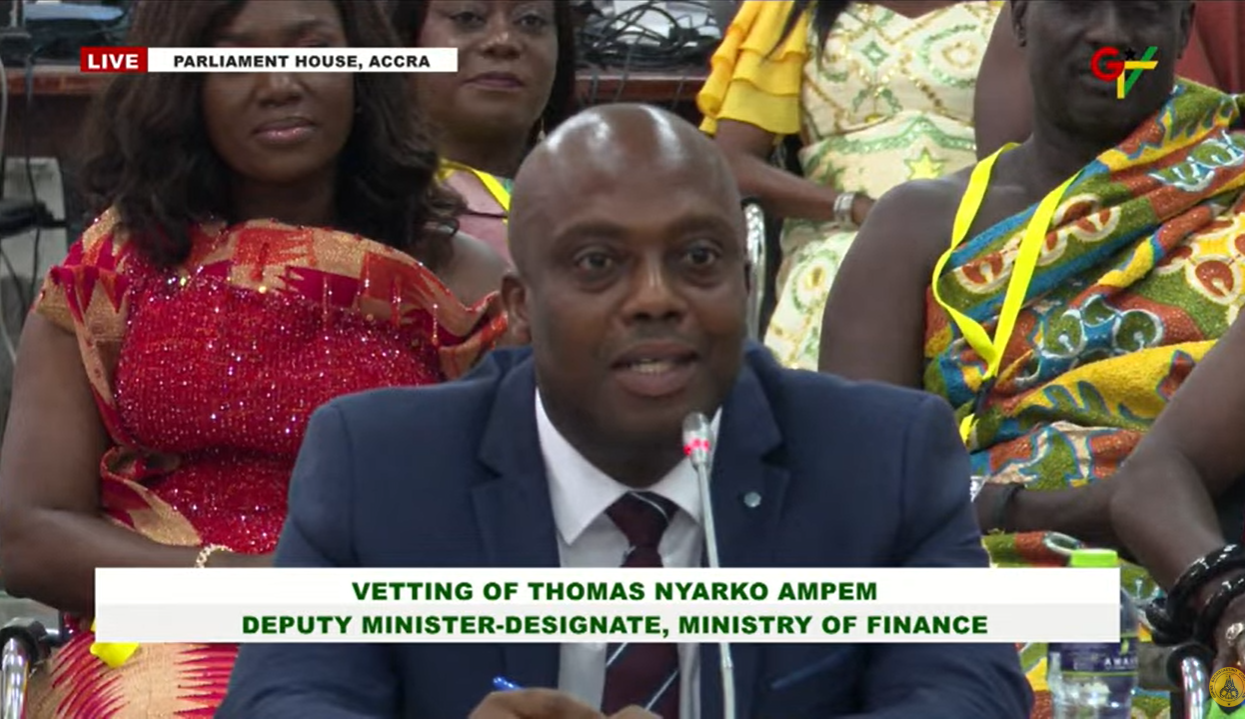
    Deputy Minister-designate for Finance, Thomas Nyarko Ampem, has proposed innovative strategies to address the persistent Value Added Tax (VAT) revenue gap, highlighting the potential of a VAT lottery as a means to encourage compliance.

    During his vetting before Parliament’s Appointments Committee today, Ampem emphasized the need to leverage technology and incentivize consumer participation in tax collection.

    “I will work with my minister and GRA to use technology to ensure that we rake in more revenue… One suggestion that has come up is a VAT lottery. Today a lot of people go to buy things and they don’t insist on VAT receipt because they do not see the need for it. If we can have VAT lottery that will let people know that if I get my VAT receipt and I enter into a draw and I’ll possibly win a fridge, an iron… it doesn’t matter how small it is. Probably some of these little things will get us there,” Ampem stated.

    This suggestion comes on the heels of a comprehensive report jointly published by the Ministry of Finance and the Institute for Fiscal Studies (UK), titled A Review of Ghana’s Value-Added Tax (VAT) System. The report delves into the design and administration of Ghana’s VAT structure, examining revenue trends and assessing current tax policies through international comparisons and extensive data analysis.

    Key findings reveal that Ghana’s VAT framework is progressive, with wealthier households contributing a larger share of VAT revenue due to exemptions on essential goods that benefit lower-income households. However, the report notes that, in absolute terms, wealthier households gain more from these exemptions, prompting the government to reconsider their effectiveness under the Medium-Term Revenue Strategy (MTRS).

    Additionally, the report highlights compliance challenges, revealing that while many businesses below the VAT registration threshold voluntarily register, numerous businesses that exceed the threshold fail to do so. Even among registered taxpayers, non-compliance remains an issue, with some businesses either not filing returns or submitting returns with zero sales and purchases. The MTRS aims to address these issues through improved voluntary compliance and stricter enforcement.

    Another significant reform noted in the report is the 2023 restriction of the VAT Flat Rate Scheme (VFRS) to small taxpayers. This adjustment is believed to have enhanced revenue collection while simplifying compliance for smaller businesses.

    The report also points to Ghana’s recent economic growth patterns as a factor in VAT revenue stagnation. Growth driven by investments and exports, rather than consumption, has limited the potential for increased VAT revenue, despite economic expansion and higher tax rates.

    These findings have already begun shaping Ghana’s tax policies, with the government exploring additional reforms in line with the MTRS. The proposed VAT lottery, aimed at incentivizing consumers to demand VAT receipts, could become a practical step toward closing the VAT gap and strengthening revenue collection.

  • EU disapproves taxation on lottery wins

    The European Lotteries has voiced disapproval of government taxation on lottery winnings and imposition of fees on the gaming sector.

    Phillipe Vlaemminck, Head of Legal at European Lotteries, speaking to the B&FT during a training program on responsible gaming organized by the National Lottery Authority (NLA) in Accra, remarked: “Lottery already has a positive impact on society in various ways, and thus it is crucial for some governments to reconsider imposing taxes on the industry”.

    He contended that individuals desire to participate in the lottery without the burden of taxes on the modest sums they win.

    Termed as a game of chance with societal benefits, Vlaemminck underscored that it is highly unnecessary for governments to tax lottery winnings, further adding: “That is the standard in many places such as the rest of Europe, the Americas and Asia which are tax free for winnings because the whole profit is given back to society”.

    The Ghana Revenue Authority (GRA) presently imposes a 10 percent withholding tax on all lottery earnings as income from lottery activities, while they are also subjected to a tax rate of 20 percent on Gross Gaming Revenue (GGR).

    Vlaemminck highlighted that when players incur losses, it is society that gains through developmental projects; and lottery merely provides a platform for individuals to fantasize, hence when they lose, society prevails.

    However, he remarked that Ghana runs an exceptionally dynamic lottery system in Africa and promotes the National Lottery Authority (NLA) as a prominent gaming operator across the continent.

    The European Lotteries observed that the NLA has demonstrated an increased dedication and curiosity in global developments within the industry, fostering knowledge exchange and positioning the Authority as a responsible gaming operator.

    Addressing the gathering, Sammi Awuku, Director-General of NLA, stated that the program is instrumental in assisting the Authority in monitoring and combating illicit lottery practices within the system.

    Mr. Awuku elucidated that the training, which includes certification, will enable lottery marketing firms and private lottery operators to comprehend the adverse effects of unlawful lottery operations on their own revenues and how they can aid the NLA in addressing the issue.

    He affirmed the NLA’s readiness to collaborate with the European Lotteries in any meaningful manner, including embracing the use of artificial intelligence and technology in the lottery sector.

    During the training, sessions covered responsible gaming, combating illicit lottery operations, anti-money laundering, and the utilization of emerging technologies in gaming.

  • Man forced to compensate wife after concealing lottery win from her for years

    Man forced to compensate wife after concealing lottery win from her for years

    A Chinese man who concelaed a lottery win of 10 million yuan ($1.5 million) from his then-wife for two years has been ordered by a court of law to compensate the woman.

    In 2021, the man, surnamed Zhou, won a lottery prize of 10 million yuan. After paying the mandatory tax, he was left with 8.43 million ($1.23 million). That was still lifechanging money for him and his family, only instead of sharing the wonderful news with his wife, he reportedly kept acting like nothing happened. On the day that the lottery prize was wired to his bank account, Zhou transferred 2 million to his sister and another 700,000 yuan to his ex-wife, to help her buy an apartment. He didn’t mention the lottery win to his wife for two years.

    It’s unclear how Zhou’s wife found out about his decption, but the moment she did, she filed for a divorce and also sued him for her cut of the lottery prize. Since the two were married at the time of the win, the money is considered common property of the two spouses, but because Zhou had gone to great lengths to conceal the win from his wife, she actually asked for two thrids of the 2.7 million yuan he had sent his sister and former wife without her consent.

    On February 1st, a Wenzhou court agreed to the woman’s request for 60 per cent of the concealed winnings, and no party has sought an appeal against the ruling.

    The story went wiral on Chinese social media, with the vast majority of people blaming Zhou for keeping his wife in the dark about their common property for so long.

    “He used the couple’s common property to buy a lottery ticket and won the top prize. He wanted to enjoy it alone?” one person asked rhetorically.

    Interestingly, this is not a unique case. Just last November, we wrote about another Chinese man who collected his lottery prize in disguise so he could keep it a secret from his wife and kids.

    Source: Oddity Central

  • Man allegedly kidnaps ex-girlfriend over lottery ticket, assaults responding officers

    A Tennessee man is in police custody after he allegedly broke into his ex-girlfriend’s house and kidnapped her, thinking she had a winning lottery ticket, per NBC News.

    An arrest affidavit filed by the Shelby County Sheriff’s Office notes that it all started when 43-year-old Dontrell Hanes arrived at his ex-girlfriend’s home in Cordova, Tennessee, demanding to get inside. Hanes was frustrated because he had not “received his lottery ticket” and believed he was owed money. Hanes’ girlfriend, who spoke to local news outlet WREG News Channel 3 on the condition of anonymity, said that’s when he allegedly kicked down the door and entered her home.

    “He initially was just choking me just dragging me out the house,” she said. “He bought five for that day, he bought my mom one. My mom has Alzheimer’s, so she took the tickets and she did not intend to…and even though it wasn’t a winning ticket he still wanted it, and so she said something he didn’t like and he just clicked and kick the door in.”

    She was brought to Hanes’ car and told police she was alone with him for seven hours as he drove from Memphis to Horn Lake, making various stops along the way to demand she pay him $10,000. The woman told police he even engaged in a shoot-out in Orange Mound. Haines eventually allowed her to call her family, who then pinged her cell phone to a gas station in Hickory Hill, where authorities arrived and tried to detain Hanes.

    “I thought I was gonna die because he said that was it,” the ex-girlfriend said. “He didn’t have anything to live for, so I kept saying: ‘why you gotta take me with you?’ I was not ready to die.”

    Hanes allegedly assaulted four deputies as they tried to arrest him, and was ultimately charged with aggravated burglary, aggravated kidnapping, domestic assault and assault against a first responder.

    The events unfolded as the Powerball lottery jackpot rose to a world record $2.04 billion on Monday night. An anonymous winner from California was announced on Tuesday morning.

    Source: Complex.com


  • Philippines lottery: Raised brows as hundreds win jackpot

    lottery in the Philippines that saw 433 winners has surprised and sparked the investigation.

    It was the highest number of people to have ever won the Grand Lotto’s top prize, according to local media.

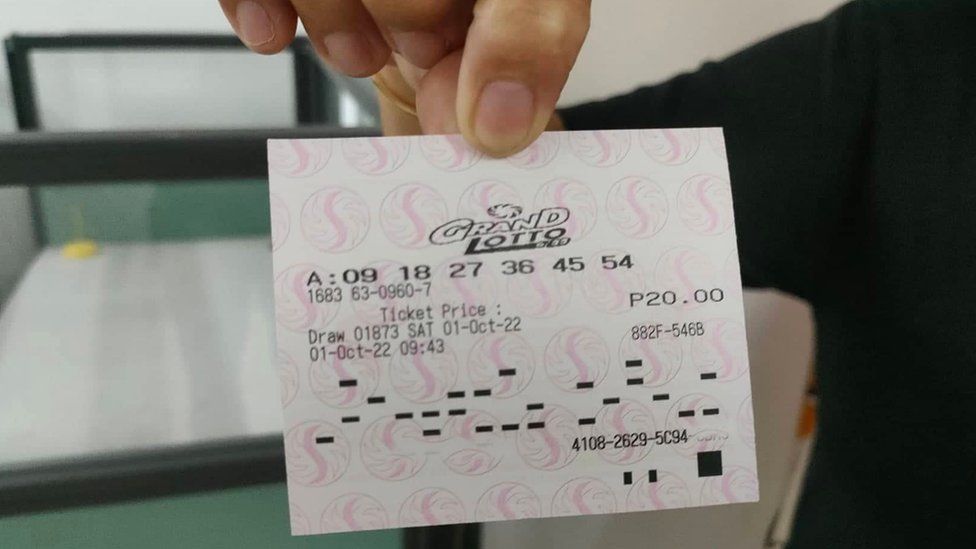
    The winning combination for last weekend’s 236m pesos ($4m; £3.5m) jackpot was a series of numbers that were all divisible by nine.

    Philippines senate minority leader Koko Pimentel has called for an inquiry into the “suspicious” results.

    One expert told the BBC, on the assumption that 10m bets had been placed, he had estimated that the probability of having this many winners was “1 out of 1 followed by 1,224 zeros”.

    “I don’t know a name for this number since it is so large. The number of molecules in the known universe has 80 zeros,” said Guido David, a mathematics professor at the University of the Philippines.

    Participants in the Grand Lotto select six numbers from 1 to 55. To win the jackpot all six of a player’s numbers have to match those drawn by the lottery’s operator.

    “These lotto games are authorized by the Republic of the Philippines. Therefore, we need to maintain and protect the integrity of these gambling games,” Mr Pimentel said as he called for an investigation into the lottery’s unusual outcome.

    On Sunday, Melquiades Robles, general manager of the Philippine Charity Sweepstakes Office (PCSO), said there were no irregularities and highlighted that people in the Philippines tended to bet on number sequences.

    “Many have held on to their numbers. It’s not only good to be loyal to your wives and husbands, it’s also good to be loyal to your numbers,” Mr Robles told a news conference.

    The winning combination for Saturday's draw.
    IMAGE SOURCE,PHILIPPINE CHARITY SWEEPSTAKES OFFICE Image caption, The winning combination for Saturday’s draw

    The PCSO also shared photographs and videos of people collecting their prize money at its office in Mandaluyong city, close to the capital Manila.

    “I’ve been betting on pattern 9, pattern 8, pattern 7, and pattern 6 for many years and I’m thankful I just won,” one winner said.

    Terence Tao, a maths professor from the University of California, Los Angeles told the BBC that a pattern like this being a winning series of numbers is rare “for any single lottery.”

    “But there are hundreds of lotteries every day around the world, and statistically it would not be surprising that every few decades, one of these lotteries would exhibit an unusual pattern,” he said.

    “It’s similar to how in any given hand of poker it would be unlikely to draw a straight flush, but if one looks at hundreds of thousands of hands at once then it actually becomes quite likely that a straight flush would be drawn,” he added.

  • $50,000 Powerball ticket spent over a month forgotten in winner’s purse

    A Missouri woman said she was shocked when a Powerball ticket that was forgotten in her purse for over a month turned out to be a $50,000 winner.The St. Louis County woman told Missouri Lottery officials she bought a Powerball ticket for the July 16 drawing at the Walmart store in Manchester and tucked it into her purse, where it soon became forgotten.

    The woman said it wasn’t until she visited a store to check a different Powerball ticket that she found the forgotten slip of paper in her purse and decided to scan it.

    The ticket, which had spent more than a month in her bag, turned out to be a $50,000 winner.

    “I am just so grateful and happy,” the winner said.

    She said some of the money will go toward paying off her student loans.

    “It’s a good present for me,” she said.


  • Regulate operations of lotto properly to provide more jobs – Agents to government

    The Concerned Lotto Agents Association of Ghana (CLAAG), has called on the government to regulate properly the operations of the lotto industry with a view to promoting employment and at the same time sourcing revenue for the badly needed development of the state of Ghana.

    The association noted that successive governments have not given due recognition to the industry as a source of employment and have neglected to regulate the operations of the industry to sustain the provision of jobs and as a regular source of employment.

    In a press statement, the Lotto Agents denied claims that the lotto industry had provided jobs to more than two million Ghanaians especially in the informal sector.

    They also raised other concerns confronting lotto agents, calling on the government to address them as soon as possible.

    Below is a statement:

    Good morning Ladies and Gentlemen of the press. It is an understatement to say that the lotto industry had provided jobs to more than two million Ghanaians especially in the informal sector.

    Unfortunately the successive governments have not given due recognition to the industry as a source of employment and have neglected to regulate the operations of the industry to sustain the provision of jobs and as a regular source of employment.

    The decision to cut off private participation in lotto industry was therefore not a step in the right direction.

    The Atta Mills regime however decided to bring back the private participation through the creation of the VAG act in 2012.

    The current administration through the Director General of National Lottories invited about 32 Private Lotto operations (firms, companies) to register and be lincensed to be able to operate.

    Huge sums of money were paid by the thirty-two companies but about only seven got lincenses to operate, we hope that the rest will get their lincense in due course.

    Those who did not apply for lincenses at all and who have no lincenses are now operating and paying huge commission to the Lotto writes because their operation is a black market sort of operation without any regulation.

    We call on the government to regulate properly the operations of the Lotto industry with a view to promoting employment and at the same time sourcing revenue for the badly needed development of the state of Ghana.

    The NLA at the moment is a player and a referee at the same time. NLA is a regulator and yet not independent as they themselves compete with lotto operations and that is a source of gargantuan confusion and chaos. We need an independent regulator who is not a competitor.

    We are therefore calling on all our members to remain calm and give their support to the government so that this unfinished business will continue after the coming elections.

    Source: Atinka Online

  • National Lottery Authority cautions public against lotto fraudsters

    The National Lottery Authority (NLA) is cautioning the general public not to fall victim to the operations and activities of lotto fraudsters.

    The said fraudsters according to the NLA are using different platforms and communication strategies to defraud unsuspecting persons.

    In a statement signed by the Public relations Unit of the Authority, said the lotto fraudsters have defrauded unsuspecting people through several social media platforms including Facebook accounts/pages, WhatsApp platforms.

    In their modus operandi, the fraudsters use the social media handles they have created using the name and logo of NLA in different formats.

    “The NLA shall not be responsible for any losses incurred by unsuspecting people who are defrauded by these lotto fraudsters and social media miscreants,” the statement said.

    The statement further urged the public to be more vigilant and not patronise the services of such lotto fraudsters.

    “Stake lotto through the NLA official short codes, and digital or online platforms on *959# for 5/90 original lotto game, 590 games mobile app, www.590mobile.com.gh, Lucky 3 with the official short code, *987#, Daywa with the official short code *446#, Super 6 game, available on the Android Point of Sale Terminals and *787# short code known as “Wotiriye.”

    The statement again urged the public to continue to play their favourite lotto via all the shortcodes and websites cited.


    Source: myjoyonline 

  • Jubilating lottery winner kills 5

    The first move of celebration by a 30-year-old unemployed who won GH¢1,200 lottery ended in the death of five people at Tegbi Vakpomda in the Anlo District of the Volta Region.  The tragedy that hit one family last Wednesday has thrown the community into a state of mourning.

    Over the years luck had been eluding Wisdom Kpodo anytime he staked lotto, but when luck shone on him eventually, his joy knew no bounds, and in an ecstatic mood, he jumped into a taxi, with registration number GT 4482 U, about 4:00pm, with two of his friends and drove recklessly thereby killing five on the spot.

    According to the Assembly Member for Tegbi Afedome Electoral Area, Mr Noel Kokoroko, Wisdom moved the taxi from Woe near Tegbi, to Keta at top speed with others shouting “no size, no size”.

    On his return to Woe, and on reaching Vakpomda, the eyewitness narrated, the driver attempted to overtake three vehicles in a row, and in the process lost control of the steering and veered into a house, which was 40 metres away from the road, ending the lives of the five persons.

    The deceased are Faustina Afi  Amegashie, 70; Regina Edzia, 41; Rebecca Agbanavor, 17; Etornam Agbanavor, nine, and Charity Agbanavor Exornam, two years.

    Three of the persons, Madam Regina Edzia and her three children died instantly, while the remaining two were pronounced dead on arrival at the Keta Government Hospital.

    The Keta Municipal Police, which confirmed the story, said the suspect was in police custody while investigations were underway into the incident.


    Source: Graphic.com.gh

  • Asylum decision-maker: ‘It’s a lottery’

    The Home Office has denied taking “arbitrary” decisions on asylum cases in order to meet deportation targets, but an asylum caseworker says staff have to work so fast that the results are a “lottery” – one that could result in people being sent home to their deaths. He contacted the BBC because he wants the public to know how the system operates. As he would lose his job if identified, we have called him “Alex”.

    Every day Alex reads the case files of people who have fled armed conflict. People who have been persecuted because of their politics, race, religion or sexuality. People who have experienced torture and sexual violence.

    It’s his job to decide whether these people, all asylum seekers, should be allowed to stay in the UK or be deported.

    And yet, when he walks into work, he is greeted by a scene that wouldn’t look out of place at a call centre selling double glazing. A leader board hangs on the wall displaying who is hitting their targets and who isn’t, and performance managers pace the floor asking for updates on progress as often as once an hour.

    Staff who don’t meet their targets risk losing their jobs.

    “There is an obsession among management with unachievable ‘stats’ – human beings with complex lives are reduced just to numbers,” says Alex who has been a decision-maker for the Home Office for almost a year.

    “These are people waiting for a decision to be made on their lives – it is probably one of the biggest things they will ever have to go through.

    “Given what we are dealing with, this is not the environment for pushy managers who try to drive results through fear and intimidation.”

    Alex is one of 140 decision-makers based in an office in Bootle, just outside Liverpool. Most were recruited last year to clear a backlog of 10,000 of asylum cases within 12 months – a project known as Next Generation Casework.

    How are decisions made?

    • Decision-makers must take into account the evidence submitted by asylum applicants, the political and human rights situation in the country of origin, and previous decisions about asylum taken by UK courts
    • Decisions often depend on whether the decision-maker finds the applicant’s account to be believable – if it contains inaccurate or inconsistent information, for example, this will be damaging
    • The claim may also be harmed if the applicant delayed claiming asylum without good reason, if (s)he did not claim asylum in the first safe country, or has been convicted of a criminal offence such as using false travel documentation

    Source: Asylum Aid

    The focus is on cases classified by the Home Office as “non-straightforward”, including pregnant women, people who claim to have been tortured and those with mental health conditions.

    But no matter how complex the case, Alex is expected to make five decisions to grant or refuse asylum seekers a week, justified by a letter that can be anything between 5,000 and 17,000 words long (that is, between two or seven times the length of this article).

    Anyone consistently hitting three or less is put on an “improvement plan” – and will be sacked if they don’t improve in four weeks, Alex says.

    “People will often take decisions based on what the easiest result will be to get through the decision as quickly as possible,” says Alex. Sometimes the easiest decision will be to grant asylum, sometimes it will be to refuse it.

    “In that sense, asylum seekers face a lottery,” he says.


    The Home Office told the BBC it didn’t recognise the picture painted by Alex and insisted that staff had an “appropriate” workload.

    I went to Liverpool to meet Alex and to see his Home Office ID. While there, I also spoke to officials from the Public and Commercial Services Union, who confirmed several aspects of his story.

    Who can claim asylum?

    Under the 1951 Geneva Convention, asylum seekers must show that:

    • They have a well-founded fear of persecution in their home country
    • The persecution is for one of the five reasons specified in the Convention: race, religion, nationality, membership of a particular social group or political opinion
    • They would be at risk of persecution if they were returned

    Asked what he means by saying that decision-makers sometimes take the “easiest” route to a decision, rather than the fairest, Alex asks me to imagine that an applicant has given several reasons why he or she needs asylum. In this case, a decision-maker may home in on just one of the reasons, Alex says, rather than considering whether the whole story adds up. In this case the application is likely to be approved, when perhaps it shouldn’t be.

    But equally, if someone’s application contains inconsistencies – regarding dates for example – this can be used as an easy way to refuse an application.

    “In reality, some inconsistencies might be down to the person having a mental health problem, or just simply that it has been such a long time between making the claim and having an interview that they’ve forgotten precise dates of things,” says Alex.

    There is nothing stopping decision-makers from doing their own research – for example, putting in a call to a UK church where someone claiming asylum on grounds of religious persecution claims to have been worshipping.

    “But there are no extra points for going the extra mile – in fact, it only hurts your targets because it takes up time. So people normally just go on the information they’ve been given,” says Alex.

    Some of this information comes from two interviews – an initial interview when the asylum seeker first arrives in the country, and a second in-depth interview, conducted by decision-makers like Alex.

    These interviews are supposed to last two-and-a-half hours and staff are criticised if they take any longer, says Alex.

    Caseworker interviewing asylum applicant over glitchy video link

    “That target is in people’s minds constantly and it’s wrong, because how do you fit into two-and-a-half hours someone’s story of how they’ve upped sticks and left the place they were born, the place their family is?”

    The pressure to get things done quickly means interviews may be rushed, especially if a decision-maker has two to do on the same day. “We are reluctant to offer breaks, we might be abrupt with asylum seekers, rather than empathetic because we simply need to power through the interview as quickly as possible,” Alex says.

    Until the beginning of this year, Bootle staff would interview asylum seekers face-to-face at the Capital building in central Liverpool. But now they increasingly do the interviews over Skype.

    The asylum seeker will beam in from one location, the interpreter, if needed, from another – and Alex from a small booth in Bootle. It means they’ve been able to interview asylum seekers living in Leicester, Sheffield, London and Glasgow. But the video link often glitches and cuts out throughout interviews.

    The charity Asylum Aid, which gives legal support to asylum seekers, says it has heard of connections being so bad that it’s difficult to make out what is being said.

    “In a matter of life and death, which is what an asylum interview is, that is unacceptable,” says spokesman Ciaran Price.

    “Anyone who has ever done a video conference knows it is not as easy to put a point across. The Home Office regularly take into account body language, it will be very difficult to make a judgement about how traumatised someone is when you’re relying on a grainy video that keeps freezing.”

    Alex says it isn’t uncommon for people to break down into tears and in that situation, it is good to be in the same room. “I can be sympathetic and encourage them to have a break. I can get them some water and sit quietly with them while they recompose themselves,” he says.

    Some days it feels too cruel to do otherwise, even if it means forfeiting a target. Alex will often go home after a tough day and break down into tears himself.

    Asylum by numbers

    • The backlog of people waiting for an asylum decision or for an appeal to be heard is reported to be in the tens of thousands
    • More than half of “non-straightforward” applicants had been waiting more than a year for a decision, as of March 2017, according to a report by chief inspector of borders and immigration David Bolt
    • 26,350 people applied for asylum in the UK in 2017, according to Gov.uk – a decrease of 14% from 2016
    • 14,767 people were granted asylum or alternative forms of protection and resettlement in 2017, including 5,866 children
    • Additionally, 5,218 family reunion visas were issued to partners and children of those granted asylum or humanitarian protection in the UK

    Sometimes it’s not possible for one decision-maker to follow a case all the way through, and in such cases Alex has to rely on notes taken by another interviewer. Reading the case files it becomes clear when the interview has been rushed, as key details will be missing.

    For example, it’s possible to check whether applicants come from the country they claim to come from by asking the right questions – questions about key landmarks in their town, perhaps, the name of the local public transport network or the country’s last-but-one leader. But sometimes interviewers have failed to do this.

    “If someone is undocumented, how can you assume their nationality without asking questions?” asks Alex.

    “The files are often missing key details and they’ve forgotten to ask key questions, which makes it very difficult for me to a make a decision.”

    Again, this can be because the interviewer is rushing. It’s rare to have time to read through the applicant’s file before going into the interview, Alex says, or to carry out research into the applicant’s home country.

    When Asylum Aid represented a gay client from Vietnam recently, the Home Office caseworker referred to a Lonely Planet guide to establish whether or not it would be safe for him to return home. Based on the guide’s description of Ho Chi Minh city, the caseworker suggested it would be safe for him to go back.

    “The target audience for Lonely Planet isn’t a Home Office decision-maker. It’s a holiday-maker, probably Western, with cash to spend. Unsurprisingly, it doesn’t offer holiday-makers the level of detail about the human rights situation that is needed in deciding a person’s fate,” says spokesman Ciaran Price.

    “This is a ridiculous source of objective evidence to use in a decision letter, and is a strong example of Home Office staff relying on information that’s quickly available and easy to find – not what is suitable in an individual’s case.”
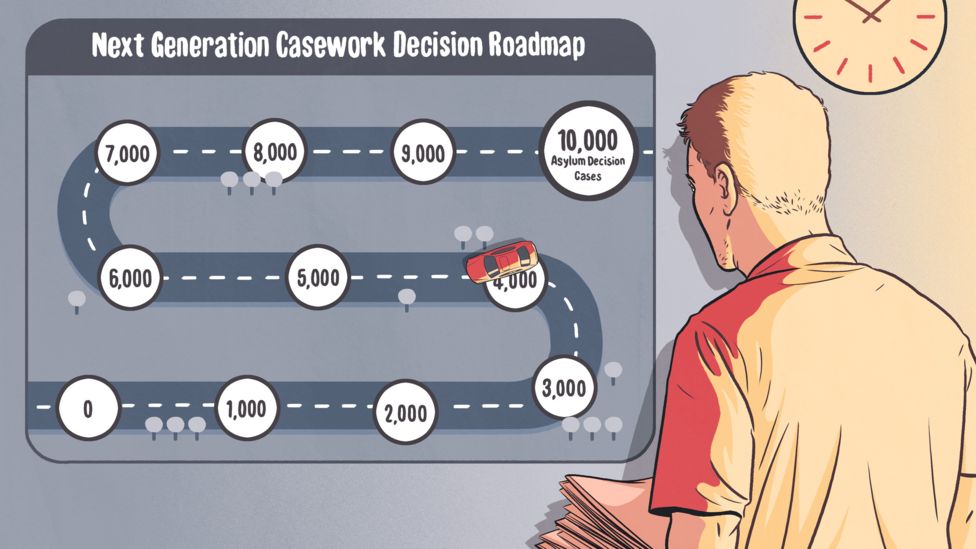
    The car race-track poster used to mark progress towards the 10,000-case target
    For a while the Bootle centre had a motivational poster showing a car moving towards the target of 10,000 decisions

    Many of the decision-makers in the Bootle centre are young graduates, with no previous experience of this kind of work and only two weeks of training before they start doing interviews, Alex says.

    Everyone else in the office is a temporary worker, employed via a High Street recruitment agency.

    This includes the performance managers driving the decision-makers to work faster. “They typically come from sales backgrounds and have never done any work involving asylum seekers or immigration themselves. They have no understanding of the process or how important it is to do things sensitively and properly,” Alex says.

    He says there are no quotas for the number of applications that must be rejected, the only target is speed – everyone is made acutely aware that the national backlog of cases in progress is in the tens of thousands and that the Home Office is under fire for long delays. But speed affects quality, he says, and the decisions are sometimes overturned on appeal. According to the Law Society, almost 50% of UK immigration and asylum appeals are upheld – evidence of “serious flaws in the way visa and asylum applications are being dealt with”.

    Asked to comment on Alex’s allegations a Home Office spokeswoman said: “We do not recognise these claims made by an anonymous source. We have a dedicated and hardworking team who are committed to providing a high level of service with often complex asylum claims. Their individual workload is appropriate and dependent on their level of experience and seniority.”

    She added that caseworkers received a proper level of training, and further mentoring if they struggled “to progress cases in line with expected standards”. There were also internal audit procedures, she said, to ensure that decision-makers do not simply make what they deem to be the quickest decision.

    Across the UK, she said, most interviews with asylum applicants took place face-to-face, though video-interviewing trials would continue.

    The spokeswoman said that appeals could be upheld for a number of reasons, including the presentation of new material not available at the time of the initial decision.

    Despite the Bootle centre’s emphasis on speed, it has failed to clear the backlog as fast as had been hoped.

    There used to be a big poster on the wall of a winding road with a plastic toy car attached, which was moved to indicate progress towards the 10,000 target. It was taken down some months ago, when it became clear that this would be impossible.

    Towards the end of March, coming up to the centre’s one-year anniversary, it was announced that 5,000 cases had been completed. (The person who made the 5,000th decision was rewarded with vouchers and some chocolate.)

    Problems with staff retention were one factor that prevented the car moving faster. More than a quarter of Home Office staff who take decisions on asylum cases quit over a six-month period, according to a report by David Bolt, the chief inspector of borders and immigration.

    Alex is looking for another job, and so are lots of his colleagues.

    “I struggle with my job from a moral perspective,” he says. “The thing that gets me the most is, if someone is telling the truth but I make the wrong decision and send them back, I’m signing their death warrant.”

    Source: BBC
  • Abeiku Santana appointed Ambassador for Ghana Mobile Phone Lottery

    “Radio Master” and entertainment personality Abeiku Aggrey Santana has been appointed as the Ghana Mobile Lottery Ambassador.

    In a Social Media post sighted by Attractivemustapha.com, the versatile broadcaster confirmed his new role with the National Lottery Authority in collaboration with “Wo tiri y3”, a new lottery operative.

    Abeiku Santana emphasized that there is no need to use a sophisticated phone to play the game because it works with any type of mobile phone and cautioned that only people above 18 years are eligible to play.

    Below are the steps to follow and play the “Wo tiri ye” game as elaborated by Abeiku Santana.

    In partnership with the National Lottery Authority a new lottery operative called “Wotiriye” has introduced an exciting mobile phone-based game called; *787#. The goal of this game is to simplify the experience of playing the lottery.

    Anyone over 18 with a mobile phone can play and they do not even need to have an expensive phone because the game works with any type of mobile phone.

    Followers who want to play and win big at their own convenience simply have to dial *787# and follow the prompts on their mobile phones. There is a small fee of 5.00 cedis to play, and participants can win from 6 different prize categories with weekly wins of up to 20,000 cedis and a jackpot that will start at 50,000 cedis.

    The game is played through the draw of random numbers and winners are determined by matching the selected digits with parts of their mobile phone numbers. The game has already run in a pilot program in certain parts of the country, and has been very well received.

    Evelyn Addo a seamstress and recent winner from Accra said “… it is a great game. I won 20,000 cedis and it was very exciting. I like how easy it is to play just using my mobile phone”.

    Richard Akoto Bamfo the Head of Customer Experience at Wotiriy? Lottery said “ We launched this game to offer our customers value for money. The game provides an opportunity for participants to enjoy weekly wins through the convenience of their mobile phones.

    There will be weekly draws and players can win from different prize categories with a one-time participation in the jackpot prize that starts at 50,000 cedis”

    The public is urged to see the newspapers, listen to the radio and visit the Facebook page for more details on exactly how to play this exciting new *787# game.

    Source: Attractivemustapha.com