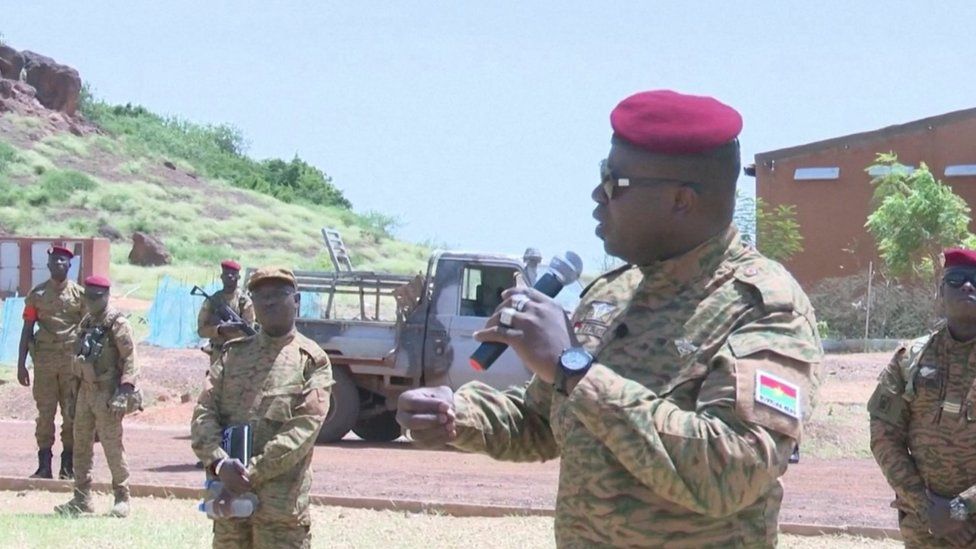
Tag: Lt Col Paul-Henri Damiba

  • Ecowas ‘confident’ after meeting Burkina Faso leader

    A West African mission that went to assess Burkina Faso‘s situation following the coup left Ouagadougou “confident” despite gatherings by demonstrators who criticised its visit.

    The delegation on Tuesday met Capt Ibrahim Traoré, the military leader who on Friday overthrew Lt Col Paul-Henri Damiba, who himself came to power in a coup in January.

    They met at the Ouagadougou airport where dozens of demonstrators were calling for more Russian cooperation and chanting anti-France and anti-Ecowas slogans.

    Former Niger president Mahamadou Issoufou, who was part of the Economic Community of West African States (Ecowas) delegation as a mediator, said they would stand by the Burkinabè people in the very difficult ordeal they were going through.

    Over the weekend he had said the country was “on the brink of collapse”.

    After initially opposing his removal from office, Lt Col Damiba agreed to resign on Sunday and left for Lomé, the capital of Togo.

    The coups have been triggered by worsening insecurity amid frequent jihadist attacks.

    Since 2015, Burkina Faso has been the target of regular attacks by armed groups affiliated with al-Qaeda and the Islamic State group.

    Thousands have died in the attacks and some two million people have been displaced

    Source: BBCAfrica
  • Who is Ibrahim Traoré, the leader of the coup in Burkina Faso?

    Captain Ibrahim Traoré, the head of Burkina Faso’s new junta and the youngest leader in the country, is a combat-tested soldier who has grown increasingly critical of his predecessor’s “unsuccessful policies” against the Islamic State and al-Qaeda extremists.

    Capt Traoré toppled Lt Col Paul-Henri Damiba on 30 September, marking the country’s second military coup this year that could slow down an eventual transition to civilian rule.

    Capt Traoré, 34, began his military career in 2009 and has served in various contingents in Burkina Faso’s volatile eastern and northern theatres.

    He was among a group of soldiers who backed Lt Col Damiba’s 24 January coup against democratically-elected President Roch Kaboré. However, eight months later, divisions emerged in the junta known as the Patriotic Movement for Preservation and Restoration (MPSR).

    Various tactics applied by Lt Col Damiba’s interim military administration – including reforms to a pro-army self-defence force, the appointment of military governors to violence hotspots, and heightened operations in the north and east – have failed to curb deadly militant attacks against civilians and security forces.

    According to conflict data analysts ACLED Info, Burkina Faso replaced neighbouring Mali as the epicentre of militant violence this year, leading to protests demanding Lt Col Damiba’s resignation.

    While the counter-coup was surprising, Burkina Faso’s army has long grappled with mistrust and disaffection since the failed coup of 2015 that led to the disbandment of an elite force.

    The morale of security forces has been further blighted by persistent insurgent attacks and poor working conditions, particularly in volatile borderlands.

    In the immediate aftermath of Capt Traoré’s power grab, a war of words ensued between his faction and that of Lt Col Damiba, raising fears of a violent power struggle.

    Lt Col Damiba’s resignation on Sunday put Capt Traoré firmly in charge of a fragmented army struggling to face a brutal insurgency that continues to destabilise vast parts of Burkina Faso and the wider Sahel.

  • Burkina Faso coup: Gun fires in the capital and closed highways

    The man who was overthrown in a coup in Burkina Faso, according to the self-proclaimed leader, is preparing a counterattack.

    Lt Col Paul-Henri Damiba, per Col Ibrahim Traoré, is being held in one of the French Army’s bases, a claim that has been refuted by French officials.

    Gunshots have been heard in Burkina Faso’s capital city Ouagadougou and helicopters are circling overhead.

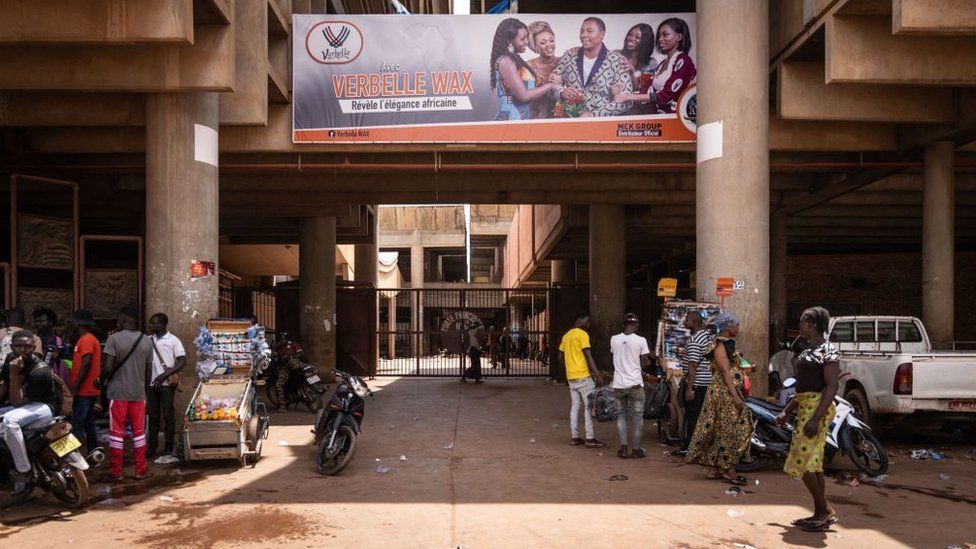
    Witnesses say troops have blocked main roads around the city and shops that had opened earlier are now shut.

    Friday’s apparent takeover had been announced on national TV and was the second time this year that the country’s army had seized power.

    On both occasions, the coup leaders said they had to step in because national security was so dire.

    Burkina Faso controls as little as 60% of its territory, experts say, and Islamist violence is worsening. Since 2020 more than a million people have been displaced in the country due to the violence.

    The African Union has demanded the return of constitutional order by July 2023 at the latest, agreeing with the regional group Ecowas that the ousting of leader Lt Col Damiba was “unconstitutional”.

    Ecowas earlier said it was “inappropriate” for army rebels to seize power when the country was working towards the civilian rule.

    The latest international criticism has come from the UN, whose chief António Guterres says he “strongly condemns” the coup.

    For the second time in under 24 hours, the coup leaders have issued a statement on national TV, signed by their leader Col Ibrahim Traoré.

    This time they claimed Lt Damiba was planning a counter-attack because of their own willingness to work with new partners in their fight against the Islamists. The statement did not name these potential new partners, but rights groups say troops in neighbouring Mali have been working closely with Russian mercenaries from the Wagner group – although both nations deny this.

    On Friday evening flanked by rebel soldiers in fatigues and black facemasks, an officer had read an announcement on national TV stating that they were kicking out Lt Damiba, dissolving the government and suspending the constitution.

    That statement was also read on behalf of an army captain called Col Traoré, who said Lt Col Damiba’s inability to deal with an Islamist insurgency was to blame.

    “Our people have suffered enough, and are still suffering”, he said.

    Little is known about Col Traoré, the 34-year-old soldier who led an anti-jihadist unit in the north called Cobra.

    His statement effectively declared himself the interim leader of Burkina Faso. But in Friday’s announcement came the promise that the “driving forces of the nation” would in time be brought together to appoint a new civilian or military president and a new “transitional charter”.

    Lt Col Damiba’s junta overthrew an elected government in January citing a failure to halt Islamist attacks, and he himself told citizens “we have more than what it takes to win this war.”

    But his administration has also not been able to quell the jihadist violence. Analysts told the BBC recently that Islamist insurgents were encroaching on territory, and military leaders had failed in their attempts to bring the military under a single unit of command.

    On Monday, 11 soldiers were killed when they were escorting a convoy of civilian vehicles in Djibo in the north of the country.

    The African Union has urged the military to “immediately and totally refrain from any acts of violence or threats to the civilian population, civil liberties, human rights”.

    The Economic Community of West African States (Ecowas) earlier condemned the move too, stating it “reaffirms its unreserved opposition to any taking or maintaining of the power by unconstitutional means”.

    The United States said it was “deeply concerned” by events in Burkina Faso and encouraged its citizens to limit movements in the country. France issued a similar warning to its more than 4,000 citizens living in the capital city Ouagadougou.

    “We call for a return to calm and restraint by all actors,” a US State Department spokesperson said.

    The gates to Ouagadougou's main market on 1 October 2022.
    IMAGE SOURCE,AFP Image caption, The gates to Ouagadougou’s main market have been shut and many roads are blocked off

    In January, Lt Col Damiba ousted President Roch Kaboré, saying that he had failed to deal with growing militant Islamist violence.

    But many citizens do not feel any safer and there have been protests in different parts of the country this week.

    On Friday afternoon, some protesters took to the capital’s streets calling for the removal of Lt Col Damiba.

    The Islamist insurgency broke out in Burkina Faso in 2015, leaving thousands dead and forcing an estimated two million people from their homes.

    The country has experienced eight successful coups since independence in 1960.

  • Burkina Faso coup: Ecowas blasts military takeover

    The country’s neighbours have blasted Friday’s alleged coup, calling it “inappropriate” for army rebels to take control when efforts were being made to impose civilian authority.

    The removal of leader Lt Col Paul-Henri Damiba was deemed “unconstitutional” by regional organization Ecowas.

    This is the second time this year the country’s army has seized power.

    Both times, the coups’ leaders said they had to step in because national security was so dire.

    Burkina Faso controls as little as 60% of its territory, experts say, and Islamist violence is worsening.

    Flanked by rebel soldiers in fatigues and black facemasks, an army captain announced on national TV on Friday evening that they were kicking out junta leader Lt Col Paul-Henri Damiba, dissolving the government and suspending the constitution.

    Ibrahim Traoré said Lt Col Damiba’s inability to deal with an Islamist insurgency was to blame.

    “Our people have suffered enough, and are still suffering”, he said.

    He also announced that borders were closed indefinitely, a nightly curfew was now in place from 21:00 to 05:00, and all political activities were suspended.

    “Faced with the deteriorating situation, we tried several times to get Damiba to refocus the transition on the security question,” said the statement signed by Traoré.

    “Damiba’s actions gradually convinced us that his ambitions were diverting away from what we set out to do. We decided this day to remove Damiba,” it said.

    Since the takeover, there has been no word on the whereabouts of the ousted leader.

    Lt Col Damiba’s junta overthrew an elected government in January citing a failure to halt Islamist attacks, and he himself told citizens “we have more than what it takes to win this war.”

    But his administration has also not been able to quell the jihadist violence. Analysts told the BBC recently that Islamist insurgents were encroaching on territory, and military leaders had failed in their attempts to bring the military under a single unit of command.

    On Monday, 11 soldiers were killed when they were escorting a convoy of civilian vehicles in Djibo in the north of the country.

    Earlier on Friday, Lt Col Damiba urged the population to remain calm after heavy gunfire was heard in parts of the capital.

    A spokesman for the ousted government, Lionel Bilgo, told AFP news agency on Friday that the “crisis” was, in essence, an army pay dispute, and that Lt Col Damiba was taking part in negotiations.

    But since Friday evening Lt Col Damiba’s whereabouts are unknown. France is a traditional ally, but French diplomatic sources have told RFI radio that Lt Col Damiba is not with them nor is he under their protection.

    The United States said it was “deeply concerned” by events in Burkina Faso and encouraged its citizens to limit movements in the country.

    “We call for a return to calm and restraint by all actors,” a State Department spokesperson said.

    The Economic Community of West African States (Ecowas) has condemned the move, stating it “reaffirms its unreserved opposition to any taking or maintaining of the power by unconstitutional means”.

    President of Burkina Faso Lieutenant Colonel Paul-Henri Damiba visits 14th Inter-Arms Regiment soldiers in Djibo, Burkina Faso
    IMAGE SOURCE, REUTERS Image caption, Lt Col Damiba urged the population to remain calm after heavy gunfire was heard in parts of the capital on Friday

    In January, Lt Col Damiba ousted President Roch Kaboré, saying that he had failed to deal with growing militant Islamist violence.

    But many citizens do not feel any safer and there have been protests in different parts of the country this week.

    On Friday afternoon, some protesters took to the capital’s streets calling for the removal of Lt Col Damiba.

    The Islamist insurgency broke out in Burkina Faso in 2015, leaving thousands dead and forcing an estimated two million people from their homes.

    The country has experienced eight successful coups since independence in 1960.