Tag: M23 rebels

  • DR Congo calls on Arsenal, PSG others to end ‘blood-stained’ Visit Rwanda sponsorship deals

    DR Congo calls on Arsenal, PSG others to end ‘blood-stained’ Visit Rwanda sponsorship deals

    Democratic Republic of Congo (DRC) has urged top European football clubs Arsenal, Bayern Munich, and Paris Saint-Germain (PSG) to sever their sponsorship ties with Visit Rwanda, condemning the deals amid a worsening humanitarian crisis in the region.

    The call comes as M23 rebels seized control of Goma, the largest city in eastern DRC, and the United Nations refugee agency reports that over 400,000 people have been displaced this year.

    UN experts have accused the Rwandan army of effectively controlling M23 operations.

    DRC’s Foreign Minister, Thérèse Kayikwamba Wagner, sent letters to the clubs’ executives, questioning the ethics of continuing the sponsorships.

    She raised concerns that Visit Rwanda’s funding could be linked to the illegal extraction of minerals from DRC’s occupied territories, with the minerals smuggled across the border to Rwanda for export.

    In her letter to Arsenal, Kayikwamba Wagner stated that Rwanda’s responsibility in the ongoing conflict has become undeniable, following a UN report revealing the deployment of 4,000 Rwandan troops in DRC.

    “It is time Arsenal ended its blood-stained sponsorship deals with this oppressor nation. If not for your own consciences, then the clubs should do it for the victims of Rwandan aggression,” she wrote.

    Arsenal, PSG, Bayern Munich and Visit Rwanda have been contacted for comment.

    Why are the Visit Rwanda deals controversial?

    The Visit Rwanda campaign has successfully raised the East African country’s profile but Rwanda’s government has been accused of investing in sport to enhance its global image – a strategy labelled by critics as ‘sportswashing’.

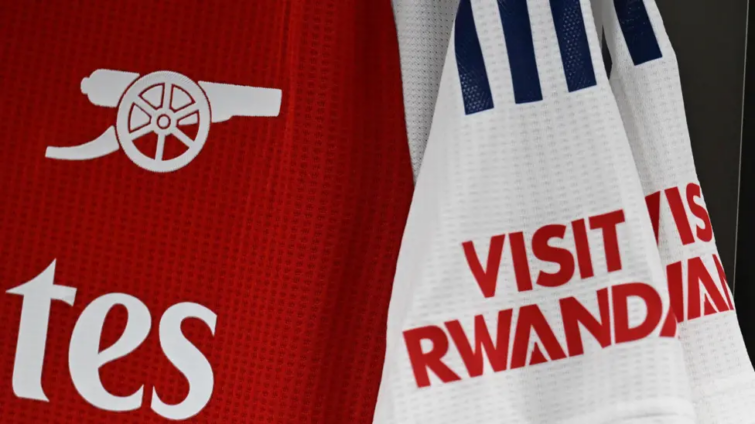
    A sleeve partnership with Arsenal began in 2018, with the latest sponsorship reported to be worth more than £10m ($12.39 million) per year.

    A sponsorship with PSG was agreed the following year, and Bayern Munich signed a five-year football development and tourism promotion partnership with Rwanda in 2023.

    Meanwhile, Rwanda President Paul Kagame has announced a bid to stage a Formula 1 race and Kigali is set to be the venue for cycling’s World Road Championships in September.

    On Friday the UCI, cycling’s world governing body, said there were no plans to relocate the event away from Rwanda.

    The Central Africa director at Human Rights Watch, a campaign group which investigates and reports on cases of abuse around the globe, says these deals and events help hide Rwanda’s “abysmal track record” on human rights.

    “Rwanda has major flaws with due process which violate its own internal laws or international standards,” HRW’s Lewis Mudge told BBC Sport Africa last month.

    “Increasingly we’re seeing the space for freedom of expression, for some degree of political autonomy, is actually shrinking.”

    The Rwandan government has dismissed accusations of sportswashing, with its chief tourism officer Irene Murerwa calling them “a distraction” from the “amazing and outstanding achievements the country has made”.

    What is the latest in eastern DR Congo?

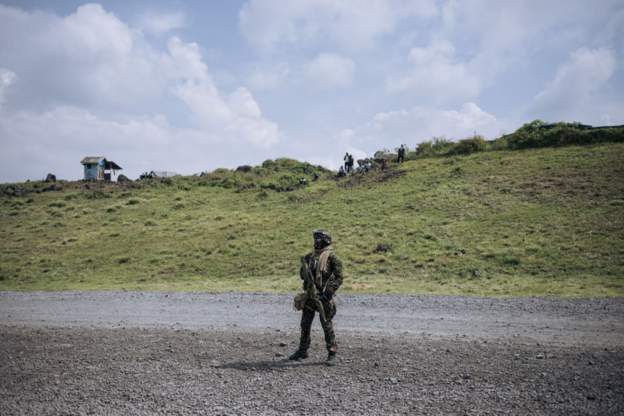
    Four armed militants wearing camouflage and holding guns sit on the back of a truck as another soldier with a grenade launcher on his shoulder walks past in the foreground.


    The UN says at least 700 people have been killed in intense fighting in Goma since Sunday.

    UN spokesman Stéphane Dujarric said 2,800 people have been injured, as M23 rebels – backed by Rwanda – captured the capital of North Kivu province.

    The rebels are now reported to be moving south towards Bukavu, the capital of South Kivu.

    The conflict in eastern DR Congo dates back to the 1990s but has rapidly escalated in recent weeks.

    M23 , which is made up of ethnic Tutsis, say they are fighting for minority rights, while DR Congo’s government says the Rwanda-backed rebels are seeking control of the eastern region’s vast mineral wealth.

    Authorities in Kigali have denied direct military involvement in the conflict, insisting its troops are only stationed along the border to protect its territory and civilians.

  • DR Congo violence: Goma shakes as M23 rebels move forward

    DR Congo violence: Goma shakes as M23 rebels move forward

    Emile Bolingo doesn’t know how much longer he and others in Goma, in the east of the Democratic Republic of Congo, can keep going.

    This big city with around two million people has been unable to get food from the nearby farms for a few days.

    This is the newest fight in a series of fights that has caused many people to leave their homes in the country. Almost seven million people have been forced to leave their homes because of several conflicts.

    The M23 rebels, who are Tutsi, are stopping food and other goods from reaching Goma by blocking the main roads from the north and west.

    “We are worried about not having enough food if the Congolese army doesn’t open the main roads soon. ” Mr Bolingo said that people are very scared and can feel the panic here.

    Goma’s population has increased a lot because people are running away from the fighters who are moving closer.

    Sake, a town 25km (15 miles) northwest of Goma, was attacked on Wednesday.

    “I got hurt in my pelvis from pieces of a bomb,” Mundeke Kandundao said to the BBC from his hospital bed in Goma where he had an operation.

    The 25-year-old driver said the rebels shot a shell from a hill above the town on Wednesday.

    “I was behind a building with many other people when it blew up,” he said.

    “We are afraid because the war keeps going on and doesn’t seem to have a point. ” We are waiting to see if it’s over so we can go home.

    Laurent Cresci from the International Committee of the Red Cross (ICRC) said to the BBC from the state-run Bethsaida Hospital in Goma that there were a lot of patients coming in on Wednesday. He said, “There were a lot of people injured. ” Before, there were 80 patients in our ward, but now there are 130 patients and it’s very difficult to take care of them all.

    Many people feel like they have seen this tragedy before and it makes them very sad.

    “How much longer do we have to live like this. We keep running away all the time,” Pascal Bashali said to the BBC when he got to Goma. People are walking, riding on motorcycles, and traveling in small buses to come to the place.

    Aline Ombeni was very upset when she arrived in the city. She said that they had run away with nothing and needed help with food, clothes, and a place to stay.

    As the fighting gets closer, it reminds me of 2012 when the rebels took over the city by the lake for 10 days but left after other countries made them.

    The M23 started in 2012 to protect the Tutsi people in eastern DR Congo from being mistreated. The United Nations experts have said that the group has support from Rwanda, which is also ruled by Tutsis. Rwanda has always said this is not true.

    “We all know that the war is happening because of money. ” Rwanda is still. For the last 25 years, the Congo has been robbed of its minerals. The Congo wants the UK to help stop Rwanda from taking its minerals.

    People are worried that the M23, a very organized and strong rebel group, might take control of Goma.

    Recently, President Félix Tshisekedi, who was elected again, said last year that the people of Congo should trust him and that the city of Goma will always be safe. He said the same thing again, in the city, while campaigning for the election in December.

    Goma is an important place for business because it is close to big mining towns that provide valuable metals like gold, tin, and coltan. The town has good roads and airports, and a big UN peacekeeping base. Because of this, many companies, international groups, and diplomatic offices have moved here.

    Therefore, Goma is an important place to capture, but the M23 says they don’t want to take it and they are only defending, not attacking.

    Onesphore Sematumba, who studies DR Congo at the International Crisis Group, said that the M23 could capture Goma using their strong military, but it would cause them a lot of trouble.

    The rebels might be showing what they can do and remembering what happened when they took over Goma in 2012 and got in trouble with other countries.

    After leaving, it lost many battles to the Congolese army with help from other countries, and had to leave the country. M23 fighters decided to join the army again with the promise that Tutsis would be kept safe.

    However, in 2021, the group started fighting again because they felt that the promises had not been kept.

    It came out of the forests on the edge of DR Congo, Rwanda, and Uganda and moved closer to Goma, taking over a lot of land.

    Truces were agreed, but they didn’t last because the government and the M23 rebel group are blaming each other.

    The M23 group has said many times that they want to talk about peace with Kinshasa.

    “We requested to talk and find a peaceful solution to this problem,” said Lawrence Kanyuka, who speaks for M23, in an interview with the BBC. “Several wars do not solve the main reasons for fighting. ” The Congo government doesn’t want peace, they want to keep fighting and kill more people.

    President Tshisekedi said that discussions are not an option.

    “We want to make it clear that the government will never talk or make a deal with M23. ” M23 is not real. Rwanda is controlling someone and telling them what to say,” a government official told the reporters.

    The East African force left DR Congo last year because the government asked them to. They were there to help keep people safe and secure areas that armed groups had left.

    In December, it left and then the ceasefire ended, and there was more fighting from the M23.

    President Tshisekedi wants the southern African force that just arrived to do better at fighting rebel groups because they have permission to attack them.

    He has also told the big UN group in the country, called Monusco, to go away. It was not liked by many people because it did not stop the fighting during its 25 years in use.

    However, some people are worried that the fighting could become more severe because the president of Congo said he might start a war with Rwanda if the rebels attack again.

    In response to the comments, Rwanda’s President Paul Kagame said in January that when defending his country, “we will fight with everything we have. ”

    At the same time, Natàlia Torrent from the medical charity Doctors Without Borders (MSF) has said that the increase in fighting in various areas since mid-January is causing a lot of harm to a population that is already in a tough situation.

    “We are in a place where many diseases have already spread before. ” We’ve been working on cholera or measles last year and we are worried. “There will be more outbreaks of diseases coming,” she told the reporters.

    Thinking about the fighting, Goma resident Mr. Bolingo said: “We are the ones who feel the pain. ”

    Mr Bashali ran away from Sake with his wife and nine kids. He said, “People, including men, women, and children are dying in the fighting. It’s sad We hope our country becomes peaceful. “

  • Rebels claim to be occupying DRC areas abandoned by withdrawing forces

    Rebels claim to be occupying DRC areas abandoned by withdrawing forces

    The M23 rebels are going to take back the areas that a regional force is leaving in eastern Congo.

    About 300 soldiers from Kenya were the first to leave their posts in Goma, the capital of North Kivu province, early on Sunday.

    About a year ago, soldiers were sent to the region because the government of DR Congo asked for help. They wanted to stop the M23 rebel group from becoming strong again.

    However, the government has said that the East African force is not doing a good job and they have decided not to continue supporting it.

    Kenya soldiers are now in control of Kibumba, Kibati, and other areas near Goma.

    The M23 said it will take back all the areas it gave to the regional forces at the start of the peace process.

    A truce that was promised last month has been ignored, and now there is more fighting.

    The President of DR Congo, Félix Tshisekedi, wants to be President again. He said areas controlled by rebels might not be able to vote in December because they are not safe.

    It is not known when soldiers from other countries will begin to move away from their positions.

    Last year, M23 rebels gave back the areas they had taken over in North Kivu to soldiers from Burundi, Kenya, South Sudan, and Uganda.

    This happened because of an agreement for peace made in discussions in Kenya and Angola.

  • Ex-Kenyan leader urges more regional troops to DR Congo

    Ex-Kenyan leader urges more regional troops to DR Congo

    Leaders of the East African Community (EAC) have been urged to expedite the deployment of more soldiers to the regional force operating in the eastern Democratic Republic of the Congo.

    According to the Luanda ceasefire agreement, more troops are required to take up positions in areas where armed groups have evacuated, according to former Kenyan president and mediator Uhuru Kenyatta for the East African Community (EAC) bloc.

    Mr. Kenyatta expressed worry about the deteriorating security situation in the province of North Kivu, where M23 rebels have recently clashed with security forces.

    After Burundi and Kenyan contingents arrived in eastern DR Congo last year to help end decades of instability, Uganda and South Sudan are preparing to send troops.

    Mr Kenyatta welcomed recent calls by East African leaders for the cessation of hostilities by all sides in the conflict.

    In a statement, the facilitator said he would intensify plans for the fourth round of talks in Nairobi by mobilising regional and international support for the meeting.

    He has urged all parties involved to accelerate implementation of resolutions of the third consultative talks in Nairobi.

    He has also appealed for urgent humanitarian support to more than half a million people displaced by the conflict in North Kivu province.

    The conflict has strained relations with the DR Congo, which accuses neighbouring Rwanda of backing the M23 rebels. Rwanda denies the accusations.

  • EU requests Rwanda to cease aiding the M23 rebels in DR Congo

    EU requests Rwanda to cease aiding the M23 rebels in DR Congo

    The bloc made its remarks after a report by UN experts revealed that Rwandan military had engaged in “direct engagement” within the DR Congo.

    The M23 rebel group, which has taken over large portions of the North Kivu region in the neighboring Democratic Republic of the Congo, has received calls from the European Union urging it to cease helping Rwanda (DRC).

    The DRC, the US, and a number of European nations have accused Rwanda, a smaller neighbor in Central Africa, of supporting the M23 on numerous occasions, though Kigali has always denied this.

    Recently, the Tutsi rebel group has made strides that have brought Goma, the capital of North Kivu, within a few hundred kilometers.

    EU foreign policy chief Josep Borrell on Saturday said the European bloc had urged Rwanda to “stop supporting the M23 and use all means to press the M23 to comply with the decisions taken by the EAC [East African Community]” at a November summit in Angola.

    “It also firmly urges all states of the region to prevent the provision of any support to armed groups active in the DRC,” said Borrell.

    He called on Kinshasa to “take all measures necessary to protect the civilian population in its territory”.

    Under heavy international pressure to disarm, M23 joined a ceremony last week to deliver the strategic town of Kibumba to an East African military force as a “goodwill gesture” for peace.

    The EAC also said the group had to withdraw to the border between the DRC, Uganda and Rwanda. However, the Congolese army promptly dubbed the Kibumba handover a “sham”.

    Borrell’s comments came after a United Nations experts’ report on DRC indicated it had collected proof of “direct intervention” by Rwandan defence forces inside DRC territory between November 2021 and October 2022.

    The report says Rwandan troops launched operations to reinforce the M23 against the mainly Hutu Democratic Forces for the Liberation of Rwanda (FDLR) – notably by supplying weapons, ammunition and uniforms.

    Kigali sees the FDLR as a threat which justifies interventions inside the DRC.

    Rwanda has also accused the DRC – where presidential elections are due next December – of using the conflict for political purposes as well as of “fabricating” a November massacre of at least 131 civilians.

    A United Nations inquiry blamed the deaths on M23 rebels.

    Prior to the massacre, Angola had been mediating peace talks designed to pave the way for a truce agreement.

    In a statement on Saturday, Kinshasa welcomed the findings of the UN experts, which it said “put an end to the lies and manipulations” of Rwanda.

    Given the gravity of the allegations, it called for the UN Security Council to examine the experts’ report with a view to possible sanctions against Rwanda.

    Meanwhile, Rwanda’s President Paul Kagame blamed Kinshasa for the chaos in its volatile eastern regions in his New Year address.

    “After spending tens of billions of dollars on peacekeeping over the past two decades, the security situation in Eastern Congo is worse than ever,” Kagame said in a statement on Saturday.

    “To explain this failure, some in the international community blame Rwanda, even though they know very well that the true responsibility lies primarily with the government of the DRC. It is high time that the unwarranted vilification of Rwanda stopped.”

    Source: Aljazeera.com

  • DR Congo M23 rebels: Church resort to street protests

    Thousands of people have demonstrated across the Democratic Republic of  Congo against the M23 rebel group, one of dozens fighting in the country’s east.

    The Catholic Church encouraged people to take to the streets, and much of the rage was directed at Rwanda, which DR Congo accuses of supporting the M23 rebels, and something that Kigali denies.

    People marched for peace after leaving Sunday services across the country.

    The Catholic Church wields enormous power in the country. Some church leaders are urging Western countries to take a tougher stance against Rwanda’s government for its support for the M23 rebels.

    Banners at protests in Kinshasa opposed the balkanisation of DR Congo and spoke of the hypocrisy of the international community.

    Regional talks have been taking place to try to stop the violence.

    Several East African countries are sending in troops but in the past the involvement of multiple armies has only complicated the conflict in the mineral-rich eastern DR Congo.