
Tag: machines

  • We have not deployed faulty machines to certain registration centres – EC

    We have not deployed faulty machines to certain registration centres – EC

    The Electoral Commission (EC) has affirmed its impartiality in the ongoing limited registration process, stating its commitment to fairness across all regions, constituencies, and zones.

    Deputy Commissioner, Dr. Bossman Asare dismissed assertions suggesting the distribution of faulty equipment to certain areas or deliberate obstruction of registration in specific regions or constituencies, dismissing them as unfounded.

    He attributed such claims to either a lack of understanding of the EC’s procedures or to deliberate attempts to tarnish its reputation among those familiar with its operations.

    Addressing reporters on Monday, May 13, 2024, Dr. Asare emphasized the EC’s dedication to safeguarding the fundamental right of all eligible Ghanaian citizens, aged 18 and above, to register and vote.

    He expressed regret over accusations of discrimination during the registration process, assuring the public that the EC remains committed to facilitating registration for all eligible individuals ahead of the December 2024 presidential and parliamentary elections.

    Dr. Asare highlighted the emergence of a notable trend during the initial six days of registration, revealing that nationally, a higher number of females than males have registered.

    Out of the 251,149 registered voters, females constitute 54.11%, with 135,898 registrations, while males make up 45.89%, with 115,251 registrations.

    Furthermore, he disclosed that first-time voters, aged between 18 and 21, constitute the majority of registered voters across all 16 regions, representing 88.02% of the total registrations nationwide, amounting to 221,066 individuals.

    Dr. Asare concluded by noting that 382 persons with disabilities had been registered by the end of the sixth day of the exercise, underscoring the EC’s commitment to inclusive participation in the electoral process.

    “The Commission understands that the right to register as a voter is a fundamental political right that must be protected for all Ghanaians who are at least 18 years old and meet the requirements for registration.

    “Consequently, it’s unfortunate that some would accuse the Commission of discriminating against a section of Ghanaians in the registration exercise.”

    “We wish to use this medium to again assure all Ghanaians that the Commission is committed to ensuring that all qualified persons get onto the Voters Register and vote in the December 2024 presidential and parliamentary elections.

    “It is in our interest to do so, and we take pride in the high percentage of the population who are registered voters.”

    “Of the 251,149 registered voters, females constitute 135,898, which is 54.11%, and males are 115,251, which is 45.89%.”

    The EC added, “First-time voters (those between the ages of 18 and 21) constitute the majority of registered voters in all 16 regions.

    “Nationally, they represent 88.02% (that is, 221,066) of the total number of registered voters so far. At the end of Day Six, we had registered 382 persons with disabilities,” he added.
  • Lab-grown blood given to people in world-first clinical trial

    Blood that has been grown in a laboratory has been put into people in a world-first clinical trial, UK researchers say.

    Tiny amounts – equivalent to a couple of spoonfuls – are being tested to see how it performs inside the body.

    The bulk of blood transfusions will always rely on people regularly rolling up their sleeve to donate.

    But the ultimate goal is to manufacture vital, but ultra-rare, blood groups that are hard to get hold of.

    These are necessary for people who depend on regular blood transfusions for conditions such as sickle cell anaemia.

    If the blood is not a precise match then the body starts to reject it and the treatment fails. This level of tissue-matching goes beyond the well-known A, B, AB and O blood groups.

    Prof Ashley Toye, from the University of Bristol, said some groups were “really, really rare” and there “might only be 10 people in the country” able to donate.

    At the moment, there are only three units of the “Bombay” blood group – first identified in India – in stock across the whole of the UK.

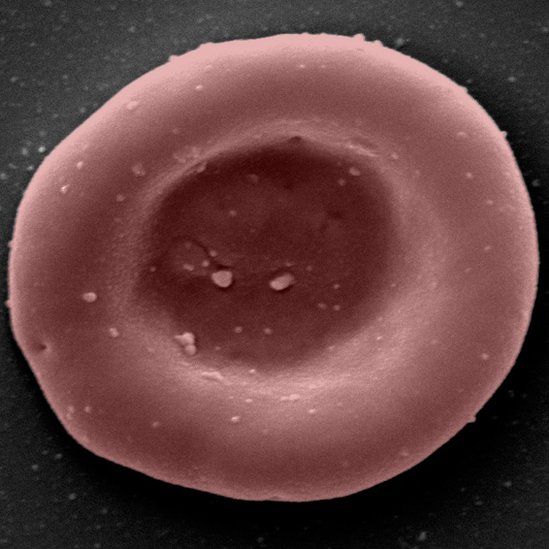
    A lab-grown red blood cell
    Image source, NHSBT
    Image caption,
    A laboratory-grown red blood cell, which carriers oxygen and carbon dioxide around the body

    So how is the blood grown?

    The research project combines teams in Bristol, Cambridge, London and at NHS Blood and Transplant. It focuses on the red blood cells that carry oxygen from the lungs to the rest of the body.

    • They start with a normal donation of a pint of blood (around 470ml)
    • Magnetic beads are used to fish out flexible stem cells that are capable of becoming a red blood cell
    • These stem cells are encouraged to grow in large numbers in the labs
    • And are then guided to become red blood cells

    The process takes about three weeks and an initial pool of around half a million stem cells results in 50 billion red blood cells.

    These are filtered down to get around 15 billion red blood cells that are at the right stage of development to transplant.

    “We want to make as much blood as possible in the future, so the vision in my head is a room full of machines producing it continually from a normal blood donation,” Prof Toye told me.

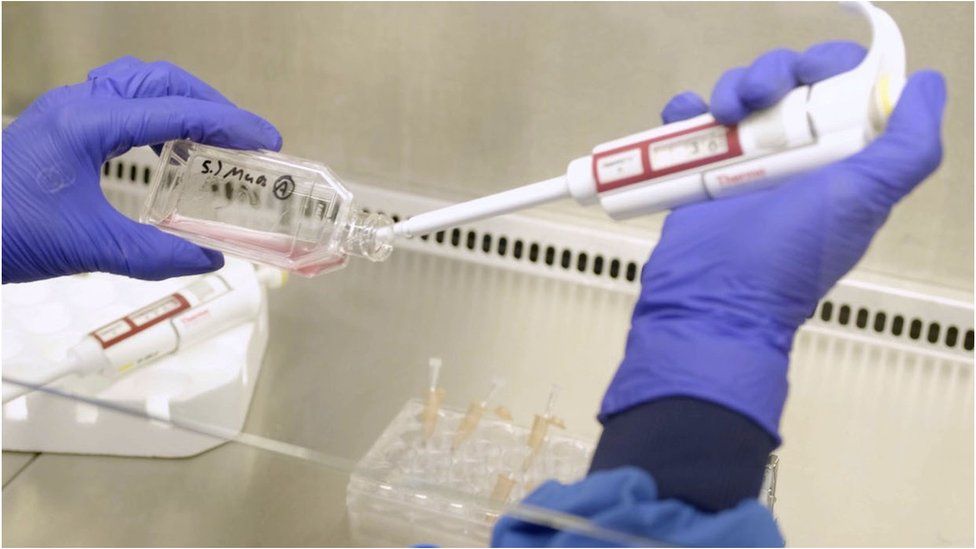
    Lab grown bloodImage source, NHSBT

    The first two people have taken part in the trial, which aims to test the blood in at least 10 healthy volunteers. They will get two donations of 5-10mls at least four months apart – one of normal blood and one of lab-grown blood.

    The blood has been tagged with a radioactive substance, often used in medical procedures, so scientists can see how long it lasts in the body.

    It is hoped the lab-grown blood will be more potent than normal.

    Red blood cells normally last for around 120 days before they need to be replaced. A typical blood donation contains a mix of young and old red blood cells, whereas the lab-grown blood is all freshly made so should last the full 120 days. The researchers suspect this could allow both smaller and less frequent donations in the future.

    However, there are considerable financial and technological challenges.

    The average blood donation costs the NHS around £130. Growing blood will cost vastly more, although the team will not say how much.

    Another challenge is the harvested stem cells eventually exhaust themselves, which limits the amount of blood that be grown. It will take more research to produce the volumes that would be needed clinically.

    Dr Farrukh Shah, the medical director of transfusion at NHS Blood and Transplant, said: “This world-leading research lays the groundwork for the manufacture of red blood cells that can safely be used to transfuse people with disorders like sickle cell.

    “The potential for this work to benefit hard to transfuse patients is very significant.”

    Source: BBC