Tag: Mali Coup

  • Sahel security pact: Mali, Niger, and Burkina Faso unite amidst West African coups

    Sahel security pact: Mali, Niger, and Burkina Faso unite amidst West African coups

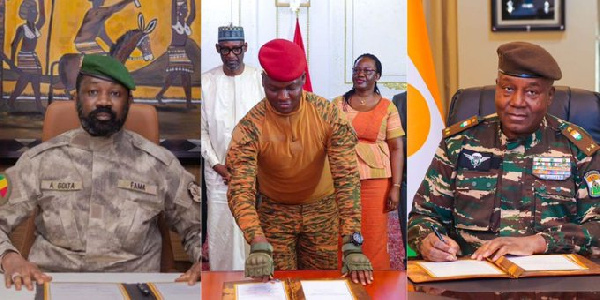
    West African Sahel States, Mali, Niger, and Burkina Faso, all currently under military rule, have signed a security pact on Saturday. This pact pledges mutual support in the event of rebellion or external aggression.

    These three nations have been grappling with the presence of Islamic insurgent groups linked to al Qaeda and Islamic State. Additionally, their relationships with neighbouring countries and international partners have been strained due to the recent coups.

    The most recent coup in Niger exacerbated tensions between these three nations and the countries in the regional bloc, the Economic Community of West African States (ECOWAS). ECOWAS has threatened to use force to restore constitutional rule in Niger.

    Mali and Burkina Faso have committed to assisting Niger if it faces an attack. The pact, known as the Alliance of Sahel States, states that any attack on the sovereignty and territorial integrity of one or more of the signatory parties will be considered aggression against all of them. The signatory states will provide assistance individually or collectively, which may include the use of armed force.

    Mali’s junta leader, Assimi Goita, announced the establishment of the Alliance of Sahel States via his social media account, stating, “I have today signed with the Heads of State of Burkina Faso and Niger the Liptako-Gourma charter establishing the Alliance of Sahel States, with the aim of establishing a collective defence and mutual assistance framework.”

    All three nations were previously members of the France-supported G5 Sahel alliance joint force, which also included Chad and Mauritania. The alliance was launched in 2017 to combat Islamist groups in the region. However, Mali left the alliance after a military coup, and Niger’s President Mohamed Bazoum declared the force “dead” following Mali’s departure in May of the previous year.

    Relations between France and these three states have deteriorated since the coups. France has withdrawn its troops from Mali and Burkina Faso and is engaged in a tense standoff with the junta that seized power in Niger. The junta requested the withdrawal of French troops and its ambassador, a request that France has refused to acknowledge.
  • UN experts call for investigations into possible war crimes in Mali by Wagner

    UN experts call for investigations into possible war crimes in Mali by Wagner

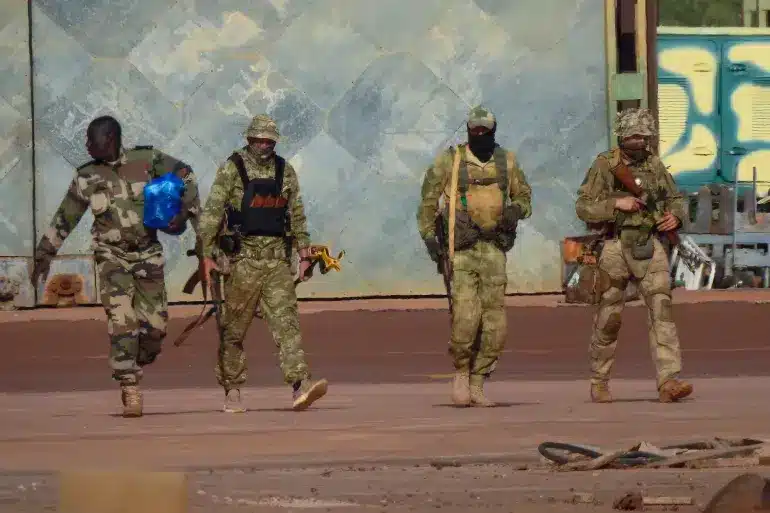
    In the struggle against insecurity in the Sahel, Western powers have accused the Malian military and Russian mercenaries of crimes against humanity.

    On Tuesday, UN experts demanded an impartial investigation into alleged war crimes and crimes against humanity committed in Mali by government forces and the Wagner Group, a Russian private military contractor.

    Mali, whose government seized control in a military takeover in 2021, has previously claimed that Russian forces stationed there are not mercenaries but rather trainers assisting local troops with equipment purchased from Moscow.

    According to Western powers, Wagner Group contractors are among the Russian forces in Mali.

    “Since 2021, the experts have received persistent and alarming accounts of horrific executions, mass graves, acts of torture, rape and sexual violence, pillaging, arbitrary detentions and enforced disappearances perpetrated by Malian armed forces and their allies,” said the statement from the independent experts.

    Mali’s army spokesperson did not immediately respond to a request for comment.

    Russian President Vladimir Putin said last year that the Russian state had nothing to do with military contractors working in Mali, adding that the African country had the right to work with private Russian firms.

    Mali is engaged in a fight against armed groups linked to al-Qaeda and ISIL (ISIS) who have waged a decade-long conflict that has spread to neighbouring countries.

    Tuesday’s statement mentioned the Wagner Group by name, and described credible reports of the involvement of military personnel believed to belong to the group in a massacre of hundreds of people in March.

    Survivors have said that white mercenaries suspected to be Russians took part in the massacre in Moura, a market town in central Mali. The incident sparked international uproar and prompted the UN to open an earlier investigation.

    Mali’s army has denied any wrongdoing in Moura and said it killed 203 militants there during what it described as a military operation.

    The Wagner Group has attracted international attention over its prominent role in fighting during Russia’s invasion of Ukraine.

    Last week, the United States designated Wagner as a “transnational criminal organisation” responsible for widespread human rights abuses.

  • ECOWAS lifts sanctions on Mali

    The Economic Community of West African States (ECOWAS) Sunday lifted economic and financial sanctions imposed on Mali.
    The bloc has also reversed the closure of Mali’s borders and has urged regional envoys to return to that country.

    The sanctions were lifted because the west African country’s military authorities had taken steps to establish an electoral code and monitoring mechanism, as well as adopted a new constitution, which would lead to elections in March 2024.

    Commission President Jean Claude Kassi Brou told a Press conference in Accra after an ordinary session of ECOWAS leaders that the lifting of those sanctions, placed on Mali in January, takes immediate effect.

    However, individual sanctions will remain in place and the country is still suspended from all activities on the block until constitutional order is restored.

    On the situation in Burkina Faso, Kassi Brou told the media that the Junta had agreed to a 24-month period to return the country to democratic rule,starting July 1, 2022.

    He said that ECOWAS Heads also removed the Economic and financial sanctions placed on the country.

    The regional grouping however rejected a 36-month transition arrangement proposed by Guinea’s military authorities.

    It asked the junta to submit a new timetable by the end of the month, and a new Mediator, former Beniniose President Yayi Bonyi, has been appointed to work with the country to ensure its delivers the new arrangement by the deadline.

    The ECOWAS leaders decided to maintain the individual sanctions against members of the junta, amd the suspension of Guinea from the regional body.

    Kassi Brou said failure on the part of the Guinean authorities to propose an acceptable transition arrangemt by the end of July will attract further economic and financial sanctions.

    “Beyond that, economic sanctions will be imposed,” he said.

    Source: GNA

  • Malian MPs endorse military rule till 2027

    Malian lawmakers have unanimously approved a transitional roadmap okaying a five-year tenure for the military junta in charge.

    The vote means the Assimi Goita-led junta has until 2027 to conduct the next democratic election.

    Failure to abide by a February 2022 electoral timeline triggered sanctions from regional bloc, ECOWAS late last year.

    The bloc rejected an extended transition period as had been proposed by the junta.

    President Nana Akufo-Addo, who is current ECOWAS chair said leaders were aghast at the four-year transition because according to him, that was a long as a democratically elected President would stay for a full term.

    Mali is now taking legal action to lift sanctions imposed by West Africa’s monetary union, Uemoa, as it battles a debt crisis, the BBC Africa page has reported.

    Source: www.ghanaweb.com

  • Imam resigns from Mali’s interim legislative body

    Mali’s interim legislative body, the National Transition Council, has been hit by the first resignation barely a week after its installation.

    Imam Oumarou Diarra, a close ally to the influential Imam Mahmoud Dicko, submitted his resignation on Tuesday in a letter to President Bah Ndaw.

    In the letter, he said the council does not meet his expectations.

    His appointment to the council had sparked controversy in his June 5 Movement, which had boycotted the body.

    The BBC’s Lalla Sy says the resignation highlights the lack of consultations in the choice of council members, some of whom had shown no willingness to be part of it.

    Source: bbc.com

  • Mali’s military takes key posts in new government

    Mali’s transitional President, Bah Ndaw, has appointed a 25-member government in which senior military personnel have been given several key posts.

    According to a presidential decree read out on state television, the ministries of defence, security, territorial administration and national reconciliation are all to be led by colonels in the Malian military.

    Mr Ndaw – who had a career in the air force – was hand-picked to be president of the country by the coup leader.

    Following the subsequent appointment of a civilian prime minister, the West African regional block – Ecowas – is expected to soon lift the sanctions it imposed after August’s coup.

    Col Sadio Camara, one of the leaders of the junta, will become the minister of defence, while the spokesman for the military junta, Col-Maj Ismaël Wagué, will be in charge of national reconciliation.

    Some significant posts also went to civilians with the former prosecutor, Mohamed Sidda Dicko, heading the justice department.

    Only four posts were given to women and just two posts to members of the opposition, M5, the group that led protests against President Ibrahim Boubacar Keïta leading to his ouster by the military.

    Source: bbc.com

  • Ecowas lifts Mali sanctions

    The West African regional group – Ecowas – has lifted sanctions imposed on Mali following a coup that ousted President Ibrahim Boubacar Keita in August.

    This comes after military authorities formed a transitional government comprising of army officials and civilians.

    “Taking into account the notable progress made towards a constitutional normalisation, and the support the process, the heads of states have decided to lift the sanctions on Mali, and called on partners to support Mali,” Ecowas said in a statement.

    Mali’s transitional leaders announced a new government on Monday, with some of the top posts going to military officials.

    Col Bah Ndaw was named as interim president, and Moctar Ouane as prime minister.

    Source: bbc.com

  • ECOWAS hints at sanctions removal – Mali presidency

    The West African regional bloc Ecowas has “hinted” that sanctions against Mali “could soon be lifted”, a tweet from the office of Mali’s interim president says.

    Ecowas imposed the punitive measures after the military overthrew President Ibrahim Boubacar Keïta in August.

    It had demanded the resumption of civilian rule, but despite a civilian president, Bah Ndaw, and prime minister, Moctar Ouane, being appointed, the sanctions are still in place.

    Earlier this week, Nigeria’s President Muhammadu Buhari said there were still some “grey areas” that needed to be worked out before relations could return to normal.

    For instance, Mali’s new vice-president is the former junta leader Colonel Assimi Goita, and Ecowas wants to make sure that he cannot become president.

    Mr Ndaw is a former military officer and defence minister.

    Source: bbc.com

  • Ecowas hopes for civilian rule in Mali ‘within days’

    Ghana’s President, Nana Akufo- Addo, says West African leaders hope to see a civilian-led government installed in Mali within days.

    He spoke after talks between regional leaders and the military junta that seized power in Mali last month.

    Mr Akufo- Addo said the regional bloc, Ecowas, would lift sanctions “the minute” civilians were in place to take over in Mali.

    Ecowas leaders met in Ghanaian capital, Accra, for the talks on Mali’s political crisis.

    The leader of Mali’s junta, Col Assimi Goita, as well as representatives from the United Nations and African Union also attended.

    West African leaders fear that the security situation in Mali could deteriorate and undermine efforts made in defeating Islamist insurgents in the north.

    On Saturday, the opposition M5-RFP rejected a proposal by the military for an 18-month transition process.

    Source: bbc.com

  • ECOWAS stands by civilian-led transition team in Mali – Akufo-Addo

    President Nana Addo Dankwa Akufo-Addo on Tuesday said ECOWAS has reaffirmed its position that a civilian leadership should be in charge of the transition in Mali.

    He said that once the required leadership was put in place through the processes that the Military rulers had agreed on in Mali, the sanctions that had placed on that country would be lifted.

    Speaking to journalists after the consultative meeting convened by him to resolve the political crisis in the West African nation, President Akufo-Addo said though an agreement had not reached, the military leadership agreed with the decisions taken at the meeting.

    However, the military leadership said they would have to go back to consult with those who were responsible for decisions to get them to buy into it.

    “The view point of ECOWAS is that matters that have been put out should be dealt with in terms of days and not weeks so that we begin the process of normalizing the situation in Mali,” he said.

    In that direction, President Akufo-Addo who was undertaking his first major assignment after being made the regional bloc’s chairman, said the mediator in the crisis, Nigeria’s former leader Goodluck Jonathan would return to Bamako in a week’s time to continue with talks with the military Junta.

    “The situation in Mali calls for a quick resolution, we have to have a government in place that can begin the process of normalising things, and more than anything else organising the resistance to the Tuareg menace.

    “The issue is now in the hands of the Malians,” he stated, hopeful that by the time the mediator returns to Mali, things would have been sorted out so that the sanctions can be lifted.

    ECOWAS had imposed sanctions on Mali and asked neighbouring states to close their land and air borders with the country after the military deposed the 75 year old Malian President Ibrahim Keita on August 15, 2020.

    The Bloc also suspended all financial flows between the 14 other member states and Mali, suspended the country from international decision making bodies and gave the military junta a deadline of September 15 2020 to appoint a new civilian president and prime minister.

    Tuesday’s meeting was attended by at least eight Presidents, Mali’s political junta and other stakeholders.

    Guinea’s Alpha Conde, Togo’s Faure Gnassingbe, Nigerien leader, Mahamadou Issoufou, who is the immediate past ECOWAS Chair, Senegalese President Macky Sall, Burkinanabe head of state Roch Marc Christian Kabore, Ivorian President Alassani Ouattara and the Nigerian Vice President Yemi Osinbajo took part in the consultative meeting.

    They have since left for their respective countries.

    Source: GNA

  • ECOWAS to hold a meeting in Ghana towards resolving Malian political crisis

    President Nana Addo Dankwa Akufo-Addo, Chair of the Economic Community of West African States (ECOWAS) will on Tuesday, September 15, hold a crunch meeting involving key stakeholders in the Malian political crisis at the Peduase Lodge, Aburi of the Eastern Region.

    The extraordinary meeting is expected to dialogue on ways of returning Mali to constitutional rule.

    It forms part of the mediation efforts to prevent further deterioration of the Malian political situation.

    The meeting will bring together delegation from nine African countries including; Key stakeholders from the Malian military junta, Civil Society Organizations (CSOs) and relevant stakeholders who spearheaded the demonstrations prior to the coup d’etat on August 18, 2020, that ousted President Ibrahim Boubacar Keita’s government.

    Addressing a news conference in Accra on Sunday, ahead of the consultative meeting, Mrs Shirley Oyorkor Botchwey, the Minister of Foreign Affairs and Regional Integration, said at the 57th ECOWAS ordinary meeting held in Niamey, capital of Niger, on September 7, 2020, the ECOWAS Authority of Heads of State demanded that the Malian National Council for the People’s Salvation present a roadmap for holding an election within 12 months in Mali.

    Therefore, the meeting in Ghana will demand the roadmap towards organising an election in Mali.

    The ECOWAS Authority also demanded that the Heads of Transitional Government and Prime Minister, both civilians should be appointed not later than September 15, 2020.

    The meeting will be the first assignment for President Akufo-Addo since his election as ECOWAS Chair.

    President Akufo-Addo’s election as ECOWAS Chair placed him in the same shoes as his predecessors towards resolving the enormous task of ensuring peace and harmony in Mali.

    Meanwhile, Mali has been suspended from ECOWAS following the political uprising in that country, therefore no representative from Malian government would be in Ghana for the meeting.

    Information Minister Kojo Oppong-Nkrumah noted that the Malian political crisis posed a serious security threat to the sub region, especially as the continent was about to operationalize the African Continental Free Trade Area (AfCTA) agreement, and it was imperative to find an amicable solution to the crisis.

    In view of the upcoming ECOWAS extraordinary meeting in Ghana, traffic situation from Accra to Peduase Lodge in Aburi would be affected.

    The Motor Transport and Traffic Department (MTTD) of the Ghana Police Service would deploy traffic wardens to direct movements of vehicles.

    Superintendent Dr Samuel Sasu Mensah in charge of Operations at the MTTD told the media that vehicular traffic on the N4 road to Peduase would be affected, therefore motorists are supposed to use alternative routes.

    Some other principal roads that would be affected include; Airport By-pass road, VVIP Lounge road to Liberation Road, Independence Avenue road to Arko Adjei Interchange, Kempinski Hotel road to Independence Avenue, and National Theatre road to Independence Avenue.

    Source: GNA

  • Mali begins national talks ahead of transition deadline

    A three-day national consultation on the make-up of Mali’s transitional government begins on Thursday in the capital, Bamako.

    The talks come ahead of a deadline given by West African leaders for the appointment of civilian leaders by 15 September.

    This follows consultative meetings held last weekend to agree on the “terms of reference” for Thursday’s talks.

    Pressure is mounting on the military rulers, the National Committee for the Salvation of the People (CNSP), to set up a civilian-led transitional government following Ibrahim Boubacar Keïta’s ouster on 18 August.

    Senior junta officials led by Colonel Assimi Goita have been reaching out to various key personalities in an effort to boost their credibility, support their base and improve their public image.

    Col Goita met two former Presidents, Dioncounda Traore and Amadou Toumani Toure, who have a history of leading transitions, and the influential High Islamic Council of Mali.

    The 5 June Movement – Rally of Patriotic Forces (M5-RFP), which galvanised the nation into pressing Mr Keïta to leave, has reiterated its call for “a civilian political transition, led by a civilian!”.

    Meanwhile, a team of experts on Wednesday submitted its work, a roadmap and a charter, to the junta. The two documents will be the basis for this week’s consultations.

    Source: bbc.com

  • Mali’s junta leader ‘visits former president in hospital’

    The leader of the military junta that ousted President Ibrahim Boubacar Keïta visited him at hospital where he was being treated, AFP news agency has reported.

    The military leader Assimi Goïta and his delegation said the former leader was free to seek further treatment abroad if need be, according to sources who are quoted by AFP.

    Mr Keïta was admitted at the private hospital after a mini-stroke, the agency reports.

    The former president is said to be recovering well and was released to go home on Thursday evening.

    Mr Keïta was detained by the military junta that ousted him on 18 August for 10 days.

    Source: bbc.com

  • Is the coup making a comeback in Africa?

    Democracy is the norm across the continent, but soldiers are still seizing power

    The coup is back in Africa. Last week, soldiers in Mali overthrew the unpopular president, Ibrahim Boubacar Keita, completing the west African country’s second coup in eight years. In Sudan, in April last year, after months of massive protests, the Sudanese military toppled the 30-year dictatorship of Omar al-Bashir. In 2017, a faction of Zimbabwe’s military ousted Robert Mugabe, who had ruled and misruled the former southern African breadbasket for 37 years.

    This is not a return to the past. Before a wave of African democratisation in the 1990s, coups were as common as military dark glasses. Now they are far less frequent, and no longer acceptable in polite circles. Coups are routinely condemned by elected leaders (who rather fancy staying in power) and by institutions such as the African Union.

    That is why, in all three recent “military assisted transitions” – as the perpetrators would have them – soldiers have bent over backwards to deny that a coup has taken place at all.

    In Zimbabwe, the spokesman for the generals who toppled Mugabe proclaimed on television: “We wish to make it absolutely clear that this is not a military takeover” – a statement somewhat undermined by the armoured vehicles on the streets. Instead of executing Mugabe or bundling him on a plane into exile, he was placed under house arrest until he saw the wisdom of resignation. Something similar happened this month in Mali.

    The president was arrested and persuaded to resign. As he put it in a broadcast: “Do I really have a choice?” With a gun to your head, the answer is generally no. In Sudan, the no-coup fiction was more convincing. The toppling of Bashir was preceded by waves of protests in which millions of Sudanese in dozens of cities took to the streets demanding he must go.

    The generals who shoved Bashir out, many of them former close allies, presented their actions as the culmination of a popular revolution. That is a second feature of recent coups. They are popular, at least initially.

    Last week’s putsch in Mali was foreshadowed by demonstrations, including by impoverished widows of soldiers who died fighting the jihadist insurgency. The president had been elected by a landslide in 2013. But by 2020, most Malians were weary of a government that had failed to bring either economic progress or peace. In Zimbabwe, the overthrow of Mugabe was more popular still.

    As he tendered his “resignation”, hundreds of thousands took to the streets of Harare to celebrate, albeit sanctioned by the generals and supplied with anti-Mugabe placards. In Sudan, in scenes of jubilation, huge crowds chanted the praises of their “people’s uprising”. Paradoxically, the return of the coup is the flipside of more entrenched democratic norms. Across the continent, regular elections are now standard. But leaders have become adept at manipulating the democratic process and at tweaking the constitution to extend their rule.

    Nic Cheeseman, a political scientist at the University of Birmingham, wrote the manual in 2018, How To Rig an Election. Both Mugabe and Bashir were experts. Four years before he was dragged away in handcuffs, 94 per cent of Sudanese voters supposedly endorsed Bashir’s presidency.

    Many of the continent’s “longest-serving” leaders, including Uganda’s Yoweri Museveni (34 years in power) and Cameroon’s Paul Biya (45 years and counting) have been periodically, if dubiously, endorsed at the ballot box. When democracy is so blatantly fixed, it becomes plausible for soldiers to seize power in the name of restoring – not rupturing – the democratic contract. Recent coups come amid a strengthening of civil society.

    An increasingly urban, social-media savvy and politicised young population has come into conflict with often ageing leaders who cannot meet their aspirations. Protests have sometimes catalysed peaceful change. In Ethiopia, years of demonstrations forced the resignation of one prime minister in 2018 and the selection by an embattled ruling elite of Abiy Ahmed, the Nobel Peace Prize-winner, as a hoped-for acceptable alternative. But protests have also emboldened the military to act.

    Popular unrest formed the backdrop to army-controlled transitions in Algeria last year, as well as in Mali and Sudan. It must be acknowledged that coups in Africa are now rare. Many countries have robust democracies.

    Ghana, once used to military rule, has held seven back-to-back democratic elections since 1992. Nations from Senegal to South Africa have no history of military takeover. Even Nigeria, once a byword for coups, has been democratic for more than two decades.

    Still, there are dangers. One coup tends to lead to another. Mali is on its second and there are already rumours of disgruntled army officers gunning for Mugabe’s brutal and ineffective successor, Emmerson Mnangagwa. And, once in power, soldiers may get a taste for it.

    Ominously, Mali’s putschists are talking about a three-year transition. In Sudan, civilians are part of a sovereign council that is supposed to organise multi-party elections in 2022. But the leadership includes generals with unsavoury pasts, and there can be many a slip between cup and lip. “We have to call a spade a spade,” says Mr Cheeseman.

    “If the military takes over, even if they don’t shoot the leader, that’s still a coup.”

    david.pilling@ft.comFollow David Pilling with myFT and on Twitter

    Source: Financial Times

  • Mali coup leaders ‘want power for three years’

    West African mediators say the leaders of last week’s coup in Mali want to stay in power for a three-year transition period.

    But the Ecowas team say they told the coup leaders that an interim government – headed by a civilian or retired military officer – should last for a year at the most.

    The mediation team was led by former Nigerian President Goodluck Jonathan.

    It is not yet clear if the issuing of sanctions and suspensions will have any impact on the coup leaders who initially said they were not interested in power.

    Source: bbc.com

  • Mali faces more isolation over coup

    Image caption: Col Ismaël Wagué (pictured) has made most of the announcements on behalf of the military

    The International Organisation of La Francophonie (OIF) has suspended Mali from its membership, the latest body to take action following last week’s overthrow of Ibrahim Boubacar Keïta’s government by the military.

    The decision, by the body that represents countries where people speak French, comes days after the regional bloc, the Economic Community of West African States (Ecowas) – which also suspended Mali from its membership – held unsuccessful talks with the military junta over a return to democratic rule.

    The coup leaders have said they were not interested in holding power and would hold fresh elections within a “reasonable time”.

    A demand by African heads of state to reinstate former President Keïta is now off the table after he withdrew interest to return as leader.

    The OIF has said it will send its own delegation to Mali in a matter of days.

    Source: bbc.com

  • Mali coup: No deal on transitional government

    Talks in Mali aimed at resolving the political situation in the aftermath of last week’s coup have ended without agreement.

    West African leaders have said that the deposed President, Ibrahim Boubacar Keïta, should be reinstated.

    But envoys from regional body Ecowas failed to convince Mali’s military leaders that this was the way forward.

    Mr Keïta faced huge street protests before his overthrow and many in Mali have welcomed his removal.

    Military spokesman Col Ismael Wague is quoted by the Reuters news agency as saying after the talks ended that the final decision on any interim administration would be made by Malians.

    But the idea that Mr Keïta could return to power may have been scuppered by the man himself, AFP news agency reports.

    It quotes separate statements from the two sides saying that the president, who has been in detention since the coup last Tuesday, no longer wished to return to office. Image copyright Getty Images Image caption Many in Lai celebrated the coup calling it a “victory”

    Many in Lai celebrated the coup calling it a “victory”

    The mediation team – led by Nigeria’s former President Goodluck Jonathan – will now report to regional heads of state on the progress made, Col Wague is quoted as saying.

    The talks began with a brief session on Saturday and then continued through both Sunday and Monday.

    At the end of Sunday’s session Mr Jonathan said: “We have reached a number of agreements but we have not reached agreement on all the issues.”

    Last week, thousands took to the streets of the capital, Bamako, to celebrate the coup, which sparked global condemnation.

    Mr Keïta won a second term in elections in 2018, but since June has faced large demonstrations over corruption, mismanagement of the economy and disputed legislative elections.

    There has also been anger among troops about pay and the conflict with militant jihadists in the north of the country, which has seen scores of soldiers killed in the past year.

    Source: bbc.com