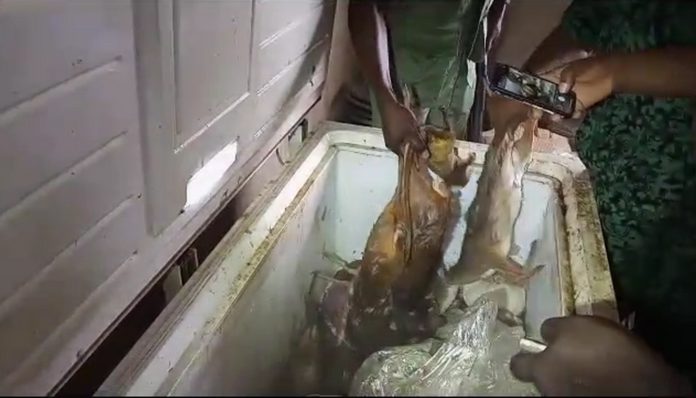
Wildlife Division officers of the Forestry Commission in the Central region have initiated operations to confiscate a variety of bush meats from chop bar operators in the area.
During the operation, which occurred on Wednesday, the team confiscated more than 100 bush meats, including some that were stored in refrigerators.
Additionally, some of the meat was taken from bowls of soup on cooking fires and from customers who had already purchased and were consuming it.
The affected chop bar operators were located in the Awutu Senya West District, Gomoa East and West Districts, and the Effutu Municipality.
In interviews with Adom News, some operators expressed disappointment with the conduct of the wildlife officers.
They claimed that the officers entered their establishments carrying firearms and other intimidating weapons, causing fear and panic.
Ernestina Adumia Anning, the Public Relations Officer of the Wildlife Division, explained that the operation aimed to enforce the ban on hunting bush meat. She further indicated that the team would soon extend their efforts to the roadside to crack down on those selling bush meat to travelers.
Anning emphasized that the chop bar operators whose meat was confiscated would face legal processing and fines.
Furthermore, she advised the general public to refrain from consuming bush meat, as anyone found in violation of this ban would face arrest.
Wild bear meat has recently been added to the menu of Japanese vending machines, which also sell edible insects, whale meat, and snails in a can.
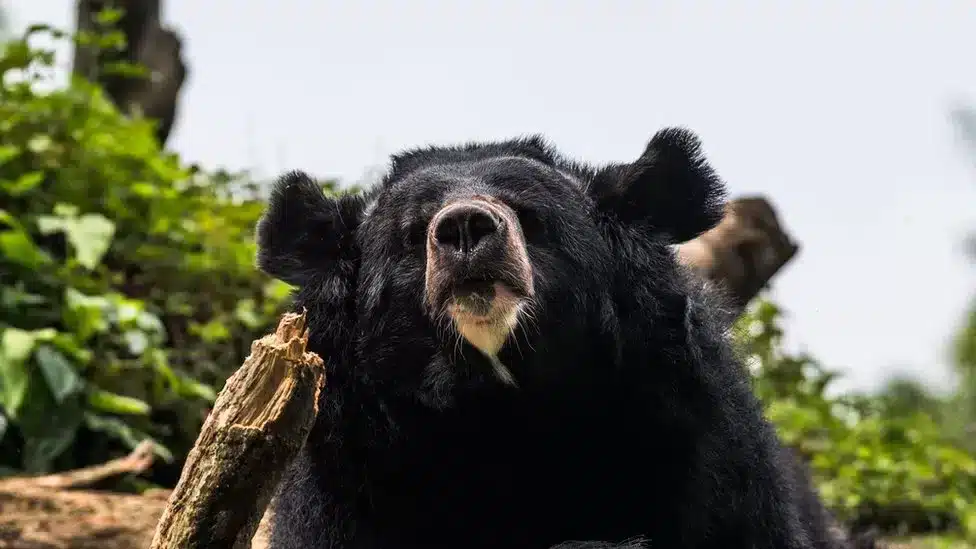
A Japanese daily claims that a vending machine in Semboku city sells several cuts of the local black bear.
According to the Mainichi Shimbun, customers can purchase lean or fatty pork for roughly 2,200 yen ($17; £13) for 250g.
Asian black bears are considered to be vulnerable on a global scale. Japan claims to have set hunting quotas.
The machine in Semboku, in the northern Akita prefecture, is purportedly operated by the neighborhood restaurant Soba Goro and sells 10-15 packs of meat each week from bears shot nearby by local hunters.
If the hunting season is weak, it runs out of supply.
Japan has the world’s highest number of vending machines per capita, located just about everywhere, from small alleyways to remote villages.
Commonly known as jidou hanbaiki or jihanki, they became popular in Japan back in the 1960s. They are a huge part of Japan’s culture of convenience stores, and can overwhelm with their sheer volume and variety.
In January, controversy ensued when an unmanned outlet in the port town of Yokohama near Tokyo, set up three vending machines offering different varieties of whale meat for as little as 1,000 yen.
The vending machine in Semboku selling ursine options stands at the entrance to Tazawako station, where the country’s famed Shinkansen or bullet train stops, as do other trains. And the meat is mainly purchased by visitors who arrive on the bullet train.
Licensed hunters are allowed to shoot and kill bears in Japan – but since the meat is considered a delicacy here, it’s not on the table at the average Tokyo restaurant.
However, since the machine selling bear meat was installed last November, its operators say they have been getting inquiries from the Kanto region around Tokyo.
“[Bear meat] tastes clean, and it doesn’t get tough, even when cold. It can be enjoyed in a wide range of dishes, from stew to steaks,” a Soba Goro representative told the Mainichi.
Experts say that more bears have been leaving forests and entering cities in recent years because they’re running out of food. They add that Japan’s dwindling human population, especially in rural areas, has also been a factor – the animals are drawn to sparsely inhabited areas, posing a threat to locals.
Five bear attacks were reported in the northern Miyagi Prefecture between April and September 2022, with seven people injured.
It was the highest number of attacks since the prefectural government began keeping records in 2001.
According to the environment ministry, between 3,000 and 7,000 bears have been killed in the past seven years as encounters between humans and the animals have risen.
The government caps the number of black bears that can be hunted at 12% of their estimated population – there are thought to be about 15,000 in the country.
It is still one of the facts supporting the claim that early humans in Africatwo million years ago used fire. Despite being an unintentional discovery, archaeologists say the Wonderwerk Cave has revealed new information about how early humans controlled fire.
The layers of soil excavated by Boston University researchers over millions of years revealed that the early men were able to light fires in the cave using dry leaves and branches.
This discovery has put to rest a decade-long debate about whether early men appreciated using fire to prepare food after hunting and gathering, as chronicled by Discover magazine.
According to the journal, the researchers were initially looking for signs of prehistoric fires to determine the age of the earth’s layers.
After analyzing it, the team discovered the remains of million-year-old campfires, putting an end to the age-old debate. According to Paul Goldberg, an archaeologist at Boston University, the research team discovered the layers of earth after digging chunks of soil from the site.
He claims that they dried it in the sun and then soaked it in a polyester resin to allow the particles to solidify.
He recalled how they were overjoyed when the results of their scientific analysis revealed the presence of ashes.
Paul stated that after further investigation, they discovered leaf and stick fragments as well as animal bones. He believes the features of the bones, such as sharp edges and leaves, indicate that the early humans lit fires in the cave rather than out in the open.
Further archaeological analysis of the layers of earth revealed that the flames burned at temperatures between 750 and 1,300 degrees Fahrenheit, which was typical of small fires made of bushes and sticks.
There were some who questioned whether early men were capable of undertaking such a task. Archaeologists believed that early humans had larger brains as they walked, hunted, and created their own world space.
Some schools of thought have advanced arguments in support of early humans lighting fire, claiming that it was done to ward off predators, sleep comfortably, and make their hunt easier to feed on.
Archaeologists who opposed this viewpoint claimed that the only environment in which early humans could light fire was a controlled environment such as a cave. They frequently dismissed that possibility because such evidence was unavailable.
Early excavations of possible fire evidence revealed fungus and minerals on the rock layers. The Wonderwerk cave discoveries, on the other hand, put an end to this debate.
Paul and his team claim to be digging deeper and analyzing layers of earth dating back 1.8 million years in order to consolidate their evidence on early humans’ use of fire in Africa.
The United States (US) Customs and Border Protection (CBP) has seized nearly nine pounds of banned “bushmeat†from a passenger who arrived on a flight from Ghana on Sunday at Newark Liberty International Airport in New Jersey.
The passenger, a US citizen, declared the bushmeat (a term for a range of wild animals, including primates, bats, civets and African rodents) to an agriculture specialist at the airport.
A CBP statement said the Center for Disease Control (CDC) identified the meat as bushmeat and advised the seizure and disposal in accordance with CDC guidelines.
“CBP Agriculture Specialists made critical interceptions of these prohibited animal products and stopped them from entering the United States before they could potentially cause grave damage to our agricultural and economic vitality,†said Troy Miller, Director, Field Operations, New York Field Office.
The traveller was not fined because the person declared the meat, a CBP spokesman said.
Threat
The statement said bushmeat was likely to cause animal disease outbreaks which are a threat to the United States and can adversely affect public health, cause global trade halts, and destabilize the economy and food supply.
The Registrar of the Veterinary Council of Ghana, Kingsley Mickey Aryee, has said per the new law, traders along the roads will be required to produce permit from a veterinary inspector before they can sell to the public.
According to him, this will ensure that the meats are safe for consumption as research shows that about 65 to 75 per cent have been poisoned.
He explained that most hunters poison the animal “before they use sticks to hit them to give the carcasses some semblance of being hunted.â€
In an interview with Daily Graphic, Kingsley Mickey Aryee said the bush meat sales had been included in a new law; Meat Inspection Regulations, 2020, which came into force on July 20, 2020.
“It is a very important thing and we insisted on putting in [the law] bush meat because we have done some research, which found out that most game — about 65 to 75 per cent – have been poisoned.â€
He added that veterinary officers were able to detect the poison in the carcasses by their smell and other investigations conducted.
Mr Aryee also advised traders to patronize meat from standard abattoirs that have proper inlet and outlets while he urged individuals to patronize meats that have stamps.
“Abattoirs are automated or semi-automated, and those are actually the standard. Abattoirs have proper inlets and outlets, and when you are designing an abattoir, you have to be very particular about the inlet and the outlet,†he said.
“I tell you: if you are going to buy meat, look out for meat that has been stamped,†he warned.
The public has been urged to only eat thoroughly cooked meat or food to prevent being infected by COVID-19 and other viral infections.
“Greens and vegetables, which are eaten raw should also be thoroughly and washed, soaked in salty water for about thirty minutes and rinsed in clean water if the salt needs to be taken off,” Dr Kwadwo Obeng Wiredu, a former Senior Veterinary Officer in charge of the Greater Accra Region, told the Ghana News Agency in an interview.
He explained that extreme heat, as well as a good concentration of salt, easily killed off viruses.
He said because some people handling foodstuffs could infect these foods with the novel Coronavirus virus it was necessary for all foods to be treated with the due suspicion, especially considering the nature of the pandemic, which was threatening the world.
Dr Obeng-Wiredu said most of the greens eaten in the country contained vitamin C, which when taken in the right quantities, immensely strengthened the immune system.
The Senior Veterinarian, therefore, urged the public to increase their intake of greens and fruits in order to boost their immune system against any potential viral attacks.
He also reminded the public to continue practising all the preventive measures against COVID-19 infection, including frequently washing their hands with soap under running water, using alcohol-based hand sanitizer, wearing face masks in public places and observing the social distancing rule.
“This virus is new and we are yet to find a cure for it and understand it better so we need to prevent people from getting infected as much as possible,” Dr Wiredu said.
He urged the media to endeavour to interview only qualified persons, such as health experts, to address the technical issues on the pandemic to ensure that the information published was accurate.
“This is a situation that has affected the whole world. It is, therefore, crucial that only information that is credible and from trustworthy sources is churned out,” Dr Obeng-Wiredu said.
Ghana has recorded more than 24,000 Covid-19 infections with more than 20,000 recoveries and over 130 deaths.
The public has been urged to buy meat and other animal products meant for human consumption, only from approved and trustworthy sources.
This is pivotal in ensuring that only wholesome meat was consumed by people, and in effect, a healthy and disease free society.
In an interview with the Ghana News Agency on the possibility of humans getting infected by diseases through meat consumption with the advent of the coronavirus, Dr. Kwadwo Obeng-Wiredu, Veterinary Officer in charge of the Greater Accra Region said fortunately, the virus had so far not been linked to the consumption of livestock products.
He said when proper care was not taken however, meat could get contaminated and become dangerous for human consumption.
The senior veterinary officer said the Ghana Veterinary Services was supposed to endorse the safety of meat products before they were sold out to consumers.
Dr Obeng-Wiredu said veterinary officials were stationed in slaughter houses throughout the country to inspect and ensure that meat consumed in the country was wholesome.
“We have our men in slaughter houses, where the meat is stamped as being cleared for consumption,” he said.
Dr Obeng-Wiredu urged people to be bold enough to insist on knowing the sources of meat they bought, adding that while there were laws to help preserve public health, individuals also had the responsibility of ensuring their own safety.
He also advised meat dealers to ensure that their products had veterinary certification, before making them available for public consumption.
A study has unveiled the likely health risks for meat consumers in Tanzania for failure to consider the animal welfare and food safety.
This was disclosed yesterday by a representative of World Animal Protection, Dr Victor Yamo during the presentation of a report titled ‘consumers perception on animal welfare and food safety’ in Dar es Salaam.
He said meat consumers in the country are less concerned about how an animal is treated before it lands on the table for consumption.
“Throughout our survey which was conducted in Arusha and Dar es Salaam, we found that 37.2 per cent of Tanzanians do not consider meat being free from chemical contamination as important for their own well-being,” Dr Yamo said.
Moreover, Dr Yamo said 54.37 per cent of the participants did not consider how the animal is raised as a very important thing while 60.7 per cent and 56.8 per cent did not care the welfare of the animal during transportation and slaughter to be important.
“Our study also showed that 89.9 per cent of the respondents would purchase more meat only if it had food safety assurance marked from Supermarkets,” said him.
He then reminded consumers that the use of antibiotics in farm animals has led to proliferation of antimicrobial resistance which he said has serious impact on human health.
“If you treat animals well, they can bring good products for human consumption but, likewise, if you treat them poorly, they can produce products which are harmful for consumption,” he said.
He also pointed out that chicken remain the most loved meat in the country with 93 per cent of consumption while that of cow is 85 per cent.