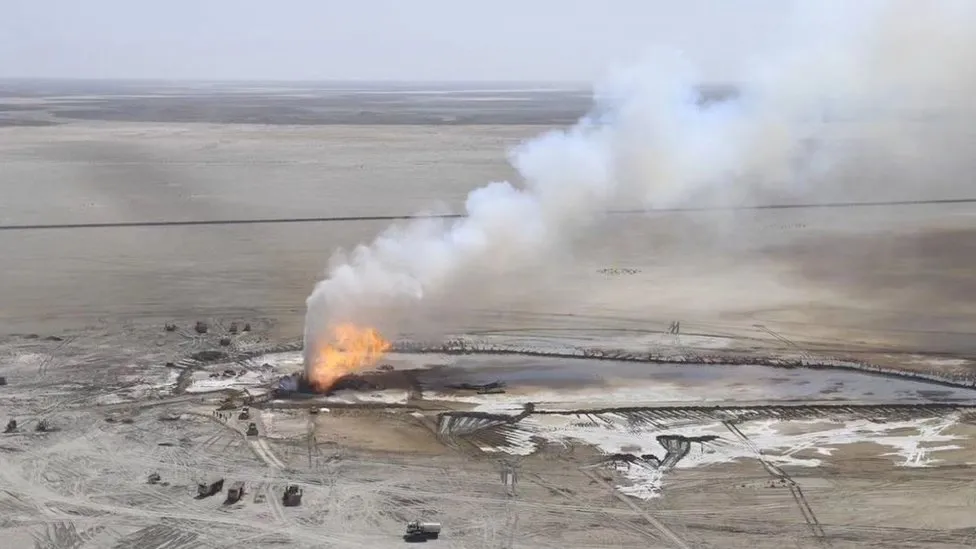
Last year, a really big methane leak happened at a faraway well in Kazakhstan. New research shared with the media has confirmed it was one of the worst ever.
Around 127,000 tonnes of gas escaped when a blowout caused a fire that lasted for over six months.
Methane is a stronger greenhouse gas than carbon dioxide.
Buzachi Neft, the company that owns the well, says they did not leak a lot of methane.
The amount of pollution from the leak is like the pollution from driving 717,000 cars for a year.
Manfredi Caltagirone, who heads the UN’s International Methane Emissions Observatory, said that the size and how long the leak has been happening is really uncommon. “It is very large. ”
The leak started on 9 June 2023 when a problem happened while drilling for oil in the Mangistau region, southwest Kazakhstan. It caused a fire that burned until the end of the year.
It was only stopped on December 25th, 2023. Local officials told the news that they are currently using cement to close the well.
Natural gas is mostly made of methane, a gas that you can’t see.
However, when sunlight goes through a group of methane, it makes a one-of-a-kind mark that certain satellites can follow.
The French company Kayrros was the first to study this methane leak. The Netherlands Institute for Space Research and the Polytechnic University of Valencia in Spain have confirmed their analysis.
Scientists saw lots of methane in the air 115 times between June and December when they looked at the satellite information.
According to the readings, they found out that 127,000 tonnes of methane came out of this one well.
This could be the second biggest man-made methane leak ever.
Luis Guanter from the Polytechnic University of Valencia said that only the Nord Stream sabotage could have caused a bigger leak.
In September 2022, two pipelines that carry Russian gas to Germany were damaged by explosions under the water. This caused a release of up to 230,000 tonnes of methane gas into the air.
The International Energy Agency says that methane is to blame for around 30% of the increase in global temperatures since the Industrial Revolution.
Satellite readings can sometimes be influenced by things like clouds, but scientists are very confident that a lot of methane came out of this one well.
“MrGuanter found methane gas clouds using five different satellite instruments that are sensitive to methane. ” “Each tool checks for methane in its own way, but we got the same results from all of them. ”
The Department of Ecology in the Mangistau region said that the amount of methane in the air was too high 10 times between 9 June and 21 September.
It was also reported that after the accident, the amount of methane in the air was 50 times more than what is allowed.
However, Buzachi Neft, the company from Kazakhstan that owns the well, says that it did not release a lot of methane gas.
The company says there was only a very small amount of gas in the well, and any leaked methane would have burned off when it came out of the hole.
It also thinks that only water vapor escaped into the air, creating big white clouds that could be seen from space.
“We have handled the situation carefully,” said Daniyar Duisembayev, the company’s deputy director for strategic development, to the media.
Tag: Methane
-
Kazakhstan: Massive methane leak persisted for months
-
Nord Stream gas pipelines: Royal Navy frigate sent to North Sea after attacks
A Royal Navy frigate has been sent to the North Sea after suspected sabotage last week on the Nord Stream gas pipelines.
The Ministry of Defence (MoD) said the ship was working with the Norwegian navy “to reassure those working near the gas pipelines”.
European nations believe the damage to pipelines under the Baltic Sea could only have been caused by an attack, with Russia strongly suspected.
The Kremlin has denied it was responsible and instead pointed the finger at the West.
Russia’s Gazprom said on Monday that the pipelines had now stopped leaking. The gas giant said pressure had stabilised in the damaged pipelines and that it was pumping gas out of the undamaged string B of Nord Stream 2 so that its integrity could be checked.
Methane had been bubbling up since four leaks were found on the pipelines near Denmark’s Bornholm Island.
A British defence source told Sky News they were likely premeditated attacks using underwater explosives.
Defence Secretary Ben Wallace said on Sunday at the Tory Party conference that Russia made “no secret” of its ability to attack underwater infrastructure.
He said the damage to the pipelines – which run from Russia to Germany – showed “the Nordic states and ourselves are deeply vulnerable to people doing things on our cables and our pipelines”.
Mr Wallace said the UK would acquire two specialist ships to protect the network as the country’s “internet and energy are highly reliant on pipelines and cables”.
“The first multi-role survey ship for seabed warfare will be purchased by the end of this year, fitted out here in the UK and then operational before the end of next year,” he said.
“The second ship will be built in the UK and we will plan to make sure it covers all our vulnerabilities.”
Mr Wallace met other ministers of the Joint Expeditionary Force (JEF) on Monday to share assessments of what the MoD called a “blatant and irresponsible” attack.
In a statement, it said the members had decided to increase their presence in the area, as well as “intelligence surveillance and reconnaissance activities” to deter future acts and reassure allies.
The JEF is focussed on security in the High North, North Atlantic and Baltic Sea region.
It includes Denmark, Estonia, Finland, Iceland, Latvia, Lithuania, Netherlands, Norway, Sweden, and the UK.