Nearly one week after the US midterm elections, the race for control of the lower chamber of Congress remains tight.
Republicans must win at least 218 seats to retake control of the House of Representatives, a task that has become increasingly difficult.
According to CBS News race projections, the party has currently won 214 seats, while Democrats have won 210.
Meanwhile, Democrats retained control of the Senate, the upper chamber of Congress.
The Biden administrationhad feared that a loss of power in Congress would bring the president’s agenda to a halt.
If the two parties split control of Washington, Democrats will “maintain our positions” but voters should not “expect much of anything”, President Biden said on Monday.
Speaking to reporters in Indonesia, where he is attending the G-20 summit, Mr Biden said the results had “sent a very strong message around the world that the United States is ready to play” and wants to remain “fully engaged in the world”.
He noted there was “a strong rejection” of election denialism, political violence and voter intimidation. But he warned that, without a majority in the House, Democrats would be unable to codify abortion rights through legislation, a key priority for liberal voters.
Out of the 11 House races that still remain to be called, most are in western and southwestern states, including California and Arizona.
The latter’s race for governor is also too close to call, with Republican Kari Lake – a chief proponent of false claims that the 2020 election was stolen from Donald Trump – trailing Democrat Katie Hobbs.
A loss for Ms Lake would see her join the ranks of pre-eminent Trump-backed election deniers who lost last week. But a BBC News tally of results found at least 125 election deniers have won races for the House, Senate and governorships.
Newly elected members of Congress, including the first lawmaker from Generation Z and the first openly gay Republican, have already begun arriving in Washington for orientation.
History suggests the party controlling the White House usually loses seats in a midterm election, and Democrats’ performance this year is considered the best for a sitting party in at least 20 years.
That has endangered leadership bids for the top Republicans in the Senate and House ahead of the party’s internal elections on Tuesday.
House Minority Leader Kevin McCarthy – who hopes to succeed Nancy Pelosi as Speaker in the next Congress – and Senate Minority Leader Mitch McConnell are both reportedly scrambling to garner support from their colleagues.
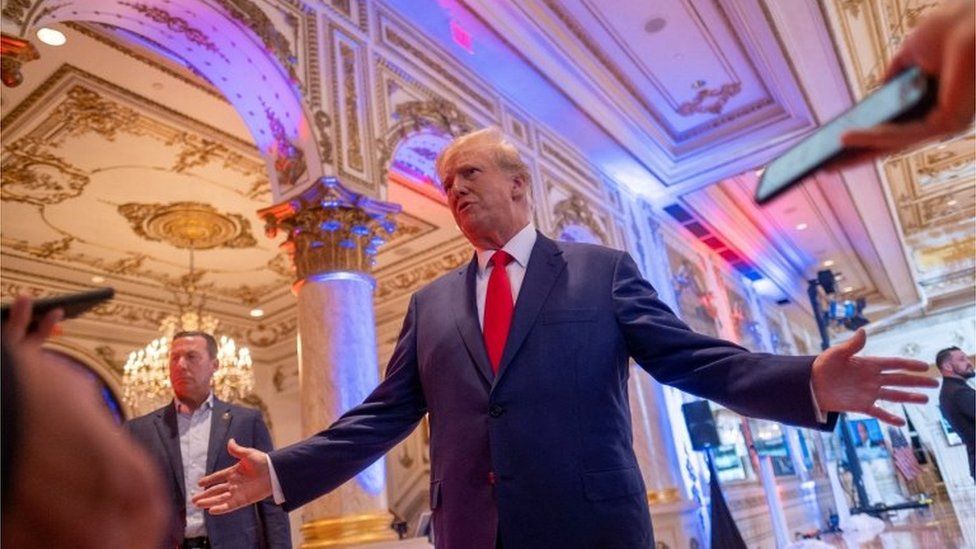
Divisions within the party have been on full display in recent days as former President Donald Trump,who has received some of the blame for a poor showing, prepares to launch another presidential run later this week.
For TV personalities-turned-politicians, Pennsylvania delivered a stinging rebuke in this election. Not only for Mehmet Oz, the celebrity doctor who came to fame on The Oprah Winfrey Show, but for Donald Trump too, the – well, you know the back story.
Mr Trump lent Dr Oz his endorsement in April, saying that his chosen candidate for the crucial Senate race would help “stop the Radical Left maniacs from destroying our country”.
Instead, he’s gone down to a convincing defeat at the hands of his Democratic opponent John Fetterman, who successfully courted blue-collar Pennsylvanians with a traditionally left-wing raft of policies, including a promise to tackle corporate greed.
And – in a further twist that could be right out of a Hollywood script – the slick TV physician came up short against a candidate who’s been struggling to overcome the debilitating effects of a stroke on the campaign trail.
Dr Oz’s political demise arguably leaves Mr Trump’s role as Republican kingmaker on life-support, and the ex-president’s chance of a third tilt at the White House in 2024 now the subject of serious probing.
Even his staunchest of allies are advising that he puts on pause a widely anticipated announcement, earlier teased to come next week.
No wonder Pennsylvania is being so roundly cheered by Democrats.
It is the highlight of an election that looks to have been about rejecting the Trumpian alternative at least as much as any condemnation of President Joe Biden’s handling of the economy.
IMAGE SOURCE,REUTERS Image caption, Trump has said he will not take responsibility for those Republicans he supported but did not get elected
Livid Trump, triumphant Fetterman
And it is with no small degree of relish that insiders are sharing tweets – unconfirmed – suggesting that the former president is furious, with one claiming he has even begun blaming his wife Melania for the choice of Dr Oz.
Mr Biden took Pennsylvania in the 2020 presidential vote by a narrow margin after appealing to white working-class voters and winning them back from Mr Trump.
The hoodie-wearing, tattooed Mr Fetterman – once mayor of the former steel-town Braddock, and director of its youth programme – has used those credentials to do the same.
But the health setback introduced a huge note of uncertainty on the campaign trail, particularly after he was seen to be struggling to articulate fluently in last month’s TV debate.
How much would his stroke weigh on the minds of voters and raise questions about his fitness to govern?
When we caught up with Mr Fetterman before polls opened, his minders were working hard to keep reporters at bay as he posed for photos outside a United Steelworkers Union chapter in Coatesville, a suburb of Philadelphia.
“Are you feeling confident?” I shouted out over their heads, but there was no reply.
However, as votes were counted into the early hours of the morning, it was clear he had overcome the doubters, and the personal and the political came together in an emotional victory speech.
“I’m proud of what we ran on,” he told supporters.
“Protecting a woman’s right to choose, raising our minimum wage, fighting for the union way of life, healthcare as a fundamental human right. It saved my life and it should be there for you if you all ever need it.”
Did abortion help win it for Fetterman?
Pennsylvania also brought another key election issue into sharp focus – the central role that abortion is playing across the US political landscape.
Mr Fetterman referenced it in his victory speech, and it was something female voters we spoke to outside the polling stations mentioned, too.
One young woman told us it was the only issue she was voting on – turning out for Mr Fetterman for his pro-choice stance.
Another woman – an anti-abortion Republican mother – said she could no longer speak about politics to her voting-age daughter because they were so firmly in opposite camps.
In his televised debate, Dr Oz’s weakest moment was seen by many to come when he said that abortion was an issue for “women, doctors [and] local political leaders” to decide.
His strong anti-abortion stance was already known, but that formulation – seeming to conjure the image of lawmakers in the room alongside women and doctors – was considered a major blunder.
Democrats may be buoyed by the midterm results, but they would be wrong to be complacent.
Mr Trump still holds significant sway with a large swathe of the Republican base and still has a major financial war-chest at his disposal.
And even if he is now politically weakened, he may have to face bigger threats out there.
The triumph of Ron DeSantis in Florida – re-elected governor with a massively increased majority – is a victory for a culture warrior promising to make Florida a place where “woke comes to die”.
The result is seen as raising his chances of winning the Republican 2024 nomination for the presidency.
Some argue he may be a far more formidable rival for Democrats than Mr Trump – but harbouring the same anti-democratic instincts.
The former president is certainly treating Mr DeSantis as a threat, warning this week that he would reveal things about the governor that “won’t be very flattering” if he does launch a presidential bid of his own.
And perhaps more than anywhere else, it is the victory in Pennsylvania of a man who – just a few months ago suffered a stroke that nearly killed him – that has kept Democrat hopes alive.
On the final day of campaigning, President Joe Bidenwill hold a rally in Maryland, while his predecessor, Donald Trump, will be in Ohio.
An election year that has unfolded against the backdrop of economic turmoil, the elimination of federal abortion rights, and widespread concerns about the future of democracy is coming to a close with a final full day of campaigning in which leaders from both parties will make urgent appeals to their supporters.
President Joe Biden is holding a Monday evening rally in Maryland, where Democrats have one of their best opportunities to reclaim a Republican-held governor’s seat. The appearance is in line with Biden’s late-campaign strategy of sticking largely to Democratic strongholds rather than stumping in more competitive territory, where control of Congress may ultimately be decided.
Biden’s predecessor Donald Trump will hold his final rally of the campaign in Ohio. As he readies another run for the White House, Ohio holds special meaning for the former president because it was one of the first places where he was able to prove his enduring power among Republican voters.
His backing of JD Vance was crucial in helping the author and venture capitalist – and one-time Trump critic – secure the GOP’s nomination for a Senate seat.
With more than 41 million ballots already cast, Monday’s focus will be ensuring that supporters either meet early voting deadlines or make plans to show up in person on Tuesday. The results will have a powerful effect on the final two years of Biden’s presidency, shaping policy on everything from government spending to military support for Ukraine.
In the first national election since the violent January 6 insurrection, the final days of the campaign focused on fundamental questions about the nation’s political values.
Campaigning in New York for Governor Kathy Hochul on Sunday, Biden said Republicans were willing to condone last year’s mob attack at the US Capitol and that, after the recent assault on Paul Pelosi, husband of House Speaker Nancy Pelosi, some in that party made “light of it” or were “making excuses”.
“There’s never been a time in my career where we’ve glorified violence based on a political preference,” the president said.
Meanwhile, during a Sunday evening Trump rally in Miami, a reference to Nancy Pelosi prompted chants of “Lock her up!” – a stark reminder of the nation’s deep political divide.
Trump speaks at a rally in support of the campaign for Florida Senator Marco Rubio on Sunday in Miami [Rebecca Blackwell/AP Photo]
Trump was campaigning for Florida Senator Marco Rubio’s re-election, but also focused on his own political future. After telling a crowd in Iowa last week that he is “very, very, very probably” going to run for president again, he again teased the possibility on Sunday and encouraged supporters to watch his Ohio rally.
“I will probably have to do it again, but stay tuned,” Trump said, teasing the Monday event. “We have a big, big rally. Stay tuned for tomorrow night.”
Not attending the Miami event was Florida’s Republican Governor Ron DeSantis, who is running for re-election against Democrat Charlie Crist and is widely considered Trump’s most formidable challenger if he also were to get into the White House race.
DeSantis held his own, separate events on Sunday in other parts of the state where he stuck to the centrepieces of his re-election campaign, including railing against COVID-19 vaccine mandates. The governor’s counter-political programming avoided antagonising Trump – meaning it did not deliver the duelling 2024 events that could be in his and Trump’s near future.
Trump said on Sunday that Florida would “re-elect Ron DeSantis as your governor”. But he was more confrontational during a Pennsylvania rally on Saturday, referring to Florida’s governor as “Ron DeSanctimonious”.
It is a rivalry that has been simmering for more than a year as DeSantis has taken increasingly bold steps to boost his national profile and build a deep fundraising network – even as Trump remains unquestionably the party’s most popular leader.
For national Democrats, meanwhile, the focus is on their narrow control of the House and the Senate, which could evaporate after Tuesday.
Voters may rebuke the party controlling the White House and Congress amid surging inflation, concerns about crime and pessimism about the direction of the country. History suggests the party in power will suffer significant losses in the midterms.
Biden has made the case that the nation’s very democracy is on the ballot and the first lady went to Texas on Sunday to sound a similar alarm. “So much is at stake in this election,” Jill Biden said in Houston. “We must speak up on justice and democracy.”
Travelling in Chicago, Vice President Kamala Harris said, “These attacks on our democracy will not only directly impact the people around our country, but arguably around the world.”
Trump has long falsely claimed he lost the 2020 election only because Democrats cheated and has even begun raising the possibility of election fraud this year. Federal intelligence agencies are warning of the possibility of political violence from far-right extremists.
Ronna McDaniel, the Republican National Committee chairwoman, said Democrats were “inflation deniers”, trying to deflect the other side’s branding of her party as anti-democratic for rejecting the results of 2020’s free and fair presidential election simply because Trump lost it.
“If we win back the House and the Senate, it’s the American people saying to Joe Biden, we want you to work on behalf of us and we want you to work across the aisle to solve the problems that we are dealing with,” McDaniel told CNN.