Over the previous year, more than two million migrants were held at the US-Mexico border, a record number that gives the Biden administration political headaches.
The amount of 2.15 million is a 24% increase over the previous year, according to recent data from US Customs and Border Protection (CBP).
Statistics indicate that while migration from Mexico and the Northern Triangle of El Salvador, Guatemala, and Honduras decreased, migration from Venezuela, Nicaragua, and Cuba increased sharply.
In a statement, CBP Commissioner Chris Magnus said that “failing Communist regimes” were “driving a new wave of migration” at the border.
Experts point to several other reasons for the spike, including large numbers of repeat crossings and lingering pandemic-related economic issues across Latin America.
The rising number of migrants at the border is a politically contentious issue ahead of the US midterm elections in November.
Why the recent spike?
The number of migrants arriving at the border rose dramatically after Mr Biden took office in late January 2020.
Experts point to a number of reasons for the increase, including environmental disasters and economic woes in El Salvador, Honduras, and Guatemala. In other cases – such as Cuba, Nicaragua, and Venezuela – economic problems have been compounded by political repression.
“There’s a level of desperation we hadn’t quite seen before,” said Adam Isacson, a migration and border expert from the Washington Office on Latin America. “And you’ve got people coming from countries that had not sent migrants in significant numbers before now becoming top senders of migrants, due largely to a lack of economic opportunities. Smugglers take advantage of that.”
Many of the migrants are now seeking asylum, a process that was severely restricted by the previous US administration of Donald Trump.
Where are the migrants from?
Migrants from Mexico and the countries of Central America’s Northern Triangle – Guatemala, El Salvador, and Honduras – continue to account for the bulk of the total, with Mexicans alone accounting for about 744,000 of the detentions over the past year.
Collectively, these three nationalities account for about 494,000 migrant detentions this year.
Ariel Ruiz, a policy expert with the Washington DC-based Migration Policy Institute, noted that the links between these countries also contribute to increases in each.
Cuba, for example, has lost much of the aid it received from Venezuela pre-pandemic – creating more economic difficulties there – while Nicaragua’s decision last year to eliminate visa requirements for Cubans means they now have a starting point to begin their journey from Central America to the US. A lack of diplomatic relations between the US and these countries also means that the US cannot repatriate them home.
“We have a system of enforcement at the border that’s really meant to respond to Mexican migration,” Mr Ruiz said. “All these policy schemes have combined in some ways to provide an opportunity for migrants to head northward, at the same time as economic conditions and political repression worsen in these countries.”
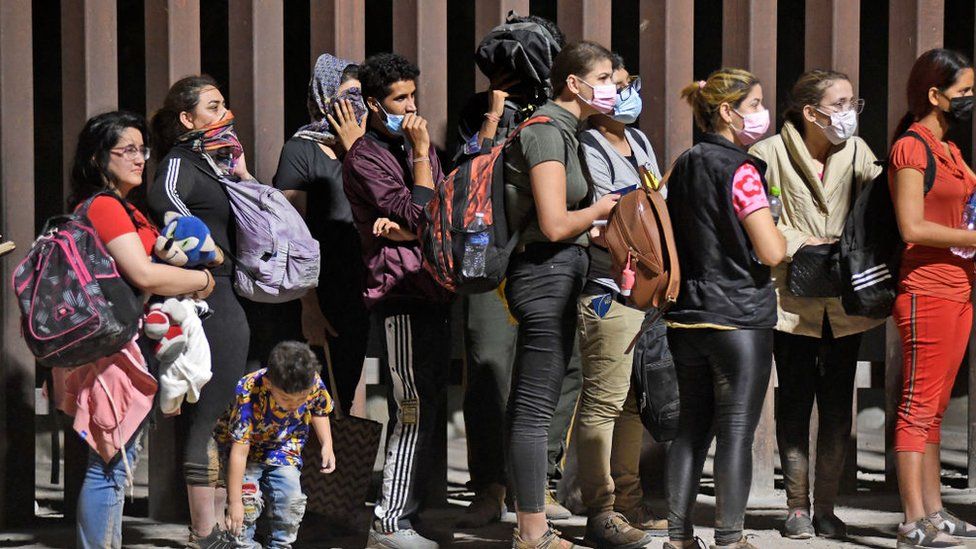
A Trump policy remains
Since coming into office, Mr Biden has kept in place a controversial Trump-era policy that allows officials to automatically expel undocumented migrants seeking entry, bypassing normal immigration laws and protections.
Some experts, however, believe that Title 42 has caused migrant figures to rise as the policy does not prevent migrants from multiple crossing attempts.
On Monday, CBP said, “a large number of expulsions during the pandemic has contributed to a higher-than-usual number of migrants making multiple border crossing attempts”.
Mr Isacson said that the policy leads to statistical “distortions”.
“We’re not actually hitting two million individuals, But Title 42 has made it easy for people to try over and over and over,” he said. “If they keep getting caught, there’s no real sanction.”
Statistically, Mexican citizens are likely to be repatriated back to Mexico, which also accepts migrants from Guatemala, Honduras, and El Salvador. Collectively, more than 962,000 citizens of these countries have been sent back across the border using Title 42 over the past year compared to less than 10,000 from Nicaragua, Cuba, and Venezuela.
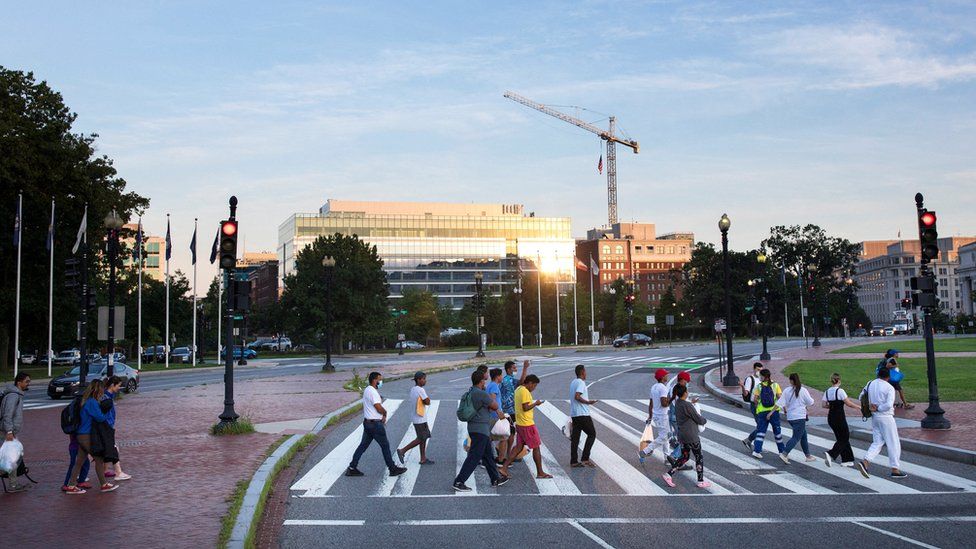
A political headache for Biden
The rising migrant figures represent a growing political problem for the Biden administration, particularly with the midterm elections rapidly approaching.
Three Republican-run states – Texas, Arizona, and Florida – have announced initiatives to move migrants to Democratic-led ones, sometimes leaving them at high-profile locations such as wealthy Martha’s Vineyard in Massachusetts or near Vice-President Kamala Harris’ residence in Washington DC.
Officials in these states have argued that the tactic is aimed at mitigating the impact of migration flows in local communities. Florida Governor Ron DeSantis, for example – who earlier in September began to fly migrants to Massachusetts – said that “the minute even a small fraction of what those border towns deal with every day is brought to their front door, they [Democrats] all of a sudden go berserk”.
The issue of migrants at the border is one that is likely to have an impact on the polls. A recent poll from NPR and Marist, for example, found that immigration was a primary electoral issue – behind only inflation – for 20% of Republican voters, compared to 1% of Democrats.
Juscelino Colares, a professor of political science at Case Western Reserve University, said the issue is one that has the potential to cause a “swing” among many voters, particularly those who live near the border – even among those who are naturalized immigrants or the children of immigrants.
“[People there] have seen the demands that uncontrolled immigration has brought to their localities. And they, and those migrants who have become legal, tend to hold the view that immigration should be taken seriously,” he said.
“I think inflation will play a bigger role in the midterms and the economy is causing greater concern, but immigration is a significant concern to the US electorate,” he added.